1863 $20.00 NGC AU58

The 1863 is the third rarest Type One double eagle from this mint, after the 1862 and the 1859. But because of its Civil War date of issue it is generally in greater demand than the latter. It is a hard issue to find in the higher AU grades and it is rare (and expensive) in Uncirculated. This light yellow-gold example shows no real wear to speak of; just some light friction on the face of Liberty. The left obverse field shows a cluster of small marks near the outline of the portrait while the reverse is clean save for a small spot on the left side of the shield. The most recent auction price realized (APR) for this date in AU58 is Heritage 3/11: 4926 (a PCGS coin) that brought $14,953 in their March 2011 sale. I have had the good fortune of selling two other AU58 examples of this popular issue in the last three months and both sold quickly (with multiple orders received on the first day they were listed on my website).
1848-C $2.50 NGC EF40

Variety 2, later die state with swelling beginning to form at the centers. The aforementioned die swelling, caused by dies that had bulged, gives the central obverse a slightly concave appearance while the reverse is weak on the eagle's head and neck. This coin is totally original with lovely deep russet and green-gold color and there is a good amount of dirt in the protected areas of the obverse and reverse. From the standpoint of actual wear, this piece is probably a full 45 but it has been net graded by NGC due to the weakness of strike on the reverse. I think this is one of the neater varieties of all the Charlotte quarter eagles and it is a great companion piece to a normal strike 1848-C.

1882-CC $20.00 PCGS AU55 CAC

The 1882-CC is a much tougher date than the 1883-CC, 1884-CC and 1889-CC though it is not nearly as scarce as the low mintage 1885-CC. It becomes hard to find in nice AU55 to AU58 and it is a rare coin in Uncirculated with a five-figure price tag. This mostly lustrous example has the eye appeal of many 1882-CC double eagles that I have seen in AU58 holders. It shows nice medium green-gold color and it has very choice surfaces with just a few small marks visible under magnification. My guess is that this coin saw no actual circulation but it incurred some light wear and rubbing when it was shipped loose in a bag. This would be a perfect type coin for the collector seeking a single nice quality Carson City double eagle.

CAC has approved six examples in this grade with eight finer.

1848-D $5.00 NGC AU55

The 1848-D is not that rare a coin in lower grades but in properly graded AU55 and above it is actually one of the five scarcest half eagles from the Dahlonega mint. Nearly every known piece in higher grades is poorly struck, unoriginal or abraded (or all three!) and it is exceedingly difficult to find a sharply struck piece with good eye appeal. The present example is very well struck with no die lapping on the obverse or clashmarks. It shows flashes of luster in the protetced areas which are offset by rich lemon-gold hues on both sides. A few marks scattered here and there in the fields are consistent with the grade and this piece is really nice for the issue. The last AU55 examples to sell at auction were Stacks 3/09:5908 (encapsulated by NGC) that brought $4,888 and Heritage 11/07: 2027 (also an NGC coin) that sold for $3,594. Both were late die state coins with marginal eye appeal. If you collect Dahlonega half eagles, you are probably aware at how difficult it is to find examples of this date with good eye appeal.

1849-O $10.00 PCGS EF40 CAC

This appealing coin has very deep rich orange-gold color that is suggestive of having been stored in a source such as an old coin album, a manila envelope or even a leather pouch. This sort of coloration is not often seen on examples of this date, especially pieces with this amount of circulation. As is typical for the issue, the strike is flat on the obverse and this gives the impression of more wear than what is actually present. Other than a few small, scattered marks on the obverse, the surfaces are clean and this is among the more attractive 1849-O eagles in this price range that I can recall having seen.

1883-CC $20.00 PCGS AU50 CAC

Old Green Holder. By today's grading standards, I feel that this coin is at least an AU55. It has beautiful deep natural orange-gold color atop slightly prooflike surfaces that exhibit relatively few marks for the grade. This coin is almost certainly from an overseas source and it has a "Euro" look but with less darkening on the surfaces than usual. The typical dipped, processed AU50 example of this date is an easy sale to a dealer who doesn't care about quality for $3,000 or even a bit more. For a few hundred dollars extra, you can purchase a gorgeous, unmolested example that is one of just eight 1833-CC double eagles in AU50 that has been approved by CAC.

1868 $20.00 PCGS AU53

The 1868 is the scarcest Type Two double eagle from the Philadelphia mint. In fact, it is the hardest non-Carson City issue of this popular type to locate in all grades. When available, the 1868 tends to grade in the EF40 to AU50 range and is characterized by bright, excessively abraded surfaces. The present example is among the most original 1868 double eagles that I have seen. It has rich straw-gold color that strongly suggests that it has never been cleaned or dipped. There is some friction in the left obverse field and some marks around star eight on the obverse; the reverse is exceptional and grades AU58 on its own. There are no auction records for a PCGS AU53 example of this date since January 2008 (a coin that was sold by Bowers and Merena for $7,188) and I can't recall the last time I handled an example with the eye appeal that this piece shows. A special coin for the savvy double eagle collector.

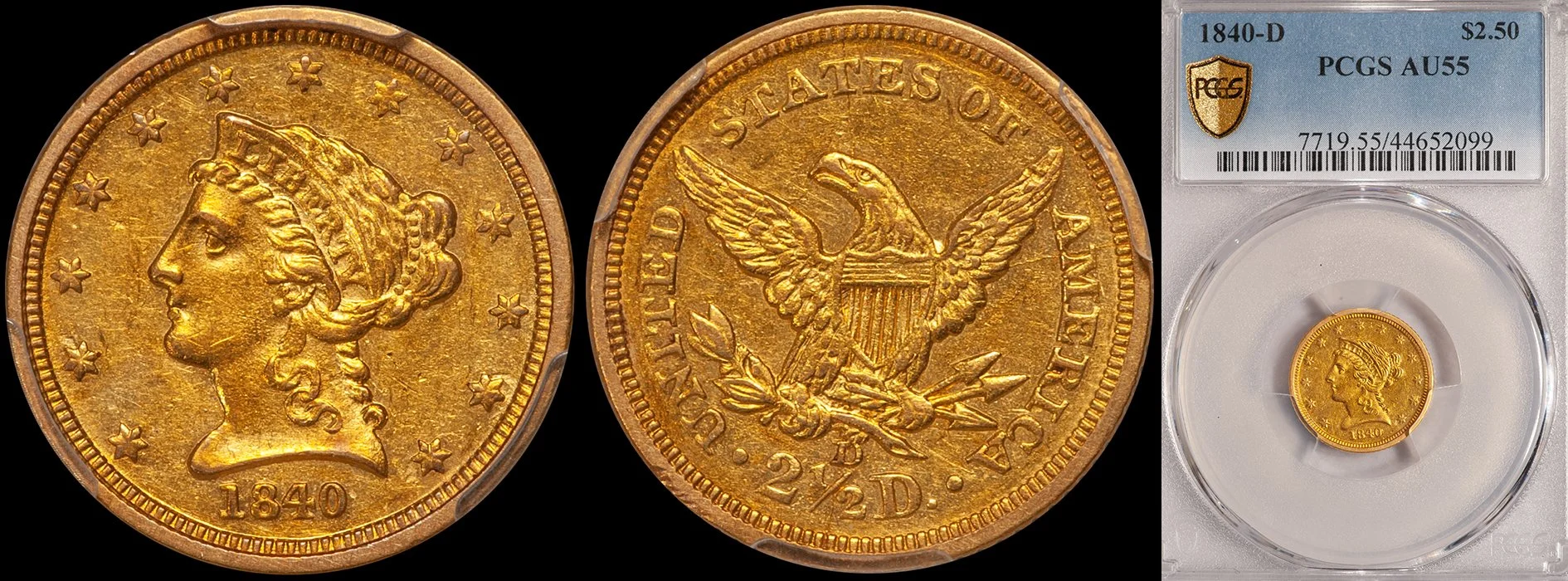
1843-D $2.50 NGC MS61

Small D mintmark variety. This lovely example has great eye appeal for a Dahlonega quarter eagle. It is semi-prooflike and shows very pleasing deep green-gold and reddish colors, in different configurations, on the obverse and reverse. The strike is very sharp with just a touch of weakness on the curl above the ear while the surfaces show a few scattered ticks in keeping with the assigned grade. This coin is nearly identical in appearance to Heritage 10/11: 4651, graded MS62 by PCGS, that brought $12,650. In fact, it is so similar that I did a double take when I bought it, thinking it might actually be the aforementioned example. As a date, the 1843-D is the most common quarter eagle from this mint. It is scarcer in Uncirculated than most people realize and nearly all of the fifteen to twenty known in Uncirculated grade in the MS60 to MS61 range. I have never seen an 1843-D that I grade MS63 and only three or four MS62's. An affordable yet special coin that would be perfect for a type collector seeking a single, special quarter eagle from Dahlonega.

1872 $2.50 PCGS PR64 DCAM

One of only 30 Proofs struck. Looking at population statistics and auction records over the last two or three decades, I believe that there are no more than 12-15 Proofs known and only a handful of these grade PR64 or better. This example is a virtual Gem with strong black and white contrast between the frosted devices and the watery fields. There are no significant hairlines noted below magnification; the obverse has a pair of small mint-made lintmarks in the left field and a tiny dark spot immediately above the eagle's left beak. There are no auction records whatsoever for this date in Proof DCAM or Proof UCAM and the last 1872 quarter eagle in Proof to sell was Stack's 8/07: 3125 (a PCGS PR64CAM) that realized $20,700. This coin is tied with two others as the best Proof 1872 quarter eagle graded by PCGS; NGC has graded a pair of PR65's and a single PR66 with Ultra Cameo contrast. Proof gold coins of this rarity and significance are almost never offered for sale except at auction and few coins that I have offered for sale in some time offer the value that this fantastic quarter eagle possesses in spades.