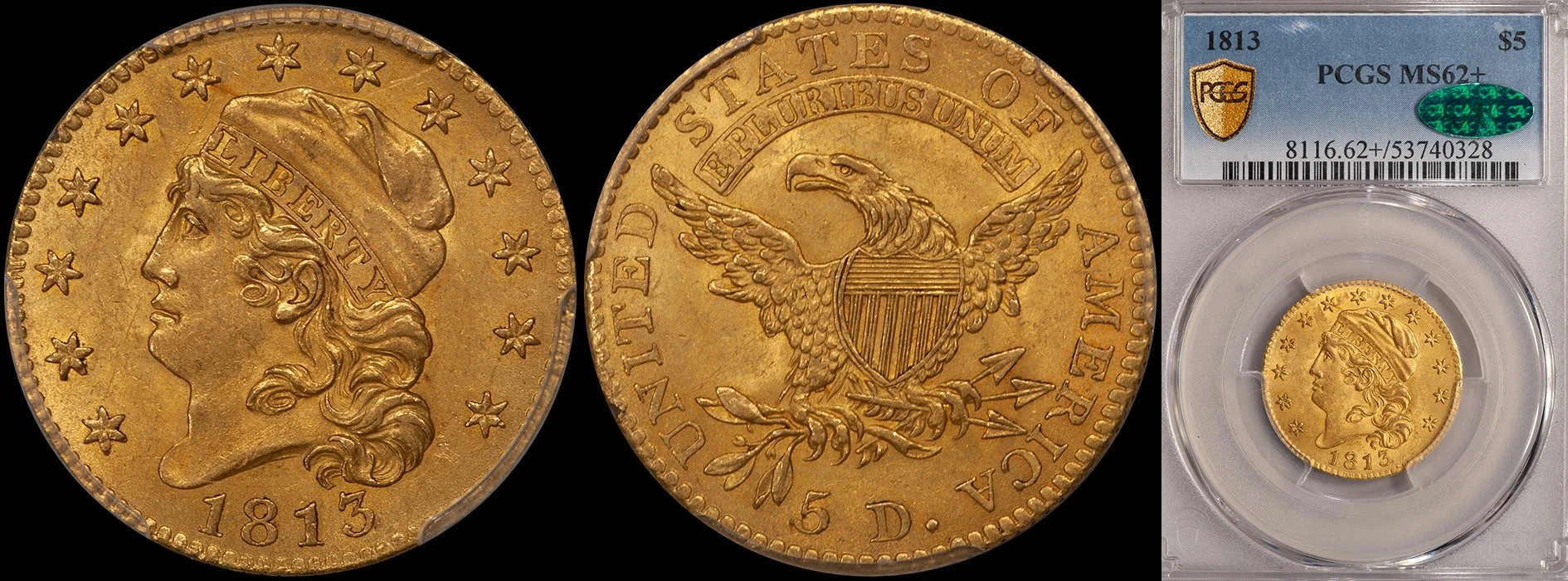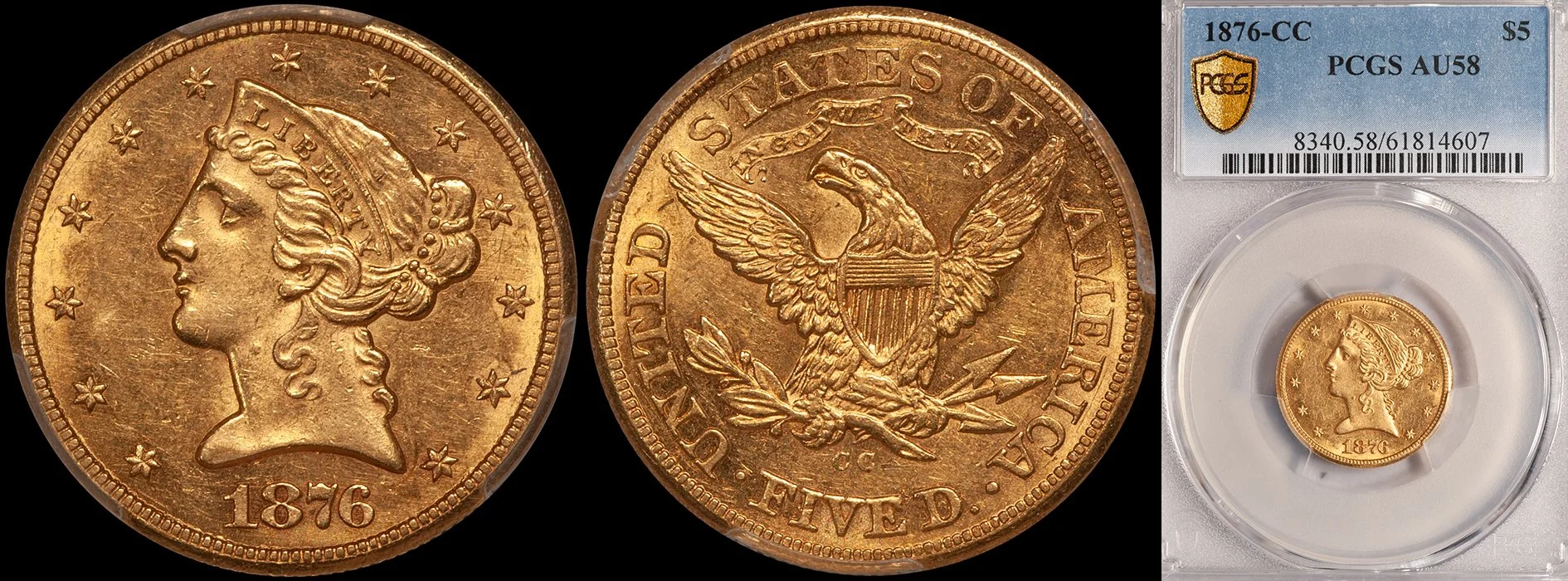
Assembling a World-Class Set of Indian Head Eagles
/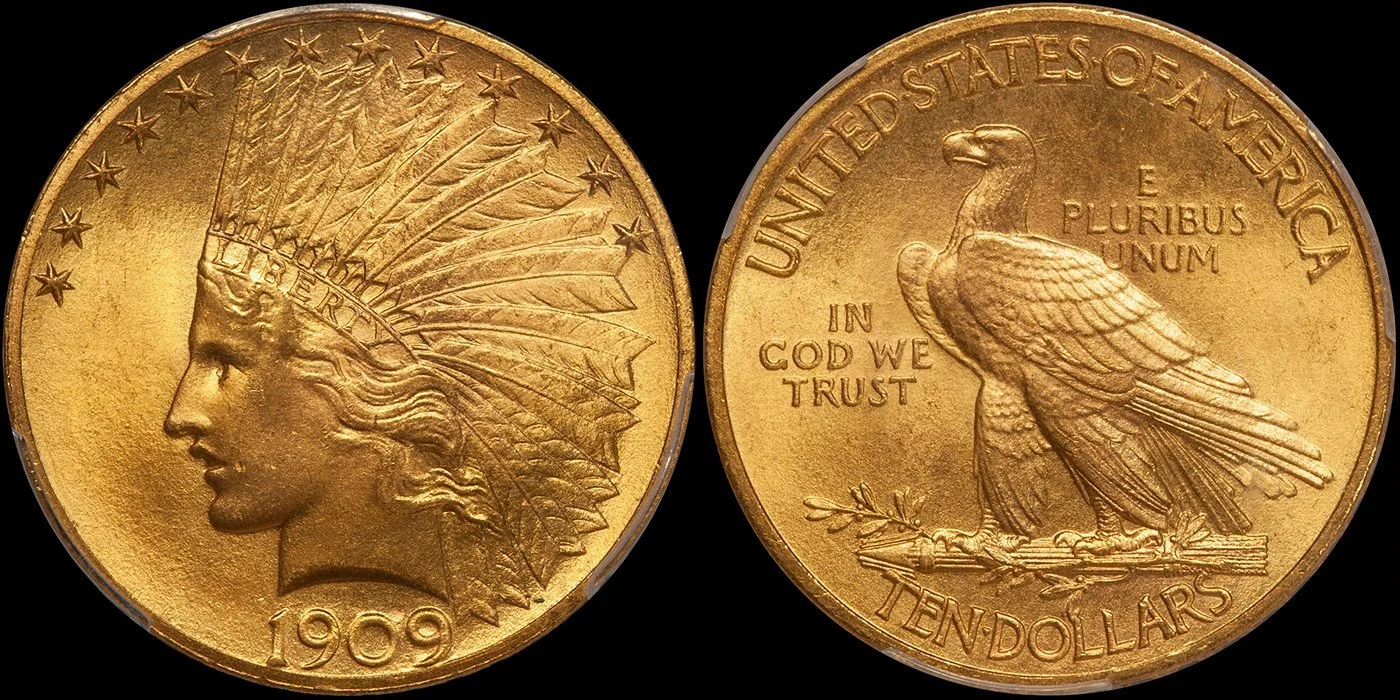
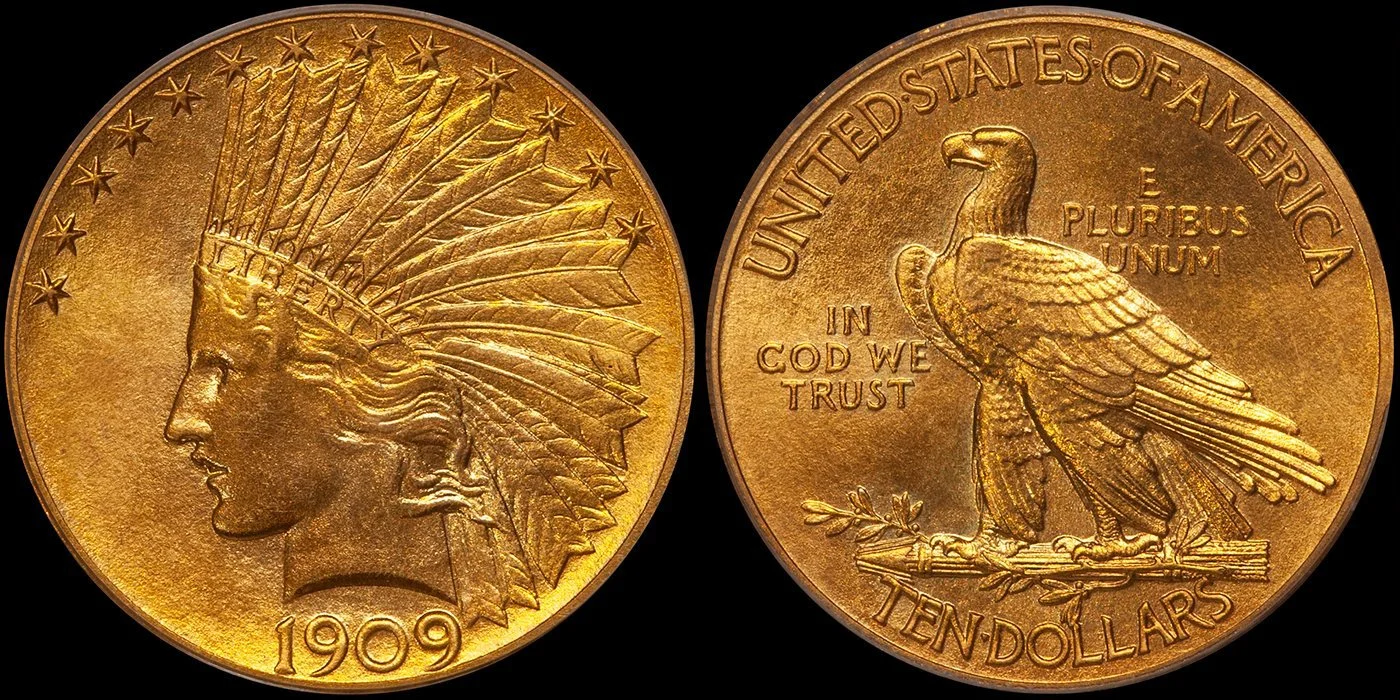
1909 $10.00 PCGS MS65+ CAC. DWN Archives.
In my opinion, the Indian head eagle design represents the single most beautiful gold coin ever struck for circulation by the US mint. The St. Gaudens double eagle design gets all the love, but for my money, the eagle design by the great American sculptor is unimprovable in every respect.
This is not an easy series to collect. Only a small handful of dates are common in properly graded MS65, and every date is rare in MS66 or finer. The good news is that there are no seven-figure coins in this series (although the right 1933 in MS65 or higher will likely run close to). Nor are there any “impossible” issues (although a few issues in PCGS/CAC MS65 and higher grades will prove nearly impossible to locate; see below for more thoughts on this).
Most collectors work on a 32-coin set of business strike issues. This includes the 1907 Wire edge and Rolled edge varieties. There are also at least eight different Proofs struck from 1908 through 1915, and these are an excellent companion collection to acquire alongside the regular issues.
There is a lot of important information for me to share with you. I think a question and answer format is going to be the best way for me to convey what will be a potentially overwhelming amount of information.
Q. What is a realistic time frame to assemble a great set of $10 Indians?
A. This depends on whether or not a great collection or two becomes available in a timely fashion. The Bob Simpson collection—containing no fewer than nine pop 1/0 finest known coins—was seeded by the sale of the Steve Duckor collection which, in turn, had its genesis in the Thain Price, Bob Kruthoffer, and Louis Eliasberg collections. The current finest collection of Indian head eagles, containing five pop 1/0 finest known coins, is the Half Dome Collection.
If a great collection comes available and a new collector is able to knock out five to ten coins at a single auction, then a very good to excellent set is feasible within a four to six year time frame. If the buying process is slower due to a lack of available coins, the set could take 10-15+ years.
Q. What sort of price range are we talking about?
A. For a mostly PCGS/CAC set in the MS64 to MS67 grade range, we are likely talking about a total investment of around $4 million+. A superb set of Proofs in 65 to 67 would likely add another $1 million or so to the set.
Q. Where can I learn about the series?
A. David Akers wrote the standard reference on 20th century US gold issues, but with the last update done back in 1988, it is very out of date. I would suggest a deep dive into online auction catalogs. Collections to seek out include Duckor, Robert Kruthhofer, Thain Price, Eliasberg, Bob Simpson.
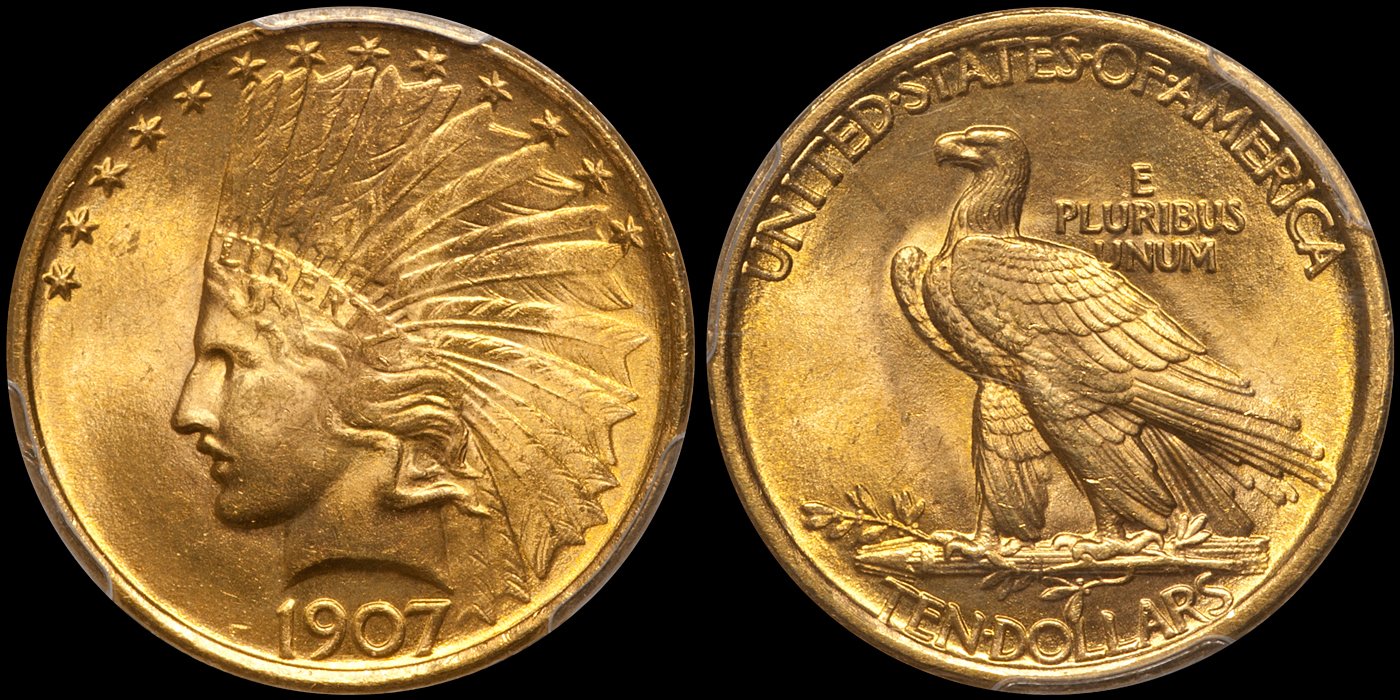
1907 No Motto $10.00 PCGS MS66. DWN ARCHIVES.
Q. What are the biggest obstacles to completing such a set?
A. In my experience, the two big roadblocks that impact most collectors in almost any segment of the pre-1933 US gold coin market in late 2025 are: a) a lack of good coins, and b) one or more crazy competitors.
Let’s look at obstacle #1.
Whether you collect $10 Indians, three dollar gold pieces, or Charlotte quarter eagles, you’ve no doubt noticed that’s it’s gotten frustratingly difficult to buy good coins right now, and this goes back at least a few years. If you are a highly specialized and very picky buyer (as I am and as you—the $10 Indian Maven will become—)it was never easy to locate the very good to great coinsm but now it’s become insanely difficult.
This is attributable to a combination of factors. Coins used to be marketed as investments which meant that they had a short shelf life; usually a three year hold period. Today, the “I” word is mostly verboten as a sales pitch—at least for coins such as high-grade better date Indian eagles—so they don’t trade as often.
Secondly, the pool of coin buyers is probably a lot larger than we realize. A platform like Whatnot which many older collectors have never used or might not even know exists are now responsible for tens of millions of dollars per month in coin sales…and it ain’t all modern junque. In a year, these numbers will grow, and I’m 99% certain that in another few years, a 22 year old kid will come up with a more sophisticated way to sell coins which leaves Whatnot—and other platforms—in the dust.
In case, you haven’t noticed, prices for Proof $20 Liberty head double climbed dramatically during Covid. Some of the new buyers were bitcoin folk who were unsophisticated when it came to coins but who interpreted coin data well and were playing with free money, so what did it really matter if they paid 25% too much?
Chances are better than good that as a sophisticated connoisseur of Indian head eagles you’re going to go head-to-head on a number of occasions with a kamikaze buyer. This is great for the consignor, but can be really aggravating (and costly) for you the buyer.
Q. What are the rarities in the set?
A. For all 20th century gold series there are two different types of rarities: absolute rarities and condition rarities. An absolute rarity is a coin which is rare in any grade. There are just a handful of Indian head eagles that I would put in this category, and these are the 1907 Rolled Edge, 1920-S, 1930-S, and the1933.
There are a significant number of Indian head eagles that are conditionally rare. These include the 1908-D No Motto, 1909-D, 1910-S, 1911-D, 1913-S, 1914-S, and the1915-S,
Three issues qualify as both absolute and condition rarities. These are the 1920-S, 1930-S, and the 1933.
With the exception of the 1932, there are no dates in this design type that are easily located in MS66; especially if a PCGS/CAC coin is the target.
Q. What drives prices for this series?
A. It’s all about supply and demand. Ever since I can recall, the demand for this series—at the very highest grade level—has been odd. During some periods, there are just one or two people who are buying the six-figure coins in this series. At other times, there are four or five people active in the very highest end of the Indian head eagle series. Four or five deep-pocketed collectors doesn’t seem like many until you realize how few great coins exist for dates such as the 1911-D or the 1920-S.
In late 2025, there do not appear to be all that many collectors who are actively buying six and seven figure Indian head eagles. The current #1, #2, and #3 sets in the PCGS Registry are either complete or they are inactive.
1909 $10.00 PCGS PR64 CAC. DWN Archives.
Q. Are hoards a factor with this series?
A. Yes but not nearly as much so as with St. Gaudens double eagles. There were no significant individual Indian head eagles in the Fairmont hoard, and according to my sources, while there are still huge numbers of US gold coins in Europe, virtually all of the coins of this design type are dated 1926 or 1932.
It is important for me to stress that there is a certain degree of hoard risk with any 20th century American gold coin. However, using past hoards as an indicator, you are far safer buying a coin like a 1920-S $10 in MS64 or finer than you are in MS62 or MS63 as the way in which hoard coins were handled tend to preclude that they will be well-preserved enough to be a Gem or a near-Gem.
Q. How hard is it to grade this series?
A. In my experience, grading $10 Indians is far easier than grading the incuse designs found on the quarter eagles and half eagles of this era. The design of the Indian head eagle has two prime obverse focal points; the face and cheek of the portrait, and the left obverse field which is open and spacious.
When I am evaluating a coin of this type, I look for three things:
severity and placement of marks
intensity of luster
richness of color
Q. Where will the collection be sourced?
A. It is extremely difficult to locate world-class Indian head eagles on the bourse floor at shows. For the last 25+ years, virtually every great coin of this type has sold at auction. To successfully navigate the tricky auction market, the collector is going to find it essential to work with a dealer who understands how to grade and price these coins. They must be able to answers questions such as;
is the coin original and what is the real grade
if the coin isn’t graded by PCGS, why isn’t it in the “right’ holder
will the coin cross from NGC to PCGS, and if not at the same grade will it downcross
what is the pedigree and price history of a specific coin
is the coin the right one for your set
what is the right price to pay for the coin
Q. The Concept of Best Value Grade and how it applies to the set
A. I have long believed in the concept of Best Value Grades (BVGs), and I feel that this is highly applicable to the $10 Indian series. Each type of US coin has a grade point where value goes off the rails. An example of this would be a 1926 $10. It is common in MS66 with 35 graded by PCGS, and you should expect to pay around $10,000 for a nice example. In MS66+, there are seven graded and this is a $30,000 coin. In my opinion, the 66+ is in all likelihood, an overbuy at a 3x multiple over a 66.
There are a number of instances where it is worthwhile to pay a hefty premium for a coin and in 99% of these scenarios, it is for a one-off such as a gem 1911-D or a really nice Condition Census 1930-S.
Not every coin in the set has to be the finest known, but in order to be recognized as a Great Set, the key issues need to be outstanding.
Q. What is your exit strategy?
A. A surprisingly small number of collectors understand the concept of branding their coins. Two of the smartest collectors I ever knew in this regard were the late Stewart Blay and the late Steve Duckor. When you were offered a coin from one of their collections, you knew with certainty that the coins were outstanding quality with superior eye appeal.
How did these two gain their reputations? They had skin in the game. Steve paid insane prices back in the early 1980s for Indian head eagles and Saints, and held them for 20-30 years. The insane price he paid in 1982 suddenly looked cheap in 2005 when he became a seller. Steve’s mentor was the great David Akers, from who he learned about rarity, eye appeal, and market insight. It helped that Steve was a total mensch who was a joy to be around.
Stewart Blay was an abrasive New Yorker which meant that he could from time to time come off like a total jerk, but there was no denying that he knew more about Gem copper coinage than virtually anyone on the bourse floor at a major show. As fewer and fewer red copper coins retained their originality, Blay’s superb gem coins gained an almost-mythical reputation for obsessive quality.
In 2025, you have to build your coin cred more by online methods than by the method of kissing babies and wearing out shoe leather at coin shows/auctions employed to perfection by Stewart Blay and Steve Duckor.
Build a website. Make Instagram reels about your coins. Post Indian Head videos on TikTok. Start a podcast or create a You Tube channel. Better yet write the long-need book, “A Collectors Guide to Indian Head eagles, 1907-1933.”
Let Douglas Winter numismatics be your concierge for the exciting set of $10 Indians that you want to build. You can contact Doug via phone at (214) 675-9897 or by email at dwn@ont.com.