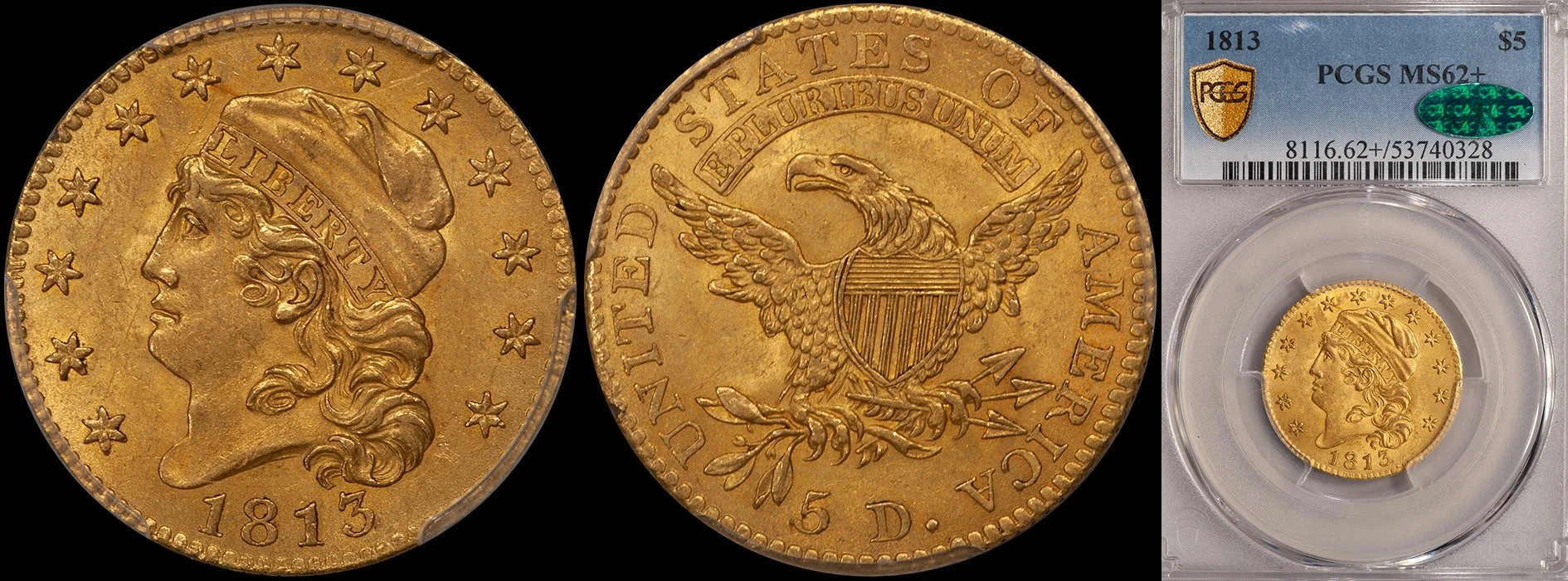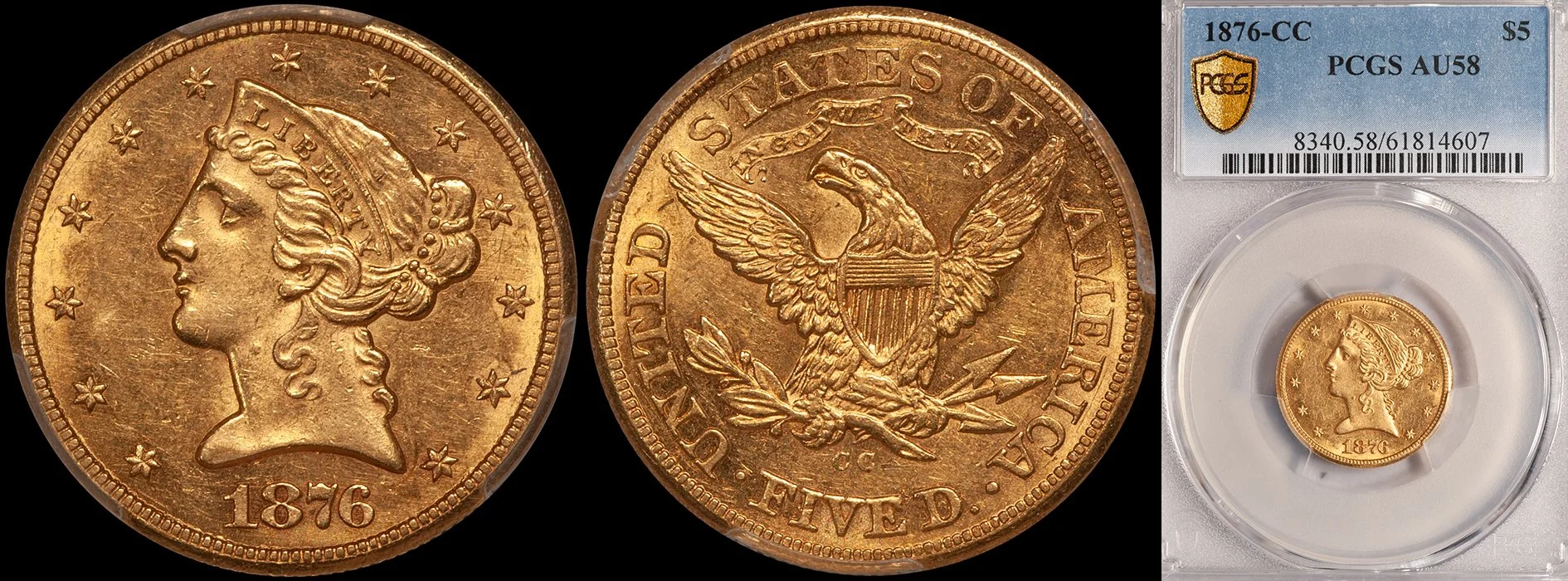
Proof-Only US Gold Coins
/From 1795 up through 1933, there were a total of seven Proof-only gold coins struck at the Philadelphia Mint. They are as follows:
1863 $2.50*
1875 $3.00
1876 $3.00
1887 $5.00
1883 $20.00
1884 $20.00
1887 $20.00
*Many collectors regard the 1841 quarter eagle as the very first proof-only regular issue gold coin produced in the US. I feel that there were both business strikes and Proofs produced.
In 2025, all of these issues are well-known and recognized as major rarities within their respective series.
Let’s take a look at each.
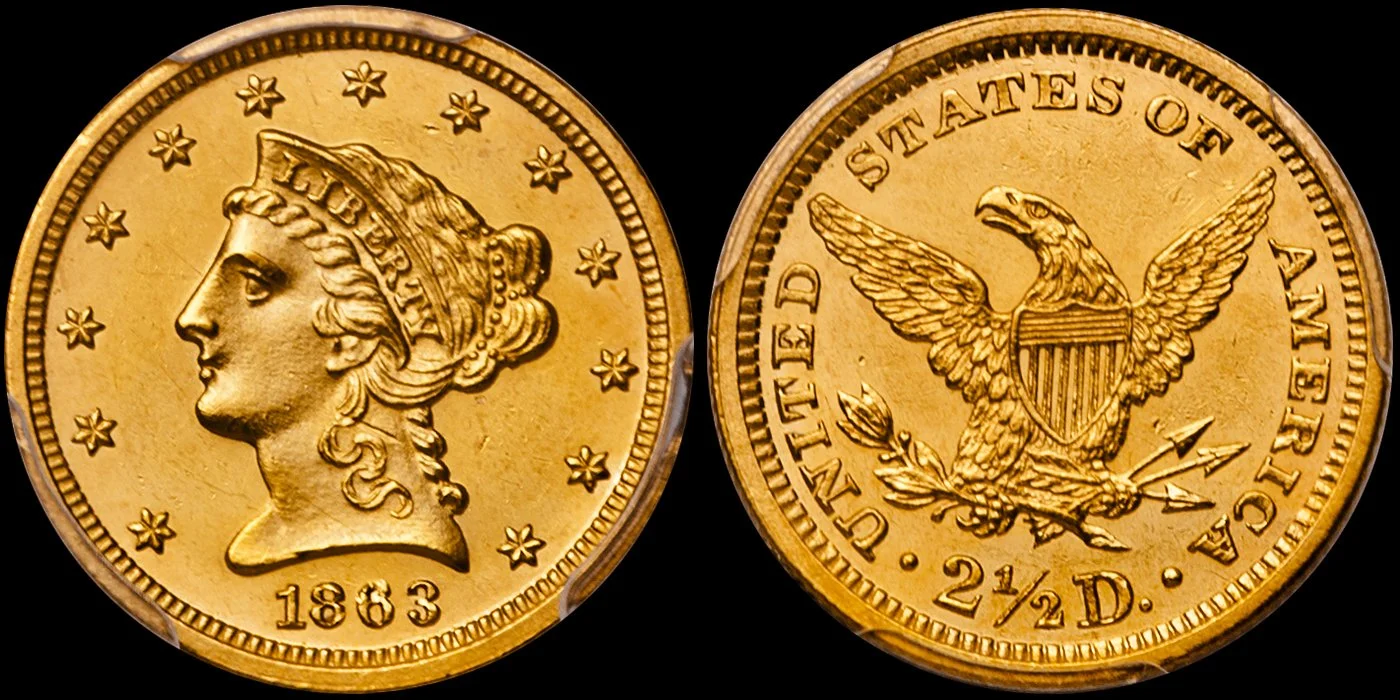
1863 $2.50 PCGS PR63CAM and CAC approved
1863 Quarter Eagle
With the exception of the double eagle which had a mintage of 142,820 business strikes, all of the other Philadelphia issues of this Civil War year are rare, low-mintage issues. The most available of the remaining three is the gold dollar, of which an estimated 100 or so survive from a mintage of 6,200. There were just 2,442 half eagles produced for circulation (with around 40 to 50 known today), and the 1,218 eagles struck rank as the single lowest mintage for the entire No Motto Liberty Head eagle type. I regard this as the second most valuable and the second rarest date of this type, trailing only the 1854-S. Fewer than three dozen business strike 1863 eagles likely exist.
I’ve always found it curious as to why no business strike 1863 quarter eagles were made. It is obvious that the demand for this denomination was minimal by 1863, and in the years that immediately follow, we continue to see very low mintages for non-Proof Quarter Eagles:
| YEAR | MINTAGE |
|---|---|
| 1864 | 2,824 (+50 Proofs) |
| 1865 | 1,520 (+25 Proofs) |
| 1866 | 3,080 (+30 Proofs) |
| 1867 | 3,200 (+50 Proofs) |
These figures would stay under 5,000 every year until 1873 when they “exploded” with a total of nearly 180,000 struck in total.
The primary reason, though was the extreme frailty of the American economy at the beginning of 1863. With the Philadelphia Mint operating, basically, on an “as needed” basis, the real question here is why were any half eagles or eagles made in Philadelphia in 1863? The double eagle mintage is plausible, as these coins were used for international trade payments and for deposits of bullion received from Western mines. But there was no real need or demand for these other two denominations. Contemporary collectors would have been happy to own 1863 half eagles and eagles in a Proof format.
With an original mintage of just 30 coins—all Proofs—the 1863 quarter eagle was known as a rarity within a decade or so after it was made and examples were bringing considerably higher prices at auction than for other Proofs of this era.
There are an estimated 16 to 18 known. This includes at least one or two damaged coins plus two in museums. Most of the non-impaired coins are nice with PR63CAM to PR64CAM seeming to be around the average grade for 1863 quarter eagles.
The current record sales price for an 1863 $2.50 was set by Heritage 2022 FUN: 3781, which sold for $432,000; more than double the previous high for this issue. That coin grades PCGS PR66DCAM and it is approved by CAC. It is by far the finest I have personally seen. The best I’ve handled is an NGC PR66 Ultra Cameo that I sold to the Kansas Collection back in 2018 for under $200,000. I’m not sure that a Gem would bring anywhere near what the record-setting 2022 FUN piece brought if offered for sale tomorrow.
In my personal coin collection, I have an 1864 quarter eagle in PCGS/CAC PR64DCAM. I paid a fraction for this compared to what an 1863 would sell for, and this was primarily motivated by the fact that business strike 1864 quarter eagles are extremely rare as well.
Are 1863 quarter eagles overpriced? Yes and no.
Any coin with a total of 15 or so known in all grades is a very rare coin, and the fact that most of the known examples are choice Proofs makes them far more digestible to trophy coin buyers than the slightly rarer 1854-S quarter eagles (around a dozen are known of which nearly all are graded lower than EF40 and are FUGLY+++). In 2025, you’ll have to pay around $250k for an 1854-S. At around this level, a nice PR64/64+DCAM 1863 feels fairly priced and it is a better value than its western counterpart.
There are just a handful of collectors doing high grade date sets of Liberty head quarter eagles, and the year “1863” can be filled far less expensively by an 1863-S.
Every Proof quarter eagle struck during the 1860’s is very rare with many having fewer known than the 1863.
So I think that the 1863 is very rare when regarded as an issue, but not when viewed strictly as a Proof. The majority of advanced numismatists regard the 1863 as a major rarity and this status will not likely change any time soon.
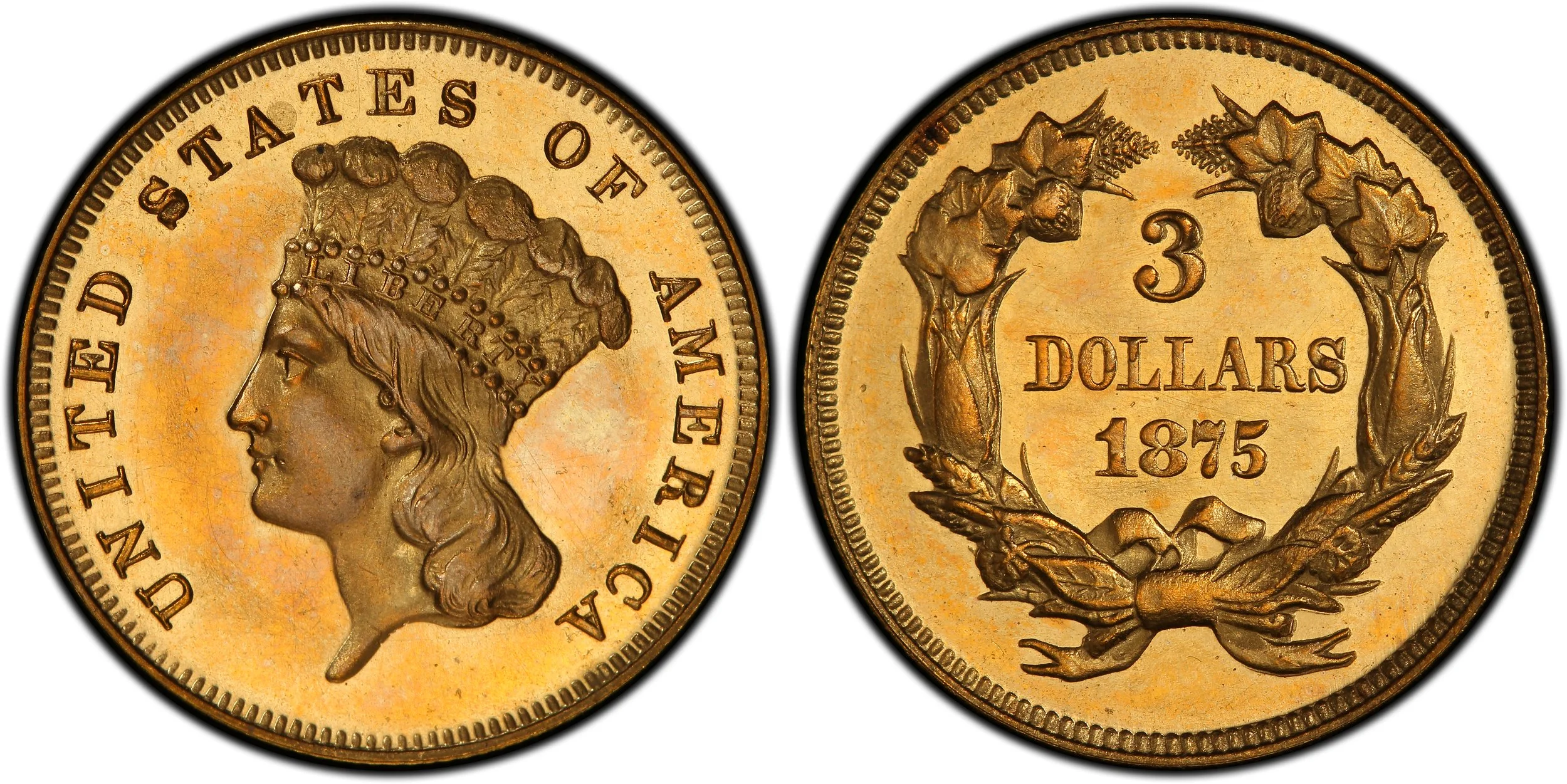
$3.00. 1875 PCGS PR65CAM. Courtesy of PCGS.
1875 and 1876 Three Dollars
According to Mint records, the mintage figures for these two dates are a scant 20 for the 1875 and 45 for the 1876. But according to the current PCGS population figured, there have been 20 graded for the former and 54 for the latter. What gives?
It is probable that while 20 Proofs were made at one specific point in time during 1875, others were likely struck later in the year to satisfy collector demand. I do not feel that these coins are “restrikes” as they were made the same year in which they were dated, and a “restrike” is a coin made at a later date. But given that the survival rate for all the other dates of this type in Proof is around 50% of the original mintage, it would seem that the original mintage figure for 1875 Three Dollar gold pieces is in the area of 35 to 40.
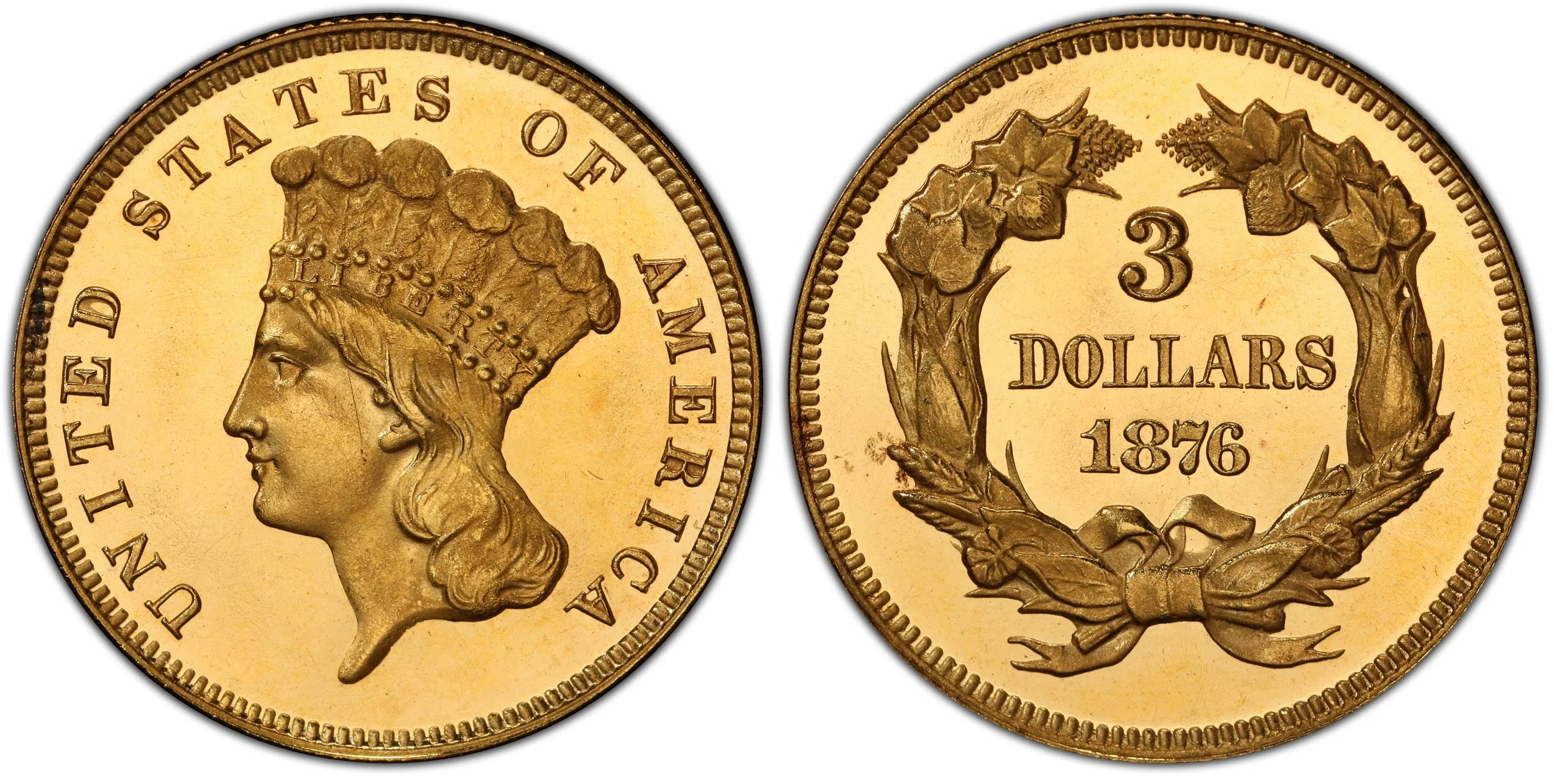
$3.00. 1876 PCGS PR65CAM. Courtesy of PCGS.
The 1876 is a seriously confusing date because of excessive resubmissions that have inflated the numbers graded in PR64 (the current population of 14 seems awfully high…) and in PR65DCAM, where the current population of eight is likely too high as well.
Even if we reduce the number graded at PCGS from 54 to 40, that is still a ton of coins. This makes the reported mintage of 45 possible only if we surmise that virtually every piece that was struck still survives. As this is clearly impossible, the mintage figure for proof 1876 Threes may have been a high as 65 to 75 coins, which would make it the most common Proof date of this design struck prior to 1882; an issue with an original mintage of 76.
If you are an old-time numismatist you likely are aware that in 1973, an 1875 Proof $3 was the very first US gold coin to smash the $100,000 barrier. Today, the 1875 is not held in nearly as high regard as it was 50+ years ago. The rarest proofs of this design—namely the 1854-1857—have shown greater price appreciation in the past decade than the 1875. It is possible that in another decade or two, a PR65CAM 1856 will be more valuable than a Gem 1875.
I can see a case being made for the 1875 continuing to bring the highest price of any proof of this design. The 1876, however, deserves a nominal premium over other low mintage Proofs of this era. The PCGS Price Guide for an 1876 in PR64 is $82,500, and in PR65 it is currently $120,000. The number graded by PCGS in PR64 and PR65 is 32. Compare this to the 1874, 1877, and 1878—all with a mintage of only 20 Proofs.
| 1875 and 1876 Three Dollars | ||
|---|---|---|
| DATE | PCGS PRICE GUIDE IN PR64/65 |
NUMBER GRADED IN PR64/65 |
| 1874 | 50000/85000 | 14 |
| 1877 | 55000/87500 | 11 |
| 1878 | 45000/62500 | 18 |
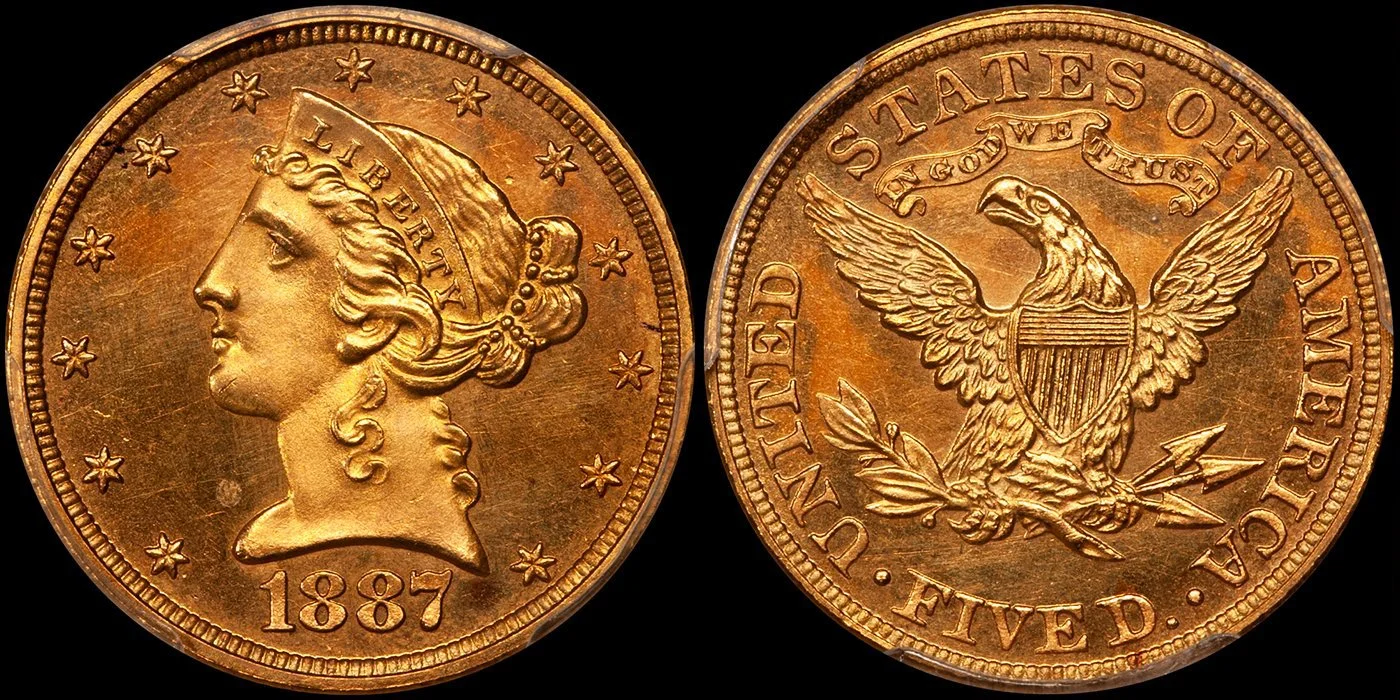
1887 $5.00 PCGS PR64+ CAC.
1887 Half Eagle
The 1887 is an enigmatic issue. It is the sole Proof-only half eagle of any design type, and I have never been able to determine exactly why this issue was struck only in this format. Interestingly, production figures for the 1887-S (1,912,000) and its predecessor the 1886-S (3,268,000), set all-time records for San Francisco half eagles that would be exceeded only one time for the rest of the life of this design from this mint (1901-S with 3,648,000). The answer likely lies in the fight of gold vs. silver during this era, and it is certainly no coincidence that another denomination from this year—the double eagle—was not coined in business strike format as well.
A total of 87 Proof 1887 half eagles were made with an estimated with around three dozen known. It seems that this issue was not recognized as a rarity by contemporary dealers and collectors (as were the 1875 and 1876 Threes), as around a quarter to a third of these are either circulated Proofs or they have been noticeably cleaned. While many of the 1880-1886 Proof half eagles were made with strong contrast between the devices and the fields, this is generally not the case for 1887 Proofs and most of the very few pieces I’ve seen designated as DCAM by PCGS show no more contrast than those designated merely as “Cameo.”
There is no clear finest known proof 1887 half eagle. The current record-setting APR is Stack’s Bowers 2018 ANA: 1286 graded PCGS/CAC PR65CAM at $144,000.
Price guides generally assign PR63 and PR64 1887 half eagles around a 3x multiple price valuation (60k vs. 20k for 63s, and 120k vs. 40k for 64s). I can easily get to a 2x multiple, but have a bit of a harder time at 3x. Nonetheless, I don’t regard the Proof-only 1887 as a dramatically overvalued coin when compared to such comparable proof half eagles as the 1884 or 1886. It should also be pointed out that a set of With Motto liberty head half eagles is an interesting but “doable” project that could conceivably become popular in the coming years.
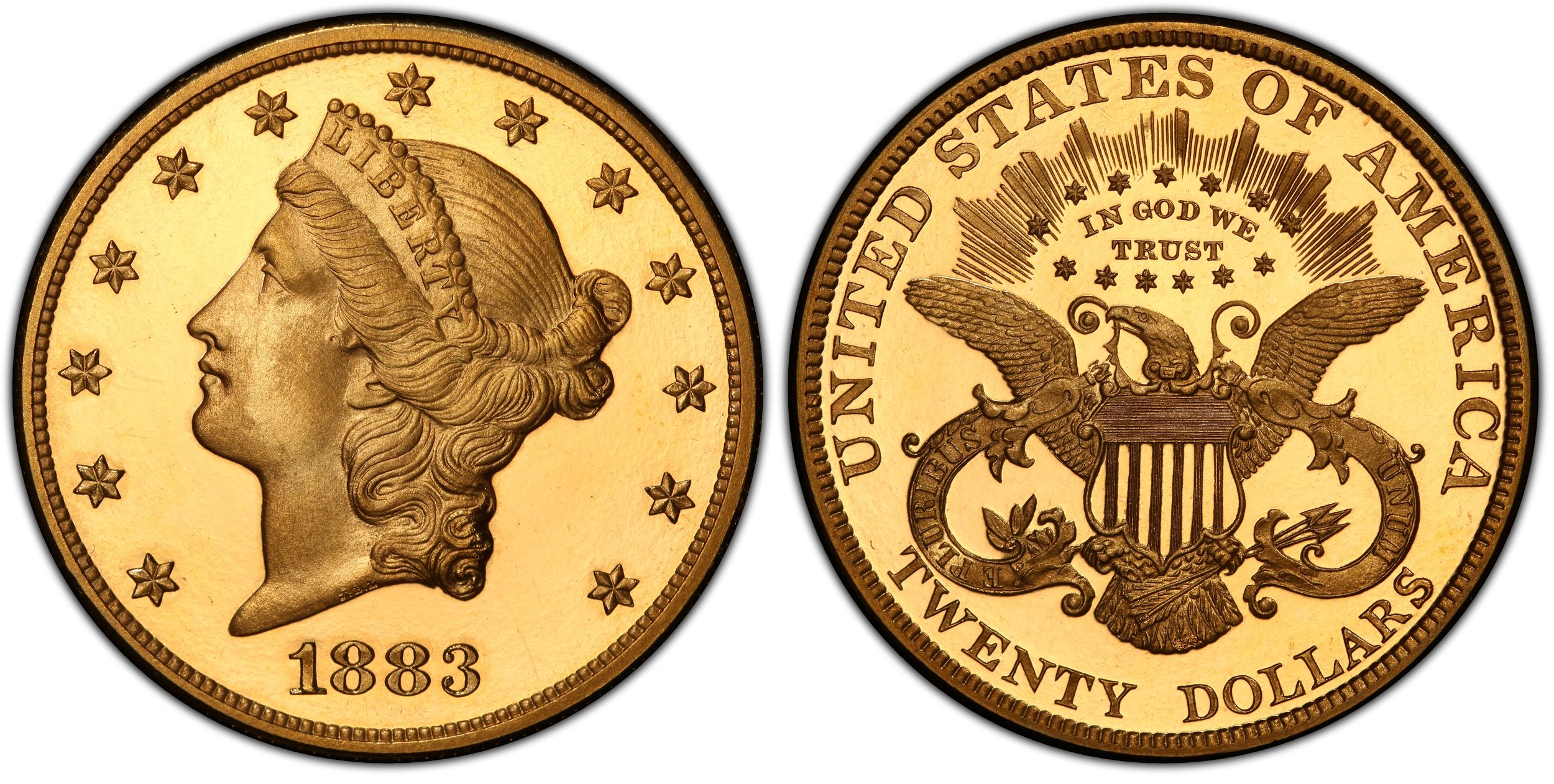
1883 $20.00 PCGS PR66DCAM. Courtesy PCGS.
1883, 1884, and 1887 Double Eagles
By a significant margin, the Triplets* are the best-known and the highest valued of the various Proof only issues.
The mintages for these are as follows:
| DATE | MINTAGE |
|---|---|
| 1883 | 92 |
| 1884 | 71 |
| 1887 | 121 |
If we go back a few years, we will see that mintage figures for Proofs of this denomination were significantly lower than they were for the three Proof-only issues. Going back as far as 1877 (the first year of issue for the new Type Three design), the mintages are as follows:
| DATE | MINTAGE |
|---|---|
| 1877 | 20 |
| 1878 | 20 |
| 1879 | 30 |
| 1880 | 36 |
| 1881 | 61 |
| 1882 | 69 |
In my opinion, the most interesting thing that we can glean from this chart is that the two rarest dates in circulation strike format in this six coin run—the 1881 and the 1882—have by far the highest Proof mintages. It is safe to assume that this was the result of collector demand fueled by the very small number of business strike 1881 and 1882 double eagles; just 2,199 and 571, respectively.
Unlike Liberty head quarter eagles and half eagles and three dollar gold pieces, there are a good number of collectors who are working on date sets of Liberty head double eagles. This has been the impetus for strong price appreciation for all three of the Triplets.
Let’s look at each issue.
1883: A total of 92 Proof 1883 double eagles were made with an estimated population of around 30 survivors. This includes a dozen so gems (PR65 and higher; most with a DCAM appearance). The all-time auction price record is currently held by the PCGS PR66 DCAM that sold for $492,000 as Heritage 2025: 4915.
Proof double eagles became very popular around 2020/2021 with virtually every nice coin breaking previous auction records when available. Gem examples of the rare 1883 went from being worth around $250,000 to $275,000 up to the $350,000-400,000 range in the current market. But is the premium for this proof-only date substantial enough?
Here is pricing data for the 1883 as compared with the 1882 and the 1885, two dates that are not proof-only as is the 1883 but both of which are exceedingly rare in PR65DCAM and finer.
| DATE | PROOF MINTAGE | PCGS PRICE GUIDE VALUE | PCGS POPULATION | ||
|---|---|---|---|---|---|
| 65DCAM | 66DCAM | 65DCAM | 66DCAM | ||
| 1882 | 59 | $485,500 | $575,000 | 1 | 0 (1 in 66+) |
| 1883 | 92 | $575,000 | $700,000 | 3 | 4 |
| 1885 | 77 | $335,000 | $525,000 | 1 | 0 (2 in 67) |
Based on this very small sample size, the 1883 is far more available than the 1882 and the 1885. The price ratio between the 1882 and the 1883 seems about right but I would have to say that the 1885 in Gem Proof seems undervalued when compared to the 1885.
Before we move on to the 1884 and the 1887, let’s compare the total number of Proofs graded by PCGS for the three Proof-only issues
| DATE | TOTAL GRADED AT PCGS (includes all designations) |
HIGHEST GRADED |
|---|---|---|
| 1883 | 19 | PR66DCAM |
| 1884 | 12 | PR66CAM |
| 1887 | 27 | (2) PR66DCAM |
These figures correspond nicely to the original mintages of each of the three issues and their rarity rankings are as follows:
1884 (15-20 known)
1883 (25-30 known)
1887 (35-40 known)
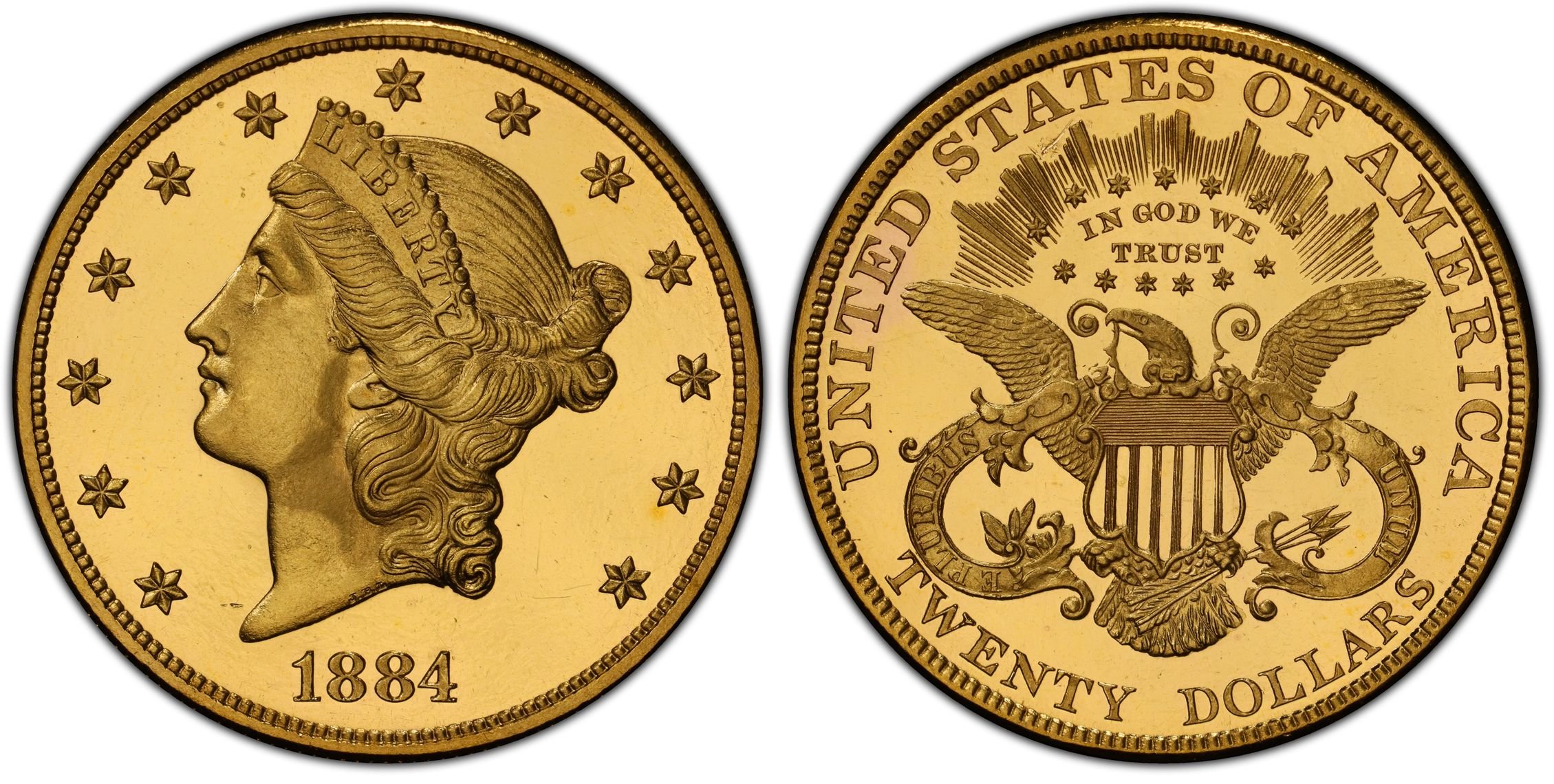
1884 $20.00 PCGS PR66CAM. Courtesy PCGS.
1884: With fewer than 20 known in total, the 1884 is a major rarity. Not a single DCAM example has sold for over a decade (only two have ever been graded by PCGS) and the only recent trade for this date is Heritage 2025 FUN: 4916 graded PCGS PR64+ CAM, at a very reasonable $252,000. The single best I have seen is the PCGS PR66 CAM that last sold for $264,500 in 2006.
If a PCGS/CAC 66 were to ever come onto the market, I could see it breaking the current APR for any Type Three Proof currently held by the awesome PCGS/CAC PR67 1885 that brought $990,000 as Stack’s Bowers 11/2022: 5109.
At current levels, I believe that his date is underpriced.
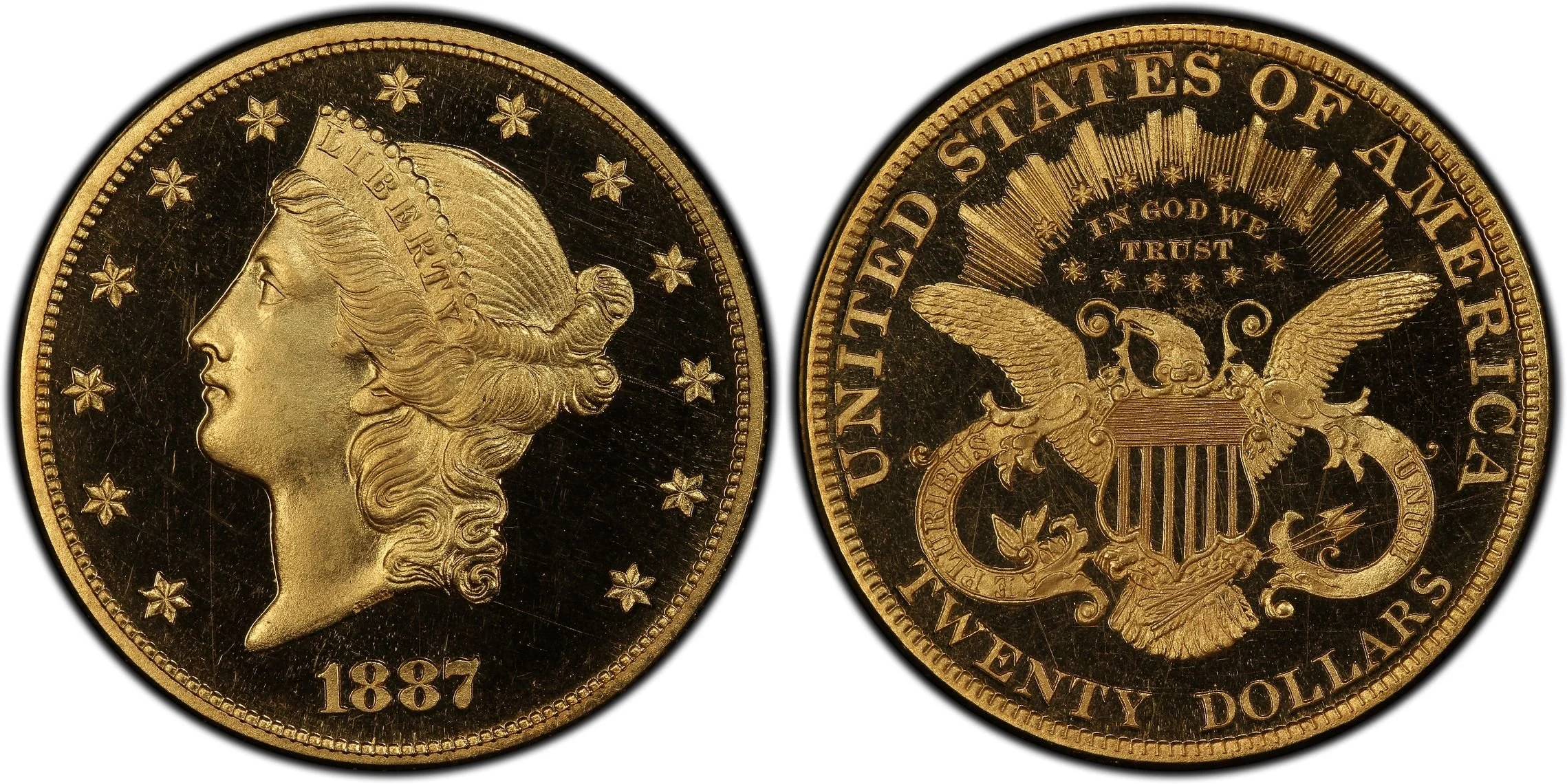
1887 $20.00 PCGS PR66DCAM. Courtesy PCGS.
1887: The third and final member of the triplets, the 1887, has a mintage of 121 which is the fourth highest figure for any Proof Liberty head double eagle. The survival rate for this date is lower than for other Proofs of this era. My estimate of around three dozen known is a bit higher than other published estimates but I base this on having seen five different coins in the past three years.
*Regarding the Triplets: There is also a group of rare/very rare business strike Type Three issues known to collectors as the Fabulous or Fantastic Five. These are the 1881, 1882, 1885, 1886, and 1891.
Would you like to assemble a set of Proof-only US gold coins? I would love to take this journey with you and we can begin it soon with the James Stack Proof-only double eagles coming up for sale in December, 2025. For more information, please phone me at 214-675-9897.