The RYK Retort: More on the 1892-CC Eagle

Editor’s note: The following reply was received by me this morning and it was written by well-known collector Robert Kanterman about the blog I published yesterday. It is unedited and, I think, an interesting insight into the mind of a sophisticated, well-focused collector. I was the lucky buyer, and I will address DW's points from the previous blog.

1. Underpriced? Perhaps a little bit, not too much — okay, I thought it was a screaming bargain! I would have been interested up to the $1200-1300 range. Maybe even $1500 if I really needed it for a date or type set.

As recently as a few months ago, the basal value of any old Liberty $10 was approaching $1000. Perhaps I am living in the past, but I still view $10 Libs as $1000 or so coins.

2. CC gold is extremely popular. More popular than ever. Just when I think that interest is starting to wane, it seems to gather more steam. Good luck trying to find me some CC $20's in OGHs.

3. I love OGHs, and I am not afraid to admit it. Graded years ago, under perhaps different standards, and untouched by human hands for 20+ years, what's not to love? Add to that the fact that many filthy gold coins from European hoards were slabbed in the OGH era (more below). I also believe that the green of the label and the gold of the coin complement one another in a way that even art enthusiasts like DW should appreciate.

A wise coin dealer friend told me earlier this year that the PCGS Reconsideration service marked the death knell of the OGH. I am not so sure. The OGH is dead. Long live the OGH!

4. DOGs (Dirty Original Gold coins) are The Bomb among serious collectors of 19th century circulated gold coin and other numismatic vagabonds. DWN has certainly educated collectors about originality, in his books, website, and in person, and made them popular, but RYK invented the "DOG" and used his big mouth (or noisy keyboard, anyway) to spread the gospel.

5. Liberty $10's are a great series, chock full of rarities and interesting dates. There are numerous logical ways to collect them that do not necessarily bust your coin budget (or require you to sell your home). There is also no question that David Hall's finest ever PCGS registry set and its well-publicized sale a few years back has raised the profile of these coins. Here's a confession — the first coin that I ever purchased from DWN was an 1849-O $10. The second coin was an 1883-CC $10. The last two were also Liberty $10's, both in OGHs. I really like Liberty $10's a lot.

And The Winner For Most Popular Coin Is....

I bought a ton of coins at the recent ANA. They ranged in price from under $1,000 to close to $100,000 and nearly all have been sold on my website in the two+ weeks since the end of the show. One coin garnered more attention than any other. It was ordered no less than eleven times (by different individuals) until I finally marked it "on hold." I would have never guessed, when I bought it, that this seemingly mundane coin would have become my Most Popular New Purchase for the 2013 ANA. And the winner for Mr. Popularity was (drumroll)......???

An 1892-CC eagle graded EF40 by PCGS (and approved by CAC) in an Old Green Label Holder.

1892-CC $10.00 PCGS EF40 CAC

Priced at a whopping $1,000, this coin connected with a wide range of people. It was ordered by two dealers and nine collectors running the gamut from beginners to seasoned vets.

What was it about this coin that made people go gaga?

I have a few theories. Let's explore them.

1. It Was Underpriced

As I mentioned in the description, by today's standards this coin grades more like AU50 to AU53 than EF40. This made it more likely to have a final value of $1,250 or so as opposed to the $1,000 it was listed for. At least eleven people spotted that this was a good deal, if not an actual bargain.

2. It Was An Affordable But Nice CC Gold Coin

If you don't have a huge budget but want to own a Carson City gold coin with a good overall appearance, you don't have a ton of choices. The typical CC double eagle now costs over $2,000 - and at the $1,000 price point any half eagle that's not dated 1891-CC tends to be kind of boring. I can't remember the last time I had an interesting CC eagle that was priced at $1,000.

3. The Lure of the OGH Is Strong...

Collectors love OGH PCGS coins and it isn't hard to understand why. The purist in me appreciates that a coin graded back in the late 1980's or early 1990's is going to look the same in another 20+ years as it does now. In other words, if PCGS had missed surface enhancement(s) on said 1892-CC eagle, the coin would have already turned in the holder. The fact that it was dark and dirty was a pretty sure sign that it was "as is" and wasn't going to turn.

4. Nice, Original Coins Are In Demand

This coin was dirty and original and coins with this sort of appearance are in demand. I'd like to think I had a little bit to do with this...

5. Liberty Head Eagles Are In Demand As Well.

As I've pointed out a number of times in the last few years, the Liberty Head eagle series has gone from mildly popular to very popular. This denomination will never be as popular as its big brother the double eagle but the number of people who dabble or specialize in this denomination has grown dramatically since 2008-2009. And an interesting Liberty Head eagle priced at a grand isn't easy to find.

I would have to guess that this perfect storm of desirability and appeal was what made this 1892-CC eagle so popular. To the collector whose email I received first and who is now the happy owner of Mr. Popularity...kudos. And to everyone else who tried and failed to buy the 1892-CC eagle...thanks and sorry. We will do another deal and soon, I hope!

The 1854-S Double Eagle: A Study

The 1854-S double eagle is one of the most interesting Liberty Head double eagles. It is widely acclaimed by collectors due to its status as the first double eagle from this mint, and the rarity of the quarter eagle and half eagle from this year makes it a famous coin as well. That said, it is an issue that is not well understood and one whose rarity profile has been made confusing by inconsistencies from NGC and PCGS.

The 1854-S has a high original mintage figure of 141,468 and one would expect it to be available in higher grades. This is not necessarily the case, despite what appears to be a decent number in Uncirculated as per the grading services’ current figures.

As of August 2013, NGC had graded a total of 48 in Uncirculated, including 23 in MS63 and another 10 in MS64. PCGS had graded a total of 55 in Uncirculated, including 17 in MS63 and another three in MS64. With a total of 103 graded in Uncirculated, we can conclude that the 1854-S is only a marginally scarce coin in higher grades and it seems more available in comparably high grades (i.e., MS63 and higher) than such contemporary non-shipwreck dates from this mint as the 1855-S, 1858-S and 1859-S.

However, this is not the case.

What the NGC and PCGS populations fail to address is the fact that virtually every Uncirculated 1854-S double eagle is a shipwreck coin. And what’s worse is that these are designated on the holder as being from a shipwreck - and both services seem wildly inconsistent with how this date is graded and why some blatantly “environmental damage” coins are in “normal” holders while others are not.

Essentially every high-grade 1854-S double eagle is from the S.S. Yankee Blade shipwreck which was found in 1977. This wreck contained approximately 200-300 coins. These were Uncirculated coins which must have been spectacular before the boat carrying them sank; the survivors tend to show very few marks but they have matte-like surfaces from exposure to seawater. Some examples have less etching in the surfaces than others; some are clearly salvaged and have oxidation as well as scratches from the process of removing crud from the surfaces.

What few collectors realize is that, as with the 1854-S eagle, the survival rate of high grade 1854-S double eagles with original surfaces is exceptionally low. I have seen exactly three with original surfaces which I grade Choice AU to Mint State by today’s standards. In comparison, I have probably owned 20 examples graded MS62 to MS64 but with “unoriginal” surfaces.

The choicest 1854-S double eagles I have seen with original surfaces include a PCGS 61 from the Bass collection (ex Bass III: 781 at $10,450; I later sold this coin to a collector on the East Coast), an NGC MS61 which I bought out of a Heritage sale around ten years ago (and can’t currently remember the exact pedigree), and a PCGS AU58 which I purchased from a New York dealer around four years ago and which was very choice for the grade. I believe that a few others are known but I can stately with reasonably strong conviction that none exist in grades higher than MS61.

There are certain diagnostics seen on the Yankee Blade coin which are not seen on the coins with original surfaces. Some of these are as follows:

  1. The shipwreck coins always have an obverse die crack which runs up from a denticle at 6:00 on the obverse through the left side of the 5 in the date, terminating at the truncation.
  2. The reverse has a total of three cracks. The first runs into the field (at the viewer’s left) from the base of the N in UNITED. The second crack begins between the denticles left of the first T in TWENTY up to the left tip of the letter. The third begins at the tip of the T in TWENTY and travels left into the field ending below the N in UNITED. On the late die state, these three cracks meet below the base of the right foot of the N in UNITED.
  3. The shipwreck coins always show a broken crossbar in the A in STATES.

The original surface coins do not show these die cracks. They do have a similar mintmark, and all seem to have the broken crossbar. Interestingly, there are a number of small raised die dots on the obverse with two to the right of the 4 in the date, and three at the throat. There is also a small raised die dot on the neck.

I don’t believe that the original surface coins are from a different die pair than the seawater coins; just a different die state.

Breen lists four different die varieties for the 1854-S, but one of these is a Proof-only die (the unique coin in the Mint Collection) while another, described as having “extra thin numerals and letters,” is just a late state with lapped dies. He states that 8 pairs of dies were created and that the mintmark “usually…touches the tail; though on one it is free.” (He then states that on one it is “embedded.”). I have only seen one reverse and it always has a broken A in STATES and a mintmark which firmly touches the tail at its top.

There is, of course, another significant difference on the original surface coins and that is a different texture from a lack of exposure to seawater and sand.

1854-S $20.00 NGC AU58+ CAC with original surfaces

Original surface 1854-S double eagles typically show a deep green-gold or orange-gold hue. The luster doesn’t tend to be as frosty as that seen on 1855-S or 1856-S double eagles. The overall look tends to be subdued with multiple abrasions from hard circulation.

1854-S $20.00 NGC MS64, with evidence of seawater

There are two distinct looks for seawater 1854-S double eagles. The first is blatantly matte-like with heavy environmental damage; some of these are slabbed as “normal” coins by NGC and PCGS while others are “details only” or “genuine.” The more familiar look on the Yankee Blade coins is bright and slightly matte-like with rich yellow-gold color and a virtual absence of circulation marks on the surfaces.

The normal surface 1854-S double eagles should sell for a significant premium in all grades due to the scarcity. This date is seen from time to time in the EF40 to AU50 range, but it becomes very scarce in AU53 to AU55, and it is very rare in properly graded AU58. As I mentioned above, I have seen only three examples with original surfaces in Uncirculated and doubt if more than five or six exist.

For more information on Type One double eagles, I invite you to look through the blog and articles archive(s) on raregoldcoins.com or email me at dwn@ont.com with specific questions.

2013 ANA Show Report: 10 Observations

You know how I feel about show reports. They tend to be self-serving, inaccurate, biased as hell, and generally not very interesting. Which is why I stopped writing them a few years ago. But most readers of this blog want to know about my experiences at the ANA and my thoughts about the market so I’m going to do what I said I wouldn’t: I’m going to write about the 2013 ANA show but from a perspective that you might not have already heard before.

1. So how was the show?

The ANA summer show has been the Big Kahuna ever since I was a kid and although its impact has slightly waned over the years (for numerous reasons which I will discuss at another time) it’s such a significant show that if you are a dealer with even a reasonable amount of a clue on how to buy and sell coins, you are going to have decent results just on account of being there. On the Doug Winter Show Grading System (with 1 being a show cancelled by a nuclear accident and 10 being the show that a dude walks up to my table with a box of unopened 1873 Proof Sets) I would call the 2013 ANA a 7.5 to 8.0. I was very busy from the beginning to the end. I sold a ton and I bought some very cool numismatic items. More on this later in the blog.

2. Modern coins made huge inroads at the 2013 ANA show.

Chances are good that if you go to your local regional show, you will see moderns. But the ANA wasn’t a place I expected to see dealers like APMEX with the mack-daddy of all coin show tables. (If my hefty-sized table was Oklahoma, they were Texas…) The strong presence of modern and bullion-related dealers at this year’s show sends a clear message: more and more, the coin market is about alternatives to classic or vintage coins.

3. There seemed to be more foreign dealers at the show than usual.

I didn’t count the exact number of Brits, Brazilians, and Bolivians - but taking a stroll through the foreign/ancient section of the show was interesting and, for a coin show, downright cosmopolitan. For me, the ANA has an interesting social aspect. There are overseas dealers who I literally see once per year and my annual three minute "heyhowyadoin’" chat always occurs at the ANA.

4. The ANA remains an overwhelming logistics operation for a one or two-person operation.

I attended the pre-show (ANA Lite) and the regular ANA and committed to a full eight days and seven nights in the process. Even after deciding to blow-off the Stacks Bowers auctions due, frankly, to being overwhelmed, I still found it nearly impossible to accomplish even half of what I wanted to do at the show. I never made it to see the book dealers, missed the exhibits, and failed to talk to at least ten people I wanted to connect with. Being busy is a good thing (and on more than one day, I said to Jenna, “Hey, I’m hungry, let’s eat lunch!” only to look at my phone’s clock and see that it was already 1:47 in the afternoon) but being too busy can be kind of flustering.

5. What do you think about the location of the show, Doug?

Chicago

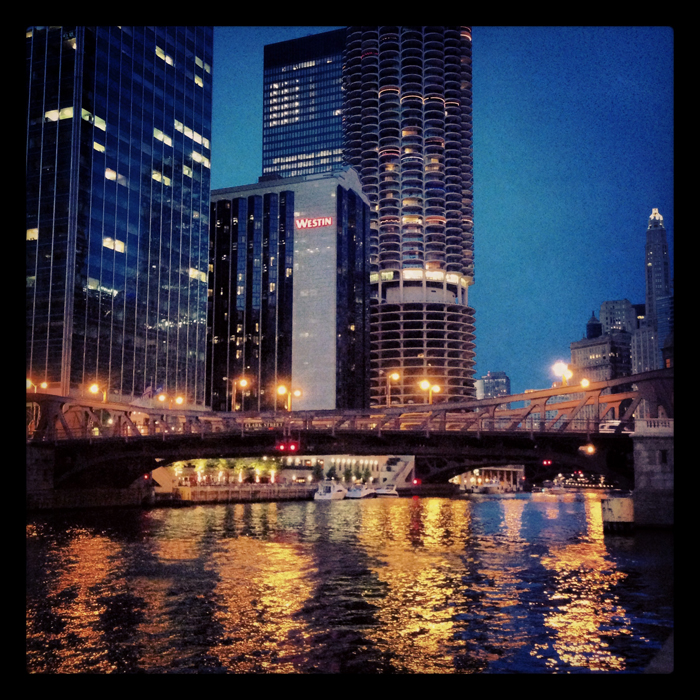
I’m about as much of a city guy as anyone you know. I grew up in Manhattan, I vacation in big cities, and my house in Portland is in the heart of downtown. That said, I despise Rosemont and everything it represents. Would I ever spend a minute more in Rosemont than I had to? Of course not. But do I think it’s a good location for a convention? Yes, it’s actually a great location. Dead center of the country. Easy and cheap air access. Nice hotels within walking distance. A small but decent number of good dining options. (Although my Gibson’s overload factor went nearly off the charts this year. The seared crusted Ahi Tuna salad was a wonderful lunch but six days in a row?) If it were up to me, coin shows would be small, highly professional 100 dealer operations that lasted two days/nights at most, and were located in great cities like San Francisco, New York and Boston. But there aren’t so we make do with locations like Rosemont. For me it’s a true love/hate relationship, but when you realize analyze it, it makes sense.

Gibson's

6. Heartfelt congratulations to John Albanese for winning the Sol Kaplan award.

This is presented annually by PNG “for work in helping to fight fraud and thievery in numismatics.” John is one of the good guys in the coin business and he has done more for consumer protection and advocacy than nearly anyone I know. I’m happy to see him get some professional recognition from the PNG.

7. The coin show wasn’t all Rosemont/Gibson’s/Numismatics for me.

I took part of Saturday and most of Sunday off and stayed in downtown Chicago. The highlight of my trip was going to the Art Institute of Chicago. As you might know, I’m a bit of an Art Weenie and the AIC was on my shortlist of great American museums that I had yet to visit. It was worth the wait. It is spectacular and I highly recommend it. I mostly wanted to see this.

The Grand Jette by Seurat

8. As you have no doubt read countless number of times in the past year(s), it is hard to buy nice coins now.

For a number of reasons, there are real issues with supply and this is across-the-board; whether you deal in Gem Proof gold or Conder Tokens, nice material is really in short supply. I actually was able to find some pretty neat coins at the show. (That surprised me.) I noticed a drop-off in coins around Wednesday afternoon and the reason for this was clear: PCGS was so slammed by submissions for walk-throughs that they shut off grading - and when I left the show on Friday, they still hadn’t returned coins. Had they done so, I would have had the appetite for more new purchases. And I’m sure so would have other dealers.

9.   In Observation #1 I mentioned that the ANA is the Big Kahuna of coin shows...

But for those of us old enough to remember back before, say, 2000, the ANA used to be a lot different. I can recall saving coins for three or four months to sell at the ANA. But that was before the internet made the coin market a 24/7 thing, and it was back when the only spring show of note was Central States, and the next show on the Coin Calendar was the Summer ANA. Back when people used to hold coins, you’d see some wild, wild stuff in dealers' cases. I remember how Dave Akers, Ed Milas, Paul Nugget, Mike Brownlee, and my other gold-coin-heroes would have crazy Territorials I had never seen before, insane early gold and groups of fresh branch mint coins (some of which I could actually buy for my fledgling business), and more. In 2013, the cupboard is pretty bare. Oh sure, I grooved on the Eric Newman silver coins. Legend’s 1894-S Dime was pretty neat, and the Proof 1921 Saint that a dealer friend of mine owns caught my attention. Ah, but for the Good ‘ol Days…

10. There were clear signs of what was hot and what wasn’t hot at the show.

The strongest areas included Carson City double eagles, Type One double eagles, virtually all interesting Liberty Head eagles, Dahlonega gold (I could have sold twenty half eagles had I found any for sale; where the heck are they?), and choice early gold with original color and surfaces.

To those of you who stopped by my table at the Throes in Rose(mont), thanks. And to everyone who has bought one or more of the new coins that I purchased at the show and listed on the website (www.raregoldcoins.com), double thanks.

A Collection of Transitional Gold Coins

I am often asked for ideas about what to collect, especially ones that are a little bit "out of the box." I recently had a conversation with a long-time collector about new directions for his set and we discussed the possibility of starting a transitional set of 19th century American gold coins.

By "transitional," I am referring to a coin that was struck as two different types during the same year. An example of this would be an 1854 gold dollar from Philadelphia which was produced as both as Type One and Type Two issue. Let's take a look at some of the transitional coins that are available to collectors who are considering this approach.

A pair of coins which is not a transition would be an 1861-S and 1861-S Paquet Reverse double eagle. This is the case because the 1861-S Paquet reverse was not used in any other year. An 1866-S No Motto reverse and an 1866-S With Motto are a transitional pair because the newer reverse was used in the following year(s).

1.  GOLD DOLLARS

The Liberty Head gold dollar was produced from 1849 through 1889.  There were a total of three types and there are a few interesting possibilities for the transitional collector.

1854 Type 1 $1.00 PCGS MS66

1854 Type 2 $1.00 PCGS MS66

In 1854, the Philadelphia, Dahlonega and San Francisco mint produced gold dollars with the Type One design. During the same year, a Type Two gold dollar was made at the Philadelphia mint as well. Both the 1854 Type One and Type Two gold dollars are common, although the latter becomes scarce and expensive in the higher Uncirculated grades. A transitional pairing of the 1854-P Type One and Type Two dollars could easily be assembled in MS63 to MS64 grades.

In 1856, there was a Type Two gold dollar made at the San Francisco mint and well as Type Three issue at Philadelphia and Dahlonega. These are not transitional issues, in the strictest sense of the word, as they were made during the same year but at different mints.

2.  QUARTER EAGLES

Production of this denomination began in 1796 and continued all the way until 1929. During this period, there were a number of transitional issues.

1796 No Stars $2.50, courtesy of Heritage

1796 Stars $2.50, courtesy of Heritage

The first transitional pair of quarter eagles occurs in 1796 when both the No Stars and the With Stars issues were made. A total of 963 examples of the No Stars were struck and just 432 of the With Stars. While the more common of the two, the No Stars is better known and considered more desirable by many collectors. The 1796 With Stars is a very rare coin in all grades and is generally seen in lower grades than its No Stars counterpart. This transitional pair will be the most expensive part of such a set with nice AU-Uncirculated examples costing at least $250,000-300,000 and possibly more.

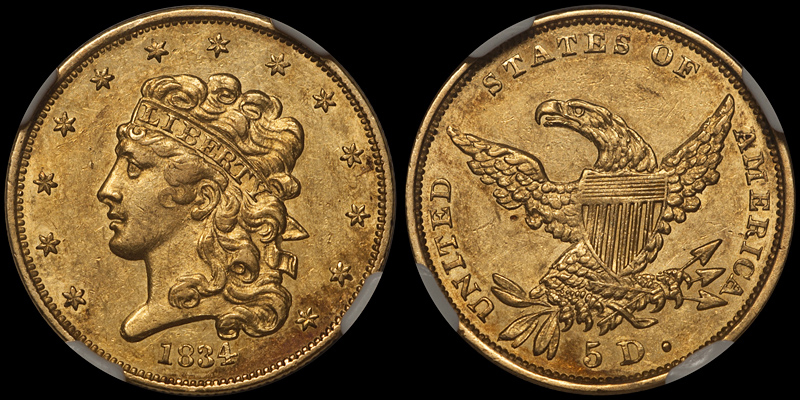
While the 1796 transitional set will be the most expensive quarter eagles in this set, the rarest coin will be the 1834 With Motto, which is the final year of issue for the Capped Head Left (reduced size) type struck from 1829 to 1834. There were 4,000 of these struck but nearly all were melted and today an estimated 20 or so exist. Later in the year, the better-known Classic Head design was introduced and the first-year-of-issue 1834 is common in grades up to MS63 and sometimes obtainable in MS64.  A transitional pair of 1834 quarter eagles could, in theory, be obtained for less than $100,000 but the earlier issue from this year might take years of waiting to locate.

No other transitional pairs exist for the quarter eagle denomination.

No transitional pairs exist for the three dollar gold piece.

3.  HALF EAGLES

The half eagle denomination began in 1795 and ended in 1929. It is fertile ground for the transitional collector with a number of interesting pairs extent, especially during the first few years of production.

1795 Small Eagle $5.00, courtesy of Heritage

1795 Large Eagle $5.00, courtesy of Heritage

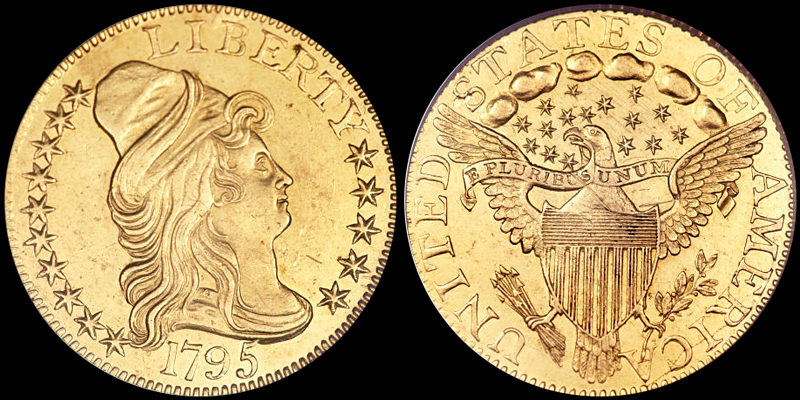
The 1795 half eagle exists with both the Small Eagle reverse (employed on this denomination from 1795 through 1798) and the Heraldic Eagle reverse (used from 1795 until 1807). The 1795 Small Eagle is a reasonably common coin by the standards of early half eagles and it is, as one might expect, extremely popular. The 1795 Heraldic Eagle is considerably scarcer, especially in higher grades, although it is more obtainable. A nice transitional pair of 1795 half eagles will run  $100,000 or so but, in my opinion, it is one of the most visually arresting contrasts in all of American coinage.

1797 15 Star $5.00, courtesy of Heritage

1797 16 Star $5.00 PCGS AU50

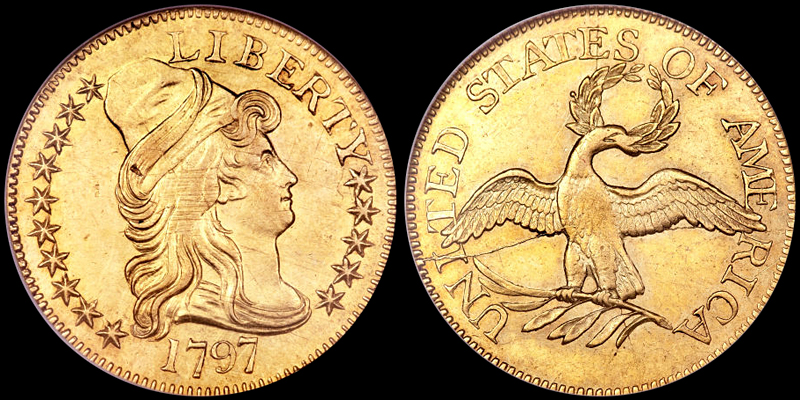
Another transitional pair exists in 1797. Two different 1797 Small Eagle half eagles are known; the 15 star obverse and the 16 star obverse. Both are very rare although the former is more difficult to find and is not often offered for sale. There is a 1797/5 Heraldic Eagle known which is also very rare although it is at least obtainable; two other 1797 Heraldic eagle varieties (the 15 star and the 16 star non-overdate) which are unique and located in the Smithsonian. A transitional set of 1797 half eagles would be expensive ($200,000+) and hard to assemble but it would make an exceptional item and would be a highlight of this set.

In theory, a 1798 transitional set could be assembled as well but the Small Eagle is exceedingly rare with just eight known; the last example to sell at auction (a PCGS EF40) brought $264,500 back in 2000. The Heraldic Eagle variety from this year is reasonably common. It is possible that this set could be assembled but it would take deep pockets and considerable good fortune to even have a shot as obtaining a 1798 Small Eagle in today's rarity-conscious market.

1807 Bust Right $5.00 PCGS MS63 CAC

1807 Bust Left $5.00 PCGS MS61

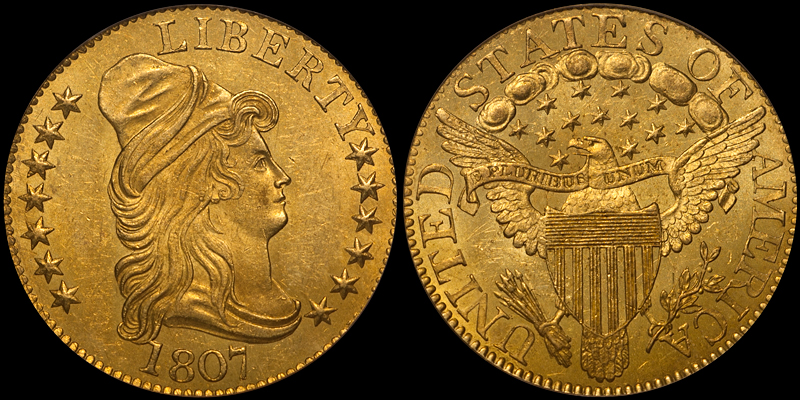
The next transitional set in the half eagle denomination is the 1807 Bust Right and 1807 Bust Left. Both issues are reasonably common and a set could be put together, if so desired, in grades as high as MS64 to MS65. For $20,000-30,000, a more reasonably price alternative would include two nice AU coins.

A very interesting and very rare transitional pair occurs in 1829 with the Large Date (Large Diameter) and Small Date (Small Diameter). Both of these issues are very rare and generally trade once every few years. We're talking in excess of $1 million dollars for this pair and even having the money is no assurance that a set could be assembled.

1834 Capped Plain 4 $5.00, courtesy of Heritage

1834 Capped Crosslet 4 $5.00, courtesy of Heritage

1834 Plain 4 $5.00 NGC AU58 CAC

1834 Crosslet 4 $5.00 PCGS EF45 CAC

A really interesting pair of transitional pairs exists for the 1834 half eagles. The Capped Head Left reduced diameter type began in 1829 and continued until 1834. During this year, both Plain 4 and Crosslet 4 varieties. Both are quite rare with the latter being harder to find. Later in the year, the new Classic Head variety was introduced and, again, both Plain 4 and Crosslet 4 coins are known with the latter being considerably rarer. It would be difficult but not impossible to put together this "pair of pairs" with the two Capped Head coins in AU-MS grades, the Plain 4 Classic Head in a grade as high as MS64 and the Crosslet 4 Classic Head in the lower MS grades.

1842 Small Letters $5.00, courtesy of Heritage

1842 Large Letters $5.00 NGC AU58

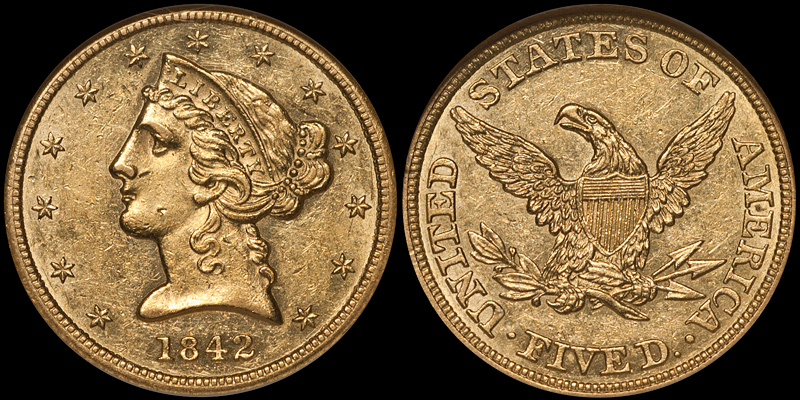
The next group of transitional pair half eagles occur in 1842 and 1843. 1842 Philadelphia half eagles are known with Small Letters and Large Letters reverse varieties. The former is the type of 1839-1842 while the latter began in 1842 and continued all the way through 1866. Both are scarce and undervalued with the Large letters being the rarer of the two. A pair could be assembled in nice AU grades for $10,000-15,000.

1842-C Small Date $5.00 NGC EF40

1842-C Large Date $5.00 PCGS EF45 CAC

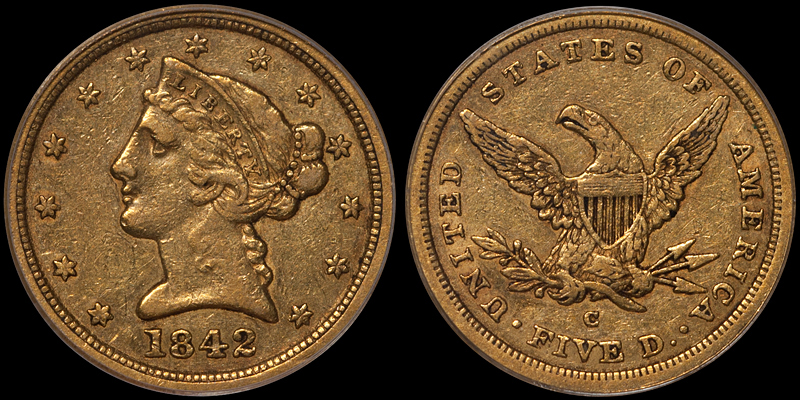
The same transitional pair exists for 1842-C half eagles. The 1842-C Small Date is very rare in all grades while the Large Date is more available. An EF-AU pair would cost $20,000-25,000 to assemble.

1842-D Small Date $5.00 PCGS AU53 CAC

1842-D Large Date $5.00 NGC AU58

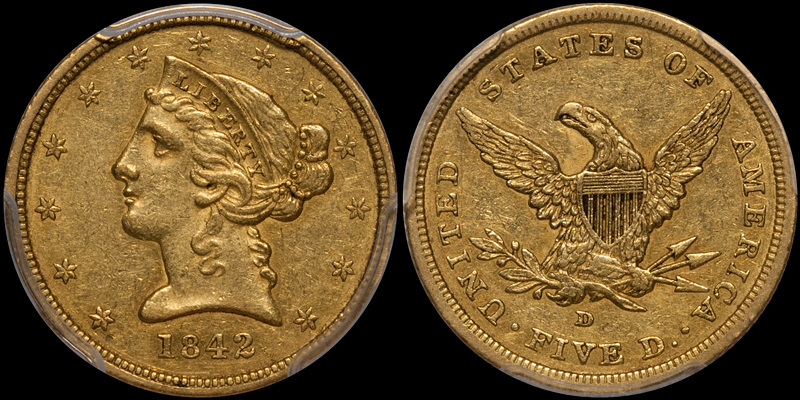
With the 1842-D half eagles, the exact opposite rarity pattern is seen. The Small Date is the more obtainable (although it is very rare in Uncirculated) while the Large Date is rare and almost impossible to find above AU55. A nice AU pair could be assembled for $25,000-35,000.

This transition occurred for New Orleans half eagles in 1843-O. The Small Letters is slightly scarcer than the Large Letters but both are reasonably easy to find in EF and AU grades. A pair in AU could be purchased for less than $10,000.

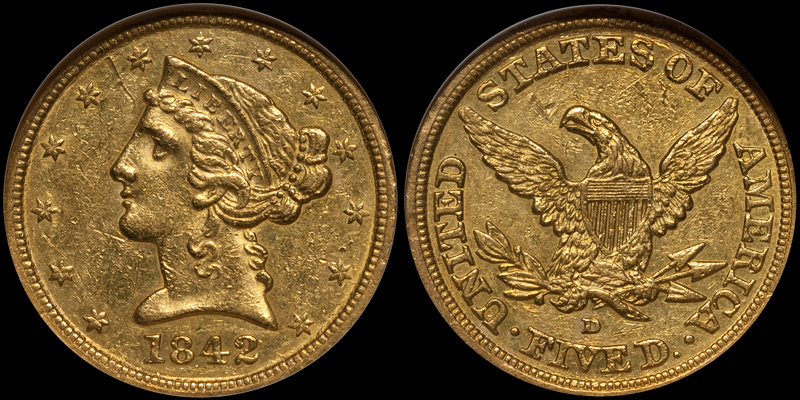
1866-S No Motto $5.00 NGC AU58

1866-S With Motto $5.00 PCGS EF40

The next transitional pair for half eagles occurs in 1866 when the San Francisco mint made 9,000 No Motto coins and34,920 With Motto coins. The former is extremely scarce while the latter is scarce but a bit more obtainable. The 1866-S No Motto is seldom found above AU50 while the With Motto is seldom found above AU53 to AU55. A pair of AU examples would cost around $20,000.

1908 Liberty $5.00, courtesy of Heritage

1908 Indian $5.00 PCGS MS65 CAC

The final transitional pair for half eagles occurs in 1908 when both the Liberty Head and Indian Head types were struck. The 1908 Liberty Head was made only at the Philadelphia mint and it is common in grades up to MS64. The Indian Head type was made in 1908 at Philadelphia, Denver and San Francisco. It's possible to assemble a 1908-P half eagle set in MS65 for less than $20,000.

4.  EAGLES

1797 Small Eagle $10.00, courtesy of Heritage

1797 Large Eagle $10.00 NGC AU58

The first transitional pair for the ten dollar eagle denomination occurs in 1797. The first coin struck this year was the Small eagle reverse of which only 3,615 were made. This is a rare coin in all grades and a very rare one in AU55 and above. Later this year, the large Eagle reverse was adapted and 10,940 were made. This issue is much easier to locate and it is sometimes seen in MS62 or even MS63 grades.  An AU set would cost at least 175,000-200,000 but it would be easier to assemble than the similarly dated half eagles (see above).

1839 Large Letters $10.00 NGC EF45

1839 Small Letters $10.00 NGC EF40

A less obvious but still important transitional pair occurs in 1839 with the Large Letters and Small Letters reverses. The former, which is the more common, employs the same size lettering as seen on the 1838. The latter, which is far rarer, uses the same size lettering as seen on the 1840 (and onwards). It is possible to assemble this set in AU for $25,000 or so but finding a nice 1839 Small Letters reverse will prove challenging.

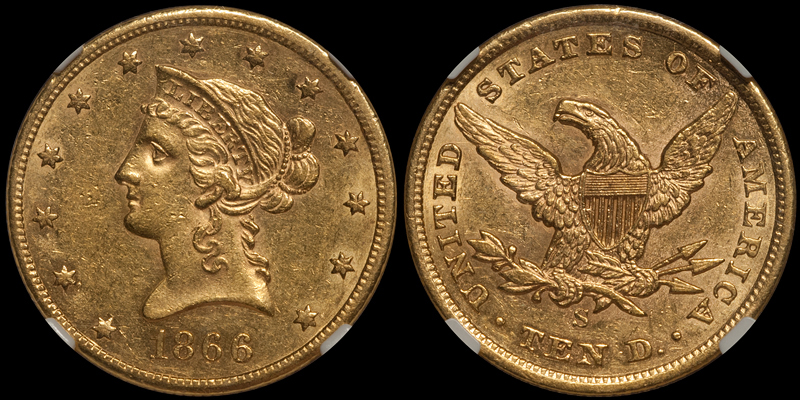
1866-S No Motto $10.00 NGC AU58

1866-S With Motto $10.00 PCGS AU53

In 1866, the San Francisco mint struck No Motto and With Motto eagles. The No Motto coins had a mintage of 8,500 and are very scarce in all grades. The With Motto coins are more available but only 11,500 were struck. Both issues are extremely hard to find above AU50. A nice EF-AU pair would cost $25,000-35,000.

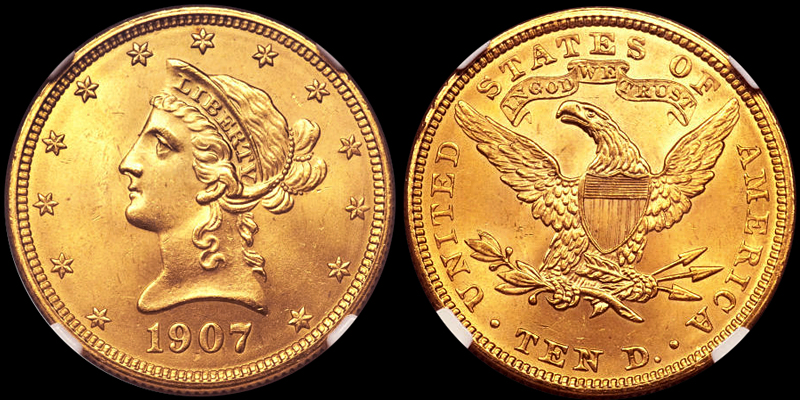
A potential transitional gold coin collector will have much to keep him busy with 1907 and 1908 eagles. In 1907, three mints (Philadelphia, Denver and San Francisco) made Liberty Head eagles. Later that year, the new Indian Head design by Augustus St. Gaudens was introduced.

1907 Liberty Head $10.00, courtesy of Heritage

1907 Wire Edge Indian Head $10.00 PCGS MS64

1907 Indian Head $10.00, courtesy of Heritage

There are actually three distinct types of 1907 Indian Head eagle: the Wire Edge, the Rolled Edge and the No Motto. The latter is by far the most common although it is probably the least numismatically interesting. Most transitional collectors purchase a 1907-P Liberty Head in MS63 to MS65 grades and a 1907 No Motto in MS63 to MS64. Adding the Wire Edge is a nice touch but it should be noted that a nice Uncirculated example runs around $50,000. And, in the parameters we discussed earlier in this article, these are not a true transitional pair as the Wire Edge design was not fully adapted in 1908.

The final transitional pair for this denomination occurs, as a "pair of pairs", in 1908. Both the Philadelphia and Denver mints struck No Motto eagles followed by With Motto issues. None of these are rare in grades below MS65 and a nice MS64 set is an accomplishment which is readily attainable.

5.  DOUBLE EAGLES

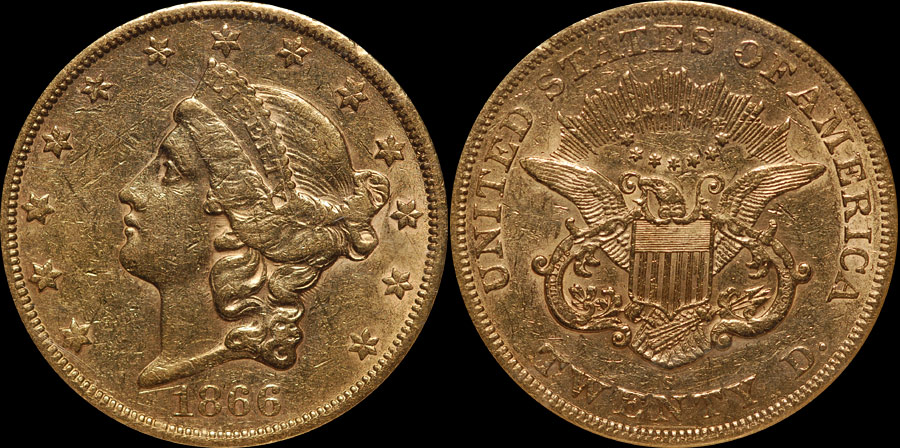
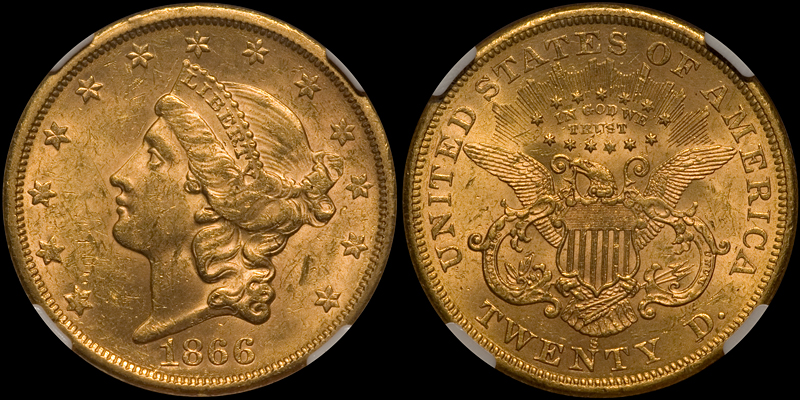
1866-S No Motto $20.00 NGC AU50

1866-S With Motto $20.00 NGC MS61

The best known transitional Liberty Head double eagle pair is the 1866-S No Motto and With Motto issues. Only 12,000 or so of the former were produced and it is a rare issue whose price has soared in the last decade. The 1866-S With Motto is much more available although it can be challenging to locate in any Uncirculated grade. An About Uncirculated pair will run at least $50,000 and possibly more if the collector is fussy about quality for the No Motto.

1907 Liberty $20.00, courtesy of Heritage

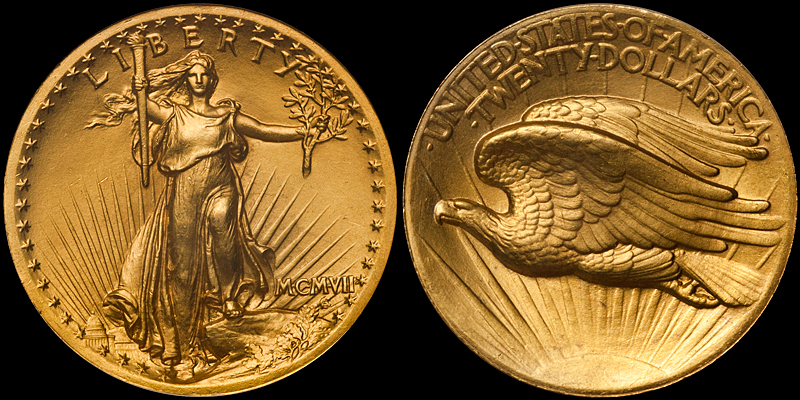
MCMVII High Relief $20.00 NGC MS65 CAC

1907 St. Gaudens $20.00 PCGS MS66

In 1907, there was a radical change in the design of the double eagle and, as with the eagle from this year, there are pieces which use the old Liberty Head design (from Philadelphia, Denver and San Francisco) and the new St. Gaudens design. There are two important varieties of St. Gaudens double eagle from 1907: the High Relief which uses Roman numerals for the date and the Arabic numerals. These were all struck at the Philadelphia. An ideal transitional set, in my opinion, would include a 1907-P Liberty Head double eagle and a 1907 Arabic numerals. A slightly more advanced set could include a High Relief as well. The two coin set is easy to assemble in MS64 for around $5,000.

A second transitional set occurs in 1908 when the motto IN GOD WE TRUST was added to the reverse of the double eagle. The 1908-P and 1908-D issues exist with a No Motto reverse; the same two dates were made with the With Motto reverse, as well as a 1908-S.

Transitional collecting is not for everyone and, as you can see from reading this article, a complete set is extremely expensive due to the rarity of certain 18th century transitional issues. I really like the idea of assembling a mostly-complete transitional set and would be happy to discuss such a set in detail if you'd like to email me at dwn@ont.com.

12 Undervalued, Affordable 19th Century Liberty Head Gold Coins: Part I

It’s been a while since I’ve written a blog discussing specific undervalued, affordable gold coins. This is a topic which has proven popular in the past and, unless I’m mistaken, some of my suggested sleeper issues have grown dramatically in popularity—and price—in the last few years. Due to space limitations, I’m keeping this list down to a manageable number but it could easily be doubled—or even tripled—in size.

1. 1865 Gold Dollar

In the past, I have focused on various Civil War gold dollars, usually the 1863 which is the rarest of these issues. The 1863 has become well-known but the almost-as-rare 1865 remains an excellent value for the astute collector.

1865 $1.00 PCGS MS65 CAC, ex Bass

A total of 3,700 business strike examples were produced. This issue appears to have seen little circulation as it is almost never found in grades below MS60. As an example, PCGS has graded a total of 48 with 38 of these (over 79%) in Uncirculated grades. Interestingly, Uncirculated 1865 gold dollars are seen more often in Gem (MS65 and above) than in the lower grades (MS60 to MS62) and this suggests that a small hoard existed at one time.

The current Coin World Trends valuation for this date in AU55 is $900 and $1,100 in AU58. I’d contend that if you are able to find a PCGS or NGC AU55 or AU58 for anywhere near those kind of numbers, you have just stolen a coin and you can pat yourself on the back.

2. 1867 Gold Dollar

In 1867, the mintage of gold dollars “soared” to 5,200 business strikes. The 1867 is more available than the 1865 but not by much and it is less widely known or regarded.

1867 $1.00 PCGS MS66 CAC, ex Bass

The current population for this date at PCGS is just 64 coins in all grades with 46 of these (or 71.87%) grading MS60 and above. You can find the 1867 with more ease than the scarcer Civil War dates but what I like about this date is its current affordability. I have sold some nice higher end AU examples in the last year for around $1,000 and I have sold nice Uncirculated coins in the MS63 to MS64 range for $2,000-3,000.

This list is about “affordable” and, in my opinion, coins like the 1867 gold dollar check all the boxes: scarce in all grades, not terribly expensive even in higher grades, occasionally available and historically interesting.

3. 1844 Quarter Eagle

I’ve discussed this issue before so it’s not really a “secret date.” But the 1844 quarter eagle remains curiously undervalued. Of the 6,784 struck, there are under 100 known. PCGS has graded just 39 examples in all grades and this includes only three in Mint State.

1844 $2.50 PCGS AU58 CAC

So why is this date seemingly a permanently undervalued issue and why has it shown virtually no price appreciation in the past decade? I’d say the answer has a few components. Firstly, the 1844 quarter eagle doesn’t fit into any neat compartments. It doesn’t have a mintmark so it isn’t a branch mint coin. It doesn’t have any historical significance or anything else to give it a level of demand; let alone multiple levels of demand. What it does have going for it is its unquestionable value.

You can buy a very presentable AU 1844 quarter eagle for $2,000-3,000. The same coin with a C or D mintmark would easily be double the price. This fact, in and of itself, may be all the impetus this date needs to become better appreciated in the future.

4. 1846-D/D Quarter Eagle

I’m going to go out a limb here and add a variety to this list of undervalued 19th century gold coins. I know the reaction that some readers will have: “what, there aren’t enough overlooked regular issues? You have to get esoteric on us and add a variety? Seriously?”

1846-D/D $2.50 PCGS AU58

The 1846-D/D quarter eagle is a well-established variety that has an important place within a very popular series. Although it is still not recognized by NGC or listed in the Redbook, it is well-known within the specialist community and recognized by PCGS. This has made it better-known than any of the other Dahlonega quarter eagles.

There are an estimated 40-50 pieces known with most in the EF40 to AU50 range. The 1846-D/D is not an inexpensive coin. You are looking at $4,000-6,000 for a nice AU, unless you are able to cherrypick an example. Put another way, the 1846-D/D is about as rare as the 1855-D quarter eagle from the standpoint of overall rarity but at a fraction of the price.

5. 1855-S Three Dollar Gold Piece

The 1855-S is an issue which should receive a lot more attention from non-specialists than it does. It is more of a Condition Rarity than nearly any issue in this group of undervalued issues and as many as 300-350 are known from the original mintage of 6,600 coins.

1855-S $3.00 PCGS MS61

Here’s why I think the 1855-S is a good value and why it is underappreciated: like the 1854-D and 1854-O it is a first-year-of-issue within the three dollar series. But unlike these two issues, the 1855-S is not a “one and done” coin. In other words, the Dahlonega and New Orleans mints both made three dollar gold pieces for just a single year while the San Francisco mint made them again in 1856, 1857, 1860 and in (sort of…) 1870. Plus the two southern mint threes have the branch mint cachet which its Western counterpart lacks.

As I mentioned above, this is a very rare coin in higher grades. An accurately graded AU55 with good eye appeal is about as nice an example as you are going to find. Such a coin, if available would cost around $9,000-10,000. Back in the heyday of three dollar gold pieces (around 2005-2006) the same coin would have cost $13,000-15,000.

6. 1842 Large Letters Half Eagle

There are two varieties of half eagle dated 1842-P: the Small Letters and the Large Letters. Both are rare, both are undervalued and both probably deserve to be included in this list. But I’m going to go with the Large Letters which is rarer.

1842 Large Letters $5.00 NGC AU58

This is the fourth rarest Liberty Head double eagle from Philadelphia after the 1875, 1863 and 1865. There are around three dozen known including three in Uncirculated; the finest is a PCGS MS64.

Despite the unquestionable rarity of this issue, it is still very affordable. A nice quality EF 1842 Large Letters still can be found in the $2,000-2,500 range while an AU example would cost $4,000-5,000+. In my opinion, this is extremely good value in comparison to the branch mint issues of this era.

7. 1864 Half Eagle

It’s widely known that the Civil War half eagle from both Philadelphia and San Francisco are rare due to their low original mintages and their low survival rates. The 1864 is more available than the 1863 and 1865 but it is a scarce issue in its own right. There are an estimated 50-60 known from the original mintage of 4,170 business strikes. When seen, the typical 1864 half eagle is apt to grade in the EF40 to AU50 range.

1864 $5.00 PCGS AU53

I could have placed any one of at least ten other half eagles in this list of undervalued coins but I selected the 1864 due to its multiple levels of demand. Civil War gold coins have become very popular with collectors in the last few years and the 1864 half eagle is a relatively affordable issue in EF and even AU grades.

I sense the “affordable” aspect of this issue beginning to wane, though. As recently as a few years ago, it was possible to find a nice EF example for around $2,000-2,500 and an AU for a bit more than double this. Today, the collector will probably have to spend closer to $4,000-5,000 for a presentable 1864 but I still think this is reasonable for a coin with this degree of rarity and this much historic association.

Should You Buy Very Rare Coins in Low(er) Grades?

As recently as a few years ago, if you asked me "should I buy very rare United States gold coins in low(er) grades" I would have resoundingly answered "no!"  But, as with so many things in life, perspectives change and my answer to this question has as well.

A piece of advice I had often given new collectors is that you shouldn't buy gold coins that grade lower than EF40. That is still a cut-off grade for me and, for many issues, I still recommend sticking with EF and finer coins. But I now will sometimes buy certain very rare issues in grades as low as Good to Very Good. What exactly made me change my mind?

I came to a conclusion a few years ago that just because someone doesn't have a $5,000 or $10,000 per coin budget doesn't mean that they don't appreciate truly rare coins. Nor should they be shut out from the potential of buying a few coins, now and then, that can be genuinely tagged as "rare" or even "very rare." I'm a coin snob who is trying to become more inclusive, I guess...

A few coins that I recently sold on my website raregoldcoins.com illustrate this belief. In the past two months, I handled a pair of 1870-CC half eagles, graded Good 6; one encapsulated by PCGS and the other by NGC. These were coins that I probably wouldn't have bought a few years ago but the New Doug Winter bought them and was pleasantly surprised at how quickly they sold; not to mention how much attention they generated.

Here's my way of thinking about a coin like an 1870-CC half eagle in very low grades. This is an issue with strong Multiple Levels of Demand. It is rare in all grades, it is the rarest half eagle from this mint, it is a first year of issue and it is the only quasi-affordable gold coin dated 1870-CC. In other words, it is a coin that's "got it all." But it is very expensive in EF and AU grades and not every collector who is sophisticated enough to want one can plunk down the $25,000-50,000+ it takes to buy a nice one.

So what's wrong with a well-worn but very problem-free example of this date in a Good 6 holder? Actually nothing; a fact that was lost on me until recently.

When you think about it, a Good 6 1870-CC half eagle is a pretty darn cool coin; certainly one of those "if it could only talk imagine the stories it could tell" kind of coins and probably more so, in some ways, than the same date in EF45 or AU50.

By the same token, I don't automatically think every CC half eagle from the early 1870's in lower grades is a cool coin. In fact, the chances are good that if I were offered a decent quality 1872-CC half eagle in Good or Very Good I would pass. Why? It is clearly a rare coin but it doesn't have nearly the cool factor that the 1870-CC not does it have the strong multiple level of demand. My grade cut-off for the 1872-CC half eagle is more like EF40.

What are some of the parameters that I would employ when choosing to purchase a very rare coin in low(er) grades?

First, just as with a very rare coin in higher grades, I would avoid any piece which has been harshly cleaned or which has poor eye appeal. A coin in Good 6 doesn't necessarily have to be CAC-quality but make sure it has reasonably good overall eye appeal.

Second, I would look for coins which are not only very rare but whose high price point in higher grades eliminates a large pool of potential buyers. As an example, I recently sold a VG8 example of the very rare 1865-S/186 Inverted Date eagle. Not only was it a decent looking coin, it was priced at less than $3,000 which is tons cheaper than the next semi-available grade point (VF/EF) for this issue. From an economic standpoint, this coin made a lot of sense to me.

Third, I wouldn't go overboard with buying very low grade gold coins. In other words, you don't want a collection which features nothing but coins like 1870-CC half eagles in Good 6. A few coins like this are cool pieces to sprinkle in your set. A lot of coins like this are, well, a collection of very low grade coins...

Fourth and final, my sudden admiration for lower grade coins is, as I've tried to make clear, highly selective. Remember: 1870-CC half eagle in Good 6, si....  1872-CC half eagle in Very Good 8, non.....

For more information on how to put together a great collection of United States gold coins, with or without very rare coins in low(er) grades, please feel free to contact me by email at dwn@ont.com.


United States Gold Coins with Multiple Levels of Demand

A trend that I have noted in recent years is that a subset of gold issues which have what I refer to as Multiple Levels of Demand (MLD). These are coins with more than one potential set of buyers competing for them. As an example, a coin such as an 1838-D half eagle is sought not only by Dahlonega specialists but by Classic Head half eagle collectors, first-year-of-issue collectors, one-year type collectors and collectors who just appreciate cool coins.

1838-D $5.00 NGC MS62 CAC

An 1844-D half eagle, in contrast, has a smaller pool of potential buyers which includes Dahlonega specialists and type collectors looking for a single nice half eagle for their set. MLD coins have increased significantly in value in the last five to ten years and this makes sense. Coin values are largely the result of a basic supply and demand relationship: the greater the demand, the more prices increase.

In this blog, let’s take a look at coins which are already stellar MLD’s and also at issues which might be the next wave of multiple level of demand coins.

GOLD DOLLARS:

1861-D $1.00 PCGS MS61

If I had to choose the one single issue in this denomination which had the highest overall level of demand among collectors it would be hands-down the 1861-D. This scarce, low mintage issue is popular for a host of reasons: it is a coin with verifiable provenance from the Confederacy, it is the final issue from this mint (along with the similarly-dated half eagle) and the rarest gold dollar from any source. These facts (and others) have made it extremely popular and prices have soared as a result.

1855-D $1.00 PCGS MS61, Full Date

Other gold dollars which have a high degree of MLD include the Type Two issues: 1855-C, 1855-O, 1855-D and 1856-S. These four coins range from rare (1855-D) to relatively common (1855-O and 1856-S) but they have interesting stories attached to them and, in most cases, they are relatively affordable in circulated grades.

1849-D $1.00 PCGS MS62 CAC

What are the gold dollars which are most likely to become MLD issues in the future? I would suggest that the 1849-C, 1849-D and 1849-O will due to their status as first-year-of-issue from their respective branch mints (side thought: this would make a great three coin set in AU for the collector of average means). I could see the 1870-S becoming an MLD due to it being the final year of issue from the SF mint for gold dollars, its low mintage and the sexiness of this date in general. The 1875, due to its mintage figure of just 400 business strikes, is another possibility as well.

QUARTER EAGLES:

1839-D $2.50 PCGS VF35 CAC

As with many of the multiple level of demand coins, the list is dominated by Classic Head issues. The 1838-C and 1839-C have proven popular with collectors in the last decade as has the 1839-D. Of the three, the 1839-C tends to have the least MLD but this is partly due to the fact that many of the EF and AU examples which appear for sale are grossly overgraded and have problems. The 1838-C and 1839-D are both first year of issue with comparably low mintages and the latter is a one-year type.

A coin which is probably better classified as a Classic Rarity but which is also an MLD issue is the 1854-S. It has a tiny original mintage (246 pieces), very low survival rate and it is the first quarter eagle produced at the San Francisco mint. But this is already a solid six-figure coin and, thus, is not a realistic purchase for most collectors.

1808 $2.50 PCGS AU53 CAC

Other quarter eagles I regard as having a high MLD include the 1796 No Stars and the 1808; both are popular one-year types. The 1848 CAL is another obvious choice due to its status as a Gold Rush issue and as the first American commemorative issue.

1864 $2.50 PCGS EF45 CAC

What are the quarter eagles most likely to become MLD issues in the future?  I’d look at the four 1840 issues (P, C, D and O) as they would make a fun set to assemble, the 1845-O due to its status as the rarest issue of this denomination from New Orleans, and the rare Civil War issues from 1864 and 1865.

THREE DOLLAR GOLD PIECES:

1854-D $3.00 PCGS AU55

I think there are really only two dates in this series right now that have MLD status: the 1854-O and the 1854-D and one of these (the 1854-O) has had a lot of its appeal ruined by blatant overgrading by the services.

The 1854-D is the clear MLD favorite right now. It is scarce in all grades but available enough to be a target for Dahlonega specialists, Three Dollar collectors, low mintage fans, and people who just like great coins with a real story to tell.

1855-S $3.00 PCGS MS61

If I had to choose the dates most likely to have MLD status in the future, they would be the 1855-S (due to its status as the first Three Dollar from the San Francisco mint), the Civil War issues from 1861-1865 (all are collectible and could be turned into interesting subsets) and maybe the 1873 Closed 3 (very low mintage).

HALF EAGLES:

There are more issues of this denomination with high multiple levels of demand than nearly any other and this includes coins from the 18th, 19th and 20th century.

1795 Small Eagle $5.00 PCGS AU58

The first issue I’d place in the MLD category would be the 1795 Small Eagle. It’s available enough to be realistically obtainable by advanced collectors and it has a high “cool factor” as a first-year-of-issue with a great design.

Nearly any sub-$10,000 early half eagle has a high MLD factor, especially if the coin is choice and original. The reasons are obvious: old, gold, semi-affordable and very appealing from an aesthetic standpoint.

1838-D $5.00 PCGS AU53 CAC

The 1838-C and 1838-D have oodles of demand due to their first-year and one-year type status. The 1839-C and 1839-D do as well but to a slightly lesser extent; both have, however, shown nice price increases in collector grades over the last decade.

1861-D $5.00 PCGS AU55

The 1861-D certainly receives consideration as an issue with lots and lots of MLD and its counterpart the 1861-C has suddenly become quite popular as well. Both of these issues have demand that far exceeds the Southern branch mint box which other C and D half eagles are trapped within.

1909-O $5.00 PCGS MS61 CAC

The 1870-CC, desirable as the first half eagle from this mint, is a coin with a high MLD. The same is true for the 1909-O as it is the only half eagle from New Orleans with the Indian Head design and it is a final year of issue. The 1929 Indian Head half eagle has become very popular in recent years due to its being the very last half eagle made.

1813 $5.00 PCGS MS64

Which half eagles have a good shot as showing high MLD in the next few years?  A few of my choices might surprise you. Due to its status as the only semi-affordable date of its type, the 1813 could have MLD. The same goes with the 1834 Crosslet 4 which is the key issue in the Classic Head half eagles; a set which is beginning to see appreciation by date collectors. The 1839-P is a neat, affordable one-year type coin which has lagged the market as has the first-year-of-issue 1840-O. The rare to very rare Civil War era half eagles from Philadelphia and San Francisco have new-found, widespread appeal and increased price levels to match.

EAGLES:

1795 $10.00 NGC MS61

The first-year-of-issue 1795 has to be considered one of the most desirable eagles of any date or design. As with the similarly dated half eagle, it isn’t a really rare coin but it is an issue which “checks the boxes” for a host of collectors and has strong MLD as such. To a lesser extent, this is true with the 1799 as it is an 18th century-dated “big coin” which is still within reach of many advanced collector’s budgets.

1838 $10.00 PCGS EF40

The 1838 eagle has become exceptionally popular in recent years and it has soared in price. It is a first-year-of-issue with a low mintage and a very cool design which appeals to many different collectors. To an extent, the 1839 Head of 1838 has a degree of MLD but not as much as its earlier counterpart.

Many of the rare Civil War Liberty Head eagles have a high degree of appeal might they are probably not quite yet what I would consider MLD coins. An issue that clearly does have multiple levels of demand, though, is the 1870-CC which is desirable for a number of reasons. There are a few Indian Head eagles which have a strong MLD profile. The first is the 1907 Wire Edge, a coin of unparalleled beauty which has a great back story and which is rare but not impossibly so. The second is the rare and high valued 1933 which is the only American gold coin of this date which is legal to own.

1841-O $10.00 PCGS AU58 CAC

I can think of numerous eagles which could have expanded levels of demand in the coming years. The key New Orleans issues, 1841-O, 1859-O, 1879-O and 1883-O, are beginning to show demand which exceeds the specialist community. The ultra-low mintage Philadelphia issues from 1873, 1876 and 1877 are becoming very popular as is the 1879-CC which has the lowest mintage of any Carson City gold coin.

DOUBLE EAGLES:

1861-S $20.00, Paquet Reverse, NGC AU53

You can make a case that many Type One Liberty Head double eagles have some degree of MLD as they are pursued by general collectors, specialists and “double play” investors. If I had to select one specific Type One issue as having the most widespread appeal, my experience would suggest the 1861-S Paquet Reverse. The Philadelphia issues from the Civil War years (1861-1865) are quite popular as well.

1870-CC $20.00 PCGS EF45

The rarest Type Two double eagle is the 1870-CC but this doesn’t have the widespread appeal that the similarly dated half eagle and eagle do because it is very expensive and tends to be found with poor eye appeal.

You can also make a good case that virtually all Carson City doubles eagles, from both the Type Two and Type Three series, have multiple levels of demand. This is especially true with the more common dates in collector grades.

MCMVII (1907) High Relief, Wire Rim, PCGS MS63

An obvious MLD issue is the 1907 High Relief. Yes, it’s probably overvalued but there are few American gold coins which have a higher level of demand from a more varied group of potential buyers.

Which double eagles have the potential to be added to this list in the coming years? Two which come to mind (and some observers might state that they already have MLD) are the 1861-O and 1879-O. The same probably holds true for the low mintage Philadelphia issues from 1881-1887 and 1891.

As coins become more expensive and harder to locate, buyers want an item which is special and which justifies what they are spending money on. Coins which have a nice design, a fascinating back-story, a very low mintage figure or some association with an historic event are the exact sort of piece(s) which people are now seeking and this is likely to continue in the coming years.

Do you want to purchase coins with multiple levels of demand? I specialize in such coins. Please contact me via email at dwn@ont.com and we can discuss how you can become a collector of these coins.

Advice to a Young Coin Dealer

The Professional Numismatist Guild (PNG) recently announced the establishment of the Edward Milas Memorial Fund which creates internships at established firms for as many as four qualified dealers/aspiring dealers aged 21-32. These internships are scheduled to be available by next summer.

I applaud the PNG for the creation of this program. I have written before that perhaps the biggest problem facing the professional side of the coin business is the aging of its dealers. Formerly young dealers like myself are now middle-aged, and when I go to shows, I can't help but notice the small number of dealers who will be factors in the market come 2023 or 2033.

The pool of dealers now basically consists of three groups: the guys in their 60's (and older) who became interested in coins during the roll craze of the 1960's, the guys in their 50's who became interested because of the gold and silver booms in the late 1970's, and the guys in their 40's who became interested after third-party grading became entrenched in the mid-1980's. There are not many dealers in their 30's, and even fewer in their 20's.

There are many reasons for this lack of young dealers. It is very expensive to run a business and this discourages young people. Interesting coins can't be found in circulation any more - and this means fewer people become collectors. The industry lacks the panache of wall Street or hedge funds and doesn't attract many of the best young financial minds; even though the chances to make an excellent income are probably better at an A-level rare coin company than at a B-level bank or hedge fund. And, for a long list of reasons, coins just aren't viewed as being "cool" like they might have been to my generation.

I love being a coin dealer and I am thankful for having the opportunity to do something I enjoy and get well paid for it. The Milas internships might add five or ten potentially good dealers to the bourse floor and I hope that I can mentor at least one or two of them once they get their foot in the door. I have a few pieces of advice for any of these potential interns (or any other young person reading this blog who is thinking of becoming or already is a coin a dealer) and I'd like to share them.

1.  Try Not to Ruin Original Coins Unless You Absolutely Have To.  

I'm not proud to admit this but my generation (and the Roll Craze dealers who came of age in the 1960's and early 1970's) has probably ruined more nice, original coins in the name of profit than all other generations combined. All I have to do to remind myself this is to go to a show and look at case after case of dipped, processed coins or attend an auction and reject a large percentage of the non-fresh coins for quality issues. I'm a purist but I'm not naive; I understand that there are circumstances where the temptation to dip a coin to make $5,000 is so strong that its foolish not to. But remember this: as a dealer you have an obligation not to ravage every coin which passes through your hands in attempt to maximize your profit. And this means, in particular, not to do anything much worse than dipping: no puttying, no carving full heads, no lasers, nothing which can be considered deception. The next time you, as a dealer, have a gorgeous MS64 No Motto half eagle with great color, think twice about dipping it and turning it into a bright and shiny MS65.

2.  Leave Some Money on the Table.  

There are essentially two types of dealers: those who let you make money when you buy from them and those who fight you for every penny.

My favorite sources for coins are the dealers who leave a little on the table in every deal. As an example, one of my best sources for buying coins is very savvy about pricing, but he understands that I would like to make 10% on the coins I buy from him. He is smart enough to realize that if I spend $75,000 with him at a show and he makes a fair margin it will work out much better for him in the long run than if he makes it hard to buy from him.

There is a dealer who I used to do a ton of business with who has a reputation as someone who squeezes you for every last penny on every coin he sells. Let's say he's got a decent quality common date Dahlonega half eagle in stock and the last three APR's for this issue are $2,600, $2,800 and $3,000. This is a coin I'd like to be in at $2,750-2,800 and sell for $3,000. But this dealer is not content to sell it for $2,750; he has to charge $3,000 even if he's making a good deal of money on the coin or it's not special and doesn't deserve PQ money. After becoming frustrated with him for squeezing and squeezing, I gave up buying from him and don't even look at his coins anymore.

3.  Give Back to the Hobby.  

As the PNG Internship program shows, it is critical to give back to the hobby.  This means writing books, teaching classes at the ANA Summer Seminar, contributing money to the Smithsonian and the ANS pledge drives, helping out at a local coin club, or just being there for a young(er) dealer. Some of the most successful coin dealers do nothing but take from the hobby and I have little admiration for them. Others give purely out of selfish motivation (to get a better ANA table or to have access to wealthy, powerful collectors) but whatever their motive, at least they are making positive contributions to the hobby.

If you ask the typical coin dealer, what is his stance on education, he is going to answer "I am pro-education! Let's do this for the kids!" I don't totally agree with this. I'd personally rather help an aspiring 25 year old further his career in numismatics than a 15 year old because the latter is unlikely to become a professional. That's one reason I really like the PNG internship program: it targets younger people who are ready to enter the coin business today not those who might possibly enter it in five or ten years.

4.  Learn to Do At Least One Thing Really Well and Embrace That Skill.

When the market was less complex than it is today, it was possible to be really good at a number of things. There are some dealers whose knowledge runs the gamut of United States coinage and they are also competent when it comes to paper money and foreign coins. Today, it is harder and harder to be really good at a lot of things. This is not only true with numismatic knowledge, it is true with business skill sets as well.

In rare coin dealing, people often aspire to be something they are not. Someone might be a great salesperson but might have only mediocre skills when it comes to grading. Typically, this sort of person fails to embrace his very important skill set (selling) and, instead, tries to convince himself (and others) that he can grade as well as a dealer who makes a living cracking coins out. It's not easy to admit that you aren't a great grader or that you can't sell well. But the sooner you learn to play to your strengths and get help with your weaknesses, the better a coin dealer you will become.

5.  Your Reputation Precedes You. 

Nearly every coin dealer I know has some sort of reputation (good or bad) and they earned this when they were in their 20's: bad check writer, hard partier, untrustworthy, always in debt...not exactly what you want to have to live down in your 30's and 40's.

You can salvage a bad reputation but it's not easy. I can remember seeing a bounced check in the case of a once-powerful dealer about 15 years ago. It was displayed along with a handwritten sign that said something to the effect of "don't do business with Dealer X." Today, the dealer who displayed the sign is essentially out of the business and bankrupt while the dealer who wrote the bad check is highly regarded and does tens of millions in business each year.  Dealers have long memories but they become curiously short, in terms of common sense, when it comes to money. I've heard it said on more than one occasion that a known serial killer could come to a coin show and many dealers would be happy to take his check so long as they thought there was a decent chance it wouldn't bounce.

6.  Turnover Your Inventory

At nearly every show I go to, there are a few dealers who have reasonably nice coins but are impossible to buy from. I can think of three dealers, in particular, who have had literally the exact same inventory for five years. This includes coins priced at under $1,000 and it also includes generic gold coins whose value has dropped appreciably in the last six months. It also includes coins which these dealers disagree with the grade which PCGS or NGC has assigned and they'll price their MS64 Bust Half Dollar as an MS65 or MS66; never lowering the price even after crackout dealers have had their chance to buy the "misgraded" coins.

I try and turn my inventory over at least once every month to six weeks. As a dealer whose coins are  exposed on a well-browsed website, I know how important it is to have fresh coins. In the World of Internet Retail sales, anything which is more than a month or two old is considered stale and stale inventory is hard to sell, even if it is fairly priced. This isn't necessarily as true for dealers who sell primarily on a wholesale basis, but I can tell you that most sharp dealers remember the good coins in other dealers' inventories. Remember what I said above about earning a reputation? You don't want the reputation as someone whose inventory is as stale as year-old bread.

7.  Don't Be Afraid to Sell Coins For Losses. 

Which brings us to the next point. Young dealers are often afraid to sell coins for losses. When you are working with a small budget, you can't afford to make many really bad decisions but you have to understand the value of money. Tying up money on bad purchases and let them stack up is going to ultimately poison your inventory. After you sell off the good deals, you will be left with a growing pile of bad deals and sooner or later they will really add up.

Let's say you bought an MS64 $10 Liberty for $2,000 because you thought it was a "lock" to grade MS65 and you could then sell it for $3,500. You've tried it six times for grading at PCGS and its graded MS64 every time. Your actual cost in the coin is now close to $2,500 with the PCGS fees, shipping and the value of your money being tied up for months. At this point, the best thing to do might be to sell it for as close to your original cost as you can and move on. It's a poor use of your money at this point and you stand a better chance to make it back on the next deal you do with the original $2,000.

Some dealers refuse to sell coins for losses. Others will stick with a coin which makes sense. Let me give you two quick examples. I might have a nice Dahlonega quarter eagle in stock for a month. Its a fresh, pleasing coin which I feel is fairly priced but its not selling because it doesn't have a CAC sticker. Assuming it won't sticker even if resubmitted, I might still believe in this coin even though it hasn't yet sold. In this case I might hang on to it another month or two before I give up on it and sell it wholesale or consign it to a Heritage auction.

Or, I might have a $10 Lib in an AU55 holder which I paid $6,000 for and which I truly believe grades AU58. It's worth $12,000 in a 58 holder. The value spread is enough that I might try this coin ten times at PCGS and NGC (over the course of six months) if I really believe in it.

As you become more experienced, you'll learn when to hold 'em and when to fold 'em but just remember that sometimes its better business to sell your losses and just move on...

8.  Find Someone You Trust to Split Deals With. 

When you are just starting out as a dealer and your money is likely to be tight, it can make a big difference to find someone to split deals with you. By this, I mean finding a partner who will put up half the money and share in your profit or loss. I did this for many years, back when my budget was more limited than it is now, and had mostly positive experiences.

It is important to choose someone you trust to split a deal with and it is important that this person has something to offer that you don't. As an example, if you are a dealer who is knowledgeable about 20th century gold and you offered a nice deal of early gold, it makes sense to split this with someone who knows more about these coins than you do. If you are going to enter into a full 50/50 split with another dealer, try and choose someone whose skill set doesn't overlap yours. If you are primarily a wholesaler, it's great to choose a partner who can sell the coins to end-users; or vice-versa.

9.  You Can't Get Collector Privileges If You Are a Dealer. 

As a collector, you are entitled to certain privileges in transactions. You can, from time to time, put coins on hold for a few hours or even days to "think" about purchasing them, show them to a collector or dealer for another opinion, send them to PCGS for crossover or CAC for approval, and even, in certain circumstances, renege on a "done deal." You don't get to do this, with rare exceptions, as a dealer.

If you are a young(ish) numismatists making the transition from collector to dealer, you have to be ready to swim with the sharks; typically with no repellent at hand.  It also means that you have to be more decisive as a dealer than you were as a collector.

10. Embrace Your Inner Accountant. 

As much as I'd like to tell you that most of my time as a professional numismatist is spent buying and selling coins, quite a bit of it entails doing paperwork. I don't necessarily like this part of my job but its something I have become fairly good at and its something that I choose to do myself as opposed to turning it over to someone else.

Some of the best coin dealers I know are terrible businessmen. They are unorganized and too impatient to do their own grading submissions, accounting, correspondence and basic record-keeping. As a result, they work for larger firms where they often give away significant amount of their profits in order to stay organized.

I was an English major in college and never took a business class so I pretty much had to learn how to keep track of my inventory and my finances on the fly. But I'm glad I've learned to do a reasonably competent job of this and haven't had to give up my freedom as a dealer in order to be properly "managed."

I look forward to meeting and eventually doing business with the winners of the Milas/PNG Internships. And if you are a young person thinking of becoming a full-time coin dealer, I encourage you to find a mentor who can help you grow and prosper in what I think is a fantastic field. I would be happy to answer any questions you might have and encourage you to email me at dwn@ont.com.