1798 Large Eagle $5.00 NGC AU50

BD-4, High Rarity-4. Large 8 in date; 13 reverse stars. The Large Eagle half eagles of 1798 are numismatically fascinating with no less than seven different die varieties known. BD-4 is among the more available and it is recognizable "across the room" on account of the numerous huge reverse cuds at 12:00 and 1:00. As a date, the 1798 is desirable as an 18th century issue and it is one of just two half eagles from this decade (along with the 1799) that is within reach of most collectors. This pleasing example has deep sunset orange-gold and red hues on the obverse; the reverse has similar but slightly lighter color. As is typical for this variety, the centers are lightly struck which makes this variety somewhat difficult to grade. This example has a considerable amount of luster and enough wear to suggest an AU53 to AU55 grade but some small abrasions at the central obverse and upper reverse keep the grade at AU50. While Dannreuther estimates that as many as 100 are known (and I agree with him), affordable mid-grade examples of the 1798 BD-4 half eagle tend to only come on the market at the rate of two or three per year. This is among the few I've seen in ages with original color and it would make a great addition to an early gold collection.
1805 $5.00 NGC AU55

BD-1, Rarity-3. . Perfect 1 in date; IT in UNITED close. I purchased this coin at the recent Baltimore show from a collector whose eye is, in my opinion, excellent and it had resided in his collection for a number of years. It is a splendid early half eagle that has great rich green-gold color that is accentuated by natural coppery hues. The obverse shows some light friction in the fields which has lightened the color; the reverse is evenly toned and choice. Both sides show a good, even strike and most of the details are up and bold with the exception of the radial lines in the obverse stars. There are no abrasions of note, no adjustment marks and the edges lack any bumps or bruises. Locating early half eagles in this grade/price range has never been more difficult and most of the pieces that I see offered for sale these days have been heavily processed and/or are very problematic.

1857-S $5.00 NGC MS60

Large S mintmark. In the rare date gold realm the date "1857-S" has gained much fame because of the S.S. Central America double eagles of this issue. But the 1857-S half eagle is a considerably scarcer coin and it is extremely rare in Uncirculated with probably no more than seven to nine known. The present example is choice and original and it is clearly not a shipwreck coin. The obverse is satiny with medium green-gold color that shades to orange; the reverse is more frosty with nice orange-gold and reddish hues. There are some obverse marks in the fields that limit the grade and a scratch on the reverse below TATE in STATES. That said, I think this piece is comparable to any of the MS61 examples that I have seen over the years. If you are a collector of undervalued gold, ask yourself this question: would you rather have a nice Uncirculated 1857-S half eagle which is one of fewer than ten known or a so-so Uncirculated double eagle of this date of which thousands exist?

1874 $5.00 PCGS AU53

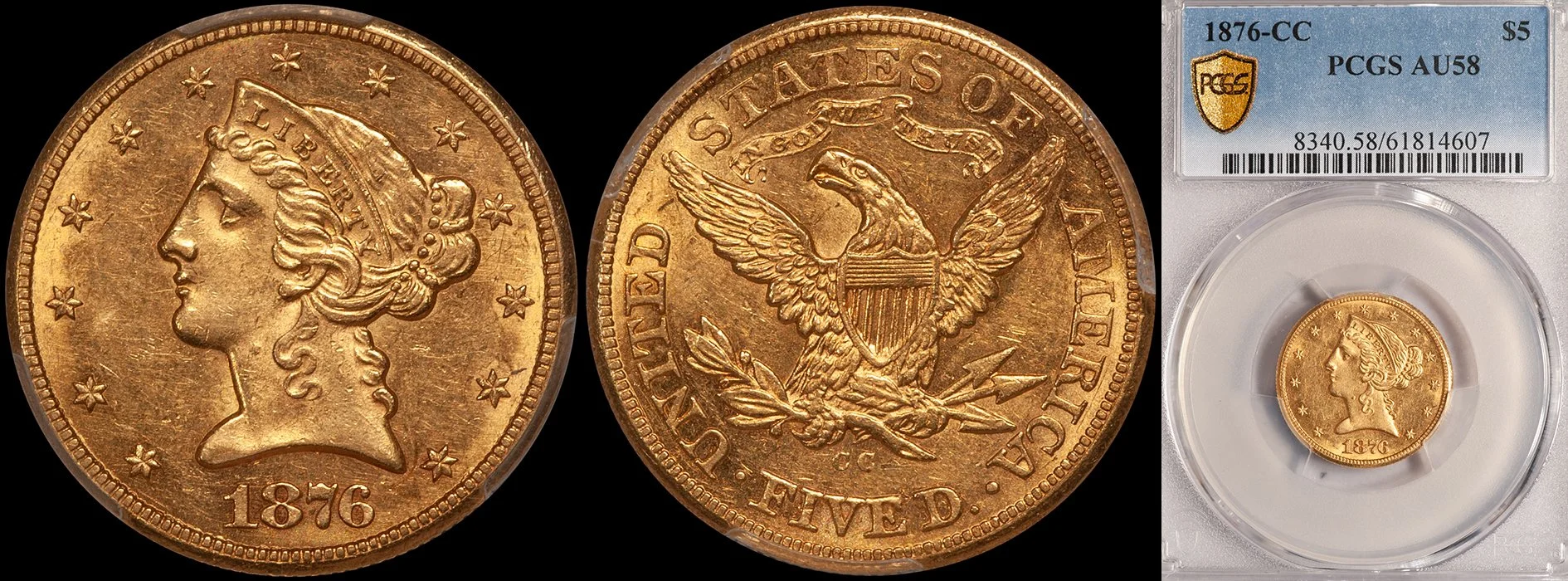
This scarce and underrated issue has fewer than 100 known survivors from an original mintage of just 3,400 pieces. Most 1874 half eagles are in the EF45 to AU55 range and I have personally only seen one that I regard as Uncirculated (a PCGS MS63 that is ex Bass 2: 1194). This semi-prooflike example has the luster and body of an AU55 to AU58 coin but it shows typical abrasions in the fields. Both sides are reddish-orange in color with the reverse border deepest in hue. There are many excellent values in the Liberty Head half eagle series and a coin like this, at under $2,500 for a nice AU example, certainly qualifies as such.

1859 $1.00 NGC PR65 Ultra Cameo CAC

One of 80 Proofs struck; most were unsold and later melted. Today there are probably no more than twenty or so known known and this is clearly among the finest of the survivors. This superb fresh-to-the-market Gem has an amazing amount of contrast between the frosted devices and the reflective fields. This contrast gives the coin a full "black and white" appearance that is very impressive to say the least. There is a tiny mint-made "C" shaped lintmark in the left obverse field that serves as identification. Otherwise, this piece is extremely solid for the grade with great visual appeal. As with all pre-Civil War Proof gold, the 1859 dollar is an extremely rare issue and most are seen in the PR63 to PR64 range. There have only been two auction records for comparable examples since the 1990's: Heritage 11/02: 7485 ($17,250; graded PR65 UC by NGC) and Goldberg 9/03: 1057 ($13,225; graded PR65 DC by PCGS). The highest graded example that I have personally seen was Heritage 2010 ANA: 3395 ($32,200; graded PR66 by NGC) and it lacked the contrast or overall eye appeal that this piece shows. A truly rare and very important piece of Proof gold.

1872-S $20.00 PCGS AU58 CAC

This lovely, high end "slider" has warm golden-orange color on the obverse and reverse and just a touch of rub on the high spots. There is a good deal of luster visible and the reverse, on its own accord, is at least an MS61. While certainly not a rare date in this grade, it is not easy to find an 1872-S in AU58 with this amount of eye appeal.

1851-O $1.00 NGC MS65 CAC

Old NGC "fatty" holder. Until a group of twenty or so Gem 1851-O gold dollars was found a few years ago, this issue was nearly unobtainable in Gem. The present example is clearly not from this source as it is in a holder that pre-dates the discovery of these coins and it has a different appearance as well. This coin is struck as sharply as one could hope for with all of the detail that you'd expect to see on a Philadelphia gold dollar of this era. It shows superb thick mint frost with appealing medium green-gold and rose color on the obverse; the reverse tends a bit more towards an orange-gold hue. There is an obverse die crack from the rim at about 9:00 to the eye of Liberty that should not be mistaken for a scratch; the reverse shows a few minor scuffs including one below the E in STATES. MS65 examples of this date have sold at auction from a low of around $6,500-7,000 (for pieces that were not choice) to a high of $11,000-12,000. At the current price level, I think a Gem New Orleans gold dollar is a tremendous value and this is the only 1851-O in MS65 to have currently received approval at CAC.

1858-D $5.00 NGC AU50 CAC

Nice even deep toning on the obverse favors russet and green-gold hues with greater depth seen at the borders than at the centers. The strike is sharp and even while the surfaces are free of significant marks. The 1858-D is certainly not a rare date but it seen far less often than the 1852-D, 1853-D and 1854-D half eagles. A nice, affordable type coin for the new collector who wants a solid, attractive Dahlonega half eagle for under three thousand

1851-C $1.00 PCGS AU55 CAC

The 1851-C is to Charlotte gold dollars as the 1881-S is to Morgan Dollars. In other words, it is the generic issue in the series and a coin that is rather available in most grades. Except for the fact that there are under 1,000 1851-C dollars while there are tens of thousands of 1881-S dollars. This pleasing mid-level AU has medium green gold color, good detail and very acceptable surfaces. A small mark through the A in DOLLAR doesn't detract and the light weakness at the central reverse is typical for the issue. How can you not love a Charlotte gold dollar of this quality priced at less than two grand?