The 1859-S Half Eagle

The date run of half eagles produced at the San Francisco mint from 1858 through 1864 includes some of the rarest and most overlooked gold issues ever manufactured at any of the various branch mints. These were issues that had limited production runs and which were eagerly absorbed into commerce by the booming local and regional economies. I recently had the good fortune of handling one of just two known 1859-S half eagles in Uncirculated (an NGC MS61) and now that I am no longer actively marketing the coin, I thought it would be interesting to take a more in-depth look at this issue and what made it such a special coin.

There were 13,220 1859-S half eagles originally struck. In the October 2008 web article that I wrote entitled “The Ten Rarest Liberty Head Half Eagles,” I ranked the 1859-S as the ninth rarest issue overall of the entire design type and called it the third rarest half eagle from this mint, trailing only the exceedingly rare 1854-S and the 1864-S.

I went on to state that there are only 50 or so known examples of the 1859-S half eagle. I believe that this is a fairly accurate number and I can further state that the survival breakdown by grade is as follows:

Uncirculated: 2 About Uncirculated: 6-8 Extremely Fine: 11-14 Very Fine (and below): 25-30

The PCGS and NGC population figures would have you believe that AU’s are more available than I suggested above. I believe these numbers are inflated on account of resubmissions and I think some of the coins in AU50 and AU53 holders are optimistically graded. In my experience, a real AU 1859-S half eagle is very rare and I have seen many examples that were heavily worn; even down to the point of Very Good to Fine detail.

The two known Uncirculated 1859-S half eagles are an interesting story and I’d like to discuss them in greater detail.

The finest known 1859-S is the wonderful PCGS MS62 example (which also appears in the NGC population report as an MS62) that I first saw in the Milas sale that Stack’s conducted back in 1995 where it brought $34,500. At the time it was in a NGC MS62 holder and while I don’t know the previous history of the coin, I do know that it was a piece that Ed Milas was especially proud of. It was purchased by a dealer agent for Harry Bass who, in retrospect, was the ideal new owner. It remained in his collection until he died and was later sold as Lot 1118 in the Bass II auction where it realized $30,800. The coin bounced around for a few years and was last sold as B+M 1/02: 694 where it garnered a reasonable $25,300.

The second Uncirculated 1859-S half eagle is an NGC MS61 that I just sold to a private collector. I acquired it from a collector at the ANA show in Los Angeles this summer. The background of the coin is interesting.

According to the collector, it was bought over the counter at a coin shop and was accompanied by a small envelope of the sort that used to accompany gold coins when they were given as Christmas presents. The collector first showed me the coin around three years ago and asked me if I was interested in obtaining it. I replied that I was. It wasn’t going to be an easy transaction, though, as the collector wanted to trade it for something “really special.” I saw the coin once a year in the interim and the collector continued to hold out for the right coin in trade.

I finally bought a coin this summer that excited the collector and, luckily for us, we were able to agree on respective valuations. He walked away with an amazing one-of-a-kind piece for his type set while I was able to procure one of the more exciting No Motto San Francisco half eagles that I’ve handled in a number of years. It seemed like a “win-win” deal for both of us.

Given the relative unpopularity of San Francisco gold, this incredible Uncirculated 1859-S half eagle will likely never receive the attention that it deserves. But it is a truly remarkable coin and, as I mentioned above, one of just two known in Uncirculated. I was excited to handle it and it makes me realize that, every now and then, a truly great gold coin does, literally, come out of the woodwork!

The Great Branch Mint Gold Popularity Contest of 2009

I realize that the title of this blog sounds like an outtake from the Dukes of Hazzard but I thought it might be an interesting topic to take each branch mint and analyze it in terms of its popularity. Then, for the icing on the proverbial cake, I thought it would also be interesting to name the five or so most in-demand issues from each mint. Just as an FYI, I am not including Denver among the five branch mints as it is relevant only to 20th century issues and this article is primarily focused on 19th century gold coinage.

1. Dahlonega: At this point in time, I’d have to rank Dahlonega as the single most popular of the branch mints. I am basing this on the following observation. Dahlonega coins, at least for me, seem to be as easy to sell now as they were a few years ago. There are certainly exceptions to this rule; namely overgraded examples priced in the $10,000+ range, high grade common date gold dollars priced at $10,000 and above and virtually any coin in any price or grade range that is not at least fairly original and appealing. But nice, properly graded and fairly priced D mint remains a best-seller for my firm.

I would have to rank half eagles as the most popular coins from Dahlonega right now, followed closely by quarter eagles. The price range that seems most in-demand is $1,500-5,000 but expensive Dahlonega gold will sell if it is a scarce, popular issue or if the coin is very high end. Coins with good pedigrees are popular right now and this is clearly an area in the market where many collectors are searching for CAC-quality coins.

The Five Most Popular Dahlonega Gold Coins in 2009: 1861-D gold dollar, 1854-D three dollar, 1838-D half eagle, 1839-D half eagle, 1861-D half eagle.

2. Carson City: As recently as a year or so ago, I would have placed Carson City as the number-one most popular of the branch mints. I’ve noted a slight slippage in popularity in this mint, especially at the high end. I think the reason for this is that a few of the collectors who were buying the five-figure rarities and condition rarities a few years back are less active. Another thing which has hurt this segment of the market is the number of extremely overgraded higher grade coins that have been floating around from auction to auction for what seems like an eternity. The problem with these coins is that when they do finally sell, they sell cheaply and this drags down the price of nice coins.

Carson City double eagles remain the most popular denomination from this mint, followed by eagles and half eagles in that order. Coins that are attractive and original and priced at $5,000 and under are the quickest movers while expensive Carson City coins, unless they are fresh to the market or really exceptional, tend to be harder to sell right now.

The Five Most Popular Carson City Gold Coins in 2009: 1870-CC half eagle, 1870-CC eagle, 1873-CC eagle, 1870-CC double eagle and any common date or slightly better date double eagle in the AU58 to MS62 range that is choice for the grade and priced below $10,000.

3. New Orleans: There’s no doubt in my mind that New Orleans gold is no longer “up and coming.” It is clearly a very popular segment of the branch mint market and I think there are probably just about as many collectors working on specialized sets of New Orleans gold as there are in any other area of 19th century American gold.

Double eagles were, until recently, the clear favorite among the many gold denominations from New Orleans. I think the popularity of this denomination has faded just a bit in the last year, mostly due to the prohibitively high price of the rarities in the series. That said, these are still the most popular New Orleans gold coins, followed by eagles, half eagles, quarter eagles, three dollars and gold dollars.

There are many New Orleans issues that can still be purchased in relatively high grades (EF and AU) for less than $5,000 and these are increasingly popular. The major rarities from this mint remain in demand, especially in the eagle denomination.

The Five Most Popular New Orleans Gold Coins in 2009: 1839-O quarter eagle, 1841-O eagle, 1883-O eagle, 1856-O double eagle, 1861-O and 1879-O double eagle (tie).

4. Charlotte: In my opinion, demand for most Charlotte gold coins is fairly light right now. There are exceptions to this. Attractive, lower priced half eagles (in the $2,000-4,000) range seem to be selling nicely and very high end half eagles with a great appearance are selling as well. The area that is weak in this end of the market is the bright-n-shiny AU55 to MS62 coins. No surprise, there....

Quite frankly I’m a little perplexed that this area of the market has remained soft for the better part of a decade. There are very few major Charlotte collectors from this part of the country and this was the case even a few years ago when the banking industry was booming in Charlotte. When I released the third edition of my Charlotte book a few years ago this gave a bit of life to the market but it still lacks the overall enthusiasm seen in the Dahlonega market.

The Five Most Popular Charlotte Gold Coins in 2009: 1838-C quarter eagle, 1838-C half eagle, 1839-C half eagle, any very original crusty XF common date half eagle priced below $3,000.

5. San Francisco: Every time I undertake an article like this that ranks the branch mint’s popularity, poor San Francisco always seems to finish last. This doesn’t make total sense to me. The city of San Francisco is by far the most upscale and “art/collectibles-friendly” of the branch mint locales, the coins are interesting and there is some real value for the money within this collecting area.

There are certainly some bright spots in this area. Type Three San Francisco double eagles are very actively collected and many of the Type One and Type Two issues from this mint are still in demand as well. I think two factors have combined to work against this mint in terms of its popularity: the lack of a good standard reference book and the fact that the various shipwrecks found in recent years have scared people away from purchasing high end coins from this mint.

The gold coins from this mint that seem to be in the highest demand right now are 1854-S quarter eagles (a Classic Rarity that has finally been appreciated), choice and rare issues from the Civil War era and better date eagles grading AU50 and above.

The Five Most Popular San Francisco Gold Coins in 2009: 1854-S quarter eagle, 1864-S half eagle, 1864-S eagle, 1854-S double eagle, 1861-S Paquet double eagle.

As you can well see, there is a pretty common theme with each of these mints. In 2009, most of the collectors of branch mint gold are sophisticated and they are back to buying real coins; not just the plastic that houses them. Collectors want coins that are either choice for the grade or rare enough that they know their opportunities to find another will be limited.

The 1810 Half Eagles

In a recent blog about undervalued early gold issues, I mentioned that the half eagles of 1810 were confusing enough (even to a specialist such as me) that this tends to suppress values for some of the rare issues that are known from this year. Let’s take a more in-depth look at the various 1810 half eagles. There are no less than four varieties known for the 1810 half eagles and each is distinctive. Two are reasonably available, one is very rare and the fourth is an extreme rarity.

1. 1810 Small Date, Tall 5. BD-1, Breen-6462, Miller-114. This is the second most available variety of the year. Dannreuther estimates that there are 150-225 known from an original mintage of approximately 20,000-30,000 coins. I think his number extent may be just a bit on the low side. This variety is reasonably easy to locate in all circulated grades although choice AU’s with original color and surfaces have become quite scarce. In Uncirculated, the 1810 Small Date, Tall 5 is quite scarce with an estimated five to six dozen accounted for. The finest known is a coin graded MS65 by PCGS that I have not personally seen. There are four to six known that grade MS64.

The Small Date variety can quickly be identified by its having the flag of the 1 in the date being at a steep angle that points downwards. The overall date size is also noticeably smaller than the Large Date. On the reverse, the 5 is placed low in the field and it appears to rest on the denticles. The three denticles below the 5 appear to be shortened and this exact reverse is found on the 1811 BD-1 half eagle.

2. 1810 Small Date, Small 5. BD-2, Breen-6461, Miller-111. This is the second rarest variety of the year. Dannreuther believes that 25-30 are known from the original mintage of approximately 2,000-4,000. Based on the total number that have appeared at auction during the last decade as well as the total number graded by PCGS and NGC (a combined eight coins with definite duplication) I would have to think there are fewer than this. The 1810 Small Date, Small 5 is very rare and much underappreciated. It is generally seen in lower grades and I am aware of a handful that are either damaged or have problems severe enough that they cannot be graded by PCGS or NGC. The probable finest known is an NGC MS62 that is ex: Stack’s 6/08: 2077 where it brought $138,000. PCGS also shows an MS62 having been graded; this may well be the same coin.

The obverse of this variety has previously been described as being the same as on BD-1 but it is slightly different. On this, the 1 is centered over the space between two denticles; on BD-1, the 1 is centered just about over a denticle. On the reverse, the 5 is distinctly smaller than on the Tall 5 variety and it is far from the denticles. The exact same reverse is found on the 1810 Large Date, Small 5 (BD-3)

3. 1810 Large Date, Small 5. BD-3, Breen-6460, Miller-110. This is by far the rarest of the four varieties and it is among the rarest early United States gold coins. Dannreuther estimates that just four to six are known from the original mintage of approximately 500-1,000. I agree with his numbers. On this variety, the configuration of the 1 in the date is different than on the Small Date. The Large Date has the flag of the 1 almost at a horizontal point. The date is also considerably larger with the 181 appearing to be equally spaced but the 10 looking closer. The reverse is the same as on BD-2 and is described above.

Recent population data for the 1810 Large Date, Small 5 confirms this coin’s extreme rarity. NGC has not graded a single example while PCGS claims to have graded two (both MS63) but I, for one, am highly skeptical that there are two known in Uncirculated.

If the Capped Bust Left half eagle series were better known and more widely collected, this coin would almost certainly have acquired semi-legendary status at this point. As it is, the 1810 Large Date, Small 5 is a coin that specialists regard as one of the most important rarities of this era.

4. 1810 Large Date, Large 5. BD-4, Breen-6459, Miller-109. This variety is the most common of the four 1810 half eagles. Dannreuther estimates that 500-750 are known from the original mintage of approximately 75,000-90,000. It appears to be at least three to four times more available than the 1810 Small Date, Tall 5.

This variety has the same obverse as the very rare Large Date, Small 5. It has a different reverse and the designation of this reverse has been the cause of a great deal of confusion over the years. The 5 in the date is actually less tall than on the Tall 5 (BD-1) but it certainly can’t be called a “Small” 5 given its size. Harry Bass referred to it as a “Fat” or “Squat” 5 and this is far more accurate.

There are a few really superb examples known. PCGS has graded an example in MS66 as well as an MS65 while NGC shows two in MS66 and five in MS65. I believe that there are as many as 250-350 known in Uncirculated with most in the MS60 to MS62 range.

To the best of my knowledge, the only collectors to have ever assembled a complete set of 1810 half eagles are George Gozan and Harry Bass. Remarkably, Bass had two examples of the ultra-rare 1810 Small Date, Small 5.

Where Have All the Nice Coins Gone?

This has been one of the “driest” times in the coin market that I can recall in terms of availability. While I have bought and sold some pretty remarkable coins so far in 2009, it has been a source of wonderment to me how few choice, interesting pieces have been available this year. And I don’t see this changing anytime soon. Why is this? I’m not certain that there is a “right” answer to this question. Being a serious ruminator, I have thought a bit about this and have some suggestions as to why we are currently experiencing the Great Coin Famine of 2009.

1. Large numbers of coins have been conserved, dipped, processed and generally monkeyed around with in the past few years. In fact, I think the number of coins that have gone from choice and original to bright-n-shiny (or, at the very worst, from decent to ugly) is far greater than anyone realizes. You know how you read the depressing articles in the newspaper where they tell you the number of Sumatran tigers in the wild has suddenly dropped to fewer than 100 because of aggressive deforestation? I think we have seen a similar situation happen with many series of U.S. coins. Really nice coins that were once accepted as being relatively available aren’t as available anymore because most of the “nice coins” aren’t so nice anymore.

2. Good coins are in strong hands and now that the economy seems to be better than it was in September 2008, people aren’t panic sellers anymore. Let me expand this thought. After people’s stock portfolios dropped dramatically in late 2008, you saw some collectors (primarily newer ones) quickly and dramatically sell large portions of their collections. But many of the collectors who had been in the coin market for a longer period of time did not panic and did not sell. (They may not have been actively buying, either, preferring to be in a “hold” position...) A year later, many of these individuals have seen their stocks rise and they are no longer feeling as worried about their investment as before. In my experience, the strong collectors of pre-2008 are more active than they were six months to a year ago and this has taken more nice coins off the market.

3. The market for nice coins is broader than most people imagine. Because of the Internet, there are more people selling more coins to more collectors. That’s not even mentioning the incredible growth of Heritage and Ebay in the last five years; two firms that have the ability to sell a tremendous amount of coins.

4. With very few exceptions, the old-time collections of coins from the 1940’s, 1950’s and 1960’s are well-dispersed and, with them, the concentrated numbers of high quality coins has dissipated as well. If you look at auction sales from the 1970’s and 1980’s it was not uncommon for firms like Stack’s, Superior and Bowers and Merena/Bowers and Ruddy to routinely sell very cool collections of coins that had been assembled years ago. Today, these collections are almost never seen.

Will the Where Are the Nice Coins scenario change any time soon? I’m afraid not. I would expect to see some more interesting coins become available during major auctions like FUN and ANA but I think the era of abundant interesting coins is disappearing about as quickly as the aforementioned Sumatran tigers.

Ten Underappreciated Early United States Gold Coins

I’ve written numerous articles about Liberty Head gold coins that I think are clearly undervalued or underpriced. I’ve never really written one that’s focused on early United States gold coins for one simple reason: it’s hard to brand coins that trade for $10,000 and up (in most cases) as “undervalued.” That said, there are a number of issues whose price levels do not make sense given their rarity. I’d like to thank my good friend Paul Nugget, from Spectrum East Numismatics, who helped me prepare this list and whose expertise in the area of pre-1834 gold is unrivalled.

Before we start, the basic question to answer here is why are these coins undervalued or underappreciated or “underwhatever?” I think the answer has to do with collecting patterns in the early gold series. Because of price considerations, most collectors who do focus on early gold do it from the standpoint of type collecting. This makes sense, especially in a denomination like half eagles that contains a number of spectacularly rare (and expensive) issues. Also, I have noted that many more early gold collectors focus on the pre-1807 issues by date (or even die variety) while the issues struck from 1808 to 1834 tend to less actively pursued as such.

Here is my list of ten underappreciated early US gold and the reasons why I think they qualify as such:

1. 1827 Quarter Eagle. The short-lived Capped Head Left quarter eagle type was produced for only five years from 1821 to 1827. All five issues are scarce but pricing guides typically lump the 1821, 1824/1, 1825 and 1827 together and accord them similar values in virtually all grades. I think that the 1827 deserves to be priced at least 10-15% higher than the 1825.

As of October 2009, PCGS shows a total of 26 1827 quarter eagles having been graded in all grades versus a total of 52 for the 1825. The population for the latter seems rather inflated but that said, the 1827 is still much scarcer. I don’t think it is as scarce as the 1821 (and it doesn’t have the 1821’s cachet as being a first-year-of-issue) but it is comparable to the 1824/1 in terms of overall rarity.

The 1827 has a reported mintage of 2,800 but it is believed that this figure includes some coins dated 1826. There are an estimated four to five dozen known in all grades.

2. 1833 Quarter Eagle. The quarter eagles struck from 1829 through 1833 are always lumped together to form a sort of “generic” Fat Head type. All five dates are priced exactly the same. In my experience, the 1833 is quite a bit scarcer than these other issues and it should be given at least a 10% premium in all grades, if not more.

PCGS has graded just 35 examples of the 1833 in all grades. Compare this to the 1829 with a total of 51, the 1830 with a total of 70, the 1831 with a total of fifty-two and the 1832 which has 50. I understand that very few people collect this design by date but I think that the 1833 is so clearly scarcer than the other dates mentioned that it should be accorded a 10% premium.

There were 4,160 quarter eagles produced in 1833. There are around five to six dozen known with the majority in the AU53 to MS62 range. In my experience, I see this date far less often than any other of the 1829-1832 issues and, for some reasons, when I do find an example it almost never is choice and/or original.

3. 1834 With Motto Quarter Eagle. This is an issue whose extreme rarity I have mentioned in previous articles on my website. Pricing data remains way too low and should be increased immediately to reflect recent auction sales. As an example, in the Heritage 2009 August Pre-ANA sale, I purchased an 1834 in an NCS “AU details” holder for $25,300. Trends for an 1834 in AU50 is only $28,500 so I paid close to 90% of this amount for a coin that had been cleaned.

PCGS has graded just nine examples of the 1834 With Motto and it is likely that fewer than twenty exist in all grades. The original mintage of 4,000 is misleading as nearly all were melted soon afterwards when the weight of all United States gold coins were lowered.

I wouldn’t have a problem with the current numbers in Trends for the 1834 With Motto quarter eagle being doubled in all grades.

4. 1805 Bust Right Half Eagle. The Capped Bust Right/Heraldic Eagle reverse series is popular with collectors and there is enough date collecting that a coin like the 1805 should get some kind of a premium over the more available 1802/1, 1803/2 and 1806 Round 6. In my experience, I would price it at around 10% more than a common issue in all grades.

The most recent PCGS population figures show that there have been 229 1805 half eagles recorded in all grades. Compare this to the total of 264 for the 1802/1, 334 for the 1803/2 and 463 for the 1806 Round 6. In my personal experience, the 1805 is quite a bit harder to find than the other three “common” dates of this type that I mentioned, especially in AU55 and higher grades.

5. 1806 Pointed 6 Half Eagle. It’s interesting to note how the respect accorded this variety tends to change almost every year. At some points in time, the 1806 Pointed 6 sells for a significant premium over the common 1806 Round 6 and at other times, the premium is very small. In my opinion, the 1806 Pointed 6 is a scarce and undervalued issue with enough of a naked-eye “coolness factor” that it should sell for at least a 15-20% premium over a common date.

This is supported by the PCGS population data for this variety which shows just 58 examples recorded in all grades. Some of this can be attributed to the fact that this variety was not always designated by PCGS and some of the 1806 half eagles in PCGS holders that are this variety are not marked as such. Nonetheless, this variety is many times scarcer than the more common issues of this type.

I personally find the 1806 Pointed 6 half eagle to be a fascinating coin. There are no less than five die varieties which is even more impressive when one considers that the original mintage was probably well under 20,000.

6. 1808/7 Half Eagle. The Capped Bust Left type probably generates less interest than any other of the early half eagle designs. I think a lot of this has to do with the fact that the only rarities in the series (1810 Small Date, Small 5 and the 1810 Large Date, Small 5) are very esoteric and most people can’t easily remember which of the 1810 varieties are rare and which are common.

The 1808/7 is a sleeper issue in this series. It is the only true overdate of this design and it is a coin that is far scarcer than most people realize. There were an estimated 10,000-15,000 produced and as few as 100-150 are known today. PCGS has only graded fifty-two versus, for example, 211 for the common 1808 Normal Date.

The 1808/7 half eagle currently gets a decent premium over the common dates of this type but I feel this premium should be increased another 15-25% given its scarcity.

7. 1810 Small Date, Tall 5. As I mentioned in my description of the 1808/7, the half eagle varieties of 1810 are confusing and it’s hard to remember which of the four major ones are very rare and which are common. The 1810 Small Date, Tall 5 (BD-1) is the second most available of the four with an estimated 150-250 known. The most common is the 1810 Large Date, Large 5 (BD-4) which has as many as 750 known in all grades. This is confirmed by the PCGS population data which shows a total of 80 graded for the former and 236 for the latter.

Despite the fact that the 1810 Small Date Tall 5 is clearly much scarcer than the 1810 Large Date Large 5, the latter gets a 10-15% premium in Trends. I’m assuming that this is a clerical error (?) as the exact opposite should be the case

8. 1828/7 Half Eagle. Here’s an example of a coin whose current published values have suffered due to its extreme rarity. There are an estimated four to six examples known and the last to sell at auction was all the way back in May 1999 when the Goldbergs offered an NGC MS63 that brought $159,500. Despite this fact, the current Coin Values shows a price of just $100,000 for an 1828/7 in AU58. If you own one and would like to sell it to me for anywhere near this price, don’t bother calling; just ship today for an immediate check!

The pricing of this coin brings us to a quick point of discussion: how does one price issues that are this rare? Given the fact that it has been a decade since an 1828/7 half eagle has sold, the last auction price realized isn’t terribly relevant. In this case, I think I would put a blank through any price for this issue as a reflection of an unknown (current) valuation. If one does trade in the near future, this one transaction will represent the “market” for the issue. I don’t generally advocate establishing a value for a coin based on one trade, but when there are only four to six known, this is the only way to create a realistic value level.

9. 1829 Large Planchet and Small Planchet Half Eagles. Both varieties of 1829 half eagles are exceedingly rare. There are just seven to eight known of the former and fewer than a dozen of the latter.

As you can imagine, there have been very few examples of either variety that have traded publicly or privately in the last decade. The last Large Planchet 1829 half eagle to have sold at auction was the fantastic Bass II Gem that brought $241,500 in 1999. In the same sale, an 1829 Small Planchet realized $80,500.

The current Trends value for the 1829 Large Planchet is $150,000 in MS60 with no other values listed in grades above or below. I’d suggest, in this case, that the value is way, way too low and should either be raised considerably or left blank. In the case of the 1829 Small Planchet, values are listed in Fine, Very Fine, Extremely Fine and About Uncirculated grades. All are far too low and all should probably be deleted.

10. 1834 Plain 4 Half Eagle. The current Trends value for an AU50 and an AU58 of this variety is exactly the same: $50,000. I would assume that this is a typo. I don’t want to seem nit-picky but this is an important, rare issue and this mistake should be fixed.

I think that the overall pricing information on early gold is pretty good, especially when one considers how hard it is to price these coins. As with all series of US gold coins, there are some issues whose prices are a bit off and need to be tweaked. Hopefully, this list will motivate the Pricing Powers that Be to make some of these changes.

The 1823 Half Eagle

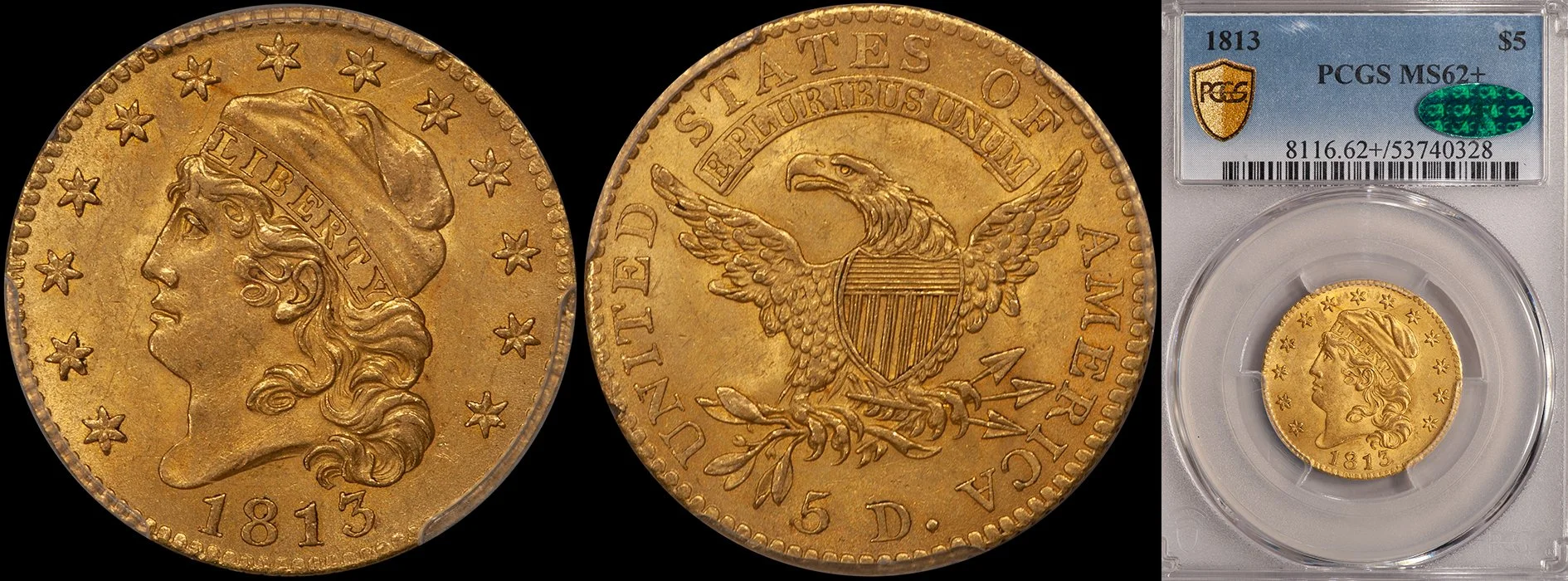
As a specialist in rare United States gold coins, there are few series that I find more interested than the Capped Head half eagles produced from 1813 through 1834. I recently purchased (and quickly sold) a PCGS graded AU53 1823 half eagle. This date, by the standards of the type, is no big deal. But the more I researched the 1823, the more I realized that it is an underrated and enigmatic issue.

The so-called Fat Head series is typically divided into segments: dates that are obtainable (1813, 1814, 1818 and 1820) and those that range from virtually unobtainable to impossible. What's interesting about the 1823 is that it is really the only issue of this type that is clearly rare but which is not an extreme rarity. Let's take a more in-depth peek at this issue.

The 1823 has the lowest recorded mintage of any half eagle made between 1821 and 1834 with only 14,485 having been struck. There are an estimated 70-90 known and nearly all of these are in the AU58 to MS62 range. As with nearly all half eagles from the 1820's, the 1823 saw very little in the way of actual circulation and virtually all of the mintage was melted in 1834 when the weight of gold coins was lowered.

It should be pointed out that mintage figures of half eagles from the 1820's are probably highly inaccurate. I feel that many of the coins struck in 1820 were actually dated 1821, 1822 and 1823. At some point, it may be possible to breakdown these mintages more accurately but it is not currently possible.

There are a few very choice 1823 half eagles known. The finest that I am aware of is the one in the Bass core collection which is ex Norweb I: 774. It sold to Harry Bass for $52,800 all the way back in 1987 which is still an uaction record for this date (!) I grade the coin MS64+ to MS65 and it has superb original luster and color. The second best that I have seen is James Stack: 1069 that sold in October 1994 for $35,200. I grade this coin MS64 or better by today's standards.

NGC has graded one example of this date in MS65 (the Stack coin?) as well as one in MS64. PCGS has never graded an MS65 but does show five in MS64. My hunch is that this number is slightly inflated by resubmissions.

As with all half eagles from the 1820's, the 1823 is a well-produced issue. It is typically fairly sharply struck although I have seen examples that are weak on the curls above Liberty's eyes and a few of the stars lacked their radial lines. High grade 1823's show splendid rich, frosty luster and original uncleaned pieces have lovely rich orange-gold color.

One of the more curious facts about the 1823 half eagle is its current pricing structure. The most recent Coin Values has a value of $13,500 for this issue in AU50 (which seems about right) and a value of $14,500 in AU55. It is hard to imagine that the value of an AU55 would only be $1,000 than an AU50 but I'm assuming that part of this has to do with the fact that so few AU 1823's are known that a small jump in grade doesn't equate to a large jump in value. Right?

Every series has a date or two that fall through the cracks and in the fabulous Fat Head fives from the 1820's and 1830's it seems that the 1823 is (currently) getting the short end of the proverbial stick. This date does not sell for an especially large premium over dates like the 1813, 1814, 1818 and 1820 but it is many times scarcer. Obviously, few people collect Fat Head fives by date so prices for this series are not as carefully scrutinized as Indian Head quarter eagles. That said, it seems to me that the 1823 is a very undervalued issue and it is a coin that I look forward to owning more of in the future.

Value Compression in the Rare Date Gold Market

The recent Coin World “Coin Values” (or Trends as we long-time dealers call it) features a number of price reductions in the various Liberty Head gold series. This has caused some interesting pricing anomalies that have major ramifications for collectors of rare date gold coins. The grade range that appears to be severely affected by the Trends revisions is AU50 to AU58. This makes sense as this is the grade range that, in my opinion, has been most severely compromised by the grading services over the years. I think this especially true for the AU55 and AU58 grades; a range that includes many coins that are marginal quality at best.

A number of factors caused these values to be reduced by the Trends editor(s). One is, of course, auction prices. As I have stated a number of times in the past, one of the biggest problems with coin pricing is the fact that one bad apple can literally spoil the whole bunch. Let me give you an example. Let’s say that Trends in AU58 for a specific Charlotte quarter eagle was $9,000 in AU58. Then let’s say that a really, really low end example in an AU58 holder sells at auction for $4,000. Does this mean that the price of this issue should suddenly be cut in half?

I would argue that it shouldn’t. But I would also argue that a compression of values for rare date gold is inevitable.

Value compression is not without precedent. Two of the most famous examples that I can think of are the Iowa half dollar (worth $85 in XF and $100 in MS65) and the Roanoke half dollar (worth $160 in XF and $180 in MS64). The reason why values become compressed for a specific coin is that the market believes that a premium is unmerited. In the case of the Roanoke half dollar, the reason is obvious: because of the cluttered design, an AU58 Roanoke looks essentially no different from an MS64. For better or worse, this is what has happened with certain branch mint gold coins due to erratic grading standards.

Let me give you an example. The more sophisticated segment of the rare date gold market believes that a choice, original coin graded EF45 is preferable to a bright, shiny processed AU53. Because of this, it tends to place a value premium on the nice 45 coin. The same collector who is willing to spend, say $2,500 on a Choice EF would probably pass on a crappy AU53 example of the same date at $3,000; even though the higher graded example is seemingly the “better deal.”

There are now at least three distinct segments of the rare date gold market. There are the serious hard-core collectors with some budget constraints who will spend $1,500-3,500 on a coin without flinching. This segment of the market is as strong as ever; maybe even more so than in the 2004-2006 Boom Years. The next segment is the casual uninformed investor, the deal-seeker or the “world-is-coming-to-an-end-so-I need-to-own-gold” buyer. They are the likely buyers of the not-so-nice coins that might range from slightly overgraded to blatantly overgraded. This segment of the market is extremely weak right now. The third segment of the market is the high budget connoisseur who is searching for coins that are in or near the Condition Census for the issue; maybe even the finest known. This segment of the market is clearly not as strong as it was a few years ago but if the right coin comes along, these buyers will pay strong prices.

With the existence of these three segments what has happened is that the market has become stronger at the lower end, much weaker at the middle end and slightly weaker but still capable of a wallop on the higher end. As a result, a coin that is worth $2,000 in EF45 and $10,000 in MS60 might only be worth $3,000-4,000 in schlocky AU53. And it might be a hard sale for a dealer even at this compressed level.

Now, here’s where the interesting play comes in for the savvy buyer. I think some nice quality AU53 and AU55 coins are going to get dragged down along with the schlock. Let’s say that you are able to buy a nice Charlotte or Dahlonega quarter eagle in properly graded AU53 for $2,750-3,250 (when a nice EF45 is worth $2,250-2,500). In this case, paying the extra 20% or so for a coin that is demonstrably better is an excellent value. If the collector learns which AU53 quarter eagles are nice for the grade, they are getting coins that are more cosmetically appealing than a nice EF45 and a compressed value that makes plenty of sense to me.

The "Deal Shopping" Mentality and Rare Coin Prices

I had an interesting experience at the Long Beach show that I thought was worth sharing. A new-to-the-market collector/investor came up to my table and asked to see my “best coins.” I was happy to share them with him and pulled out a gorgeous 1802 quarter eagle in PCGS AU58 and a lovely 1798/7 eagle in PCGS AU55. After some back-and-forth negotiating, I could see this deal was not going to get done. The reasons why it didn’t are what I want to briefly discuss. Now let me say in advance that the individual that I was dealing with is younger than I am, better looking than I am, smarter than I am and without a doubt much, much richer than I am. He’s someone whose family has had tremendous success investing in other areas and he is a recent convert to the rare coin market. But I think he’s approaching coins from a totally wrong perspective.

This guy likes deals. And he likes sexy, interesting coins. In other words, he wants to buy the best coins that I (or other dealers) have but he wants to buy them at levels that are unqualified, unquestionable “deals.” Good market or bad market, I don’t see this happening.

One thing that I have learned as a dealer in the last few years is that really good coins are really hard to find. Most of the great old-time collections have been dispersed and you just don’t see many “old time Gems” any more. Any when you do, like in the instance of the recent Naftzger Collection of late date Large Cents, the pent-up demand for the fresh, superb coins is so strong that they sell for crazy prices.

The investor I mentioned comes from a real estate background and he is, no doubt, used to panic sellers who have a nice piece of property but who are in over their heads and have to bail. Quickly. This doesn’t really seem to happen much anymore in the coin market. The speculators who bought the “deals” in the last Bull Market are the guys who bought the overgraded, overrated “stuff” that, in retrospect, maybe wasn’t such a good deal after all. The guys who bought the great coins and paid up for them aren’t selling. They aren’t selling because they don’t have to and because they know that what they have can’t be easily replaced. The "stuff" is what you tend to see, over and over, in auctions.

In the coin market, price buyers invariably wind-up with the worst possible coins for the grade. As I have mentioned before, there are coins with huge variations of value within a specific grade. For example, there are MS65 1795 half eagles that I think are worth well over $500,000 And there are MS65 1795 half eagles that I wouldn’t pay $350,000 for. The guys who “like the deals” are always going to wind up with the substandard coin. No ands, ifs or buts. It always works out this way.

That’s not to say that there aren’t good values in the coin market. I can think of dozens and dozens of coins that are undervalued in relation to their rarity and level of demand. I think that’s what the deal-hunters don’t understand. The real deals in numismatics come with knowledge of coins, not buying something for 10% less than Greysheet Bid. The Greysheet is never going to teach you that, as an example, an 1864-S eagle is a sensational value at double current published levels.

I realize that this sounds like a self-serving dealer blog justifying the “need” to stick a high price tag on nice coins. It’s not meant to be that but I can understand that interpretation. I just was sorry to see a potentially great customer pass on two incredible coins for his collection because they weren’t “deals.”