
1882-CC Double Eagle PCGS MS60
/Everyone loves the size and history associated with Carson City double eagles and this example is choice in spite of its comparatively "low" grade of MS60
Learn about buying, selling and collecting rare U.S. gold coins with Douglas Winter Numismatics and read related articles on this blog.
Everyone loves the size and history associated with Carson City double eagles and this example is choice in spite of its comparatively "low" grade of MS60
This 1843-O Large Date quarter eagle is among the finest known of the variety. Doug Winter is widely-recognized as the leading expert on New Orleans gold coinage.
There are an estimated five or six 1846-O half eagles known and Doug Winter has handled every one. If you collect choice New Orleans gold coins, you should be doing business with us!
From the Eliasberg collection and tied with one other as the finest known. We love pedigreed coins and handle many pieces from famous collections.
Draped Bust Left half eagles of this quality are rare and in demand. This example is notable for its superb color and very choice surfaces.
Choice, original early gold is a specialty of DWN. This 1813 half eagle is a magnificent, high end example with great color and luster.
A good client of mine recently asked me the question “are early gold coins overpriced?” As with most intelligent questions, I don’t think that this one has a pat answer. My feeling is that some early gold coins are poor value at current levels while others are good to very good values. Read on for my take on the current early gold market and my suggestions of where the best values are. Appearance and eye appeal are, obviously, critical factors in determining the desirability of any coin. In the area of early gold, I think these factors are especially important. The reasons are fairly obvious: these are hand-made coins that vary in quality literally from year to year, many survivors have been cleaned, abused or damaged and the third-party services tend to be inconsistent (to say the least) when it comes to grading early gold.
A fairly general statement that I think can be made about the early gold market is that only a small handful of the coins that exist have good eye appeal and a pleasing overall appearance. I personally feel that virtually every early gold coin that is choice and original remains a good value while most every good early gold coin that is low end for the grade and unoriginal is poor value. But this observation is fairly simplistic and needs to be expanded.
As with most markets, early gold issues can generally be divided into three categories: common or “generic” dates, better dates and rarities. And in the case of early gold we might even be able to create a fourth category: the “super-rarity.” How are each of these categories doing?
Even if you know very little about early gold, you might guess that the area most prone to showing weakness in a downward market turn would be the common dates. An example of what I would term a “generic” early gold coin would be an 1806 Round 6 Half Eagle. There are as many as 1,000 examples known of this issue and it is fairly readily available in grades up to and including MS63 to MS64.
If you go to a major national coin show you are likely to see a decent number of 1806 Round 6 half eagles. These would generally be available in the AU55 to MS62 grade range. (Lower grade 1806 Round 6 half eagles are difficult to find because the nice, affordable examples tend to be closely held by collectors; the very high end MS63 to MS64 tend to either show up at auction or they are placed in tightly-held, high end collections and do not trade with frequency). The examples available for sale tend to be low end and unattractive. At current price levels, I think they are not especially good values. Why is this?
As recently as five to six years ago you could buy a nice, fresh AU 1806 Round 6 half eagle for $5,500-6,000. At this affordable level, this coin was a good value, despite the fact that it wasn’t really “rare” in the sense of most early gold. Today, a similarly graded coin will cost you at least twice this amount. The problem is that these coins now tend to not be nice for the grade and the new price range of $11,000-13,000 no longer qualifies as “affordable.” Are coins such as this overpriced? If they are typical low to middle quality coins, the answer is a fairly resounding yes. If they are accurately graded and solid, choice pieces I would say that they are really overpriced but that they are relatively marginal values at these levels.
An example of an early gold coin that I regard as a “better date” would be a 1799 half eagle. This issue is not truly rare but it is available with far less frequency that an 1806 Round 6 half eagle. I think the market for an issue like this has held up rather well; even if a 1799 half eagle in, say AU55 is currently valued at least twice as highly as it was five or so years ago. Collectors still expect an AU55 example of this date to have good eye appeal and ugly examples are harder to sell than they might have been a year ago but I think this area of the market is solid. Are coins like this overpriced? I would say, pretty resoundingly, in fact, that they are not; especially in the solid collector grades of EF40 to AU55.
A “rare date” early gold coin would be, as an example, an 1826 half eagle. This popular Fat Head issue has a surviving population of maybe three dozen and it tends to be offered for sale at the rate of one or two coins per year. This is another issue that has seen significant price increases in the last five years but the fact is that the supply of 1826 half eagles in virtually all grades is nowhere near the (current) demand. Yes, coins like the 1826 half eagle are currently expensive. But given their unquestionable rarity I would have to say that coins like this remain fairly priced.
And what about our fourth and final category—the so-called “super-rarity?” An example of this would be an 1815 half eagle; an issue that is extremely rare in all grades and which typically appears for sale at the rate of approximately once per three to five years. My gut feeling is that these major rarities, in all the various early gold series, are still reasonably priced. There is an 1815 half eagle coming up for sale in the 2009 FUN auction (graded MS64 by NGC and pedigreed to the Garrett collection) that is almost certain to shatter all price records for this date and which could be one of the highlights of the 2009 Numismatic Year.
What about issues like the 1796 No Stars quarter eagle or the 1808 quarter eagles; coins that aren’t “rarities” in the classic sense of the word but which are exceptionally popular and numismatically significant? I think, in theory, that these are overpriced given their big-picture rarity. Given their strong level of demand I would still buy them for inventory. However (and this is a BIG however) I think the market has become far more selective on coins like this. If they are not CAC-quality, they have become hard to sell unless discounted in price. And this scenario is likely to continue as long as decent 1796 quarter eagles command prices in excess of $125,000-150,000+.
After a probable absence of over a century, perhaps the most important New Orleans gold coin in existence is coming back to its ancestral home. My friend Paul Hollis, a coin dealer from Metairie (a suburb of New Orleans), has arranged for the unique Proof 1844-O eagle to be placed on exhibit at the New Orleans mint. This coin, with an estimated value of $2.5 million, goes on public display November 1 and will also be taken around Louisiana on tour by Hollis.

The New Orleans Mint began producing coins in 1838. The very first issue struck by this mint was a group of 20 half dollars to inaugurate coinage and a small group of Proof half dollars were made in 1839 (plus at least one Dime dated 1839-O is known that has been designated a “Specimen” by NGC). So, we know that the New Orleans mint had experience with making Proof coins and that the quality of these was comparable to that seen at the Philadelphia mint.
In 1844, the New Orleans mint produced at least one example of a Proof half eagle and eagle. Remarkably, both still exist and, even more remarkably, both are superbly preserved. Why were they produced and who were they struck for?
Unfortunately, contemporary documentation does not exist that gives the definitive answer to these questions, so we have to make some assumptions. I think it’s safe to say that the Proof 1844-O gold set was struck in commemoration of either a special event or, more likely, a visit to the Mint by some special VIP or dignitary. My guess would be that they were made for personal presentation to President John Tyler.
What is interesting about these 1844-O Proofs is that there were no other Proof gold issues produced at the branch mints until 1854 when San Francisco struck a double eagle in this format. But in the case of the 1854-S double eagle, the reason for producing the coin is obvious as it was made to commemorate the opening of the new mint. One would think that if New Orleans were to have made gold Proofs, they would have struck a small number of Proof quarter eagles in 1839 or half eagles in 1840. But if these were ever made, they have disappeared without a trace.
The earliest numismatic reference to the 1844-O Proofs appears to be in the Seavey descriptive catalog that was published in 1873. In 1890 when they were sold as part of the famous Parmelee collection the eagle sold (as Lot 1151) for the princely sum of $16 while its companion half eagle brought just $9.50. It was next seen in the collection of William Woodin who was famous both as a coin collector and as Secretary of the Treasury for Franklin D. Roosevelt in 1933.
Woodin sold his primary collection at auction in 1911 but I am not aware if the Proof 1844-O set was included in either of his two sales (it would be easy to check these in the sale catalogs but my library does not contain them). It is documented that Woodin also sold many of his coins privately to the leading collectors and dealers of the day. I do not know this with certainty but I surmise that the 1844-O Proofs went into the Brand collection.
From here on, the pedigree chain for the 1844-O half eagle and eagle gets murky. In fact, I think it is possible that the coins were split up when the Brand collection was being sold in the 1920’s and 1930’s.
The half eagle was in all likelihood sold to Waldo Newcomer and then likely went into the Colonel Green collection. From there it is believed to have been sold to King Farouk and remained in this collection until it was forcibly sold at auction in 1954. It was later sold to a prominent Texas collector (not Harry Bass, by the way...) by Abe Kosoff in 1959. I was shown the Proof half eagle in the early 1990’s by the Texas dealer Michael Brownlee. It was still in the original flip with Kosoff’s writing on it. I used it as the cover coin of the first edition of my New Orleans book. The coin is a superb Gem.
Brownlee told me soon after showing me the Proof 1844-O half eagle that he believed the Proof eagle existed but he didn’t know where it was. In fact, he claimed, he had been searching for it for many years as he desperately wanted to reunite the two coins in the prominent Texas collection (which he had built and was, rightfully, very proud of).
If Newcomer did, in fact, buy both the half eagle and eagle, it is not likely that Col. Green would have purchased the eagle as he was not specializing in this denomination. What would be interesting to learn was, if the coins were indeed split up, in which collections did it reside between the 1920’s and the 1990’s.
Did Brownlee know where this coin was all along? I have my theories but won’t expound on them here. I will say, however, that his search for the elusive Proof 1844-O eagle was rewarded when, in the late 1990’s, he announced that the coin was “rediscovered.” It was sent to NGC where it was ultimately graded PR66 Cameo. Then, it was offered for sale by dealer Robert Leece at various price levels for a number of years.
Finally, the coin was sold to a Florida collector in 2006 by Louisiana dealer Chuck Bloomfield. The price was reported to be $1.5 million.
I have had a chance to examine the Proof 1844-O eagle and it is a simply amazing coin. It is 100% unquestionably a Proof with incredible cameo contrast and a deep “black and white” appearance that one wouldn’t expect to see on a Proof gold coin from this era, let alone one from New Orleans.
If you are going to be in the New Orleans area in the coming months, I urge you to take a look at this great coin and to visit the New Orleans mint.
If you are like most people, the last few months have been tough on your pocketbook let alone your psyche. We are, at least for the immediate future, in tough economic times. For some people, there are difficult decisions that have to be made: which bills get taken care of, can the mortgage be paid, do we eat dinner or fill the tank with gas. Fortunately most coin collectors are faced with decisions that are much less dramatic. When people are feeling wealthy, spending discretionary income on something like coins is a no-brainer. You see something you like and you buy it. In a Recession, such purchases become far less impulsive. But I don’t think the coin market is going to come to a screaming halt. Prices may come down (in some cases they may actually raise) but I sense that there will be activity. Simply put, there are just too many people who enjoy numismatics and there is just too much money (in the United States and world-wide) for established hobbies like numismatics to crash. And, if we enter an inflationary period as many experts believe, there could easily be a rush into tangible assets.
That said, I think people’s buying habits will change quite a bit in the next few years. The Irrational Exuberance we saw in the middle part of the decade could be over forever. As someone who has survived a number of lean Numismatic Cycles, I’d like to share some observations on how you can still add coins to your collection, even in tough times.
1. Buy Smart. I can’t begin to tell you the number of purchases I saw in the last few years that were just plain dumb. Collectors battling to the death at auction over coins that weren’t really that nice or rare. Dealers falling all over themselves to buy old holder coins in one grade and paying a price that assured them they would possibly break even if the coin upgraded three points...sheesh!
Being a smart coin buyer means being informed, confident and well-connected. In my opinion, this means taking the time to carefully research the coins that you are contemplating buying, fully understanding the buying and selling process(es) and having a good relationship with a small group of dealers.
I am a huge believer in first impressions being correct. In numismatics, this means having a good feeling about a coin’s appearance, a coin’s price and the person who is selling it. If you have to convince yourself that you like a coin, don’t buy it. If you have to make irrational justifications about a coin’s price, pass. If the person who is selling the coin makes your skin crawl, have a trusted dealer make the transaction for you—or shop somewhere else.
2. Look for Value. I think value is going to be a real buzzword in the coming coin market. You the collector are going to be bombarded with this word but do you really understand it? And, if so, how does it apply to what you collect?
Here’s an example of how I form opinions in regard to value. I have spent quite a bit of time in the last few days doing pricing for the 2010 edition of the Redbook. As I was going through the various sections, one thing that really grabbed my attention was the pricing structure of Extremely Fine Charlotte and Dahlonega half eagles. As an example, virtually every C+D half eagle in EF40 is priced at basically the same amount. Sure, there are a few exceptions but we are talking about issues with a wide range of rarity and availability being priced exactly the same. For instance, the 2010 Redbook prices for an 1854-C and an 1858-C half eagle in EF40 are both $2,500. That’s great except for the fact that the 1854-C is a considerably scarcer coin in this grade (and in all grades higher than EF as well). As a value conscious buyer, I’m going to be looking for the 1854-C half eagles of the numismatic world.
When money is tight and you don’t have as much to spend on your hobby as in the past, make your purchases as value-conscious as possible.
3. Think Long Term. There are many collectors who have never known a slow coin market and they’ve been spoiled. In the past few years, they’ve been able to bail themselves out of trouble when they’ve bought “bad” coins by throwing them into auctions and letting the next buyer come along. In some cases, they’ve been able to turn handsome profits on coins that they had no business buying, let alone selling, for a profit. In a slow market, these “unburials” are going to happen with less and less frequency.
There’s a pretty basic solution to this problem. Buy the “right” coins and buy for the long term. You don’t have to become a numismatic “black hole” who never sells any coins (in fact, I urge you to sell from time to time so that you better understand how this part of the market works). But buy every coin as if you were going to hold it for a reasonably long period of time.
4. Eye Appeal, Eye Appeal, Eye Appeal. If the coin market were to tank in the next few years, the coins that are going to maintain their value better than anything else are the ones that are aesthetically appealing. This is particularly true if you collect a series in which the coins aren’t really rare from the standpoint of total number known. Let’s say you collect Proof Seated Liberty Quarters. If you have a set of coins that are all bright white and which show average quality contrast, the chances are good that these coins will devolve into semi-widget status (unless they are in very high grades). The same set with all beautifully toned original coins or with a mix of toned coins and superb black and white cameo pieces is probably likely to retain more of its value and interest levels even in a poor market.
Coins do not have to be expensive to be pretty. And they don’t have to be in ultra high grades to be considered great eye appeal pieces either. Savvy, sophisticated buyers are often more content to purchase a nice EF45 example of a rare date than a marginal quality AU55. The only time you should allow yourself to buy a coin with marginal eye appeal is if essentially every known example of the type or issue is crudely made. But even in the case of an issue like this (an example would be the 1856-D quarter eagle) there are still pieces that despite a crude or “ungainly” appearance have a certain charm to them that make them clearly desirable.
5. Be Patient. I’m a strong believer of being patient even in a bull market. In a slower market, patience is, I believe, imperative. Back in the day, collectors looked at their collections as long-term endeavors. The collector who was assembling a set of Carson City gold looked at his challenge as something that would take many years, not just a few months. I blame the short attention spans of many new collectors on the internet mentality that says “I want it, I must have it NOW!!” Sure, it is possible to complete a set of Carson City gold in a few months. But the collector who rushes his way through a set is certain to make some potentially big mistakes and he is missing out on the fun of the big, long-term picture.
One thing I’ve learned over the years is that many so-called “rare” coins are not rare at all. Unless you collect a series that is replete with truly rare coins (Liberty Head eagles would be an example of a series that contains dates that ARE truly rare, in my opinion) don’t sweat it if you missed out on a certain coin on a dealer’s website or at auction. You’ll probably find another one in a few months.
6. Buy Special Coins. Whether you collect Roosevelt Dimes or Proof Liberty Head double eagles there are clearly coins which exist that are “special.” In other words, there is something about them that make the viewer stop and look twice. As an example, when I view lots at an auction, I tend to plow through the coins and after a while they literally all begin to look the same. But then some lot will pop up that make me stop, take a deep breath and exclaim, “man, is that cool/pretty/neat.”
For the Roosevelt Dime collector, this “special coin” might be a piece with monster toning or one that is fully prooflike and very unusual as such. For the Proof Liberty Head double eagle collector, his special coin might be a piece with a Bass, Eliasberg or Norweb pedigree or one with splendid natural hazy orange-gold color.
Special coins can also be pieces that have a great story to tell. I have always liked coins that are one-year types or first-year-of-issue pieces because they can be appreciated by someone who knows nothing about the specific series. Even if you could care less about Dahlonega gold or three dollar gold pieces, the chances are good that you’ll still think an 1854-D three dollar is a pretty interesting coin.
One last thought. In tough economic times, the natural instinct for many people is to panic. Your sense of fear may be played on by some of the numismatic newsletters or ads that you read. Don’t buy into this shameless marketing. If you like collecting coins and you can afford to keep buying them, do so. If you think the world’s economy is going to hell in a hand basket, putting 10% or so of your net worth into a nice coin collection probably isn’t the worst thing you can do. Coin collecting is a great hobby and I hope that you’ll call on me to help you with your purchases whether the Dow is 12,000 or 3,000.
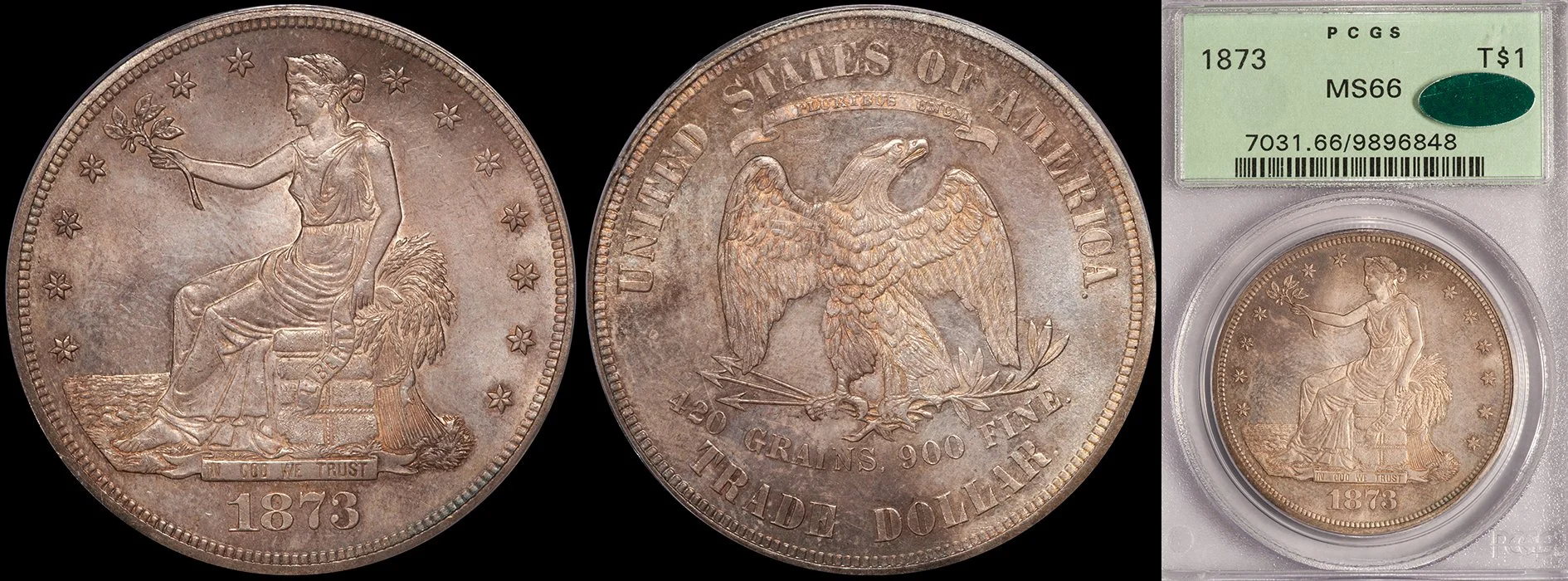
Date…….1873 T$1
Grade…….PCGS MS66 CAC
PCGS Price Guide.…….……70000
CDN Greysheet/CPG.…..…55000
Population (PCGS).……….…5/1
Population (NGC)….…………1/0
Population (CAC).….....….…..1/1
Serial Number……7031.66/9896848
PCGS Lookup Number.……….7031
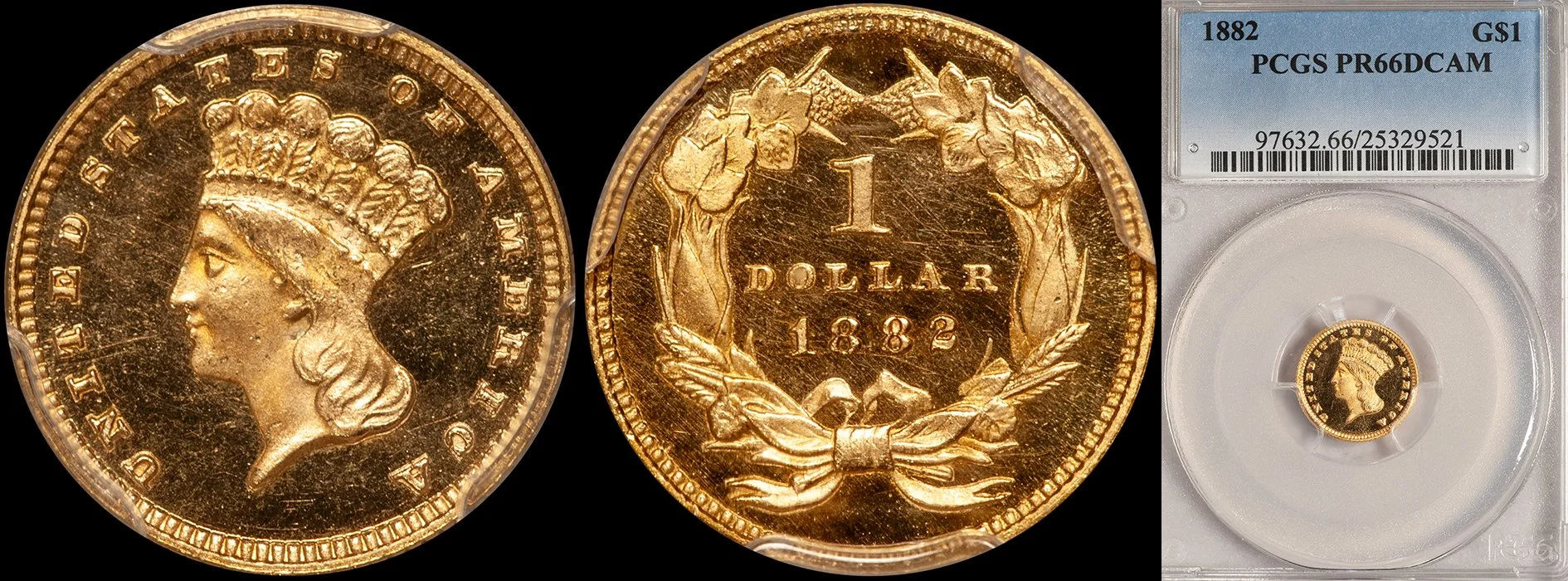
Date…….1882
Grade.…….PCGS PR66DCAM
PCGS Price Guide..……..…20500
Population (PCGS).…………4/1
Population (NGC).…….…….4/0
Serial Number……97632.66/25329521
PCGS Lookup Number.….97632
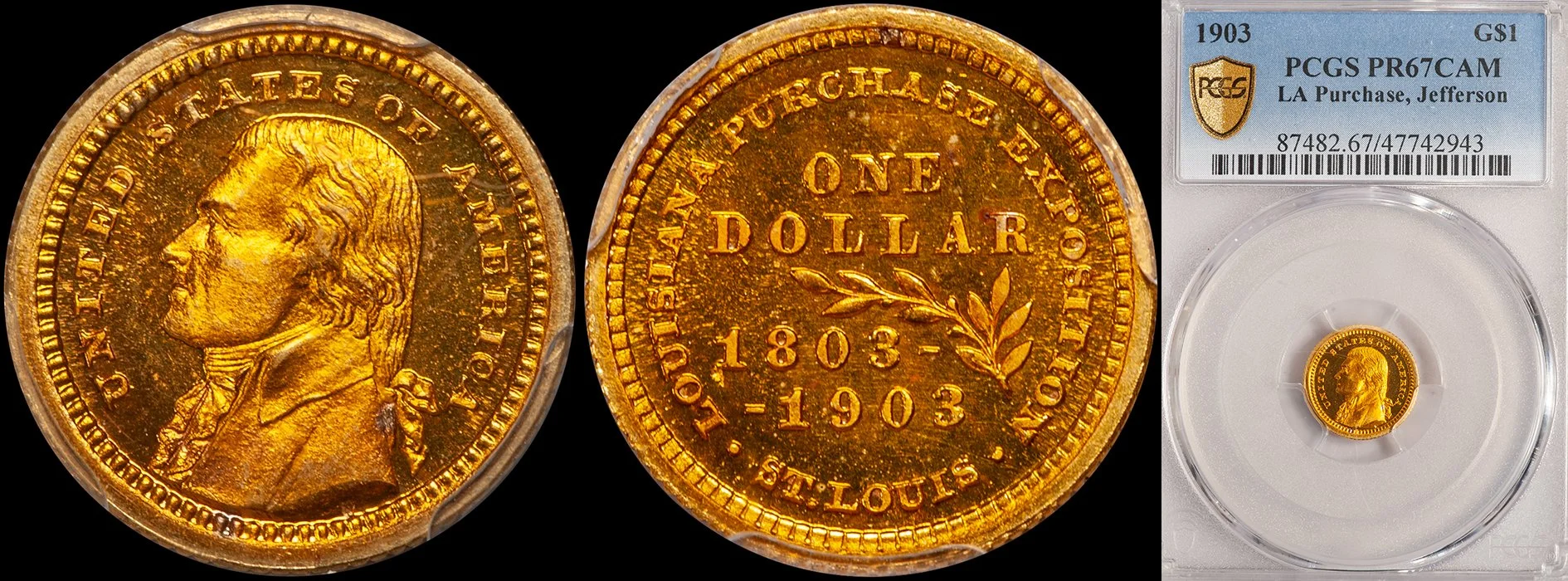
Date…….1903 LA Purchase, Jefferson
Grade…….PCGS PR67CAM
PCGS Price Guide.…….……42500
Population (PCGS).……….…2/0
Population (NGC)…..…..……0/1
Serial Number……87482.67/47742943
PCGS Lookup Number.…….87482
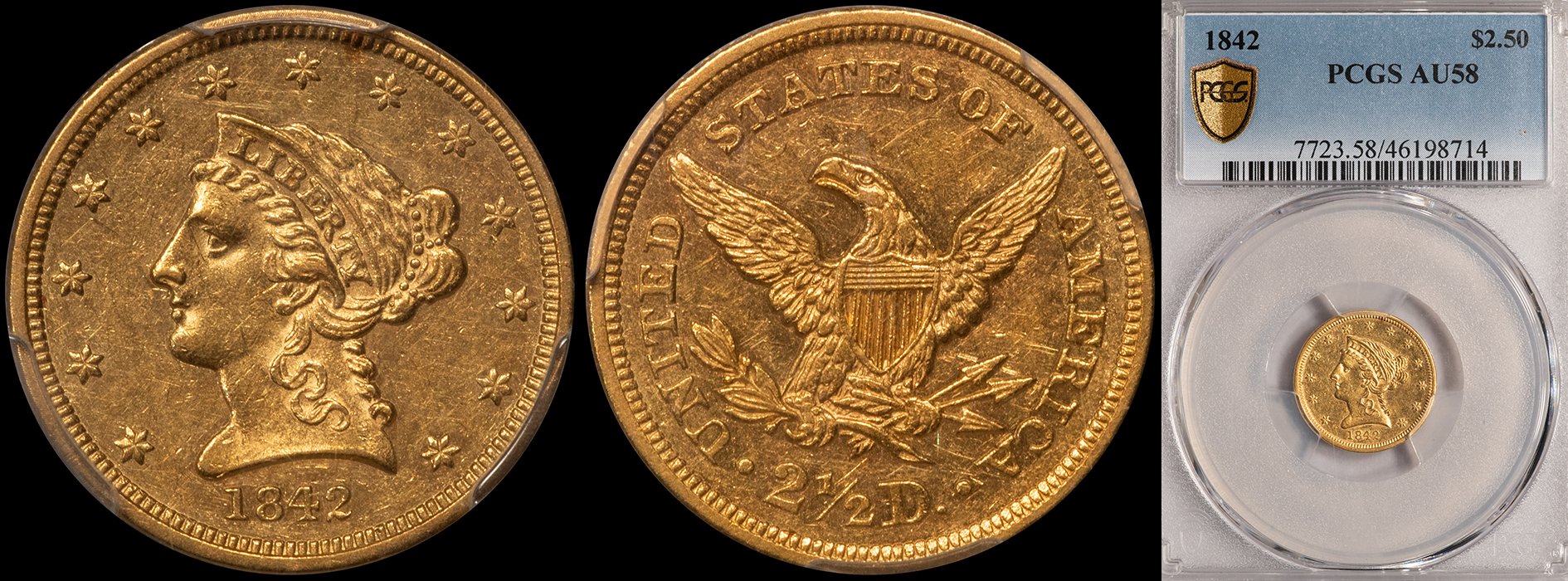
Date…….1842
Grade…….PCGS AU58
PCGS Price Guide.…….……25000
Population (PCGS).……….….…3/3
Population (NGC).……...…….…4/1
Serial Number……7723.58/46198714
PCGS Lookup Number.…….7723
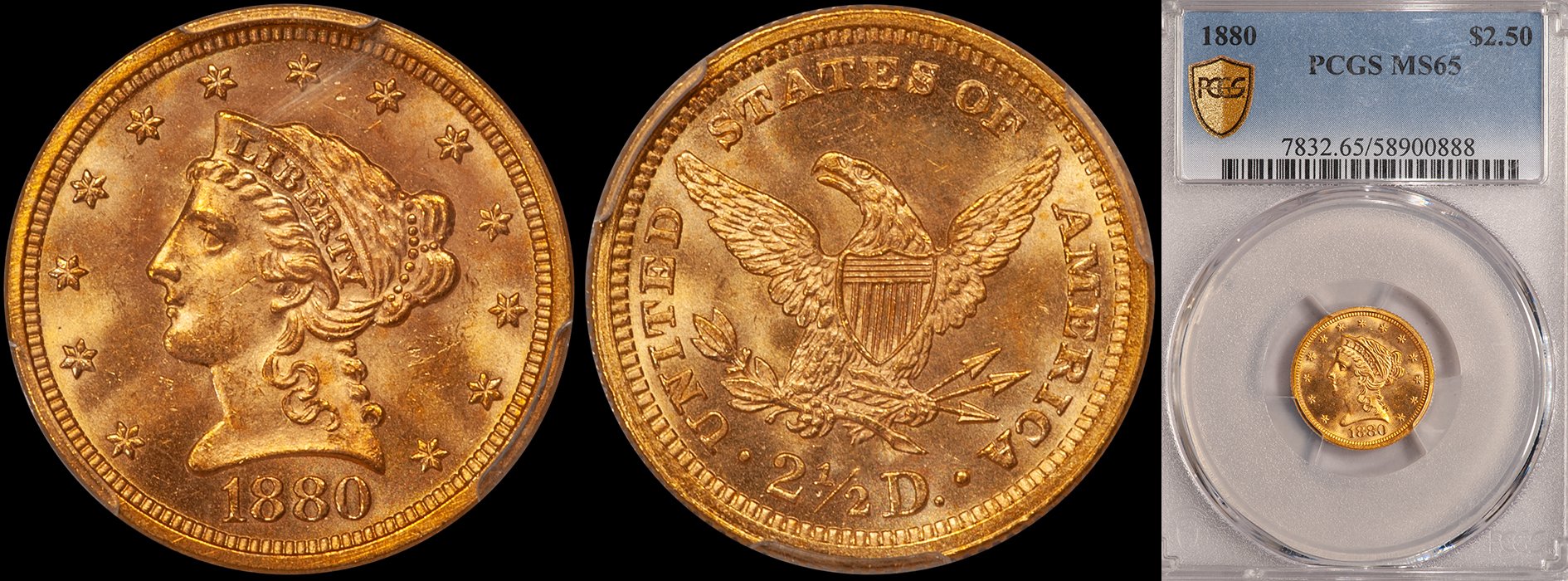
Date…….1880
Grade…….PCGS MS65
PCGS Price Guide.…….……23500
Population (PCGS).………….…7/1
Population (NGC)….……..……3/1
Serial Number……7832.65/58900888
PCGS Lookup Number…….7832
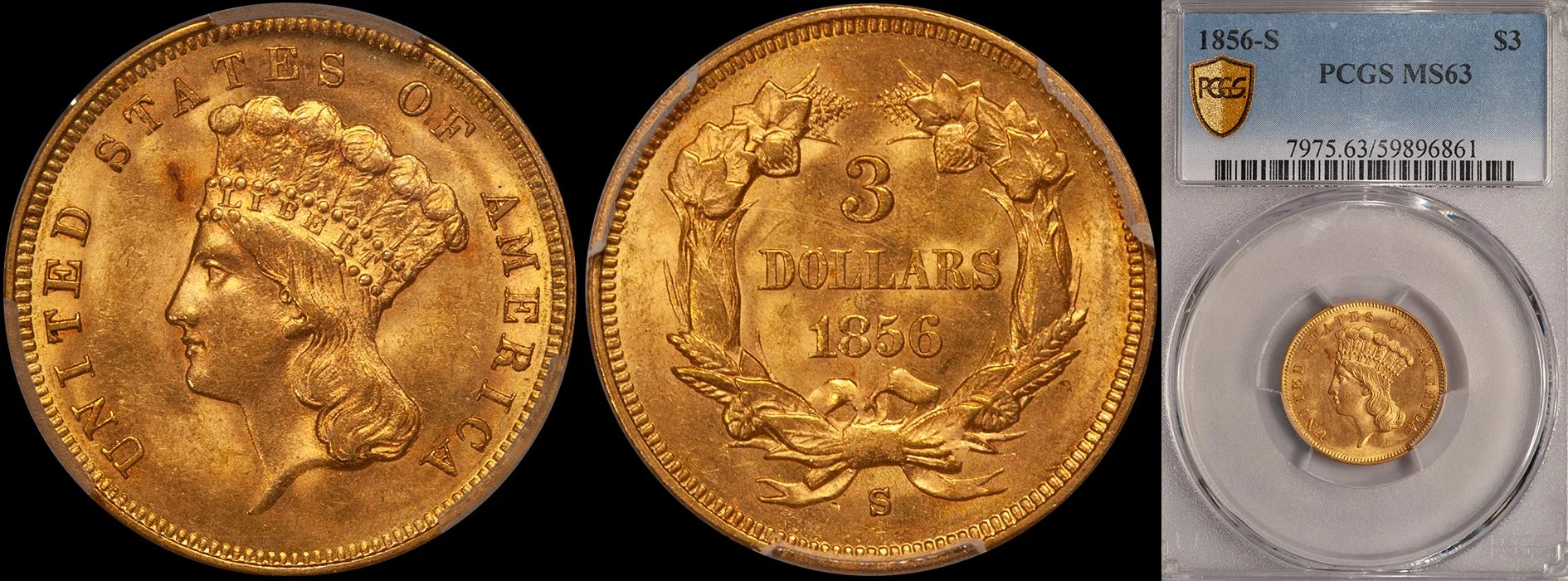
Date…….1856-S
Grade……PCGS MS63
PCGS Price Guide.….….……70000
Population (PCGS)……………5/3
Population (NGC)….….………7/1
Serial Number……….7975.63/59896861
PCGS Lookup Number…….7975
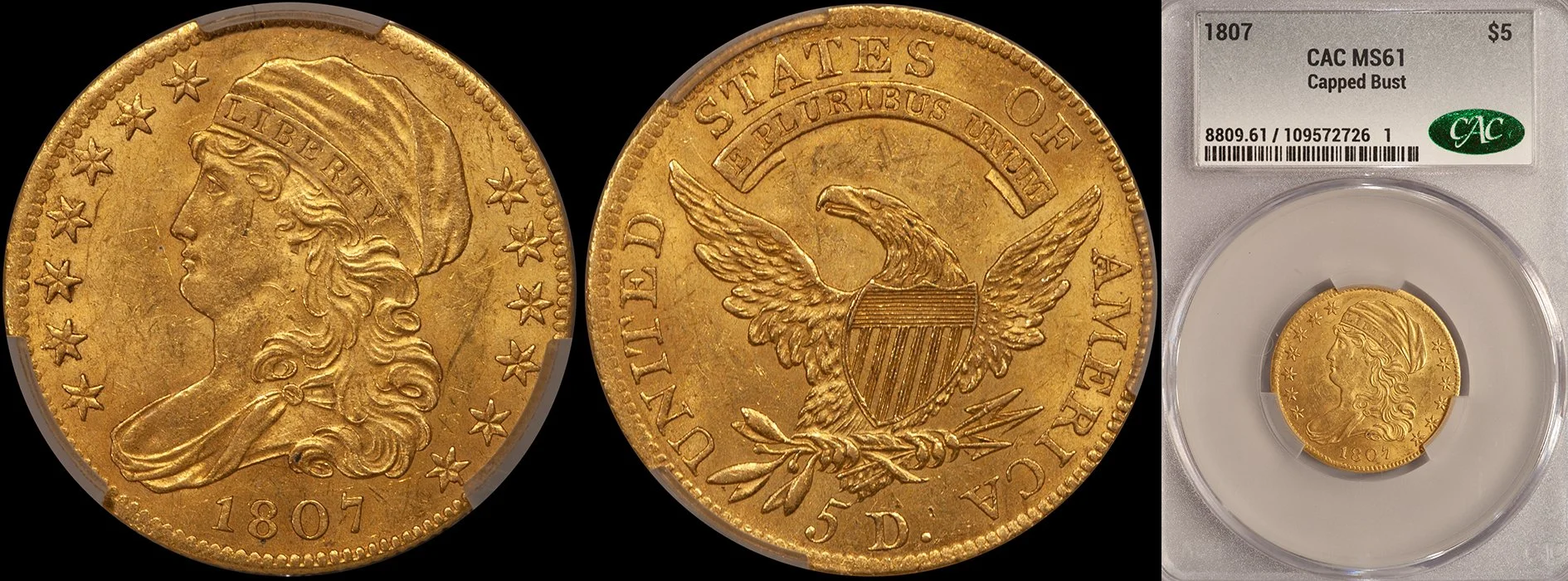
Date…….1807 Capped Bust Left
Grade…….CACG MS61
PCGS Price Guide.…….…..…18500
CDN Greysheet/CPG.…….…17500
Population (PCGS).……….…26/138
Population (NGC)….…..………39/91
Population (CAC).…..……….….8/28
Serial Number……8809.61/109572726 1
PCGS Lookup Number.……….8101
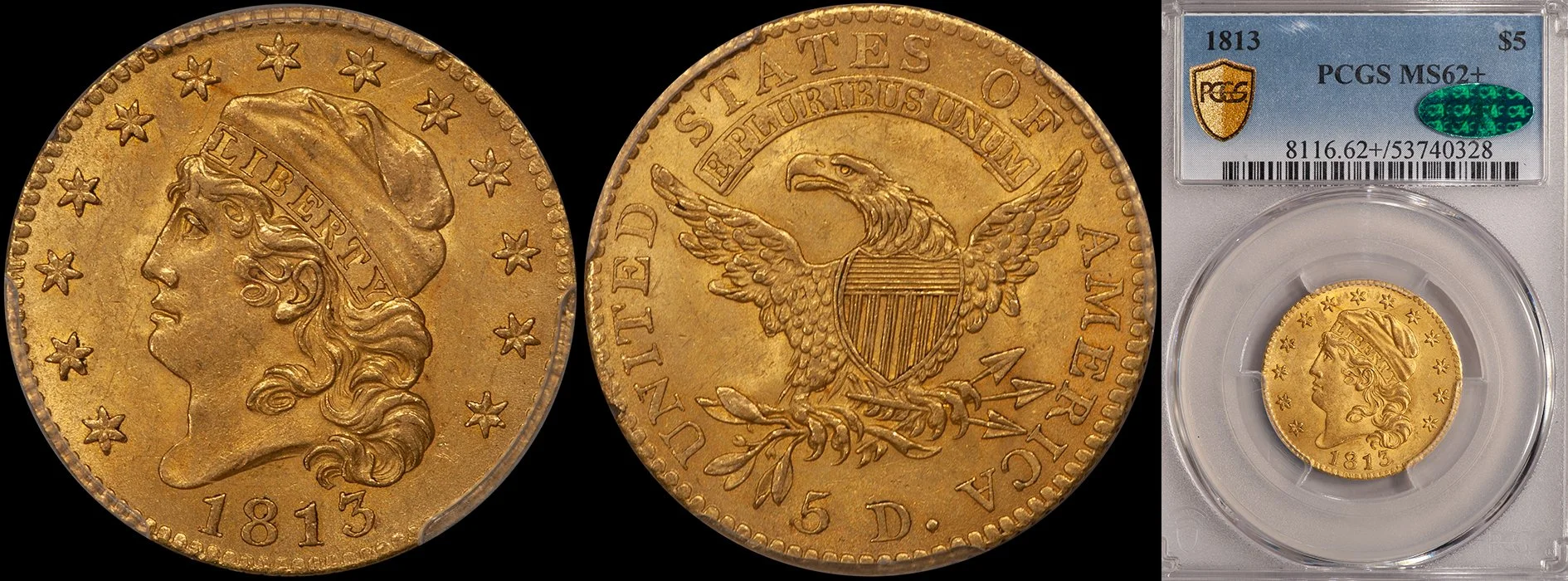
Date…….1813
Grade…….PCGS MS62+ CAC
PCGS Price Guide.……………32500 (in +)
CDN Greysheet/CPG.…….…26000
Population (PCGS)..….…….…59/124 (3 in +)
Population (NGC)..……….……62/62 (3 in +)
Population (CAC)….….....….….16/38
Serial Number……8113.62+/53740328
PCGS Lookup Number………..8113
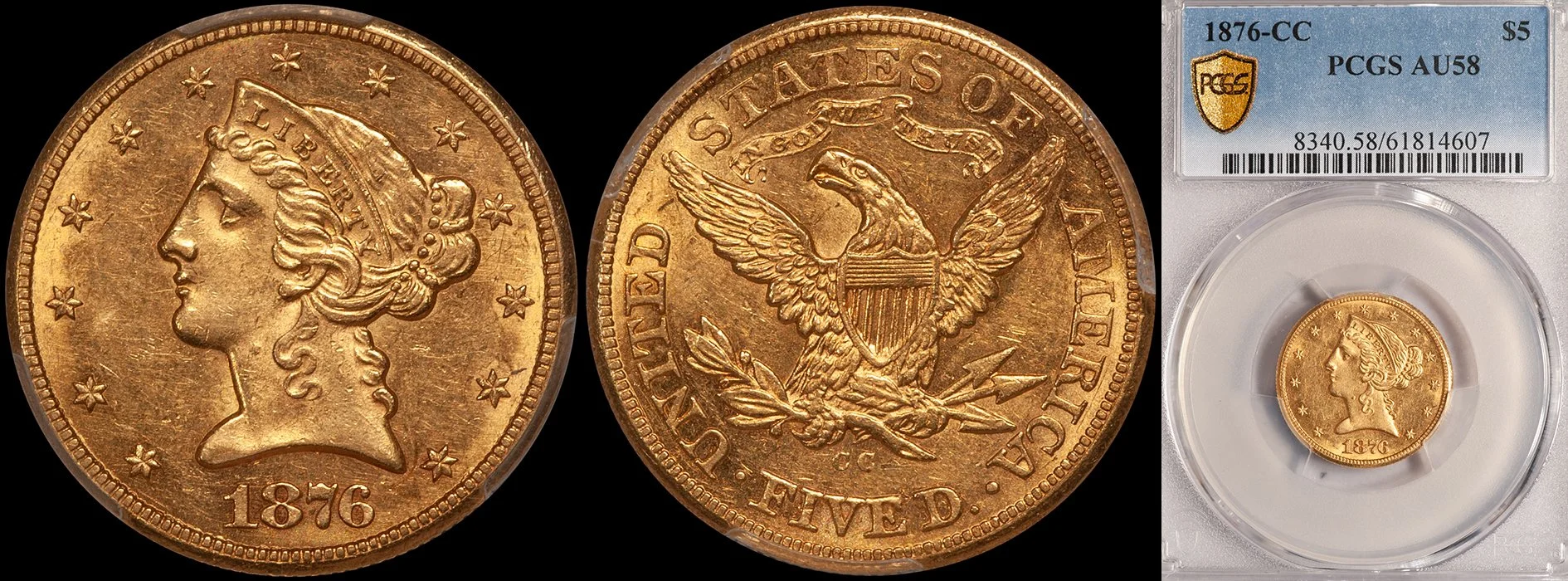
Date…….1876-CC
Grade……PCGS AU58
PCGS Price Guide.….….……85000
Population (PCGS)……………9/2
Population (NGC)….….………10/3
Serial Number……….8340.58/61814607
PCGS Lookup Number…….8340
PO Box 4383 Portland, OR 97208 | 214.675.9897
DWN collects all applicable sales taxes from HI, KY, ME, MN, MS, NV, NJ, NM, NY, TN, VT, WV, WI, DC.
© Douglas Winter Numismatics 2012-2024 | All Rights Reserved.
Photography by Jenna Van Valen.
Site design by Sarah Moon.
Date…….1849-O
Grade…….PCGS MS63 CAC
PCGS Price Guide.…….……35000
CDN Greysheet/CPG.…..…37500
Population (PCGS).……….….3/0
Population (NGC)……...………1/1
Population (CAC).….....….…..2/0
Serial Number……5414.63/61207008
PCGS Lookup Number.……….5414