Exciting Coin Sets Yet To Be Assembled

In the twenty-five years that I’ve been a professional numismatist, I’ve had the opportunity to build some pretty interesting coin collections. I’ve put together two of the finest sets of New Orleans gold ever assembled, the unquestioned finest set of Carson City gold and numerous high grade Charlotte and Dahlonega sets, to name just a few. At this point in my professional career, what sets would really excite me to have the chance to assemble? First and foremost, I’d love to have a wealthy, patient connoisseur call me and decide that he wanted to put together a complete set of high grade United States gold. How much fun would it be to be able to buy all the really high grade and really rare issues that I’ve passed on in the last few years because I just didn’t have a home for them at the time?

(And how cool would it be to walk around a coin show with a checklist of all United States gold issues and have to look at it when I saw, say, a nice About Uncirculated 1858-S eagle and remind myself if the collection already had an example of this date or not…)

My dream collection would, in some ways, use the Eliasberg collection as a benchmark but it would have some obvious differences. When the Eliasberg collection was assembled, it was much easier to locate choice, original coins than it is today. Unfortunately, I would be unable to locate early gold that could rival the phenomenal unmolested pieces in the Eliasberg collection; many of which were purchased by the Clapp family as early as the 1890’s.

But I would also be able to buy many issues in much higher grade than what was present in the Eliasberg collection. As an example, many of the post-1880 issues in this collection were represented by very low grade pieces which would be considered unremarkable, at best, today. A number of these dates are now available in fairly high grade as a result of finds in Europe and other overseas sources. It would certainly be fun to tell this new collector that a coin that he just purchased in MS64 was represented by a dingy VF in the Eliasberg collection!

Another collection that I would love to work on would attempt to replicate the John Adams collection of 1794 Cents but in a less specialized fashion (for those of you unfamiliar with this collection, John Adams is a well-known Boston collector who formed a remarkable die variety set of 1794 Cents by Sheldon variety. His parameter for purchasing a coin was to find a piece with a great pedigree entailing as many famous collectors as possible. I have always thought that this was the most fascinating specialized collection ever formed).

The gist of the Adams collection was to “collect the collectors” who had become part of the folklore of the Large Cent culture. This has never really been done in the area of gold; partially because pedigree research on gold coinage is nowhere near as comprehensive as it is on early copper. But wouldn’t a collection that included examples from all of the great gold collections from the past be interesting?

Getting to assemble a major set of early gold coinage would be a lot of fun as well. I’m currently working on a few very impressive sets of early gold but I seldom—if ever—get the chance to buy the macho, six-figure pieces that sometimes come up for sale at shows and auctions. My personal dream assignment would be to assemble a world-class set of Fat Head half eagles (from 1813 to 1834) and to be able to purchase duplicate examples of the dates that the collector and I thought were “neat” or “undervalued.” And to maybe even expand this set to include the die varieties that exist for dates such as the 1818, 1820, 1823, etc. Now that would be fun!

But, really, I have no complaints about what I’m doing right now. I get the chance to work with interesting, nice people who trust my judgment when it comes to coins. Some of these people have become good friends of mine and I’ve now known many of them for over a decade (actually two decades in some cases).

That said, if Paul Allen or Bill Gates call me tomorrow and tell me they are ready to seriously start collecting United States gold coinage, I think I can get the proposal written pretty quickly…

13 Interesting Gold Coins Priced Below $2,500

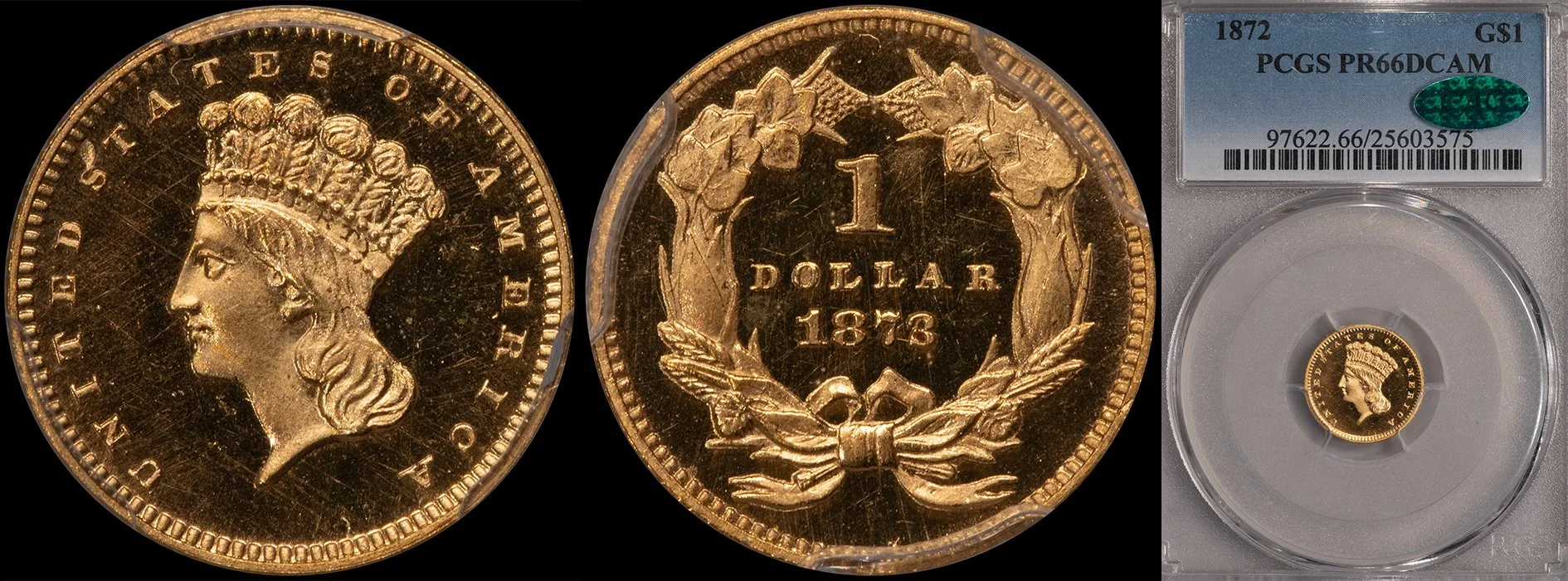
Is it possible to build an interesting collection of desirable United States gold without having a large per coin budget? I think the answer to this question is a resounding “yes.” There are plenty of extremely interesting pieces that are within the average collector’s price range and this includes a number of coins that are both scarce and in comparably high grades. Here are a baker’s dozen suggested areas for a collector with a budget of $2,500 (or less) per coin. 1. San Francisco Gold Dollars: The San Francisco mint produced seven different gold dollars. These include all three types. The 1854-S is a Type One issue, the 1856-S is a Type Two and the 1857-S, 1858-S, 1859-S, 1860-S and 1870-S are all Type Threes. With the exception of the popular (but somewhat overvalued) 1856-S, any of these dates can be obtained in AU50 to AU55 grades for $1,500-2,500. My personal favorite date in this group is the 1857-S. Did you know that from the standpoint of overall rarity, this date is actually rarer than the 1857-C or the 1857-D? The 1857-S has a current Trends value in AU55 of $2,500 which is very cheap for a coin of this rarity; the 1857-C Trends for $7,000 in this grade, while the 1857-D is listed at $6,500.

2. Reconstruction Era Philadelphia Gold Dollars: The Philadelphia gold dollars produced from 1866 to 1872 all have mintages of 7,100 or below (except for the 1868 which had a mintage of 10,500) and all of these issues are reasonably scarce in all grades. This group of coins is not generally seen in circulated grades but very presentable Uncirculated examples (in this case in the MS62 to MS64 grade range) can typically be purchased in the $1,000-2,500 range. I like the 1865 and 1867 best. The former has a Trends value of $1,700 in MS60 and $2,500 in MS62 and is a great value at anything near these levels. The 1867 is listed at $2,000 in MS63 and if you can find a piece at this level, you’ve just bought a truly scarce coin at a most reasonable level.

3. Classic Head Quarter Eagles: If you have a limited coin budget, you won’t be able to buy any early gold as it has become too expensive. But you can still purchase a really nice AU55 to AU58 common date Classic Head quarter eagle for $2,000-3,000. Classic Head gold coinage is sort of a bridge between the pre-1834 “early gold” issues and the more familiar Liberty Head design which was employed all the way into the early 20th century. I personally like the Classic Head design and have seen some pieces in the AU55 to AU58 range which are really attractive. If possible, buy a date other than the ubiquitous 1834 as these issues are considerably scarcer. My “sleeper” date is the 1839 which considerably scarcer than the mintmarked issues of this year but priced much lower.

4. Philadelphia Quarter Eagles From The 1840’s: This group includes some dates that are well out of the price range of the $2,500 and lower budget but it contains a number of other overlooked issues that fall well within these parameters. Want some suggestions? How about the 1844. This is a low mintage coin with just 6,784 pieces originally produced. There are probably no more than 50-75 pieces known in all grades and this date is considerably scarcer than the mintmarked issues from this era. Despite this fact, Trends lists an AU50 example at $2,250. Other dates from this era that I think are very undervalued include the 1843, 1846, 1847 and 1848. Your $2,500 per coin budget will go a long way in this series and you should be able to buy some nice AU pieces if you are patient.

5. Nice About Uncirculated New Orleans Quarter Eagles: There are a number of scarce New Orleans quarter eagles from the 1840’s and 1850’s that the collector can buy in AU55 to AU58 grades for $2,500 or less. This includes the 1846-O, 1847-O, 1850-O, 1851-O, 1852-O, 1856-O and 1857-O. In this same price range it is also possible to purchase nice MS61 examples of the 1843-O Small Date and the 1854-O. I would strongly recommend that the collector looking at these coins familiarize himself with their peculiarities of strike (these are described in my book “Gold Coins of the New Orleans Mint, 1839-1909”) and pay a premium for examples with original surfaces and color.

6. Low Mintage Quarter Eagles, 1880-1899: A collector with a budget of $2,500 per coin could put together a high quality set of Quarter Eagles dated between 1880 and 1899. With just two exceptions, every coin in this set would be Uncirculated and in some cases the coins could grade as high as MS64 or even MS65. What’s great about these coins is that they are well-produced and not hard to find with pleasing original color and surfaces. Some of the dates in this two decade production run are very challenging to find in Uncirculated (1880, 1883 and 1884 come to mind as the stoppers) while others (including nearly all of the coins struck in the 1890’s) are easy to find in Mint State. The real budget-busters in this set are the popular low mintage 1881 and 1885 issues. For $3,500-5,000, the collector will be able to find a nice AU 1881 should cost $4,000-5,000. This is a great set for the collector who wants to own some very high grade yet legitimately scarce gold coins.

7. Scarcer Date Three Dollar Gold Pieces: Three Dollar gold pieces have been a whipping boy in many “experts” recent newsletters but I think there is still great value in this series. For $2,500 you can buy a number of the scarcer issues from the 1860’s and 1870’s in Extremely Fine grades. These coins are not that easy to locate due to the fact that this denomination did not typically circulate enough to get word down to Extremely Fine detail. But when Three Dollar gold pieces are available in EF, they tend to be reasonably attractive and very affordable. All of the Civil War dates (except for the rare 1865) can be purchased in EF40 to EF45 for around $2,500 and a number of the tougher dates from the 1870’s (such as the 1870, 1871 and 1872) can be found in the same grade range for around the same price.

8. Classic Head Half Eagles: I like this series for the exact same reasons mentioned in Item #3, above. I’ve always looked at Classic Head half eagles as the “early gold for collectors who can’t afford early gold.” Think about it. You can still buy a nice Choice AU half eagle that is approaching 175 years in age for less than $3,000. The sleeper date in this series is the 1837 which is many times scarcer than the 1834-1836 issues but which commands just a 20-30% premium in AU. I’d suggest that the collector be fussy when looking at Classic Head half eagles as they are plentiful enough that he can wait for the “right” coin to come around.

9. No Motto New Orleans Half Eagles: This is an area where a collector with a budget of $2,500 per coin will be able to purchase some very scarce and desirable issues. One date that I feel is extremely undervalued is the first-year-of-issue 1840-O. I recently posted an example in NGC AU55 on my website (I priced the coin at $2,350) and received seven orders for it. For $2,500 or less, the collector will be able to purchase nice EF45 examples of such scarce dates as the 1843-O Small Letters, the 1845-O, 1846-O, 1851-O, 1856-O and 1857-O. All six of these dates are much harder to find in this grade than most of the Charlotte and Dahlonega half eagles from this era yet they are priced at between $500-1,000 less per coin.

10. 1890’s Carson City Half Eagles: No, the four half eagles struck at the Carson City mint during the 1890’s are not rare coins. But how can you not be attracted to the history and allure of any gold coin struck at this legendary mint. For $2,500 per coin, you could put together a set that would include an MS62 1890-CC, an MS62 1891-C, an MS61 1892-CC and a high end MS61 1893-CC. Four nice Uncirculated coins with a great story for under $10,000. How can you not like this collection?

11. No Motto New Orleans Eagles: If you have a $2,500 per coin budget, you won’t be able to assemble a complete set of No Motto New Orleans eagles; the 1841-O and the 1859-O will prove just about impossible to find in that price range. But you can buy every other date in Extremely Fine or About Uncirculated grades. On the lower end of the grade range, you’ll probably have to settle for EF45 examples of the scarce 1852-O, 1855-O, 1856-O and 1857-O and on the high end, you might be able to go as high as AU55 on the more common issues like the 1847-O, 1851-O, 1853-O, 1854-O and 1858-O. I personally think this would be an extremely interesting set to assemble and when you are done you can take pride in having assembled a group of coins that is genuinely scarce and, in my opinion, extremely undervalued.

12. Type One Philadelphia Double Eagles: A collector on a limited budget is going to find double eagles to be a frustrating area to collect. A date run of Philadelphia double eagles from the 1850’s can be assembled by the individual with tight budgetary constraints and most of his coins will actually be attractive. With just a few exceptions, nearly every coin in this group can be purchased in AU53 to AU55 for $2,500 or less. This includes the 1856, 1857 and 1858 which I feel are much undervalued. The only two dates that will cost more than $2,500 for nice AU’s are the overvalued but popular 1850 and the rare 1859. For $3,500, the collector will be able to purchase a nice AU55 1850 while an AU50 1859 will run around $4,000 and be a very good value.

13. Type Three San Francisco Double Eagles: If you are on a tight budget, you can forget Philadelphia and Carson City Type Three double eagles…they are too expensive. But a collector of average means could assemble a complete set of San Francisco Type Three issues in Uncirculated for a reasonable amount per coin. In my opinion, I think the best grades for this set are the ones just before big price jumps. In other words, I like an MS62 1889-S for this set at $1,000 as opposed to an MS63 at $6,000. With the exception of the 1878-S, 1879-S, 1880-S and 1881-S, every coin in this set could be at least MS62 (with some MS63 examples of the common later dates thrown in for good measure) while the scarcer early dates would all grade MS61.

So there you have thirteen suggestions of collecting areas for gold coin collectors with a budget of $2,500 per purchase. If your budget is a bit larger (say $3,500-5,000) you could greatly expand this list or take some of the items already discussed and move up a grade or two.

What Constitues A Complete Coin Set?

A client of mine recently asked me an interesting question about whether the addition of a specific Charlotte half eagle would—or wouldn’t—remove the stigma of Incompleteness from his set. I thought this was an interesting question and it got me to thinking about how the presence or absence of certain issues relate to rare gold coin collecting. Not everyone is cut out to work on a complete set. Some collectors do not have the patience; others do not have deep enough pockets. To some collectors, a complete set is monotonous and an exercise in futility. To others, it is an interesting challenge with defined goals.

So what exactly constitutes a complete set?

There is no standard answer to this question. As an example, what should a collector do if he collects Three Dollar gold pieces and he doesn’t want to spend $200,000+ to purchase nice examples of the 1875 and 1876. These are issues that were struck only as Proofs and, in theory, they do not need to be included in a set of Three Dollar gold pieces if the focus is business strike issues. In my opinion, a set of Threes is not technically complete without an 1875 or an 1876 but I can fully understand a collector’s decision to not purchase these two issues due to the fact that they were not struck for circulation.

In the case of Three Dollar gold pieces, what is the collector supposed to do about the proverbial elephant-in-the room, the unique 1870-S? My suggestion would be to ignore this date as its extreme rarity makes it an essentially impossible issue to obtain.

In the Charlotte series there are a few issues that are open to debate as to whether they should or should not be in a complete set. In my opinion, both varieties of 1842-C quarter eagles (Large Date and Small Date) and both varieties of 1842-C half eagles should be included. These are design variations which are readily visible to the naked eye. A set that has only one of these could be called a complete date set but it would not be a complete variety set.

What about mintmark variations on Charlotte coins, such as an 1850-C Weak C. Is a set complete without one of these pieces? This is a striking variation and it is not, in my opinion, an essential component of a set unless the set is very in-depth and it includes die varieties and strike variations. In this case, I would then include interesting items such as an 1855-C half eagle with a cud reverse or an 1840-C half eagle with broad and narrow milling.

The Dahlonega series has a few issues that are difficult to decide where they fall as far being included in a set or not. Clearly, the 1842-D Small Date and Large Date half eagles should both be included in the set as they are design variations. What about the interesting 1846-D/D and 1848-D/D half eagles? I have always regarded them as members of a complete set but can totally understand the argument that they are die varieties. And if these two varieties are included than what about the less well-known but equally significant 1840-D and 1841-D Small D and Tall D varieties? Again, my position on these is that they are die varieties and should only be included in a highly specialized collection that includes significant naked-eye die varieties.

And what about New Orleans gold coinage? I have always considered the 1843-O Large Date and Small Date quarter eagles to be essential components of a complete set as well as the 1843-O Small Letters and Large Letters half eagles. In my opinion, anything else is a die variety which does not need to be complete.

What about the 1854-O and 1856-O double eagles; two issues which now cost over $250,000 each for a presentable example? Sorry, but a set of New Orleans gold coinage that is complete except for these two coins is impressive but still not finished. These two coins are totally legitimate regular issues with no stigma of controversy attached to them. If you are a serious enough collector to want to assemble a full set of circulation strike New Orleans gold coins, you just have to face up to the fact, unpleasant or not, that there are two very, very expensive coins waiting for you down the road. And, for better or worse, these two coins are probably going to define the quality of your set.

(Oh, and by the way, the 1841-O half eagle does not exist. So don’t worry about filling a phantom hole…even if this coin is mentioned in the Redbook and the Breen Encyclopedia).

OK, so what about 20th century issues?

In my opinion, an Indian Head half eagle set is very straight forward. The Indian Head eagle set has traditionally required a 1907 Rolled Edge and 1907 Wire Edge to be considered complete. This is a pretty tricky question. The Wire Edge was issued in a large enough quantity that I think its safe to say that it was a regular issue and, thus, it should be included in any set. The Rolled Edge is a much tougher call. Only 50 or so pieces were produced and the fabric of this coin suggests that it is experimental in nature. The 1907 Rolled Edge is listed in the Judd book as a pattern (but, then again, so is the Wire Edge…) but it has traditionally been included in the regular issue set. I’m not certain what the right answer is but I think most advanced collectors have decided that they will purchase the Rolled Edge.

The St. Gaudens set contains some really tricky “include it vs. don’t include it” issues. Obviously, the Ultra High Relief does not belong in a regular issue set. Neither, of course, does the (currently) illegal 1933. What about the Wire Edge and Flat Rim varieties of High Reliefs? To me, it’s obvious that these are strike-related varieties and they do not constitute any sort of design change. The 1927-D? It’s a regular issue coin and you don’t have a complete set of Saints if you don’t have a 1927-D.

2006 Las Vegas Show Summary

The recently concluded Las Vegas coin show could certainly be summarized by the well-known Spaghetti Western director Sergio Leone as “the Good, the Bad and the Ugly.” First, the Good. I wasn’t expecting much from this show. In fact I was expecting so little that I decided to cut my stay to just one night and to bring only a small group of coins that I wanted to blow out of my inventory as I thought they were tired.

The coin show turned out to be more active than I would have expected. Dealers were clearly looking to buy. I sold all of my coins to the first (and only) two people I showed them to and for what I thought were pretty strong prices. In my conversations with other dealers at the show, I got the feeling that some of the doom and gloom that was being bandied about in September might have been a bit premature. The market has certainly corrected in certain areas but I think the pronouncements of its impending demise might have been a bit premature.

I was actually able to buy a few interesting coins as well (all of which are now listed on my website with descriptions and images). I wouldn’t by any stretch of the imagination call this show a blockbuster but it wasn’t all that bad and was certainly worth it for people like myself who live on the West Coast.

Next, the Bad. Do we really need an ANA sponsored show in Las Vegas? Clearly, Vegas is not a “coin town.” There are a lot of reasons to go to Las Vegas but trying to buy coins is probably pretty low on the list. Plus, this show is less than two months after the September Long Beach and just a few weeks before the Santa Clara show held in November. Does the West Coast need a third show in the Fall? I would tend to think not and this could really hurt the future growth potential of the Las Vegas show.

Finally, the Ugly. The previous incarnation of this show was held at the Mandalay Bay hotel. Now I do not consider myself to be a “Vegas kind of guy.” But I love the Mandalay Bay and had really gotten to know my way around the massive grounds. At the Mandalay, a non-gambler like me could find plenty to do in the way of eating, drinking and people watching.

This time, the show was moved to the Riviera Hotel convention center. I didn’t know anything about the Riviera so I went online and checked out their website when I was deciding where to stay. I figured it was a bad sign when I read that I could get a room there for $74 and that their “signature” restaurants were a buffet and a coffee shop.

The Riviera Hotel turned out to be everything I hate about Old Las Vegas. 96% of the people in the hotel were chain smokers and it looked like the average age of the gamblers there was 76 years. Many of the people were wandering around the hotel in a zombie-like stupor and the whole atmosphere was pretty depressing.

Although I didn’t stay there (I wound up at the Wynn which was four times more money but worth every penny) I was told that the rooms looked like they had been last updated in 1974. If the promoters of this coin show are interested in attracting upscale collectors and dealers, I think they are going to have to present a nicer venue than the Riviera. It might have been a swingin’ good time back in the days of the Rat Pack but, today, it was just plain Ratty…

Online Coin Sale Observations

In the last five years, my website raregoldcoins.com has become a primary focus in my business. It has been interesting to observe which coins sell the most quickly and why, in my opinion, they do. I’d like to pass on some of the lessons I’ve learned as I believe it will help you make better decisions when it comes to your collection.ntage Adidas jackets and sporting event tickets. But when it comes to buying coins on Ebay, I think I’m pretty much done. 1. Photogenic coins sell. In this instance the term “photogenic” is interchangeable with the more numismatic term “eye appeal.” When I buy a coin which has really pretty color or which has great luster or which has a very sharp strike (or, better yet, a combination of all these attributes) I can be reasonably certain the coin will sell well. If a coin has a glaring negative attribute that is readily apparent in an image, it is likely to be a hard sell. As an example, an otherwise nice coin which has a large grease spot on Liberty’s cheek will be hard to sell, even if the coin is quite rare. When you are putting together a collection, buy coins that are pretty.

2. Coins in the right pricing “sweet spot” sell. For me, this pricing zone is in the $2,500 to $7,500 range. There are coin dealers who seem to be able to sell lots of $25,000+ coins. (I certainly sell my fair share of them). But once you get past $10,000 or so, the air gets pretty thin in most series and liquidity drops. That’s why I like interesting coins in the $2,500-7,500 range. They are generally quite liquid and I can turn over my inventory a lot more quickly when I’m selling coins in this price range then when I’m selling expensive coins. Let me add that I have no problem with buying expensive coins but that my resistance level increases based on the series. In other words, with early gold coins, there are virtually no decent pieces available in the $2,500-7,500 and I would expand this sweet spot to $10,000-20,000. But with Charlotte, Dahlonega and New Orleans issues, I feel that there is excellent value in the lower price range(s) and my focus shifts accordingly. I will certainly buy a $20,000 Charlotte or Dahlonega coin but it has to be pretty special to get me interested.

3. Interesting coins sell. People like coins which can be summarized in a few words or less. The 1838-C half eagle is popular because it’s a first year of issue and it’s the only Classic Head half eagle from the Charlotte mint. Even if you aren’t a specialist in Charlotte coinage, you are likely to quickly discern the appeal of this coin. In the same series, an 1844-C half eagle may not be an easy to sell. It is clearly a scarcer date than the 1838-C but its range of appeal is limited to collectors who specialize in Charlotte gold coinage; whereas the 1838-C might appeal to type collectors, date collectors and people who just like neat coins. There are other “neatness factors” that appeal to collectors: very low mintage figures, unusual designs, key date status, good pedigrees and large size are all positive attributes. If a coin which I am being offered for sale has one or more of these attributes, the chances are good that I will add it to my inventory. A collection that contains interesting coins is a collection that I would be very pleased to purchase from its owner.

4. Coins have to be properly priced. In this day and age, it is reasonably easy for a collector to determine how much the last four AU55 1840-0 quarter eagles have brought at auction. If I price a coin comparably to these four auction records (and it is a decent looking piece) the chances are good that it will sell. If I price my coin at 50% more than the last four records, it won’t sell. Now there are exceptions to this rule. Coins that do not trade regularly at auction (like the same 1840-O quarter eagle but in MS63) are much harder to price. And certain coins (like an 1880-O eagle in AU50 or better grades) are clearly undervalued and are worth more than most published pricing guides suggest.

5. Rare coins sell. This sounds obvious but it is a point that needs to be reiterated. Whenever I list a really rare coin for sale (like an 1861-D gold dollar, an 1847-O half eagle or an 1870-CC eagle) it sells quickly and receives multiple enquiries. People want to own rare coins, especially if they are attractive and fairly priced. If I had to chose between, say, an 1870-CC eagle in EF45 and an 1873-CC eagle in AU55 (an issue which is rarer than the 1870-CC in higher grade yet priced comparably) I would always choose the former. Unless you are putting together a date set, focus on the rare dates for each series.

So what doesn’t sell? Obviously, I don’t go out and try to purchase coins for my inventory that are going to sit around for months and stagnate. But there are patterns I see on my website and these are patterns which you should avoid when assembling your collection:

1. No matter how rare the coin, certain series are really hard to sell. An example of this would be Liberty Head San Francisco eagles. Even if I have a really attractive, fairly priced example of a very rare issue like an 1863-S this is a hard coin to sell unless I happen to be working with a specialist collector who needs this specific date. I try to avoid thin, highly specialized markets.

2. Even if they are cheap, I avoid ugly coins. On more than one occasion, I’ve bought a coin at auction because it’s been too cheap to resist. But it’s been cheap for a good reason: it has heavily abraded surfaces or it is obviously scrubbed or it is very poorly struck. You get what you pay for and if you are buying coins based solely on price, you are destined to have a collection full of duds.

3. Ubiquitous coins are hard to sell as well. If I listed a bunch of common and semi-common Liberty Head half eagles or had a long list of common Saint Gaudens double eagles, the chances are good that they wouldn’t sell, even if they were genuinely nice coins for the grade or if they were priced competitively. Buyers go on my website looking for rare gold coins. You are building a rare coin collection. Always keep the word “rare” in mind when you are considering adding a coin to your set.

I Hate Ebay

It’s official. I hate Ebay. This is a pretty big statement coming from someone who has, in the past, been an enthusiastic user and supporter of Ebay. And I still do use Ebay to look for knick-knacks like National Bank postcards, vintage Adidas jackets and sporting event tickets. But when it comes to buying coins on Ebay, I think I’m pretty much done. For the sort of coins that I am interested in, the selection of coins on Ebay has gotten pretty dismal. With a few exceptions, most of the coins are either cleaned no-grades or they are housed in third-world slabs (including a few so-called grading companies that even I haven’t heard of!). Yes, there are occasionally a few interesting, fresh coins but, man, do you have to troll through a lot of trash to find the occasional jewel.

For me, it’s a question of time. If I want to spend time searching through coins online (and at this point in my life I’d like to think I have a few better things to do…) I’d rather spend an hour on the Heritage website going through their 7,000+ Signature Sale lots. There seems to be a lot more of a payoff on an auction site specifically designed for coins than on one like Ebay, where coins are one of hundreds of categories.

Ebay really is like the world’s biggest flea market. It’s as if every item was dumped on a table and you have to sort through it (with the assistance of some pretty nifty technology…). I’m tired of the lousy images, the poor descriptions and the games that you know many of the sellers are playing.

And when I do bid on something on Ebay…ah, that’s when the fun begins. It seems that every day I get yet another Phishing email from someone trying to get my account number or password or credit card number. When I bid with Heritage, I might get a little too much spam but at least I don’t get Phished three times a day. Not to mention the fake post-sale re-offering of lots from my friend Vladimir in Estonia.

With Ebay, I just don’t feel a sense of security anymore. Sure, I’m willing to bid on a $65 Adidas jacket but I’m very hesitant to bid on a $5,000 coin from a seller that I don’t know. I think that Ebay’s caveat emptor attitude is tiresome.

Ebay would argue that their feedback system is safe and it represents the market policing itself. I say that is a crock. I have seen coin sellers with extremely high feedback rates (and hundreds—if not thousands-- of transactions) that I wouldn’t trust as far as I could throw them. When I bid in an online coin auction with Heritage or ANR or Goldberg, I know exactly who I am dealing with and I have recourse in case there is a problem. In Ebay’s world, you’re on your own.

Another thing that drives me crazy about Ebay is sniping. Yes, I know that I can use software that enables me to bid 0.01 seconds before a lot closes. But why should I have to go through the hassle? The problem with Ebay is that I never feel secure enough about the whole process to bid my maximum early in the game.

I’m not certain that I’ll ever be able to totally resist the allure of Ebay. I can think of at least three items I purchased on Ebay that I’ve made alot of money on. The greedy side of my nature thinks there is another five-figure payday waiting for me at the end of the Ebay Rainbow and I guess I’ll have to check the coin listings every now and then to find that special New Orleans double eagle or Dahlonega gold dollar.

But that doesn’t mean that I’m going to enjoy my Ebay experience any more than I already do…not.

Proposed New Grading System

Oh great…just what we need: more numbers to further complicate grading. I’ve got a proposal that doesn’t entail expanding the current Sheldon scale or creating new adjectives. But I think it could be very beneficial to collectors. Let me run it by you and see what you think. Back in the early to mid 1980’s, before the creation of PCGS and NGC, I knew a few reputable dealers who employed an expanded numerical grading system. This system never really caught on but the more I think about it, the more I like it.

A sample grade using this system would be as follows:

1886 $2.50 MS65 A/B/A/B/B

Basically what this means is that an 1886 quarter eagle has been graded MS65 and it is rated as an A for strike, B for luster, A for color, B for surface quality and B for overall eye appeal. This system was used, in a form somewhat similar to this, by ANACS back when they were the only game in town and graded coins using photo-certificates. What if PCGS and NGC decided to use this system and these expanded ratings appeared on their holders?

There are, of course, good things and bad things about this system. The good things are that these expanded grades tell a potential buyer more about a coin that just the simple grade of “MS65.” The negative aspect is that it potentially adds more subjectivity to a system that has already been accused of being too subjective.

But I don’t think this system is a negative. I think if standards are created within each series, than a system with expanded grade modifiers could be very helpful to the collector.

As an example, rating a coin from “A” to “F” based on strike is really not all that difficult. In the case of an 1886 quarter eagle—an issue that is generally seen very well struck—most examples will garner either an “A” or a “B.” What would be more difficult is an issue like an 1844-O eagle which shows a wide variation in strike. My answer for this is that only a few 1844-O eagles will be given an “A” for strike; most will be called a “B” or even a “C.”

Luster is not difficult to categorize. A coin either has superior luster (which means it will be given an “A”) or it has inferior luster (it will, in this case, probably be given a “C”).

Coloration on gold coins does not presently carry the weight that it does on silver so it should not prove to be as controversial to call a coin an “A” when it comes to this factor. However, there are certainly some subjective areas here, especially when it comes to circulated coins. As an example, I tend to not like coins which have what I call a “Euro Grime” look. These are coins that have been stored in European bank vaults for 50-100 years and they have developed a dark golden color with blackish highlights. Other people do like this color and think coins with this look are “original.”

Surface preservation is also reasonably easy to categorize. A coin with very clean surfaces for the grade and issue is clearly easy to identify as is a coin with heavily marked surfaces. Certain issues, like Type Two double eagles from San Francisco, are almost never seen with choice surfaces so an example that was given an “A” for its surfaces might be more desirable than one given a “C.”

The really difficult category would be the fifth and final one: eye appeal. This is clearly the most subjective of these categories. A coin that one person finds appealing might be looked at as unappealing by others. However, I think that experts can reach a very high level of consensus on eye appeal. If you show a certain Dahlonega half eagle to ten experts, I think that nine or ten of these people would consistently agree that this coin has “A” level eye appeal.

If all coins were given these five categories, it would be interesting to see the effect on pricing. Obviously, an 1886 quarter eagle in MS65 that was rated as A/A/A/B/A would sell for more money than a similarly graded coin that was rated as B/B/B/A/B.

I’ve read about possible changes to the Sheldon system which include expanding to a 100 point system. I hate this idea. But changing the current 70 point system to a system with five ranked categories just might make sense.

Fat Head Fives: A Date By Date Analysis Part One: 1813-1824

The half eagles struck from 1813 through 1834 have been given the appellation of the “Fat Head” design, due to the uncommonly large size of Liberty’s head and neck. John Reich’s half eagles of this era certainly have a “so ugly it’s charming” quality about them. But while they will probably never win a beauty contest, they are a fascinating series of coins which contain a host of great rarities. There are two major types of half eagle known with this design. The first, struck from 1813 to 1829, has a smaller bust with a larger sized planchet. There were a total of 667,536 pieces produced. The second, struck from 1829 through 1834, was modified by William Kneass and these coins show size reduction in the date, stars and lettering as a reduced diameter. There were 700,279 coins struck.

The Fat Head half eagles are a good example why a coin’s true rarity can not be gauged solely by its original mintage figure. The vast majority of half eagles struck between 1813 and 1834 were melted and the survival rate for most dates tends to be well under 1% of the original production.

Very few collectors attempt to collect Fat Head half eagles by date. This is due to the extreme rarity of most of these coins and their per-coin price levels. There is only one date in the entire series that is reasonably available (the 1813) and one (the 1822) is considered by many collectors to be among the greatest of all United States numismatic rarities. That said, these coins have become very popular with collectors in the past few years.

This date-by-date analysis is not meant to be a standard reference on this series. Rather, I intend to touch on some basic points on each date so that the collector can make informed decisions if and when he is considering the addition of one of these coins for his type (or date) set.

1813

As mentioned above, the 1813 is by far the most available date of this type. There were a total of 95,428 struck of which an estimated 600-900+ are known today. This is one of the few dates of this design that appears to have actually circulated and examples can be found in grades as low as Extremely Fine. The 1813 is reasonably common in all circulated grades and can even be found in the lower Uncirculated grades without a huge amount of effort. It becomes rare in MS63 and it is very rare in properly graded MS64. Gems are extremely rare. Most 1813 half eagles are yellow-gold or green-gold and have very frosty luster. The strike is usually sharp at the centers but weak at the borders with many of the denticles not completely defined. I have seen a number with adjustment marks and others with dark spots. Due to the availability of this date, it is the perfect Fat Head Five for the collector seeking a single piece for a type set.

There are two varieties known. The more common shows the first S in STATES over the right side of the E in E PLURIBUS UNUM. The scarcer variety has the first S over the left side of the E.

1814/3

The mintage for this date has traditionally been believed to be 15,454 coins but some contemporary researchers believe that the actual figure might be as low as 10,000. Given the fact that there are probably no more than 75-100 examples known, I would tend to concur with the lower mintage. This variety shows a clear overdate and it is considerably rarer than the 1813 although it does not get a substantial premium over this common issue, especially in lower grades. The 1814/3 tends to be much better struck than the 1813 with strong detail noted at the centers and borders. The color is typically a deep green-gold hue which is sometimes accentuated by orange-gold shadings. The luster is frosty but not as good as seen as on the 1813. The 1814/3 is usually seen in AU to MS61 grades. It is very scarce in MS62 and rare in properly graded MS63. This is a very rare issue in MS64 and I am not aware of a single coin that could be called a Gem by today’s standards.

There is just a single variety known. The reverse is the same as seen on the second variety struck in 1813 and it was also used to produce the very rare 1815 half eagles.

1815 The 1815 has the lowest mintage figure of any half eagle of this type. Only 635 are believed to have been struck. There are approximately a dozen pieces known and this includes five pieces that are housed in museums. The last example to be sold was the lovely AU58 from the Bass collection that was previously in the Eliasberg sale. It sold for $103,500 in 1999, a figure that seems extremely cheap today. There is a single Gem known (ex: Naftzger collection) which is graded MS65 by PCGS and is in a well-known private collection that, in my opinion, is one of the most impressive early gold coins in existence. This tends to be a well-produced issue with a good strike. The Bass II: 805; Eliasberg coin has superb rich coppery coloration and the other Bass coin (ex Norweb, Farouk), which is housed in the ANA Museum, is attractively toned as well.

All 1815 half eagles have the same reverse as that seen on the second variety of 1813 half eagles and on all 1814’s.

1818

There were no half eagles struck in 1816 or 1817. Coinage resumed in 1818 and a total of 48,588 pieces were produced. There are three important varieties known and these are as follows:

Normal Reverse: This variety is easily distinguished by ample space between the words STATES and OF. This is the second most available of the three varieties. There are around five to six dozen pieces known. Unlike the other two varieties, the Normal reverse is sometimes seen in relatively low grades; I have personally handled at least two in EF40. This variety is most often seen in AU50 to AU55 and it is quite scarce in the lower Uncirculated grades. It is rare in properly graded MS62 and very rare in MS63 or better. There is a single MS65 that has been graded by PCGS while NGC shows a solitary Gem as well. This is the best struck of the three varieties and most are very bold at the centers and borders. Most have rich orange-gold color, very frosty luster and numerous marks on the surfaces.

STATESOF Reverse: On this variety, there is no spacing between these words. It is the most available of the three 1818 half eagles with as many as 125-150 pieces believed to exist. This variety is seldom seen in grades below AU55, suggesting that it did not see a great deal of commercial usage. It is somewhat available in the lower Uncirculated grades and sometimes seen in grades as high as MS63 but it is very rare above this. PCGS has graded one coin in MS66 (ex: Norman Stack type set) which is among the best Fat Head half eagles of this type that I have ever seen. This variety is often somewhat weak at the centers and some of the denticles are not fully brought up as well. The luster is often frosty and the natural coloration is a handsome canary yellow hue.

5D/50 Reverse: This is the rarest of the three varieties known for this year but it is not as rare as has been claimed in the past. This variety was created when the D in 5D was inadvertently punched over a 0. This reverse was used again in 1819. There are an estimated 30-40 pieces known and most are in the AU55 to MS60 range. PCGS has graded two Gems (an MS65 and an MS66) and there appear to be around four to six pieces known in the MS63 to MS64 range. The strike is usually somewhat weak at the borders while the curls are not fully brought up. The natural coloration is a distinctive green-gold hue while the luster is very frosty and sometimes has some semi-prooflike reflectiveness in the fields. Most examples are somewhat scuffy and at least a few have light mint-made adjustment marks.

1819

While the mintage figure for this date is reported to be 51,723, it is believed that this might include coins dated 1820. Whatever the actual number struck (and I personally believe the number is significantly lower than 51,723), the 1819 is unquestionably a very rare coin with an estimated 20-30 pieces known. There are two significant varieties known to exist. The first uses the 5D/50 reverse that is found on 1818 half eagles. This is the more available of the two and it is likely that around 15-22 exist. This includes one or two Gems (PCGS and NGC have both graded coins MS65 although I am not certain if these are the same) and a small number in the MS63 to MS64 range.

The second variety of 1819 half eagle has a different date with the numerals much closer and a normal reverse without the 5D/50 blunder. This is a very rare coin with as few as 5-8 examples known. PCGS has only graded one in any grade (an MS61) while NGC has graded two (an EF40 and an MS60 which may be the same coin as the PCGS MS61). This variety is typically seen only in great collections of early gold and it generally appears at the rate of once every two or three years at auction.

1820

There were more half eagles struck in 1820 than in any other year between the advent of this denomination in 1795 and the beginning of the Classic Head design in 1834. The mintage is reported to be 263,806 but this is somewhat misleading as the great majority of these coins were melted. Today, the 1820 is much scarcer than the 1813 but it is more available than the 1818 and 1814/3. There are no less than nine die varieties of 1820 half eagles including a number of extreme rarities. Most advanced collectors focus on the major varieties of this issue of which there are three. These are as follows:

Square Base 2, Large Letters: There are four die variations of this obvious, naked-eye variety. On the obverse, the base of the 2 is flat while the reverse has the A and the second T in STATES close at the base. This variety is easily the most available of the 1820 half eagles. It is almost always seen in Uncirculated grades and this suggests that most were either melted soon after they were struck or were stored in banks and did not enter commerce. Survivors often have exceptional luster which can be frosty or prooflike in texture and vivid rich yellow-gold or green-gold shadings. Most of the Uncirculated coins that exist are in the MS62 to MS63 range. The current population at PCGS in MS64 (55 coins!) is greatly inflated by resubmissions and Gems are extremely rare.

Curved Base 2, Large Letters: There are two die variations of the 1820 Curved Base 2, Large Letters. The more available of the two has the tip of the bottom arrowhead pointing to the outside of the C in AMERICA. It is unlikely that more than two dozen 1820 Curved Base 2, Large Letters half eagles are known. Most of these are Uncirculated coins and many of these are choice examples that grade in the MS63 to MS64 range. The finest known is a PCGS MS66. When available, this variety tends to come very well struck, with excellent luster and superb green-gold or rich yellow-gold coloration. A Proof exists in the Bass collection at the ANA Museum and this is regarded as the earliest known Proof half eagle. It is an absolutely spectacular coin in person!

Curved Base 2, Small Letters: Three die varieties of the 1820 Curved Base 2 Small Letters are known and all are very rare. In all, it is likely that fewer than fifteen examples exist with nearly all of these grading Uncirculated. Interestingly, the last three that I have seen have all been Gems (two were graded MS65 by PCGS while one was graded MS65 by NGC) and all were superb pieces with amazing detail, blazing semi-prooflike and frosty texture and rich green-gold coloration.

1821

The 1821 is a date that does not receive as much attention as other half eagles from this decade but it is a major rarity. There were reportedly 34,641 pieces struck and if this number is accurate than an amazingly high percentage were melted as it is unlikely that more than 12-15 pieces are known. There are actually two die varieties. The more available has the thirteenth star touching the hair while the rarer shows this star away from the hair. There appear to be around four or five 1821 half eagles known in circulated grades (these are all in the AU53 to AU58 range) while the rest are Uncirculated pieces. The finest known is a single MS66 graded by PCGS and also by NGC. All of the 1821 half eagles that I have personally seen are prooflike with a good strike and greenish-gold coloration. There is at least one Proof known (ex: Norweb collection) and the Bass coin in the ANA Museum is a fully prooflike Gem business strike.

1822

The 1822 half eagle is one of the great rarities in all of American numismatics. There are just three examples known to exist. Two are housed in the Smithsonian Institution and are off the market while the third is in the Pogue collection and was obtained for $687,500 back in 1982 when the Eliasberg collection was auctioned by Bowers and Ruddy.

Time for an Editorial: I have always thought that one of the best ways to solve the never-ending cash crunch at the Smithsonian in relation to the National Numismatic Collection would be to sell one of the 1822 half eagles in the collection. Here’s a coin that would fetch $5 million or thereabouts in the open market and which would focus tremendous attention on the collection. Does the Smithsonian really need two examples of this coin?

1823

The 1823 generally gets lumped in the “semi-available” category of Fat Head half eagles along with the 1814/3, 1818 and 1820 but it is a date that I see less often. The mintage figure was reported to be 14,485 coins but I believe that this is a bit low and the actual number might be more like 17,500-20,000. There are probably in the area of 75-100 known with nearly all of these coins grading at least AU55 to AU58. Uncirculated examples of this date tend to be heavily abraded and generally grade in the MS60 to MS62 range. The 1823 is very rare in MS63 and extremely rare in MS64. NGC has graded one coin in MS65 while PCGS has never graded an example better than MS64. The 1823 is generally weakly struck at the left obverse border and on the curls around the face of Liberty; the reverse is bolder with sharp denticles and good detail on the feathers. The luster is very frosty in texture while the original color tends to be a deep green-gold. Many examples have been dipped.

There is just a single variety known and it shows the Large Letters reverse first used in 1820.

1824

The 1824 is the third most available Fat Head half eagle from this decade but it is a very rare coin in all grades. The original mintage figure is listed at 17,340 but I believe the actual number is somewhat lower than this. I believe that there are around 30-40 pieces known. As with most of the half eagles from this era, the 1824 saw virtually no circulation and there are not more than a small handful of pieces that grade below MS60. Most of the Uncirculated coins are in the MS60 to MS62 range and pieces that grade MS63 are quite rare. The combined PCGS/NGC population of twenty-two coins graded in MS64 is definitely inaccurate and this reflects a few coins that have been submitted multiple times in an attempt to secure a higher grade. There are one or two Gem examples known; both PCGS and NGC have graded an example in MS65 but these may be the same coin.

The 1824 is generally a well struck issue although some show weakness at the obverse border from 9:00 to 12:00. The luster is a bit less frosty than that seen on the 1823 and examples that have not been dipped are often a medium to deep green-gold. Only one die variety is known and it employs the Large Letters reverse first used in 1820.

In Part Two of this article, which will be added to www.raregoldcoins.com in November 2006, we will discuss the 1825-1834 half eagles and offer a number of collecting and grading tips for the series.


Atlanta Coin and Collectibles Expo Show Summary

The Atlanta Coin and Collectibles Expo has real potential. It’s held in an excellent facility which has seen many great shows in the past—including at least one ANA convention. It’s well-run by friendly and efficient people and it has an aura of class that is sadly lacking at most other shows. In fact, it is only missing one thing…attendance. There just weren’t a lot of collectors at the show. The crowds were very light on Thursday and you’d almost have to view this day as wholesale-only. I actually did a decent amount of wholesale business and sold a few five-figure coins. I would have liked to have bought some interesting new material but, to my regret (but not my surprise) there was not much available to purchase. The few new coins I came home with are described and imaged on my website.

I’m told that Friday and Saturday are the more active retail-oriented days of the show. I can’t really offer any incisive comments on this as I bailed out during the early afternoon hours of Friday. I did see most of the major collectors from the Atlanta area and had the chance to speak with a few new collectors who I had not previously met.

In my opinion, there are two major reasons why this show is not doing well and these are problems that, if not corrected soon, will probably do irreparable damage. The first is that the auction that is part of the show has not traditionally been strong; certainly not strong enough to draw any collectors for a special trip down to Atlanta. Secondly, neither PCGS nor NGC were at the show. Simply put, no grading services and no auction of note means no new coins getting made and becoming available for trading among dealers.

Speaking of the auction, I attended the Stack’s/ANR sale on Thursday night. It was an extremely small sale with just 100 or so lots of United States gold. Prices, for the most part, reflected the quality of the coins that were offered. Most of the gold coins appeared not to hit their reserves but the few lots I purchased were extremely reasonable. I would blame the weakness of this sale more on its venue and lack of exciting material than on the market.

From my observation at the show and from conversations with a number of savvy wholesale traders, I can state with no fear of rebuke that the market has clearly slowed down from a few months ago. What is interesting about the current market, though, is the strong degree of realism shown by most of the leading market traders. Certain coins have dropped 15-35% in the past few months but with very few exceptions, I do not see people refusing to believe in these new levels and trying to get “old market” prices for their coins. This is a complete change from past market slowdowns where certain dealers might hold onto their bad deals for years before conceding that, in fact, their values had dropped.

There are still a number of areas that are showing strength. These include Carson City issues of nearly all denominations and price points and early gold. I had four pieces of early gold that I brought to the show and I sold every one of them to dealers for my full asking price. If I had had another four (or maybe even fourteen) similar coins I think I could have sold them as well. New Orleans gold is also selling well. I bought six New Orleans gold coins at the show and sold four of them to collectors. Scarcer half eagles and eagles from New Orleans appear to be in very strong demand right now with a number of collectors beginning sets of these two denominations.

Other areas are clearly showing weakness. Charlotte and Dahlonega gold priced at over $10,000 is very hard to sell right now unless the coin is either really nice or really rare. Common date Three Dollar gold pieces have dropped dramatically in price in the last few months, especially in MS63 to MS66 grades. I actually think the market has overreacted on these coins and they are really good deals at the new, lower levels. Generic gold is also very weak right now, especially Indian Head quarter eagles and half eagles. While I do not encourage speculating in generics, I think that some smart people will make a fortune in the next few months buying depressed series like Liberty Head eagles in MS63 and MS64 or Indian Head half eagles in MS64, running prices up and selling into the market.

At this point, there are not many major shows or auctions left until the end of the year. The forthcoming October Stack’s auctions in New York are impressive and we should see some record-breaking prices. The Baltimore show in November will, in my opinion, be much better than most people expect as this is going to be, for all intents and purposes, the close to the numismatic year.