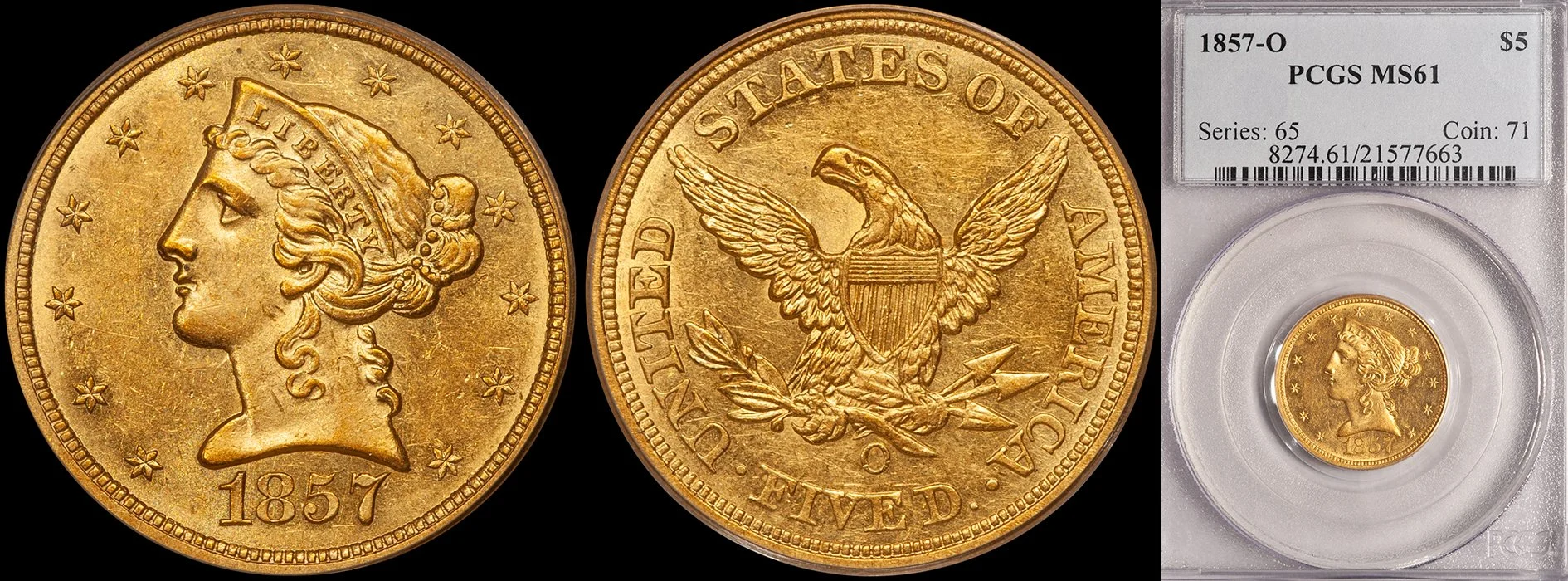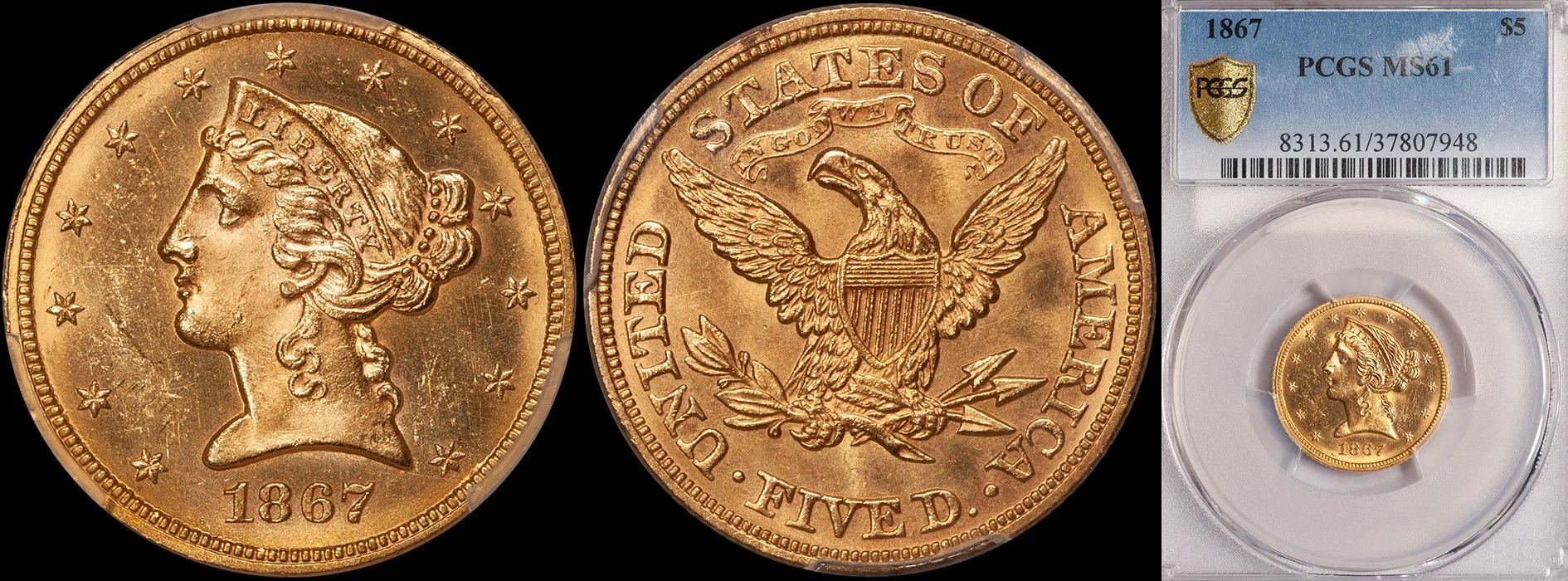
Grade Distribution of Branch Mint Gold Coinage

It is interesting to study the grade distribution patterns for various branch mint gold issues. By this, I am referring to what percentage of a certain issue’s survivors exist in a specific grade range. In order to apply this to a practical numismatic situation, I am going to use the Dahlonega quarter eagle series as my lab experiment. Any assumption that I make in this blog is series specific.

By this, I mean that what applies to Dahlonega quarter eagles doesn’t apply to New Orleans half eagles or San Francisco eagles. And within the Dahlonega quarter eagle series there are differences; as an example the issues from the 1840’s are likely to have different grade distribution patterns than those from the 1850’s due to a number of factors. In the case of Dahlonega quarter eagles, the primary consideration is that of usage: these coins circulated differently in the 1840’s than they did in the 1850’s.

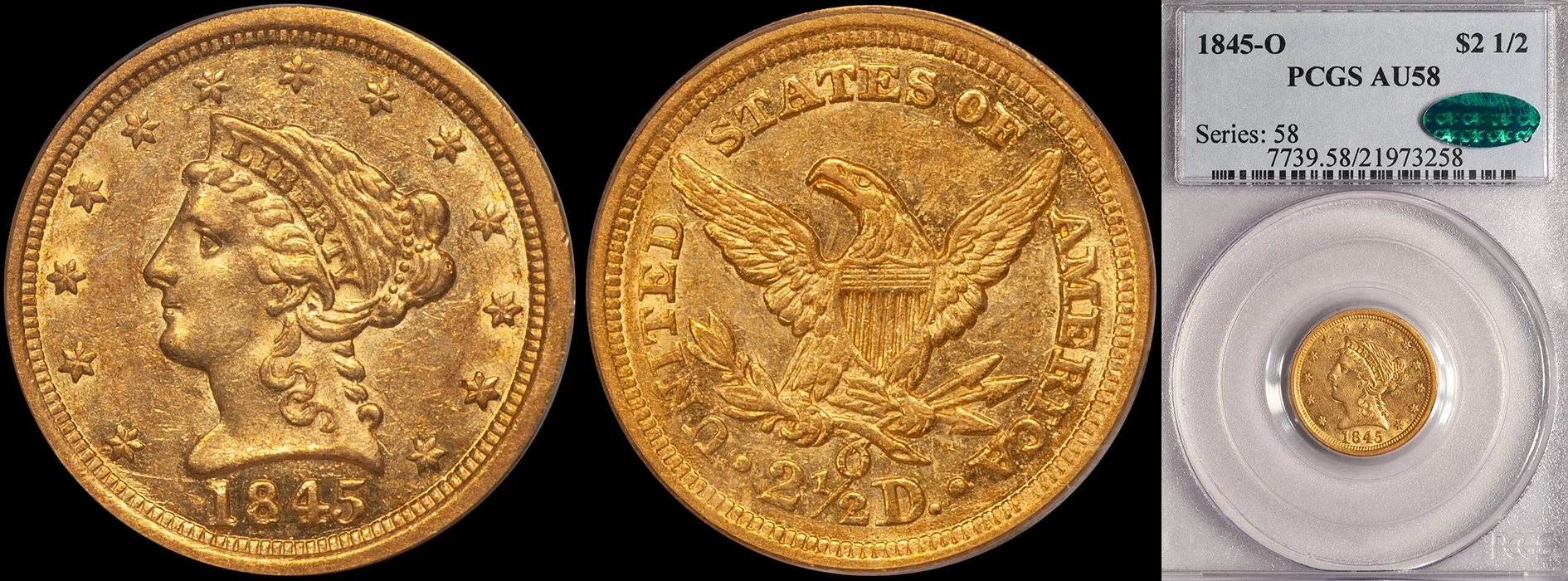
1843-D Small D $2.50 graded PCGS AU50

I think the best “base line” Dahlonega quarter eagle to use in our brief study is the 1843-D Small D. This is the most common date in this series both in terms of overall and high grade rarity. It has the highest mintage figure of any quarter eagle from this mint, and with over 500 examples known, it can be found in a variety of grades.

According to the most recent data from PCGS, there have been a total of 243 coins graded. This number, of course, is inflated by resubmissions, but it gives a good indication of the grade distribution for this issue. According to PCGS, the grade distribution is as follows:

  • VF and lower: 58 coins (23.86%)
  • EF: 77 coins (31.68%)
  • AU: 97 coins (39.91%)
  • Uncirculated: 11 coins (4.52%)

Before analyzing this, there are a few things to remember. First, there are probably more raw low grade 1843-D quarter eagles than there are high grade ones, meaning that the number at the low end of the grading scale could easily inflate if these were ever submitted. Secondly, the number of coins in very high grades (in this case AU58 and Mint State) is clearly inflated on account of the financial incentive to upgrade a coin. An upgrade from VF25 to VF30 is pretty meaningless, but an upgrade from AU55 to MS60 translates to a not inconsiderable amount of money. And lastly, the grade range that has seen the most gradeflation in the last decade is AU, meaning that a significant number of coins graded AU50 or even AU53 by PCGS would not necessarily qualify as such if broken out and submitted again.

Taking all of these caveats into consideration, this grade distribution makes sense to me. I expected at least 60-70% of all 1843-D quarter eagles to grade EF45 and below, and according to PCGS’s figures, the current percentage is 55.54%. If we were able to dismiss all the superfluous AU submissions included in the numbers above, and punt all the marginal AU50 coins that are actually EF’s, this figure might well be close to 70%.

I think that the actual number of 1843-D quarter eagles which grade AU is more likely in the 25-30% range; not all that far off from the 39.91% figure shown.

By any stretch of the imagination, Uncirculated 1843-D quarter eagles are rare. My best estimate is that 15-20 are known, and many are marginal MS60 to MS61 examples. In MS62 and MS63 there are likely no more than four to six and none finer.

The grade distribution for the 1843-D Small D quarter eagle is reasonably similar to that seen for the 1844-D, 1845-D, 1846-D, 1847-D, and 1848-D. These are six of the most available quarter eagles from this mint and they represent the Golden Age, if you will, of commercial use for this denomination in the antebellum south. Beginning in 1848, gold discoveries in California made the Dahlonega (and Charlotte) mint redundant, and by 1854, mintage figures of all C and D mint denominations except half eagles were cursory at best.
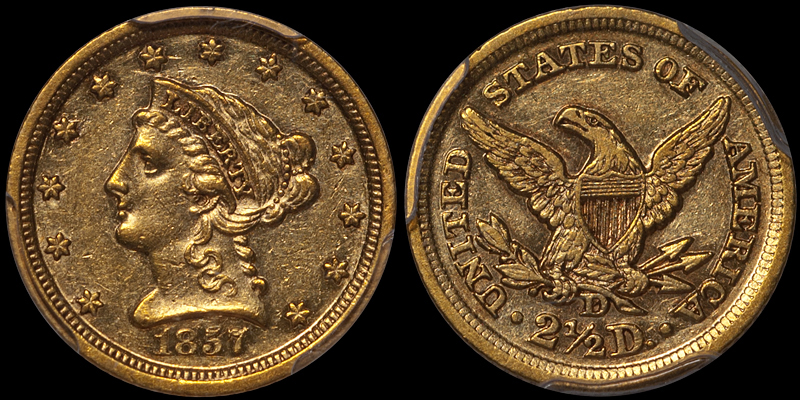
1857-D $2.50 PCGS AU55

There is a Dahlonega quarter eagle whose grade distribution is complete different than the 1843-D; enough so to be a complete anomaly within the series. This is the 1857-D; let’s look at the PCGS figures.

A total of 70 1857-D quarter eagles have been graded by PCGS. The by-grade breakdown is as follows:

  • VF and lower: 4 coins (5.71%)
  • EF: 6 coins (8.57%)
  • AU: 45 coins (64.28%)
  • Uncirculated: 15 coins (21.42%)

The 1857-D is the second to last quarter eagle from this mint with an original mintage of only 2,364 with an estimated 125-150 known. As long as I have specialized in Dahlonega coins, I’ve noted that the 1857-D is almost never seen in VF or EF grades, and most of the survivors are in the AU53 to AU58 range.

What is most interesting about this date is that so many of the survivors have a similar look. The typical example in AU55 to AU58 has an “Unc-ish” appearance with many of the hallmarks of a Mint State coin but with either light friction or soft hairlines suggestive or a gentle old cleaning. And, on most of the high grade coins, the color and quality of luster are similar.

These facts combined with the PCGS grade distribution lead me to believe that the 1857-D is a hoard coin. I can’t prove this—and even if it is true I know nothing specific about the so-called hoard. But the fact that 85% of all 1857-D quarter eagles graded by PCGS are AU or Uncirculated is interesting and is completely different in pattern than for any other date in this series.
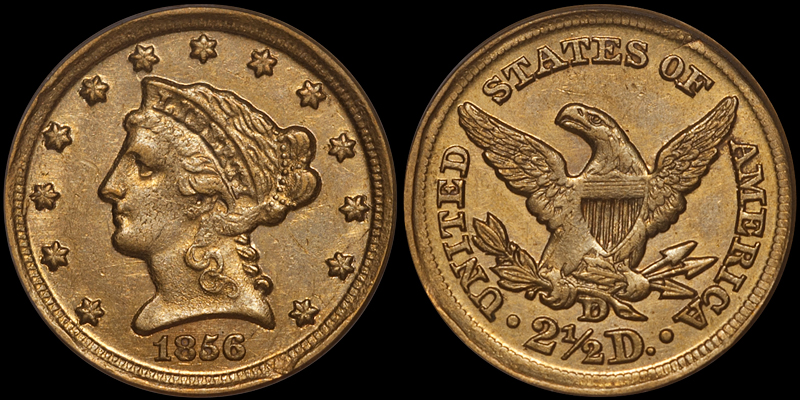
1856-D $2.50 PCGS AU58 CAC

There is one final Dahlonega quarter eagle with a grade distribution pattern which varies from the norm but for a different reason: the 1856-D.

The 1856-D is not only the rarest quarter eagle from this mint; it is the rarest single issue of any denomination. Only 874 were struck and around 45-55 are known in all grades.

The distribution by grade is very interesting; let’s take a quick peek at how the PCGS has graded the 35 they have recorded:

  • VF and lower: 5 (14.28%)
  • EF: 8 (22.85%)
  • AU: 21 (60%)
  • Uncirculated: 1 (2.85%)

There are many interesting things about these numbers, but two points need to be mentioned first. The 1856-D is an extremely poorly produced coin which is exceptionally hard to grade. I have seen 1856-D quarter eagles which could be graded VF30 just as easily as they could be graded AU50. It is also important to remember that as a rarity within the series, PCGS (and NGC as well) tend to push the grade on the 1856-D quarter eagle. Because it is such a rare coin, a nice EF45 example is typically graded AU50 or AU53 with little complaint from specialists.

I think the PCGS grade distribution for the 1856-D is skewed way too far towards AU and I very, very seriously doubt if “60%” of all known examples grade AU50 to AU58. But given the difficulty of grading this issue, I can understand how this is the case.

As I mentioned at the beginning of this blog, the grade distribution for each series depends on a number of factors. Age and the original mintage figure are obvious and important, but there are less subtle factors at play such as perceived rarity, appearance of the coin, whether or not a hoard exist(ed), and if examples were expatriated to Europe and are now returning to the American market.


Do you buy rare gold coins?

Do you have coins to sell?

Would you like to have the world’s leading expert with you assembling a set of coins?

Contact Doug Winter at (214) 675-9897 or by email at dwn@ont.com.
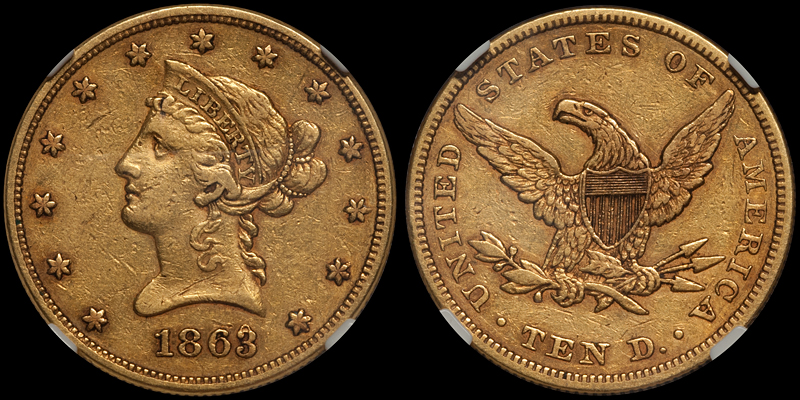
The 1863 Eagle: An Unheralded Rarity

One of my favorite American coins is the 1863 eagle. I had a lovely NGC EF45 pass through my hands recently and it inspired me to write a blog about what I think is one of the absolute rarest Liberty Head eagles. Production of this issue was limited to a scant 1,218 business strikes, and I rate the 1863 as the third rarest Liberty Head eagle after the 1875 and the 1864-S. There are probably fewer than 30 known in all grades, with most in the EF40 to AU50 range. There are very likely as few as six or seven known in AU grades and two in Uncirculated; more about these a little further down the page.

1863 $10.00 NGC EF45 CAC

A quick search of auction records shows that no problem-free 1863 eagles have sold since October 2010, and only seven records exist for problem-free coins in the last decade. My records show that I have handled exactly two pieces in the last five years: an NGC EF45 and a PCGS AU53.

When available, the 1863 tends to be bright from having been cleaned or dipped and it is invariably very heavily abraded. This piece shown above is one of the very few circulated pieces that I have seen with natural color. There are a few small abrasions on the surfaces, but they are much cleaner than usual.

There are two high-grade 1863 eagles known. The finest is the Bass IV: 683 coin which sold for $52,900 in 2000; a price which, at the time, I thought represented possibly the single biggest bargain all of the three Bass sales which featured gold coins. Bass had, through an agent, bought this exact coin in August 1991 for $104,500. Harry didn't lose money on many coins but he got spanked — and good — on this one; all the more remarkable considering that it is the finest known example of a truly rare issue and it is exceptional for the grade. Today, it would bring considerably more than in either of its previous auction appearances.

The other Uncirculated 1863 eagle is an MS62 that was found as part of the S.S. Republic treasure. I have never personally seen this coin, but it is in the collection of a western specialist along with many other finest known or Condition Census pieces from this shipwreck.

Civil War gold coins have been very popular in recent years as a result of the sesquicentennial of the war plus promotions/popularization by dealers such as myself. While it is not well-known outside of the specialist community, it is my belief that there are currently many collectors who would appreciate a nice 1863 eagle in their holdings.

Do you buy rare gold coins?

Do you have coins to sell?

Would you like to have the world's leading expert with you assembling a set of coins?

Contact Doug Winter at (214) 675-9897 or by email at dwn@ont.com.


A Letter from a Collector Regarding the Newman Sale

I recently received a really thoughtful email from a reader of this blog - and with his permission am reproducing it in full. November 16, 2013

An Open Letter to Doug Winter

Hi Doug,

On the day following the Eric Newman Part II early silver auction, I wanted to take the time to thank you for all you’ve done for the hobby over these years. In internet parlance, I’ve been a lurker, someone who follows a blog for some time without contributing. Truth be told, I’ve never even done business with you, despite calling you some years back regarding a branch mint coin. Back to the story, I read your recent blog regarding your experience with the Newman preview and was inspired to view it. Engineering a trip to NYC earlier this week, I had the pleasure of previewing the auction which you had described as “one of the most pleasurable coin-related experiences [you’d] had in years”. Not being a collector of early silver, I’ve always been intrigued by its beauty and historical significance. Add the beautiful toning from the Wayte Raymond albums’ sulfur to what was already a gorgeous assembly of high-grade coins and you were certainly right that this was an historic opportunity.

Like most collectors, I don’t have unlimited resources to commit to coins. Since I have historically concentrated upon territorial and gold-rush period shipwreck coins, I’ve typically felt that a dollar spent on non-territorial, moves me away from my specialty. Frankly, after viewing the magnificent Newman collection, I felt like the proverbial fellow at the dance who keeps falling in love with the last girl he danced with (read “the last coin he viewed”) as I went through box after box. After attending on-line and reviewing the results of last night’s Signature auction, I could hear in my head many of the lessons you’ve written about over the years. To loosely paraphrase you, here are a few:

  • fresh material that’s been off the market for years brings spirited bidding

  • with the really good coins, don’t be surprised that today’s price that seems a stretch will look like a bargain in retrospect

  • superior eye appeal can transcend traditional grading values and pricing

  • a good (in this case, great) collection is worth more than the sum of its parts

  • use of a knowledgeable, honest, good-hearted dealer (readers of your blog know you resemble that remark) can add tremendous value

To make a long story short, I fell in love with many of the coins, and was prepared to buy a few based on pre-auction bid prices. I had done my due diligence as best I could by viewing comparables on the auction websites and reviewing population data. Note to self, many coins were so appealing there were few visible “comparables” to judge fair pricing. As the bidding developed, I quickly saw that factors 1) thru 4) above were at work, bringing prices multiples of what I had determined were already solid prices. Not having significant experience with early silver, nor the time to consult a knowledgeable dealer, I was on my own.

I passed on most lots I had identified as their prices went to levels way beyond my estimates, although they may very well look like bargains later. Truth be told, I bought only one coin, solely because I thought it was cool on multiple factors. The coin is the 1817 over 3 bust half dollar in MS-64, Lot 33447. The factors:

  1. a big, bold, well-struck coin with great Wayte Raymond toning and almost cameo-like eye appeal

  2. a very visible error with the 7 looming over much of a 3; magnification not necessary to enjoy and much more prominent than the 1815/2 error which goes for big money

  3. interesting vivid clash marks on both sides, very visible given the strike and toning

  4. proof-like features so prominent that they were noted by Eric Newman and Walter Breen and the subject of considerable discussion

  5. well-nestled in the condition census by grade, only 11 of 70 Heritage auction appearances were uncirculated, with few near gems, and frankly, none I liked more

  6. provenance before Eric Newman was “Colonel” Green, son of Hetty Green, known as the witch of Wall Street; interesting history and connection to two great collections

  7. I’m not sure if the Newman envelope that accompanies the coin reflects his acquisition or offer price, but he paid or valued it at $100 many years ago, far more than many of the other coins in this auction. I know it’s not scientific, but buying it for $28,200 seems a bargain when many other coins annotated by Newman for much less than $100 sold for a quarter million dollars or more.

It wasn’t quite graded a gem and it doesn’t have the CAC bean. It may not have the PCGS look. As a traditionally gold coin guy, I have trouble appreciating and viewing the somewhat muted toned “original” look much early silver exhibits; I like the flash. Perhaps I overpaid or knowledgeable folks could find fault, but it literally jumped out of the box during my preview. It turned me on for the above reasons and shall proudly sit in my cabinet to remind me of this historic sale for years to come!

Closing the loop, I wanted to thank you again for what you do for the hobby. Keep on dealing and writing. I’ve read and enjoyed all your branch mint books and I visit your website often to view your inventory and gain perspective. Your enthusiasm is contagious and your eye for the right look in a coin is superb. Don’t ever think that because you don’t get feedback on a particular piece you write or a sale from every interaction you have with a collector, you are not making an impact. It is folks like you (and Eric Newman, thru his generosity) that knowingly or not mentor, develop, and inspire the future collectors that keep our hobby vibrant. Developing future generations of collectors should be a goal of us all.

Please feel free to publish this article if you see fit, but withhold my name for privacy reasons. I hope this gives you some material, so you can have a well-deserved break from the excellent writing. Thank you.

1817/3 Bust Half NGC MS64, lot 33447, image courtesy of Heritage

Our writer also attached a wonderful photo of himself, with his 4-month old daughter, bidding on the 1817/3 bust half. He plans to give it to her when she’s old enough to understand. Thank you to our ghost-writer for sharing!

Do you buy rare gold coins?

Do you have gold coins to sell?

Would you like to have the world’s leading expert working directly with you when assembling a set?

Contact Doug Winter at 214.675.9897 or by email at dwn@ont.com.

When the "Best" Coin isn't the "Better" Coin

In many series, collectors are slaves to the holder. By this, I mean, they make purchases which aren’t always prudent based on what a PCGS or NGC holder says. This is most prevalent in Registry-oriented 20th century series such as Lincoln Cents and Washington Quarters (amongst others) - series in which a single grading point can inflate the value of a coin by 5, 10 or even 20 times.

This tends not to be the case with classic 19th century gold coins, but every now and then a situation arises in which a coin which is theoretically the highest graded may not be the best purchase for an advanced collector.

A situation involving this scenario emerged at the recent Baltimore Stacks Bowers auction and I’d like to share my thoughts.

Please note that this is not meant to be a negative rant about the following coin, and the buyer of this coin is, no doubt, happy with his or her purchase.

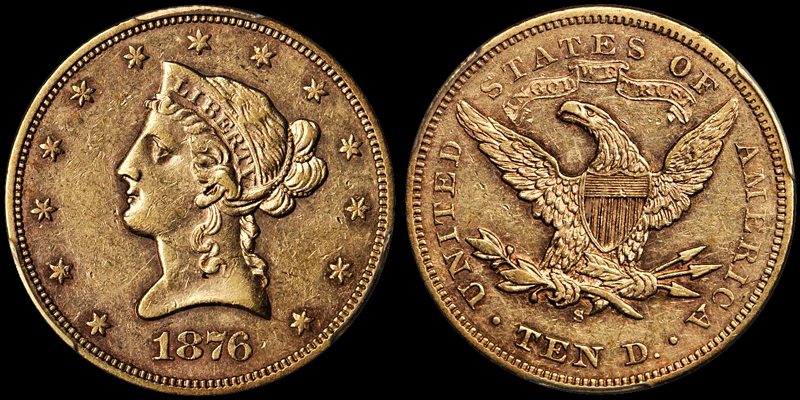
The 1876-S eagle has long been a favorite issue of mine. It has a small mintage of just 5,000 coins, and I think five or six dozen exist, with most in the VF to EF grade range. I have never seen an 1876-S which grades higher than AU53 to AU55, and my best estimate is that there are around six or seven properly graded AU examples known. Until recently it was an unloved and generally undervalued coin.

In the recent Stacks Bowers Baltimore show, a newly graded PCGS AU55 example of this date was offered. In theory, this is the “finest known” example as it is a population one, none finer, coin. It sold for $22,325. I examined the coin and, in my opinion, it was sub-par for the grade. (Had it been a very choice coin for the grade, I think it would have brought closer to $30,000).

1876-S $10.00 PCGS AU55, image courtesy of Stack's Bowers

While $10 Libs are not a typical Registry Set series, there are a few advanced, deep-pocketed collectors who are specializing in these coins. And the opportunity to acquire a PCGS finest known coin—with the “points” this would add to such a set—is an unusual opportunity to say the least.

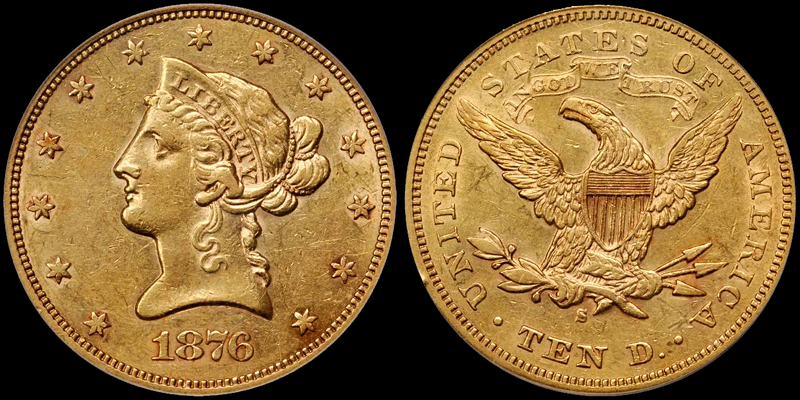
But what if a cheaper example of this same date was actually a “better” coin? What if an 1876-S eagle graded AU50 by PCGS were more original, more appealing (in my opinion), and a fraction of the price?

Back in their 2011 ANA auction, Stacks Bowers sold a PCGS AU50 example of an 1876-S eagle. I didn’t buy it even though, in retrospect, I probably should have.

Take a look at this coin:

1876-S $10.00 PCGS AU50, image courtesy of Stack's Bowers

I think it compares favorably to the PCGS AU55 shown above. It is a bit less “meaty” but it is more original, less “baggy,” and has comparable—if not better—overall eye appeal.

Most intriguingly, it sold for just $6,325 - or around a quarter of what the AU55 brought.

Here is an instance where Registry-mania caused a so-so coin to sell for a lot of money but didn’t have an impact on a nice, slightly lower grade coin because it wasn’t “the finest known.”

Examples like this are becoming more and more prevalent in the area of 19th century United States gold coins.

The moral of the story? Don’t always trust the plastic you buy to equate with the best value in your series. There is no substitute for knowledge and, in many cases, this knowledge will save you money and provide you with a better overall collection.

Do you buy rare gold coins?

Do you have gold coins to sell?

Would you like to have the world’s leading expert working directly with you when assembling a set?

Contact Doug Winter at 214.675.9897 or by email at dwn@ont.com.

First Impressions of the Newman Sale

I’m freshly returned from Dallas, where I attended a spectacular coin dealer wedding, and combined the nuptials with viewing the remarkable silver coins that are being sold on behalf of Eric P. Newman. I spent close to two full days viewing, and it was one of the most pleasurable coin-related experiences I’ve had in a long time.

I’ll be writing more blogs on the Newman sale as I think it is one of the most important numismatic events which will occur in many years to come. But I’d like to share a few impressions about the coins — namely the appearance and surface preservation.

In a nutshell there were basically three types of coins in the sale:

  1. Coins which were spectacular before they were stored long term, and which were carefully handled in the ensuing 50-75+ years.
  2. Coins which were average quality before they were stored, but which have toned superbly and which now appear “better” than they might actually be.
  3. Coins which may (or may not) have been nice, but which were not well-stored and now are dull or drab. These are coins that almost certainly will be dipped if they are purchased by dealers. In some instances I believe that this dipping will significantly improve the coins.

Let’s look at an example of each of these three categories and briefly discuss the impact of how they were stored.

Hands down, my favorite group of coins in the sale was a date run of Large Size Bust Quarters, struck from 1796 to 1828. Viewed as a type, these are among the most difficult silver designs to find in high grades. The Newman collection had a number of Gems; far more than I can recall having ever seen in one place — even more than Eliasberg or Norweb.

Lot 33334, image courtesy of Heritage

Possibly my favorite early quarter, from a technical standpoint, was Lot 33334, an 1807 graded MS66* by NGC.

Close examination of this coin revealed nearly flawless surfaces with wonderful luster and no signs of hairlines or past attempts of “improvement.” I don’t know what this coin looked like 75 years ago, when it was probably lightly toned or even white,  but the color it has acquired from storage was simply breathtaking. This coin, along with a number of the Bust Quarters and Bust Half Dollars in the collection, had been placed in old Wayte Raymond albums. These contain paper with high sulfur content and this tends to impart superb color with rainbow hues in instantly-recognizable concentric patterns.

The next classification of coin is one that wasn’t as nice as category #1 but which was beautifully toned from storage in a Wayte Raymond or another high sulfur source.

Lot 33321, image courtesy of Heritage

Lot 33321 was an 1840 With Drapery dime graded MS64* by NGC. In my opinion, this looked like a coin which had been cleaned many years ago and there were a decent number of hairlines on the surfaces. However, these were easy to overlook on account of the superb color shown on the obverse and reverse. I counted a number of coins in the sale which were clearly given a significant bump in grade due to exceptional second-generation color.

The third and final category are coins whose actual appearance is difficult to determine due to storage issues; probably in old 2x2 brown paper envelopes which imparted a lot of toning but not in the spectacular manner as seen on the two coins displayed above.

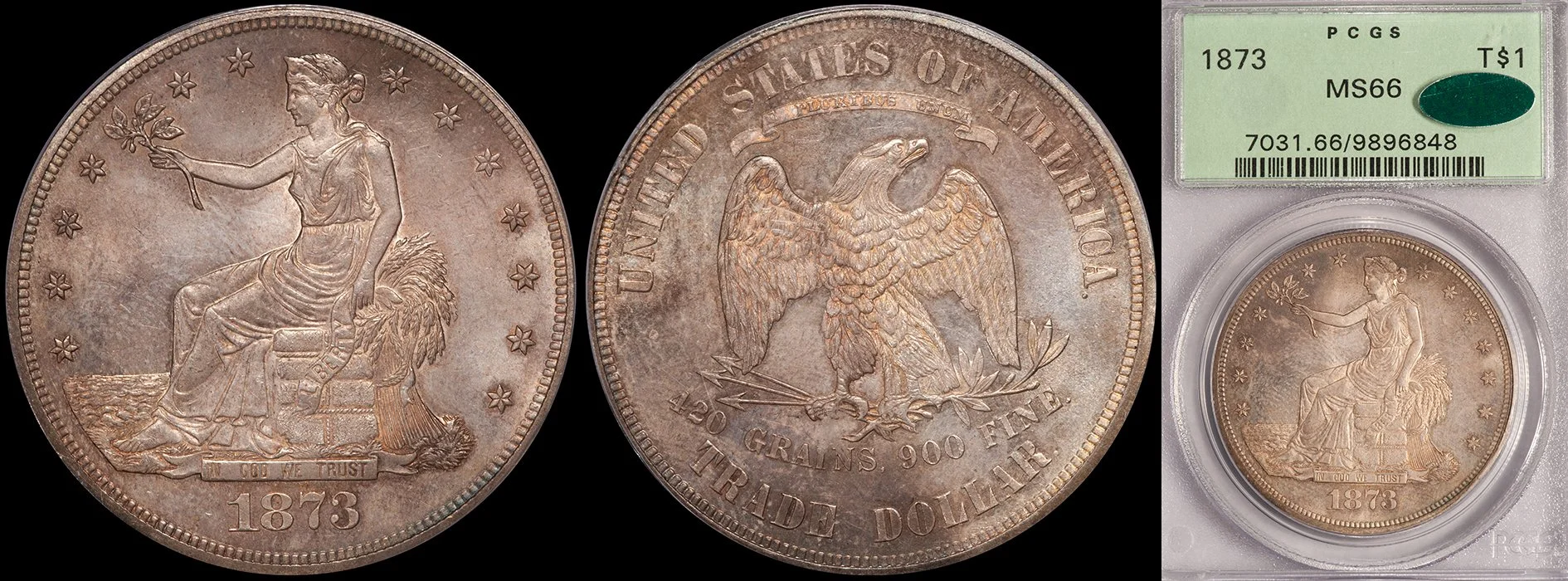
Lot 33883, image courtesy of Heritage

On his inexpensive coins, Mr. Newman clearly placed less of a premium on careful long-term storage. This is clearly easy to understand given that some of these cost of just a few dollars when they were purchased. An example of this is Lot 33883, an 1875-S Trade Dollar graded MS62 by NGC. It is hard to say what this coin looked like when it was first placed in the brown envelope it had been stored in for decades. Today, it was very deeply toned with somewhat impaired luster as a result.

Will this coin look better if it is dipped? Possibly yes, possibly no. One of the interesting things in this sale is trying to imagine what the category 3 coins look like without 75+ years of dirt, grime, and monochrome color.

The dealers who are best at determining which coins will dip well will be fascinated by this sale, and I have no doubt that they will be active participants. As I said above, this is not necessarily a bad thing. No one is going to dip a coin like the amazing multi-hued 1807 quarter shown above. And I doubt that any of the category 2 coins will be dipped either; nor should they. Ah, but the category 3 coins…here is an interesting subtext to the Newman Sale!

If you need representation at this sale, please feel free to contact me via email at dwn@ont.com.

What Can CAC Population Figures Tell Collectors About Quality and Rarity?

Now that CAC has become an integral part of the rare date gold market, there are certain things that their database of coins that have been approved can tell collectors. This wasn’t necessarily true as recently as a year to a year and a half ago, but I believe that enough coins have been seen by CAC that their numbers have gained a degree of legitimacy. This is especially true for expensive and/or truly rare coins.

One thing that CAC data can tell a savvy collector is how rare a coin is with good eye appeal. In other words, if the combined PCGS/NGC population of a certain date/mintmark is 15 coins in EF, how many of these are choice and original?

How do these figures look in a series which is notorious for having numerous condition rarities? I decided to analyze the increasingly popular Liberty Head eagle series using CAC population data from their most recent report (September 2013) and compare it to research which I published a few years ago.

In 2008 I published an article entitled The Ten Rarest Ten Libs. I based this research on my 25+ years of specializing in this denomination, consulting auction records from the past two decades, and looking at current PCGS and NGC population data. My Top Ten list was concerned more with absolute rarity (i.e., the total number of coins known in all grades) versus condition rarity (the number of coins known in higher grades).

1844 $10.00

 According to my research, here are the ten rarest Liberty Head eagles:

  1. 1875

  2. 1864-S

  3. 1873

  4. 1863

  5. 1865-S Normal Date

  6. 1860-S

  7. 1883-O

  8. 1844

  9. 1839, Head of 1840

  10. (tie) 1858, 1859-S, 1864, 1866-S With Motto, 1876, 1877

Looking back on this list five years later (!), I basically still agree with it - except for one glaring omission: the 1855-S. I’m not sure why I didn’t include this date in my Top Ten; I very possibly might have forgotten it. Today, I would certainly include it and place it as high as #8 on the list. I would also eliminate the 1858 from the #10 grouping, and quite possibly the 1859-S and 1864 as well.

Before I delve into the CAC populations, there are a few caveats which I think are important to better understand this blog.

Firstly, we are assuming that at this point in time a good number of rare date gold coins get sent to CAC. However, I happen to know at least four major collections of Liberty Head eagles which have never been seen by CAC, and which contain many coins currently “unbeaned” by CAC which should be nice enough to qualify if and when they are sent in.

Secondly, we are making an assumption that “CAC quality” coins really are nice for the date and grade. I personally don’t think that is a stretch, but I clearly have seen some better date Liberty Head eagles with CAC stickers that weren’t all that nice and, conversely, have sent some coins to CAC which I thought were very nice and, for whatever reason(s), didn’t get blessed.

Thirdly, I think making assumptions about the rarity of coins like Liberty Head eagles based solely on CAC data would be a mistake. Instead, I would view the CAC data as a component of determining high grade rarity.

Let’s look at the Liberty Head eagles which, as of October 2013, have yet to see a single example approved by CAC:

  • 1844

  • 1863

  • 1864

  • 1865

  • 1865-S Normal Date

  • 1866

  • 1866-S No Motto and 1866-S With Motto

  • 1872

  • 1873

  • 1875

  • 1876-S

There are no huge surprises here. This group of 12 coins is well represented on my Top Ten rarest list. The 1864 is a bit of surprise as I have handled a few nice pieces in the last few years and the same is true with the 1866-P and the 1866-S No Motto.

Now, how about the dates in this series with only 1 coin approved by CAC. Along with the dates, I’m going to list the grade of the sole CAC-approved coin.

  • 1839 Head of 1840 (EF40)

  • 1858-S (AU50)

  • 1859-S (AU50)

  • 1867-S (AU55)

  • 1870-CC (EF45)

  • 1877 (AU55)

This is an interesting group. All five are rare, and at least one (the 1839 Head of 1840) is on the Top Ten rarest list. The other four are dates which are a bit more available but which seldom come with nice surfaces and natural color; two elements which are rewarded by CAC. In this instance, the CAC results hold pretty true to form; more so than what I expect from NGC or PCGS results.

As a final list, let’s look at the dates in this series with just 2 coins approved by CAC. Again, along with the dates I’m going to list the grades in which CAC has approved these.

  • 1855-S (EF45, AU55)

  • 1859-O (EF45, AU53)

  • 1860-S (VG8, AU55)

  • 1862-S (EF45, AU55)

  • 1864-S (VF30, EF45)

  • 1870 (AU50, AU55)

  • 1871 (AU55, AU58)

  • 1876  (AU53, AU55)

  • 1895-S (EF45, AU53)

To me, this is the most interesting list, for two reasons. The first is the dates (1859-O, 1862-S, 1864-S) which I didn’t expect to see two of, let alone one. The second is the presence of the 1895-S, a date which gets little respect from even the most ardent specialist and which only two reasonably low grade pieces have been approved by CAC to date. Sleeper alert!!

I’m going to revisit this topic in the near future, as I think it is a good way of determining the true rarity of certain coins in high-end “PQ” grades. By the same token, it also has relevance for lower grade coins like VF and EF when it comes to determining how nice a really rare coin is for its respective grade.

For more information on CAC and on Liberty Head eagles—with or without CAC approval—please feel free to contact me by email at dwn@ont.com.

The RYK Retort: More on the 1892-CC Eagle

Editor’s note: The following reply was received by me this morning and it was written by well-known collector Robert Kanterman about the blog I published yesterday. It is unedited and, I think, an interesting insight into the mind of a sophisticated, well-focused collector. I was the lucky buyer, and I will address DW's points from the previous blog.

1. Underpriced? Perhaps a little bit, not too much — okay, I thought it was a screaming bargain! I would have been interested up to the $1200-1300 range. Maybe even $1500 if I really needed it for a date or type set.

As recently as a few months ago, the basal value of any old Liberty $10 was approaching $1000. Perhaps I am living in the past, but I still view $10 Libs as $1000 or so coins.

2. CC gold is extremely popular. More popular than ever. Just when I think that interest is starting to wane, it seems to gather more steam. Good luck trying to find me some CC $20's in OGHs.

3. I love OGHs, and I am not afraid to admit it. Graded years ago, under perhaps different standards, and untouched by human hands for 20+ years, what's not to love? Add to that the fact that many filthy gold coins from European hoards were slabbed in the OGH era (more below). I also believe that the green of the label and the gold of the coin complement one another in a way that even art enthusiasts like DW should appreciate.

A wise coin dealer friend told me earlier this year that the PCGS Reconsideration service marked the death knell of the OGH. I am not so sure. The OGH is dead. Long live the OGH!

4. DOGs (Dirty Original Gold coins) are The Bomb among serious collectors of 19th century circulated gold coin and other numismatic vagabonds. DWN has certainly educated collectors about originality, in his books, website, and in person, and made them popular, but RYK invented the "DOG" and used his big mouth (or noisy keyboard, anyway) to spread the gospel.

5. Liberty $10's are a great series, chock full of rarities and interesting dates. There are numerous logical ways to collect them that do not necessarily bust your coin budget (or require you to sell your home). There is also no question that David Hall's finest ever PCGS registry set and its well-publicized sale a few years back has raised the profile of these coins. Here's a confession — the first coin that I ever purchased from DWN was an 1849-O $10. The second coin was an 1883-CC $10. The last two were also Liberty $10's, both in OGHs. I really like Liberty $10's a lot.

And The Winner For Most Popular Coin Is....

I bought a ton of coins at the recent ANA. They ranged in price from under $1,000 to close to $100,000 and nearly all have been sold on my website in the two+ weeks since the end of the show. One coin garnered more attention than any other. It was ordered no less than eleven times (by different individuals) until I finally marked it "on hold." I would have never guessed, when I bought it, that this seemingly mundane coin would have become my Most Popular New Purchase for the 2013 ANA. And the winner for Mr. Popularity was (drumroll)......???

An 1892-CC eagle graded EF40 by PCGS (and approved by CAC) in an Old Green Label Holder.

1892-CC $10.00 PCGS EF40 CAC

Priced at a whopping $1,000, this coin connected with a wide range of people. It was ordered by two dealers and nine collectors running the gamut from beginners to seasoned vets.

What was it about this coin that made people go gaga?

I have a few theories. Let's explore them.

1. It Was Underpriced

As I mentioned in the description, by today's standards this coin grades more like AU50 to AU53 than EF40. This made it more likely to have a final value of $1,250 or so as opposed to the $1,000 it was listed for. At least eleven people spotted that this was a good deal, if not an actual bargain.

2. It Was An Affordable But Nice CC Gold Coin

If you don't have a huge budget but want to own a Carson City gold coin with a good overall appearance, you don't have a ton of choices. The typical CC double eagle now costs over $2,000 - and at the $1,000 price point any half eagle that's not dated 1891-CC tends to be kind of boring. I can't remember the last time I had an interesting CC eagle that was priced at $1,000.

3. The Lure of the OGH Is Strong...

Collectors love OGH PCGS coins and it isn't hard to understand why. The purist in me appreciates that a coin graded back in the late 1980's or early 1990's is going to look the same in another 20+ years as it does now. In other words, if PCGS had missed surface enhancement(s) on said 1892-CC eagle, the coin would have already turned in the holder. The fact that it was dark and dirty was a pretty sure sign that it was "as is" and wasn't going to turn.

4. Nice, Original Coins Are In Demand

This coin was dirty and original and coins with this sort of appearance are in demand. I'd like to think I had a little bit to do with this...

5. Liberty Head Eagles Are In Demand As Well.

As I've pointed out a number of times in the last few years, the Liberty Head eagle series has gone from mildly popular to very popular. This denomination will never be as popular as its big brother the double eagle but the number of people who dabble or specialize in this denomination has grown dramatically since 2008-2009. And an interesting Liberty Head eagle priced at a grand isn't easy to find.

I would have to guess that this perfect storm of desirability and appeal was what made this 1892-CC eagle so popular. To the collector whose email I received first and who is now the happy owner of Mr. Popularity...kudos. And to everyone else who tried and failed to buy the 1892-CC eagle...thanks and sorry. We will do another deal and soon, I hope!

The 1854-S Double Eagle: A Study

The 1854-S double eagle is one of the most interesting Liberty Head double eagles. It is widely acclaimed by collectors due to its status as the first double eagle from this mint, and the rarity of the quarter eagle and half eagle from this year makes it a famous coin as well. That said, it is an issue that is not well understood and one whose rarity profile has been made confusing by inconsistencies from NGC and PCGS.

The 1854-S has a high original mintage figure of 141,468 and one would expect it to be available in higher grades. This is not necessarily the case, despite what appears to be a decent number in Uncirculated as per the grading services’ current figures.

As of August 2013, NGC had graded a total of 48 in Uncirculated, including 23 in MS63 and another 10 in MS64. PCGS had graded a total of 55 in Uncirculated, including 17 in MS63 and another three in MS64. With a total of 103 graded in Uncirculated, we can conclude that the 1854-S is only a marginally scarce coin in higher grades and it seems more available in comparably high grades (i.e., MS63 and higher) than such contemporary non-shipwreck dates from this mint as the 1855-S, 1858-S and 1859-S.

However, this is not the case.

What the NGC and PCGS populations fail to address is the fact that virtually every Uncirculated 1854-S double eagle is a shipwreck coin. And what’s worse is that these are designated on the holder as being from a shipwreck - and both services seem wildly inconsistent with how this date is graded and why some blatantly “environmental damage” coins are in “normal” holders while others are not.

Essentially every high-grade 1854-S double eagle is from the S.S. Yankee Blade shipwreck which was found in 1977. This wreck contained approximately 200-300 coins. These were Uncirculated coins which must have been spectacular before the boat carrying them sank; the survivors tend to show very few marks but they have matte-like surfaces from exposure to seawater. Some examples have less etching in the surfaces than others; some are clearly salvaged and have oxidation as well as scratches from the process of removing crud from the surfaces.

What few collectors realize is that, as with the 1854-S eagle, the survival rate of high grade 1854-S double eagles with original surfaces is exceptionally low. I have seen exactly three with original surfaces which I grade Choice AU to Mint State by today’s standards. In comparison, I have probably owned 20 examples graded MS62 to MS64 but with “unoriginal” surfaces.

The choicest 1854-S double eagles I have seen with original surfaces include a PCGS 61 from the Bass collection (ex Bass III: 781 at $10,450; I later sold this coin to a collector on the East Coast), an NGC MS61 which I bought out of a Heritage sale around ten years ago (and can’t currently remember the exact pedigree), and a PCGS AU58 which I purchased from a New York dealer around four years ago and which was very choice for the grade. I believe that a few others are known but I can stately with reasonably strong conviction that none exist in grades higher than MS61.

There are certain diagnostics seen on the Yankee Blade coin which are not seen on the coins with original surfaces. Some of these are as follows:

  1. The shipwreck coins always have an obverse die crack which runs up from a denticle at 6:00 on the obverse through the left side of the 5 in the date, terminating at the truncation.
  2. The reverse has a total of three cracks. The first runs into the field (at the viewer’s left) from the base of the N in UNITED. The second crack begins between the denticles left of the first T in TWENTY up to the left tip of the letter. The third begins at the tip of the T in TWENTY and travels left into the field ending below the N in UNITED. On the late die state, these three cracks meet below the base of the right foot of the N in UNITED.
  3. The shipwreck coins always show a broken crossbar in the A in STATES.

The original surface coins do not show these die cracks. They do have a similar mintmark, and all seem to have the broken crossbar. Interestingly, there are a number of small raised die dots on the obverse with two to the right of the 4 in the date, and three at the throat. There is also a small raised die dot on the neck.

I don’t believe that the original surface coins are from a different die pair than the seawater coins; just a different die state.

Breen lists four different die varieties for the 1854-S, but one of these is a Proof-only die (the unique coin in the Mint Collection) while another, described as having “extra thin numerals and letters,” is just a late state with lapped dies. He states that 8 pairs of dies were created and that the mintmark “usually…touches the tail; though on one it is free.” (He then states that on one it is “embedded.”). I have only seen one reverse and it always has a broken A in STATES and a mintmark which firmly touches the tail at its top.

There is, of course, another significant difference on the original surface coins and that is a different texture from a lack of exposure to seawater and sand.

1854-S $20.00 NGC AU58+ CAC with original surfaces

Original surface 1854-S double eagles typically show a deep green-gold or orange-gold hue. The luster doesn’t tend to be as frosty as that seen on 1855-S or 1856-S double eagles. The overall look tends to be subdued with multiple abrasions from hard circulation.

1854-S $20.00 NGC MS64, with evidence of seawater

There are two distinct looks for seawater 1854-S double eagles. The first is blatantly matte-like with heavy environmental damage; some of these are slabbed as “normal” coins by NGC and PCGS while others are “details only” or “genuine.” The more familiar look on the Yankee Blade coins is bright and slightly matte-like with rich yellow-gold color and a virtual absence of circulation marks on the surfaces.

The normal surface 1854-S double eagles should sell for a significant premium in all grades due to the scarcity. This date is seen from time to time in the EF40 to AU50 range, but it becomes very scarce in AU53 to AU55, and it is very rare in properly graded AU58. As I mentioned above, I have seen only three examples with original surfaces in Uncirculated and doubt if more than five or six exist.

For more information on Type One double eagles, I invite you to look through the blog and articles archive(s) on raregoldcoins.com or email me at dwn@ont.com with specific questions.