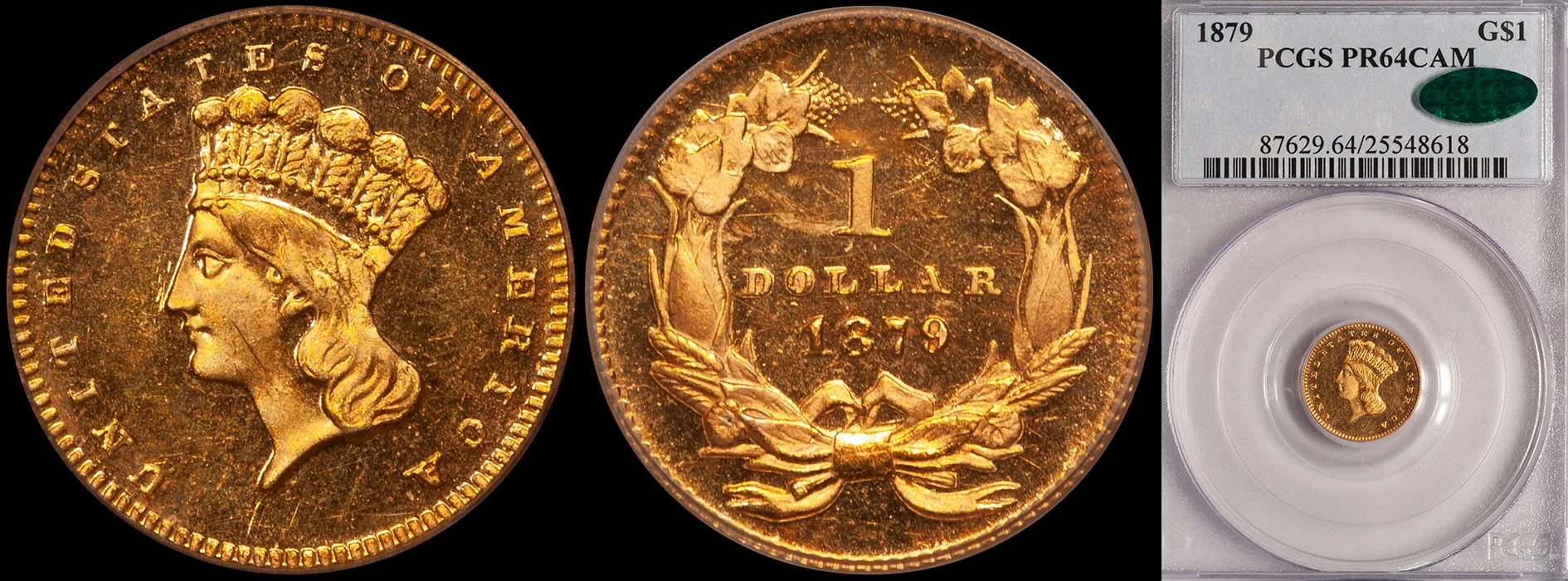
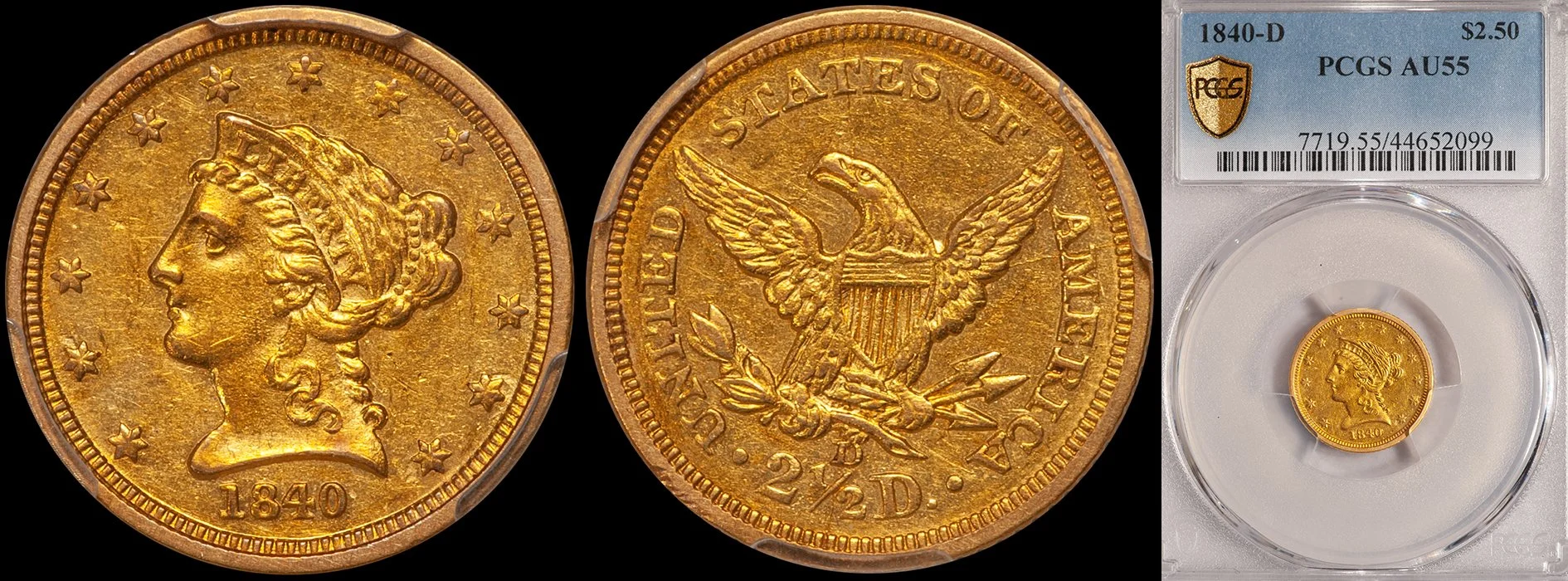
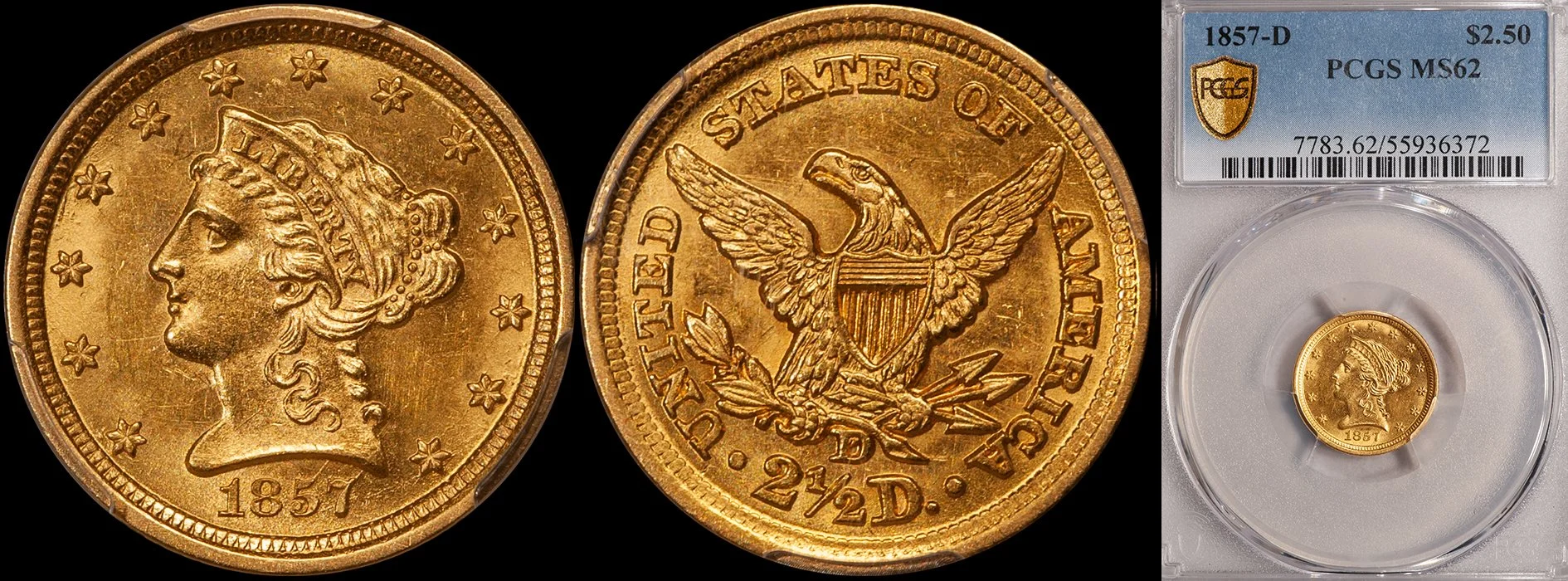
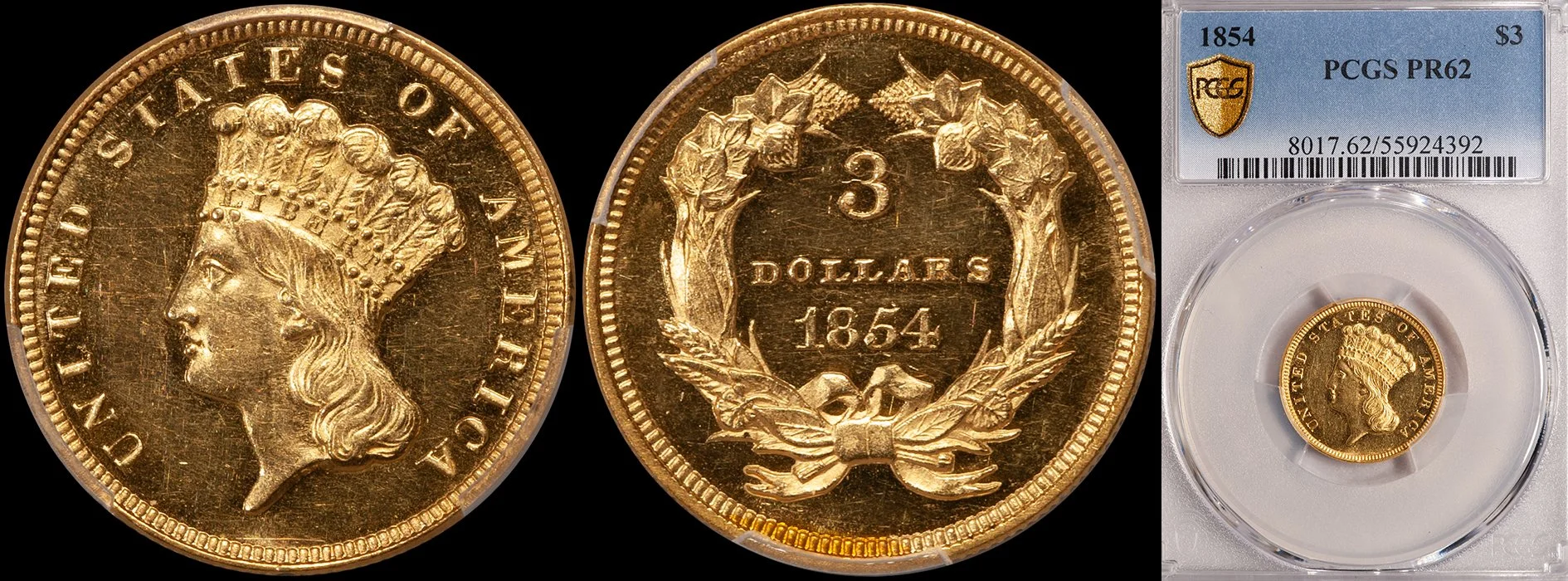
1843-O Large Date $2.50 PCGS MS61 CAC

The 1843-O Large Date is one of the scarcer New Orleans quarter eagles in Uncirculated. There are probably fewer than ten known in properly graded Uncirculated and I have never seen an example that I felt graded higher than MS62 to MS63. The present piece is solidly within the Condition Census and it is unusual in that it displays reflective surfaces instead of the usual thick, frosty luster. There is some mint-made roughness in the planchet as made and the color is a rich, even orange-gold hue with a small spot on the reverse above the left side of the E in STATES. There have been just two auction sales for a PCGS MS61 in the last few years. The first was Heritage 10/11: 4654 at $9,200 while the second was Stack's Bowers 2011 ANA: 7610 which was bid up to $8,625. CAC has approved three in this grade with another two finer.

1852-C $2.50 NGC MS62 CAC

Elrod/Dingler Pedigree. The 1852-C is the seventh rarest of twenty quarter eagles struck at this mint. But this is misleading as it is an extremely rare coin in Uncirculated. To the best of my knowledge there are just two or three known in Uncirculated. The finest is the Bass coin (ex Bowers and Merena 10/99: 453) which is graded MS63 by PCGS and which sold for $26,450 well over a decade ago. The present example is the second best and it is clearly the best available. It is semi-prooflike and exceptionally well struck for the issue with far better detail than usual for the issue. Even more remarkable is this coin's rich natural yellow-gold and greenish color and the lack of marks on the surfaces. I have owned this coin twice before and when I sold it to Paul Dingler back in the late 1990's, it was in a PCGS MS62 holder. It was later cracked out in an attempt to upgrade it to an MS63 at NGC and it has valid claims to this level given its quality. This coin was originally owned by Stanley Elrod who owned the best set of Charlotte gold coins ever assembled. If you collect Charlotte quarter eagles or if you just want to own a great coin to salt away for a few years give this wonderful piece some serious consideration as it is an important and impressive example.

1823 $5.00 PCGS MS62 CAC

BD-1, High Rarity-4/Low Rarity-5. Struck from the exact same reverse die as the famous and ultra-rare 1822 half eagle. The 1823 is an overlooked date in the Fat Head half eagle series with a surviving population that appears to be as low as 75 coins. It is far rarer than the 1814/3, 1818 or 1820 and it is dozens of times rarer than the "common" 1813. This example is absolutely beautiful for the grade with fully prooflike surfaces that have toned in rich lemon-gold and orange shades. The fields have a few light handling marks but they have the body and appearance of a coin that grades at least a point higher. Here's my take on why this coin is a good value: an MS62 CAC 1813 of this quality is worth around $17,500 and can be found without a great deal of trouble. This 1823 is priced at just a bit more than double the amount but it is a rarity in all grades and it is almost impossible to find in grades above this unlike the 1813 which is reasonably common even in MS63. After the recent Heritage FUN sale, the Fat Head half eagle series is really starting to come into its own. There are still good opportunities in this series, though, and this 1823 is one of them.

1850-D $5.00 NGC AU55

The 1850-D ranks as one of the five scarcest Dahlonega half eagles in terms of its high grade rarity. It is a really hard sisue to find in the upper AU grades, especially with natural color and good eye appeal. This example is one of the few 1850-D half eagles that I have handled in a number of years that is characterized by deep, natural coloration. The obverse and reverse show pleasing even green-gold hues and there is a good deal of dirt visible in the protected areas of the reverse. As on nearly all known 1850-D half eagles, this piece shows a reasonably faint mintmark but it is not a "Weak D" coin as these have nearly no traces of the D.

1862 $1.00 PCGS PR66DCAM CAC

I'd like to think that I'm not overly prone to hyperbole when it comes to describing coins but I'm going to go out on a limb and state that this 1862 Proof dollar is one of the single best looking pieces of Proof gold that I have seen in years. It has remarkably strong contrast between the devices and the fields and it has clearly never been dipped or processed as have most Proof gold coins. A careful look at the surfaces with a 5x glass shows virtually no marks and a total absence of hairlines. A total of 35 Proof gold dollars were struck in 1862. Some were not sold and others were later impaired. All told, there at most fifteen known of which maybe four or five are Gems. The present example is clearly the second finest, trailing only the Eliasberg: 50 coin which was later sold as Scotsman 10/08: 790 (and graded PR67 Ultra Cameo * by NGC) where it brought a record $51,750. Proof gold coins of this quality, regardless of date or denomination, are almost never available and the fact that this amazing piece is a rare issue and a Civil War date makes it especially desirable.

1858 $1.00 NGC PR66UCAM

The U.S. Mint began selling Proof coins directly to the public in 1858 and this proved to be quite popular. The exact mintage figure for Proof 1858 gold coinage is not recorded but it is thought that the number of dollars struck was somewhere in the range of 30-40. Around half of these are known today and most of the survivors grade in the PR64 to PR65 range and are characterized by planchet problems and lintmarks. The present example is the second finest known 1858 Proof gold dollar that I am aware of, trailing only Stacks 11/09: 1778, graded PR67 Ultra Cameo by NGC, that sold for a rousing $92,000. The present example is superb with stark black and white contrast and lovely natural yellow-gold coloration. The surfaces are fully reflective and lack any marks which might serve as identification. At the recent FUN show I was able to view a PCGS PR66 Cameo example of this date which was a lovely coin but, in my opinion, technically inferior to this piece. It was priced at $52,000. Here is one of the few pre-1860 Proof gold coins that can be purchased in superb gem for under $50,000 and it would make a wonderful addition to an advanced set of proof U.S. gold coins.

1871 $1.00 PCGS PR65DCAM CAC

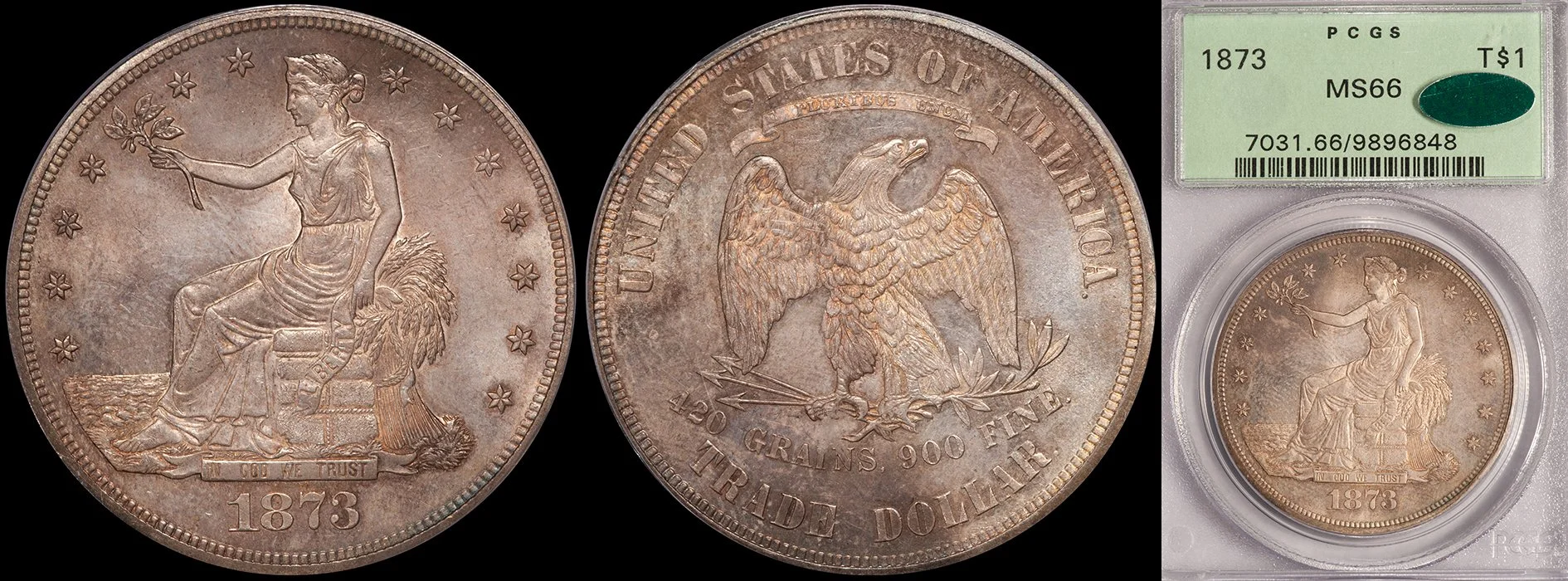
Only 30 Proofs struck. It has been suggested that as many as ten Proofs were unsold and later melted at the U.S. Mint; this would help to explain the great rarity of this issue in Proof. My best estimate is that there are only eight or nine known and just three of these qualify as Gems by today's standards. The present example is the second finest known Proof 1871 gold dollar, trailing only the superb NGC PR67 Ultra Cameo that last traded as ANR 8/04: 921 where it brought $42,550. The present example is one of only two known with full black and white contrast and it clearly deserves its Deep Cameo designation by PCGS. There is really nothing to identify this coin other than a small mint-made obverse lintmark below the F in OF. Here is a coin that combines great rarity with great beauty and it presents the collector with an opportunity that may not be repeated again for many years.