
DWN IS THE SOURCE FOR CHOICE, RARE PRE-1933 US GOLD COINAGE
ON HOLD - $50.00 - 1851 "887" RE, Augustus Humbert PCGS VF30
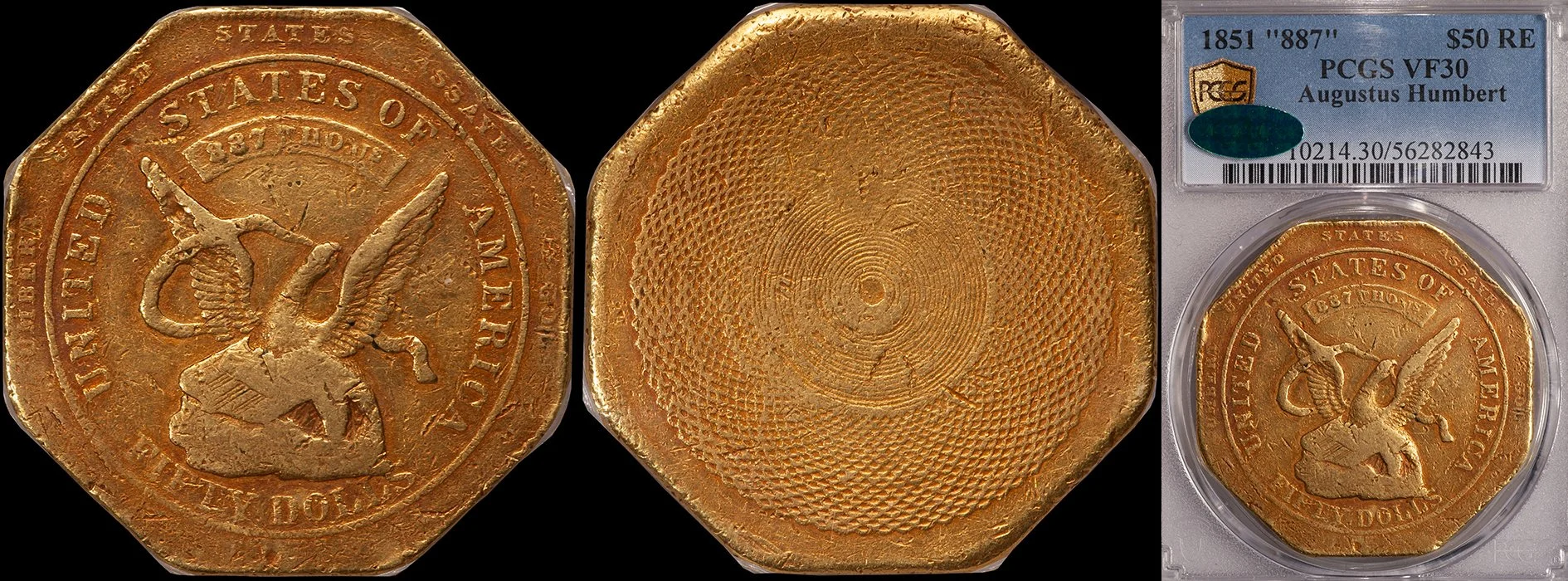
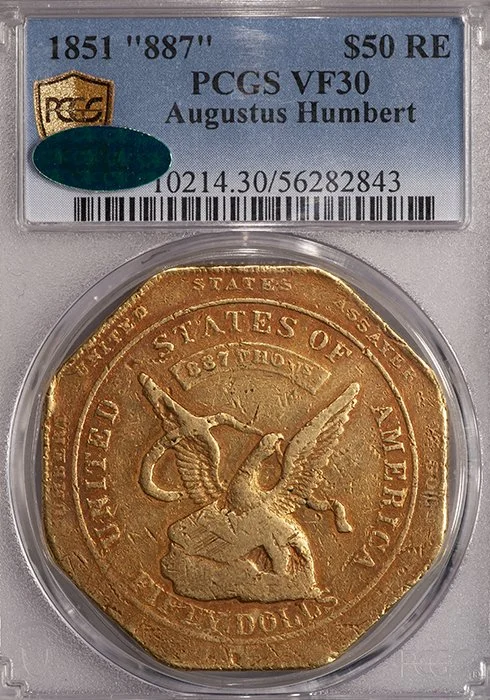
ON HOLD - $50.00 - 1851 "887" RE, Augustus Humbert PCGS VF30
Date……….1851 “887”
Grade…….PCGS VF30 CAC
PCGS Price Guide.…….……40000
CDN Greysheet/CPG.…..…37500
Population (PCGS).…………25/108
Population (NGC)….…....….…6/107
Population (CAC).…...….….…..3/25
Serial Number……10214.30/56282843
PCGS Lookup Number.……….10214
THE PERFECT CIRCULATED HUMBERT $50, GRADED VF30 BY PCGS AND CAC APPROVED
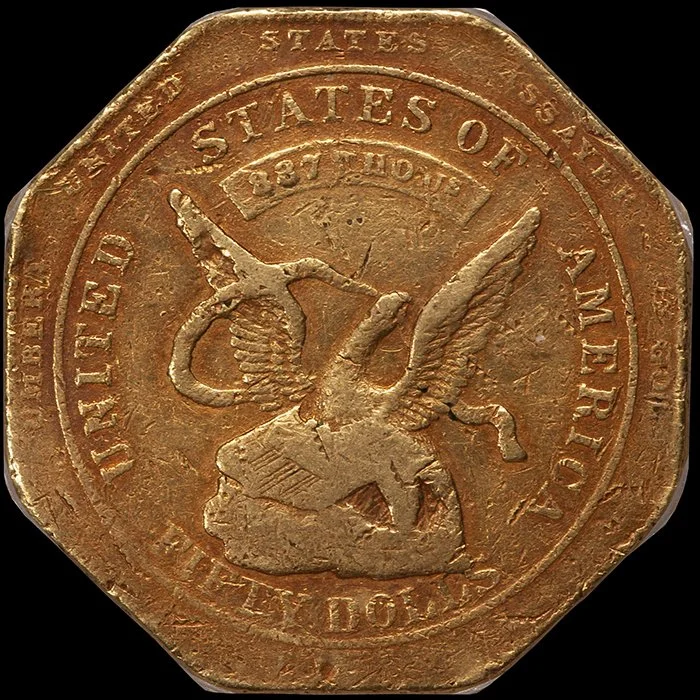
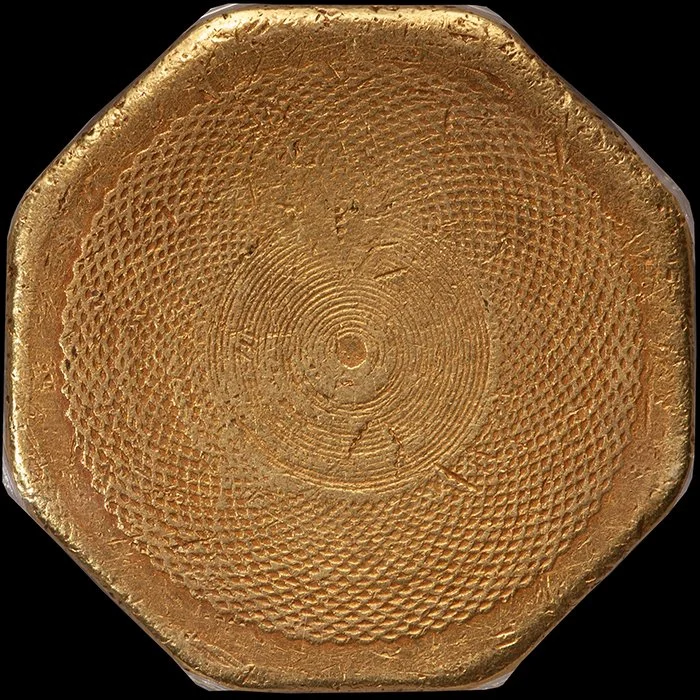
1851 Augustus Humbert $50. Reeded Edge, .887 Thous. Kagin-6, R-5.
The fact that there was a need for a coin with the purchasing power of $50 during the early 1850s tells you just how inflated prices were in San Francisco and the gold fields. With $50 carrying the same purchasing power in 1851 and 1852 as $2,192+ in today’s dollars, the scope and power of the various $50 gold coins (this includes pieces struck by the US Assay Office of Gold/Augustus Humbert in 1851, the US Assay Office of Gold/Moffat & Co in 1852, and Wass Molitor in 1855) quickly becomes evident.
The number of $50 Slugs struck in total possibly numbered between 50,000 and 100,000. Many were melted, but there are enough with extensive circulation to reach the conclusion that these coins were used in daily commerce and that some circulated at least until the the late 1850s.
To best enjoy a $50 slug, the collector who considers himself a purist is not going to be looking for an AU example as such a coin was likely put aside in the 1850s and saw very little—if any—circulation. I am personally most attracted to Slugs in the VF30 to EF45 grade range. Coins in this range saw obvious use in the day-to-day Gold Rush doings; whether this was a poker game at some saloon or for equipment used to extract gold from the mines or from the creeks. That said, I avoid Slugs that have major edge bumps and those that have been obviously cleaned.
The coin I am offering here meets the criteria I use when examining a Slug for potential purchase. The first thing I note is the color: is it real and if it is legit, do I care for it? Second is the surface quality: are there detracting marks visible—especially on the obverse? Third are the edges: an Octagon has eight edges or sides, and if more than two or three show detracting rim knocks or bumps, its unlikely that I will buy the coin.
Here’s how I see this particular Slug according to the Winter Laws of Slugs:
The color is very attractive with deep reddish-gold on much of the obverse and, less so, on the reverse.
The surfaces are just average. Some fairly deep marks can be seen beneath the ribbon as well as in the obverse fields. However, none are bad enough that they kill the coin for me.
The edges are very choice for the grade.
My conclusion is that this is a solid coin for the grade, and that I think its closer to a VF35 than a VF30.
No PCGS/CAC VF30 example of an 1851 Humbert 887 $50 has been sold at auction. There have been three different PCGS VF35 coins that have sold with the most recent bringing $47,580 in the Heritage 9/2026 auction. Two other examples—both with CAC stickers—brought $38,400 and $36,000 in 1/2022 and 1/2021 respectively.
Just a great coin and an essential type for a Box of 20.
CAC has approved three in VF30 with 25 finer.
Date……….1877-CC
Grade…….PCGS MS67 CAC
PCGS Price Guide.…….……8500
CDN Greysheet/CPG.…..…8250
Population (PCGS).……….….14/0
Population (NGC)……..………18/3
Population (CAC).….....….…..3/0
Serial Number…4863.67/64716879
PCGS Lookup Number…….4863