Rekindling Your Numismatic Passion

I’ve seen it happen many times in the past few years. An avid new collector storms into the hobby and buys lots of coins but then hits critical mass and thinks about leaving numismatics. What can you do as a collector who has reached the “burnout” phase to rekindle your passion for numismatics? The first thing I would suggest is to get all of your coins together and lay them out on a table or desk. Take a good hard look at them and decide what deserves to be in the collection and what does not. If you are like any new collector, it is likely that in your initial burst of enthusiasm, you bought coins that you shouldn’t have. In retrospect, they may be ugly or they just don’t fit in with the core collection you have. My best advice is to jettison them.

Now I’m not suggesting a fire sale. The best way to sell the coins is an orderly, organized fashion. You might do it yourself or select a dealer to help you. Or, you could always choose to put the coins in an auction. If possible, give yourself at least 90-120 days to plan and execute a strategy that makes sense.

It is likely that some of the “duds” that you originally purchased are going to be losers when it comes time to sell. Assuming that you are out of love forever with a specific coin, it’s alright to sell it for a loss. Just make certain that use this as a learning experience and try not to repeat this specific mistake in the future. (FYI, even smart dealers sometimes have to sell coins for losses. Really smart dealers get out of their bad deals as quickly as possible and reinvest their money in other coins that, hopefully, will be better deals).

The next thing I would suggest to recharge your battery is to take the next $500-1,500 you were going to spend on a coin and use it to form a basic library. Buy the five to ten essential books that should be in every collector’s library and then buy useful books in your chosen field(s) of specialization. I would also suggest buying a core group of auction catalogs from the 1980’s and 1990’s as well. Find a numismatic literature dealer and tell him that you collect Liberty Seated quarters or Type Three double eagles and the chances are good that he can recommend some older but still very useful catalogs that can greatly enhance your collecting experience.

Taking the numismatic literature theme one step further, get a current auction catalog from a specialist dealer like George Kolbe, Charles Davis or Fred Lake and buy some interesting 19th or early 20th century books or catalogs. As an example, the upcoming Kolbe sale of the John Pittman library has some really wonderful books and catalogs that will make a great test for your numismatic DNA. If you find everything in the catalog to be boring and the history of numismatics and its personalities has no appeal to you, maybe you are being sent a message: coins just aren’t in your blood. But if you find some of the obscure books, catalogs, letters and manuscripts to be very exciting, then you can take this as a message: coins are in your blood but you just need to reinvigorate your interest.
Collecting "Significant" Coins

As rare coins become more expensive and harder to locate, collectors have to develop new strategies. I know of a number of collectors who are adopting a technique that I find very interesting. These collectors don’t necessarily specialize in any specific series or mint. Instead, they focus on coins that they consider “significant” or “special.” So what exactly is a “significant” or “special” coin? I would define such an item as something that, if I were at a coin show, would stop me dead in my tracks as I was strolling down the aisle looking in each dealer’s case. I might regard a particular coin as being special because it is a fully struck example of a coin that nearly always is found weakly detailed. Or, I might regard a coin as being significant (I use the two terms interchangeably) because it has great original color.

What are some of the other criteria I would base my collection of special coins on? Some would be as follows:

History: I personally like coins that have an interesting history. This might mean that an issue was struck during the first year of a design or in the final year. It may have been struck during an important period of our history (World War I or the Civil War) or was used during the Gold Rush. One of the truly appealing things to me about Numismatics in general is its historic connotations and I certainly want the majority of the coins in my collection to have a special sense of history about them.

Provenance: Some collectors could care less about the history of ownership of their coins. To me, in some ways, this is even more interesting than the coins themselves. I might not ordinarily care about a coin like a 1794 Large Cent but if I learn that it has a wonderful 125+ year pedigree including having been owned by some famous collectors I would buy it; even if it didn’t “fit” into my collection. For me, the pedigrees that are important include the modern giants such as Pittman, Norweb, Bass and Eliasberg and more esoteric collectors from the 19th and early 20th century whose names are known to me mainly from my years of collecting old auction catalogs.

Beauty: The more coins I see, the more I realize how few truly beautiful United States coins still exist. By “beautiful” I do not mean a coin’s design. From an artistic standpoint, I personally feel that most American regular issue designs are mediocre at best. What I am referring to is more of an aesthetic sense of a coin’s appearance. In other words, I like coins that are pretty. I like Bust half dollars with rings of concentric iridescent toning from storage in old coin boards. I like Dahlonega half eagles with dark natural crust on their obverse and reverse. I like blazing, lustrous coins that don’t look like they just came from the Lab.

Scarcity: I like coins that are fundamentally rare. By this, I mean issues that are rare in all grades, not just in Super Grades. I recently sold an 1859-S in VF25 (for less than $2,000) and as I researched this coin, I realized that it was truly rare. To me, it was more exciting than the common date Three Dollar gold piece in PR65 that I had sold earlier in the day for $30,000. The Proof coin was pretty and it was certainly rare but, for some reason, the circulated 1859-S quarter was far more appealing to me. When one or more of the factors that I listed come together, then this can make for a special coin. As an example, a piece that I would regard as truly irrestible would be a 1794 half dollar pedigreed to a famous Chapman Brothers auction from the 1890’s with lovely original coloration in the VF-AU grade range. It’s got history (the first half dollar struck), an interesting pedigree, the right “look” and it is a genuinely scarce coin. After I purchased it, would I instantly become a collector of early half dollars? Probably not. In fact, I might not ever buy another half dollar. But this coin would be incredibly appealing to me because it satisfies all of my criteria in determining what makes a numismatic item “special” or “significant.”

The Condition Census Defined

I make frequent reference to the term “Condition Census” in many of my articles, blogs and individual coin descriptions but it has been brought to my attention that some beginning collectors do not know what this term means. The concept of the Condition Census is credited to Dr. William Sheldon who employed it in the late 1940’s with the publication of his seminal work “Early American Cents.” The census was a “scientific” way of arriving at a coin’s value by listing, in serial order, the finest known example of a specific die variety and then a list of the next five finest. For each specific variety of early cent, a “basal value” was listed and a coin’s worth on the open market would be that value times the grade. As an example, if a specific variety had a basal value of $5 and it was graded EF40 by Sheldon’s standards, the value of the coin would be approximately $200.

This system seems somewhat quaint in the coin market of the 21st century, but the concept of the Condition Census has been co-opted to apply to a host of other series besides Large Cents. In some cases, the system is practical; in others it clearly is not.

When specifically applied to United States gold coins, the concept of a Condition Census sometimes makes sense. As an example, it is possible for an expert to create a list of the five or six finest examples of a rare issue such as an 1841-D quarter eagle. It is not practical to create a list of the five or six finest 1924 double eagles as there are numerous examples that could qualify in the Condition Census and it is virtually impossible to substantiate a claim that one is better than the other.

Sheldon’s concept of basal value certainly no longer applies to coins (when they became $10,000+ items, how could you establish an accurate basal value?) but the validity of listing the finest known examples of a specific date or major variety remains interesting to collectors. And the value of such a listing has become more and more important as collectors enter their sets into the PCGS and NGC Registries.

Most of my books have included listings of finest known and Condition Census branch mint gold coins. But beginning with my new book on New Orleans gold, I have stopped listing a Condition Census. I did this for a number of reasons. The first is that grading standards for most gold coins have clearly changed. So it made little sense to list a coin that last appeared at auction in 1997 versus another similarly graded coin that appeared for sale in 2005; in nearly all cases the 1997 coin was clearly better. The second factor was that owners of these coins (mainly dealers) were continually breaking them out of one holder and putting them into another in attempt to increase the value of the coin. It looked ridiculous, in my opinion, to have the same Condition Census coin appear in my listings as a PCGS MS61, then as an NGC MS62 and still later as a PCGS MS62.

What I have tried to do to replace this system is to list “significant examples” of a certain date. As an example, if there are five Uncirculated examples of a specific New Orleans half eagle known to exist, I’ve tried to list them all. They may not necessarily be listed in order from “best” to “worst” but I have included their prices realized when they appeared at auction and let the numbers speak for themselves.

One problem with a Condition Census listing is that there is a somewhat arbitrary nature in creating any such list. Grading will always have a degree of subjectivity attached to it and a coin that is graded MS61 may, in my opinion, not be as nice as one graded MS62 or even MS63. Let me give you a great example. A few years ago I was asked to look through what was probably the single greatest collection of Dahlonega gold ever assembled. For nearly every date, the collector had multiple coins and, in some cases, he had what were probably the first, second and even third finest known. He made the decision to reduce his holdings and wanted me to select the single coin for each date that I thought was the finest. I remember choosing an 1855-D half eagle in AU58 as a nicer coin than one in MS63 and eventually listed the AU58 coin ahead of the MS63 (both coins were graded by PCGS, in case you were wondering...) in my Dahlonega Condition Census listings.

A Condition Census listing is only valid if the person making the list is very knowledgeable and has no ulterior motive for making one coin “better” than another. I’ve always been impressed by the Large Cent collectors who, for the love of the game, keep meticulous Census listings not only for each variety but, in some instances, for die states. Now that’s what Numismatics is all about!

September 2007 Long Beach Show Review

I had very little in the way of expectations for the third and final version of this year’s Long Beach coin show. In my opinion, the show was slightly above average, primarily due to interest caused by the surge in metals price. I thought that set-up (on Wednesday) was a bit perkier than usual for a Long Beach. I sold coins to dealers who I don’t ordinarily do much business with but who are so in need of nice coins that they are, literally, doing everything they can to find material. One dealer, who was working a want list that included a number of scarcer Liberty Head double eagles, was able to find a few scarce dates in my inventory. I also sold virtually all of my generic gold to another dealer.

With auctions being as strong as they are these days, I decided to again focus my buying attention on the bourse floor. I was able to purchase more interesting coins than I would have expected at a Long Beach show. Some of the highlights are as follows:

    A nice group of New Orleans gold dollar including a Condition Census PCGS MS63 1850-O

    A spectacular 1867 quarter eagle in PCGS MS65, which is the Finest Known

    A lovely PCGS VF25 1870-CC half dollar

    An NGC NS60 example of the underrated 1882-O eagle

    A superb PQ NGC MS62 1837 quarter eagle

Thursday saw a decent number of collectors attending the show, including a couple of new faces. I sold a few nice quality branch mint gold coins to brand-new collectors; something that hasn’t happened at a Long Beach for quite some time.

Friday, on the other hand, was very slow with poor attendance and limited dealer enthusiasm. Clearly, this show is pretty much over by Friday afternoon and most collectors, at this point, are hanging around and waiting for the evening auction session(s).

I can’t say that I’m sorry that I won’t be attending another Long Beach show until the Winter of 2008. None of the three I was at in 2007 were exactly barn-burners. My next two shows, in Atlanta and Baltimore, respectively, are sponsored by Whitman so, at the very least, I know they will be very well attended and professionally run.

I have also acquired a wonderful complete set of Carson City half eagles which I will be breaking up. The coins in this set range in grade from AU50 to MS63 and include a number of Finest Known and Condition Census pieces. If you have a specific want list that includes any of these, please call me or email me and let me know what you are looking for. Most are very high end for the grade with great original color and surfaces.

Superior Pre-Long Beach Elite Auction

In their recent pre-Long Beach Elite Auction, Superior sold a nice set of Carson City half eagles and eagles. These coins were interesting due to the fact that they were in old green label PCGS holders and, as one might expect, a number of coins appeared to have considerable upgrade potential. The half eagles were led by an 1870-CC graded EF40 by PCGS. It was notable for its excellent strike and seemed to me to be close to an AU50 grade by today’s standards. It sold for $25,300 (note that all prices in this blog include the 15% buyer’s premium charged by the auction company). One of the most undergraded coins in the half eagle collection was an 1871-CC in an old EF40 holder. I really liked this coin a lot and it brought $16,100. An 1872-CC graded EF40 by NGC was bid to $14,950.

Not all green label holder coins are “lock upgrades.” An 1873-CC graded VF35 by PCGS had the detail of an EF45 to AU50 but it had been harshly cleaned at one time. Despite this, it brought a strong $12,650 to a “lucky” mail bidder. Other interesting results included a PCGS EF40 1875-CC at $9,200, an uncommonly nice PCGS VF35 1876-CC (I graded it AU50 by today’s standards) at $9,488 and a pretty 1877-CC in PCGS EF45 for $9,775.

I personally liked the Eagles in this collection better than the half eagles and one of my absolute favorites was a perfect, crusty PCGS EF40 1870-CC which was bid to $39,100. A lovely 1871-CC in NGC EF45 with dark, crusty surfaces sold for $14,950 while an 1872-CC in NGC AU50 was bid up to a surprising $26,450. One of the rarest dates in the series is the 1873-CC and the example in this collection was a superb NGC EF45 which had the appearance of an AU50 to AU53. It sold for $27,600.

Another Carson City eagle in this group that I thought had great eye appeal was a PCGS EF40 1875-CC with deep, dark green-gold color. It sold for a solid $14,950. I was not all that wild about a PCGS AU50 1878-CC but at least two other bidders disagreed with me and it sold for a strong $29,900. Probably my favorite eagle in the sale was a PCGS AU53 1879-CC that was one of just a handful I have seen with original color and surfaces. It sold for $35,650.

Two other Carson City eagles in this sale worthy of a quick mention were a nice 1883-CC in PCGS AU55 that sold for $6,900 and a crusty, original 1893-CC in NGC AU58 that was bid to a strong $7,475.

Overall, this was an interesting group of coins. Virtually every coin in the Carson City collection sold to knowledgeable dealers and I would be surprised if any of these remain in their current holders. This was a sale that a collector bidding strictly on Internet images and catalog descriptions had simply no chance for success, unless it was for a “trap” coin like the 1873-CC half eagle mentioned above.

How Does the Increase in the Price of Gold Affect the U.S. Rare Coin Market?

As I write this, gold has hit a high not seen since 1979-1980 and it is flirting with the $750 mark. How is this run-up in prices affecting the United States rare gold coin market? If you have a position in generic issues (such as St. Gaudens double eagles) you’ve made yourself a nice chunk of change these last few weeks. MS64’s have risen from the mid to high $700’s up to the mid $900’s and MS65’s have seen an increase of around $250 per coin as well.

But if you are a reader of my raregoldcoins.com blogs chances are good that you do not play the generics market. You own “real” coins; issues like New Orleans double eagles or Charlotte gold dollars or Carson City half eagles. How are these rarer issues being affected by the new record levels in the gold market?

In a word (or three) they really haven’t. One of the fallacies of a rising gold market is that anything that is yellow rises in prices when the market shoots up. This simply is not the case. An EF45 1853-D half eagle will rise in price as the result of increased demand, not because its intrinsic worth is now an additional $25-50. Most of the brand new buyers of physical gold (as least for now) are strictly investors and they do not even know what an 1853-D half eagle is.

New gold buyers generally follow a predictable progression. They begin by purchasing gold stocks or, perhaps, modern bullion coins like American Eagles or Krugerrands. For every 1,000 buyers, perhaps 5% graduate to generic issues such as Saints or Indian Head eagles. And of these buyers, a small number may, after some time, become aware of a coin such as the aforementioned 1853-D half eagle. But this is a lengthy process and today’s new buyers of gold may not get involved in numismatics for years, if ever.

So this is, in my opinion, why the current run-up in gold prices impact on the typical coin in my inventory is wishful thinking. I’d love to report that the phone is ringing off the hook with new investors screaming for Dahlonega half eagles but this is just not the case (not to mention that if anyone does call me regarding coins as an investment, my blunt answers tend to send them running for the hills…)

One thing that is a real positive about the run up in gold prices is that this clearly does focus a lot of fresh attention on gold and on gold coins. And any good publicity about gold coins can’t be bad, right?

I’ve had many people in the last few days ask me what my take is on gold in the short and long term. I don’t claim to have any profound insights in this area. I’m probably the world’s leading expert on branch mint gold coins but when it comes to geo-political thought and macroeconomics I’m just another Hack with a Keyboard. My opinion (for what’s its worth) is that as long as we have cheapened the dollar to its currently absurdly low levels, gold will become more and more of a hedge. I could easily see it go to $800-900 in the coming months. I’ll personally be selling into the market once it reaches these levels but I think the days of sub-$500 to $600 gold are long gone; probably for good. I would suggest that everyone own some gold as it seems like a safe place to put your paper dollars right now, especially given the alternatives.

Low Mintage Philadelphia Double Eagles

One of my favorite groups of coins are the low mintage Philadelphia double eagles produced in 1881, 1882, 1885, 1886 and 1891. During this five year period, only 5,911 business strikes were produced; an average of just 1,182 pieces per year. Despite the obvious rarity of these coins, they are still overlooked by many collectors. A total of 2,199 business strike 1881 double eagles were produced. Estimates of the surviving population range from a low of 25-35 to a high of 35-40. This date is usually seen in the EF40 to AU50 grade range and it becomes extremely rare in AU55 and above. To the best of my knowledge there are just two examples known in Uncirculated. One of these, ex: Heritage 1/07: 3203 (graded MS61 by PCGS) sold for a record $138,000. The other, ex: Goldberg 5/05: 1086 ($69,000), Heritage 6/04: 349 ($57,500), ANR 3/04: 1067 ($39,100; as PCGS MS60) is now graded MS61 by PCGS.

Price levels for this date in Uncirculated have, obviously, increased dramatically in recent years. But this date seems like very good value in EF and AU grades. Trends is $18,000 in EF45, $25,000 in AU50 and $30,000 in AU55. Given the fact that the last Uncirculated 1881 to trade brought more than double Trends (which is $60,000 in MS60), my feeling is that EF and AU Trends are considerably out of date.

In 1882, the mintage figure for business strike double eagles produced at the Philadelphia mint dropped to a record low 571 coins. I regard this as the single rarest Type Three double eagle in business strike form and the number known is probably in the range of 20-25 coins. I am aware of two or three in Uncirculated. The finest is owned by a prominent Midwestern collector and is ex: Dallas Bank Collection (Stack’s/Sotheby’s 10/01: 88) where it brought $86,250. It is now in a PCGS MS61 holder. In January 2007, Heritage sold a PCGS MS60 for a whopping $138,000. This coin had first appeared in their 2000 ANA auction where it went unsold.

While far less underappreciated than the 1881, the 1882 is still an excellent value when compared to the rare date Type One double eagles from New Orleans. The 1882 is just a bit less rare than the celebrated 1854-O and 1856-O double eagles yet it sells for about a fifth of the price of these two issues in AU grades.

In 1883 and 1884, only Proof double eagles were produced in Philadelphia. Business strikes resumed in 1885 but only 751 pieces were struck.

When I first became interested in double eagles (back in the early to mid 1980’s), this date was almost impossible to find and it was considered a major rarity on par with the 1881 and 1882. It seems that a small hoard reached the market in the late 1980’s/early 1990’s and today the 1885 is a bit more available in circulated grades than one might assume given its incredibly low mintage figure. I think around four to five dozen are known with most in the AU50 to AU55 range. There may be as many as eight or nine known in Uncirculated with most in the MS60 to MS62 range.

There are two known in MS63. The first, which was graded by PCGS, is owned by a prominent Midwestern collector and it is the finest known. The second, also in a PCGS MS63 holder, is ex: Bowers and Merena 2003 ANA: 4291 ($50,600), Kingswood 2/00: 882 ($39,100).

The 1885 is the most affordable of these five issues. I recently sold a nice EF45 example in the mid-$10’s and have handled two attractive AU58’s within the last two years in the $25,000-30,000 range.

Production of business strike double eagles in Philadelphia shot up to a “whopping” 1,000 coins in 1886. This date has a much lower survival rate than the 1885 and it is actually close to the 1881 and 1882 in terms of overall rarity. At one time, it was believed that as few as 15-18 pieces were known. I feel that the correct number is more in the 25-30 range. This includes a greater number of lower grade coins than the 1881, 1882 and 1885; the 1886 is sometimes seen in the VF-EF range.

There are at least three 1886 double eagles known in Uncirculated. The finest by a vast margin is the PCGS MS63 owned by a Midwestern collector. There is also a PCGS MS61 that was last sold as Lot 7845 in the Heritage March 1998 auction (where it brought $35,075) and a PCGS MS60 which I have not seen or been able to trace its pedigree.

The price appreciation for this date has been pretty amazing in the last few years. As an example, in January 2004, Heritage sold a PCGS AU55 example for $24,150. In January 2007, another PCGS AU55 brought $69,575. It is also interesting to note that Trends for this date in AU55 is still just $40,000.

After a year in which only Proof double eagles were struck at the Philadelphia mint (1887), production of business strikes increased dramatically from 1888 to 1890. But in 1891, production was severely curtailed and only 1,390 business strikes were made.

For many years, the 1891 was regarded as the major sleeper in the Type Three series by gold coin experts. Only 35-45 coins are known but this issue traded in the $12,500-17,500 range in AU grades until recently. The 1891 is, curiously, as rare as the more celebrated 1882 and 1886 in Uncirculated. I am aware of just two that qualify as such. The best is the amazing NGC MS64 from the Dallas Bank Collection that is owned by the same Midwestern collector who is mentioned frequently throughout this blog. This coin realized $80,500 when it was first offered in 2001. It brought $155,200 five years later when Heritage offered it in their January 2005 auction.

This group of five Type Three Liberty Head double eagles is not as well known as The Fab Five St. Gaudens double eagles or as popular as the rare Type One issues from New Orleans but it is a remarkable and highly challenging group that is clearly worth careful examination by the serious, deep-pocketed collector.

Scarcity of Branch Mint Issues

When examining surviving populations of branch mint gold coins it is easy to forget just how scarce some of these issues are in higher grades. I’d like to demonstrate a little numismatic “magic trick” and turn 200 into 20 (or less) right in front of your very eyes. Let’s take a random issue and play around with survival numbers. How about the 1848-C quarter eagle?

The 1848-C is a date that doesn’t get much attention. It’s certainly no big deal, rarity-wise, in lower grades but it is scarce in the lower AU grades, very rare in the higher AU grades and exceedingly rare (and overlooked) in Uncirculated.

A total of 16,788 1848-C quarter eagles were produced. As with most Charlotte quarter eagles, it has a survival rate of around 1%-2% of the original mintage figure. I estimate that 150-200 are known, although this figure does not take into account what are probably a number of low grade and/or damaged specimens. Of these 150-200 coins, I estimate that at least 70-100 grade VF or below by my standards (which, by the way are not necessarily the same as NGC’s or PCGS’) and another 56-70 grade EF40 to EF45. All of a sudden the population of higher grade 1848-C quarter eagles has shrunk considerably.

I believe that 22-26 examples of this date are known in the various AU grades. That seems like a reasonably decent number of coins; certainly a large enough pool of coins for the casual collector to choose from, right? This number does not take into account that many of the 22-26 coins have problems. Certainly at least half of these two dozen or so coins have been cleaned, processed or unnaturally brightened. Suddenly, the available population of nice higher grade 1848-C quarter eagles has been reduced to maybe a dozen coins.

But these dozen coins include another potential monkey wrench which might thwart the collector seeking a nice 1848-C quarter eagle. If you read my book on Charlotte quarter eagles, you’ll learn that this issue is notorious for poor strikes and that a number were produced from severely swollen dies which leave the coins looking like a mess. So now these dozen coins might now be reduced down to as few as seven or eight nice, original (or “original-ish”) AND decently struck 1848-C quarter eagles. Assuming that there are at least four or five collectors assembling circulated Charlotte quarter eagle sets by date, this means as few as three or four pieces might become available in, say, a two or three year period. I’d say that qualifies as a pretty rare coin.

These numbers do not apply to all branch mint gold issues. There are certain dates that, for a variety of reasons, have a much higher overall survival rate or because of hoards have a higher percentage of high grade coins among the survivors.

A few examples of branch mint dates that have uncommonly high survival rates include the 1854-D $3.00 (I estimate that as much as 10% of the original mintage figure exists) and the 1838-D $5.00. There are generally pretty obvious reasons why issues like these have higher survival rates than usual. In the case of the 1854-D $3.00 it is because this is a one-year type coin and the novelty factor of a Dahlonega Three Dollar gold piece probably caused a number to be saved as souvenirs by curious locals. The same is probably the case with the 1838-D $5.00. This is a first-year-of-issue and it seems almost certain that a few were saved as curiosities by Dahlonegonians. (By the way, I just made up that word. I wonder if the correct expression isn’t actually Dahlonegites??)

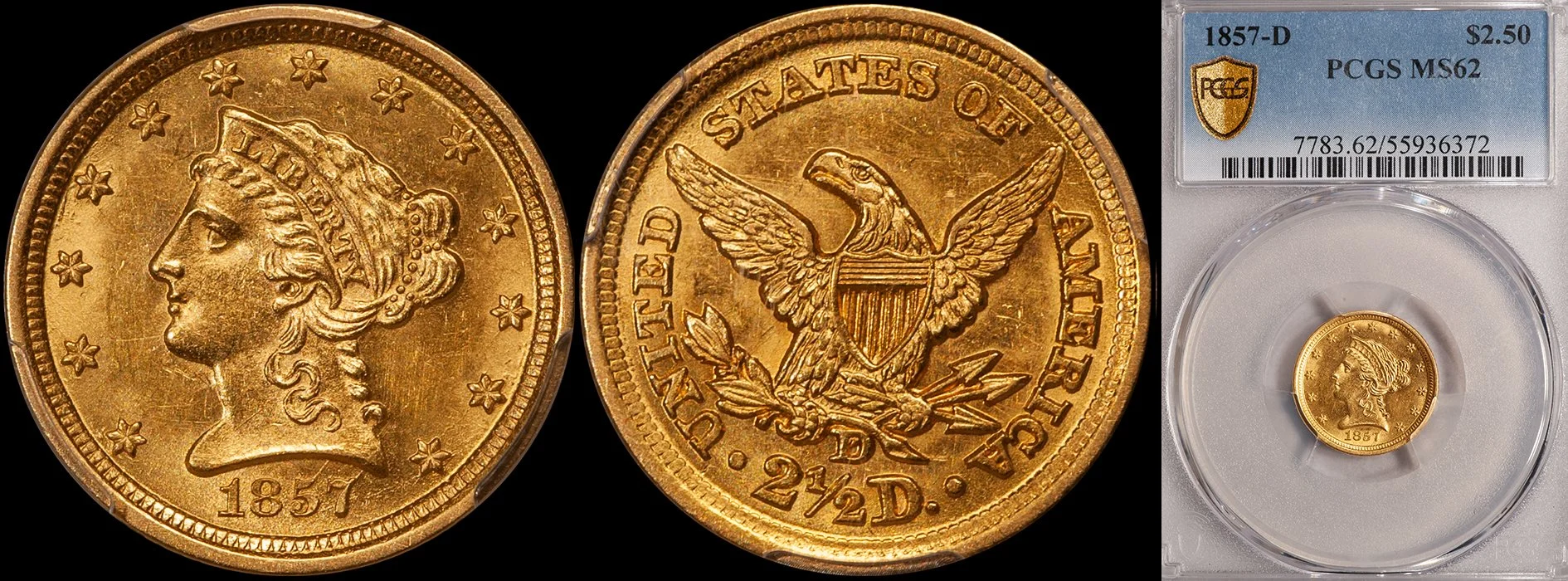
There might also be another reason to consider in regards to high grade rarity for certain branch mint issues. A few dates have had their populations of higher grade pieces swelled by the (possible) existence of hoards. I surmise this to be the case with issues such as the 1857-D and 1858-C quarter eagles and the 1841-D half eagle and know this to be a fact for issues like the 1856-D half eagle.

The bottom line is that many branch mint issues are much, much scarcer in higher grade (say AU55 and above) than their certified populations might suggest. As a rule of thumb, even the “common” issues such as 1849-D gold dollars or 1847-C quarter eagles are far less available in choice AU than one might expect and these issues are certain to get scarcer in the coming years.

State of the Market Report: New Orleans Eagles

A few weeks ago I did a State of the Market Report on New Orleans gold. In that report, I barely touched on Eagles from this mint. Afterwards, I received a number of perturbed emails from readers who wanted to know my thoughts about New Orleans eagles. I hear you loud and clear Unhappy Nawlins Eagle Collectors and this blog’s for you. I’ve written a number of times that I regard New Orleans eagles as the “next best thing” for collectors who can’t afford high quality examples of New Orleans double eagles. But I think this is short-changing what is truly a collectible and very interesting series in its own right.

New Orleans eagles can be neatly divided into two distinct groups: the No Motto series (1841-1860) and the With Motto series (1879-1906). There are twenty–one issues in the former group, sixteen in the latter.

The No Motto series has become extremely popular in the last two years. Collectors have learned that even the common dates (such as the 1847-O and the 1851-O) are, in reality, very scarce to rare in the higher circulated grades and genuinely rare in Uncirculated. Something that I find remarkable is the lack of Uncirculated No Motto eagles that have been available in the last two years. The one exception to this was the coins from the S.S. Republic but the “cream” of this deal was quickly sold and virtually none of the important No Motto eagles from this source have ever re-appeared for sale.

There have been a few very important No Motto eagles sold in the last year or two. The finest known 1843-O, graded MS64 by NGC, brought nearly $60,000 when it was auctioned by Bowers & Merena in 2006 and Heritage sold what I feel may have been the finest known 1857-O (graded AU58 by PCGS but better than this in my opinion) in their October 2006 auction for a touch over $40,000. But for the most part, it has been remarkable how few important No Motto New Orleans eagles have been available since the release of my book on New Orleans gold in the fall of 2006.

My experience in buying No Motto New Orleans eagles at coin shows hasn’t been much different in the last year or two. I have been able to acquire a couple of very interesting coins but, overall, the pickings have been very slim. I see a few dates (1843-O, 1844-O, 1847-O and 1851-O) in AU55 to AU58 but these coins are usually scrubbed and very low end for the grade. The key dates have become exceedingly hard to locate. I’ve owned two 1841-O and two 1859-O eagles in the past year and I am certain I could have sold each of these coins to a long list of eager collectors.

The demand for the keys in the No Motto series is quite high but so is the demand for the second-tier issues such as the 1849-O, 1852-O, 1855-O, 1856-O and 1857-O. Around two months ago, I listed a nice PCGS AU53 example of the 1852-O on my website and within a day I had received seven orders for it. The same would probably be true if I were to list a coin such as a nice EF45 1849-O or an AU55 1856-O. These coins are really scarce and there is clearly a strong demand for them.

The With Motto New Orleans eagles have also increased dramatically in popularity in the last few years. Unlike their No Motto counterparts, there have actually been a number of significant pieces that have been available in the last year or two. In the Stack’s January 2007 auction, I purchased the finest known 1879-O (graded MS61 by NGC) for a client for $52,900 and a Condition Census 1880-O (graded MS61 by NGC) for $16,100. In the 2007 ANA auction, one of the two finest known examples of the 1882-O (graded MS63 by PCGS) sold for $37,375 and in the same auction, a PCGS MS63 1892-O brought $10,350 which is a record price for this issue.

One thing I’ve noticed about the With Motto New Orleans eagles is that higher grade examples of the common dates (1901-O, 1903-O and 1904-O) are not nearly as available as they once were. I used to buy nice PCGS MS63 and NGC MS63 1903-O eagles at nearly every major show I attended. Today, these are still available but not with any degree of regularity. Plus, the few I do see tend to be lower quality pieces that look as if they were recently upgraded from MS62 holders.

My favorite With Motto New Orleans eagle is still the 1883-O. After years and years of being neglected, people are finally recognizing the true rarity of this issue. For some reason, Trends is still far behind on this date and the few examples that I have purchased or know of trading between knowledgeable sources have brought far in excess of published price levels. I fully expect values to continue to rise for this date and would strongly suggest acquiring one posthaste if you are specializing in this series (if you can find one that is...)

My overall perspective on both No Motto and With Motto New Orleans eagles is that they have become very popular and that the demand for the rare dates and high grade examples of the more common issues has soared in the last few years. Collectors are quickly learning that a seemingly mundane coin like an 1845-O in AU55 is actually quite scarce if it is attractive and original. At the high end of the market, there is intense competition for finest known and Condition Census pieces. This is also the case with the key issues from this mint.