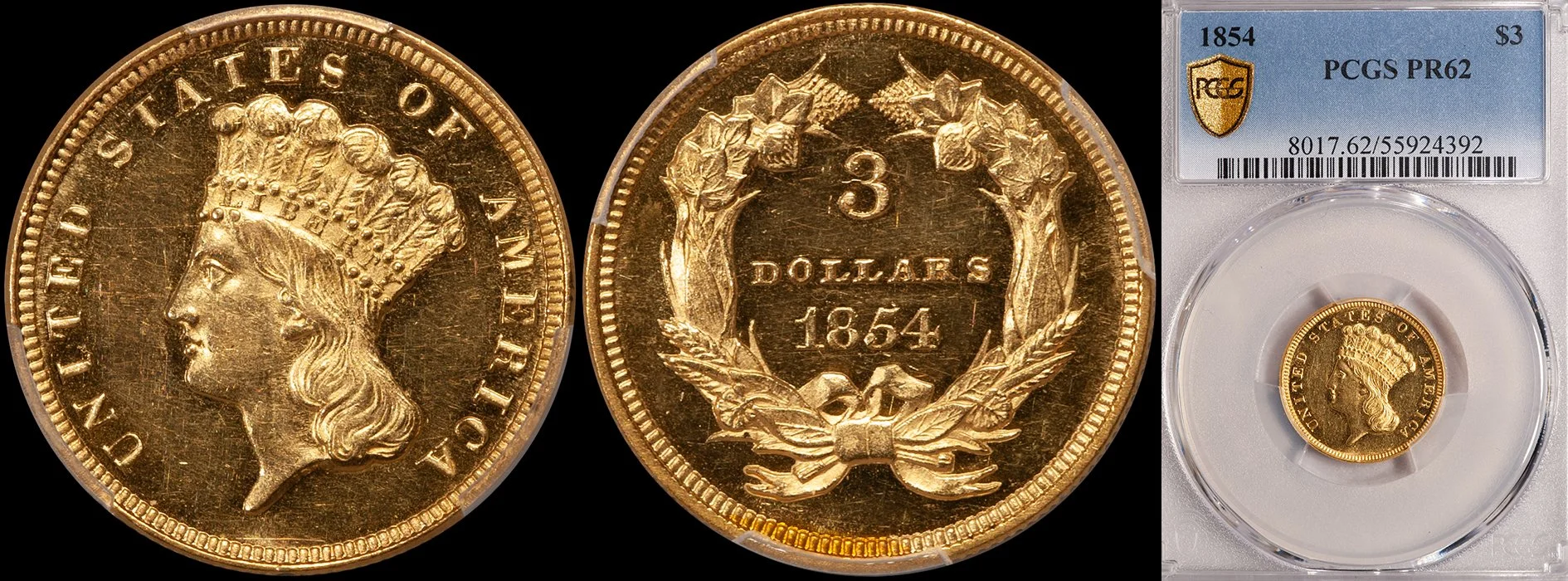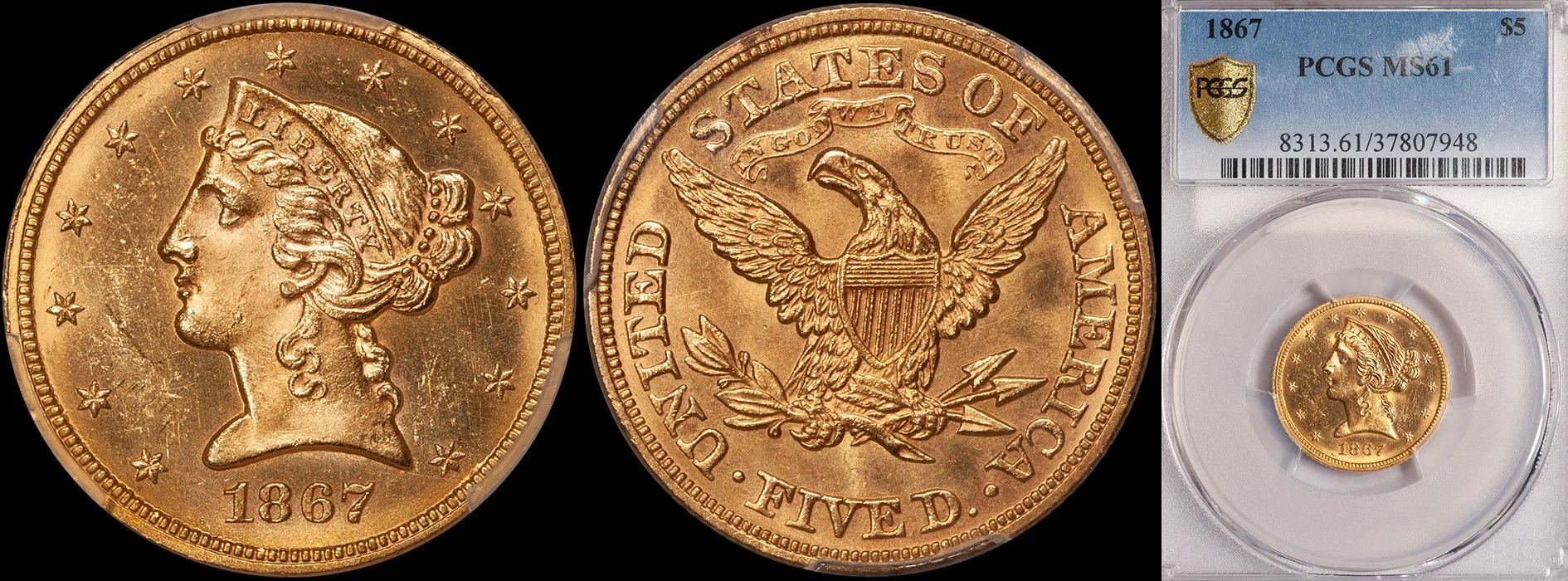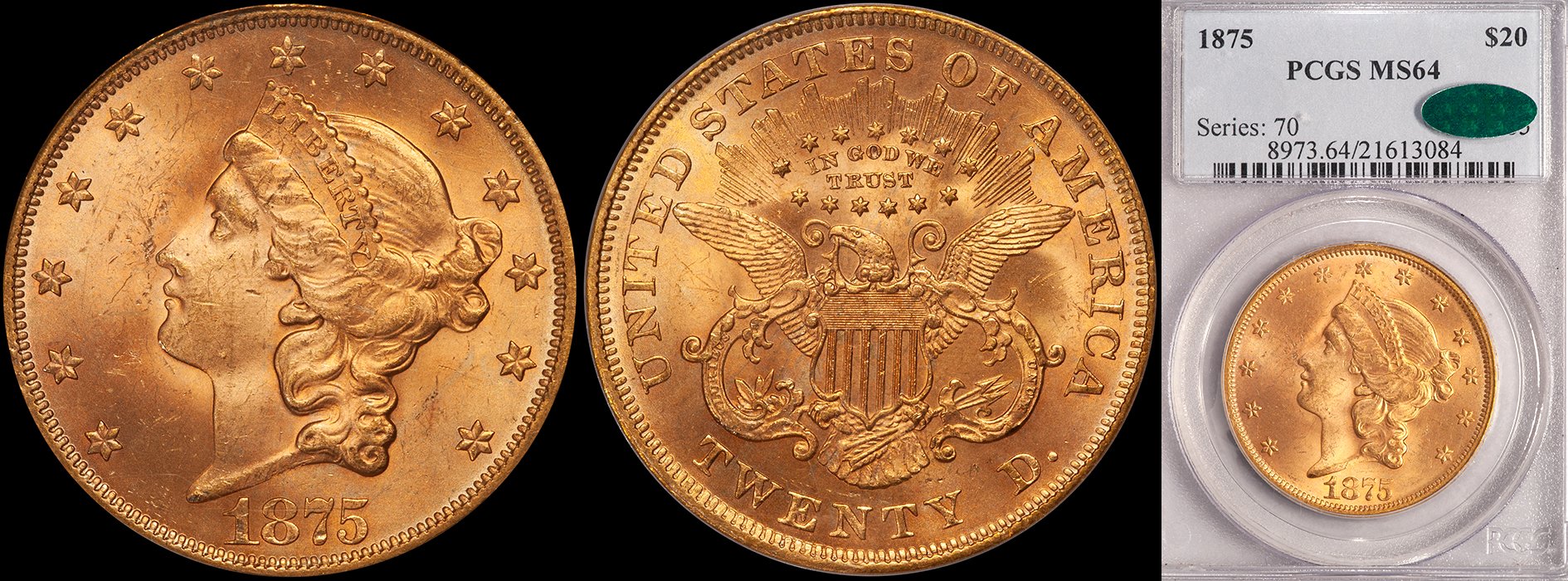
The Byron Reed Collection Sale

In October 1996, the Western Heritage Museum and the City of Omaha decided to sell coins and manuscripts from the Byron Reed collection in order to raise funds for a renovation and expansion project to house the Reed collection. Reed, who lived from 1829 to 1891, was an unsung numismatic hero. Reed came to Nebraska in the mid-1850’s and became a successful businessman. He began collecting coins in the 1870’s and by the time of his death he had assembled one of the finest groups of United States coins ever assembled. Despite the importance of this collection it was largely forgotten until a small portion of it became available for sale a century after Reed’s death.

Spink’s of London was chosen to sell the coins and the auction was held at the old Christie’s showrooms on Park Avenue and 59th street in New York. Even though this sale seemed a bit out of the mainstream at the time, it was the sort of event that attracted all the big buyers. I can remember viewing the lots at Christie’s and thinking how out of place many of the coin dealers seemed in comparison to the well-dressed and impeccably groomed art collectors and dealers who were viewing lots from an upcoming sale.

The coins in the collection were, for the most part, fabulous. But this would not be an easy sale to buy out of. The salesroom would be full of every smart dealer in the country and the coins were, in many cases, very hard to grade. Some of the Proof silver type coins had been poorly stored and had literally turned black. And many of the Proof gold coins in the collection appeared to be lovely but were so heavily toned that they may have had heavy hairlines below the color if and when they were dipped.

I was mostly interested in the early gold coins in the collection. There was a splendid date run of Fat Head half eagles including such extremely rare coins as an 1828/7, an 1829 Small Planchet, and an 1832 12 stars.

One of the coins I really wanted to buy was Lot 113, an 1824 which I graded AU55 to AU58 (by today’s standards this coin would no doubt grade MS61 or even MS62). I had a bid of $14,000 and I stretched to $18,000 but was outbid by someone on the phone. The same pesky phone bidder outspent me on the next two lots, an 1825/1 that I graded MS61 to MS62 and an 1826 that I graded MS62. The two coins sold for $23,000 and $20,000 respectively. To make a long story short, I did finally buy one coin in the group: an 1833 Large Date that I graded MS61 to MS62 for $9,500. I remember thinking that the prices for these coins seemed insanely high. Today they seem insanely low.

Having the luxury of a decade’s reflection, I now realize that even though the prices in the Byron Reed sale seemed incredibly strong at the time, many of them are almost laughably low by today’s market values. We now forget just how awful the coin market was in 1996 and 1997. Not only did the coins bring a fraction of what they are worth today, but many of the people who spent big money in the sale had trouble selling the coins and they were later sold for losses.

The moral of the story: buy great coins in great auctions when the market is crummy and no one else wants them. Even better: let all the smart dealers buy them, let them get nervous because they can’t sell them and then buy them when they get even cheaper.
Changes in the Coin Auction Market

Has any segment of numismatics changed more in the past ten years than auctions? A hypothetical collector who pulled a ten-year Rip Van Winkle and suddenly rediscovered coin auctions would note a host of differences including the following: The Internet now plays a huge role in auctions. Ten years ago, the Internet was a non-entity when it came to coin auctions. In today’s auction world, a large percentage of the lots are sold online; often times to collectors who have never seen the coins in person and are relying solely on the images.

Many auctions now play out in nearly empty rooms. Ten years it was not uncommon to see a hundred people bidding live in an auction room. Today, many big buyers never set foot in a live auction.

The numbers and dollar values of coins sold at auction have grown astronomically. Ten years ago a $10 million auction was front-page-of-Coin World-news. Today, it’s nothing. In fact, for many of the big firms a $10 million dollar sale would be a disappointment. And the physical sizes of the sales themselves have grown immensely. For certain firms, a 5000+ lot auction is routine. Ten years ago, auctions were seldom more than 2500 lots. And let’s not even mention the size of the catalogs themselves. You could use many of today’s catalogs for weight training devices…

The catalogs have become better and more sophisticated. The average auction catalog in 2006 is much slicker and glossier than it was in 1996. Most of the descriptions have gotten better and the photography has, for the most part, improved. In 2006, most coin auction catalogs compare favorably to the catalogs produced by Sotheby’s and Christie’s for their major art sales.

The players in the coin auction business in 2006 are remarkably similar to who they were in 1996. But the power structure has changed radically. Heritage has gone from an also-ran to the dominant force in the business while Superior and Bowers & Merena have become far less significant. Stack’s has kept its business model fairly consistent and has lost business as a result. The new kid on the block, ANR, has basically become what Bowers & Merena was ten years ago.

The entire numismatic auction business has become more transparent and information-driven. Heritage posts the reserves for every coin it sells and has a prices realized archive with over 1 million lots included. It is only a matter of time before other firms become more transparent and it seems likely that someone will take the Heritage archive and enlarge it to include other firms’ lots. In 1996, coin auctions were about as un-transparent as you could imagine and it was not uncommon to see consignors bidding on their own coins at auctions in an effort to drive up prices.

While the entire coin market is a very different animal today than it was a decade ago, it seems that more of these changes are noticeable in the auction arena than anywhere else. It will be very interesting to see how different the landscape looks in 2016.

Collecting New Orleans Gold Dollars

For many collectors New Orleans gold dollars are a perfect set to assemble. They are within reach of nearly any budget and with only six pieces required to assemble a complete set they do not require years and years of patience to complete. The New Orleans mint produced six different gold dollars between 1849 and 1855. Two design types are found in the series. The first five issues employ the familiar Type One design while the final (1855) one uses the popular Type Two or Indian Head design.

The keys to the series are the 1850-O and the 1855-O. The beauty of these two dates are that while both are popular and desirable, neither is so rare or expensive that they can not be obtained by the collector of average means.

The 1849-O is a favorite among collectors due to its status as a first-year-of-issue. It is common in circulated grades and a nice AU example can be obtained for under $500. Many collectors try to purchase an MS60 to MS62 piece which is typically valued in the $1000-2000 range. This date does not really get expensive until the higher MS grades and a Gem will run in the $13,000-16,000 range.

The 1850-O is the rarest date in the series and it is much undervalued in my opinion. I typically sell nice AU pieces in the $1500-2000 range and an Uncirculated piece in the MS60 to MS62 range should be available for $3000-5000. This date becomes rare in MS63 and it is very rare above this. The best pieces I have handled are a pair of MS64’s and I am not currently aware of a Gem.

The 1851-O is one of the more common dates in the series. It is very easy to find in AU grades and a nice piece can be purchased for under $500. A collector seeking a nice entry-level Uncirculated coin can purchase a solid MS62 for $1200-1400 and an MS63 will run around $2100-2300. Due to a small hoard some Gems do exist and I have sold some pieces graded MS65 in the $13,000-16,000 range.

The 1852-O is the second scarcest New Orleans gold dollar and it is the hardest Type One to find with a good strike. A high quality circulated piece can be obtained for under $1,000 while an MS60 to MS62 example will cost $1,250-2,500 depending on the quality. This date becomes scarce in MS63, rare in MS64 and extremely rare in MS65.

The 1853-O is the most common date in the series and a very nice AU is easily located at less than $500. A very presentable Uncirculated piece can be found with some searching for $600-1,200 and even an MS63 is a good value at $2,500-3,000. This date is much harder to find in MS64 and higher than typically assumed and a Gem, if available, will sell for as much as $15,000.

The 1855-O is the only Type Two gold dollar from this mint and it is an exceptionally popular issue. It has appreciated quite a bit in price in the last few years but it is still a good value. The collector searching for a nice AU example should be prepared to pay between $2,000 and $5,000 while an MS60 to MS62 will require an outlay of between $7,000 and $18,000. In any grade above MS62, the 1855-O is rare and expensive but is always an easy issue for a specialist-dealer such as myself to sell.

In my opinion, an ideal beginner’s set of New Orleans gold dollars would contain AU55 to AU58 examples of the 1850-O and the 1855-O plus MS61 to MS62 examples of the other four dates. The more advanced collector should shoot for a set with all six coins grading Uncirculated. The former set could be completed for under $10,000 while the latter could require as much as $100,000+ depending on the quality of each piece.

Market Premium Factor (MPF)

Although I can’t take credit for inventing the concept of Market Premium Factor (MPF), it is something that I have discussed before and find very interesting. The basic concept of MPF is that in a specific series of coins, certain dates trade for premiums over the common (or basal) issues. An interesting series to explore the concept of MPF is Indian Head eagles. In this series, basically any coin not dated 1926 or 1932 (the two basal issues) is considerably scarcer than a basal issue. However, until very recently most of these dates sold for little more (if any) than the two common issues. A date like the 1912 with a PCGS population of fewer than 500 in MS63 and fewer than 175 in MS64 and above did not command much of a premium over a 1932 with a population of over 10,000 in MS63 and over 5,000 in MS64 and above.

Why could dates like the 1910, 1910-D, 1911, 1912, 1914 and 1915 be purchased for virtually no premium over the common dates like the 1926 and 1932? Because until recently, the Indian Head eagle series was not seeing many collectors putting together date sets. These coins were trading primarily as type coins and this meant that no one really cared about what date they were purchasing.

The MPF for a series changes when it becomes popular. Suddenly, Indian Head eagles have become more popular. There are not necessarily a ton of new collectors putting complete sets together. But there is enough new interest in the series that even a neophyte can recognize the fact that a 1910-D eagle in MS64 is much scarcer than a 1932 in the same grade. When this occurs, the premium factor between the basal issues and the slightly scarcer issues increases. Suddenly a coin like the 1910-D eagle is now bringing 10-20% more than a 1932.

There are still a number of series that do not have fully developed MPF’s. In the St. Gaudens double eagle series, there are at least a dozen issues which sell for “type coin” prices which are considerably scarcer than the basal issues such as the 1924, 1925, 1926, 1927 and 1928.

For the savvy collector or investor a key to making a good return on your investment is to identify coins that are scarce but which do not sell for a significant premium. If and when this series becomes popular and collectors start paying attention to specific dates, you might well have some nice profits.

Baltimore Coin Show Report

The Baltimore coin show opened to the public on Thursday and to the public on Friday. Thursday was one of the more active days at a coin show that I can remember. I had a steady stream of dealers looking through my coins and made a number of sales, including some to other dealers that I have not done business with in a number of years. Areas that seemed most active with dealers included early gold, New Orleans half eagles and eagles and Indian Head eagles.

Has anyone else noticed that Indian Head eagles in MS63 to MS65 grades have dramatically increased in price in the past two months? A little birdie at the coin show told me that prices in this series could see even more dramatic price increases in the next three to six months.

Public attendance on Friday was excellent. The size of the bourse floor was much bigger than in past versions of this show and, at times, it felt like being at a cavernous ANA or FUN convention. I met a number of new collectors including one gentleman who had just spent over $1 million at the ANR sale and appeared to be buying at a furious pace from dealers. Clearly, coins have reached a new level of popularity.

Both PCGS and NGC “made” more coins that at recent shows. I was pleased with most of my grading results and other dealers I spoke with felt both services were making a better effort to grade according to market standards than at other recent major shows. Because of this fact, it was possible to buy a few interesting coins. But it was clearly a grind to buy and I generally was able to purchase just one or two interesting pieces at a time.

Overall, I would grade this show an A- for Douglas Winter Numismatics and a B for most other dealers. It was a great show for selling and it turned out to be a bit better for buying than I expected. After the uneventful February Long Beach, the coin market got a nice little shot in the arm and seems to be in good health as we approach the Spring.

Coming up in April are two important shows: the Spring ANA in Atlanta and the Central States in Columbus. The sale of the Duke’s Creek collection of Dahlonega gold coinage is going to be a major test for the high end of the Southern gold market while the repercussions of the State of Ohio Coin Scandal should make this year’s edition of the CSNS interesting to say the least.

Virtues of Coin Clubs

I did something fun last night. I was asked to speak in front of a local coin club. Randy Clark, the President of the South King County Coin Club, asked me to make a presentation to his group. The meeting was held at the Tukwila Convention Center which is a few miles south of Sea-Tac airport. The facility is extremely nice and I was encouraged when Randy told me that the meeting usually attracted thirty to forty collectors. With very cold weather and impending snow on the horizon, the actual number of attendees turned out to be less. I counted around twenty people in the crowd; not including my wife who I dragged along for moral support and who I figured could be a ringer in case no one in the crowd had any questions. (Mary: “So what are some of the most interesting coins you’ve sold…”)

The meeting turned out to be a success. It lasted for close to two hours and I was encouraged that the crowd was knowledgeable and enthusiastic. While very few people in the club collected United States gold coins, they asked me some really interesting questions about grading, the price of gold and silver, toning, the market acceptability of “conservation” and more.

Coin clubs are an excellent place for new collectors to share knowledge and improve their education. As a national dealer I often forget about the grass roots of numismatics and that not everyone is necessarily interested in buying Condition Census New Orleans coins. Most collectors start small and as they become more confident because their knowledge is increasing, they buy more expensive coins.

If you are a new collector, go to a local coin club meeting and see if you like it. If you are an experienced collector or dealer, give a little of your time once or twice a year and help the local club. It’s a win-win situation for everyone.

"Fundamental" vs. "Grade" Rarity

When discussing “rarity” it is important to realize that there are two different types of rarity. These are “fundamental rarity” and “grade rarity.” Fundamental rarity refers to the overall rarity of an issue. A coin like a 1796 No Stars quarter eagle is fundamentally rare in any grade. The value of such a coin is due primarily to its rarity and not its grade. There is a high level of demand for this issue, even in very low grades. If you have a 1796 No Stars quarter eagle that looks like it was run over by a train, someone is still going to buy it.

A coin that is a grade rarity is one that is considered rare solely because of its high grade. A classic example of this is a 1920 Saint Gaudens double eagle. This is a common issue in the lower Uncirculated grades and it is only moderately scarce and desirable in MS63 to MS64. But it is extremely rare in MS65 and there is a dramatic jump in price between MS64 and MS65.

From my personal viewpoint, I like coins that are fundamental rarities. As someone who has a significant amount of money invested in coins (i.e., my inventory) I feel a lot better buying a coin that is considered desirable by virtue of its rarity in any grade than one that is desirable ONLY because of its high grade.

Some coins are “hybrids” which can be considered both fundamental rarities and condition rarities. As an example, a Proof Barber quarter is a relatively scarce coin with most issues having mintages figures below 1,000. Even an Impaired Proof has a degree of collector value. But at what point in the grading continuum does a Proof Barber Quarter morph from a fundamental rarity to a condition rarity? I’m not certain that I know the answer but I do know that once Proofs of this design are graded PR67 or higher, they become less interesting to me.

Another factor to consider is this. What if third-party grading ended tomorrow and slabs no longer had any relevance? In this scenario, a coin like an 1854-D Three Dollar gold piece would still be considered a desirable numismatic item with many potential buyers. But would a PR68 Barber quarter be considered four or five times “better” than a pretty, lightly hairlined piece that had previously been in a PR64 slab? I’m not sure I know the answer but…

These are interesting questions that the collector needs to ponder as he decides what his next purchase will be.

Modern Coin Epiphany

I’ve recently had a bit of an epiphany regarding modern coins. For someone who has traditionally snickered at Walking Liberty half dollars and Mercury Dimes because they were “too new” this isn’t totally unlike the President of Coke admitting that a Pepsi tastes pretty good with a Cheeseburger. Now don’t get to thinking that I really “like” modern coins because I don’t. But the more I look at people collecting moderns, the more I can appreciate the coins and respect the collectors.

I hear “old school” dealers registering the same complaints about modern coins: they are ugly…they are overpriced…they are unsophisticated…the market favors sellers. Let’s look at these points.

Looks: While I personally have a hard time getting excited about the design of a $50 Platinum eagle or a modern commemorative half dollar, I can understand that some people like they way they look. Hey, I love Abstract Expressionist art and a lot of people think it looks like squiggles on a canvas that a cranky three year old drew before his afternoon nap. And, to be honest about it, is a Chain Cent or a Capped Bust Right half dollar a really “beautiful” coin from an aesthetic point of view?

Prices: I think modern coins in super-grades are marginal deals but, you know what, so are many classic issues. If someone told me that they were spending $35,000 on a common date Barber Quarter in Proof-69, I’d suggest that they might be better off spending $5,000 on the same issue in PR67. I feel the same way about modern coins. A modern commemorative half eagle in MS70 at $5,000 is questionable value. The same coin in MS68 at $500 seems like a nice addition to someone’s collection.

Sophistication: From my perspective, I think a Bust Half dollar in AU at $500 is a more interesting, sophisticated coin than a Statue of Liberty $5 commemorative. But this is just my opinion. As “sophisticated” as I think my own tastes are, there are plenty of collectors who would look down their noses at me and my “silly southern gold coins” because they are not as worldly as their Roman Imperial coinage. Until the 1970’s, most Morgan dollar collectors were considered numis-morons and today these collectors are now in the upper echelon of collectordom.

Unfair Market: The modern coin market is a developing entity and it will take time for two-way markets to develop. At this point, EBay and Teletrade must be considered the largest modern coins dealers. No, they don’t offer the warm and fuzzy customer service that Douglas Winter Numismatics does, but most collectors of modern coinage don’t want this “frill.”

I can see modern coinage becoming a more and more viable part of the numismatic marketplace in the coming years. People will start researching these series and serious books will be written. In the meantime, why don’t we “classic coin lovers” and their “modern coin” counterparts just try to get along?

Prooflike Gold Coins

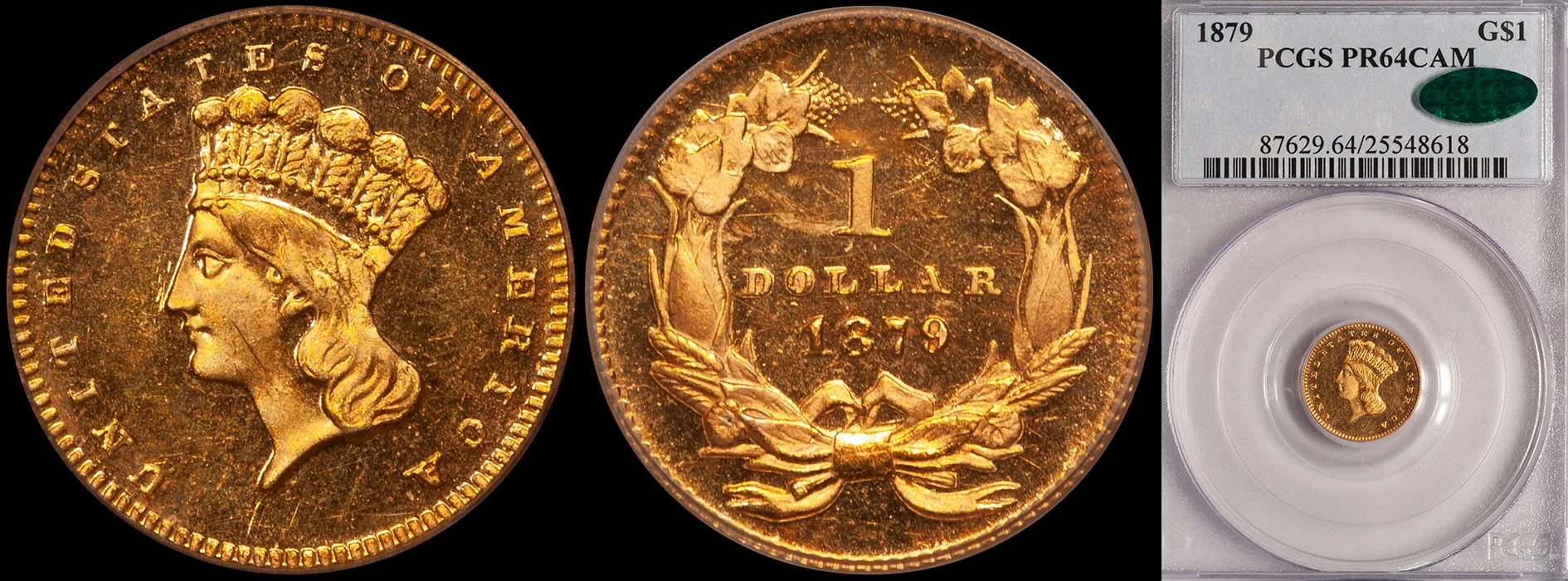
Are Prooflike gold coins an interesting future collecting trend or are they yet another piece of clever marketing hype? Yes and possibly yes. Business strike gold coins are usually frosty or satiny in texture. Occasionally, a group of coins are struck from newly-polished dies and they show reflective surfaces. Such coins are termed as “prooflike” by collectors. There are certain issues, such as gold dollars from the 1870’s and 1880’s and three dollar gold pieces from the same era that are frequently encountered with prooflike surfaces. This is due to the fact that these issues have low mintage figures and most were struck from fresh, new dies.

In the case where most examples of a specific date come prooflike, a coin designated as “prooflike” is, in my opinion, not interesting nor is it worth a premium. The one exception might be in the case where a coin has a very reflective or “deep mirror” surfaces.

Other issues are rarely seen with prooflike surfaces. As an example, a small number of New Orleans eagles from the 1840’s are found with very reflective surfaces.

In the case where only a fraction of examples of a certain date come prooflike, a coin designated as “prooflike” is, in my opinion worth a premium. It can be worth a significant premium if the prooflike surfaces add considerably to the coin’s overall eye appeal.

What about very common coins like 1904 double eagles that are sometimes seen with Prooflike surfaces? In my opinion, if a 1904 double eagle is slightly prooflike or reflective only on one side it is worth no premium. If the coin is very reflective and actually resembles a Proof, then it is worth a premium. This begs the question: exactly how much of a premium? At this point it is hard to say. No one really knows how rare Prooflike coins are, on a relative and absolute basis. As the grading services collect more data from submissions of prooflike gold coins, perhaps it will be possible to know the answer.

My advice on Prooflike gold is to go ahead and buy pieces with very reflective mirror surfaces but just don’t get caught up and pay huge premiums in a market for which value levels are still highly speculative.