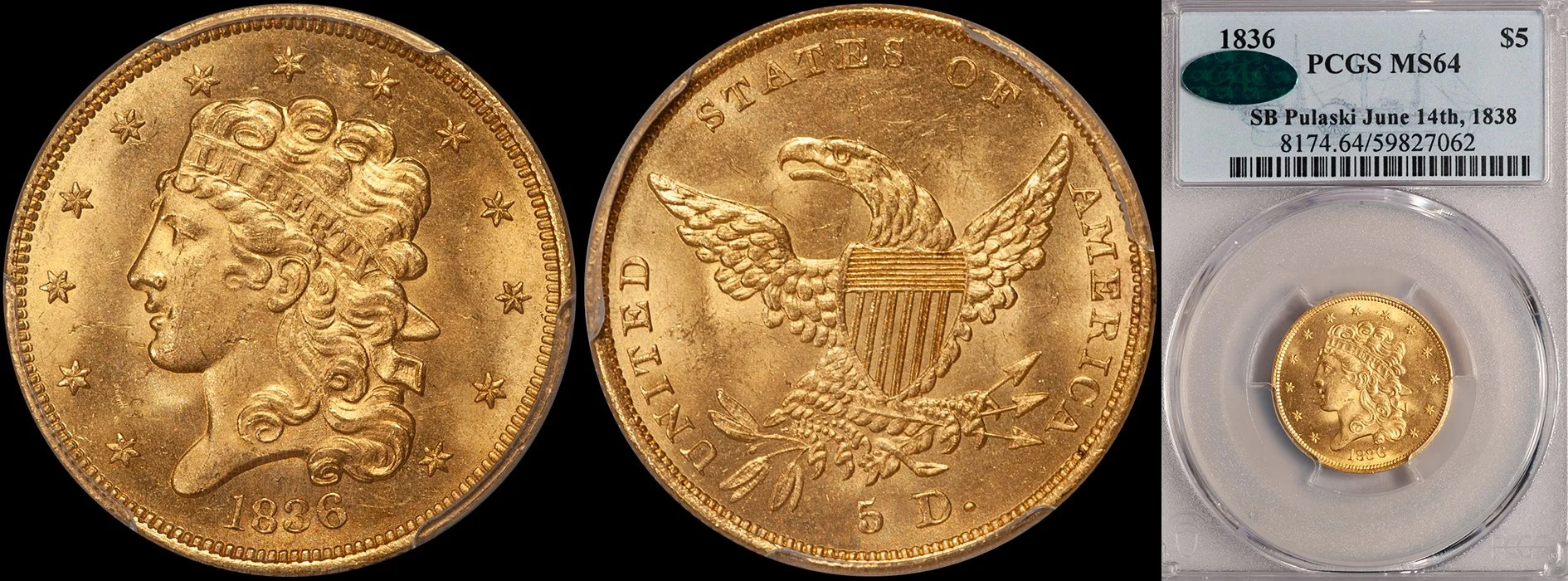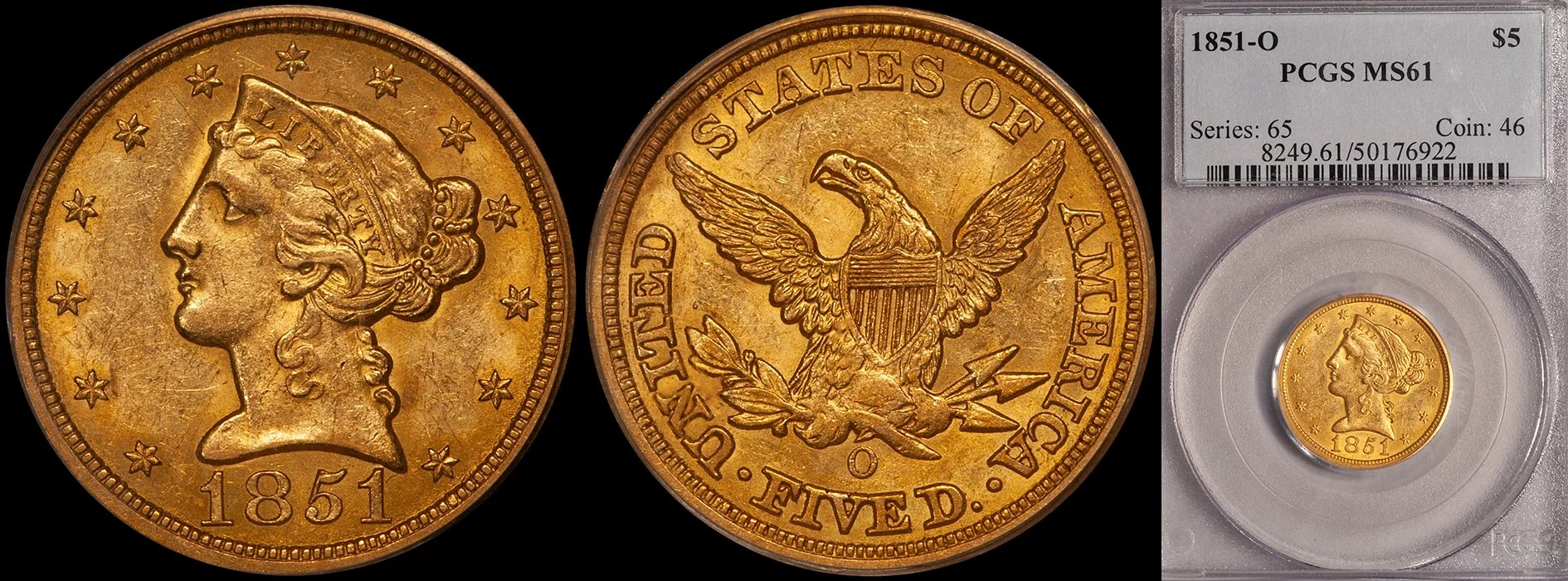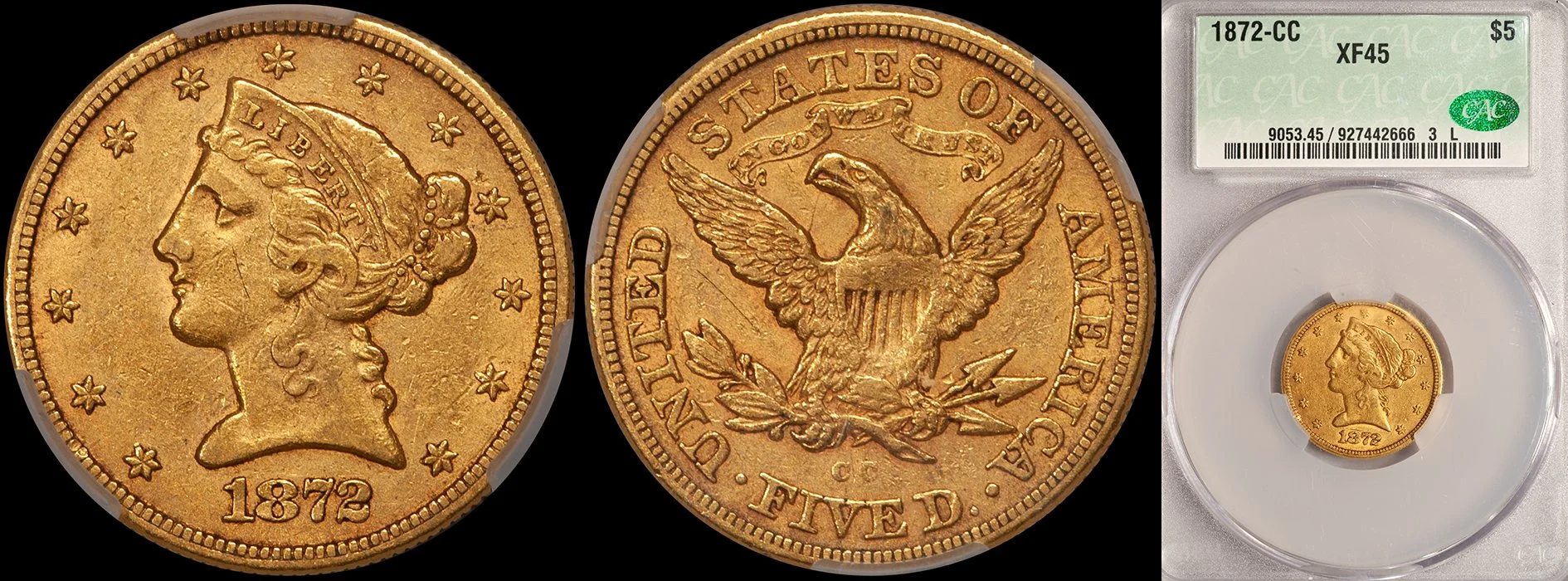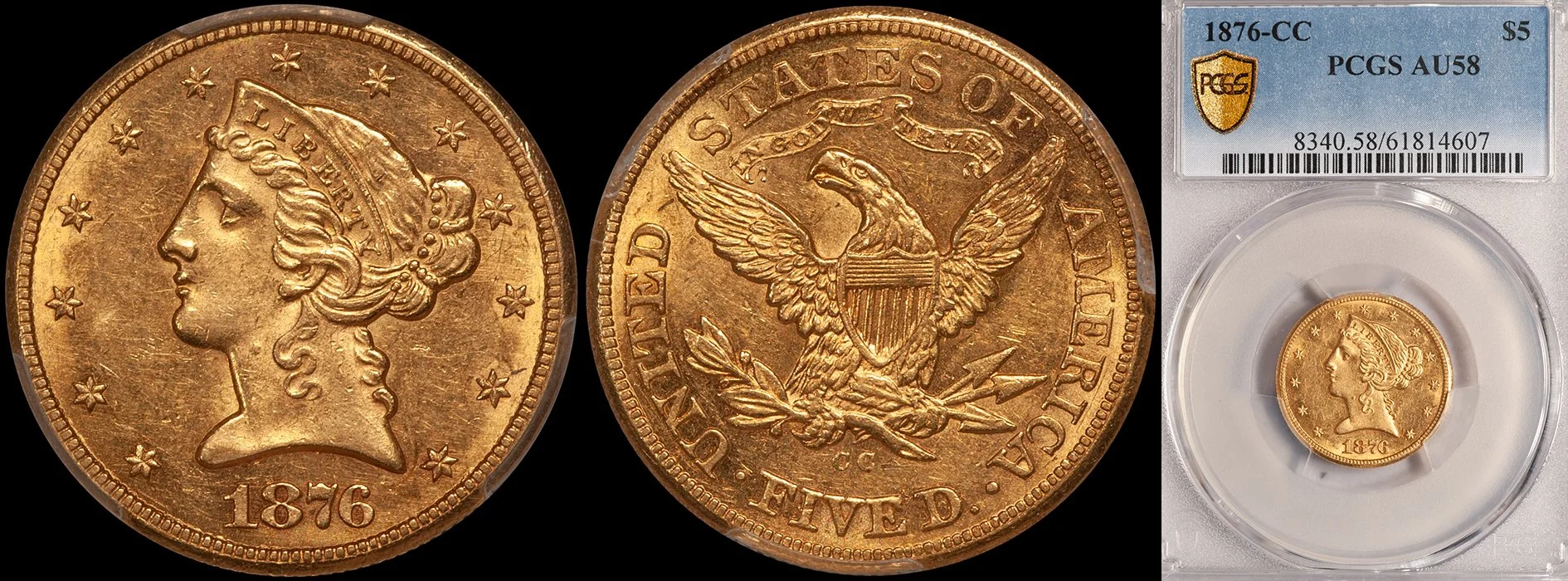
Classic Head Half Eagles, 1834 - 1838

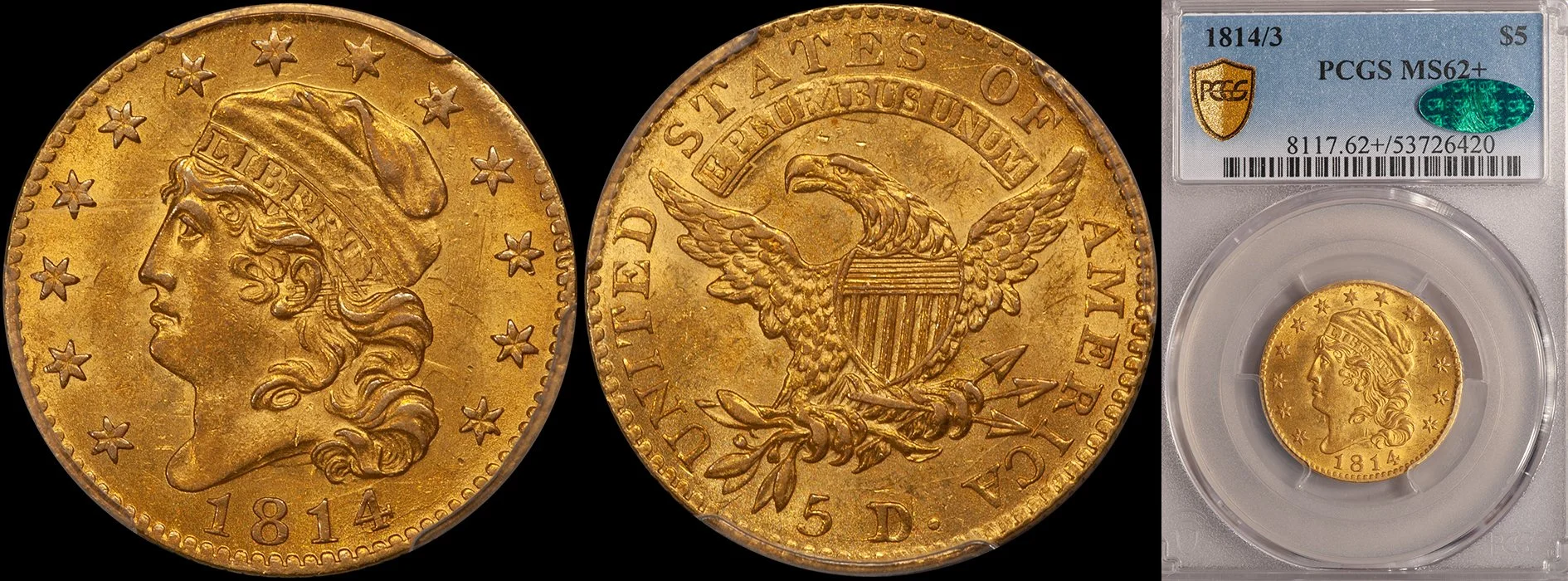
Through the 1820's, half eagles did not circulate. They were, instead, used by bullion depositors for export trade or melted by speculators due to their being worth more than face value. This problem was remedied with the passage of the Act of June 28, 1834 which lowered the weight of the quarter eagle and half eagle. A new design was rendered by William Kneass and the Classic Head half eagle series was born in the latter part of 1834. Classic Head half eagles are an interesting bridge between the "old gold" designs of the early 19th century and the Liberty Head issues which ran from 1838 until 1907. The Classic Head design was produced for only five years. The half eagles of this design are notable for including the first branch mint issues of this denomination.

This is an interesting series to collect. You can assemble a date set or a three piece mint set that contains examples from Philadelphia, Charlotte and Dahlonega. There are also enough interesting die varieties to consider specializing in Classic Head half eagles.

1834 Plain 4

This is the most common Classic Head half eagle. There are a few thousand known in grades ranging from heavily worn to Gem Uncirculated. Most are weakly struck at the central obverse, especially on the curls below BER in LIBERTY. The luster is often exceptional with textures ranging from frosty to satiny to almost fully Prooflike. The natural coloration is a rich orange-gold or yellow-gold. High grade 1834 Plain 4 half eagles can have extremely good eye appeal and there are some truly handsome pieces known. Varieties are known with a Large 4 and a Small 4 as well as two different styles of Liberty Head. The finest piece I can recall having seen was a PCGS MS-66 which brought $85,600 in the 1994 ANA sale. This issue makes a good type coin given its relative availability in high grades and the relative availability of attractive pieces.

1834 Crosslet 4

A small number of the nearly 700,000 Classic Head half eagles produced in 1834 show a Crosslet 4 in the date. This variety is also distinguished by having smaller arrows on the reverse than on the Plain 4 coins. It is usually found in the Extremely Fine-40 to About Uncirculated-50 range and has a better strike than the Plain 4 coins. The luster is often semi-prooflike and the surfaces show numerous marks below green-gold color. This is the rarest Classic Head half eagle in terms of its overall rarity and the rarest Philadelphia issue in high grade. Uncirculated pieces are quite rare and I have never seen or heard of one that graded higher than Mint State-63. It is still possible to "cherrypick" a piece from a dealer and I previously did this with some degree of regularity in the 1970's.

1835

The 1835, while not a rare date, is many times scarcer than the 1834 Plain 4. It is generally fairly well struck with slight weakness noted at the central obverse and on the wing tips. The luster is not as good as on other Classic Head half eagles and original, higher grade pieces typically have a slightly subdued grainy texture. The natural coloration is often medium to deep green-gold. Many 1835 half eagles have been cleaned at one time and also show deep, detracting abrasions. This is a hard coin to find with good eye appeal and it becomes quite scarce in Mint State-62 and rare in Mint State-63 or above. I have never seen a Gem and have seen maybe half a dozen accurately graded Mint State-64's. There are three major varieties known. The first has a noticeably curved neck on Liberty, a single forelock and a small date. The second has a much more curved neck and a small date with the 3 nearly closed in appearance. The final variety, which is rare, has a head that is also distinguished by a curved neck on Liberty but with a more narrow end. On this variety, the date is large.

1836

The Classic Head design was slightly modified in 1836 by Christian Gobrecht. There are numerous varieties known this year and the 1836 is, along with the 1834 Plain 4, the most fertile Classic Head half eagle for the die variety specialist. The most easily distinguishable varieties have a Small 5 and Large 5 in the valuation on the reverse. The 1836 is the second most common half eagle of this design. It is common in all circulated grades and only moderately scarce in Mint State-60 to Mint State-62. It becomes very scarce in Mint State-63 and rare in Mint State-64. Gems are extremely rare. The best piece I have personally seen was the Bass II: 848 coin, graded Mint State-64 by PCGS, that brought $29,900. Most examples show weakness of strike at the centers and are characterized by heavily abraded surfaces. The natural color ranges from medium orange-gold to deep green-gold. The luster is often satiny but tends to be impaired as the result of prior cleanings or dippings.

1837

Like the quarter eagle of this year, the 1837 half eagle is a scarce and very underrated issue. A lower than average percentage of the original mintage figure of 207,121 has survived and most are well worn. This date is not easily found in the higher About Uncirculated grades and it is very scarce in Uncirculated. It becomes rare in Mint State-63 and it is very rare in any grade higher. The best example I can recall seeing was the sensational PCGS MS-66 that brought $97,750 in the Bass II sale. Varieties are known with a Large Date and a Small Date; the latter is considerably scarcer. The 1837 half eagle usually has a decent strike with some weakness on the hair below BE in LIBERTY and at the corresponding reverse. The surfaces are often very heavily abraded and it is hard to locate a piece that has not been cleaned or dipped. The luster is typically frosty but some impressive semi-prooflike or even fully prooflike pieces exist.

1838

This issue is unusual for the type as it is scarce in terms of its overall rarity but fairly available in higher grades. This suggests that a hoard existed at one time and this observation is given further credence by the fact that most of the Uncirculated pieces have a similar appearance. The 1838 makes an ideal Classic Head type coin as it is among the best produced issues of this type. It is often seen with a very sharp strike, attractive rich orange-gold color and frosty, bold luster. Two major varieties are known. One has large arrows and a small 5 in the value while the other has small arrows and a large 5. The 1838 is not hard to locate in the higher circulated grades and Mint State-60 to Mint State-63 coins can be found without much difficulty. Gems are rare but do surface more often than any other Classic Head half eagle.

1838-C

The 1838-C is the rarest Classic Head half eagle in high grades. It is also one of my favorite branch mint gold coins. Its popularity is due to its status as the first half eagle from this mint and its status as a one-year type. Unlike the 1838-D, there are very few examples known in high grades. Of the estimated 150-175 pieces in existence, most are in the Fine to Very Fine range. Accurately graded Extremely Fine coins are quite scarce and About Uncirculated-50 to 53 coins are rare. In the higher AU grades, the 1838-C half eagle is very rare and there are just two Mint State pieces currently known. The best is a PCGS MS-63 that was most recently sold in the Bass II auction (in 1999) for $86,250. This issue is typically found with poor detail, extensive abrasions and unoriginal color. Two varieties are known. The more common has a repunched 5 in 5 D. while the rarer has a repunched 5. The great majority of 1838-C half eagles have massive die cracks on the reverse; examples with no cracks are extremely scarce.

1838-D

The 1838-D is popular for the same reasons as the 1838-C. Unlike its Charlotte counterpart, this is an issue that is relatively available in higher grades There are 200-250 pieces known from an original mintage of 20,583. While most often seen in Very Fine and Extremely Fine, there are enough About Uncirculated pieces around that the collector should be able to find one without difficulty. In Uncirculated, this is a rare issue but it is much more available than the 1838-C. Nine or ten Uncirculated pieces exist with most of these in the MS-60 to MS-61 range. The 1838-D is a much better struck issue than the 1838-C and it shows considerably more detail on the hair and the feathers. Most higher grade pieces have nice luster but it is hard to find coins with original color. There are a few exceptionally attractive 1838-D half eagles known and when they are offered for sale, they tend to sell for strong premiums over typical quality pieces.

Proofs

Bona-fide Proofs are known for a number of dates in this series. The 1834 is the most "common" issue in Proof. These coins were probably made for dignitaries to commemorate the new design. A number of very deceptive fully prooflike business strikes exist, so it is imperative to buy an example that has been "blessed" by a reputable grading service. There were Proofs dated 1835 (two examples) and 1836 in the Pittman sales. The 1835's brought $264,000 and $308,000 respectively while the 1836 brought $198,000. I have never seen a Proof 1837 half eagle but an example is located in the Smithsonian. A controversial 1838 Proof was sold in the Bass II auction for $115,00 and was earlier in the October 1996 Byron Reed sale.

CLASSIC HEAD HALF EAGLE RARITY RANKINGS Overall Rarity High Grade Rarity 1. 1834 Crosslet 4 1838-C 2. 1838-C 1834 Crosslet 4 3. 1838-D 1838-D 4. 1837 1837 5. 1838 1835 6. 1835 1838 7. 1836 1836 8. 1834 Plain 4 1834 Plain 4
New Orleans Eagles, 1888 - 1906

In recent years, a number of "short sets" have become popular within certain series of United States coins. As examples, there are short sets in the Mercury Dime and Walking Liberty half dollar series. These sets offer excellent opportunities for collectors who want to purchase high grade coins but who can not afford the expensive early date issues. This concept has not yet become popular in United States gold coinage but there are a number of potentially collectible short sets. Among these are the eleven Liberty Head eagles produced by the New Orleans mint between 1888 and 1906.

This is an interesting set for a number of reasons. All of the coins are affordable. In fact, a collector could assemble a nice complete set of Mint State-61 to Mint State-62 pieces for around $10,000. All of the coins become extremely scarce above Mint State-62. Most can be found with nice color, good luster and eye appeal that is comparable to the Philadelphia and San Francisco eagles of this era. And they are very undervalued at current price levels.

To better understand the appeal of this short set, let's look at some basic information about each date.

1888-O

At one time, the 1888-O eagle was very hard to find in any Uncirculated grade. A large number of low-end Mint State pieces have come onto the market in the past five years, making it relatively available in grades up to and including Mint State-62. The 1888-O is still very rare in Mint State-63 and above. It is usually seen with excellent frosty luster and nice green-gold or orange-gold color. The surfaces are almost always very heavily abraded and the obverse border may show some weakness of strike. It is extremely hard to locate without heavily abraded surfaces but the overall eye appeal is often good due to nice color and luster. Mint State-62 coins are worth $1100-1400. I would recommend a Mint State-62. Mintage: 21,355

1892-O

The 1892-O eagle is similar in rarity to the 1893-O. It is usually seen in About Uncirculated-55 to Mint State-61 grades and it is very rare in Mint State-63 or better. The luster is typically soft and frosty but it is interrupted by excessive abrasions. The 1892-O is perhaps the hardest New Orleans eagle of this era to find with clean surfaces. Original, uncleaned coins are often seen with attractive deep orange-gold color. A relatively clean Mint State-62 is currently worth in the area of $1750-2000 and is excellent value. I would recommend either a very high end Mint State-61 or a Mint State-62. Mintage: 28,688

1893-O

The 1893-O is a rarer coin overall than the 1892-O but it is very similar in high grade rarity. This date did not see much circulation and most survivors are in the About Uncirculated-55 to Mint State-60 range. The luster is a bit more satiny than on the 1892-O. Like the 1892-O, the 1893-O is usually found with excessively abraded surfaces. Original coins often show handsome orange-gold and greenish color. The 1892-O is almost never seen above Mint State-62 and in this grade it is scarce and undervalued. A nice Mint State-62 is worth $1850-2150 and is, again, an outstanding value. I would recommend either a very high end Mint State-61 or a Mint State-62.Mintage: 17,000

1894-O

At one time, the 1894-O eagle was a very rare coin in Uncirculated. In the mid-1990's, a hoard of 100 or so Uncirculated pieces entered the market. Today, the 1894-O is more available in lower Mint State grades but it is seldom seen above Mint State-62. The surfaces tend to be a bit cleaner than on the 1892-O and the 1893-O and the strike is a bit sharper than on those two dates. Original coins have hard, frosty luster with orange-gold and pale green coloration. I can remember paying $2000 for an MS-60 1894-O in the mid-1990's. Today, such a coin can be bought for $650-750. A Mint State-62 is worth $1750-2000 while an MS-63 is worth $4000-4500. I would recommend either a very high end Mint State-61 or a Mint State-62. Mintage: 107,500

1895-O

The same hoard which contained the 1894-O eagles mentioned above also contained a number of 1895-O eagles. This formerly rare coin is now very similar in rarity to the 1894-O and it sells for less than half of its pre-hoard price level. This date is most often seen in Mint State-60 to Mint State-61. It has a somewhat blunt strike on the high spots but this is often compensated for by good color and luster. The surfaces are often heavily abraded and this is why the 1895-O is almost never seen above Mint State-62. In MS-62, the 1895-O is a great value at its current level of $1000-1200; in MS-63 it sells for $3000-3500 and is another very good value. I would recommend either a very high end Mint State-61 or a Mint State-62. Mintage: 98,000

1897-O

The aforementioned hoard contained some 1897-O eagles but not as many as with the earlier dates. Because of this, the 1897-O has remained scarce in all Uncirculated grades. Most examples grade About Uncirculated-58 to Mint State-61 and are somewhat softly struck with heavily abraded surfaces. This date becomes quite scarce in Mint State-62 and it is rare in Mint State-63. There are a few more very choice pieces known than for the earlier issues in the "short set." A nice Mint State-62 is currently worth $1000-1200 while a Mint State-63 is worth $1750-2000. It would be hard to think of a 19th century gold coin that is a better value than an 1897-O eagle in nice Mint State-63 in the $2000 range! This would be a great date for the collector to "stretch" for and if you can find a Mint State-63, I'd urge you to buy it. Mintage: 42,500

1899-O

The 1899-O is the scarcest coin the New Orleans eagle short set. It is sometime seen in Mint State-60 and Mint State-61 but it becomes very hard to find in Mint State-62. In Mint State-63, this issue is rare and extremely undervalued. It is the best struck coin in this set from the 19th century. But most are heavily abraded and have impaired luster and a result. The current Trends (as of 4/23/01) value for this coin is $2250 in Mint State-63; exceptionally low when one considers that PCGS has graded just six in Mint State-63 and one better. A Mint State-62 is currently worth $900-1000; another great value given the true scarcity of this date in this grade. I would recommend a Mint State-62 example. Mintage: 37,047

1901-O

The 1901-O is significant as the first New Orleans eagle produced in the 20th century. Unlike its 19th century predecessors, it can be found in the higher Uncirculated grades with a bit more regularity. This date is characterized by a good strike and excellent frosty luster. Original coins often have attractive rich yellow-gold or pale green-gold color. The 1901-O eagle is most often seen in Mint State-60 to Mint State-62. It is scarce in Mint State-63 and very rare in any grade higher than this. Current price levels are $700-800 for a Mint State-62 and $1500-1750 for a Mint State-63. A high end Mint State-62 or a Mint State-63 would be my suggestion for a nice quality short set. Mintage: 72,041

1903-O

The 1903-O has the highest mintage figure of any New Orleans eagle in the short set and it is the most common date in terms of overall and high grade rarity. It is relatively common in Mint State-60 to Mint State-62 grades but it becomes scarce in Mint State-63 and very rare in Mint State-64 or above. The 1903-O is not as well struck as the 1901-O and it tends to have slightly inferior soft luster. The natural coloration is most often a medium to deep green-gold hue. A Mint State-62 can be bought for $500-600 while a Mint State-63 will cost $1400-1700. A high end Mint State-62 or a Mint State-63 would be my suggestion for a nice quality short set. Mintage: 112,771

1904-O

This is one of two dates in the short set with a mintage of more than 100,000 and it is one of the more available single coins. The 1904-O is available in the Mint State-60 to Mint State-62 range with a good degree of regularity. It becomes scarce in Mint State-63 and it is quite rare in any grade higher than this. The 1904-O is a well-produced issue that is generally very well struck with nice luster and color. Most pieces are very heavily abraded and, thus, fall into the lower Uncirculated grades. In Mint State-62, this is a very affordable coin, selling for $600-700. In Mint State-63 it is valued in the $1600-1800 range. I would suggest a nice quality Mint State-62 or a Mint State-63 for a short set. Mintage: 108,950

1906-O

The 1906-O eagle is the final gold coin of this denomination to be produced at the New Orleans mint. It is also among the most underrated. It is scarcer than the 1903-O and the 1904-O in the lower Uncirculated grades and it is surprisingly scarce in Mint State-63. It is actually the most available New Orleans eagle of the With Motto type in very high grades (Mint State-64 and above) but it is still a rare issue in this range. The 1906-O is usually seen with a very good strike and excellent luster. Most pieces are heavily abraded and have somewhat dark color. A Mint State-62 is currently valued at $700-900 while a Mint State-63 is worth $1750-2000. I would suggest a nice quality Mint State-62 or a Mint State-63 for a short set. Mintage: 86,895

In closing, here is an interesting statistic to ponder when regarding the level of value for higher grade coins in the New Orleans eagle short set. A very common date Liberty Head eagle, such as a 1901-S, is currently worth $400 in Mint State-63. This date has a PCGS population, as of April 2001, of 3,450 coins in MS-63 with 2,513 graded higher. The most common high grade New Orleans date in the short set is the 1906-O which has a population of 24 in MS-63 with 13 graded higher. A nice PCGS MS-63 is currently valued at $1750-2000. This means that a coin which is over 143 times rarer is only priced at 4.5 times more.

I. CERTIFIED COINS, BY GRADE Date Grade Range/Service MS-60-62 PCGS/NGC Grade Range/Service MS-63 and above PCGS/NGC Total PCGS/NGC 1888-O 160/262 14/2 174/264 = 438 1892-O 167/230 1/0 168/230 = 398 1893-O 125/112 2/0 127/112 = 239 1894-O 118/103 15/7 133/110 = 243 1895-O 144/117 11/5 155/122 = 277 1897-O 79/58 14/4 93/62 = 157 1899-O 76/30 8/4 84/34 = 128 1901-O 162/117 40/15 202/132 = 334 1903-O 379/258 41/22 420/280 = 700 1904-O 210/198 37/28 247/226 = 473 1906-O 105/82 37/32 142/114 = 256

II. RARITY RANKINGS, BY TOTAL NUMBER CERTIFIED

Date Total Number Certified Ranking 1899-O 128 1st 1897-O 157 2nd 1893-O 239 3rd 1894-O 243 4th 1906-O 256 5th 1895-O 277 6th 1901-O 334 7th 1892-O 398 8th 1888-O 438 9th 1904-O 473 10th 1903-O 700 11th

III. HIGH GRADE COINS (MINT STATE-63 AND ABOVE) - TOTAL GRADED Date Total Number Certified 1888-O 16 1892-O 1 1893-O 2 1894-O 22 1895-O 16 1897-O 18 1899-O 12 1901-O 55 1903-O 63 1904-O 65 1906-O 69

IV. RARITY RANKINGS - HIGH GRADE COINS (MINT STATE-63 AND ABOVE) Date Number Graded Ranking 1892-O 1 1st 1893-O 2 2nd 1899-O 12 3rd 1888-O 16 4th 1895-O 16 4th (tie) 1897-O 18 6th 1894-O 22 7th 1901-O 55 8th 1903-O 63 9th 1904-O 65 10th 1906-O 69 11th

The Type Collectors Approach to Branch Mint Gold Coinage

Most branch mint gold collectors focus on a specific mint and then assemble a date set. As an example, a Charlotte collector often decides to specialize in quarter eagles and then attempts to assemble a complete set of twenty issues. This has become more difficult, though, due to the high price of choice coins and the relative unavailability of nice, original affordable medium grade examples. As a result, many date collectors become frustrated and abandon their specialty.

There is a solution to this problem. Collecting coins by type entails acquiring a single representative of a design or variety and supplementing it with other types. There are some variations on this theme which apply well to branch mint gold. These include the following:

I. The Basic Type Set

A basic type set includes a single example of every design that was struck at a specific mint. This will be discussed more specifically below.

II. The Denomination Set

This is one of the simplest and most affordable ways to collect branch mint gold. As an example, a denomination set of Carson City gold would include an example of a half eagle, an eagle and a double eagle.

III. The Decade Set

This set includes an example of a denomination in each decade it was struck. As an example, a decade set of Carson City double eagle would contain three coins: one each from the 1870's, 1880's and the 1890's.

IV. The Year Set

A year set contains an example of each denomination from a specific mint struck during a specific year. An example of this would be an 1878-CC year set which would contain a half eagle, eagle and double eagle from this year.

Let's look at the most popular branch mints (in alphabetical order) and see how these collecting methods apply to them.

A. CARSON CITY GOLD COINS

The prohibitive price of most high grade Carson City gold coins makes them a perfect candidate for type collecting.

A basic type set of Carson City gold coins contains the following four designs:

  • With Motto Liberty Head Half Eagle (1870-1893) With Motto Liberty Head Eagle (1870-1893) Type Two Liberty Head Double Eagle (1870-1876) Type Three Liberty Head Double Eagle (1877-1893)

The basic four coin set can be completed for a very reasonable sum if a collector selects common dates in affordable grades. The more affordable coins include the 1891-CC half eagle and eagle, the 1875-CC double eagle and the 1884-CC or 1893-CC double eagle. Or, this could be a small but expensive set if rare dates in high grades are used.

A denomination set of Carson City half eagles consists of just three coins: half eagle, eagle and double eagle. As with the basic type set, this group can be assembled for a reasonable sum or it can be an "over the top" trio with very high grade (in this case, Mint State-63 and Mint State-64) examples of available issues. Another option would be to select rare dates for all three denominations and attempt to purchase them in the best available grade.

Building a decade set of Carson City gold coinage is interesting and challenging. For both the half eagle and eagle denominations, a coin from the 1870's is the most challenging, with the 1880's and 1890's issues progressively easier to obtain in higher grades. A complete nine piece decade set of Carson City gold (containing three half eagles, three eagles and three double eagles) would be a very desirable group.

There are many interesting year set options for the Carson City gold coin collector. The 1870-CC issues are all very rare and are historically important as the first gold issues from this mint. The 1893-CC issues are considerably more affordable but are also interesting as the final Carson City gold coins. Practically speaking, any year set from the 1870's will contain rare but fairly expensive coins while the 1890's issues will be more common but far more affordable. A good alternative is a date from the 1880's. The only years in which all three denominations were produced are 1882 and 1884. Both contain coins that are obtainable in higher grades (in this case up to About Uncirculated-55) but are still reasonably priced.

B. CHARLOTTE GOLD COINS

Charlotte gold coins have many more basic types than their counterparts from Carson City. This makes them an excellent choice to collect in this manner. The basic type set of Charlotte issues consists of the following eight coins:

  • Type One Gold Dollar (1849-1853) Type Two Gold Dollar (1855 only) Type Three Gold Dollar (1857 and 1859) Classic Head Quarter Eagle (1838 and 1839) Liberty Head Quarter Eagle (1840-1860) Classic Head Half Eagle (1838 only) Liberty Head Half Eagle, Obverse Mintmark (1839 only) Liberty Head Half Eagle, Reverse Mintmark (1840-1861)

This eight coin set is not hard to assemble as none of the specific types is extremely rare or expensive in average circulated grades. However, this set can become very expensive (and a real challenge) if the collector wants to acquire each coin in as high a grade as possible. A pair of specific issues, the Type Two gold dollar and the Classic Head half eagle, are very rare and expensive in Uncirculated. In fact, I have only seen three or four Uncirculated Type Two Charlotte gold dollars and just two Classic Head half eagles from this mint in over twenty years of specializing in Charlotte coinage.

A three coin denomination set of Charlotte gold coins is an excellent introduction to this mint. If the collector chooses issues such as the 1851-C gold dollar, 1847-C quarter eagle and the 1857-C half eagle he can assemble a set that includes high grade pieces that are quite affordable. Or, he can pick scarcer issues to make this a more numismatically interesting group.

Charlotte coins were struck during four decades: the 1830's, 1840's, 1850's and 1860's. This means, obviously, that a decade set consists of four coins. Since gold dollars were not produced during one of these decades (the 1830's), this four coin decade set would either contain quarter eagles or half eagles; or even a combination of the two.

There were only five years in which the Charlotte mint produced coins from all three denominations: 1849, 1850, 1851, 1852 and 1855. Any one of these years would lend itself well to a challenging three coin year set. The rarity of the quarter eagles struck in each of these years would make this set extremely hard to complete in Uncirculated. A nicely matched About Uncirculated set is a more practical alternative for most collectors.

C. DAHLONEGA GOLD COINS

Dahlonega gold coins are often collected alongside Charlotte issues. As with Charlotte coins, there are a number of interesting Dahlonega types and this makes them another excellent area to collect in one of the following manners. A basic type set of Dahlonega coins consists of the following:

  • Type One Gold Dollar (1849-1854) Type Two Gold Dollar (1855 only) Type Three Gold Dollar (1856-1861) Classic Head Quarter Eagle (1839 only) Liberty Head Quarter Eagle (1840-1859) Three Dollar Gold Piece (1854 only) Classic Head Half Eagle (1838 only) Liberty Head Half Eagle Obverse Mintmark (1839 only) Liberty Head Half Eagle Reverse Mintmark (1840-1861)

This nine coin set is quite a bit more expensive to assemble than the Charlotte eight coin set. This is due to the presence of the rare and popular 1854-D Three Dollar Gold Piece. A nice example will cost in the area of $15,000-25,000+ and it is far and away the most expensive single type from any of the Southern branch mints. The collector on a more limited budget might simply elect to not include this coin. The next most difficult issue to obtain in higher grade is the Type Two gold dollar. There are just three Uncirculated examples currently known (all are in tightly-held collections) and even nice About Uncirculated examples are rare and expensive. Figure spending $15,000-25,000 for a well struck, accurately graded About Uncirculated 1855-D gold dollar.

A denomination set of Dahlonega issues includes four coins. As mentioned above, the Three Dollar gold piece is an expensive piece that will constitute a good percentage of the money spent on this set. It is always an option to "forget" that this coin exists and make the denomination set consist of three issues. If a collector wishes to include coins in higher grades In this case About Uncirculated-55 to Mint State-62), he should focus on such relatively available issues as the 1849-D gold dollar, the 1843-D, 1844-D or 1848-D quarter eagles and the 1852-D, 1853-D or 1854-D half eagles.

Assembling a four coin decade set of Dahlonega coins is an interesting approach to collecting issues from this mint. However, if the collector seeks to assemble such a set using only one denomination than he must select half eagles as these were the only coin struck at Dahlonega in the 1830's, 1840's, 1850's and 1860's. This would be a very numismatically interesting set and it could be completed in grades ranging from Very Fine to Mint State-62.

There was only one year in which the Dahlonega mint produced coins in all four denominations: 1854. This would make an extremely interesting year set. The years in which three coins were produced simultaneously are 1849, 1850, 1851, 1852, 1853, 1855, 1856, 1857 and 1859. A few of these years are more practical for the collector on a budget as they do not contain a specific issue that is rare and/or expensive. These "easy" years include 1849, 1850, 1857 and 1859. In the other years, the quarter eagle tends to be the rarest and most expensive coin.

D. NEW ORLEANS GOLD COINS

The New Orleans mint was open for a far greater period of time than Carson City, Charlotte and Dahlonega and more types of gold coins were produced. A basic type set from this mint consists of the following:

  • Type One Gold Dollar (1849-1853) Type Two Gold Dollar (1855 only) Classic Head Quarter Eagle (1839 only) Liberty Head Quarter Eagle (1840-1857) Three Dollar Gold Piece (1854 only) Liberty Head Half Eagle Without Motto (1840-1857) Liberty Head Half Eagle With Motto (1892-1894) Indian Head Half Eagle (1909 only) Liberty Head Eagle Without Motto (1841-1860) Liberty Head Eagle With Motto (1879-1906) Type One Liberty Head Double Eagle (1850-1861) Type Three Liberty Head Double Eagle (1879)

This twelve coin set is very interesting in that it contains no less than four one year types. Fortunately, only one of these is rare in any grade (the 1879-O double eagle) and the other three can be obtained in comparably high grades for reasonable prices. The average grade(s) should be higher than for Charlotte or Dahlonega sets due to the affordability of many of the types. In fact, even a collector with a modest budget should be able to purchase About Uncirculated examples of most of the types and Extremely Fine examples of the scarcer issues.

The denomination set from New Orleans is unique among the mints we are discussing as it contains six coins. Unlike the 1854-D Three Dollar Gold Piece, the 1854-O is an affordable issue in most circulated grades. A representative Uncirculated gold dollar, quarter eagle, half eagle and eagle from New Orleans are all very affordable. The most difficult--and expensive--denominations from this mint are the Three Dollar Gold Piece and the Double Eagle. An Uncirculated 1854-O Three Dollar Gold Piece, if available, will cost at least $12,500-15,000 while an Uncirculated New Orleans Double Eagle, most likely an 1851-O or an 1852-O, will cost as much or more than the aforementioned Three Dollar gold piece.

New Orleans gold coins were struck in no less than seven decades: the 1830's, 1840's, 1850's, 1860's, 1870's, 1880's, 1890's and 1900's. This seven coin decade set is reasonably easy to complete. The 1830's must be represented by a Classic Head quarter eagle from 1839 as this was the only gold coin produced at the New Orleans mint during this decade. Luckily, this is a relatively common and inexpensive coin. During the 1860's, coinage was limited to eagles (1860 only) and double eagles (1861). Both of these issues are scarce but are not expensive unless the collector wishes to obtain a coin that approaches the Uncirculated level. In the 1870's, coinage was, again, limited to eagles and double eagles (both in 1879 only). These are both scarce and desirable but nice quality 1879-O eagles and double eagles can be obtained in the $10,000-15,000+ range. In the 1880's, the only denomination struck at the New Orleans mint was the Eagle. The 1888-O is the most affordable of the five Eagles produced during the 1880's.

There was never a single year in which all six denominations produced at the New Orleans mint were struck simultaneously. The closest a collector can come to this is a year set containing five different denominations from New Orleans. The only year this occurred was 1851. Fortunately, none of the 1851-dated New Orleans coins are rare and most are readily obtainable in the higher circulated grades. An ambitious collector with a large budget could even assemble an Uncirculated 1851-O year set as all five denominations exist in Uncirculated grades ranging between Mint State-60 and Mint State-62.

Collecting branch mint gold coins by date is certainly not for everyone and, hopefully, some of the "type-centric" suggestions offered above will be of interest to the new or frustrated advanced collector.

Ten Best United States Coin Books

New collectors often ask me to recommend books to add to their numismatic libraries. I find myself recommending a core group of fifteen or so over and over again. This made me realize that it would be very helpful to write a short article that listed the ten essential United States coin books. My parameters for these books are simple: they are well-written and useful. I have built and sold at least three different numismatic libraries but I have always kept copies of the following books. Simply put, they are too useful--and too good--to ever sell.

These books are not listed in any specific order. None are terribly hard to locate and all are essential.

A Guide Book of United States Coins, Richard Yeoman. The Early Coins of America, Sylvester S. Crosby. The U.S. Mint and Coinage, Don Taxay. Fractional Money, Neil Carothers. Numismatic Art in America, Cornelius Vermeule. Early American Cents/Penny Whimsy, Dr. William H. Sheldon. Walter Breen's Encyclopedia of United States Coins. The History of United States Coinage, Q. David Bowers. Early United States Dimes, 1796-1837, Davis, Logan, et. al. United States Gold Coins, Significant Auction Records 1990-1999, John Dannreuther and Jeff Garrett.

    1. A Guide Book of United States Coins, Richard Yeoman.

    Better known as the "Redbook," this reference was first published in 1947. Today, it is among the best selling non-fiction books of all time. More than just a catalog of prices, the Redbook is a wonderful one-volume reference that is full of important information. I have been proud to be a contributor since 1983! This work is easily located at any bookstore or it can be bought online through such website as Amazon.com.

    2. The Early Coins of America, Sylvester S. Crosby.

    This incredible one volume reference was first published in 1875 and it has been reprinted a number of times since. Perhaps the most impressive fact about this book is the fact that over 125 years after it was written, it is still the standard reference on Colonial coinage. Just as impressive is the fact that virtually none of its historical and numismatic information has been improved upon. Originals are rare and expensive; the Quarterman Publications reprint, available for under $100, is fairly easy to find and it is the best produced of the various reprints.

    3. The U.S. Mint and Coinage, Don Taxay.

    Published in 1966, this is a well-researched and extensively illustrated book. It contains information on the history of the United States mint(s) and many of its most interesting issues. Of particular interest are the sections on the issues of 1792-1793. While long out-of-print, originals are not hard to find and generally sell in the $40-60 range. After a brilliant career as a researcher in the 1960's and 1970's, Taxay disappeared from the numismatic scene and has not been heard from in over twenty years.

    4. Fractional Money, Neil Carothers.

    This somewhat obscure work was actually Carothers' doctoral thesis, written in 1930 while he was at Princeton. It is a fascinating analysis of economic conditions and their impact on coinage. Rather than focusing on the larger denomination silver coins (and gold), this work is most closely concerned with minor coinage. It is not always the easiest book to read, but it is extremely interesting and comprehensive. Originals are scarce and cost in the area of $100; a reprint was produced by Bowers and Merena a few years ago and this is an excellent value in the $20-30 range.

    5. Numismatic Art in America, Cornelius Vermeule.

    Written in 1971 by an Art professor and, as such, a unique look at the aesthetics of United States coinage designs. The book contains many interesting photographs, including design sketches of coins that can be found nowhere else. This is a very underrated work but one that I have read and enjoyed a number of times. It is reasonably scarce but can be found with some patience. A nice, slightly used copy fetches $45-65 and is well worth it.

    6. Early American Cents/Penny Whimsy, Dr. William H. Sheldon.

    Early American Cents was published in 1949 while Penny Whimsy, written with the assistance of Walter Breen and Dorothy Paschal, was published in 1958. The former is the book that introduced the 70 point grading scale to American numismatics; the latter has better plates and revised information. Penny Whimsy has been reprinted but originals are often offered for sale in the $40-60 range. Both are expertly written, interesting to read even if you do not care about Large Cents and enduring classics.

    7. Walter Breen's Encyclopedia of United States Coins.

    This is quite possibly the most ambitious book ever written about United States coins. It is over 1,000 pages in length and it contains information on essentially every major issue struck in the United States from the 17th century to the present. It is marred by Breen's personal biases and politically motivated theories but it is the single best one volume work on American coins and a mandatory work in any library. It is readily available in the $100 range and should be carefully read by all coin collectors.

    8. The History of United States Coinage, Q. David Bowers.

    This book was written in conjunction with Bowers' four auctions containing the Garrett collection, sold from 1979 to 1981. Bowers is the most prolific numismatic author of the modern era and all of his books are worthwhile additions to a library. This is probably my favorite of his works as it is a superb overview that appeals to both the novice and the advanced collector. It is well illustrated and attractively produced as well.

    9. Early United States Dimes, 1796-1837, Davis, Logan, et. al.

    This 1984 book is a classic one volume reference on a previously undercollected and misunderstood area of American numismatics. It is a collaborative effort of five well-known collectors and it is a nearly perfect work; easy to use, well-illustrated and with enough information to satisfy the beginning or advanced collector. The 1980's and the 1990's saw a considerable number of important references on silver and gold coins and this was, in my opinion, one of the very best.

    10. United States Gold Coins, Significant Auction Records 1990-1999, John Dannreuther and Jeff Garrett.

    Let's face facts. Most collectors would rather know what a coin is worth than the history behind it. The value of this new book is that, in one convenient place, a tremendous amount of pricing information can be found. I find this book extremely useful when buying and selling gold coins, especially for rare, esoteric items that I do not handle on a regular basis. Currently available from PCGS for $129 and worth every penny.

    Conclusion:

    It would have been easy to add a number of other books to the list. And, of course, I am totally ignoring other areas of American numismatics such as medals, tokens and paper money.

    I would strongly that suggest that you invest your next $500 - $1,000 numismatic purchase on books as these will more than pay for themselves over the course of time. I would be happy to provide any additional information on coin books and welcome your email.

The Gold Coinage of The San Francisco Mint

PART TWO: HALF EAGLES Part One of this article covered gold dollars, quarter eagles, and three dollar gold pieces from the San Francisco mint. This part will cover the Liberty Head half eagles.

LIBERTY HEAD HALF EAGLES (1854-1906)

No Motto (1854-1866)

Fifty Liberty Head half eagles were struck at the San Francisco mint between 1854 and 1906. These issues range from extremely common to extremely rare. Excluding the 1854-S, this is a completable set in circulated grades but it would be virtually impossible to assemble in Uncirculated due to the rarity (and cost) of many of the issues struck between 1858 and 1876.

1854-S: The 1854-S half eagle is the second rarest San Francisco gold coin, trailing only the unique 1870-S Three Dollar gold piece. The only example that has sold in the last twenty years is the Eliasberg coin, a nice AU now owned by a prominent Dallas collector. In some ways, the great rarity of this date works against it as many non-specialists overlook the 1854-S when mentioning the great U.S. gold rarities. Were the Eliasberg coin to appear at auction today, I think it would bring well over $1 million.

1855-S: The first collectable half eagle from this mint and an issue that seems to have become more available in the AU-50 to AU-55 grades in recent years. The only real Uncirculated example I have ever seen was the Bass II: 1077 coin, graded MS-62 by PCGS, that brought $17,250. Almost always found with excessively abraded surfaces.

1856-S: A harder issue to find than its original mintage figure of 105,100 would suggest but still the most obtainable of the early San Francisco half eagles. The survivors are well-spread between Very Fine, Extremely Fine and lower end About Uncirculated grades. Six to eight exist in Uncirculated. The best I've seen is an NGC MS-64 that brought $26,450 in the Heritage February 1999 sale. Varieties are known with Large S and Medium S mintmarks; the former is rarer. There were some included in the S.S. Central America cargo with the best a PCGS MS-62 that brought $12,650 in the Christie's December 2000 sale.

1857-S: Currently a bit scarcer than the 1856-S in lower grades but more available in Uncirculated; as many as 10-12 are now known in Mint State. There were a pair recovered from the S.S. Central America that were later graded MS-64 by PCGS. Both were in the Christie's December 2000 sale; they brought $20,700 and $36,800 respectively. Varieties exist with Small S and Medium S mintmarks; the former is rarer.

1858-S: Beginning with this issue, mintage figures for San Francisco half eagles drop appreciably. There were 18,600 1858-S half eagles struck and this is a very rare coin in all grades. An estimated 30-40 exist (all with a Small S mintmark) with most in the VF-XF range. I have only seen four or five AU examples and none that were truly Uncirculated. The best I am aware of is the Bass II coin, graded AU-58 by PCGS, which sold for $13,800 in October 1999. This is my favorite No Motto San Francisco half eagle and I believe it is significantly undervalued.

1859-S: A bit more available than once assumed but still a very scarce issue; around 40-50 are known. The 1859-S half eagle becomes hard to locate in high end EF and it is rare in any AU grade. There is a single Uncirculated example known. It was first offered for sale in the May 1995 Milas collection sale held by Stack's where it brought $34,100 and was graded MS-62 by NGC. It was reoffered in October 1999 in the Bass II sale (now in a PCGS MS-62 holder) and it realized $29,900.

1860-S: The mintage figure is 21,200; a bit more than the 1858-S and 1859-S half eagles. But it is another rare issue with an estimated 45-55 known. Most are very well-worn and an accurately graded EF-45 is about the best available quality. I am not aware of more than five or six AU's. The only Uncirculated 1860-S half eagle I have ever seen is the PCGS MS-62 that is ex Bass II: 1128 (at $27,600) and, earlier, was Lot 499 in Bowers and Ruddy's October 1982 Eliasberg sale.

1861-S: The 1861-S has a mintage figure that is nearly identical to the 1858-S but it is less rare, especially in lower grades. There are an estimated 50-60 known but nearly all of these are in EF-45 or lower. The 1861-S is extremely rare in full AU and unknown in Uncirculated. The NGC AU-58 Milas coin is the best I can recall seeing. Most 1861-S half eagles are very heavily bagmarked and unappealing due to a lack of originality.

1862-S: This is a very rare coin with just 9,500 originally struck and around 30-40 known. The majority are well worn and this is a major rarity in AU grades with four or five known. The best I've seen is the Bass II: 1141 ex Milas: 527 coin, graded AU-55 by both PCGS and NGC. The 1862-S is usually softly struck and extensively abraded. I put together a complete set of Condition Census quality Civil War half eagles two years ago and this issue was, along with the 1864-S, the hardest to locate.

1863-S: While nearly twice as many 1863-S half eagles were struck than in 1862, it is nearly as rare. I doubt if more than 35-45 are known; most are EF-40 or below. The 1863-S is another major rarity in AU with no more than a half dozen known and no Mint State pieces. The best I've seen was the NGC AU-58 Milas coin that sold for $19,800 in 1995. The Bass II coin, graded AU-55 by PCGS, went very reasonably at $9,775.

1864-S: This is the rarest collectable San Francisco half eagle and it is among the rarest Liberty Head gold coins of any denomination. An estimated 15 exist from the tiny mintage of 3,888. Most are very well worn. There is a truly remarkable PCGS MS-65 that brought $178,000 in the Bass II sale in October 1999 and $110,000 in the October 1987 Norweb sale. This is among my very favorite United States gold coins and it is currently owned by a Georgia collector.

1865-S: The 1865-S half eagle's mintage is a comparatively robust 27,612 and it is quite a bit less rare than the 1862-1864 San Francisco half eagles. Around 70-80 are known including as many as a dozen AU's. Interestingly, at least two or three nice examples have been discovered with metal detectors in recent years. The finest known is the PCGS MS-64 that was recovered from the Brother Jonathan shipwreck. Varieties are known with a Large S mintmark and a Medium S; the latter appears to be rarer.

1866-S No Motto: An important stand alone issue as it is the only Half Eagle dated 1866 that does not have the motto on the reverse. 9,000 were struck; an unusually high percentage have survived, albeit in very low grades. There are an estimated 80-90 known with the majority in the Fine to Very Fine range. AU coins are extremely rare with six to eight known. The best I have seen is the Bass II coin, graded AU-58 by PCGS, which realized $25,300. The James Stack coin, sold by Stack's in October 1994, brought $20,900 and it was also very choice.

With Motto (1866-1906)

1866-S With Motto: Nearly 40,000 were struck, but this variety is actually rarer than the 1866-S No Motto. Many of the 65-75 known are very well worn. The mintmark is so small and weakly impressed than it is easy to mistake these for Philadelphia coins. This is an extremely rare issue in AU and I have never seen one I graded higher than AU-53, although the grading services have encapsulated examples as high as AU-58.

1867-S: This rare and underrated issue is my favorite With Motto San Francisco half eagle. There are around 40-50 known but most are very well worn. I have only seen two or three that I grade About Uncirculated and none better than AU-53. Usually seen weakly struck and heavily abraded. Clearly, this was an issue that was heavily used in local commerce. An extremely good value at current price levels.

1868-S: The 1868-S is more readily available than the 1866-S With Motto and the 1867-S, especially in higher grades. There are at least a dozen known in AU including some reasonably choice pieces. I have only seen one I considered Uncirculated; a PCGS MS-61 that was sold by Heritage in their 1997 FUN sale for $14,950. Remarkably, this coin would probably sell for less today if available; showing what a good value high grade San Francisco half eagles from this era are.

1869-S: Similar in overall rarity to the 1868-S but scarcer in high grades. Most 1869-S half eagles are in very low grades and have extensively abraded surfaces. For some reason, nearly every piece I have seen has been cleaned. In AU grades, the 1869-S is a strong Rarity-7 issue with between six and nine known. I cannot recall one better than AU-55 nor do I not remember one ever having really good eye appeal.

1870-S: Another of my favorite "sleeper" dates and a coin that is almost always well worn. There are around 50-60 known and most are in the VF-EF range. In AU, the 1870-S half eagle is a major rarity with between five and eight in existence. The best I have seen was the Bass II: 1171 coin (at $14,950) that I thought was much better than its original PCGS grade of AU-55. This is an especially hard date to find with original color and clean surfaces.

1871-S: The 1871-S appears with much more regularity in higher grades than the 1870-S. It is similar in overall rarity to the 1868-S and I estimate that there are between ten and fifteen known in AU including some at the higher end of this range. I have personally seen two PCGS MS-61 pieces: the Bass II: 1177 coin (that went very reasonably at $9,775) and a coin that brought $9,680 in the 2/99 Kingswood sale. A variety exists with a noticeably double punched date.

1872-S: About as available as the 1871-S in terms of the total number known but scarcer in high grades. I have never seen one that I thought was Uncirculated and just two or three higher end AU pieces. It is usually seen with a tiny, faint mintmark and heavy surface marks. The example in the May 1993 Superior sale that was graded AU-55 by PCGS is the best I know of. Extremely undervalued in higher grades.

1873-S: Closed 3 only. Similar in overall and high grade rarity to the 1872-S. This is another date that is generally well worn and heavily abraded. Fewer than a dozen are known in AU and most are in the lower range of this grade. I have never seen an Uncirculated 1873-S half eagle and can not recall more than one or two accurately graded AU-55's. Like the 1872-S half eagle, this is a very undervalued coin in higher grades.

1874-S: Rarer than the 1871-1873 San Francisco half eagles as one would expect from its considerably lower mintage. There are an estimated 45-55 known with more than three-quarters of these grading EF-40 or lower. Most 1874-S half eagles are poorly struck, heavily abraded and have a faint mintmark. PCGS has graded a single example in AU-58 but the best I have personally seen was in the AU-50 to AU-53 range.

1875-S: The 1875-S is a curious issue as it is rarer than the 1870-1874 San Francisco half eagles in terms of its overall rarity but it is actually a bit more available in higher grades. There is a lovely Uncirculated example known (now in an NGC MS-64 holder) that was last sold as Lot 1204 in the Bass II auction (where it brought $27,600 and was graded MS-63 by PCGS). It had been purchased by Harry Bass for $46,750 in the October 1994 James Stack sale. I have seen at least five or six above average AU examples as well.

1876-S: Only 4,000 were struck, giving this the third lowest mintage figure of any San Francisco half eagle (trailing only the 1854-S and the 1864-S). It is also one of the rarest gold coins from this mint with just 30-40 known. While usually seen in low grades, there are some fairly nice pieces including a lovely PCGS MS-64 that is from Stack's 1976 Garrett sale (at a then-incredible $34,000). Always seen with a center punch in the earlobe of Liberty and a small, very weak mintmark.

1877-S: This date is often classified as "common," but it is actually quite scarce. Most survivors grade EF-45 or below and there are probably fewer than ten accurately graded AU's. The finest known is the PCGS MS-64 that was offered "raw" in the Bass II sale. It was purchased by Martin Paul for $24,150. I recently sold a nice PCGS AU-55 for $3,500; an exceptional value for its new owner when one considers it is solidly in the Condition Census.

1878-S: The mintage for the 1878-S is the highest of any San Francisco half eagle up to this date and it is one of the most common pre-1880 issues from this mint. In any grade above Mint State-62, the 1878-S is quite scarce and I have never seen or heard of a gem.

1879-S: By far the most common San Francisco half eagle from the 1870's with over 400,000 struck. This is the only date from this era that is sometimes available in MS-63 and MS-64, but I have never seen a gem. Usually with good color and luster and much better struck than the issues from the early 1870's.

1880-S, 81-S, 82-S: Mintages jumped to the 1 million range for these three dates. All three are seldom seen well worn, unlike their predecessors from the early 1870's. All are relatively common in grades up to and including MS-63, moderately scarce in MS-64 and very rare in MS-65. Uncirculated examples are generally characterized by excellent color and superb luster.

1883-S: One of the few San Francisco half eagles from the 1880's that appears to have circulated. Examples exist in grades as low as Extremely Fine-40. Scarce in Uncirculated and most are in the MS-60 to MS-61 range. The 1883-S half eagle is rare in Mint State-63 and I have not seen any better than this.

1884-S: More available than the 1883-S and usually seen in the AU-55 to MS-62 range. Somewhat scarce in MS-63, very rare in MS-64 and possibly unknown in Gem. Often with rich orange-gold and green-gold colors but with heavily abraded surfaces.

1885-S, 86-S: Both are common and readily available in grades up to and including MS-64. The 1886-S is much harder to find in very high grades. These two issues often show superb color and thick, frosty luster.

1887-S: Very common in grades up to MS-63. Gems are rare. Often found with deep orange-gold color and slightly dirty surfaces.

1888-S: Until a small hoard of Uncirculated pieces was discovered a few years ago, this date was essentially unknown in Mint State. Still a scarce issue in Uncirculated and probably unknown above MS-63.

1892-S: Coinage resumed in 1892 after a three year hiatus. Until recently, the 1892-S was very rare in Uncirculated but a few small hoards have made it available in MS-62 and, on occasion, MS-63. Still a rare coin in MS-64 and currently unknown better.

1893-S: Common in circulated grades and easily obtainable in Uncirculated up to the MS-63 level. Very scarce in MS-64 and extremely rare in grades higher than this. A PCGS MS-66 is evidently the finest known. Another issue that is often seen with excellent color and luster.

1894-S: Like the similarly dated Eagle, the 1894-S half eagle is a deceptively scarce coin, although I expect more to be discovered in the coming years. Around a dozen are currently known in Uncirculated and nearly all have been found overseas in the past decade. The finest known is the incredible NGC MS-69 (last sold at auction in 1990 for $264,000) which is ex Eliasberg/Clapp. It was obtained by John Clapp Sr. from the San Francisco mint at face value in 1894 and it is the single best Liberty Head half eagle of any date that I have ever seen.

1895-S: Another date that is currently very rare in Uncirculated but whose curiously low survival rate suggests the existence of a potentially sizable group overseas. The NGC MS-65 Eliasberg coin is the finest known.

1896-S: Around ten years ago, the 1896-S was considered quite scarce but it is now relatively easy to find in circulated grades. It is still very scarce in Uncirculated and it is quite rare above MS-62. I have seen just one better than MS-63, the PCGS MS-67 Eliasberg coin that was obtained from the mint at face value in 1896 by John Clapp Sr. This is another date that could, in my opinion, become more available in higher grades in the coming years.

1897-S: Similar in overall rarity to the 1896-S but a little less rare in the higher Mint State grades. There are a few truly superb pieces known including a pair of MS-66's and MS-67's at NGC and three PCGS MS-67's and a single PCGS MS-68.

1898-S, 99-S, 00-S: These three issues become progressively more available but all are currently quite rare in gem. There are a very small number of superb examples of each date including a PCGS MS-68 1898-S, an NGC MS-69 1899-S and a PCGS MS-69 1900-S. These are all from the Eliasberg collection and were obtained directly from the mint at face value by John Clapp, Sr.

1901-S: Far and away the most common San Francisco half eagle and easily located even in gem condition. High grade examples make nice type coins because of their good color, strong detail and excellent luster.

1902-S, 03-S: Both are common in all grades up to MS-65 and gems are sometimes seen. There are a handful of really incredible 1902-S half eagles known including a PCGS MS-69 example from the Eliasberg/Clapp collection; the 1903-S from this source is "only" in an NGC MS-67 holder.

1904-S: The lowest mintage San Francisco Liberty Head half eagle from the 1900's and a (currently) scarce and underrated issue. I would not be surprised if a quantity awaits discovery overseas. The finest known is the exceptional PCGS MS-67 from the Bass II sale that realized $29,900.

1905-S: The 1905-S is the only 20th century Liberty Head half eagle from San Francisco that appears to have seen some degree of circulation. It is somewhat scarce in Uncirculated and becomes rare in MS-64. A few truly superb examples exist including solitary MS-67's from NGC and PCGS (the same coin?).

1906-S: The final Liberty Head half eagle from the San Francisco and an issue that is seldom seen below AU-55. Moderately scarce in the higher Mint State grades but a few truly superb examples are known including two graded MS-67 by PCGS.

CONCLUSION

The San Francisco half eagles are currently out of favor with collectors. This means that there are some exceptional values available. As an example, important Condition Census quality pieces from the 1860's and the early 1870's are available for a fraction of their Carson City counterparts. If the San Francisco coins were to be properly promoted in the coming years, the supply would dry up quickly and prices could rise accordingly.

Ten Undervalued U.S. Gold Coins Under $2,500

Many of the articles that I have written in the past have focused on expensive, "glamorous" issues. I may have given the unfair impression that collecting United States gold is a rich man's pursuit. This is clearly not the case. There are a number of exciting, undervalued coins that can be purchased for $2,500 or less. I have decided to focus on ten of these issues but I could just as easily made a list of twenty, thirty or even forty undervalued United States gold coins. With a little effort, a collector should be able to compile a list of similar pieces as well.

Please note that Trends prices in this article refer to those listed in the February 19, 2001 issue of Coin World. PCGS populations are based on February 2001 figures.

1856 Upright 5 Gold Dollar, MS-64 1844 Quarter Eagle, AU-50 1883 Quarter Eagle, MS-61 1881 Three Dollar Gold Piece, EF-45 1858-S Half Eagle, EF-45 1863 Half Eagle, EF-40 1844 Eagle, EF-45 1873-S Eagle, Ef-45 1863 Double Eagle, AU-53 1868 Double Eagle, AU-55

    I. 1856 Upright 5 Gold Dollar, MS-64

    There are two varieties of date style known on 1856 gold dollars. The more common shows a Slanted 5. The Upright 5 is a scarce and very undervalued issue in my opinion. Trends for this variety is $1,800 in MS-64 versus $1,475 for the Slanted 5. Current PCGS populations for the two varieties are forty-two with twelve better for the Slanted 5 and two with three better for the Upright 5. Even if you take into consideration that these figures are skewed by virtue of the Upright 5 being a relatively new addition to the Population Report, this is still a very undervalued coin and a great value in the $1,500-1,750 range.

    II. 1844 Quarter Eagle, AU-50

    The Philadelphia quarter eagles struck between 1840 and 1849 include some extremely undervalued issues. The 1844 is among the best values in this group. There were just 6,784 produced and 45-55 are known today. In high grades, the 1844 is a major rarity. I have personally only seen one example better than AU-55. In fact, in all grades of AU, there are fewer than ten known. Trends for an AU-50 is $2,250. In this grade, the 1844 is as rare or rarer than the 1844-C quarter eagle and Trends for that date in AU-50 is $6,500.

    III. 1883 Quarter Eagle, MS-61

    Only 1,920 quarter eagles were produced in 1883. Unlike some of the other low mintage quarter eagles of this era, not many were saved by contemporary collectors or hoarders. As a result, it is rare in all grades and is almost never seen better than Mint State-62. As of February 2001, PCGS had graded five in Mint State-61, four in Mint State-62 and none better. Trends is just $1,900 in MS-60 and $3,250 in MS-62, meaning that a nice MS-61 could be bought for $2,250 - $2,500.

    IV. 1881 Three Dollar Gold Piece, EF-45

    Four little words best describe the appeal of this issue: "only five hundred struck!" The problem with including this date in our list is that locating an example in Extremely Fine will be very difficult. The 1881 Three Dollar Gold Piece did not actively circulate and most survivors are in the AU-55 to MS-63 range. But with Trends for an Extremely Fine-40 example currently a mere $2,000, you'd certainly add a nice Extremely Fine-45 to your collection if one became available.

    V. 1858-S Half Eagle, EF-45

    This date has been a favorite of mine for many years. It is considerably rarer than any Charlotte or Dahlonega half eagle from the 1850's yet it has a current Trends value of only $3,300 for an Extremely Fine-45. There are 30-40 known and just four of five grade AU. A nice EF-45 example would be among the finest known and would set you back $2,500-3,000. Compared to other branch mint No Motto half eagles, the 1858-S is an incredibly good deal.

    VI. 1863 Half Eagle, EF-40

    I once made the mistake of telling another dealer I could find him a nice Extremely Fine 1863 half eagle with minimal effort. It took me over a year and I looked for one at every coin show and major auction I attended. This Civil War issue had a small original mintage of 2,442 and a high attrition rate. Today, there are probably no more than 30-40 known. Around a dozen grade Extremely Fine and six to nine are About Uncirculated. Trends is $3,500 and you might have to stretch and pay as much as $3,000 for a nice EF-40 coin. In my opinion, this would be a very prudent purchase, give the rarity of the 1863 half eagle.

    VII. 1844 Eagle, EF-45

    The 1844 is the rarest Philadelphia Liberty Head eagle made prior to 1858. There were 6,361 struck and an estimated 40-50 are known today. It is a major rarity in grades above About Uncirculated-50 and most of the survivors are in the VF-35 to EF-45 range. A nice EF-45 is valued at $2,500-3,000 in today's market. If you can find such a coin, you'll be the owner of a near-Condition Census quality example of a truly rare date.

    VIII. 1873-S Eagle, EF-45

    San Francisco eagles are among the most out-of-favor issues with collectors. But that doesn't mean that there are not some excellent values for the contrarian. There were 12,000 1873-S eagles produced and approximately fifty exist today. Nearly all of the survivors grade EF-40 or thereabouts and this issue becomes a major rarity in About Uncirculated. Current Trends for an EF-45 is $3,250, meaning that a nice EF-45 could be obtained for $2,500 or a touch more. This is a truly rare (and undervalued) coin.

    IX. 1863 Double Eagle, AU-53

    It is harder to find undervalued issues in the Liberty Head double eagle series that any other 19th century gold type. But the 1863 stands out as a truly underpriced coin. It is almost never seen above AU-55, making an AU-53 surprisingly close to Condition Census quality. If available, an AU-53 should cost $2,500 or a bit more. But be forewarned that you will have a lot of competition for such a coin. If I could somehow find a dozen nice AU-53 1863 double eagles, I could probably sell them all within a few hours.

    X. 1868 Double Eagle, AU-55

    Type Two double eagles are exceptionally popular. Despite this fact, the 1868 has remained a tremendously undervalued issue. It is the rarest Philadelphia issue of this type and it is almost never seen above AU-55. Current Trends for an AU-55 is $2,875 and if you find such a coin, you'll probably have to pay close to this amount. But an AU-55 1868 Double Eagle would be a great addition to any collection. PCGS has graded just seven better than this (and none of these are higher than MS-60) and I have not personally seen or sold more than a small handful that grade higher.

    Conclusion: In closing, I have a word of advice. Don't try to assemble a collection that includes all of the above coins in the exact grades listed. Their lack of availability will prove frustrating. I would rather that this list inspire you to find your own "Top Ten" list of undervalued issues.

    If you need help in compiling such a list, or would like to share your own "Top Ten" list with me, feel free to email me.

Avoiding Costly Mistakes When Beginning a Coin Collection

Most new collectors make mistakes when they begin to assemble a collection of coins. Some of these are easily avoidable; others require a "heads up" from an expert such as myself. Here are some of the mistakes I see made most often and some practical suggestions on how to avoid them. 1. Buy Third Party Graded Coins

Unless you are purchasing inexpensive coins or bullion-related gold issues, you need to buy coins that have been professionally graded. It's a virtual guarantee that the "raw" coins you buy are going to be overgraded at best or counterfeit/repaired at worst.

2. But...Buy the "Right" Third Party Graded Coins

When it comes down to it, there are only two grading services that, as of early 2001, are readily accepted in the market: PCGS and NGC. Coins graded by other services either trade at a discount or are absurdly overgraded. You can save yourself a lot of grief and aggravation by buying only PCGS and NGC coins.

3. And...Buy the Coin and Not The Holder

Not every PCGS or NGC coin is "high end" for the grade. Establishing a relationship with a dealer who can determine which coins are nice and which are average (or inferior) is essential.

4. "I Can Do Everything Myself"

No you can't. You need to have a close working relationship with one or two knowledgeable coin dealers. New collectors who think they can compete in the market against experienced dealers and collectors are a virtual certainty to have their heads handed to them. End of discussion.

5. Take Your Time

Most great coin collection are assembled over the course of decades; not months. Sure, you can complete a set of Indian Quarter eagles in thirty days. But rushing though a set is a good way to make mistakes; most of which will cost you in the long run.

6. Learn about Coins

No matter what you collect, the more you learn the better your collection will be. Learn how to grade. Learn what nice coins look like. Learn about the coins you have decided to specialize in. Learn how the coin market works. If you don't have the time to learn as much as you should, establish a relationship with a dealer who can teach you basic knowledge in a short period of time.

7. Don't Overinvest

When you buy coins remember this: they should be purchased for enjoyment not investment and they should be purchased for long term hold. Even if you buy good coins from a very reputable dealer, there is a good chance that if you have to sell them quickly, you'll lose 10-30%. If you can't afford this sort of market risk, either don't buy coins or buy issues with smaller downside risk.

8. Deals That Are Too Good To Be True ARE Too Good To Be True

You hear about a coin that generally sells all day long for $1500 but is priced at $750. Sounds like a "great" deal, right? Wrong! When you see a coin advertised in Coin World or listed on Ebay that seems like its just too good a deal...need I say more?

9. Buy Quality Not Quantity

I look at coin collections to buy all the time. Some of them have hundreds (or even thousands) of cheap, low grade coins. Others have a small number of really nice (and not necessarily expensive) coins. Take a guess which collections excite me more. If you have an annual budget of $10,000, buy three or four really neat $2,500-3,500 coins; not thirty $300 space eaters.

10. Coins Are A Hobby!

If you view numismatics as a life and death endeavor, you won't enjoy it. Coin collecting is a fun hobby with many obvious benefits. Learn to appreciate the positive attributes that come with coin collecting and leave the stress to others.

11. Set Goals For Yourself

If your collection has a beginning, middle and end, the progress you make will be easier to measure. Make certain that your goals are realistic.

12. Stretch For Truly Rare Coins

Don't make the common mistake that you skimp on the rarest issues in your chosen set and splurge on the most common. The right way to collect is doing the exact opposite.

Stand Alone Coins

I have noticed a very interesting numismatic trend in the past few years. The coins that have shown the greatest increases in demand (and have had their prices rise accordingly) are what I term "stand alone" coins. I loosely define a stand alone coin as one whose rarity and level of interest transcends the series of which it is a part. A list of qualifications for stand alone coins includes the following criteria:

    The coin is rare but not so rare that it becomes esoteric. The appeal of the coin is widespread. Its "essence" is easily definable--it has a great story or interesting history. It has "cross appeal" --i.e. collectors in various series all want this particular coin. It is affordable. It exists in relatively high grades(s).

Stand alone coins exist in many series and range in date from the 1790's to the 1950's. What follows is a list of coins that, in my opinion, meet the criteria that I listed above. I have also included a short comment about each.

1793 Half Cent: First year of issue; one of the first U.S. coins. 1796 Half Cent: Rarest single year of issue; lowest regular issue mintage. 1793 Half Cent: First year of issue; a desirable issue for 150+ years.

1793 Liberty Cap Cent: The rarest of the three types of 1793 Cents. 1799 Cent: Rarest Large Cent and hardest to find choice. 1856 Flying Eagle Cent: Rarest and most popular small cent. 1877 Indian Cent: Rarest Indian Head Cent. 1909-S VDB Cent: Most famous US small cent; a coin every collector wanted as a kid. 1955 Double Die Cent: Best known error coin; very distinctive appearance.

1792 Half Disme: First regular issue U.S. coin; association with George Washington. 1802 Half Dime: Rarest half dime; important U.S. rarity.

1796 Dime: First year of issue. 1838-O Dime: First mintmarked issue of this denomination. 1916-D Mercury Dime: Rarest and best known coin of this design. 1942/1 P+D Dimes: Only recognized overdates in the Mercury Dime series.

1796 Quarter: First U.S. quarter dollar; one year type. 1870-CC Quarter: First Carson City quarter; earliest issue from this mint. 1916 Standing Liberty Quarter: Popular first year of issue; famous bare breast design. 1918/7-S Quarter: Rarest issue of this design; only overdated issue. 1932-D Quarter: Key issue in the newly-popular Washington Quarter series.

1794 Half Dollar: First U.S. half dollar; rare low mintage issue. 1796-97 Half Dollars: Rarest U.S. silver type (Small Eagle reverse). 1815 Half Dollar: Rarest year of the Capped Bust design. 1836 Reeded Edge Half Dollar: Popular low mintage; first Reeded Edge issue. 1839-O Half Dollar: First collectible branch mint half dollar; obverse mintmark. 1870-CC Half Dollar: First Carson City half dollar. 1921-D Half Dollar: Rarest modern half dollar.

1794 Silver Dollar: First U.S. silver dollar; very rare low mintage issue. 1836 Gobrecht Dollar: Popular short-lived design, attractive design. 1851-52 Silver Dollars: Very rare issues that exist both as originals and restrikes. 1870-CC Silver Dollar: First coin struck at the popular Carson City mint. 1889-CC Silver Dollar: Rarest Carson City Morgan dollar. 1893-S Silver Dollar: Rarest Morgan dollar. 1895 Silver Dollar: Popular proof-only(?) issue. 1921 Peace Dollar: First year of issue; one year type with High Relief design.

1855-C & 1855-D Gold Dollars: One year type coins; popular Type Two issues. 1861-D Gold Dollar: Only coin that was unquestionably struck by the Confederacy.

1796 No Stars Quarter Eagle: First issue of this denomination; one year type. 1808 Quarter Eagle: Rare and popular one year type. 1838-C Quarter Eagle: First quarter eagle from Charlotte. 1839-D & 1839-O Quarter Eagles: First quarter eagles from these mints; one year types. 1848 "CAL" Quarter Eagle: Struck from first California gold. 1856-D Quarter Eagle: Rarest issue from this mint; less than 1,000 struck. 1911-D Quarter Eagle: Rarest 20th century quarter eagle.

1854-O & 1854-D Three Dollar Gold Pieces: Only issues of this denomination from these mints. Closed 3 1873 Three Dollar Gold Piece: Affordable rarity with a mintage of 100+.

1795 Small Eagle Half Eagle: First year of issue and one of the first U.S. gold coins. 1838-C & 1838-D Half Eagles: First half eagles from these mints; one year types. 1839-C & 1839-D Half Eagles: One year type coins; only $5 Libs. with obverse mintmark. 1870-CC Half Eagle: First Carson City issue of this denomination. 1909-O Half Eagle: Only 20th century New Orleans half eagle.

1795 Small Eagle Reverse Eagle: First year of issue and one of the first U.S. gold coins. 1799 Eagle: Only affordable 18th century issue of this denomination. 1838 Eagle: First year of issue ; scarce, low mintage date. 1854-S Eagle: Earliest collectible issue from this mint. 1870-CC Eagle: First Carson City issue of this denomination. 1883-O Eagle: Lowest mintage New Orleans gold coin (800 struck). 1907 Wire Edge Eagle: Popular, low mintage, beautiful issue. 1933 Eagle: Only gold coin dated 1933 that is legal to own.

1850 Double Eagle: First collectible Double Eagle. 1854-O & 1856-O Double Eagles: Rarest Liberty Head double eagles. 1854-S Double Eagle: Along with similarly dated eagle, first collectible San Francisco coin. 1861-S Paquet Reverse Double Eagle: Popular experimental issue. 1870-CC Double Eagle: Rarest Carson City gold coin; first CC double eagle. 1907 High Relief Double Eagle: Popular, beautiful, great story; always in demand.

1893 Isabella Quarter Dollar: First modern commemorative issue; only commemmorative of this denomination. 1900 Lafayette Dollar: First commemmorative silver dollar. 1915-S Panama Pacific Exposition Round and Octagonal $50's: Largest size and value commemorative issues; low mintage and beautiful designs.

There are certainly other coins that could be placed on this list; my personal likes and dislikes definitely affected the coins that I included.

A collector who assembled a set that included nice examples of the 75 stand alone coins listed above would have a truly remarkable group that would encompass an incredible array of types and a broad range of dates.

Classic Head Gold Coinage, 1834-1838 Part One

For the first quarter of the 19th century, production of gold coinage was sporadic. Quarter eagles were produced intermittently and in very small numbers during this era. Half eagles saw the bulk of production but they were primarily storehouses of value and traveled from bank to bank. The eagle denomination was discontinued in 1804 and would not be resurrected until 1838. Many of the reasons for this lack of gold coin production were economically related. After the War of 1812, the economy of the United States was in shambles. Things became so bad by 1815 that, for the first and only year in the history of the U.S. mint, production of the Cent was suspended. In addition, the price of gold was very low in relation to silver and demand for high denomination gold coinage was non-existent.

A number of events converged to change this scenario. The Industrial Revolution, which overtook Western Europe during the early 1820's, was quickly transported to America, where it, too, revolutionized the economy and means of production. The discovery of large amounts of gold in Western North Carolina and North Georgia in the late 1820's and the early 1830's made gold more plentiful and made its price rise on the open market. By the middle part of the 1830's, there was clearly a need for circulating gold coins in the United States.

Chief Engraver William Kneass was ordered to produce a new design for the quarter eagle and half eagle. His design, known to collectors as the Classic Head, was to last until 1839 when it was replaced by the more familiar Liberty Head design of Christian Gobrecht.

Classic Head gold coinage represents an interesting transition between the old and the new types of United States gold coinage. These were the first United States gold coins to be produced in large quantities using technological breakthroughs such as the steam press and they were the first gold coins to be struck at the new branch mints which were authorized in 1835 and opened in 1838.

Despite the inherent collectability of these coins, they tend to be overshadowed by their earlier and later counterparts. It is my opinion that the Classic Head gold coins offer the collector an excellent value and a very fertile area in which to specialize.

A number of very interesting varieties exist for many of these dates. These are not currently popular with collectors but the affordability of most Classic Head issues (especially those produced at the Philadelphia mint) make them a good candidate to develop a strong die variety collector following in the future.

Classic Head Quarter Eagles

1834: More quarter eagles were struck in this year (112,234) using the Classic Head design than in the previous twenty years combined. The 1834 is, along with the 1836, the most common issue of this denomination and it is plentiful in all circulated grades. In Uncirculated, it is relatively available in the Mint State-60 to Mint State-63 range and is even available, from time to time, in Mint State-64. Gems are very scarce but are seen more often than any other Classic Head quarter eagle. The strike is usually sharp except for the hair curl around the ear of Liberty and on the corresponding reverse. The surfaces are often semi-prooflike or even fully prooflike and the natural color is often a very pleasing deep green-gold hue. Many show mint-made planchet problems. A small number of Proofs exist including the Pittman II: 1718 coin that realized $176,000 in May 1998.

A number of varieties exist. The most important are the Small Head (identifiable by the curl below star seven being somewhat distant and the curls at the back of the head being in a straight line) and the Large Head (identifiable by the curl below star seven being close, a much larger 4 in the date than on the Small Head and uneven curls at the back of Liberty's head).

1835: Despite a mintage similar to the 1834, this is a much scarcer date. It is typically seen in Very Fine to About Uncirculated grades. When available in Uncirculated, specimens tend to grade Mint State-60 to Mint State-62 and coins grading Mint State-63 and above are rare. I have only seen one or two real gems. The strike is not as sharp as on the 1834 with most showing considerable weakness at the central obverse. The luster ranges from frosty to semi-prooflike and the natural color is most often a medium to deep green-gold. The only Proof to be sold in recent memory was the Pittman II: 1719 coin that realized $176,000 in May 1998.

There are three minor die varieties with one obverse and three reverses employed.

1836: An incredible 547,986 quarter eagles were produced in 1836; a mintage figure that would not be exceeded in the quarter eagle denomination until 1851. This date is comparable to the 1834 in terms of its overall rarity and is also readily available in the lower Uncirculated grades. It is considerably scarcer than the 1834 in Mint State-63 and Mint State-64 and it is extremely rare in Gem condition. The strike is better than on the 1834-35 issues although most show weakness at the central obverse. The luster is typically a blend between satiny frost and prooflike reflectiveness while the coloration ranges from medium orange-gold to green-gold. A Proof was sold as Lot 1720 in the Pittman II sale and it brought $110,000.

A number of interesting varieties exist. This includes two distinct styles of 8 in the date: the Script or "Fancy" 8 and the Block 8. In addition, varieties exist with the Head of 1834 (the second curl on the top of Liberty's head lies directly the seventh star), the Head of 1835 (the second curl lies below the far left side of the seventh star) and the Head of 1837 (the second curl lies below the far right side of the seventh star). There are currently eight die varieties known and this is a very fertile issue for the die variety collector.

1837: The mintage figure for quarter eagles dropped to 45,080 in 1837. This issue is far more rare than the 1834-1836 and is exceeded in rarity only by the 1839 among the Philadelphia Classic Head quarter eagles. The 1837 is usually seen in Very Fine to extremely Fine grades and it is scarce in About Uncirculated. It is rare in any Uncirculated grade and very rare above Mint State-62. The only gem I have ever seen was the Bass II: 305 coin which was graded MS-65 by PCGS and which sold for $37,950 in 1999. This date is always found weak at the centers but usually has nice satiny luster and medium to deep green-gold color. In my opinion, it is a substantially undervalued issue.

There are a total of three die varieties but, unlike the 1836, none are significant.

1838: The 1838 has a mintage figure that is similar to the 1837 (47,030 were produced) but it is much more readily available. It is typically seen in slightly higher grades than the 1837 and locating a piece in any circulated grade is not hard. In high grades, the 1838 is moderately scarce in Mint State-60 to Mint State-62, rare in Mint State-63 and very rare above this. A few really superb pieces exist with the finest of these the incredible PCGS MS-67 that sold for $69,000 in the Bass II auction conducted by Bowers and Merena in October 1999. The 1838 is usually better struck than other Classic Head issues and has nice frosty luster, medium to deep orange-gold color and a very distinctive thick border on the obverse.

Only one die variety is known.

1838-C: This is the first branch mint quarter eagle and, obviously, the first Charlotte quarter eagle. Only 7,880 were struck and around 100-125 exist. Circulated examples tend to be well worn with most in the Very Fine to Extremely Fine range. While fairly hard to locate in the middle About Uncirculated grades, choice AU and Uncirculated 1838-C quarter eagles are actually a bit more easily located than generally believed; this is probably due to a small number being saved as souvenirs. There are as many as ten-twelve known in Uncirculated with the nicest of these being the North Georgia collection/Melish coin that sold for $40,250 in the 1999 FUN sale conducted by Heritage. Most show weak strikes at the centers, heavily abraded surfaces and low quality satiny luster. The original coloration tends to be a deep coppery-gold or green-gold.

Only one die variety is known. There are a number of Die States in which varying cracks are seen on the reverse.

1839: While almost never viewed as an important issue, the 1839 is actually the single scarcest Classic Head quarter eagle. I have personally owned more Uncirculated examples of the 1838-C, 1839-C and 1839-O than I have of this supposedly common date. The 1839 is most often seen in Extremely Fine and lower end About Uncirculated grades. It is very scarce in the higher AU grades and it is very rare in Uncirculated with fewer than ten known. The best I've personally seen are a pair of MS-62's including the Bass II: 309 coin that sold for $10,925. This is generally a well struck date that shows numerous surface abrasions and inferior luster. The natural coloration seen most often is light to medium greenish-yellow gold.

The 1839 is often described as an overdate but, in my opinion, it is a repunched date. There is only a single die variety known.

1839-C: The 1839-C is a much more available issue than the 1838-C. There are as many as 200-250 known and it is not hard to locate an example in Very Fine to Extremely Fine. There are more known in About Uncirculated than generally realized but many of these are enthusiastically graded. Uncirculated 1839-C quarter eagles are extremely rare and I have seen fewer than I have of the 1838-C. The finest known is the Miller/Bareford/Boyd coin, currently in an NGC MS-63 holder, that was last offered as Lot 6137 in Heritage's February 1999 sale. Most 1839-C quarter eagles are better struck than the 1838-C but tend to show weakness at the centers. The luster is usually not especially good and the natural color ranges from orange-gold to a medium green-gold hue.

There are three varieties known. An 1839-C recut date exists as does an 1839/8-C overdate. The overdate is found with two reverse varieties (one uses the reverse of 1838-C while the other is a reverse seen only on 1839-C quarter eagles).

1839-D: The 1839-D is the first quarter eagle produced at the Dahlonega mint and the only issue that has the Classic Head design. It is, in addition, the only quarter eagle from this mint with the mintmark on the obverse. It is quite comparable to the 1839-C in terms of its overall rarity and, like its Charlotte counterpart, it can be located in the lower to middle About Uncirculated grades without a great deal of effort. In Uncirculated it is more comparable in rarity to the 1838-C and less rare than the 1839-C but far rarer than the 1839-O. Some examples are very softly struck at the centers although a few exist that are reasonably well detailed. The surfaces are often abraded and the luster is better than average with a frosty texture most often seen. The natural color is a medium to deep orange-gold. The best piece I have ever seen is the James Stack coin, sold by Stack's in October 1994 for $55,000. It is now in a PCGS MS-64 holder.

1839-O: The 1839-O is the first gold coin produced at the New Orleans mint, the only quarter eagle that employs the Classic Head design and the only New Orleans gold coin with the mintmark on the obverse. These factors combine to make it extremely popular. More survive than the original mintage figure of 17,781 suggests and this is actually not a hard coin to locate in any grade up to and including About Uncirculated-58. There are a few dozen Uncirculated pieces known including a number in the Mint State-63 to Mint State-64 range. I have seen three or four accurately graded MS-64's and one that I consider a Gem by today's standards. Some show a good strike while others are weak at the centers; the luster is typically frosty and the natural coloration is often a pleasing orange-gold or deep green-gold hue. Many have been cleaned or dipped and original, problem-free pieces are desirable.

There are two varieties known. The more common has a high date with the 3 lower than the 89 and a widely spaced fraction; the scarcer has a lower date with the 839 more closely in line and a closely spaced fraction. These varieties are significant enough that I believe they will be collected side-by-side some day.

NOTE: Part Two will feature an analysis of Classic Head half eagles and will appear next month.