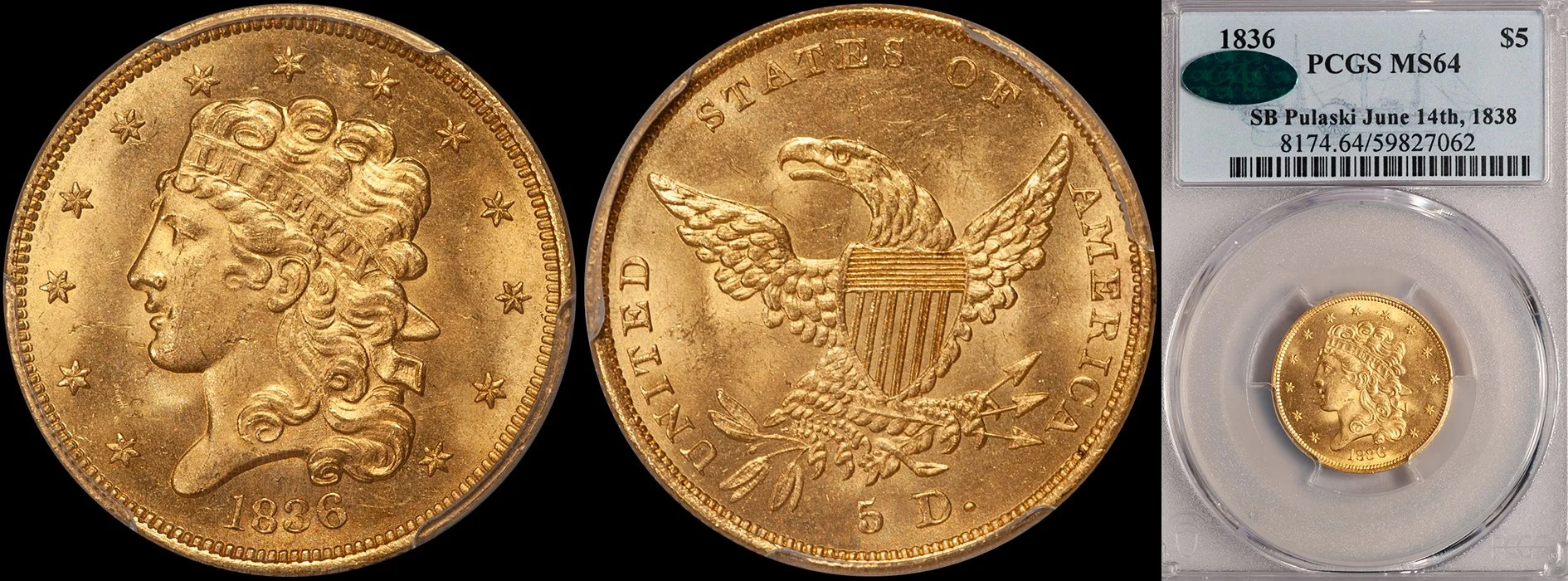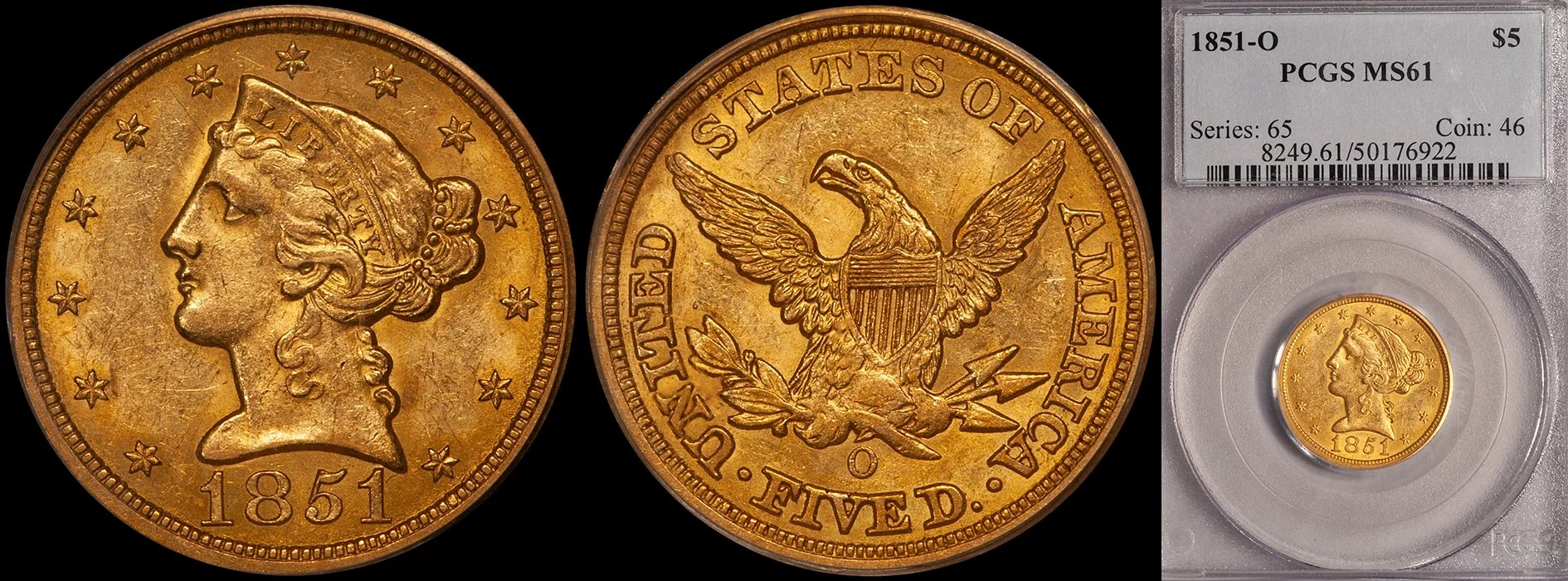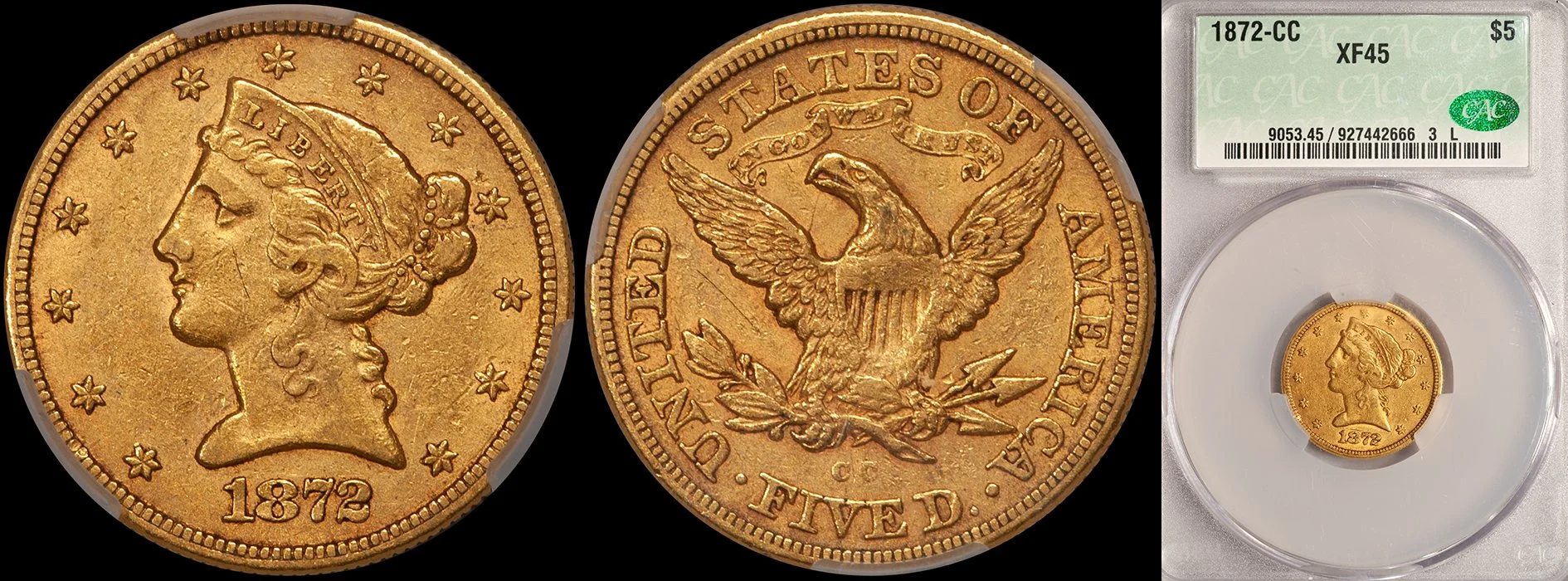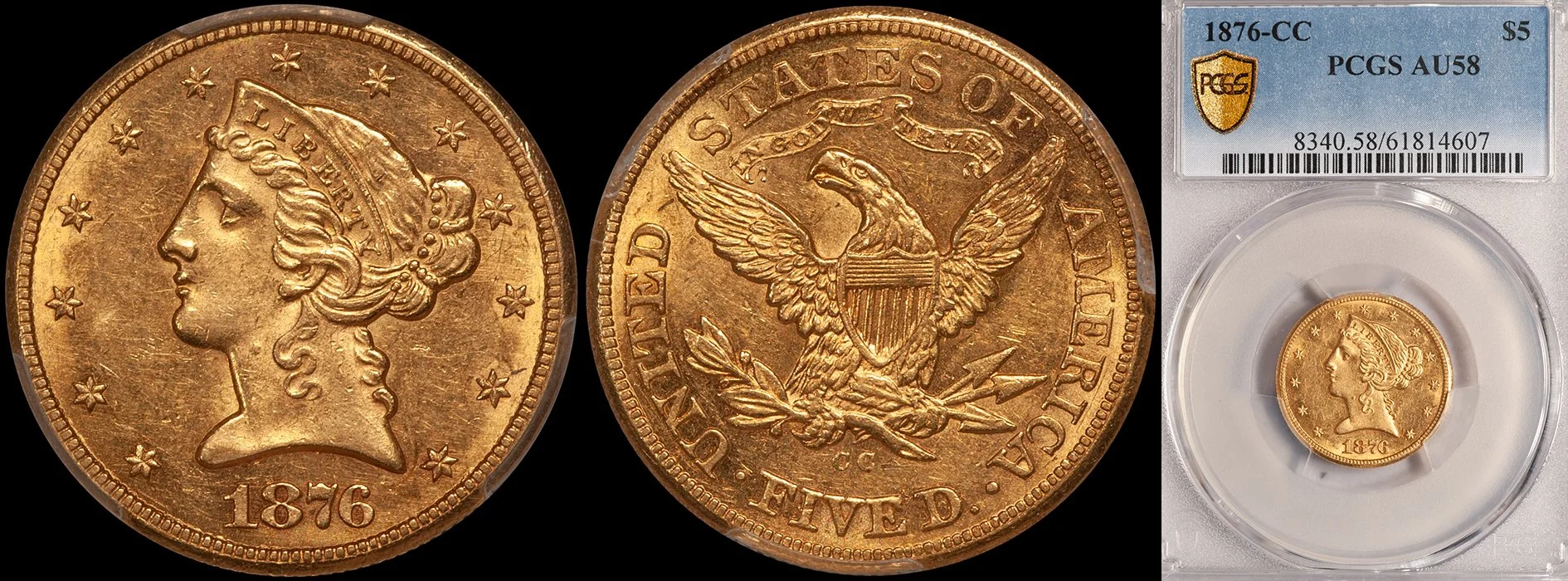
Carson City Half Eagles: An Introduction and Overview

Assembling a collection of Carson City five dollar gold pieces or half eagles is extremely challenging. Completing a set of these coins, regardless of grade, is among the more formidable tasks a gold coin specialist can endeavor to undertake. Consider the fact that only 45-55 examples of the key coin in this set -- the 1870-CC -- are thought to exist. This means that only 45 to 55 complete collections of Carson City half eagles can ever be assembled. Much of the allure of collecting these coins (in addition to the romantic appeal of the "Old West") has to do with the fact that this series can be completed. There are only 19 different dates. This aspect is very appealing to many collectors. Unlike certain series where the run of dates seems endless and often numbing, this is a relatively short yet challenging project. In addition, there are no great rarities which are impossible to locate or prohibitively expensive. The challenge of this set can increase dramatically when the grades and eye appeal for each issue are factored upwards.

For the collector who is not familiar with Carson City half eagles, this series will come as a surprise. These are true "collector coins." They tend to hold their value in bear markets and show strong, steady appreciation over time. Carson City half eagles have multiple levels of demand. They are sought by general collectors, type collectors and specialists. Certain pieces may attract the attention of half eagle specialists, Carson City specialists or general collectors who are putting together seven mint sets of Liberty Head half eagles (the only gold denomination struck at all seven United States mints).

It is impossible to complete set of Carson City half eagles in Mint State regardless of a collector's time or resources. Several of the dates are unknown in any Mint State grade. Currently, there is not a single Uncirculated 1872-CC or 1878-CC half eagle known to exist. Five other dates--the 1871-CC, 1873-CC, 1875-CC, 1876-CC and 1877-CC--are currently represented by just one or two Uncirculated examples. And six more dates--the 1870-CC, 1874-CC, 1879-CC, 1881-CC, 1883-CC and 1884-CC--have just two to four Uncirculated coins known.

The only Carson City half eagles which are relatively obtainable in Uncirculated are those struck in the 1890's. These range in scarcity from the 1892-CC with 50-75 coins known in Uncirculated to the 1891-CC with a population believed to be in the area of 400-500+. The availability of an issue such as the 1891-CC half eagle makes it very popular as it is the only half eagle from this mint which can be purchased in Mint State by the collector of average means. (But, at the same time, this issue is surprisingly rare in Mint State-64 and almost unknown in any grade above this level.)

An incremental breakdown for the Mint State-63 grade is as follows:

Choice (Mint State-63 and Mint State-64) and Gem (Mint State-65) Carson City half eagles are very rare. I estimate that there are probably fewer than 10 pieces surviving in true Mint State-65. As of the spring of 2000, only one Carson City half eagle has ever been graded higher than Mint State-65 by one of the major grading services.

There are probably fewer than three dozen choice Uncirculated Carson City half eagles known to exist. The vast majority of the choice and gem Carson City half eagles were struck during the 1890-1893 era.

Why are these coins so rare in Mint State? The best answer has to do with the fact that there were no coin collectors living in Nevada in the 19th century. No one saved these coins and the few Mint State pieces which exist today are here by chance. They may have been placed in a bank vault and forgotten for a century. Some found their way to European or South American banks where they were sent as payment for international debts. A few others may have been put in a drawer or a cabinet and subsequently lost by their original owners. And some were undoubtedly assay pieces which were sent to the Philadelphia Mint for inspection but never destroyed.

In examining the rarity of Carson City half eagles, several trends are noted. Survival figures depend on the original mintage figures for a specific issue and they also vary by the decade in which a coin was struck. In general, the rarest issues are those which were struck from 1870 to 1878. With the sole exception of those struck in 1881, the half eagles produced from 1879 through 1884 are less rare. And those coined from 1890 to 1893 are relatively common in comparison.

After careful analysis, it becomes apparent that one cannot simply deduce the number of surviving coins or the condition rarity of any Carson City gold coin solely from their original mintage figures. One must study auction records and private treaty sales and gather as much information as possible from prominent collectors and dealers as well as examine the population reports issued by PCGS and NGC. After carefully examining the currently available information, certain trends clearly begin to emerge.

The older coins (i.e., those struck from 1870 to 1878) have survived roughly in proportion to their original mintage figures below. I estimate that between 2 percent to as little as one-half of 1 percent of each year's half eagle production has survived. In general, the older the coin, the lower the average surviving coin's grade and the lower number of high grade pieces which exist. This is common sense as the longer an issue is in circulation, the more likely it is that coins of that date will be worn or destroyed. Thus, the rarest Carson City half eagle is the 1870-CC (which is also the oldest) despite the fact that it has only the third lowest mintage.

The second rarest Carson City half eagle is the 1873-CC. This issue has an estimated surviving population of only 50-60 coins. My research indicates that this date is even more rare than was previously believed. The reasons for the rarity of the 1873-CC half eagle include its low mintage figure of 7,416 and its early date of issuance combined with the fact that it was not saved.

One issue which I find very interesting is the 1878-CC. It has a relatively high mintage of 9,054 but it is the third rarest Carson City half eagle with an estimated population of 60-70. The reason for the rarity and unusually low survival rare of this issue is not known.

Another interesting issue is the 1876-CC. I estimate that 70-80 are known out of a low original mintage of 6,887 coins. Despite a significantly lower mintage than the 1878-CC, the 1876-CC is actually less rare. Conversely, the 1881-CC half eagle (with a mintage of 13,886) appears to be as rare as the 1876-CC.

The 1877-CC (with an original mintage of 8,680 coins) has a disproportionately high survival rate. Approximately 75-85 are known, making it as rare as the 1872-CC, which has an original mintage of 16,980 coins. There is no clear explanation as to why the 1877-CC half eagle is more common than its mintage suggests. It is interesting to note that the 1877-CC eagle is found in higher grades (i.e., Extremely Fine and better) out of proportion to the other dates in the eagle series. This strongly suggests that there was a small hoard of higher grade 1877-CC half eagles and eagles in existence at one time.

The 1879-1884 Carson City half eagles are found in proportion roughly to their original mintage figures with the notable exceptions of the 1880-CC and the 1881-CC. The number of surviving 1880-CC half eagles is less than its original mintage of 51,017 suggests. In fact, the surviving population of this date most closely resembles the 1879-CC, which has a mintage nearly two-thirds smaller (17,281 coins). The 1881-CC has a surviving population of 70-80 coins, which is much smaller than one might project from its original mintage of 13,886.

What is unexpected about these two dates is that they actually have lower survival percentages than the issues from the 1870's. I cannot state with certainty why this is so, but a possible reason might be that some 1880-CC and 1881-CC half eagles were melted. This explanation becomes more plausible when one notes that there was a bullion shortage at the Carson City Mint in 1880-1881. (This is further confirmed by the fact that no double eagles were struck in Carson City during these two years due to a lack of available gold bullion). Another reason might be that the original mintage figures are incorrect and fewer 1880-CC and 1881-CC half eagles were produced than the current figures indicate.

The general trend of the 1890's Carson City half eagles is that the issues with higher mintage figures are more available today than those issues with lower original mintages. The one exception is the 1892-CC. While it has an original mintage of 82,968 coins, it is less commonly found in high grades than the lower mintage 1890-CC (53,800 struck) and 1893-CC (60,000 struck). Again, there is no satisfactory explanation for this anomaly.

Carson City gold coinage was heavily circulated. In the early days of the western gold and silver rushes, paper money was viewed with suspicion and contempt. Gold coins quickly became the accepted medium of exchange. Thus, it is not surprising to learn that most surviving Carson City gold coins show heavy wear and excessive contact marks. These marks were often compounded when loose coins were thrown into bags and shipped by stagecoach to San Francisco or other distant cities. Gold is the softest coinage metal and it is relatively easy for coins struck in this metal to pick up heavy contact marks when they hit against each other. As a rule, half eagles have fewer marks than eagles and double eagles. This is because when these smaller coins hit against each other in bags they do not have the weight and surface area to make large bagmarks on each other (as do double eagles, in particular).

For the collector, locating attractive, higher grade Carson City gold coins without excessive surface marks is a tremendous challenge. Certain dates, especially those struck from 1870 to 1878, are inevitably found heavily worn and severely marked.

The rarest Carson City half eagle in Extremely Fine or higher grades is the 1878-CC. I estimate that only 16-20 such coins are currently known, of which only three or four grade About Uncirculated. Even though the 1870-CC is a rarer coin overall, it is more available in higher grades as witnessed by the fact that as many as 23-27 pieces remain in Extremely Fine or higher grades. One can speculate that the number of 1870-CC half eagles which do exist results from being a first-year-of-issue coin which may have been saved (albeit in very small quantities) as a souvenir. The 1878-CC, on the other hand, lacked this novelty value and those which survived the melting pot tend to show considerable evidence of hard circulation.

Two other Carson City half eagles which are prohibitively rare in higher grades are the 1873-CC and the 1872-CC. Approximately 17-21 of the former are known in Extremely Fine or higher while the latter issue has a population estimated at 19-22 coins. The 1873-CC is extremely rare in About Uncirculated with just five or six known and two known in Mint State while only 6-8 About Uncirculated pieces and no Mint State 1872-CC are known.

As one might well expect, dates with higher mintage figures are more available in high grades. The 1872-CC is more available than certain other dates in the early 1870's because of its relatively high mintage. But its age makes it a very rare coin in About Uncirculated (with just six to eight known). The 1871-CC, while also an "older date," is a bit more available in higher grades (46-52 known in Extremely Fine or better including one or two Uncirculated pieces) since it has the second highest mintage figure of any date struck in the 1870's.

The 1874-CC is the second most available Carson City half eagle struck in the 1870's. Between 40-46 coins are known which grade Extremely Fine or better with twelve to fifteen of these grading About Uncirculated and three grading Mint State. I have an interesting theory to explain why this date is not only one of the two most common Carson City half eagle struck in the 1870's (aside from having the highest mintage) but also why a higher percentage of the survivors than one would assume are in high grades. In 1874, there was a coin shortage on the East Coast. Much of the Carson City coinage from 1874 was transported to the East for use in circulation there. As paper money was more readily accepted in this area of the country, it is possible that many of these coins did not see wide circulation. Perhaps some of them were even stored in banks and were never used. This also seems to be the case with 1874-CC eagles which have a similar level of availability in higher grades.

By 1879 and into the 1880's, the mintages of Carson City half eagles were higher and more were sent overseas to banks for debt payment. These coins saw less circulation than those struck in the 1870's and, thus, are found in higher grades today.

The 1881-CC is the rarest Carson City half eagle struck in the 1880's. But more examples have survived in high grades than its low mintage and overall rarity would suggest. I estimate that 33-39 pieces exist in Extremely Fine or better with possibly nine to twelve of these in About Uncirculated and another two or three in Mint State. As one might expect, the diminished use of gold in the 1880's gives this coin an unusual grade distribution of survivors.

The 1890's Carson City half eagles are by far the most plentiful of these issues. More than 50 percent of all the surviving Carson City half eagles--regardless of date--are dated from 1890 to 1893. Approximately 90 percent of all surviving Mint State Carson City half eagles date from the 1890's. Furthermore, about 75 percent of the remaining About Uncirculated Carson City half eagles date from the 1890's.

The relatively large number of high grade Carson City half eagles from the 1890's stems from several causes. The mintage figure for coins in this decade was much higher than in the previous two decades. More of the coins were shipped overseas and thus escaped wholesale government meltings in the 1930's. As paper money became more readily accepted in the western United States, these coins saw less and less circulation. And the decline of the western mining industry in the 1890's meant that fewer coins were needed in circulation.

Most of the early issues (particularly those dated 1870 through 1876) are weakly struck. This weak strike is most noticeable in the central portion of the coin where the greatest amount of pressure is needed to raise the metal of the actual planchet. On the obverse, coins which are weakly struck will display flatness in the curls on the neck of Liberty as well as flatness on the top and the back of her hair. On the reverse, this weakness of strike is usually seen on the neck of the eagle, the central shield and on the talons of the eagle. This weakness is frequently misinterpreted as wear. Because of this, many early Carson City half eagles are often undergraded even by professional graders. Finding a sharply struck example of a certain date is very challenging at best and it is nearly impossible for others.

The 1870-CC is usually found weakly struck in the curls on Liberty's neck and in the neck feathers of the eagle. The 1871-CC half eagles are usually found with a better strike except for the shield on the reverse which often comes flat. The 1872-CC is nearly always very flat on the obverse as are 1873-CC's; this latter issue is also frequently weak on the eagle's neck. The 1874-CC shows a sharper obverse but the reverse comes weakly impressed, especially on the eagle's neck feathers. The 1875-CC is unquestionably the worst struck Carson City half eagle. Several varieties are known; some have a weak obverse and others have a weak reverse. The 1879-1893 issues do not suffer from these problems of strike although it is not uncommon to see examples with some weakness at the centers of the obverse and the reverse.

The estimates of survival given in this book are based on current knowledge, as of 2000. As time passes, it is certain that more coins will surface from old or previously unknown collections, hoards and accumulations. This will lead to more accurate survival estimates and Condition Census data. While most dates will show an increase in the number of coins believed to exist, others may actually show a decrease due to examples being lost by accident or ignorance.

When Walter Breen wrote his landmark monographs on United States gold coins in the 1960's, he stated that many Carson City coins are much, much rarer than we now know them to be. Multiple higher grade examples of even the rarest issues have surfaced in the past three decades. There are, without a doubt, several other very significant Carson City half eagles which will be "discovered" in the years to come. I have attempted to address this situation by providing a probable high end and low end spread in our rarity estimates. This allows for the inclusion of currently unrecorded coins which I believe may exist.

My review of auction data, fixed price lists, dealer advertisements and available private treaty sale records provides an accurate idea as to the difficulty in amassing a complete collection of Carson City half eagles. For the 1870-1878 issues, it is typical for between zero and four specimens to be available each year. Often the only examples which can be purchased are in lower grades and may have minor to significant problems. As probability would have it, in some years a certain date may be prevalent or it may be nearly impossible to find. As a rule of thumb, it is safe to say that the rarer the date and the higher the grade desired, the harder it will be to find a specific coin. Many high grade pieces are held by museums or are owned by collectors who have no intention of selling them.

It is certainly possible to put together a run of Extremely Fine to About Uncirculated Carson City half eagles dated from 1870 to 1884. Trying to complete this group in Uncirculated is, of course, impossible and an About Uncirculated set is a virtual impossibility as well. Obtaining nice Mint State examples of the 1890's issues, fortunately, is not that difficult or costly.

The budget-conscious collector should not feel excluded from this series. All of the Carson City half eagles (even the 1870-CC) can be found in nice Very Good to Very Fine grades. Although these coins do show substantial wear and are not as attractive as higher grade specimens, they are wonderfully evocative of the history of the Old West and the colorful characters who are the basis of its legends.

For the typical United States gold coin collector, obtaining one example of each date in grades ranging from choice Very Fine to Uncirculated is a realistic goal. This project can be completed in a year or two. Its estimated cost can be determined by obtaining a current numismatic pricing guide.

The connoisseur with a generous budget might be interested in putting together a set of Carson City half eagles grading Extremely Fine and better. For the 1870-1878 and 1881 issues, he should look for examples which grade Extremely Fine-40 or better and which have as few contact marks as possible. For the 1879, 1880 and 1882-1884 issues, the collector should look for pleasing, lustrous About Uncirculated-50 or better coins. For those issues struck in the 1890's, he should seek clean, lustrous Mint State-60 or better pieces. A collection such as this could be completed within a three to five year time frame.

There are a few advanced collectors who study die varieties. Such individuals seek to complete a collection which includes all of the known--and possibly some unknown--die varieties. To my knowledge, only a small number of individuals have a complete or nearly complete collection of Carson City half eagles by die variety.

Coin collectors of all budgets can enjoy the fun, romance and challenges of Carson City half eagles. To further assist collectors of all levels, the following pages give detailed information on each half eagle issue. Information on die characteristics, varieties and overall rarity as well as grade rarity are provided. Also, the current Condition Census listing of the finest known examples for each issue is listed for reference. The photographs of each half eagle are enlarged to twice their actual size for better clarity.
Incremental Grading

Old time collectors often bemoan the fact that there are "too many grades." In their opinion, there is no need for a ten point Mint State/Proof scale (i.e., Mint State-60 to Mint State-70 and Proof-60 to Proof-70) and even less of a need for multiple numerical levels in the circulated grades. I strongly disagree with the theory that there are too many grades. In fact, I can let you in on a secret that would make many of these old collector's eyes roll if they were aware of it. Expert graders, such as myself, actually use a whole series of "secret grades" (which I refer to as "incremental grades") when examining coins.

Before I explain what incremental grades are, it is important to understand why they exist. Back in the "old days," coins weren't very expensive and there were not very large spreads between nice coins and not-so-nice coins. A really superb 1927 $20 might sell for $55-60 while an average quality example was readily available for $50-55. This all changed when coins became more popular and a greater emphasis was placed on owning "the best." Today, a superb quality 1927 $20 might sell for $4000-5000 (or more) while an average quality Uncirculated example is worth just $400-500.

The most important thing to remember about grading is that it is subjective. While most experts can reach an impressive degree of consistency when grading a group of coins, there is always some room for disagreement. The reason this exists is due to the fact that a grade actually represents a shorthand for a range of grades. This is where the aforementioned "incremental grades" come into play.

Let's say, for example, that we are discussing a coin that grades Mint State-63. In actuality, the "63" grade is a shorthand for an entire range of grades that goes from 63.0 to 63.9. A coin that is regarded as a "63.0" is extremely low end for the grade. If it were examined by ten experts, four or five of them might not even call it a 63 and it could very well grade MS-62 if submitted to PCGS or NGC. A coin that is regarded as 63.9 is extremely high end for the grade. If ten experts examined it, half of them (maybe even more) would call it a 64 and it could easily grade MS-64 if submitted to a grading service.

An incremental breakdown for the Mint State-63 grade is as follows:

MS-63.0 to MS-63.2: A very low end coin for the grade. If a savvy dealer were offered such a coin already in a PCGS or NGC holder, he would not remove it for fear that it might be downgraded if it were resubmitted.

MS-63.3 to MS-63.5: A coin that is average quality to slightly above average quality for the grade. A coin at the upper range of this grade would be regarded as having a 50% chance of upgrading if it were resubmitted to PCGS or NGC. A knowledgeable dealer would probably pay a modest to significant premium for such a coin.

MS-63.6 to MS-63.9: A very high end quality coin for the grade. If such a coin were already encapsulated in an MS-63 holder, it would be regarded as an excellent candidate to "crack out" if shown to a knowledgeable dealer. Coins such as this generally trade for large premiums.

Grade and price go hand-in-hand. And when coins can be worth many multiples more in one grade than another, this means that two coins in the same PCGS or NGC holder can be worth considerably different amounts of money.

How significant are incremental grades on a coin in which a one-point improvement can mean a very substantial amount of money? Let's look at randomly selected issue: an 1860 double eagle in Mint State-63.

According to the March 2000 issue of the Coin Dealer Newsletter Quarterly, a Mint State-63 1860 double eagle is bid at $14,000 while an MS-64 is bid at $35,000--a value spread of $21,000. How would a smart dealer value a Mint State-63 1860 double eagle if he were figuring it as part of collection he were attempting to purchase or if it was a lot in auction he was attending?

This dealer's decision would be predicated on a number of factors. First, he might look at a PCGS or NGC population report and see just how rare the 1860 double eagle is in MS-63 and MS-64. A quick search of the February 2000 PCGS figures show that this service has graded two in Mint State-63 with two better (an MS-64 and an MS-65) while NGC has, as of January 2000, graded two in MS-63 and two better (both in MS-64). The combined population of four coins in MS-63 with just two better demonstrates that high grade 1860 double eagles are legitimately rare.

The next factor he would consider is the popularity and subsequent marketability of such a coin. Is the Liberty Head double eagle series popular and are there customers for an expensive, high grade 1860? If the dealer is a specialist in Liberty Head double eagles, he is well aware of his ability to sell such a coin and he probably already has a few potential customers lined up for it. If the dealer is not a Liberty Head double eagle specialist, he will either determine its marketability by asking another, more knowledgeable dealer or he will decide not to take a risk on such an expensive coin.

Now that our hypothetical dealer has performed his due diligence and has determined that this high grade MS-63 1860 double eagle is a truly rare and saleable coin, he can grade it incrementally and value it accordingly. An incremental range of prices that he would pay for this coin might be as follows:

MS-63.0 to MS-63.2: In this grade range, the 1860 double eagle would be regarded as "product" if it were already in a third-party grading service holder or as a low-end coin if it were unencapsulated. Assuming that the dealer had a client for the coin or he thought it could be sold in a relatively short period of time (60 days or less) he would probably figure its value in the $12,500 to $15,000 range.

MS-63.3 to MS-63.5: In this grade range, the dealer would be willing to pay more for the 1860 double eagle. If the coin were just a 63.3--meaning that it was just average quality--he would probably still figure it around CDN "bid" level. If the coin were a 63.5--meaning that the coin was nice and had maybe a 50% chance of grading MS-64--the dealer might figure it at $17,500 or a bit higher. This would mean that if the coin did not grade MS-64 after it had been submitted (and resubmitted) to a grading service, he would have a few thousand dollars downside (assuming he could not sell it to a retail client as a "premium quality" specimen) but would have had considerable potential upside if the coined had worked and been graded MS-64.

MS-63.6 to MS-63.9: Here's where determining the value for such a coin gets dicey. The dealer now has to really weigh the upside and downside of his potential purchase. Let's say the coin is a 63.8 in his opinion and he is willing to pay $23,000 for it. This means that he has around $9,000 downside (using the CDN bid of $14,000 in MS-63 as his "cash out" price should his gamble be unsuccessful) and $12,000 upside (using the CDN bid of $35,000 in MS-64 should the coin be graded MS-64 by PCGS or NGC). While I would not personally like the risk/reward ratio inherent in these numbers, many dealers would; especially the "adrenaline junkies" who populate the world of wholesale trading and the upgrading/"cracking out" subculture.

What these figures show is that an MS-63 1860 double eagle could be worth $12,500 to $23,000 based on its incremental grade. This explains why two identical coins in an auction might sell for vastly different sums.

If you are unwilling or unable to learn how to grade incrementally, you could be leaving thousands of dollars on the table the next time you sell an expensive coin with a high value spread between one grade and the next. My suggestion is that you work with a very knowledgeable dealer who understands the intricacies of incremental grading in your area of specialization.

The Concept of "Best Value Grade"

Unless you are Bill Gates, the chances are good that you have a coin buying budget. It is my contention that every United States coin has a price point above which it no longer makes economic sense to purchase it; unless you are an avid specialist within a series or you are totally compelled to have the best of every coin and/or type you collect. I refer to this price point as the "Best Value Grade." There are a number of applications of the Best Value Grade theory (heretofore referred to as the BVG) and these are directly related to the classification in which a specific coin falls.

In my opinion, coins can be classified in two distinct classes: absolute rarities (coins that are rare and desirable in all grades) and condition rarities (coins whose rarity is predicated solely on a high level of preservation). Using Type Three double eagles as the series to examine some coins, we find a number of perfect examples.

The 1891 double eagle is an absolute rarity. Fewer than 50 examples are known from the original mintage of just 1,390 business strikes. This is truly a coin that can be described as rare and desirable in any grade. Coin World Trends (dated 2/28/00) shows the following price information for this date:

EF-40: $4000 EF-45: $5000 AU-50: $7750 AU-55: $11750 No Trends values are listed for this date in any grade above AU-55.

Population data on this date is interesting as well. As of 2/00, PCGS had seen a total of just 25 examples in all grades (quickly confirming that it is a true rarity) with the breakdown as follows:

EF-40: 2 coins EF-45: 1 coin AU-50: 7 coins AU-55: 5 coins Five coins have been graded higher than AU-55 (all AU-58) with none in Mint State.

This data shows that the 1891 double eagle is seldom available and when it does come up for sale, it is most likely to be found in the AU-50 to AU-55 range. Assuming that your budget allows for a purchase in the $7500-15,000 range, the question you must now ask is: "at what point does the 1891 double eagle become overpriced?"

It could be said that there is no real point that the 1891 becomes overvalued as this is a truly rare coin that seems quite undervalued when compared to other more famous but less rare double eagles. But let's say that a collector has a choice between an AU-50 example at $6500 and an AU-55 at $10,000. In my opinion, I think the higher grade coin makes sense. It is priced at less than double the level of an AU-50 but is considerably scarcer, quite close to being the finest available quality (remember that the highest recorded grade level for this date at PCGS is only AU-58) and, from a cosmetic standpoint, a nice AU-55 should be considerably more appealing than an AU-50.

The 1891-S double eagle is a good example of a condition rarity. Nearly 1.3 million were struck and thousands of examples exist in the lower to medium levels of Uncirculated. Coin Dealer Newsletter bids for this date, as of 12/99, are as follows:

MS-60: $390 MS-63: $2,040 MS-64: $6,100 MS-65: No Bid (Note: While there is no published bid for this date in MS-65, we can establish a hypothetical value level of $15,000-17,500, based on other comparable issues of this era).

The 2/00 PCGS Population report shows that 1,840 1891-S double eagles have been graded in all grades with the majority of these in the MS-60 to MS-63 range. The breakdown is as follows:

MS-60: 164 MS-61: 459 MS-62: 784 MS-63: 217 MS-64: 23 MS-65: 0

This data shows that the 1891-S is easily obtainable in MS-63, somewhat scarce in MS-64 and extremely rare in MS-65.

If a collector were to ask my advice what the BVG is for the 1891-S I would unhesitatingly advise him to pursue a nice, high end MS-63.

To my way of thinking, there is nothing especially exciting about this date. If you are collecting Type Three double eagles by date, you need an 1891-S to complete your set but it is unlikely that I will be called by a single collector this year who just happens to be looking for an example. So, right off the bat, this issue lacks the "sex appeal" factor that the 1891 double eagle has.

A look at the price levels for this date are interesting. An MS-63 can probably be bought in the $1750-2000 range, an MS-64 would be at least three times that amount and an MS-65 (if available) might cost ten times the amount of an MS-63.

The population data above tells me that this coin is available enough in MS-64 that I would not want to pay $6000+ for one. And the possibility always exists that one or more of the coins currently graded MS-64 could be upgraded to MS-65. The first PCGS MS-65 example that is graded will, no doubt, command a strong price from a collector or investor who is sold on its status as a "finest known" piece. But what happens to the value level of this coin when two or three other MS-65's are graded?

I also believe that there are certain coins which it always makes sense to stretch for. A good friend of mine has a theory that the most desirable issues are those whose essence can be summed up in fifteen words or less.

An example of this is the 1861-O double eagle. Here's how I would distill the essence of this coin to a new collector: "A rare, historic issue with a strong possibility of having been struck by the Confederacy."

A little background research shows that the 1861-O double eagle is rare in all grades with an original mintage figure of just 5,000. It is probably unknown in Mint State and very scarce in all AU grades. Most interestingly, a number were produced by the Confederacy in the Spring of 1861, after the New Orleans mint had been seized.

According to the 2/28/00 issue of Coin World Trends, the price levels for better quality 1861-O $20's are as follows:

AU-50: $6,500 AU-55: $13,800 No trends value is listed for any grade higher

As of 2/00, PCGS had graded seven examples of this date in AU-50, seven in AU-53, three in AU-55, two in AU-58 and none better.

Now let's say a collector of this series is suddenly offered the chance to purchase two really nice 1861-O double eagles. One is an AU-55 that is priced at $12,000 while the other is an AU-58 that is priced at $17,500. Which coin is the better value?

In this case, I would strongly advise him to purchase the AU-58. To me, this is an easy choice. The price spread between the AU-55 and the AU-58 is not unreasonable. There should be a discernible difference in quality between the two coins. The AU-58 would be tied with just one other coin as the finest graded by PCGS. And, this is a very desirable, truly rare issue with a level of demand that extends beyond specialists within the series. All of these factors combine to make this a logical purchase.

What if the same collector were suddenly confronted with a fantastic, newly discovered 1861-O double eagle that had been graded MS-62 by PCGS and was clearly the finest known by a mile? Would this be a coin that he should stretch for?

It is always very hard to determine a value for coin such as this. But let's say that after careful reasoning, the collector and the dealer who owned the coin agreed that it should be priced at $45,000.

Clearly, $45,000 is a lot of money to pay for an 1861-O double eagle. It would represent a world record price for this date. In my opinion, this would be an instance where a stretch would make sense.

As discussed above, the 1861-O is an issue that passes the "fifteen word test" with flying colors. The finest known example of this date would be a coin that would appeal not only to specialists but to any collector of rarities as well. The price level of $45,000 is not way out of line with the value for an AU-58. And, presumably, this MS-62 coin would be vastly more attractive than the aforementioned AU-58.

There are circumstances that might make this coin a bad deal. For example, its overzealous owner might originally price it at $85,000. At five times the price of an AU-58, this would not make sense. Or, the coin in question might be unappealing and, in the opinion of the collector, not all that much better than the AU-58 he already owned. In this case, the coin should be passed on at the inflated price and maybe even at the more realistic price of $45,000.

The Best Value Grade theory can be applied to all issues of United States coins. Every time I purchase a coin for my inventory, I do a quick BVG calculation. The immediate questions I ask myself are: does the value that this specific coin make sense to me and does this coin offer good value for my clients? I would strongly suggest that before you decide to specialize in an area of make any significant coin purchase that you make your own BVG calculations.

If this theory intrigues you and you'd like to know my thoughts on the Best Value Grade for the coins that you collect, please e-mail me at dwn@ont.com.

Numismatic Glossary

The following terms appear are commonly used in numismatics. A basic understanding of them can make the new collector's experience in this hobby more enjoyable. Abrasion:

A mark on a coin caused by contact with another coin.

Bagmark:

A mark on a coin caused by contact with other coins when placed inside a bag for shipment to a bank. Most large-sized gold coins, show extensive bagmarks from this process.

Border:

A design element employing a raised circle with the outer circumference called the rim. On Liberty Head gold coins, the border consists of beads.

Business Strike:

A coin which was struck for general circulation. Business strikes were intended to be used in the normal course of commerce.

Clashmarks:

Impressions of a portion of the detail of one side of a coin onto another in the field of a die facing it. Clashmarks occur when dies strike each other during the coinage process without a planchet or blank between them.

Comparative Rarity:

The relative rarity of a specific issue in a specific grade when compared to another issue in the same grade.

Condition Census:

A ranking of the five or six finest known examples of a specific issue.

Die:

A piece of fabricated steel which stamps the design into a planchet.

Die Variety:

Distinct varieties within a specific issue caused by using and/or combining new dies within a coinage run.

Edge:

The cylindrical boundary of a coin.

Edge Reeding:

Raised ribs on the edge of a coin which serve as an anti-counterfeiting device. All Liberty Head gold coins have a reeded edge.

Eye Appeal:

A combination of characteristics such as luster, strike and coloration which make a coin, literally, "appealing to the eye."

Grade:

The rating of a coin's place on a numerical scale which encompasses the range between extreme wear and perfection.

Hairlines:

Fine scratches which are caused by cleaning a coin with an abrasive.

Hoard:

A group of coins, which can vary greatly in size, which have been taken off the market by a non-numismatic source and which re-enter the market through a numismatic source. A hoard may contain one specific date or many dates. When a hoard contains multiple examples of one date, this issue will lose value but other dates which share its design may gain value through increased collector demand.

Key Date:

A date in a series which is recognized as an especially difficult date to locate in all grades. As an example, key dates in the Type Three double eagle series are the 1881, 1882, 1883, 1884, 1885, 1886, 1887 and the 1891.

Mintmark:

A letter or symbol that identifies the mint that produced a coin. As an example, the letter "S" indicates that a United States coin was struck at the San Francisco Mint.

Mint State:

A coin with no wear. Mint State coins are rated on a scale which goes from Mint State-60 to Mint State-70.

NGC:

Numismatic Guaranty Corporation, an East Coast third party grader and authenticator of coins.

Obverse:

The front or the "head" side of a coin.

Overall Rarity:

A term which refers to the total number of examples known of a specific issue.

PCGS:

The Professional Coin Grading Service, a West Coast third party grader and authenticator of coins.

Pedigree:

The chain of ownership of a coin or a collection. A coin pedigreed to a famous collection typically carries a premium over a non-pedigreed coin.

Population Report:

A listing published by both NGC and PCGS which lists the number of coins graded and how the individual coins break down. Each date in the various gold series is listed in both services' reports.

Premium Quality:

Within the parameters of this book, the term "Premium Quality" refers to coins which grade About Uncirculated-50 or higher for rare dates and Mint State-62 or higher for common dates.

Proof:

A coin which is struck specially for collectors on a polished planchet. Proof coins receive multiple blows of the dies and afforded special care and handling.

Prooflike:

A coin struck for circulation which has some of the reflective qualities of a Proof coin. Liberty head gold coins that are Prooflike can sell for substantial premiums.

Reverse:

The back or the "tail" side of a coin.

Sleeper:

A coin which is underrated and undervalued is said to be a "sleeper." In the Type Three double eagle series, the 1891 is one example of an issue that is currently regarded as a sleeper.

Type One Double Eagle:

A United States twenty dollar gold piece struck at either the Philadelphia, New Orleans or San Francisco mints between 1850 and 1866. This type is most easily identifiable by the absence of the motto IN GOD WE TRUST on the reverse.

Type Two Double Eagle:

A United States twenty dollar gold piece struck at either the Philadelphia, Carson City or San Francisco mints between 1866 and 1876. This type is most identifiable by the presence of the motto IN GOD WE TRUST on the reverse and the value denoted as TWENTY D.

Type Three Double Eagle:

A United States twenty dollar gold piece struck at either the Philadelphia, New Orleans, Carson City, San Francisco or Denver mints between 1877 and 1907. This type is most identifiable by the value denoted as TWENTY DOLLARS.

Weak Strike:

A coin which shows inferior detail as a result of the striking process. A weakly struck coin is only accorded a reduced value if most examples of the specific date in question are well struck.

Well Struck:

A coin which shows good detail as the result of the striking process. A well struck coin is accorded high value if most examples of the specific date in question are weakly struck.

Uncirculated:

A coin with no wear. See "Mint State."

How To Collect Type Three Double Eagles

Type Three double eagles have proven to be a very popular series with collectors. It is a long-lived and highly varied series with issues ranging from extremely common to extremely rare. Type Three double eagles are appealing for a number of reasons. They are big, beautiful coins which can be appreciated even by the non-collector. They are plentiful enough that many issues can be found in high grades. However, many are scarce enough that they also appeal to the rarity conscious collector.

There are a number of excellent ways to collect Type Three double eagles. Here are a number of suggestions.

    Collecting Type Three Double Eagles As Type Coins Collecting Type Three Double Eagles By Mint Collecting Type Three Double Eagles By Year Assembling A Complete Set of Type Three Double Eagles Collecting By Die Variety Collecting Proof Type Three Double Eagles

I. Collecting Type Three Double Eagles As Type Coins

Type coin collectors seek to obtain one representative example of a specific type or design. For Type Three double eagles, they would focus on obtaining a common date in the highest grade which they can afford. There are a number of specific dates which they might purchase including the 1900, 1901, 1903, 1904 and 1904-S. Each of these is common enough in grades up to and including Mint State-64 that there is little--if any--date premium.

A type set could be made more interesting by including a common date from the 19th century in addition to one from the 20th century. The most common Liberty Head double eagles from the 19th century include the 1895, 1897 and 1899. These are easily obtainable in Mint State-63 but they are somewhat scarce in any grade higher than this.

If you are interested enough in Type Three double eagles to take the time to read a web article devoted to this series, the chances are good that you will become more involved with them than as mere type coins. If you decide to purchase a Type Three double eagle strictly as a type coin, it might make sense to pay a small premium and obtain a date which is a bit more rare in higher grades but which sells for a small premium.

II. Collecting Type Three Double Eagles By Mint

Type Three double eagles were produced at five mints: Philadelphia, San Francisco and Carson City, New Orleans and Denver. Some collectors are attracted to the issues from just one of these mints and they attempt to put together a complete set of dates and major varieties.

Assembling a complete thirty-one coin set of Philadelphia Type Three double eagles is very difficult and costly. The 1881, 1882, 1885 and 1886 each had extremely limited original mintage figures (between 571 and 2,199 coins) and are seldom available to collectors. The rarest of these are the 1882 and the 1886, both of which are represented by approximately 20-25 surviving examples. The 1883, 1884 and 1887 dates were struck only as Proofs. If a collector wishes to have a truly complete set, he will have to include this trio and can count on spending upwards of $50,000 per coin for examples in the Proof-63 to Proof-64 range and considerably more for Gems.

There are other Philadelphia issues which are far more elusive than generally known, especially in the higher Mint State grades. These include the 1877-1880, 1888, 1890, 1892, 1898 and 1905. The 1891 is an extremely rare and very overlooked coin, in spite of its tiny original mintage figure of 1,390 business strikes. It is actually comparable to some of the more-heralded dates from the 1881-1886 era and an acceptable specimen will cost the collector between $7,500 and $15,000.

A complete thirty coin set of San Francisco Type Three double eagles can be assembled with patience. There are no dates which stand out as being excessively rare and just a small number are very hard to locate above Mint State-62 to Mint State-63. The scarcest Type Three issues from this mint are the 1879-S through 1882-S date run and the 1887-S. After years of neglect, the San Francisco series is gaining in popularity. A very attractive set with all coins grading between Mint State-62 and Mint State-64 could be assembled for approximately $50,000-$60,000.

The Carson City Type Three double eagles are the most popular issues with collectors. A total of twelve different dates were produced between 1877 and 1893. Unlike the Type Two issues from this mint which have one issue (the 1870-CC) which makes a set nearly impossible to complete, the Type Three Carson City set is easily completable. The key issues are the 1878-CC, 1879-CC, 1885-CC and the 1891-CC. All four of these are very rare and costly in Mint State but choice About Uncirculated pieces can be obtained for under $10,000 per coin, depending on quality. An extremely nice set of Type Three Carson City double eagles can be assembled for under $75,000. This includes all of the more common dates in Mint State-60 to Mint State-62 grades and the "big four" mentioned above (plus the 1877-CC) in grades ranging from About Uncirculated-55 to About Uncirculated-58.

Production of Type Three double eagles at the New Orleans and Denver mints was very limited. The 1879-O is the only New Orleans issue of this type. Just 2,325 were struck and approximately 100 survive with most of these in Extremely Fine grades. The Denver mint opened in 1906 and produced relatively large numbers of Liberty Head double eagles in 1906 and 1907. The 1906-D is common in all grades up to Mint State-63 but it becomes scarce in Mint State-64 and very rare in Mint State-65. The 1907-D is the more common of these two issues as it is more often used as a type coin.

III. Collecting Type Three Double Eagles By Year

A popular and practical way to collect Type Three double eagles is by year. Such a collection would consist of a single example for each year in which the Type Three design was produced. In this case, such a set would have thirty-one coins.

In a year set, it is advisable to choose the most affordable issue produced in a specific year. For example, an 1879-S double eagle would be chosen over an 1879 Philadelphia, 1879-O or an 1879-CC since the San Francisco coin is the easiest to obtain in both circulated and Uncirculated grades. The 1879-O would be the least likely coin to include in this set due to its rarity and comparably high price.

There are a few years which are very difficult to find affordable double eagles from any mint. In 1885 only two mints struck double eagles. The Philadelphia issue is very rare while its Carson City counterpart is quite scarce but affordable, especially in lower grades. 1886 is perhaps the most difficult year in this entire set as only the Philadelphia mint produced double eagles and just 1,000 business strikes were made. Every other year contains at least one common issue which can be purchased by the collector of average means.

IV. Assembling A Complete Set of Type Three Double Eagles

Many collectors decide to assemble a complete set of Type Three double eagles. Such a set will include one example of each Type Two double eagle struck between 1877 and 1907. Including the Proof-only years of 1883, 1884 and 1887 a complete set consists of 76 coins. (Due to the price of these three coins, many collectors decide to not include them in their set. If this is done, the theme of the set can be changed from being a "complete set of Type Three Double Eagles" to a "complete set of business strike Type Three Double Eagles.") For the most part, the grades of this set will range from Extremely Fine to Mint State. The more common issues are generally represented by high grade coins while the rarer issues are represented by lower grade pieces. The rarities of this set are 1881, 1882, 1885, 1886 and 1891 which are seldom offered for sale and will cost at least $20,000 for above average examples. However, most of the other Type Three double eagles are well within the budget of the average collector.

There are some basic principles which the complete set collector should follow as he acquires coins. A complete set should be as well-matched as possible. The collector should try to purchase coins which have a similar appearance. As an example, a collector might try to acquire coins which are as original as possible and which show reasonably similar coloration.

A complete set should not be "all over the map" as far as grades are concerned. Instead of spending $10,000 on an unappealing, bagmarked 1879-O (as opposed to a choice example of this date in this price range) merely to fill a hole, buy two or three outstanding MS-62 semi-key dates from the 1870's. Do not assemble a complete set with unrealistic expectations. A collector who has previously worked on more common sets may approach Type Three double eagles with the idea that he will be able to complete this set in the higher Mint State grades. Since many issues in the Type Three double eagle series are essentially non-existent above Mint State-60 (and some like the rare Philadelphia dates from the 1880's are either unknown or excessively rare in Mint State), certain allowances will have to be made. Conversely, a collector does not have to settle for coins he does not like just because he thinks he will not be able to do any better.

Set building is the key to realizing additional value without spending extra money. This phenomenon is known to numismatists as a "set premium" and it definitely applies to Type Three double eagles. Carefully assembled sets of coins have proven over the years to bring substantial premiums over randomly assembled, meaningless accumulations of coins. A set that has been assembled with the assistance of a professional numismatist should prove emotionally and financially rewarding to the collector or investor.

An especially good idea for the new collector would be to discuss assembling a set of Type Three double eagles with a dealer who specializes in 19th century gold coins. Get his thoughts as to which grade each specific date should be purchased in. Reading this article should also give the collector a good idea about this as it attempts to give a breakdown of the total number known of each date in each grade range.

V. Collecting By Die Variety

For most Type Three double eagles, a number of different obverse and reverse dies were employed. As one die became worn and/or damaged, it was replaced by a new die. The different combinations of dies created a number of die varieties.

The field of gold coin die variety collecting is extremely fertile. Very little has been written about the varieties of U.S. gold coins and next to nothing has been written about the die varieties of Type Three double eagles. It is very probable that a number of interesting, potentially rare die varieties exist for this series.

A collector wishing to start a die variety collection needs to pay attention to such things as date placement, mintmark placement and diagnostic characteristics such as die scratches and/or die breaks. He should record this information and compare each example of a specific date which he has the chance to examine.

While it is possible that this sort of collecting may become popular in the future, for now it is the province of a tiny handful of specialists. Therefore, the die variety collector should not pay an extra premium for supposedly rare varieties (such as a mintmark position previously unseen on a specific issue).

VI. Collecting Proof Type Three Double Eagles

Proof Type Three double eagles were struck in exceedingly limited quantities at the Philadelphia Mint from 1877 through 1907. In fact, the mintage for Proofs for the entire thirty one year period was just 2,414 pieces.

The tremendous rarity of these coins is what makes them appealing to a small segment of wealthy collectors. It is possible to assemble a complete set of Proof Type Three double eagles. However, this set would require considerable patience and a very deep pocketbook.

Historically, during bull markets, proof gold coins have been favorites with rare coin funds or wealthy individual investors. In the 1989-1990 bull market, the rare coin funds managed by Merrill Lynch and Kidder Peabody were major buyers of coins such as proof Type Three Liberty Head double eagles.

Most of the Proof Type Three double eagles which appear on the market grade in the Proof-63 to Proof-64 range. The extreme rarity of Proof-65 and better examples makes this set all but impossible to complete in the highest Proof grades.

Conclusion: These are just some of the ways in which to collect Type Three double eagles. Part of the appeal of coin collecting is the myriad possibilities it offers the collector with imagination.

Type Three double eagles have proven to be a very popular series with collectors. It is a long-lived and highly varied series with issues ranging from extremely common to extremely rare.

Type Three double eagles are appealing for a number of reasons. They are big, beautiful coins which can be appreciated even by the non-collector. They are plentiful enough that many issues can be found in high grades. However, many are scarce enough that they also appeal to the rarity conscious collector.

There are a number of excellent ways to collect Type Three double eagles. Here are a number of suggestions.

    Collecting Type Three Double Eagles As Type Coins Collecting Type Three Double Eagles By Mint Collecting Type Three Double Eagles By Year Assembling A Complete Set of Type Three Double Eagles Collecting By Die Variety Collecting Proof Type Three Double Eagles

strong>I. Collecting Type Three Double Eagles As Type Coins

Type coin collectors seek to obtain one representative example of a specific type or design. For Type Three double eagles, they would focus on obtaining a common date in the highest grade which they can afford. There are a number of specific dates which they might purchase including the 1900, 1901, 1903, 1904 and 1904-S. Each of these is common enough in grades up to and including Mint State-64 that there is little--if any--date premium.

A type set could be made more interesting by including a common date from the 19th century in addition to one from the 20th century. The most common Liberty Head double eagles from the 19th century include the 1895, 1897 and 1899. These are easily obtainable in Mint State-63 but they are somewhat scarce in any grade higher than this.

If you are interested enough in Type Three double eagles to take the time to read a web article devoted to this series, the chances are good that you will become more involved with them than as mere type coins. If you decide to purchase a Type Three double eagle strictly as a type coin, it might make sense to pay a small premium and obtain a date which is a bit more rare in higher grades but which sells for a small premium.

II. Collecting Type Three Double Eagles By Mint

Type Three double eagles were produced at five mints: Philadelphia, San Francisco and Carson City, New Orleans and Denver. Some collectors are attracted to the issues from just one of these mints and they attempt to put together a complete set of dates and major varieties.

Assembling a complete thirty-one coin set of Philadelphia Type Three double eagles is very difficult and costly. The 1881, 1882, 1885 and 1886 each had extremely limited original mintage figures (between 571 and 2,199 coins) and are seldom available to collectors. The rarest of these are the 1882 and the 1886, both of which are represented by approximately 20-25 surviving examples. The 1883, 1884 and 1887 dates were struck only as Proofs. If a collector wishes to have a truly complete set, he will have to include this trio and can count on spending upwards of $50,000 per coin for examples in the Proof-63 to Proof-64 range and considerably more for Gems.

There are other Philadelphia issues which are far more elusive than generally known, especially in the higher Mint State grades. These include the 1877-1880, 1888, 1890, 1892, 1898 and 1905. The 1891 is an extremely rare and very overlooked coin, in spite of its tiny original mintage figure of 1,390 business strikes. It is actually comparable to some of the more-heralded dates from the 1881-1886 era and an acceptable specimen will cost the collector between $7,500 and $15,000.

A complete thirty coin set of San Francisco Type Three double eagles can be assembled with patience. There are no dates which stand out as being excessively rare and just a small number are very hard to locate above Mint State-62 to Mint State-63. The scarcest Type Three issues from this mint are the 1879-S through 1882-S date run and the 1887-S. After years of neglect, the San Francisco series is gaining in popularity. A very attractive set with all coins grading between Mint State-62 and Mint State-64 could be assembled for approximately $50,000-$60,000.

The Carson City Type Three double eagles are the most popular issues with collectors. A total of twelve different dates were produced between 1877 and 1893. Unlike the Type Two issues from this mint which have one issue (the 1870-CC) which makes a set nearly impossible to complete, the Type Three Carson City set is easily completable. The key issues are the 1878-CC, 1879-CC, 1885-CC and the 1891-CC. All four of these are very rare and costly in Mint State but choice About Uncirculated pieces can be obtained for under $10,000 per coin, depending on quality. An extremely nice set of Type Three Carson City double eagles can be assembled for under $75,000. This includes all of the more common dates in Mint State-60 to Mint State-62 grades and the "big four" mentioned above (plus the 1877-CC) in grades ranging from About Uncirculated-55 to About Uncirculated-58.

Production of Type Three double eagles at the New Orleans and Denver mints was very limited. The 1879-O is the only New Orleans issue of this type. Just 2,325 were struck and approximately 100 survive with most of these in Extremely Fine grades. The Denver mint opened in 1906 and produced relatively large numbers of Liberty Head double eagles in 1906 and 1907. The 1906-D is common in all grades up to Mint State-63 but it becomes scarce in Mint State-64 and very rare in Mint State-65. The 1907-D is the more common of these two issues as it is more often used as a type coin.

III. Collecting Type Three Double Eagles By Year

A popular and practical way to collect Type Three double eagles is by year. Such a collection would consist of a single example for each year in which the Type Three design was produced. In this case, such a set would have thirty-one coins.

In a year set, it is advisable to choose the most affordable issue produced in a specific year. For example, an 1879-S double eagle would be chosen over an 1879 Philadelphia, 1879-O or an 1879-CC since the San Francisco coin is the easiest to obtain in both circulated and Uncirculated grades. The 1879-O would be the least likely coin to include in this set due to its rarity and comparably high price.

There are a few years which are very difficult to find affordable double eagles from any mint. In 1885 only two mints struck double eagles. The Philadelphia issue is very rare while its Carson City counterpart is quite scarce but affordable, especially in lower grades. 1886 is perhaps the most difficult year in this entire set as only the Philadelphia mint produced double eagles and just 1,000 business strikes were made. Every other year contains at least one common issue which can be purchased by the collector of average means.

IV. Assembling A Complete Set of Type Three Double Eagles

Many collectors decide to assemble a complete set of Type Three double eagles. Such a set will include one example of each Type Two double eagle struck between 1877 and 1907. Including the Proof-only years of 1883, 1884 and 1887 a complete set consists of 76 coins. (Due to the price of these three coins, many collectors decide to not include them in their set. If this is done, the theme of the set can be changed from being a "complete set of Type Three Double Eagles" to a "complete set of business strike Type Three Double Eagles.") For the most part, the grades of this set will range from Extremely Fine to Mint State. The more common issues are generally represented by high grade coins while the rarer issues are represented by lower grade pieces. The rarities of this set are 1881, 1882, 1885, 1886 and 1891 which are seldom offered for sale and will cost at least $20,000 for above average examples. However, most of the other Type Three double eagles are well within the budget of the average collector.

There are some basic principles which the complete set collector should follow as he acquires coins. A complete set should be as well-matched as possible. The collector should try to purchase coins which have a similar appearance. As an example, a collector might try to acquire coins which are as original as possible and which show reasonably similar coloration.

A complete set should not be "all over the map" as far as grades are concerned. Instead of spending $10,000 on an unappealing, bagmarked 1879-O (as opposed to a choice example of this date in this price range) merely to fill a hole, buy two or three outstanding MS-62 semi-key dates from the 1870's. Do not assemble a complete set with unrealistic expectations. A collector who has previously worked on more common sets may approach Type Three double eagles with the idea that he will be able to complete this set in the higher Mint State grades. Since many issues in the Type Three double eagle series are essentially non-existent above Mint State-60 (and some like the rare Philadelphia dates from the 1880's are either unknown or excessively rare in Mint State), certain allowances will have to be made. Conversely, a collector does not have to settle for coins he does not like just because he thinks he will not be able to do any better.

Set building is the key to realizing additional value without spending extra money. This phenomenon is known to numismatists as a "set premium" and it definitely applies to Type Three double eagles. Carefully assembled sets of coins have proven over the years to bring substantial premiums over randomly assembled, meaningless accumulations of coins. A set that has been assembled with the assistance of a professional numismatist should prove emotionally and financially rewarding to the collector or investor.

An especially good idea for the new collector would be to discuss assembling a set of Type Three double eagles with a dealer who specializes in 19th century gold coins. Get his thoughts as to which grade each specific date should be purchased in. Reading this article should also give the collector a good idea about this as it attempts to give a breakdown of the total number known of each date in each grade range.

V. Collecting By Die Variety

For most Type Three double eagles, a number of different obverse and reverse dies were employed. As one die became worn and/or damaged, it was replaced by a new die. The different combinations of dies created a number of die varieties.

The field of gold coin die variety collecting is extremely fertile. Very little has been written about the varieties of U.S. gold coins and next to nothing has been written about the die varieties of Type Three double eagles. It is very probable that a number of interesting, potentially rare die varieties exist for this series.

A collector wishing to start a die variety collection needs to pay attention to such things as date placement, mintmark placement and diagnostic characteristics such as die scratches and/or die breaks. He should record this information and compare each example of a specific date which he has the chance to examine.

While it is possible that this sort of collecting may become popular in the future, for now it is the province of a tiny handful of specialists. Therefore, the die variety collector should not pay an extra premium for supposedly rare varieties (such as a mintmark position previously unseen on a specific issue).

VI. Collecting Proof Type Three Double Eagles

Proof Type Three double eagles were struck in exceedingly limited quantities at the Philadelphia Mint from 1877 through 1907. In fact, the mintage for Proofs for the entire thirty one year period was just 2,414 pieces.

The tremendous rarity of these coins is what makes them appealing to a small segment of wealthy collectors. It is possible to assemble a complete set of Proof Type Three double eagles. However, this set would require considerable patience and a very deep pocketbook.

Historically, during bull markets, proof gold coins have been favorites with rare coin funds or wealthy individual investors. In the 1989-1990 bull market, the rare coin funds managed by Merrill Lynch and Kidder Peabody were major buyers of coins such as proof Type Three Liberty Head double eagles.

Most of the Proof Type Three double eagles which appear on the market grade in the Proof-63 to Proof-64 range. The extreme rarity of Proof-65 and better examples makes this set all but impossible to complete in the highest Proof grades.

Conclusion:

These are just some of the ways in which to collect Type Three double eagles. Part of the appeal of coin collecting is the myriad possibilities it offers the collector with imagination.

For more information on Type 3 Double Eagles, I recommend purchasing Type Three Double Eagles, 1877-1907: A Numismatic History and Analysis by Douglas Winter.

The Ten Rules of Successful Coin Collectors

If you do not learn how to become a good coin collector, you will not enjoy this hobby. This will become quickly apparent; especially the first time you have your rash, uninformed purchases looked at (and, probably, summarily dismissed) by a knowledgeable dealer or collector. There are a number of rules that all coin collectors should remember every time they make a purchase. Here are ten that I feel are especially important. 1. Education

The most successful coin collectors take time to learn as much as they can about numismatics. They not only study coins but the dynamics of the market as well. To learn about coins, I strongly suggest that you buy and read as many books as possible. You can supplement these books with specific catalogs that relate to your chosen field of specialization. A serious collector might even go as far as creating a database of prices that relate to his specialty. Other suggestions for new collectors include subscribing to periodicals such as Coin World and Numismatic News. You should join the American Numismatic Association and use their library (they will send books by mail to members). Become friendly with other collectors and communicate with them by phone or e-mail. And don't be afraid to ask questions.

2. Specialization

It is too hard to begin a coin collection without having goals and boundaries. I have always been a strong believer that it is better to view numismatics with a "micro" perspective as opposed to a "macro" perspective. As an example, if you start by collecting Charlotte gold coinage, your "world of focus" becomes 52 specific issues. It is realistic to assume that an intelligent individual who is willing to commit time to this area of study could become relatively knowledgeable within a year or two. To become similarly knowledgeable in a larger field of study (such as all branch mint US gold coins produced between 1838 and 1907) requires many more years. Becoming a well-versed specialist will allow you to level the playing field between you and dealers and it should enable you to make better purchases.

3. Patience

We live in an era of immediate gratification. New collectors often have the urge to jump in very quickly and complete their sets as fast as they can. The best coin collections are built over the course of many years. Sometimes, it is possible to purchase a number of great coins in a very short period of time. But most times, the opportunities to purchase great coins are few and far between. The new collector should avoid the temptation to buy the "wrong coin" just because he needs it for his set and he does not want to wait. Impetuous decisions are invariably incorrect and usually prove costly over the course of time.

4. Connections

It amazes me how many serious collectors get their "meatiest" information on topics such as pricing, market conditions and future trends from such third-hand sources as newsletters, coin magazines and coin brokers. This information is almost always well out of date and totally biased. (Remember that most newsletters which recommend specific coins are written by dealers who have taken a position in what they are touting). The only way to get real information about the coin market is from a dealer or collector who regularly attends shows and auctions. This discounts most coin brokers/salesmen as they get diluted information from their superiors and then pass on these half-baked "truths" to the masses. I personally view it as my duty to pass on accurate information to good clients. Conversely, I will not willing pass this information onto "tire kickers." The best way to get good information is to establish a good working relationship with a well-connected, reliable dealer.

5. Thinking Like A Collector

Anyone who approaches numismatics with a dispassionate attitude is a virtual certainty to lose money. Conversely, most pure collectors make money; often times in spite of themselves. This is because they buy coins for the right reason: they love them. They what interests them and they carefully research their purchases. They know for example, that a coin similar to one they just purchased sold for 10% more at a major auction. They know that they are not buying overhyped coins at the height of a promotional period. They are not buying coins just because a voice at the other end of the phone told them to and they are not buying them because this person told them their new coins would "increase in value 50-75% over the next three years." Remember this rule because it may be the most important one of the ten listed here: learn to think and act like a true collector and you will have more fun now and have a better chance to expect a reasonable profit on your purchases over the course of time.

6. Connoisseurship

I define connoisseurship as the ability to discern true quality in a specific field. In numismatics, the connoisseur is able to determine which coins have the most aesthetic eye appeal and which, literally, stand apart from the "typical" piece. A numismatic connoisseur, for instance, is able to appreciate a truly original gold coin with rich, "crusty" coloration. He is able to innately sense that 150 year old coins do not have to be big and bright in order to be desirable. Connoisseurship is a natural ability. You either are able to naturally determine the "best" or you are not. If you are not a born connoisseur (and very few people are) then you should find a dealer who has this ability to assist you with your purchases. I would estimate that less than 5% of all coin collections are "connoisseur quality" and those that are typically the ones that show the greatest financial appreciation over the course of time.

7. Learning to Grade

I have seen people spend millions of dollars on rare coins without having the slightest idea how to grade. They put their complete trust in dealers and in third-party grading. Frankly, this attitude leaves me baffled. If I do not feel very comfortable grading a specific type of coin, I do not buy it. As an example, I think Indian Head half eagles are extremely hard to grade. To be totally honest, I can't grade the damn things. My solution? I don't buy them. By the same token, I feel that I am a world-class grader of Liberty Head half eagles. So I buy a lot of them. There are some simple rules when it comes to grading. First--and foremost--you need to view as many coins as possible. I would recommend that you attend shows and auctions and carefully look at coins. Secondly, I would take one of the grading classes offered by the American Numismatic Association at their annual Summer Seminars. Thirdly, I would make the decision to specialize, so that you have fewer types of coins to learn to grade. Fourthly, I would try to learn grading tips from the dealer(s) that I buy the majority of my coins from. Finally, I would always remember that while third-party grading is a great safety net for the beginner, there is nothing like your own knowledge.

8. Thinking Long Term

Coins are a terrible short-term investment. Even if you buy coins at a fair "retail" mark-up, you are still paying at least 10-20% over typical wholesale prices. This means that any coins that you purchase has to go up at least 10-20% for you to break even. When coins were heavily touted as investments in the 1980's, the common logic was that you needed to hold at least three to five years. I would suggest that you should plan to hold your coins at least ten years and preferably more. The greatest collections (Eliasberg, Pittman, Norweb, etc.) were built over the course of fifty+ years.

9. Quality Not Quantity

Let's say that you have a coin budget of $20,000 per year. I would suggest that you purchase four or five really nice $4000-$5000 coins each year than twenty $1000 pieces. The coin market of the future will be even more predicated on quality than it already is. High quality coins will become harder to find and, consequently, more expensive. The decision to purchase the best coins you can afford will prove to be very intelligent over the course of time. A few years ago, another dealer had an advertising campaign that basically said that your entire collection should be able to fit into a PCGS shipping box (i.e., it would be twenty coins). While this never really caught on, I think his idea actually has some merit. If you have decided to be more of a "generalist" buyer than a "specialist," I like the concept of having a small collection of great coins instead of a large collection of nondescript coins.

10. Buying the Best You Can Understand

If you are new to coin collecting and you know next to nothing about coins and the coin market, you have no business purchasing $10,000+ items. I would strongly suggest that you start small and take at least three to six months to study the market. Once you feel more comfortable, you can take a bigger plunge into the coin market.

Conclusion:

The regimen that I have discussed above is not easy to follow. Most people are not willing (or able) to follow this approach as it requires considerable discipline and a major commitment of time. If some of these steps seem practical to you and others do not, then I suggest you follow what you can and keep the other steps in the back of your mind as you become better acquainted with numismatics.

New Orleans Gold Coins: A Date by Date Analysis - Part One

PART ONE: GOLD DOLLARS - HALF EAGLES The New Orleans mint produced gold coins from 1839 through 1906. During this period, twelve different major design types were produced, encompassing six denominations. These coins range from relatively common to exceedingly rare and all are interesting, collectible issues.

I. Gold Dollars

DATES OF ISSUE: 1849 - 1853, 1855 TYPES: Type One (1849 - 1853), Type Two (1855)

1849-O: A popular first year of issue which is common in grades up to MS-61; becomes scarce in MS-62 and rare in MS-63 or better. Usually well struck; often with pretty green-gold color.

1850-O: The rarest New Orleans gold dollar. Scarce in all grades and rare in Uncirculated; almost impossible to find above MS-62. Very undervalued in higher grades. Usually seen with grainy surfaces; often cleaned.

1851-O: The second most common issue and a date that can be found up to MS-62 without much difficulty; becomes scarce in MS-63 and rare better than this. Usually found well struck and a good type coin because of its excellent appearance.

1852-O: A scarce and underrated issue that is usually seen in lower grades; very scarce in lower Mint State grades and rare in MS-62 or better. Often weakly struck at the centers but original coins show lovely orange-gold and green color.

1853-O: The most common New Orleans gold dollar but less available than its mintage figure of 290,000 would suggest. Obtainable up to MS-63 but rare above this; often comes well struck and lustrous.

1855-O: A very popular one year type coin; overvalued relative to its rarity as are all Type Two gold dollars but its high level of demand justifies its price level; Mint State coins are often low end and poorly struck. Population figures for MS-63 and MS-64 coins seem inflated due to regrades and this is a truly rare issue in higher grades.

OVERALL ANALYSIS: This is a short, easily completed series. An AU-55 to Mint State-62 set is well within the budget of most collectors and an all Mint State set is not unfeasible or prohibitively expensive.

II. Quarter Eagles

DATES OF ISSUE: 1839-1843, 1845-47, 1850-1852, 1854, 1856-57 TYPES: Classic Head (1839), Liberty Head (1840-1857)

1839-O: A one year type coin that, like the 1855-O gold dollar, is overvalued but popular enough to justify its price level. A few dozen are known in Mint State and any coin grading MS-62 or better is rare. Two varieties are known: High Date, Wide Fraction and Low Date, Close Fraction.

1840-O: Historically significant as the first Liberty Head quarter eagle from New Orleans and a very scarce coin above AU-50; very rare and underrated in Mint State. Often found poorly struck. Two varieties known: Large Mintmark and Small Mintmark. The best I know of is the Ex: Eliasberg coin now in the Bass collection.

1842-O: One of the rarest New Orleans quarter eagles. Usually seen in low grades; scarce in EF, rare in AU and very rare in Mint State. Most are poorly struck and have inferior planchets; well struck examples should carry a large premium. Two or three exist in MS-63 with the best of these in a Nevada collection.

1843-O Small Date: The most common New Orleans quarter eagle; easily located in most circulated grades but surprisingly rare and significantly undervalued in Mint State. Extremely scarce above MS-62 and unknown in Gem. Often seen with die rust on the surfaces.

1843-O Large Date: Much rarer than its Small Date counterpart and actually one of the rarest New Orleans quarter eagles. Usually seen in Extremely Fine and very scarce in AU. Around 12-15 are known in Mint State; I have never seen one better than MS-62.

1845-O: Only 4,000 struck and easily the rarest quarter eagle from this mint. In fact, this is one of the hardest Liberty Head quarter eagles of any date; very undervalued in comparison to comparable C+D issues. Perhaps a dozen are known in AU plus two or three in Mint State. Original, problem-free pieces are extremely hard to locate. The finest known was just offered in the 1999 ANA sale.

1846-O: Relatively common in lower grades but becomes scarce in AU and very rare in Mint State with around a dozen known. Many are found with very weak strikes. The example from the Pittman sale (later graded MS-66 by NGC) sold for $121,000 which is a record price for any New Orleans quarter eagle.

1847-O: More available than the 1846-O in circulated grades and less rare in Mint State but still a very tough issue with probably no more than two dozen known in Uncirculated. Another issue that is often found with poor strikes. Sharp examples exist and should sell for strong premiums. An MS-65 in a Louisiana collection is the finest known.

1850-O: Similar in rarity to the 1847-O in circulated grades; slightly rarer in Mint State. Around 12-15 known in Mint State with most of these in MS-60 to MS-62 grades; extremely good value in this grade range at current levels. The very choice example from the 1999 ANA sale is the finest known.

1851-O: One of the more available of the "medium rarity" N.O. Quarter eagles but still a very scarce coin in AU and a rarity in Mint State. About 12-14 are known in Mint State. Weak strike are a problem with this date as on most New Orleans quarter eagles. A lovely MS-65 exists and this is in a private collection.

1852-O: Similar in overall rarity to the 1850-O and 1851-O but a bit more common in AU grades; another rare and very undervalued date in Mint State with 10-12 known. Frequently seen with weak strikes but easier to locate with good deal than the 1840's dates.

1854-O: Along with the 1843-O Small date, the only New Orleans quarter eagle that is common in circulated grades. In Mint State, this is a very scarce and surprisingly undervalued issues. I have never seen one better than MS-63 and just two or three at that level.

1856-O: A true "sleeper" and one of the hardest quarter eagles of any date to find in higher grades. Around 6-8 known in Mint State with none better than MS-62. Many are found with weak centers and poor luster. The only Uncirculated example to sell in some time was the NGC MS-61 in the 1999 ANA which was a great value at $8337.50

1857-O: Formerly rare but now relatively common in AU due to a small hoard; still fairly scarce in Mint State but, again, now more available due to the aforementioned hoard.

OVERALL ANALYSIS: This thirteen issue set is completable but very challenging, especially if the collector is not willing to purchase weakly struck examples of certain dates. An all Mint State set is feasible, albeit difficult, while a nice AU set is an exceptionally good value at current levels.

III. Three Dollar Gold Pieces

DATES OF ISSUE: 1854

1854-O: Common in lower grades but very scarce and undervalued in the higher AU grades; properly graded Mint State examples are very rare. Most are seen with very weak strike and a "delicate" appearance due to die lapping and polishing. A popular one year type that still seems to have growth potential from the standpoint of price.

IV. Half Eagles

DATES OF ISSUE: 1840, 1842-1847, 1851, 1854-1857, 1892-1894, 1909 TYPES: Liberty Head, Without Motto (1840-1857), Liberty Head, With Motto (1892- 1894), Indian Head (1909)

1840-O: Unlike most first year of issues, this date was not saved and is rare and undervalued in higher grades. Usually seen well worn, abraded and in deep green-gold. An extremely undervalued coin in Mint State with fewer than ten known; the finest I have seen is the Pittman coin (graded MS-64 by NGC). Varieties are known with a Broad Mill (very rare) and a Narrow Mill.

1842-O: Tied with the 1847-O as the rarest New Orleans half eagle in terms of overall rarity (with around 45-55 known) and the rarest in high grades. This date is still unique in Mint State (the Milas/Eliasberg coin) and there are no more than 9-11 real AU's known.

1843-O Large Letters: The more common of the two varieties. Usually seen with very heavily abraded surfaces and yellowish-green color. Quite scarce in AU and rare in Mint State; around a dozen Uncirculated pieces are known including a few fairly choice ones. There were two lovely Uncs. in the Milas sale.

1843-O Small Letters: Once believed to be of similar rarity to the Large Letters variety but now known to be considerably scarcer. Usually seen in VF-EF grades and often weakly detailed due to die cracks and lapping. Very rare in full AU and an extreme rarity in Mint State.

1844-O: By far the most common New Orleans half eagle of the 1840's and an easily located date in any circulated grade. MS-60 and MS-61 coins are not particularly scarce but this date becomes rare in MS-62 and very rare above this. Often found with excellent frosty luster and superb green-gold or yellow-gold color. A single Proof is known in the John Murrell collection.

1845-O: An overlooked, undervalued date that is typically seen well worn, softly struck and heavily marked. Rare in AU and very rare in Mint State with approximately seven to nine known. Very good value in comparison to comparable Charlotte and Dahlonega half eagles of this era. There is a gem in the Bass collection.

1846-O: A bit rarer than the 1845-O overall and another rare coin in the higher AU grades. In Mint State, this is a true rarity with around a half dozen known. Mostly found with a soft overall strike and unappealing surfaces. The MS-63 Milas/Eliasberg coin is the finest known.

1847-O: Tied with the 1842-O for the rarest New Orleans half eagle overall but a bit more available in AU grades. Unknown in strict Mint State and excessively rare in AU-55 or better. The AU-58 Milas coin is still the best I have seen. Often found with below average surfaces.

1851-O: Comparable to the 1846-O in terms of overall and high rarity. This issue is characterized by excellent luster and nice green-gold color; often weak on Liberty's hair. Rare in the higher AU grades and very rare in Mint State with around seven to nine known.

1854-O: The second most common No Motto New Orleans half eagle but much scarcer in the higher AU grades than realized and quite rare in Mint State. A well produced issue with pleasing green-gold color; sometimes found prooflike.

1855-O: A favorite of mine and one of the most undervalued Liberty Head half eagles of any date; just a bit less available than the 1842-O and the 1847-O and a truly rare coin in AU-50 or above. I know of two or three Uncs. and none of these grade above MS-61 to MS-62. A small hoard of 10-15 coins entered the market in the Summer of 1996.

1856-O: At one time, similar to the 1855-O in terms of overall rarity but more available due to a small hoard found in the mid-1990's; still very rare in AU and extremely rare in Mint State. Often seen weakly struck and nearly always on inferior planchets. The MS-62 Milas coin is currently the best known.

1857-O: The most available of the underrated 1855-1857 dates but still very scarce in all grades and rare in AU; very rare in Mint State with maybe half a dozen known. The best I've seen is a lovely PCGS MS-63 owned by a Pennsylvania dealer a few years ago.

1892-O: The rarest of the three With Motto half eagles from this mint. This date appears not to have seen much circulation as it is usually in AU grades. It is rare in Mint State and appears to be unknown above MS-63. Almost all known are excessively abraded.

1893-O: Common in all circulated grades and not hard to locate in the lower Mint State grades. Becomes scarce in properly graded MS-62 and very rare above this. A hoard of two dozen or so Mint State 60 to Mint State-62 coins entered the market in the mid 1990's.

1894-O: A much scarcer coin than the 1893-O as its lower mintage figure would suggest. Most Mint State examples are excessively abraded and have satiny, slightly reflective surfaces. I have never seen one better than MS-63 and just one or two at that level.

1909-O: The only Indian Head half eagle from New Orleans and very popular as a result. Common in "slider" but very scarce in real Mint State and quite rare in MS-63 and above. The best I have seen is the Price/Eliasberg coin that brought an incredible $374,000 when last sold in May 1998.

OVERALL ANALYSIS: The Liberty Head half eagles from New Orleans are an interesting group of coins. The only two reasonably common Without Motto half eagles are the 1844-O and the 1854-O are neither of these is exactly obtainable in Mint State. This is a very challenging set to collect in high grades. The three With Motto coins are easily obtained in the lower Mint State grades as is the 1909-O.

New Orleans Gold Coins: A Date by Date Analysis

PART TWO: EAGLES - DOUBLE EAGLES The first part of this study looked at the gold dollars, quarter eagles, three dollar gold piece and half eagles from the New Orleans mint. This part looks at the eagles and double eagles from this mint.

I. Eagles DATES OF ISSUE: 1841-1860, 1879-1883, 1888, 1892-1895, 1897, 1899, 1901, 1903-1904, 1906 TYPES: Without Motto (1841-1860), With Motto (1879-1906)

1841-O: Only 2500 struck and desirable both as a genuinely rare coin and a historically significant first-year-of issue. Usually very low grade with extremely heavy abrasions and a soft strike. Unknown above AU-55 and very rare in AU with around six-seven known. One of my favorite New Orleans gold coins of any denomination.

1842-O: Fairly common in lower grades; becomes scarce in the lower AU grades and rare in AU-55 and above. A very rare coin in Mint State with around a half dozen known. The best I've seen was a coin sold by Stack's in a 1996 and later graded MS-63 by PCGS.

1843-O: Among the more obtainable New Orleans eagles from the 1840's; rather easy to locate in lower grades but scarce and underrated in AU and very rare in Mint State. Often seen weakly struck and with scruffy surfaces. The few known Mint State coins are in the MS-60 to MS-62 range.

1844-O: Similar in overall rarity to the 1843-O and more obtainable than the 1842-O. This date comes well struck for an eagle of this era but most seen are heavily abraded. The typical coin is well worn and an 1844-O eagle in choice AU is quite rare. The finest business strike I have seen is the Byron Reed coin which was graded MS-62 by NGC. A single Proof is known. It traces its pedigree to the Woodin and Parmelee collections and was "rediscovered" at the end of 1994.

1845-O: Comparable in rarity to the 1842-O but a bit rarer in the upper circulated grades. Around four or five are known in Mint State including a very choice example that was in the Eliasberg sale. A number of interesting varieties are known including a dramatic doubled date and a repunched date. The Eliasberg: 674 coin (now owned by Harry Bass) is by far the finest known.

1846-O: The most undervalued N.O. Eagle from the 1840's and another of my favorite coins from this mint. Usually seen in VF-EF grades; rare in AU and extremely rare in Mint State. The grading services are nearly always wrong in designating examples as "Overdates" or "Normal Dates."

1847-O: The most obtainable No Motto eagle from this mint. Relatively common in all circulated grades but rare in Mint State with around 15-20 known; mostly in the MS-60 to MS-61 range. The best I've seen is the MS-64 Warren Miller coin that brought $26,000 + 15% in the Heritage 10/95 sale.

1848-O: A very hard coin to grade as most have a peculiar sunken appearance; use the amount of intact luster as an accurate guide. Scarce in any grade and rare in AU; very rare in Mint State although one absolutely superb piece (ex Stack's James Stack sale, 10/94) exists.

1849-O: The second rarest New Orleans eagle from the 1840's. Usually seen in VF-EF and flatly struck with poor luster, bagmarked surfaces and distinctive deep green-gold color. AU's are very rare and I have never seen an unequivocally Mint State example.

1850-O: A scarce and underrated date in all grades; usually seen in VF-EF grades and rare in full AU. The only fully Mint State piece I know of is the superb MS-65 example that was originally in the Eliasberg collection. Another date that is notorious for weakness of strike and poor quality surfaces.

1851-O: More eagles were struck at the New Orleans mint in 1851 than in all the other years during this decade put together. Common in all circulated grades although nice AU coins are harder to locate than one might imagine; around 13-16 exist in Mint State with the best of these a Gem from the Eliasberg collection.

1852-O: The second rarest issue from this decade. Most known are well worn with flat centers and weak stars. Scarce in choice EF, rare in the lower AU grades and extremely rare in Mint State. The Byron Reed coin is the best I have seen, followed by the example in the 1999 ANA sale.

1853-O: One of the more common Without Motto eagles from this mint but surprisingly rare in higher grades; I have never seen a strictly Mint State example although I am sure a few exist. A supposed Branch Mint Proof was in Auction 79.

1854-O Small Date: A bit less rare than the next overall but probably more rare in high grades. Most are not well struck at the centers; the surfaces are usually bagmarked and slightly reflective. A very rare coin in Mint State with four to six known.

1854-O Large Date: An interesting variety that uses a silver dollar date logotype. It is not as rare as generally believed in lower grades but very tough in AU grades and very rare in Mint State. Many are seen with a sunken appearance that can be mistaken for wear.

1855-O: Like the 1855-O half eagle, this issue is rare and underrated. It is usually seen in VF-EF grades and an AU is quite rare. The only Mint State example I have seen is the coin in the 1999 ANA sale; another six to eight pieces are known in the AU-55 to AU-58 range.

1856-O: Another rare and very underrated issue that is most often seen in low grades. Hard to find with a good struck and often very heavily abraded. I have never seen or heard of an Uncirculated coin; around ten are known in the AU-55 to AU-58 range.

1857-O: Better known than the 1855-O and 1856-O eagles due to its small mintage figure of 5,500 pieces yet still underappreciated. Most are in the EF-40 to EF-45 range with slightly below average strikes and dull, abraded surfaces. The best I know of is the 1999 ANA/James Stack coin.

1858-O: More common than its mintage figure of 20,000 would suggest due to a number of pieces found in the Jackson, TN, hoard in the mid-1980's. Not hard to find in the EF-40 to AU-53 range; scarce in the higher AU grades and rare in Mint State. The best I have seen grade MS-62 but it is rumored that some gem quality pieces from the aforementioned hoard exist.

1859-O: The second rarest New Orleans eagle; only 2,300 struck with 50-60 known. Most of the pieces that have been graded AU-50 by the services are no better than EF-40 to EF-45 and real AU's are very rare. I have never seen an 1859-O eagle that I graded higher than AU-50 to AU-53.

1860-O: The final Without Motto eagle from New Orleans and a very overlooked coin. Softly struck, well worn pieces are the rule and this date is very rare in AU -55 or better. I have seen just one or two that were Mint State.

1879-O: The first With Motto eagle from this mint and popular due to its low mintage of 1,500. A bit less rare than generally believed; often found in EF with very heavily abraded surfaces. Becomes rare in AU-55 and extremely rare with just one or two real Mint State examples known.

1880-O: The most common of the popular 1880-1882 date run; fairly obtainable in grades up to AU-53 but scarce in the higher AU grades and very rare in Mint State with around eight to ten known. Often seen slightly prooflike and with heavily marked surfaces.

1881-O: The scarcest of the three dates in the 1880-1882 run; mostly seen in the EF-40 to AU-50 range and very scarce in the higher AU grades. Mint State examples are very rare with five to seven known and none of these above MS-60 to MS-61. NGC supposedly graded an MS-63 many years ago but it has never surfaced; perhaps it is a data entry error and represents an 1881-O silver dollar.

1882-O: Usually seen in baggy EF-40 to AU-55; scarce in the higher AU grades and rare in Mint State with a dozen or so known. I have never seen a Mint State 1882-O eagle that I thought was better than MS-60. At current price levels, Uncirculated examples of the 1880-O to 1882-O issues are superb values.

1883-O: The rarest New Orleans eagle. I love this issue for a number of reasons: only 800 were struck (making it the only N.O. Gold coin with a mintage of less than 1000), fifth lowest mintage figure for the entire type, etc. Usually seen flatly struck and prooflike with heavy abrasions and orange-gold color. 30-40 are known with fewer than ten AU's; I have never seen a real Uncirculated piece and just two or three AU-58's.

1892-O: Beginning with this issue, the rarity of the With Motto N.O. Eagles takes on an entirely different complexion: somewhat available in low end, baggy Mint State, very scarce in MS-62 and rare above this. I have never seen an 1892-O that I graded better than MS-62.

1893-O: Scarcer than the 1892-O in terms of overall rarity but very similar in Uncirculated. Usually seen well struck and lustrous with nice color but with numerous deep, detracting bagmarks. Again, I have never seen one I graded better than MS-62.

1894-O: At one time, a very rare coin in Uncirculated but a hoard of 50-100 Mint State pieces entered the market in the mid-1990's. These were nearly all in the MS-60 to MS-62 range and examples that grade MS-63 and above are very rare. No gems are known, unlike for most of the post-1895 New Orleans eagles.

1895-O: Nearly all examples are flatly struck and have slightly subdued luster. Around 100-150 Mint State pieces entered the market in the mid-1990's. While now available without great difficulty in MS-60 to MS-62, this date is still very rare in MS-63 and all but unknown above this.

1897-O: Many are found with soft strikes and very baggy surfaces. Usually seen in the AU-55 to MS-62 range; scarce in MS-63 and rare in any grade above this. Two superb gems are known: the Eliasberg coin and the James Stack coin.

1899-O: Less rare than once believed but still very tough in MS-62 and rare in MS-63 or better. This issue seems to have seen little circulation as it is almost never seen below AU-55. The finest known is the incredible MS-68 from the Eliasberg collection which is one of the two single finest New Orleans gold coins of any denomination that I have seen or heard of.

1901-O: Another date that went from rare in Mint State to reasonably available after a hoard of 100-200 entered the market in the mid-1990's. Harder to find with nice surfaces than the other dates from this decade. The finest known is an MS-66 gem from the Eliasberg collection.

1903-O: One of the most available New Orleans eagles in Mint State. 200-300 Uncirculated pieces entered the market in the mid-1990's. A good type coin due to the fact that many are very well struck and have great rose and yellow-gold color. The finest known is the MS-66 from the Eliasberg collection.

1904-O: The most common New Orleans eagle in very high grades with as many as a dozen known in MS-64 to MS-66. Many are found with very sharp strikes and great luster. The finest known is an MS-68 coin (ex Marty Haber) that is the closest thing to a Proof I have seen on a With Motto branch mint eagle. I believe it is some sort of presentation piece.

1906-O: The final Eagle struck at the New Orleans mint and another date that became far more available after a few hundred Mint State examples entered the market in the middle part of the 1990's. A good number of MS-63 to MS-65 pieces are known.

II. Double Eagles DATES OF ISSUE: 1850-1861, 1879 TYPES: Type One (1850-1861), Type Three (1879)

1850-O: This date is nearly always seen well worn, poorly struck and excessively abraded. Most known are in VF-EF and properly graded AU's are rare, especially at the 55 to 58 level. I've never seen an unquestionable Mint State example and just one or two AU-58's.

1851-O: The most common N.O. Double eagle. Plentiful in lower grades; becomes scarce in the middle AU grades. Mint State examples are very rare with around a dozen known. There is a gem in the Dallas Bank collection and another that was sold by Stack's in their 9/85 auction.

1852-O: A bit more rare than the 1851-O in lower grades but more available in AU and a touch less rare in Mint State. Sometimes found prooflike but most often frosty; pieces exist that are well struck and very appealing. The finest known is the superb gem in the Dallas Bank collection 1853-O: Considerably rarer overall than the 1850-1852 issues but not as rare as the 1850-O in AU. Very rare in Mint State with seven to nine known; the finest is a PCGS MS-63 in a midwestern collection. Usually found better struck than the 1850-1852 issues.

1854-O: The second rarest New Orleans gold coin and one of the rarest Double Eagles of any date or mint. There an estimated 25-30 pieces known with most of these in the VF-EF range. An extremely hard coin to find with any degree of eye appeal due to soft strikes, rough handling and considerable wear. The best known is in the Dallas Bank collection and it would probably grade MS-60 to MS-62 by today's standards.

1855-O: Not anywhere as rare as the 1854-O or the 1856-O but still a very scarce coin in any grade. Around 65-75 are known with most of these very well worn. A very rare coin in AU. I have only seen one or two with claims to a Mint State grade. Nearly every example is heavily abraded and most have been cleaned at one time.

1856-O: The rarest New Orleans gold coin and, in my opinion, the rarest regular issue Double Eagle. Fewer than two dozen are known (more likely 15-20 pieces) with at least half of these well worn. There is an incredible MS-63 in a Texas collection that is a specimen striking. At the present time, this coin appears on more want lists than any other Liberty Head gold coin that I can think of.

1857-O: Both this date and the 1858-O are definite sleepers in the series. The 1857-O is scarce in all grades and very seldom seen above AU-50. In the higher AU grades it is very rare and the only Uncirculated coin that I am aware of is the superb example in the bass collection.

1858-O: Like the 1857-O, this date is usually seen with a below average strike, very baggy surfaces and slightly prooflike fields. I consider it a bit more rare overall the 1857-O, especially in AU-55 and above. I have never heard of or seen one in Mint State.

1859-O: This is the rarest collectible New Orleans double eagle (many collectors overlook the 1854-O and 1856-O issues because of their high price levels), narrowly eclipsing the 1860-O. There are 50-60 known and most are weakly struck VF-EF coins with semi-prooflike fields and very extensive abrasions. There are four or five known that grade AU-55 to AU-58 and just one piece (from the Fairfield collection) with claims to Mint State.

1860-O: A bit less rare than the 1859-O but probably even a bit more rare in higher grades. The finest known is an NGC AU-58 in a Midwestern collection that is ex Superior 2/92: 2965. Nearly always found weakly struck, slightly prooflike, well worn and extensively abraded.

1861-O: The most historic double eagle from New Orleans due to the fact that 5,000 (out of the total mintage figure of 17,741) were struck by the Confederacy. Usually seen in VF-EF grades and probably the single worst produced Liberty Head double eagle of any date. Rare in the lower AU grades, very rare in the higher AU grades and currently unknown in Mint State.

1879-O: An extremely popular coin due to its low mintage, proven rarity and its status as the only Type Three double eagle from New Orleans. Not as rare overall as its low mintage would suggest but extremely scarce above AU-50. There are three to five known in Mint State with the best of these an MS-63 that was first sold in the Spink's December 1995 auction.

OVERALL ANALYSIS: The New Orleans double eagles are a short series but they are very difficult to complete. There are only two relatively available issues in higher grades (the 1851-O and the 1852-O) and even these are very rare in Mint State. To complete this set, a collector must have deep pockets and a lot of patience.

Pedigrees and Numismatics

I. What Are Pedigrees and Why Are They Important? A pedigree is a list that documents the ownership sequence of a specific coin. It is the numismatic equivalent of a legal title chain. In the world of art and antiques, the pedigree of an object is referred to as its "provenance." On some coins, pedigrees can be traced back to the date of issue. On others, the pedigree information is far more sketchy and may only include recent owners.

Typically, a pedigree refers to a public auction appearance for a specific coin. This is due to the fact that since auctions are public, they are easier for researchers to trace. On many coins, pedigrees will have gaps caused by private treaty sales that are conducted in secret between two collectors, two dealers or a dealer and a collector.

Coins with good pedigrees often command premium prices over coins with no history. There are a number of reasons for this. Numismatics is a hobby in which history plays an important role. Knowing that a coin in your collection was good enough to be owned by a famous or important collector provides pride of ownership and a high level of connoisseurship.

Pedigrees are especially important on very rare coins. On coins that are controversial, such as a 1913 Liberty Nickel or an 1804 Silver Dollar, a lone pedigree serves to establish the fact that a specific coin is genuine. On other coins, it helps to establish if a coin is among the finest known for its specific issue.

There are certain great collections that carry considerable cachet in any collectibles field. In numismatics, there are certain collections that are important enough that PCGS and NGC indicate that a specific coin is from one of these collections. The following collections are regarded as among the most important numismatic assemblages and coins from these collections often carry a premium among collectors.

II. Collections That Are Regarded As Important For Pedigree Purposes

It is often very hard to prove that a coin is from a collection sold before 1980, due to the lack of availability of old catalogs, poor catalog descriptions and inferior photography. In addition, many of today's collectors are new to the hobby and are unfamiliar with these older sales. So, the collections that form this study are ones that have been held in the last two decades and are more familiar to today's collectors.

a. The ELIASBERG Collection Louis Eliasberg was a financier from Baltimore who began collecting coins in the 1940's. In 1942, he was able to purchase the Clapp Collection. This was a collection formed by a father and son from Pittsburgh between the 1890's and the 1930's. It contained superb coins from famous auctions held from 1895 to 1915 as well as pieces that had been purchased directly from the United States mints at their time of issue. The Clapp Collection was very advanced for its era as it contained not only very high quality coins but also significant die varieties and types as well.

Eliasberg continued to add to the collection and by the last 1950's it was regarded as the most complete and highest quality collection of United States coins ever formed.

After Eliasberg dies, his collection was divided among his two children. One received his gold coins and this collection was sold by Bowers and Ruddy in October 1982 as the "United States Gold Coin Collection."

The Eliasberg gold sale consisted of 1074 lots and the final price realized was $12.4 million. The highlights of the sale were the unique 1870-S Three Dollar gold piece and the excessively rare 1822 Half Eagle, both of which realized $687,500. Other areas of strength in this sale included long runs of early coins, many rare proofs and spectacular pieces obtained directly from the Philadelphia, San Francisco, New Orleans and Denver mints from the 1890's and 1900's.

The remainder of the Eliasberg collection was sold by Bowers and Merena (the successor firm to Bowers and Ruddy) in two sales. The first of these was held in May 1996 and it contained colonials, patterns, copper coinage, nickel coinage and silver coinage from half dimes through dimes. The sale consisted of 1348 lots and it realized $11,598,000. Highlights included a Gem Proof 1913 Liberty Nickel which sold for a record $1,485,000 and the unique 1873-CC No Arrows Dime that brought $550,000.

The final Eliasberg sale was held by Bowers and Merena in April 1997. It contained silver coinage from twenty cent pieces through silver dollars and miscellaneous items from the collection. The sale consisted of nearly 2,000 lots and it realized $20.9 million. Highlights included a Proof 1804 dollar that brought a record $1,815,000 and a Gem Proof 1885 Trade Dollar that sold for $907,500.

The Eliasberg collection is the finest group of United States coins ever sold at auction. This is considered the most desirable pedigree for any coin to have, as it is a virtual guarantee that a coin is choice, original and appealing.

b. The NORWEB Collection

As with many of the great collections, the Norweb Collection was formed through a number of generations. The collection was begun by Liberty Emery Holden, the owner of the Cleveland Plain Dealer in the 1890's. His son, Albert Holden, was an ardent numismatist who added a number of important coins to the collection between the late 1890's and his death in 1913. His daughter Emery May Holden Norweb (or "Mrs. Norweb" as she became known to the collecting fraternity) and her husband R. Henry Norweb Sr. were well-known collectors who were very active from the 1930's to the early 1970's; he died in 1983 and his wife passed away in 1984. Their son R. Henry Norweb Jr. and his wife are still collectors although they decided to sell the bulk of their family's collection in 1987 and 1988.

The firm of Bowers and Merena was chosen to sell the United States coins from the Norweb Collection. The first of three sales was held in October 1987. It contained half cents, Indian and Lincoln cents, two cent and three cent pieces, half dimes, dimes, twenty cent pieces, three dollar gold pieces, California fractional gold and colonials. There were a total of 1413 lots and highlights included a Gem Proof 1829 Small Planchet half eagle that sold for $352,000 and a Gem Uncirculated 1864-S half eagle that realized $110,000.

Part II of the Norweb Collection was conducted in March 1988. This sale contained nickels, quarters, Trade dollars, gold dollars, quarter eagles, eagles and Colonials. There were 1269 lots in this sale and highlights included a Proof 1885 Trade Dollar that sold for $121,000 and a superb gem 1911-D eagle that realized $132,000.

The final Norweb sale was held in November 1988. This 1451 lot sale included large cents, half dollars, patterns, colonials, silver dollars, and double eagles. Highlights were a gem 1797 half dollar that brought $220,000, a Proof 1838-O half dollar that sold for $93,500, a 1792 Silver Center Cent that realized $143,000, an Uncirculated 1794 silver dollar which sold for $242,000, a gem 1893-S dollar which broke all records at $357,500 and the extremely rare 1861 Paquet reverse double eagle which sold for $660,000.

Overall, this 4000+ lot sale realized more than $10 million dollars. Many price records were set in all series.

The Norweb collection will long be remembered for its broad scope and superb quality. Over 95% of all United States regular issue coins were present and there were many finest known or Condition Census pieces in all series. The strongest areas included pre-1834 gold coins, early copper and silver proofs and mintmarked 19th century gold.

As with the Eliasberg collection, many of the Norweb coins were from famous auctions conducted in the early part of the 20th century. Thus, by owning a Norweb coin, it is often possible to trace its pedigree back another 50 to 75 years.

c. The GARRETT Collection

The Garrett Collection is another collection that was the result of the efforts of several generations of one family. In this case, the collection was begun by T. Harrison Garrett, an owner of the Baltimore and Ohio Railroad, in the 1870's. The collection grew considerably in the 1880's, until Garrett died in 1888. The collection was continued by his son Robert, who loaned it to Princeton University for nearly two decades at the beginning of the 20th century. The collection was acquired by Robert's brother John in exchange for his art collection. It was added to until the death of John Work Garrett in 1939, after which it was donated to Johns Hopkins University in Baltimore.

The first Garrett sale was conducted by the New York auction firm of Stack's in March 1976. This sale featured long runs of original 19th century proof sets and one of the finest selections of proof gold coins ever offered.

The bulk of the Garrett collection was auctioned by Bowers and Merena from 1979 through 1981. The first sale was held in November 1979 and it contained 622 lots which realized a bit over $7 million. The unquestionable star of this sale was an example of the celebrated Brasher Doubloon that sold for a record $725,000. As this sale was held during a numismatic bull market (as were the next two parts of the sale), many price records were set.

The second Garrett sale was held during the incredibly strong market of March 1980. Consisting of just 572 lots, the prices realized for Part Two was an impressive $7.05 million. The two highest prices realized were $400,000 for an 1804 silver dollar and $500,000 for a Proof 1851 Humbert octagonal $50 "slug."

The third Garrett sale was held in October 1980 in a market that was still extremely strong. A total of 496 lots sold for over $4 million dollars and numerous new price records were established. The highest individual prices realized for this sale included $130,000 for an Uncirculated 1795 $10 and $120,000 for a choice 1798/7 eagle.

The final Garrett sale was held in the more tranquil market of March 1981. Nonetheless, the prices realized for the 661 lots totalled over $4 million, bringing the gross prices realized for the four Bowers and Ruddy sales of this collection to over $25 million. This is the second highest price realized at auction for a single collection, exceeded only by the Eliasberg collection (which brought over $40 million).

The Garrett collection was one of the first great sets of American coins and included many extreme rarities with pedigrees back to the 1870's and the 1880's. This was clearly one of the greatest collections of all time and one which probably could not be duplicated today.

d. The ELROD Collection

For most of the first part of the 20th century, branch mint coins were overlooked by all but a small number of collectors. Assembling specialized sets of coins from Charlotte and the other branch mints really did not begin in earnest until the late 1950's/early 1960's. One of the first collectors to specialize in high grade examples of Charlotte coins was Stanley Elrod from Matthews, North Carolina. Elrod began collecting coins from his "local mint" in the 1960's and would go on to assemble at least three complete sets.

The last of these was clearly the finest set of Charlotte coins ever assembled. It included a number of finest known and Condition Census pieces. It was first offered for sale as a complete set in the mid-1980's but serious negotiations regarding its sale did not begin until the end of that decade. It was eventually sold to a consortium of dealers who later sold it intact to California dealer/collector/investor Hugh Sconyers.

For the next few years, Sconyers added to the collection. He was able to include a number of coins that were significantly finer than the original Elrod coins but which, at the same time, were of similar quality and appearance to the Elrod coins that were retained. In the middle part of the 1990's, Sconyers decided to sell the collection and it was purchased by Winthrop Carner, a New York dealer who specialized in rare gold coins. Carner proceeded to break up the collection and began selling coins to an eager audience of new collectors. The majority of the coins went to two collectors: William Miller from Michigan and Paul Dingler from North Carolina.

Carner later sold the remainder of the Elrod collection back to Sconyers who then quietly brokered the coins to other collectors through a small number of dealers.

In February 1999, some of the Elrod coins were offered for sale as part of the Miller collection in the Heritage Long Beach auction. The pieces in the Dingler collection remain off the market and the other Elrod coins are owned by a number of collectors and investors.

The Elrod collection was unquestionably the finest set of Charlotte coins ever formed. Elrod was fortunate to begin collecting these coins at a time when he had little competition and nice, original Charlotte coins could still be found from time to time.

The Elrod pedigree carries a great deal of weight among Charlotte collectors as it is an assurance that a coin is not only among the finest known examples of its respective issue but that it is choice and original as well.

e. The REED Collection

Byron Reed was born in upstate New York in 1829. He moved to Omaha, Nebraska in 1856 and by the early 1860's, he had become an important figure in this new settlement. After the end of the Civil War, Omaha became an important gateway to the West and its economy boomed. Reed, who was one of the major landowners in this city, became very rich and assumed a prominent position in the business and political affairs of both the city and the state.

Byron Reed began to collect coins (as well as art, manuscripts and other objects) in the mid 1870's and continued his purchases until he died in 1891. After his death, the collection was willed to the City of Omaha and the Omaha Public Library. It was later placed in the Western Heritage Museum where part of it is now on display.

A portion of the collection was sold Spink's/Christie's in October 1996 in order to raise funds for the renovation, expansion and endowment of the Western Heritage Museum. As with all museum collections, the announcement of this sale was met with controversy. A decision was made to replace the coins that were sold with similarly dated but lower value examples.

The Byron Reed sale contained 407 lots of coins and it realized over $5 million. The strengths of the sale included proof gold coins and superb pre-1834 gold issues.

Highlights of the Reed sale included an Uncirculated 1796 With Stars quarter eagle that brought $232,000, a Gem Uncirculated 1864 quarter eagle at $132,000, a Gem 1828/7 half eagle that realized $159,500, a Gem 1829 small planchet half eagle at $374,000, a Gem 1832 twelve stars half eagle at $297,000 and a three coin partial proof set of 1875 gold issues that sold for $352,000.

Unlike some of the other great "name" collections that have been sold in recent years, the Reed sale represented just a small part of his holdings. There are many other great coins in this collection that are now on public display in Omaha and the estimated value of the entire coin collection is a conservative $25 million+.

The coins from the Reed collection are noteworthy for their originality. The silver coins from this collection were poorly stored and, unfortunately, they are so deeply toned that they have no eye appeal. The gold coins luckily avoided this fate and were characterized by nice color and good eye appeal.

f. The PITTMAN Collection

John Jay Pittman was different from the other collectors in this group. He did not come from great wealth nor did he have unlimited funds to buy coins with. His forte was an uncanny ability to spot good value and the ability to determine underpriced areas in the market before they became "fashionable" or fully priced.

Pittman was born in 1913 and went to work for Kodak in Rochester, New York in 1936. He began collecting in the early 1940's and became very active towards the middle part of that decade. Pittman's single most brilliant decision as a collector was to attend the sale of the famous King Farouk collection that was held on behalf of the Egyptian government in Cairo in 1954. At this sale, Pittman spent a considerable amount of money and actually wound up taking a second mortgage on his home to finance his purchases. When one considers what these coins sold for some forty five years later, it is clear that this great financial risk was amply rewarded.

David Akers Numismatic Auctions was chosen to sell the collection. The first Pittman sale was held in October 1997 and it featured 1264 lots of coins including half cents, large cents, small cents, minor coins, nickels, half dimes, dimes, gold dollars, half eagles, double eagles, territorial gold coins and proof sets. The total price realized for this sale was $11.8 million. Some of the highlights included a complete 1843 proof set that sold for $412,500, an 1844 proof set that realized $440,000 and an 1859 proof set that brought $426,250. Other notable coins included a Proof 1833 half eagle that brought $467,500 (Pittman paid $635 for this coin at the Farouk sale in 1954), a Gem Proof 1835 half eagle at $308,000 (this piece cost $140 in the Memorable sale of 1948) and a Gem Proof 1836 half eagle that realized $198,000 (Pittman purchased this as part of a large group of coins for $483 in the Farouk sale.

The second Pittman sale was held in May 1998. It consisted of 869 lots and the total price realized was $12.2 million. Included in this memorable offering were quarter and half dollars, silver dollars, quarter eagles, three dollar gold pieces, half eagles, eagles, proof sets, and miscellany. Some of the highlights included a Gem Proof 1852 quarter at $176,000 (it cost Pittman $50 in 1953), a Proof 1839 With Drapery half dollar for $132,000 (Pittman paid $725 for this in 1961), a complete 1845 proof set which brought $756,250, an 1846 proof set that sold for $522,500 and a Gem Proof 1838 eagle that brought $550,000 (Pittman bought this coin as part of a four coin lot at the Farouk sale in 1954 for $590).

The final Pittman sale will be held in August 1999. It consists of his foreign coins and its estimated value is $10-15 million. Assuming that this sale brings in the middle of this range, the entire Pittman collection will have brought over $35 million.

Coins from the Pittman sale are notable for their originality and superb coloration. These coins are very highly prized by collectors and a Pittman pedigree will, no doubt, become greatly desirable in the future.

g. The BASS Collection

Harry Bass was a Dallas collector who specialized in United States gold coins. His collection was unique in that it was concerned with die varieties of specific issues. Bass was a keen student and had more technical knowledge about varieties of United States gold coins than anyone else. What made his collection all the more impressive is that most issues were represented not only by multiple examples but numerous Finest Known or Condition Census pieces.

In the middle part of the 1990's, Bass announced that he was creating a foundation (the Harry Bass Research Foundation or HBRF) that was dedicated to numismatic scholarship and would contain his coins. The Foundation was responsible for creating groundbreaking research sites on the Internet and contains excellent reference sets of pattern coinage and paper money.

Bass died in 1997 and it was soon announced that the majority of his collections would be sold at auction by Bowers and Merena. The first Bass sale was held in May 1999 and it contained paper money, pattern coinage, colonials, a small number of regular issue copper and silver coins and miscellany.

The major value of the Bass collection is its gold coinage and Bowers and Merena has announced that these coins will be offered in two sales. The first is to be held in October 1999 while the second is scheduled for May 2000.

It is expected that these two sales will contain between 4000 and 5000 lots and they have an estimated value of $25 million. When these sales are completed they should break many records and the Bass collection will rank as among the most valuable ever sold at auction.

The Bass coins are being sent to PCGS and will be specially designated by this firm with the bass pedigree. It is certain that many of the coins will be removed from the PCGS holders and sent to NGC. The Bass pedigree will certainly be recognized by this grading service as well.

The Bass collection is one of the last great "old time" collections that will be sold and it is probable that coins with the Bass pedigree will be revered by future collectors.

III. Other Important Pedigrees

The following private collections or public auctions are considered very important by collectors:

Jack Lee Collection: A complete set of Morgan and Peace Dollars (including proofs from the first type) that is regarded as the finest ever assembled. This set was sold by private treaty to a group of dealers in 1998. The Jack Lee pedigree is recognized by both PCGS and NGC.

Knoxville Collection: A superb quality type collection that was assembled by a collector in this Tennessee city. It contains many finest known, ultra-high grade pieces. The Knoxville pedigree is recognized by NGC.

Whitney Collection: A highly specialized set of 1796 coins in all metals formed by John Whitney of New York and sold at auction by Stack's in 1999. The Whitney pedigree is recognized by both PCGS and NGC.

Price Collection: A very high quality set of Indian Head gold coins and St. Gaudens double eagles formed by Dr. Thain B. Price. This collection was auctioned by David Akers in 1998. The Price Pedigree is recognized by both PCGS and NGC.

Starr Collection: Also known to collectors as the "Philadelphia Estate." This collection was formed by Floyd Starr from the 1920's to the 1950's and contained a very wide range of important rarities. The collection was sold in three parts by Stack's. The first contained half cents and large cents, the second contained other regular issue United States coins while the third featured Canadian and World coins. This was one of the finest collections of American coins to be sold in the 1990's. The Starr pedigree is recognized by PCGS and NGC.

Milas Collection: Ed Milas, a well-known dealer, formed a magnificent set of No Motto half eagles (1839-1866) that were auctioned by Stack's in May 1995. This set was particularly rich in Charlotte and Dahlonega issues and contained many finest known coins. A number of these were re-offered in Stack's November, 1995 sale. The Milas pedigree is recognized by both grading services.

Bareford Collection: Harold Bareford was a New York collector who formed a very high quality collection in the 1940's and 1950's. His gold coins were sold at auction by Stack's in 1978 while his silver and copper coins were auctioned by the same firm in 1981. The Bareford pedigree is recognized by both services.

James Stack Collection: This very high quality collection was assembled in the 1930-1960 era and contained an exceptional array of high quality coins in all metals. The coins have been sold at a series of auctions by Stack's that began in 1975 and concluded in 1994. PCGS and NGC both recognize the James Stack pedigree.

Brother Jonathan: In July, 1865, the steamship S.S. Brother Jonathan was lost in the waters off the border of California and Oregon. Included in its cargo were thousands of United States gold coins with most of these being double eagles dated 1863-S and 1865-S. The ship was salvaged in 1996 and in 1999 Bowers and Merena sold these coins at auction. The high quality of these coins and the romance attached to them being from a shipwreck have made them very popular. Both PCGS and NGC recognize the Brother Jonathan pedigree.

IV. Some Final Thoughts and Important Considerations on Pedigrees In series that are collector-dominated, such as Large Cents or Bust Half Dollars, pedigrees are more important than in series such as Commemorative gold coins that are investor-dominated.

It is easier to determine the pedigrees on older "hand made" coins (i.e., those struck before the introduction of the steam press to U.S. coinage in 1837) because these coins were more prone to such phenomena as die cracks, planchet faults, etc.

Both PCGS and NGC will recognize the pedigree of a coin by providing a notation on the insert that is encased with their "slabs." To have either service provide a pedigree, it helps to make it easy to prove that a coin is from a specific collection. The easiest way to establish proof is to, of course, have a record from the auction sale which the coin came from. If this is not available and the coin is clearly recognizable as being from a specific sale, it helps to indicate a certain feature (such as a pattern of toning or the location of a mark or a manufacturing characteristic) that is easily visible in the catalog's photograph.

As Internet coin sales increase, the importance of a coin's pedigree will increase. If four people are offering the same type of coin for sale, the person who markets it best is mostly likely to sell it. Stating an important pedigree and explaining its significance is likely to make a coin more saleable; especially if the buyer is someone who has experience with antiques or art.

At this point in time, the Eliasberg pedigree is considered the most valuable among collectors. A coin with an Eliasberg pedigree typically commands a 10-15% premium due to its high level of demand. In terms of desirability, the next tier of "name sales" includes Pittman and Norweb.