The Charlotte Gold Market, 1987-1997: A Decade Brings Radical Changes
/In 1987, my book "Charlotte Mint Gold Coins: 1838-1861, A Numismatic History and Analysis" was published by Bowers and Merena Galleries. In the ensuing decade, the changes in the Charlotte market have been so radical that I have been compelled to rewrite and totally update this book. In preparing my new book on Charlotte gold coins (to be published in 1998 by DWN Publishing), I have been amazed at the breadth of the changes which have characterized this market in the past decade. My first book on Charlotte has become so out-of-date that when people inquire as to its availability, I tell them not to buy it and to wait for the revision.
As I have been researching the various Charlotte issues, I have made some interesting observations. The following areas represent, in my opinion, the biggest changes which have pervaded the Charlotte market (many of these changes can also be applied to the "rare date gold" market as a whole).
I. The Advent of Certified Grading
The population and Condition Census data in the 1987 edition of my book was based on research done in the mid-1980's. This was before the creation of PCGS and NGC. Needless to say, the changes brought about by these two services have had profound effects--both good and bad--on the Charlotte market and on numismatics as a whole. Some of the changes are obvious. After ten years of grading Charlotte coins, enough pieces have been seen by the services to create a useful population and grade distribution database. Everyone knows that the numbers in the PCGS Population Report and the NGC Census Report are skewed due to resubmissions, crossovers, etc. However, this data is far more advanced than anything available in 1987. For the first time, it is possible to get meaningful comparative rarity data. As an example, the population reports are best used in determining how rare an 1840-C half eagle in Extremely Fine-45 is relative to an 1850-C half eagle in the same grade. In 1987, this data was far more speculative and open to interpretation. Today, the collector can easily find out if the information he is being told about a specific coin or date is accurate.
II. An Increase in the Population of High Grade Coins
For a variety of reasons, the number of important high grade Charlotte gold coins has dramatically increased in the past decade. Some of the reasons for this include the following: rising prices have brought new coins into the market, many old collections have been sold and some previously unknown hoards or accumulations have quietly entered the market. Population "explosions" for a few dates are readily noticeable. One example of this is the 1838-C quarter eagle. When the 1987 edition of my book was released, I estimated that only three to four were known in Mint State. In the 1998 edition, my estimate of Mint State examples has been revised upwards to seven or eight coins. In 1987, I estimated the number of Mint State 1844-C half eagles to be two or three; today, I can account for five separate pieces. These numbers may not sound significant when compared to very common coins but in a narrow, tightly traded field such as Charlotte gold, these increases are dramatic.
III. An Increase in Prices
Many series of coins have seen dramatic downward movement in prices when viewed as a whole from 1987 to 1997. Collector-based series such as Charlotte gold, on the other hand, have seen very solid increases. The following chart takes the most common dates in all three denominations from this mint and compares the 1987Redbook prices with those in the 1997 edition of this book.
DATE/DENOM. 1987 REDBOOK PRICES 1997 REDBOOK PRICES EF-40 AU-50 MS-60 EF-40 AU-50 MS-60 1851-C $1.00 500 825 2,000 700 1000 2,500 1847-C $2.50 450 900 2,500 900 1,900 5,750 1847-C $5.00 750 1,000 3,000 1200 3,000 10,000
As this chart shows, the prices for even the most common Charlotte coins rose considerably in the past decade. Many coins doubled in price and one, the 1847-C half eagle in MS-60, tripled. These prices are even more dramatic when one examines the levels for rarer dates or for extremely high grade coins (i.e., Mint State-62 and above). Simply put, high grade examples of Charlotte gold have proven to be an excellent investment during a coin market which has seen a lot more downswings in price than upward movement (at least since 1990).
IV. A Change In Grading Standards
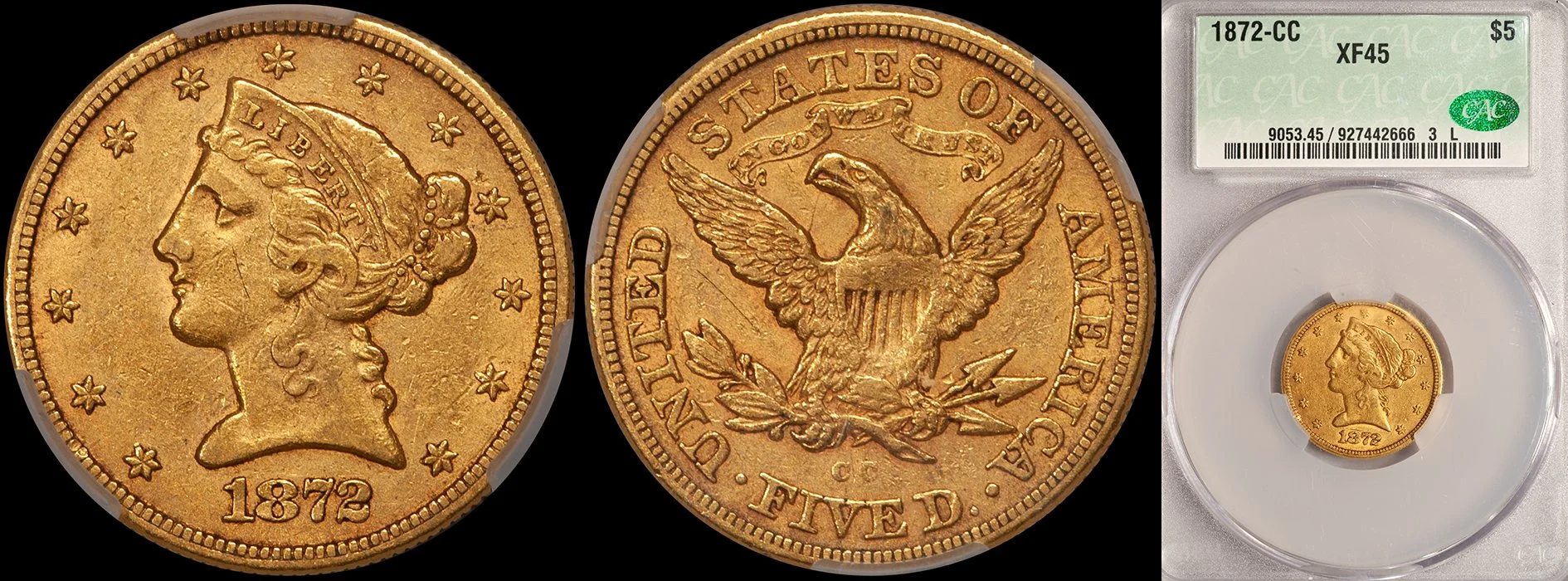
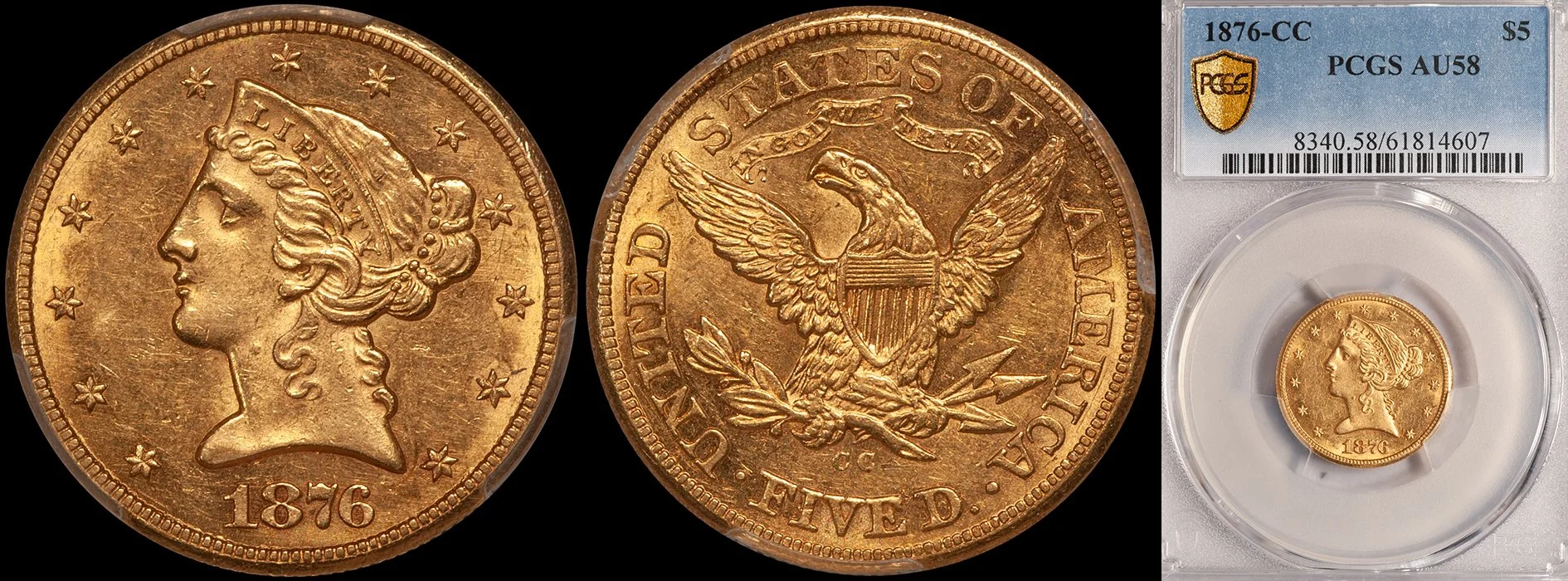
The most important thing to remember about grading is that, despite claims to the contrary, it remains highly subjective. It is hard enough to get a group of experts to agree on Mint State common date Morgan Dollar grades; let alone complex issues such as Charlotte coins. In the late 1980's/early 1990's, PCGS and NGC began grading significant amount of Charlotte gold coins. For the most part, the grading standards of that era tended to be very conservative. Today, standards have relaxed considerably. In my opinion, the EF-45 of the late 1980's is an AU-50 (or even an AU-53) today. And the AU-55 of the late 1980's is an MS-60 (or even an MS-61) today. The primary effect of this is to provide an unrealistic picture of availability for certain issues. As an example, as of September, 1997, PCGS had graded 41 1849-C half eagles in the various About Uncirculated grades. In the forthcoming revision of my Charlotte book, I estimate that the total number of 1849-C half eagles known to exist in all AU grades is 35-37. It is my opinion that many of the 17 coins graded AU-50 by PCGS (as well as some of the 10 coins graded AU-53 by this service) are coins which would have graded Extremely Fine a decade ago.
V. The Fall and Decline of "Crust"
I am a fan of original surfaces on gold coins. To my eyes, there is nothing more attractive than a Charlotte piece with layers of old "crust." (I define "crust" as original toning over a heavy layer of natural "skin" on a coin's surface which develops over the course of time). To me, originality provides great eye appeal. Unfortunately, the two grading services have unwittingly contributed to the destruction of a great number of gold coins by penalizing them for originality. It is my experience that if you submit a "crusty," original AU-50 coin, it is invariably graded EF-45. But, if you take the same coin, scrub off the crust and make it bright, it will grade AU-50 to AU-55. Ironically, the financial incentive for submitters is to destroy their coins in order to maximize their value. This is especially true in a market such as Charlotte gold where the difference between an EF-45 and an AU-50 can be thousands of dollars. As time passes, I think the number of truly original Charlotte coins will continue to shrink. The few remaining coins with original surfaces will invariably trade for strong premiums among knowledgeable buyers and unwitting new collectors and investors will get stuck with the overgraded, unnaturally bright dregs.
VI. A Shift in the Supply and Demand of Charlotte Gold
One of the major reasons why common coins have dropped significantly in price in the 1990's is the fact that more and more come onto the market while fewer collectors, investors and dealers are around to absorb them. Charlotte gold coins are one of the few series where the supply/demand ratio has been such that enough new collectors have come into the market to absorb the coins which have come onto the market. A typical "common date" Charlotte half eagle has a surviving population of 150-200 pieces. At least half of these coins are in very low grades and, therefore, are of little interest to collectors. Another large group are either in museums or tightly-held private collections and are off the market. Suddenly, an original population of 150-200 may now have shrunk to twenty or fewer coins which are of the quality which an advanced collector will find acceptable. If there are 50-100 serious collectors of Charlotte gold (and my guess is that the actual number is greater than this), than there exists a demand for coins which is two to five times greater than the actual supply. The result is that prices for Charlotte gold coins have risen and should continue to do so as fewer and fewer coins are chased by more and more collectors.
VII. Many Major Collections are Sold and ManyNew Players Enter the Market
In the decade from 1987 to 1997, many of the finest collections of Charlotte gold coins ever assembled have been sold. Important collections sold at auction include Norweb (Bowers and Merena, 1987-1988), Willard Blaisdell (Stack's, 3/90), Billy Fuller (Heritage, 7/93) Reed Hawn (Stack's, 10/93), James Stack (Stack's, 10/94), R.T. Wilder (Stack's, 11/94) Ed Milas (Stack's, 5/95 and Stack's/RARCOA/Akers, 11/95) and the forthcoming Pittman sale (Akers, 10/97). In addition, the Stanley Elrod collection, which is recognized by experts as the final complete set of Charlotte coins ever assembled, was sold intact and then broken-up and sold individually from 1995 to 1997. Coins from these sales now dominate the revised Condition Census listings for Charlotte gold coins and this will be reflected in my forthcoming book.
At the same time, there has been a change of leadership in the Charlotte market; both from the standpoint of the sellers and the buyers. Of the ten leading dealers in Charlotte gold in the current market, at least half of them were not active in 1987 and others, such as myself, have only recently had the financial resources available to compete in the higher end market. Of the ten leading collectors of Charlotte gold in 1987, at least half of them are either deceased or no longer active. Many of the most significant buyers had never seen a Charlotte gold coin in 1987, not to mention the fact that they were unable or unwilling to spend serious money on their current passion a decade ago.
VIII. Summary
Collectors of Charlotte gold who have been active since the mid-1980's are, no doubt, marvelling at the tremendous changes that they have seen in the past decade. The number of high grade rare coins which have been made available to them, especially in the 1990's, has been nothing short of incredible. As one collector recently said to me, half-jokingly, "it's like they reopened the Charlotte Mint for a few years and decided to give us a second chance at the really nice, rare pieces we needed for our collections. Conversely, the prices which these same collectors now have to pay for choice pieces makes the prices of 1987 seem very, very reasonable. In 1987, the collector of average means could afford to put together a nice Extremely Fine to About Uncirculated set. Today, this set is out of the price range of the lower budget collector.
Nearly all of the major collections which have been formed since 1987 have been built around slabbed coins. Unless a Charlotte coin is from an old-time collection and is being sold at auction, the chances are good that it if it is unslabbed, it has a problem.
In my opinion, the future for collector-oriented series such as Charlotte gold coins looks very bright. Assuming that my new book creates even a moderate number of serious new collectors, the supply/demand ratio will become even more skewed. If three or four major players decide to assemble high grade sets of Charlotte gold in the next two or three years, the supply will noticeably dwindle. This will lead to further price increases and, perhaps, even more radical market changes than the ones discussed above.