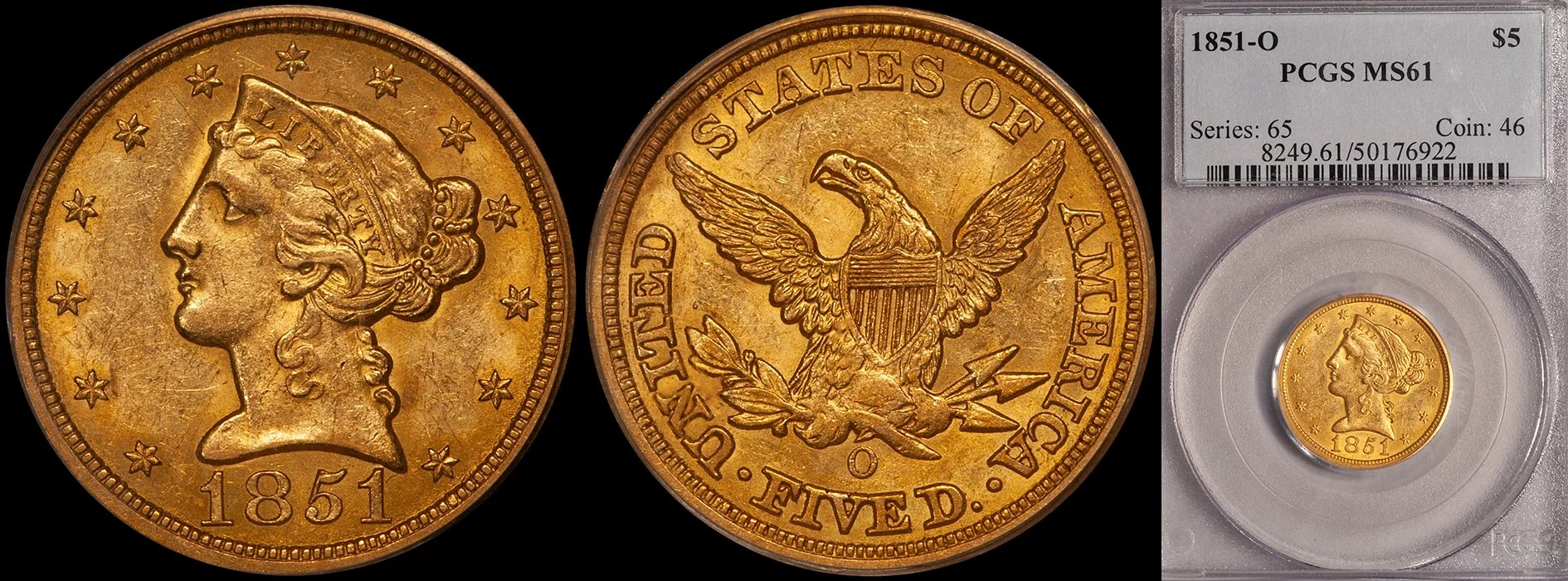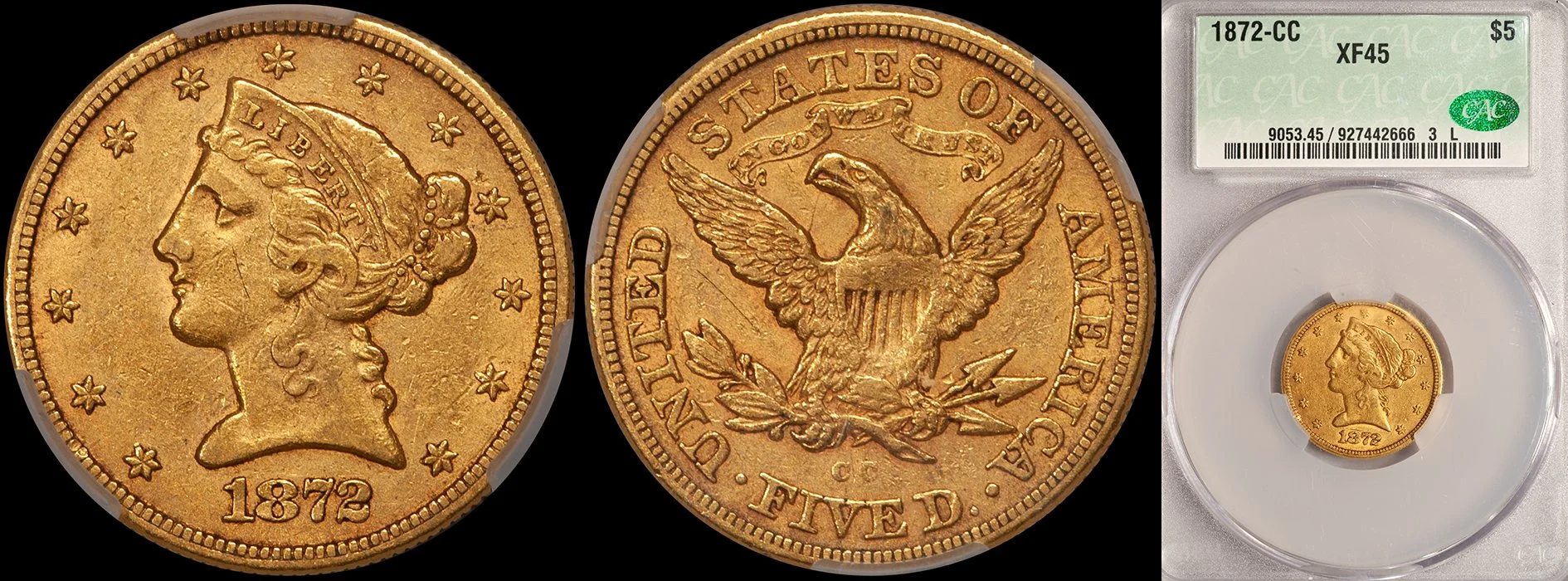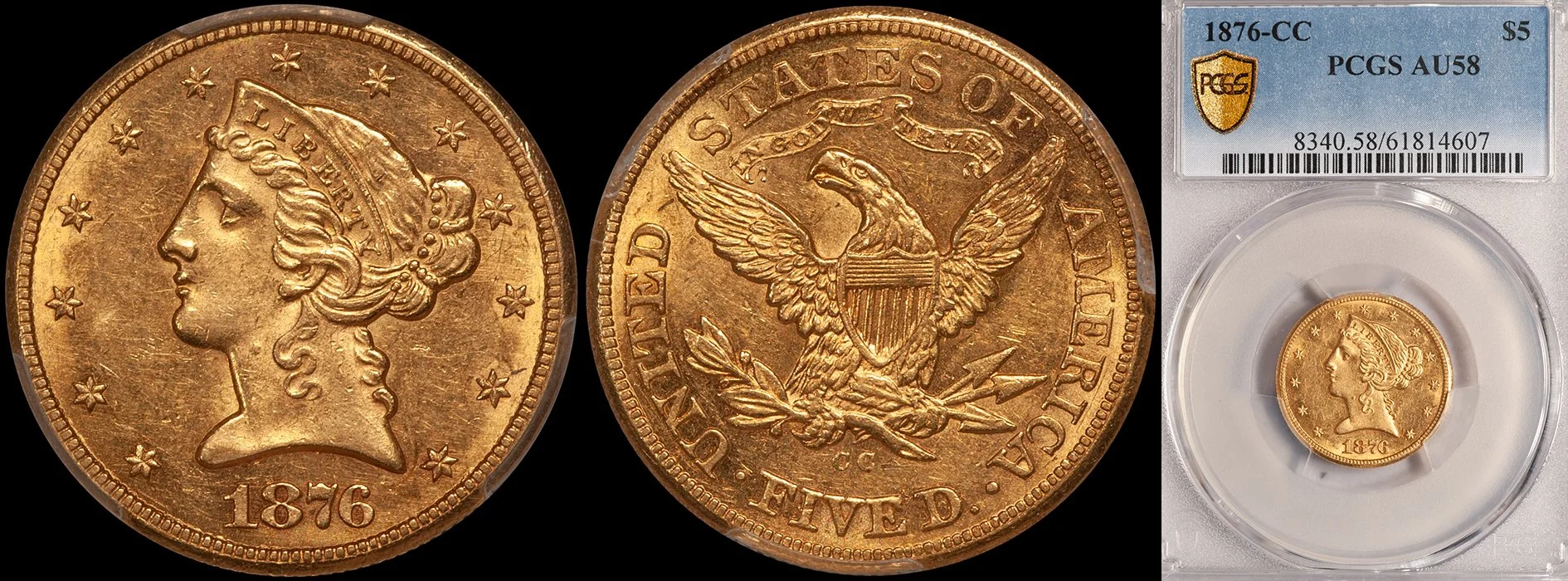
The Henry Lang Collection of Carson City Gold Coinage: An Analysis And Appreciation Part Two: Eagles (1880) - Double Eagles

In their July 31st Rarities Sale, Bowers and Merena auctioned off one of the finest specialized groupings in recent history: the Henry Lang collection of Carson City gold coinage. A close look at this collection is very revealing about the current state of the Carson City market and about high end 19th century gold coinage in general. These coins were mostly purchased in the early 1990's and were notable for their "fresh" original surfaces and overall high quality. Many were undergraded by today's standards, due to the fact that both PCGS and NGC were especially conservative regarding Carson City gold coinage when these pieces were first graded.

In the descriptions below, "Trends" values refer to the July 29th edition of Coin World Trends while "Bid" refers to the June 2002 edition of Coin Dealer Newsletter Greysheet. When the expressions "No Trends" or "No Bid" is used, this refers to instances where one of these publications does not list a value for a specific date in a specific grade.

All prices realized listed below include the 15% buyers charge which is applied to all lost sold by the auction house.

EAGLES (1880-1893)

1880-CC: Lot 636, graded Mint State-61 by NGC. This was the best example of this date that I had ever seen. I graded it MS-62 and thought it could even grade MS-63 on the right day. It sold for $19,550, which is easily a record price for this date.

1881-CC: Lot 637, graded Mint State-63 by NGC. I bought this coin for $26,450 which seems expensive (Quarterly bid for an MS-63 is $16,000) until one realizes that it is now in an NGC MS-64 holder. This is the finest 1881-CC eagle I have ever seen and one of the best coins in the collection from the standpoint of condition.

1882-CC: Lot 638, graded Mint State-61 by NGC. I have never seen another Uncirculated 1882-CC eagle. I loved this coin and it was the eagle I most wanted to buy out of this collection. I did wind up purchasing it for $20,700 and it immediately upgraded to MS-62 at NGC.

1883-CC: Lot 639, graded Mint State-60 by NGC. This is one of just two known Uncirculated examples of this underrated date. I graded it Mint State-61 to Mint State-62. I thought it would be a hotly-contested lot but was very surprised that it sold for a record $17,250 (CDN bid is $10,500 while Trends is $11,500).

1884-CC: Lot 640, graded Mint State-60 by PCGS. This coin was bought back at $9,200. I did not really care for it as the surfaces had a few too many abrasions. But it was a really Uncirculated coin and one of around a half dozen known of this date. At $7,500 or so, I would have been more interested.

1890-CC: Lot 641, graded Mint State-63 by NGC. This was the shocker of the late date eagles. It sold for an incredible $18,400. Bid is $10,000 while Trends is $16,000. Clearly, at least two people graded this coin Mint State-64. If the buyer is right, this will become a highest graded coin. If he is wrong, he made a very expensive mistake as a nice MS-63 is worth $9,000 or so.

1891-CC: Lot 642, graded Mint State-64 by NGC. A really nice borderline gem and one of the best examples of this common date that I have seen. But it opened at a robust $9,000 ($10,350 with the buyer's premium) and there were no takers in the audience.

1892-CC: Curiously, there was no example of this date in the Lang collection.

1893-CC: Lot 643, graded Mint State-60 by NGC. The crowd was probably too busy buzzing about the next lot (the 1870-CC double eagle) to pay attention to this lovely and very underrated piece. It went unsold.

Overall Analysis: The Lang collection of Carson City eagles contained some magnificent coins. I thought that prices for the coins from the 1870's were, for the most part, quite strong. Buyers realized that many of these coins were unlikely to improved upon in the next few years, so the finest known or high Condition Census pieces went for very strong prices. The coins from the 1880's were amazing and buyers bid accordingly. Auction records were set for the 1880-CC, 1881-CC, 1882-CC and 1883-CC. The coins from the 1890's went more reasonably, although the 1890-CC was a surprise and a world record.

DOUBLE EAGLES (1870-1893)

1870-CC: Lot 644, graded Extremely Fine-40 by PCGS. In recent years, this has been an incredibly popular issue and prices have risen accordingly. The Lang coin was one of the sharpest I had ever seen I thought it would upgrade to EF-45. But I was stunned that this coin brought $149,500. I would guess that Mr. Lang paid less than half this amount and he was, no doubt, pleased with the result.

1871-CC: Lot 645, graded About Uncirculated-58 by NGC. This was a great coin that only a handful of viewers appreciated. Most examples show dense abrasions and have been repeatedly cleaned. This was a lovely "slider" that was crisp and original. I bought it for $20,700 and thought it was a sensational purchase.

1872-CC: Lot 646, graded Mint State-61 by NGC. This was another lovely early date CC double eagle. It had superb color, great luster and lovely color. It sold for $26,450, which is just a bit higher than MS-60 Trends. I think this was a great value as it is the finest known and it could well upgrade to MS-62.

1873-CC: Lot 648, graded "net MS-60" by Bowers and Merena. This coin was unencapsulated due to a large mint-made planchet flaw and spotting on the obverse. It still sold for $14,950 and I'm sure that the dealer who purchased it is confident that he can get it graded at PCGS or NGC.

1874-CC: Lot 649, graded Mint State-61 by PCGS. Few people realize just how rare this date is in high grades. Apparently all of the people "in the know" were in the room as this coin brought a remarkable $17,250. This is more than double MS-60 Trends (and more than triple MS-60 bid!).

1875-CC: Lot 650, graded Mint State-63 by NGC. Most higher grade 1875-CC double eagles have been cleaned or dipped at one time. This was a superb, fully original piece that was very high end for the grade. I paid $14,375 for it and quickly resold it to a type collector who wanted a single choice Carson City double eagle for his set.

1876-CC: Lot 651, graded "net AU-58" by Bowers and Merena due to having been cleaned. This sold for $4,830.

1877-CC: Lot 652, graded Mint State-62 by NGC. This coin was bought back at $23,000 which was a bit of a surprise as I thought it would bring in the $22,500-25,000+ range. It is probably the finest known and important CC double eagles of this quality are seldom offered for sale.

1878-CC: Lot 653, graded About Uncirculated-58 by PCGS. I thought this was a very nice coin but did not think it would upgrade. It sold to a dealer for $12,650. With Trends at $11,500 in AU-58 and $20,000 in MS-60, this individual clearly believed this coin had a realistic chance of upgrading.

1879-CC: Lot 654, graded Mint State-60 by NGC. There were some noticeable spots on the upper obverse but I still liked this coin a lot and thought it was better than its indicated graded, It sold for $24,150 (Trends is $22,500 in MS-60) so I obviously was not the only person who felt this way.

1882-CC: Lot 655, graded AU-58 by PCGS. This coin sold for a very strong $5,290, which is full Mint State-60+ money for the date. I thought it was a nice 58 but not better.

1883-CC: Lot 656, graded Mint State-63 by PCGS. The 1883-CC is a date that is almost never seen above MS-62. This coin is one of just two graded MS-63 by PCGS with none better. It brought $18,400, which is a strong but not absurd price, given that Trends is $22,000. In my opinion, buying a great coin like this for a bit more than 80% of Trends is a very fair value in today's market.

1884-CC: Lot 657, graded Mint State-62 by PCGS. Trends for this date in MS-62 is $6,500. This coin sold for a healthy $7,475.

1885-CC: Lot 658, graded AU-58 by PCGS. This was a very nice coin that I felt was accurately graded. It sold for $9,250. With AU-58 Trends at $7,250 and MS-60 at $10,750, the new owner clearly graded this coin at least Mint State-60.

1889-CC: Lot 659, graded "MS-64" by Bowers and Merena. This coin was oddly presented as it was one of just two pieces in the Lang collection that wasn't a "no-grade" but was not encapsulated by PCGS or NGC. I graded this piece MS-62 to MS-63 and it was passed on by the bidders at an aggressive opening bid of $15,000.

1890-CC: Lot 660, graded "MS-63" by Bowers and Merena. This was the other piece in the collection that was raw but was capable of being graded. I agreed with B+M's grade and was prepared to pay in the $10,000-12,000 range. The final bid was a very strong $17,250.

1891-CC: Lot 661, graded Mint State-61 by NGC. People who viewed this lot were divided on its quality. I liked it but many people were not crazy about the heavily spotted obverse. Despite the spots, the coin brought $17,250, which is well above CDN MS-60 bid ($10,000) and MS-60 Trends ($12,500).

1892-CC: Lot 662, graded Mint State-62 by NGC. This was a very nice coin for the grade and with a huge jump in Trends between MS-62 and MS-63 ($8,000 to $21,000) it was inevitable that there would be some serious bidding. At $11,500, this piece will either be a great deal for its new owner (if it upgrades) or it will be an all-time record for the date in MS-62.

1893-CC: Lot 663, graded Mint State-63 by PCGS. This was among the nicer 1893-CC double eagles I had ever seen. It brought a very strong $16,100. With MS-63 Trends at $10,000 it was obvious that the successful bidder was hoping for an upgrade to Mint State-64.

Part Two of this article will contain an analysis of the Lang collection's eagles dated 1880-1893 and all of the double eagles from 1870 to 1893.
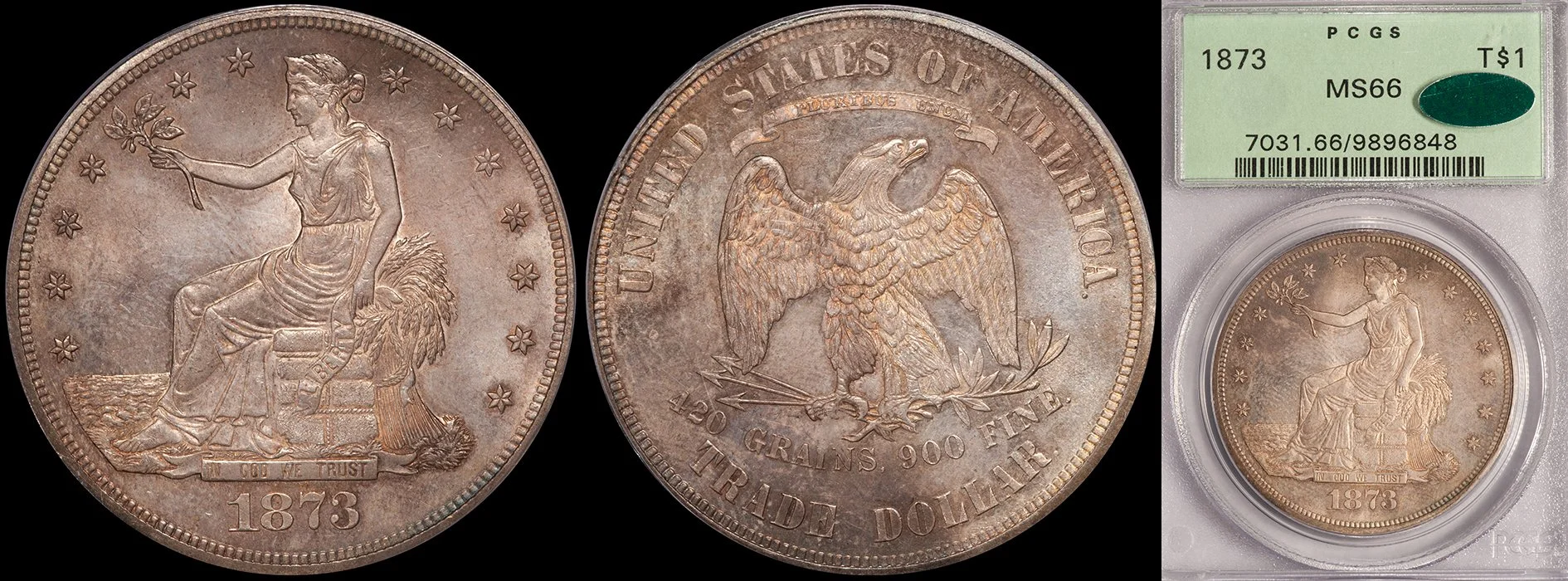
The Henry Lang Collection of Carson City Gold Coinage: An Analysis And Appreciation Half Eagles - Eagles

In their July 31st Rarities Sale, Bowers and Merena auctioned off one of the finest specialized groupings in recent history: the Henry Lang collection of Carson City gold coinage. A close look at this collection is very revealing about the current state of the Carson City market and about high-end 19th century gold coinage in general. These coins were mostly purchased in the early 1990's and were notable for their "fresh" original surfaces and overall high quality. Many were undergraded by today's standards, due to the fact that both PCGS and NGC were especially conservative regarding Carson City gold coinage when these pieces were first graded.

In the descriptions below, "Trends" values refer to the July 29th edition of Coin World Trends while "Bid" refers to the June 2002 edition of Coin Dealer Newsletter Greysheet. When the expressions "No Trends" or "No Bid" is used, this refers to instances where one of these publications does not list a value for a specific date in a specific grade.

All prices realized listed below include the 15% buyers charge which is applied to all lost sold by the auction house.

HALF EAGLES

1870-CC: Lot 607, graded MS-61 by NGC. I loved this coin but it was very flatly struck on the neck. Bid is $80,000 and this coin sold for $77,625. In retrospect, this was a very good deal as it is one of just three known Uncirculated examples of this major rarity.

1871-CC: Lot 608, graded AU-55 by NGC. One of the nicer examples of this date I have seen in some time. I graded it solid AU-58. Bid is $8,750 in AU and $45,000 in MS-60 with no Trends listed over EF-45. The coin sold for $14,950 which is a solid price for the issue.

1872-CC: Lot 609, graded AU-50 by PCGS. Very undergraded and a solid AU-55+ to AU-58 in my opinion. Probably the best 72-CC half eagle I have ever seen with a great strike and superb color over very lustrous surfaces. I purchased this coin for $25,875.

1873-CC: Lot 610, graded AU-53 by PCGS. A solid coin for the grade and accurately graded by today's standards. Bid is $20,000 in AU while Trends is $32,500. This brought $18,975 which seems a touch cheap.

1874-CC: Lot 611, graded AU-50 by NGC. Undergraded; I thought it was a nice AU-55. Bid is $6,500 in AU while Trends is $11,500 in AU-50 and $16,500 in AU-55. This piece brought $10,350. It would have brought more except that there are currently a few other nice 74-CC half eagles on the market.

1875-CC: Lot 612, graded AU-55 by PCGS. I couldn't decide whether I liked this coin or not. I thought it might upgrade to 58 but it was a touch on the dull side. It brought $16,100 with Bid at $8,400 in AU and Trends at $12,250 in AU-50.

1876-CC: Lot 613, graded MS-65 by PCGS. I didn't have to decide about this coin...I loved it and thought it was the single best CC gold coin that I had ever seen. In fact, I grade it MS-67 by today's standards. I purchased this coin for $138,000 and genuinely believe it was fantastic value. I would have paid considerably more and feel that this will be a $250,000 coin the next time it becomes available.

1877-CC: Lot 614, graded AU-58 by NGC. This was the second best 77-CC half eagle I had ever seen and I graded it MS-61. It was a lovely coin that I really wanted to buy but I was outbid by a Florida dealer who paid a solid $29,900. Bid for an MS-60 is $38,000. This is an example of a price that will seem strong to someone who did not view these coins but was probably a good value in the long run.

1878-CC: Lot 615, graded AU-55 by NGC. This was one of the few disappointments for me in the sale. It had a funky orange-gold color which appeared to be artificial. It still brought $24,150, which is a strong price for a date that is bid at $14,500 in AU. Had this coin been choice for the grade, however, it would have brought over $30,000.

1879-CC: Lot 616, graded AU-58 by NGC. I thought this was a nice coin for the grade but I did not see it as Uncirculated. I was obviously wrong, as it brought a strong $10,925. If this coin "works" for the dealer who bought it, it was a purchase, as a Mint State-60 to 61 example is worth $15,000+. If it stays in an AU-58 holder, it's a truly bad deal as it is worth $6,000+.

1880-CC: Lot 617, graded MS-61 by NGC. A really nice coin for the grade which I thought had a solid shot to grade MS-62. I bought it for $11,500. Unlike nearly every 1880-CC I have seen that was graded MS-60 or MS-61 by the services, this one was a real "BU" coin with no evidence of wear.

1881-CC: Lot 618, graded AU-58 by NGC. This was my favorite "sleeper" lot in the half eagle section. I thought it was a very high end MS-61 and easily one of the best I had ever seen. It brought a very strong $17,250; Trends is $13,250 in AU-58 and $20,000 in MS-61 while MS-60 Bid is $16,500. An expensive coin but well worth it.

1882-CC: Lot 619, uncertified due to having been cleaned. An ugly coin that was out of place among the other lovely half eagles in the Lang collection.

1883-CC: Lot 620, graded MS-61 by PCGS. I graded it an MS-62 but didn't like the noticeable scrape in the left obverse field. This coin brought $29,900, which I thought was among the strongest prices in the sale. MS-60 trends is $18,500 while MS-60 Bid is $14,500. This coin was purchased by a very smart dealer but I'm not exactly certain how he's going to make money on this purchase...

1884-CC: Lot 621, graded AU-55 by PCGS. I graded it AU-58 with no chance of being called Mint State. At least two people disagreed with me as this coin brought an incredible $11,500, which is nearly triple the current Trends listing of $4,500 in AU-55.

1890-CC: Lot 622, graded MS-65 by NGC. A really lovely gem example that was one of the nicest common date CC half eagles I have ever seen. It was bought back by the consignor at its opening bid of $14,000. I thought this coin was worth $20,000+ and regretted not buying it as soon as the lot closed.

1891-CC: Lot 623, graded MS-64 by NGC. Bid in MS-64 is $4,350 and this nice example sold for $4,083.

1892-CC: For some odd reason, there was no 1892-CC half eagle in this collection.

1893-CC: Lot 624, graded MS-64 by NGC. I haven't seen many better 1893-CC half eagles than this but I have a hard time getting excited by this date. It brought $14,950 which I thought was the right price considering its quality. Bid is $13,500 in MS-64.

EAGLES (through 1879)

1870-CC: Lot 625, graded EF-45 by NGC. This was the nicest EF example of this date that I have seen in a number of years. It brought $26,450, which is a strong price but not unreasonable when one considers how rare and undervalued this issue is. Bid is $18,000 in EF while Trends is $25,000 in EF-40.

1871-CC: Lot 626, graded MS-62 by NGC. This was one of my favorite coins in the sale. It was a superb, very high end coin with claims to an MS-63 grade and it is easily the finest known 1871-CC eagle. I bought it for $66,125 which I thought was good value given the rarity and quality that this one-of-a-kind coin represents.

1872-CC: Lot 627, graded AU-55 by PCGS. I graded this coin AU-58 and feel it is the finest known example of this rare date. It sold to a collector bidding on the phone for $41,400. This is a strong price but when one considers that this is a finest known coin that will probably never be improved on, it is hard to "overpay."

1873-CC: Lot 628, graded AU-53 by NGC. This coin was reserved for $24,000 and did not sell. A second example, Lot 629, was graded EF-45 by NGC and it brought a very strong $17,250 (Trends is $18,500 in EF-45). This coin will probably wind-up in an AU-50 or AU-53 holder but was not especially nice.

1874-CC: Lot 630, graded MS-64 by NGC. This was the highlight of the Lang collection eagles. It sold for $103,500 to the same dealer who had sold it to Mr. Lang in the mid-1990's. I thought this was a very strong price for this coin but would add that this is another coin, like many in this collection, that truly represents one-of-a-kind quality.

1875-CC: Lot 631, graded AU-53 by PCGS. I wasn't wild about this coin because of its abraded surfaces but did like its originality. It sold for $20,700. Quarterly Bid is $20,000 in AU-50. I consider this to be a strong price for the coin, as I recently sold a similar quality PCGS AU-53 to a collector for 20% less.

1876-CC: Lot 632, graded AU-58 by NGC. This coin was just a bit bright from a dipping but it was very "meaty" with quite a bit of luster visible. I bought it for $29,900 which I thought was a strong price but not out of line for a coin that was the third finest known example of a rare issue. Bid is $12,000 in AU and $45,000 in MS-60.

1877-CC: Lot 633, graded AU-55 by PCGS. I graded this coin AU-58 and consider it the second finest known example of a rare and very underrated issue. It sold for $24,150. At the sale, I thought it was expensive but upon reflection I think this was a good value for the collector who purchased it. Bid is $11,000 in AU (too low) and $40,000 in MS-60.

1878-CC: Lot 634, graded AU-55 by NGC. I graded this coin AU-58 and thought it was either the first or second finest that I had ever seen. It brought $19,550 which I thought was an extremely good value. Trends is $20,000 in AU-50 while Bid is $16,000 in AU. The extreme originality of this coin made it worth considerably more than these published levels.

1879-CC: Lot 635, graded AU-53 by PCGS. I graded this coin AU-53 to AU-55 and thought it was well above average for the date and grade. It sold for $25,300 which I thought was a very strong price, given the fact that Bid is $16,500 in AU.

Part Two of this article will contain an analysis of the Lang collection's eagles dated 1880-1893 and all of the double eagles from 1870 to 1893.
Assembling a New Orleans Gold Coin Type Set

Due to the various denominations and designs struck at the New Orleans mint, assembling a type set of gold coins from this facility is extremely popular with collectors. This mode of collecting makes even more sense when realizes the difficulty and expense of acquiring New Orleans gold coins on a date-by-date basis. Gold coins were struck at the New Orleans mint from 1839 until 1909. Six different denominations were produced: gold dollar, quarter eagle, three dollar, half eagle, eagle and double eagle. There were a total of twelve major types produced, and these are as follows:

    Type One gold dollar, 1849-1853

    Type Two gold dollar, 1855 only

    Classic Head quarter eagle, 1839 only

    Liberty Head quarter eagle, 1840-1857

    Three Dollar gold piece, 1854 only

    Liberty Head half eagle, no motto reverse, 1840-1857

    Liberty Head half eagle, with motto reverse, 1892-1894

    Indian Head half eagle, 1909 only

    Liberty Head eagle, no motto reverse, 1841-1860

    Liberty Head eagle, with motto reverse, 1879-1906

    Type One Liberty Head double eagle, 1850-1861

    Type Three Liberty Head double eagle, 1879 only

There are a number of reasons why collecting New Orleans gold coins by type purposes is sensible for most collectors.

Affordability: High grade examples of these types can be obtained, in many cases, for $5,000-10,000. This means that a very nice twelve coin type set can be assembled for less than $100,000.

Variety: Since each major type of New Orleans gold coin has a significantly different appearance, the collector can assemble a set that is richly varied.

Distinctiveness: Five of the twelve New Orleans gold coins mentioned above are distinct one-year types, meaning that they were produced only in a single year. This adds quite a bit of historic interest to a New Orleans type set.

Completeability: None of these twelve types is so rare or expensive that the collector of average means cannot put a nice example into his or her set. With a date set, there are always issues that are so hard to obtain that they are "stoppers" for many collectors.

A brief discussion of each of the twelve major types of New Orleans gold coins should prove useful for new collectors.

1. Type One Gold Dollar: The gold dollar denomination was introduced in 1849. The first major type was produced from 1849 until 1854 and it has a small liberty head on the obverse. New Orleans produced Type One gold dollars for five years. The 1850-O is by far the scarcest of these issues but a very nice example can be purchased for under $5,000. Mint State-63 to Mint State-64 examples of the other dates (except the 1852-O) can be had for $3,000-7,000. I personally like the 1849-O as a type coin since it is a first-year-of-issue.

2. Type Two Gold Dollar: This is a one-year type that was produced only in 1855. It is relatively common in circulated grades but it is rare in the lower Uncirculated grades and very rare in Mint State-63 or better. It is extremely hard to locate a nice piece that is well struck and has original color and surfaces. For most collectors, an example in the Mint State-60 to Mint State-62 range will suffice and such a coin is valued in the $5,000 to 10,000+ range.

3. Classic Head Quarter Eagle: The Classic Head New Orleans quarter eagle of 1839 is similar in rarity and historic profile to the 1855-O gold dollar. The 1839-O quarter eagle is a popular one-year design type that is not really rare in circulated grades and can sometimes be found in the lower range of Uncirculated. It becomes rare in Mint State-62 and is very rare in Mint State-63 or better. A nice Mint State-60 to Mint State-62 is valued in the $5,000-10,000 range.

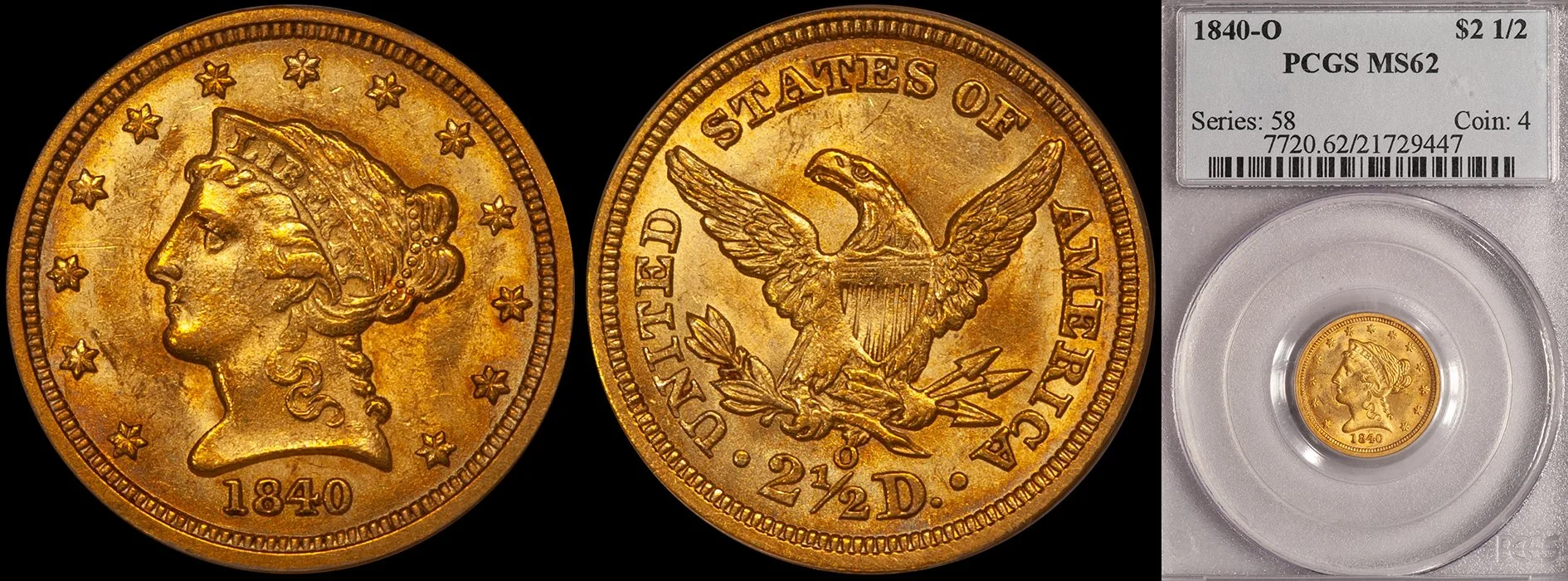
4. Liberty Head Quarter Eagle: A total of fourteen different quarter eagle issues were struck at the New Orleans mint between 1840 and 1857. This includes a Small Date and Large Date variety in 1843. The most common issues in higher grades are the 1843-O Small Date, 1854-O and 1857-O while the rarest are the 1840-O, 1842-O and the 1845-O. I would suggest that the type collector seek a coin like an 1843-O Small Date or an 1854-O in Mint State-62 for his set. When available, such a piece sells for $2,500-3,500 and is very good value.

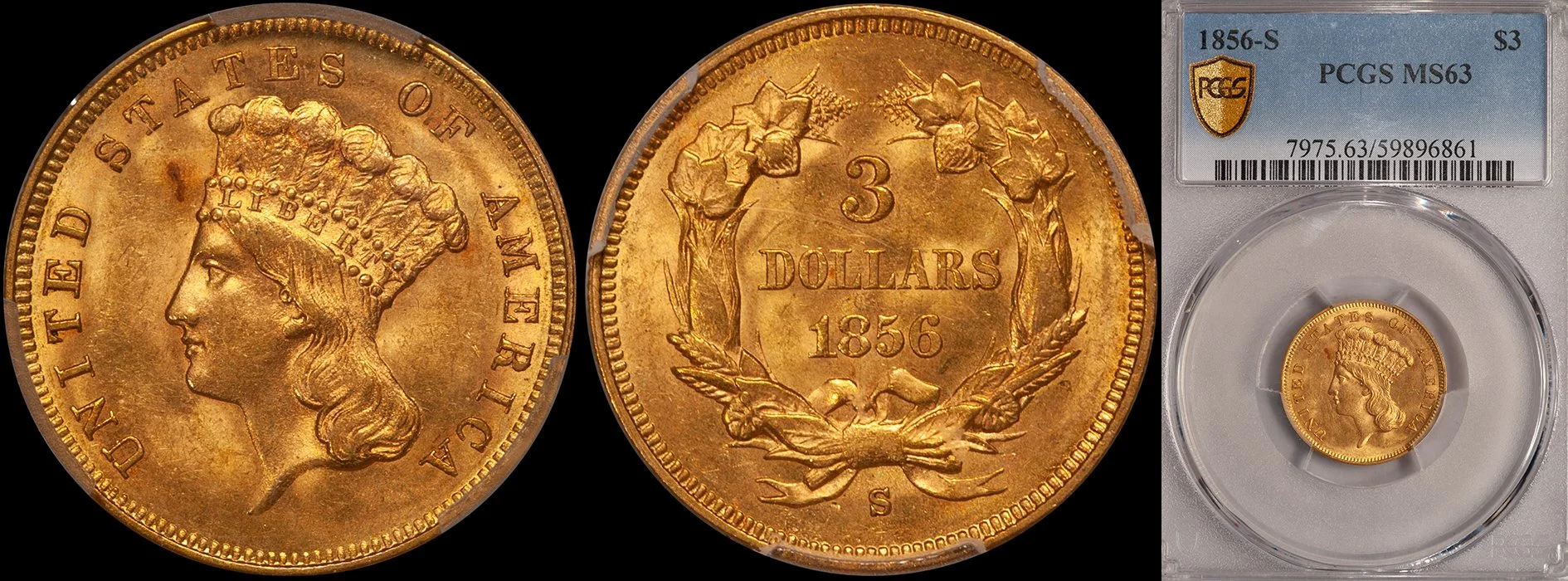
5. Three Dollar Gold Piece: This is the third one-year type in the New Orleans set. It was produced only in 1854. The 1854-O three dollar gold piece is common in Very Fine and Extremely Fine and only slightly scarce in the lower About Uncirculated grades. It becomes very scarce in About Uncirculated-55 to About Uncirculated-58 and it is extremely rare in Uncirculated. A Mint State-60 to Mint State-61 coin, if available, will cost in the area of $20,000 and will prove to be among the most difficult pieces for the type collector to acquire. Nice About Uncirculated-55 to About Uncirculated-58 pieces range from $5,000 to $10,000+.

6. No Motto Liberty Head Half Eagle: Thirteen No Motto half eagles were struck between 1840 and 1857. This includes Large Letters and Small Letters varieties from 1843. The two most common dates are the 1844-O and the 1854-O while the rarest are the 1842-O and the 1847-O. All No Motto half eagles from this mint are scarce in Mint State-60 to Mint State-62 and all are very rare in Mint State-63 or better. An 1844-O in Mint State-60 to Mint State-62 would be a perfect type coin and would cost between $4,000 and $7,500. The only other issue that is sometimes seen in Uncirculated is the 1854-O.

7. With Motto Liberty Head Half Eagle: This type was produced for just three years: 1892, 1893 and 1894. The rarest of these is the 1892-O while the most common is the 1893-O. For type purposes, most collectors look for either an 1893-O or an 1894-O. Both are common in all circulated grades and modestly scarce in Mint State-60 to Mint State-62. They are very rare in Mint State-63 and excessively rare above this. A nice Mint State-62 example of the 1893-O or 1894-O half eagle is currently very good value in the $2,000-2,500 range.

8. Indian Head Half Eagle: The 1909-O is the only one-year half eagle type from New Orleans. It is also regarded as one of the rarest Indian Head half eagles in high grades. Most 1909-O half eagles grade Extremely Fine-45 to About Uncirculated-55. This is a scarce coin in About Uncirculated-58, a rare one in the lower Uncirculated grades and a very rare issue in Mint State-63 or better. A nice Mint State-60 to Mint State-62 example should cost in the area of $5,500 to $10,000+.

9. No Motto Liberty Head Eagle: There were twenty-one different No Motto eagles struck at the New Orleans mint between 1841 and 1860. This includes a Large Date and Small Date variety in 1854. The rarest issues of this type are the 1841-O and the 1859-O while the most available dates are the 1847-O and the 1851-O. While a number of these issues have reasonably high mintage figures, Eagles were a workhorse denomination in local commerce. This resulted in most issues being well circulated. In addition, many coins were melted. As a result, any Uncirculated no motto New Orleans eagle is very scarce. A nice Mint State-60 to Mint State-62 piece should be available in the $5,000 to $10,000 range.

10. With Motto Liberty Head Eagle: After the end of the Civil War, the New Orleans mint was closed. It did not resume coinage until 1879. From this year until 1906, a total sixteen different With Motto Liberty Head eagles were produced. The major rarities of this type are the 1879-O and the 1883-O while a number of issues, such as the 1903-O, 1904-O and the 1906-O, can be located in grades up to and including Mint State-63 without much effort. Any date of this type in Mint State-64 is quite rare and gems, while more available than other large denomination New Orleans gold coins, are still very rare and desirable. A common date example in Mint State-63 is currently valued at $1,500 to $2,000 and in Mint State-64 at $4,500-6,000+.

11. Type One Liberty Head Double Eagles: This type was struck from 1850 to 1861. There were a total of twelve issues produced. This includes two legendary rarities: the 1854-O and the 1856-O. For type purposes, the two most practical dates are the 1851-O and the 1852-O. These are common in lower grades, scarce in the higher About Uncirculated grades and very rare in Mint State-60 or better. A Mint State-60 to Mint State-62 examples of one of these two issues is valued at $12,500-22,500. Most other Type One double eagles from this mint are extremely rare in Uncirculated and are not practical for a type set.

12. Type Two Liberty Head Double Eagles: Only 2,325 Type Three double eagles were struck at this mint and all were produced in 1879. The 1879-O is a rare and very popular coin whose status is enhanced as a one-year type. When available, this coin is typically seen in the Extremely Fine-40 to About Uncirculated-50 range. There are only four to six known in Uncirculated and the finest of these sold at auction for $115,000 in late 2001. In most type collection of New Orleans gold coins, this will be one of the few pieces that are not Uncirculated. A nice mid-range About Uncirculated example should cost $15,000 to $20,000.

In my opinion, the basic twelve coin New Orleans type set is a very interesting option for the collector. The price ranges listed above are for high end examples, and this set could be assembled for $30,000-40,000+ if Extremely Fine-45 to About Uncirculated-55 pieces are substituted for such expensive types as the three dollar gold pieces and the Type One and Type Three double eagles.

All About The Condition Census

The concept of Condition Census was first introduced to numismatics by noted Large Cent collector and researcher Dr. William Sheldon in the 1940's. Since then, it has been refined to include a listing of approximately the five or six finest examples of a specific date or type or in the case of series such as Large Cents or Bust Half Dollar, a specific die variety. All of my books on branch mint gold coins contain Condition Census information and I actively maintain a database with updated information for Charlotte, Carson City, Dahlonega and New Orleans issues. Some of these Condition Census databases can be purchased from me.

People who are new to rare coin collecting may not understand this information and this brief article is an attempt to make sense of the data which is contained in a typical Condition Census listing.

The three listings below are for 1839-D half eagles. They represent the coins that, in my opinion, are the finest examples of this date that exist. Obviously, this listing does not include coins that have never appeared at auction or which have traded privately in transactions of which I am not aware. In addition, there are probably links in these pedigree chains of which I am not aware; i.e., dealers who have sold or brokered one or more of these coins during a period of time in which the coin's history was not known.

1839-D Half Eagle Condition Listings

Private collection, ex New York Gold Mart (Ron Karp), Numisma (Stack's/RARCOA/Akers) 11/95: 1451 ($16,500), Winthrop Carner, Stack's 5/95: 433 ($24,200), Ed Milas. Graded Mint State-62 by NGC.

Green Pond collection, ex Heritage 1999 ANA: 7666 ($19,550), Chestatee collection (Duke's Creek duplicates), Hancock and Harwell, Leon Farmer collection. Graded Mint State-62 by PCGS.

Alabama collection via Al Adams, ex Bowers and Merena Bass IV sale, 11/00: 352 ($25,300), Harry Bass collection, Kreisberg 11/70: 1693. Graded Mint State-61 by PCGS.

As these three listings show, there are two Mint State-62 1839-D half eagles known. I regard the NGC MS-62 as the better one so it is listed first. There is more than one Mint State-61 piece known but the coin rated as #3 above is, in my opinion, the best and it is therefore listed as the first MS-61 in the Census.

The location of coin #1 is not currently known to me so it listed in a "private collection." There are other cases when I know the location of a coin but the collection wishes to remain completely anonymous.

This coin was either purchased directly or indirectly (I am not certain which) from New York Gold Mart, a firm owned by dealer Ron Karp, who in turn, purchased it directly out of a November 1995 auction where it was Lot 1451 and sold for $16,500. It was consigned to this sale by a dealer named Winthrop Carner who had purchased it from the Stack's May 1995 auction for $24,200. Prior to this, it was in the collection of Ed Milas, a well-known Chicago dealer. I am not aware of any pedigree information before it was obtained by Milas.

The second finest known 1839-D half eagle is a PCGS Mint State-62 coin that is in the Green Pond collection. It was obtained directly by this collector from the Heritage 1999 ANA sale where it brought $19,550. It was consigned to the sale by the owner of the Chestatee collection which was, in fact, a group of duplicates from the Duke's Creek collection. Before this, it had been obtained via private treaty from the Georgia firm of Hancock and Harwell who purchased it from a collector named Leon Farmer. I am not certain where the coin was before this, thus there is no earlier information listed.

The third finest known 1839-D half eagle is currently in an Alabama collection and it was obtained from the Bass IV sale held by Bowers and Merena in November 2000. In this sale, the collector employed the dealer Al Adams as his agent, which is why it is listed as being "via" him instead of "ex Al Adams." Harry Bass bought the coin from a November 1970 Abner Kresiberg sale.

Depending on your knowledge of Dahlonega gold coins and the players in the rare coin market, the information listed above either makes complete sense or it looks like the Dead Sea scrolls in ancient Hebrew.

To comprehend any Condition Census, you must learn the market participants. Learning the names of the dealers and auction companies is easy. Learning the name (real or assumed) of the collectors is harder and will take longer for the newcomer.

Assuming that you have read this article and have decided to make use of a Condition Census, your next question should be: how can I use this information to my best advantage? Some suggestions are as follows:

    Condition Census information can help you determine what to pay for a coin. The listings for high grade 1839-D half eagle shown above give an indication of what these pieces have brought at auction in the past ten years.

    Condition Census listings can help identify the pedigree of a coin. If you have purchased a high grade piece and you discover it is from a famous collection such as Bass, Eliasberg or Pittman, you have added value to your collection.

    A Condition Census will teach you which auction catalogs you should add to your numismatic library. You will see certain names mentioned again and again in any Condition Census. If you do not have this catalog in your library, you should consider purchasing it.

    A Condition Census will inform you which dealers are players in the market and which are not. My name is mentioned all through the 19th century branch mint gold Condition Census listings since I have handled so many of these coins in the past. This, in my opinion, verifies my claim as being an expert in this area. If a dealer you are buying high end pieces from claims he is an expert but has never owned important coins, this may be a sign that you need to look elsewhere.

Even if you collect lower grade coins which are not close to being Condition Census quality, you should still become familiar with these listings. In numismatics, knowledge is power and having this information will make you a better collector in every sense of the word.

The Registry Set Phenomenon

PCGS introduced the concept of the registry set a few years ago but the concept did not seem to catch on until the early part of 2000. In the last two years, it has become an unqualified hit for PCGS with over two thousand collectors currently participating. The concept of the registry set is simple. Collectors seek to assemble complete sets and list them on the PCGS website when they wish to share the information. Some collectors wait until their sets are complete or nearly finished; others list sets that include just a few dates.

Registry sets have had a huge impact on certain market areas. As an example, prices in series such as Jefferson Nickels and Eisenhower Dollars have risen dramatically in the past two years. If an issue in one of these series is (currently) low population, the chances are good that at least one registry set collector will pay a very strong price for it.

Interestingly, the registry set phenomenon has had virtually no affect on the rare date gold market. When I last checked, there were only one three sets listed for Dahlonega gold and none for Carson City or Charlotte. Collectors of such popular series as Type One Liberty Head double eagles or New Orleans gold couldn't list their sets in the PCGS registry if they wanted to as they are not yet granted their own category.

Many experienced collectors look at the registry set phenomenon as a current market fad that is destined to die a quick and painless death. While I strongly believe that prices on many modern coins have become ridiculously inflated as a direct result of registry set demand, I do not think this is a passing fad. In fact, I think it can be a real long-term benefit to the coin business.

In order to benefit from this new system, the collector must understand it and use it to his benefit. Here are some points to consider:

    At this point in time, it is to late to jump on the registry set bandwagon as far as modern (post 1950) coinage goes. But, since virtually no one has properly used this system for 19th century gold coins, it is very easy to have a #1 or #2 set in a popular series such as Charlotte or Dahlonega gold.

    Registry sets are all about marketing. Placing your set on the PCGS registry does not mean you are going to sell it. But it provides you with terrific (free) exposure. It also adds instant creditability to a set. Your set sounds more impressive as "Joe Blow's Carson City Gold Set: The #1 Set on the PCGS Registry" than just "Joe Blow's CC Gold Set." And this could translate to higher prices when you sell your coins.

    The collector needs to make the registry set concept work for him and not vice-versa. Paying outlandish prices for common date coins solely to have a #1 set is not a prudent move. Being on the cutting edge and assembling the #1 set of Charlotte gold when everyone else (or so it seems...) is chasing MS-67 Eisenhower dollars may prove to be extremely intelligent in the long run.

    There are a few hardcore registry collectors who have already assembled a number of high ranked 20th century sets. It is likely that at least a few of these will turn their attention to 19th century sets and when they do, the demand for certain coins could rise quickly.

    If PCGS begins to promote the concept of "classic coin" registry sets, it is likely that the concept will catch on more quickly. Knowing the marketing savvy that PCGS has, it seems likely that they will create more classic coin sets and promote them in the future.

I have a few basic complaints about the registry set concept and how it hurts the coin market. I'd like to point these out:

    Many registry set buyers make foolish purchases. In most modern series, the price differential between an MS-67 and an MS-68 can be astronomical. This doesn't apply to the rare date gold market yet...but if it does, collectors should think carefully about buying "supergrade" coins if the only reason for doing this is to score extra registry points.

    The concept of the registry set does not reward the coin itself; only its "plastic grade." As the savvy collector knows, there can be an AU-58 Charlotte half eagle that has infinitely better eye appeal than an MS-62; yet in the registry the ugly MS-62 is more highly rated than the high end AU-58. Don't make poor buying decisions just because your "competition" has a high grade example of a specific issue. Your lower grade piece could well be a better coin!

    The rarity factor of certain coins are not (yet) properly weighted. In the modern coin series, PCGS has addressed this problem. But as the system currently works, a high grade example of a very rare issue such as an 1856-D quarter eagle is given the exact same value as a more common issue. Until this is properly addressed, the ranking of rare date gold sets is irrelevant.

    Collecting is about more than having a highly ranked registry set. If the sets are used to promote numismatics and the fun inherent in this hobby, great. If they become a tool for dealer hype and collector ruthlessness, as they are in the modern coin arena, than they are causing more harm than good.

    Registry-related fads can be harmful to the neophyte's pocketbook. As an example, it is likely that at some time in the near future, deep cameo and ultra cameo proof gold and silver coins from the 19th century will be given more weight in the set registry than their non-cameo counterparts. Don't pay a large premium for one of these cameo pieces; especially in a series that most coins already tend to come with cameo contrast.

Like it or not, the registry set phenomenon is here to stay. For the collector of rare date gold coins, it is an interesting opportunity to get in on the ground floor and, quite possibly, add some "free value" to an already collectible set.

Type One Philadelphia Double Eagles: A Date By Date Analysis

The Philadelphia mint struck Type One double eagles between 1850 and 1865. This is an extremely interesting group of sixteen dates (plus varieties), which run the gamut from common to rare. In my opinion, they are the best value among Type One double eagles. They are much more affordable than their New Orleans counterparts and far scarcer than the issues from San Francisco. This is a set that can be completed in reasonably high grades by the collector of average means but it will prove challenging to find nice, original examples of most of these dates. 1850: A very popular issue due to its status as a first-year-of issue date. The 1850 is known for having a very good strike and nice luster. Original pieces exhibit attractive orange-gold or deep rose-gold coloration. This date has risen considerably in price in the past three years but is still a good value in the mid-level AU grades and above. It is sometimes seen in MS-60 to MS-62 but it becomes quite rare in MS-63 and is extremely rare above this.

1851: The most available date from this decade along with the 1852 but still not a common coin in higher grades. There are a number of decent AU's around but properly graded Uncirculated 1851 double eagles are quite scarce and any that grades MS-62 or better is rare. Higher grade examples often have nice color and good luster but exhibit numerous wispy hairlines. Circulated pieces are prone to show bagmarks or deep abrasions. This is an issue that the collector would do well to be patient and wait for the right piece for his collection.

1852: The 1852 is similar in rarity to the 1851. It is common in lower grades and only moderately scarce in AU-55 to AU-58. In Uncirculated it is quite scarce and rare in MS-62 or better. Most are well struck and have good luster but are prone to display heavy bagmarks. As with the 1851's, a number of higher grade 1852 double eagles have great color and luster but show fine hairlines on the surfaces. An interesting variety in known that shows strong doubling on the date. If you want a single "type coin" from the 1850's, this is probably the best choice.

1853: The 1853 is not a rare date but it is much harder to locate than the 1851 or 1852. In the higher AU grades, it is scarcer than most people realize and it is rare and very underrated in Uncirculated. I have not seen more than a handful that grade MS-62 and just one or two that were better than this. As a rule, the 1853 is found with minor weakness of strike at the centers and heavily marked surfaces. The natural coloration is medium to deep orange-gold. There are varieties known with repunching on the 3 in the date (common) and with noticeable repunching on the entire date (rare).

1853/2: The only unquestioned overdate in the entire Liberty Head double eagle and one of the key issues in higher grades. Easily identifiable by the presence of a raised die dot below the RT in LIBERTY. Usually found in Extremely Fine grades and very scarce in the lower range of AU; very rare in AU-55 to AU-58 and extremely rare in Mint State. I have only seen three Uncirculated pieces, all of which graded MS-61. Every 1853/2 double eagle I am aware of is extensively abraded and very few have not been cleaned or dipped. If you have a chance to buy a piece that grades AU-50 or better and is clean for the grade, I would highly suggest you "go for it."

1854: The 1854 is one of the more common Philadelphia type one issues in terms of its overall rarity but it is much harder to find in high grades than the 1851 or the 1852. In AU-58, the 1854 is very scarce and it is quite rare in Uncirculated. I have only seen one or two that I graded MS-63 and none better. As a rule, the 1854 is very heavily abraded and is characterized by dull grainy luster. A number of pieces have mint-made planchet problems. Most show a small date. A rare and undervalued variety has a large date punch. The large date is extremely rare in Uncirculated and is grossly undervalued in AU-50 and above.

1855: The 1855 ushers in a quintet of scarce, underrated double eagles from this mint. While available in lower grades, this date is very scarce in properly graded AU-55 to AU-58 and very rare in Uncirculated. Most of the few available Mint State coins are low-end and have extensive deep abrasions. The typical 1855 is relatively wells truck with deep green-gold color. Many have been dipped or cleaned and most are riddled with bagmarks. Attractive, original pieces are undervalued at current levels.

1856: My favorite "sleeper" issue from the 1850's. While fairly common in lower grades, the 1856 is very scarce in the higher AU grades and very rare in Uncirculated. In the past five years, I have only seen three Uncirculated examples of this date and not all that many nice AU-58's. Most 1856 double eagles have heavily marked surfaces and grainy, dull surfaces. A number have mint-made planchet problems. At current price levels, this date is very good value.

1857: The 1857 is not as scarce as the 1854-1856 issues, especially in higher grades. However, this is still far from being a common date and most are seen in lower grades. Nice AU-55 to AU-58 examples are scarce and Uncirculated pieces are rare. This is generally a well struck and lustrous date but many higher grade pieces have serious mint-made planchet problems. A number have been cleaned and the few that show original color are worth a substantial premium over the typical example.

1858: Generally regarded as a fairly common issue but actually quite scarce in any grade above AU-50. This is a very rare coin in Uncirculated and most of the higher grade pieces have mint-made planchet problems or noticeable marks. Often found with heavy abrasions and unappealing deep coloration or very bright from overzealous cleanings and/or dippings. I think the 1858 double eagle is a great value at current price levels, especially in the AU-55 to MS-62 grade range.

1859: This is the rarest Philadelphia double eagle from the 1850's and it is one of the rarest of all the Type One issues in high grade. Nearly every one I have seen has extensively abraded surfaces and most have been cleaned at one time. Any piece with minimal detracting marks and original color is extremely desirable. The 1859 is very rare in the higher AU grades and it is an extreme rarity in Uncirculated. I have only seen three or four Uncirculated coins and none were better than MS-61.

1860: The 1860 is among the more available Type One issues from this mint, although it is considerably more scarce than the 1861. It is often seen with a good strike and nice luster. The natural coloration is often an attractive rose-gold shade. There are some very high grade examples known (MS-63 to MS-65) and these are similar enough in appearance to suggest a small hoard many have existed at one time. Nice MS-60 to MS-62 1860 double eagles remain an excellent value at current levels.

1861: In anticipation of the approaching Civil War, the mintage figure for double eagles skyrocketed in 1861. This is the most common Type One double eagle and before the discovery of the S.S. Central America, it was the most available date in higher grades. The 1861 is fairly easy to find in MS-60 to MS-62 grades but it remains rare in MS-63 and very rare in any grade higher. There are some extremely nice pieces available with great luster and color but most offered for sale have been cleaned and are extensively abraded.

1862: The 1862 has long been one of my favorite double eagles of any type. This is a scarce date in all grades and it is the rarest Type One issue in higher grades (AU-50 and better). I feel it is extremely undervalued and it generally trades and substantial premiums above current published price guides. Most have inferior luster and are "baggy." A few very nice higher grade coins are known and these have good color and luster. They trade for very strong premiums among knowledgeable collectors.

1863: The 1863 is a bit less rare than the 1862 and it is slightly more available in premium quality grades. It is still a very scarce and undervalued coin that appears on many collector's want list. It is generally a well-made issue with good overall detail and attractive satiny to semi-prooflike luster. The natural coloration is medium to deep green-gold or orange-gold. Nearly every known example shows significant marks on the surfaces. The few nice 1863 double eagles I have seen in recent years have sold at levels exceeding "Trends" and "Quarterly Bid" so the collector should be willing to "step up" if the right coin becomes available.

1864: The 1864 is another very scarce Civil War date although not as much so as the 1862 and the 1863. It is generally seen in Extremely Fine and it is quite scarce in the lower to mid AU grades. The 1864 is quite rare in properly graded AU-58 and very rare in Uncirculated. Many show dark, unappealing coloration and most have poor eye appeal due to heavy surface marks. At current price levels ($4500-5000 for a nice AU-58) this date is a wonderful value, especially given the fact that it is essentially unobtainable in any Uncirculated grade.

1865: This is the final Type One double eagle from the Philadelphia mint. It is scarce, although not nearly as much as the 1862-64 issues. The 1865 is usually seen in EF-40 to AU-50 and it is very scarce in the higher AU grades. It is very rare in Uncirculated and the few that are known in this range are generally in the MS-60 to MS-61 range. This date tends to have better eye appeal than the 1862-64 and there are some nice, original 1865's available from time to time. An interesting variety is known with a noticeably repunched date. This is another issue that is a great value at current levels ($3000-3500 for a nice AU-58).

Type One Double Eagle Buying Tips

  1. Look for coins that are as original as possible. It is my opinion that, in the coming years, nice original examples of Type One Philadelphia double eagles will bring strong premiums over dipped, "typical" quality examples.

    Stretch on the rarities. The perfect Type One set would have very high end examples of dates such as the 1853/2, 1859, 1862 and 1863 and average to above-average examples of the 1851, 1852, 1853, and 1861.

    Don't pay a premium for varieties that are not yet recognized. The only Type One varieties that are widely recognized are the 1853/2 and the 1854 Large Date. Other varieties may become recognized in the future but they do not currently requite a premium to buy them. Become familiar with these and learn how to "cherrypick" them.

    Buy the coin and not the holder. There are PCGS and NGC Type One double eagles that are outstanding for the grade and there are those that are very low end.

Rarity Charts Overall Rarity

This chart ranks the Philadelphia Type One double eagles in terms of their overall rarity; i.e. the total number known to exist in all grades combined.

1. 1853/2

2. 1862

3. 1859

4. 1863

5. 1864

6. 1856

6 (tie). 1865

8. 1855

8 (tie). 1858

10. 1857

11. 1851

12. 1860

13. 1850

13 (tie). 1852

13 (tie). 1853

13 (tie). 1854

17. 1861

Premium Quality Rarity

This chart ranks the Philadelphia Type One double eagles in terms of their overall rarity; i.e. the total number known to exist in all grades combined.

1. 1862

2. 1853/2

3. 1863

4. 1859

5. 1856

6. 1864

7. 1855

8. 1858

9. 1857

10. 1865

11. 1854

12. 1850

13. 1853

14. 1851

15. 1852

16. 1860

17. 1861

A Source List For Supplies

In over twenty years as a professional numismatist, I have discovered some excellent supplies and "peripherals" that make my business easier and more pleasurable. I'd like to share some of these with you. Coin Viewing: I generally use a 5x magnifier when I am viewing coins. In my opinion, anything stronger than this makes even the nicest coin look bad and does not present a realistic view of its appearance. When it comes to magnifiers, nothing compares to German optics. The best magnifiers I have ever seen are made by Zeiss. These are very expensive and given the fact that they can be easily lost, you may not want to spend this much (typically in the $100-200 range). I use Eschenbach magnifiers. They are reasonably priced (around $50 for a compact unit) and last forever.

An equally important component of coin viewing is lighting. When I am grading coins, I like to use a small, intense halogen source. The best halogen lamp I have found is made by Zelco. One model I like is the "Micro," which comes in a variety of colors and sizes. These can be purchased at a good lighting store or over the Internet.

Coin Insurance: If you have a collection that is worth more than a few thousand dollars, you should consider purchasing insurance. The insurance policy should cover your coins while they in storage and in transit. If you bring your coins home from time to time, make certain that your insurance is also applicable to your residence.

Most traditional insurance companies do not understand collectibles so it is wise to look for a specialist. I have used North American Collectibles for a number of years (as do many dealers) and can highly recommend them. Speak with Barbara Wingo at (410) 857-5011 and ask for an application.

Coin Storage: Unless you live in a house with exceptional security, you need to store your coins in a secure area. If you haven't already done so, I would strongly recommend going to your local bank and renting a safe deposit box. Most banks charge $100 per year for a good-sized box.

If you live in an area that has above-average humidity, consider placing a desiccant (moisture remover) in your safe deposit box. There are a few good products available; call one of the supply dealers listed below for suggestions. If you collect mint red copper coins and live in a humid area, it is IMPERATIVE that you use a good desiccant.

Coin Boxes: I use two types of boxes to store my coins. My favorite is the hard plastic model sold by NGC. These fit twenty pieces and unlike the boxes made by PCGS, they comfortably fit coins graded by both major services. They cost around $5.00 each and can be ordered through NGC's customer service department (800-NGC-COIN).

For larger numbers of coins, I like the traditional "big red boxes" that are made from reinforced cardboard. These boxes, which also come in black, can be ordered from any good supply company for just a few dollars each.

Briefcases: If you plan to take a significant amount of merchandise to a coin show to sell, you will need a good case to transport it. I strongly recommend a canvas case that has a telescoping handle and wheels. I have burned my way through numerous expensive cases and found that the best rolling case I have yet to buy is the $50-75 version from Office Depot.

If this is not classy enough for you, look into a leather salesman's sample case or a ballistic nylon case from a manufacturer such as Tumi. I would strongly caution you against purchasing a fancy metal case (such as a Halliburton) as these are very heavy and conspicuous. In fact, they virtually scream at all viewers that "I am carrying something expensive. Please rob me!"

Shipping Supplies: It is a good idea to have some basic shipping supplies on hand. I would highly recommend purchasing safe-t-mailers. These are self-adhesive ribbed cardboard holders that fit inside a number of envelope sizes. They can be purchased from any of the supply dealers below.

You should also make certain you have a supply of padded mailers and tape. These can be found at any good local office supply company.

Coin Books, New: There are a number of good sources for new books. The American Numismatic Association (www.money.org) has an excellent selection of new books. Both Coin World and Krause Publications feature books that they have published, including a number of must-have titles for the gold coin collector. Any of the book dealers listed below will have a number of titles that are important.

Coin Books, Scarce and Out-of-Print: As you become more serious about coins, it is likely that your thirst for knowledge will increase. For many series, there are few current references and you will have to search for scarcer, out-of-print books, monographs, and auction catalogs. I strongly recommend establishing a good relationship with one or more of the following dealers. Let them know your interests and get on their mailing lists.

Charles Davis: numislit@aol.com

George Kolbe: gfk@numislit.com

Fred Lake: fredlake@tampabay.rr.com

Karl Moulton: numiscats@aol.com

Recommended Supply Dealers:

Brooklyn Galleries (www.brooklyngallery.com) 718-745-5701

J.T. Stanton (www.stantonbooks.com) 912-232-8655

TransLine (www.transline.com) 714-258-0963

South Park Coins (www.southpark.com) 972-564-6995

Are Population Reports Useful For The Collector?

Both PCGS and NGC publish listings of the coins that they have graded. The PCGS report comes out on a monthly basis while NGC's report is issued quarterly. At one point in time, I found these to be extremely useful, both as a buyer and seller of rare coins. Today, I dislike them and, more often than not, have to make excuses regarding their numbers when I sell coins. What went wrong with these reports and why are they no longer a good tool for the coin collector?

There are many flaws inherent with the PCGS and NGC population listings. The first is their reliance on dealers to maintain the integrity of the data.

When a coin is submitted to PCGS or NGC, it is registered in a database. In a perfect numismatic world, each unique coin would be counted just once. But, as even the most casual collector realizes, grading is subjective and a tiny increase in grade can mean a huge increase in value. If I purchase a coin in a Mint State-63 holder and I think it is very high end, the chances are good that I will remove it from the old holder in an attempt to get a Mint State-64 grade, especially if the financial rewards are great.

Each PCGS and NGC holder contains a "tag" or an insert that lists the date, grade and unique serial number of a coin. Once a coin has been removed from its holder it is the responsibility of the dealer (or collector) to send the tag back to PCGS or NGC. When the tags are returned they are deleted from the original database.

But this creates a number of problems. What if the dealer loses the tag? What if he does not care about the population figures and throws the tag(s) away? Suddenly the population figures lose much of their value.

Let me give you an example. I recently bought an 1891 double eagle. This is a very rare coin in all grades with an original mintage of just 1,390 business strikes and an estimated surviving population of four dozen pieces. After a few submissions, it attained an AU-58 grade from NGC. I was very excited about this coin and prepared to add it to my website. And then came a total shock...

When I looked in the October 2001 NGC population report, I was astonished to find that the population for AU-58 1891 double eagles was twenty-two (with another two higher). PCGS had, as of February 2002, graded seven with none better. This means that the two services had graded twenty-nine examples in AU-58. Suddenly, my very rare 1891 double eagle seemed a lot less rare. Or was it?

As someone who is knowledgeable when it comes to gold coins, I know that there are not twenty-nine AU-58 1891 double eagles in existence. In fact, there are probably no more than a dozen accurately graded 1891 double eagles in all AU grades combined. So what happened to distort the data?

An NGC or PCGS AU-55 1891 double eagle is worth approximately $10,000-12,000. An AU-58 is worth $14,000-17,000. If a coin is a "tweener" (i.e., it is right between a 55 and a 58 in terms of quality) there is considerable motivation for it to be resubmitted. In MS-60 the same coin is worth $30,000-35,000. When one considers how infinitesimal an amount of difference in quality there is between most AU-58 and MS-60 coins (or even AU-55 and MS-60, to be honest), is it any wonder why an especially nice 1891 double eagle might be resubmitted ten, fifteen or even twenty times?

The dealer who owns a coin such as an AU-58 1891 double eagle can be profiled (fairly or unfairly) as a reasonably wealthy individual with reasonably sophisticated taste. In other words, he is likely to know the difference between a "58" and a "60" and have deep enough pockets to tie the coin up for three months while it is submitted and resubmitted. Rare coins with big price spreads are, therefore, more likely to have inaccurate populations then common coins or scarcer coins with minimal price spreads between one grade and the next.

Unfortunately, many of the leading coin submitters are not what I would describe as "avid numismatists." For them, coins are a business and submissions are a major part of their day-to-day operations. This means that any of the major wholesale submitters are exactly the type least likely to care if populations are accurate. I have confronted a number of these individuals about distorting coin populations and their reactions are always similar: they could care less.

The population reports have other inherent flaws. PCGS, as an example, has graded over 7 million coins as of February 2002. Managing a database of this size is a huge task. And the person managing this database is most likely to be a data entry clerk making a few dollars over minimum wage, not a numismatist. How are they going to know that a certain population figure is obviously inflated? Many savvy professional numismatists would have trouble making these judgement calls.

Are the population figures of 2002 totally worthless? Not really. I have long maintained that the true value of these numbers is comparative as opposed to quantitative. Let's say, for example, that you look at the population figures for Type One double eagles. It makes no sense to compare an 1853 Philadelphia double eagle to an 1853-O in terms of the total number graded. One--or both--of these issues could have a population that is distorted by at least 30-40% due to resubmissions. But it makes some sense to compare the number of 1853 double eagles graded in AU-55 to the number of 1853-O double eagles graded in AU-55.

When examining population figures, here are a few things to remember:

  • High-end coins are more likely to have inflated populations than low-grade coins. As an example, a coin that grades AU-50 is less likely to be resubmitted than an AU-58. This is due to the fact that the AU-50 probably isn't a very nice coin and the value spread between this and the next grade up is much less than between an AU-58 and an MS-61.

    Many low-end examples of scarcer to rare coins do not get submitted. As an example, if I owned a Fine-15 1851-O half eagle, I would just as soon sell it unencapsulated as slab it. If I did this, it would never be counted in a population report. But this coin clearly exists, as do no-grades, damaged coins and other "misfits." The total number of coins graded for an issue may represent only a percentage of those actually available in the market.

    Be aware of population figures at both services. As an example, I currently own a PCGS AU-58 1852-D half eagle. The February 2002 population at PCGS is four in AU-58 with three better. The current NGC population of this issue is twenty in AU-58 with eleven better. This means one of two things. Either NGC grades this issue much more loosely than PCGS or the NGC population is severely inflated due to resubmissions. Given the fact that this coin is worth $5,000-6,000 in AU-58 and $8,000-12,000 in MS-60 to MS-61, I would suggest that the latter is more likely the case.

    Only a small fraction of modern coins have been resubmitted. Never purchase a modern coin based solely on population figures as there are tens of millions (or more) of most issues waiting to be graded.

    With well over 10 million coins submitted between the two services, mistakes do exist on the population report. As an example, NGC shows two 1883-CC half eagles graded MS-64. I have never seen or heard of an 1883-CC half eagle in any grade higher than MS-62 (let alone two of them) and am inclined to believe that these represent data entry errors. Similarly, I know coins that exist that for whatever reason have never made it onto the PCGS or NGC reports.

What can you as a collector do to improve the accuracy of the population reports? I would suggest the following:

  • Compile lists of inaccurate numbers and send them to PCGS and NGC. But, you need facts to change a population. Merely telling one of the services "I think the number of 1847-O quarter eagles graded in Mint State-62 seems a little high" will not work. You need to be able to prove your assertion.

    Urge your dealer (or dealers) to be careful in managing PCGS and NGC inserts. Encourage him to turn in his tags if he does not already do so. If he is resubmitting a coin of yours for an upgrade, make certain the tags are redeemed.

    Tell PCGS and NGC that the population figures are important to you and you would like them to become accurate. Both services are sensitive to the needs of collectors.

    Realize that PCGS and NGC figures are inaccurate and make your purchasing decisions accordingly. Never pass on a good coin because of the population figures in one--or both-of the reports.

Deconstructing Ten Popular Coin Maxims

We've all heard them a thousand times: the numismatic maxims that have been repeated enough times that they have acquired near-mythic status. So are they true or not true? 1. "Size Matters"

True. Big coins are more popular than small coins and will continue to be. While there are some small coins that are popular (most noticeably branch mint gold dollars) most others are unpopular. Double eagles may seem high priced given their mintage figures and relative availability but the demand for choice and rare pieces is increasing. In the long run, it seems likely that new collectors will prefer the heft of larger-sized gold coins than their smaller counterparts.

2. "Sets Are Worth More Than Individual Coins"

True. One of the most significant developments in the coin market in the past few years has been the PCGS Registry Set. Collectors are now able to post the grades of their coins and compete against others. So far, this has most dramatically impacted modern issues. It is likely that "classic" 19th century issues will see more competitive set building in the coming years, especially as such sets are promoted by dealers and encouraged by PCGS and their collectorsuniverse.com website.

An exception to this maxim is a meaningless set. As an example, a set of 1850-O gold coins (gold dollar, quarter eagle, eagle, and double eagle) is not worth any premium over individual price levels for each piece. But, a complete set of New Orleans quarter eagles is worth more, as a set, than the individual coins.

3. "If It's Slabbed It's Properly Graded"

False. There is a definite hierarchy when it comes to third-party graded coins. Clearly, PCGS and NGC are the two best grading companies. The next tier is occupied by ICG and ANACS who are also good but whose product is not valued as highly in the marketplace as PCGS and NGC's. The bottom rung is occupied by such firms as SEGS, PCI and Accugrade. These services grade much more liberally and allow many "problem" coins into their holders. New collectors should be careful to realize that a 1907 High Relief in SEGS Mint State-64, as an example, is typically worth far less than the same issue in a PCGS or NGC MS-64 holder.

4. "Grade Is Better Than Rarity"

False. Back in the 1980's, there was a widely-held belief that if a coin was not a "gem" than it was essentially worthless. When coin prices came crashing down in the early 1990's, it was ultra-high grade common issues that suffered the most. As the market became more sophisticated, rarity became more appreciated and in recent years it has generally outperformed grade.

The ideal coin collection features "fundamentally rare" coins in comparatively high grades stressing eye appeal and originality. By fundamental rarity, I mean a coin whose rarity and desirability is not wholly a function of its grade. As an example, a 1795 eagle is a desirable coin whether it is a damaged Very Good or a superb Mint State-65. An 1895 eagle has very little value above its bullion content in low grades and really only attains numismatic value at the Mint State-64 to Mint State-65 level. For this reason, a coin like a 1795 eagle is "better" than an 1895 eagle.

5. "All Coins Sell Best At Auction"

False. For very rare or very high grade coins, auction is an excellent selling venue. But auction is not ideal for all coins or collections.

If you have a collection that primarily features generic coins or have a large amount of coins with tight buy sell spreads (like modern proofs sets and mint sets) then it makes sense to sell these to your local coin dealer. The 10-15% that you pay to the auction company will erode your entire profit margin.

High quality, "fresh" coins sell very well at auction. In some cases, however, private treaty sales can work every bit as well or better. As an example, a specialist dealer may be a better choice to handle the sale of a small to medium sized collection than an auction house. My firm has been chosen to sell some wonderful specialized collection of branch mint gold and has, in my opinion, done a better job of getting top dollar for the owners than if the coins had been placed in auction.

6. "Buy The Book Before The Coin"

True. This hoary old maxim has been repeated to the point of triteness but it remains one of the best pieces of advice a new collector can get. All collectors should assemble a good library of basic coin books and, once they have decided on an area of specialization, assemble a comprehensive specialized library.

Once the basic books have been purchased, it may take some work to find scarce, out-of-print specialty works. The collector should contact numismatic book dealers and specialist dealers to get their input as far which books are important and which are not. If you spend thousands (or ten of thousands) or dollars per year or coins and nothing on books, you are operating under flawed logic.

7. "Quality Is Better Than Quantity"

True. Many new collectors begin with the idea that it is good to have lots of average quality coins. The best collections focus on quality over quantity. In most instances, this means that an important specialized collection will not have more than a few hundred pieces. There are, of course, exceptions to this rule. The Harry Bass collection contained thousands of American gold coins. But many of these were duplicates or they represented lower grade die varieties. Plus, Bass had the good fortune to be buying gold coins when they were reasonably priced. Today, it is not practical to assemble a collection as large as the Bass holdings; both from the standpoint of cost and availability.

I purchase (or attempt to buy) collections all the time. The ones that impress me most are "lean and mean." They contain choice, attractive, interesting coins and often number fewer than one hundred individual pieces.

8. "Non-U.S. Coins Are Good Investments"

False. There are more serious coin collectors in the United States than in all other countries combined. Because of this, it remains unlikely that non-American coins will ever show considerable price appreciation. This doesn't mean that foreign or ancient coins are "bad deals" and should not be purchased. It just means that if you are concerned with the return on your numismatic investment dollars, you should stick with American coins. Look at foreign coins as a pleasant diversion that can fill in the down time between significant purchases of American issues.

9. "Don't Be Loyal To A Single Coin Dealer"

False. If you study the buying habits of the greatest collectors, you will note one particularly significant common factor. All of these individuals had close working relationships with one or two coin dealers. This meant that they were able to purchase the best coins from these dealers at fair prices.

The worst way to assemble a collection is to buy fifty coins from fifty different dealers. By doing this you will never earn "most favored nation" status with any one dealer. You may get to speak with a lot of different people (which may not be a good thing...) but you will never get the really good service that they give to their best clients.

10. "High Grade Modern Coins Are A Time Bomb"

True. Tick, tick, tick... The sound you hear is the modern coin market getting ready to self-destruct. In the past year, prices for low population ultra high grade modern coins have skyrocketed. I personally think they are due for a major correction. The most obvious reason for this is potential supply. When price levels for a modern issue are low, there is no motivation to send in examples to PCGS or NGC. But when price levels raise to the point that there is reason to send them in, the floodgates open. Most of these modern issues have mintage figures in the hundreds of millions (or even billions!) and were carefully manufactured. In addition, they are not graded as carefully as older coins. Thus, today's low population modern coin is tomorrow's pocket change in a fancy plastic holder. Proceed with caution!!