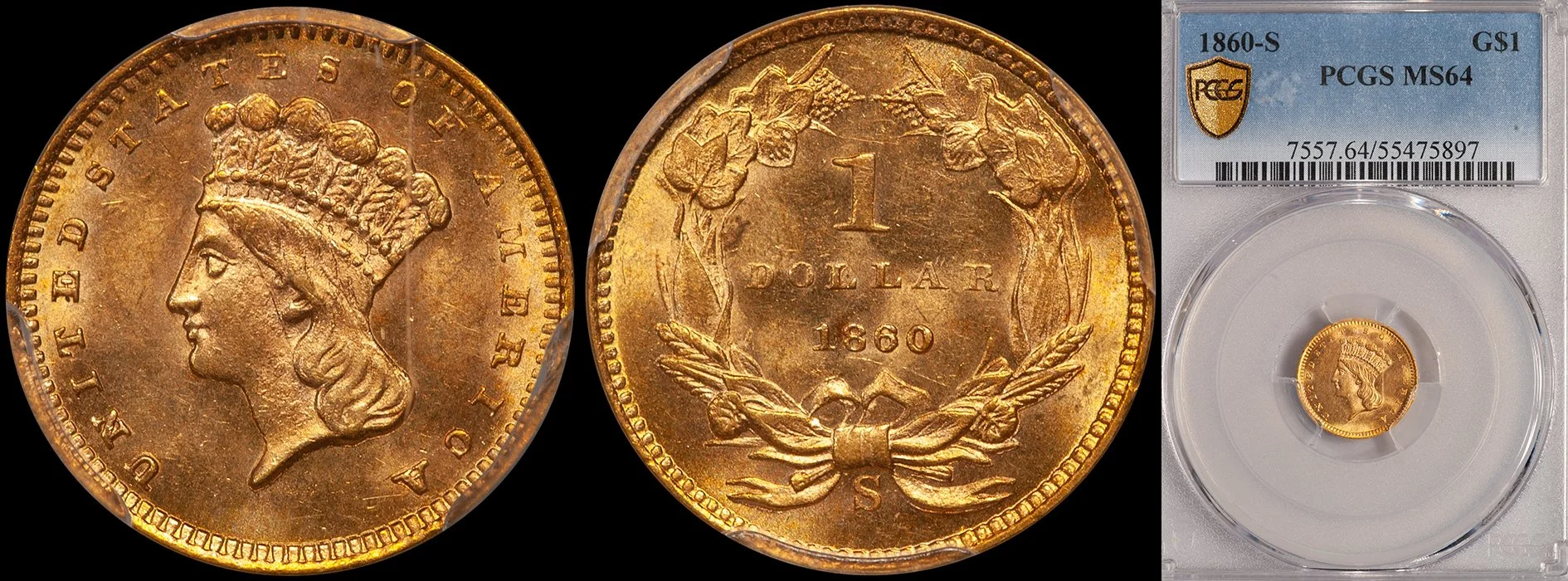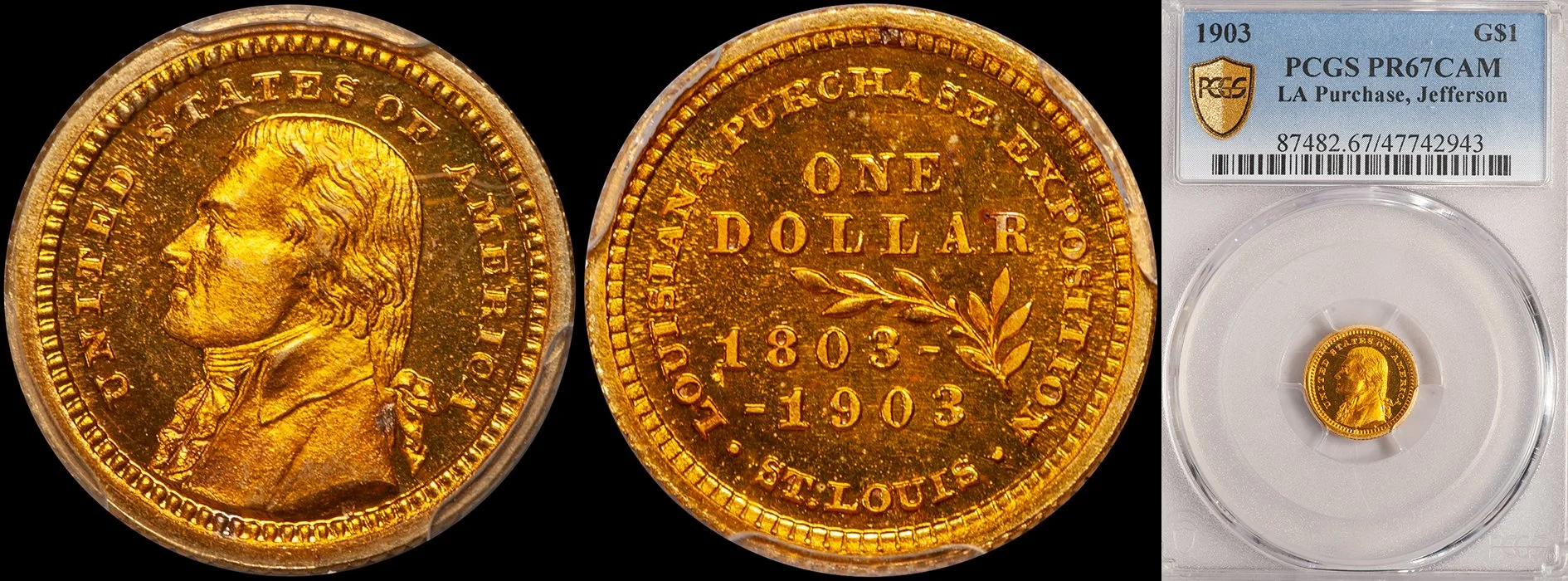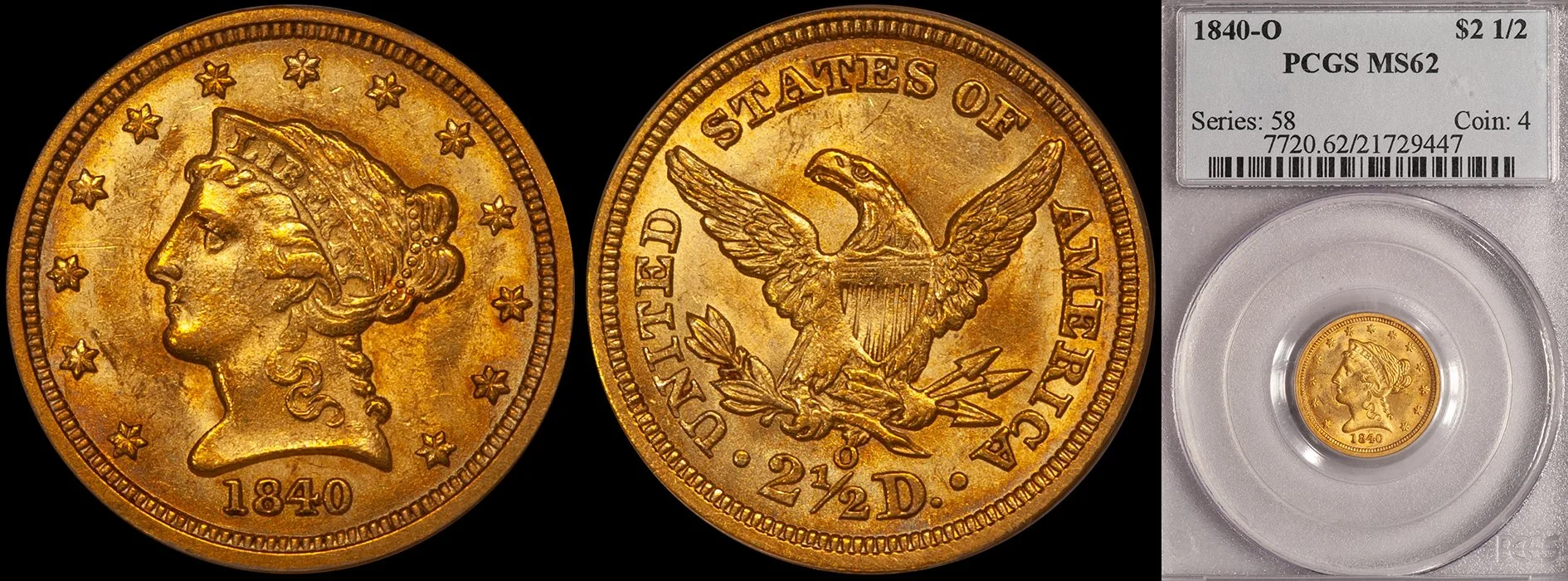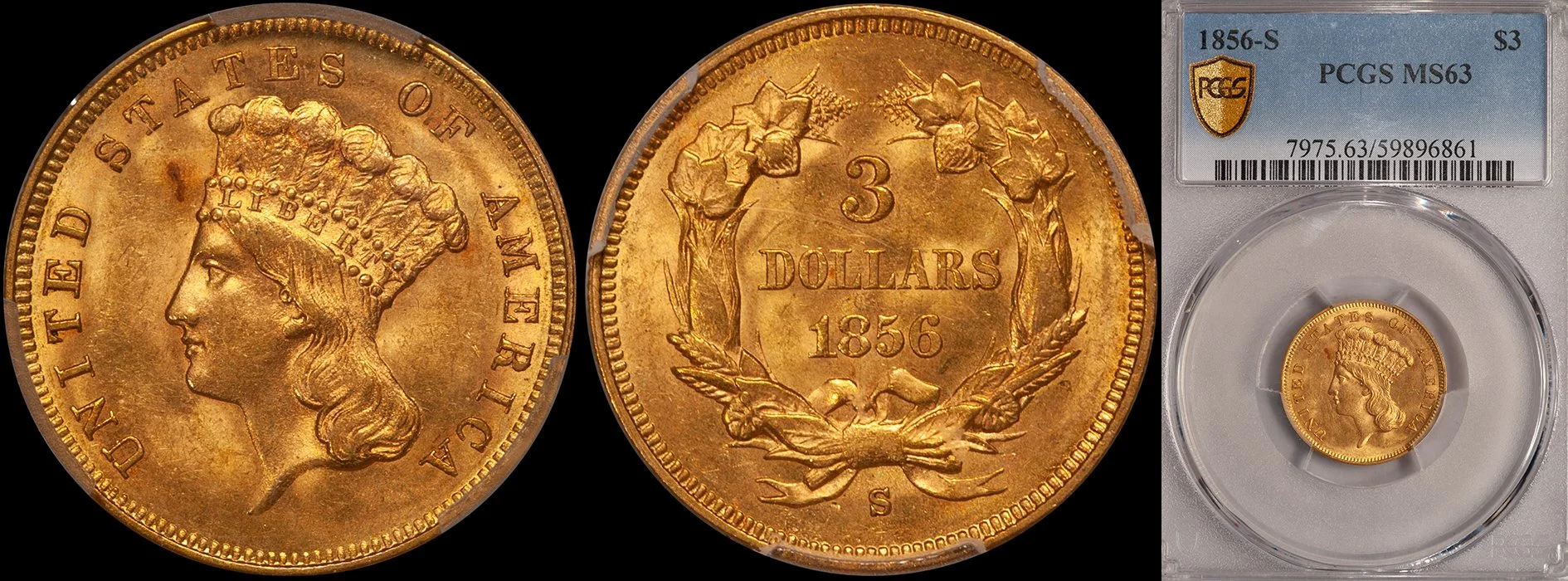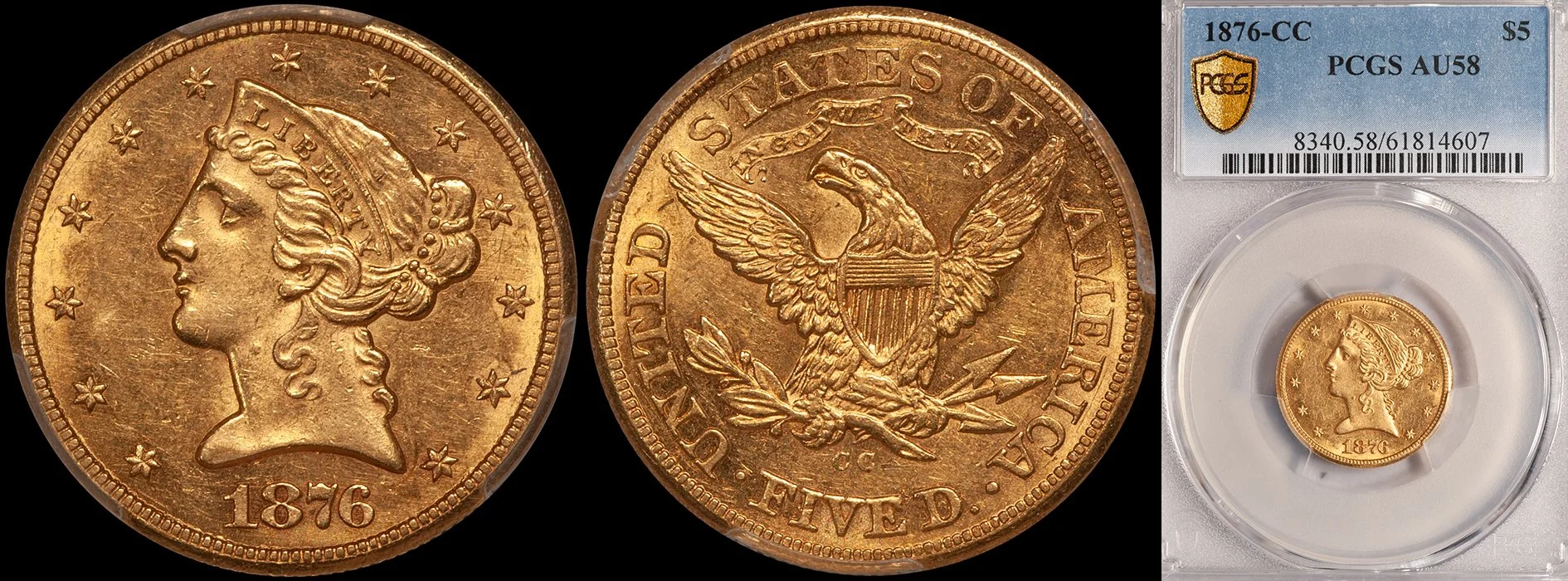
Proof Gold: An Overview Part Two Half Eagles--Double Eagles

The first Proof gold coins were produced in the early 1820's. Mintages remained extremely limited until the late 1850's and, in most instances, never climbed above more than a few hundred pieces. While out of the price range of most numismatists, Proof gold makes a very interesting area to collect. For all but a handful of individuals, collecting Proof gold by date is not realistic. A collector on a more limited budget might consider assembling a type set of Proof gold. This article contains suggestions on how to accomplish this, as well as an overview of the various types of proof gold issues.

The final of two parts, this article focuses on proof half eagles, eagles, and double eagles.

HALF EAGLES

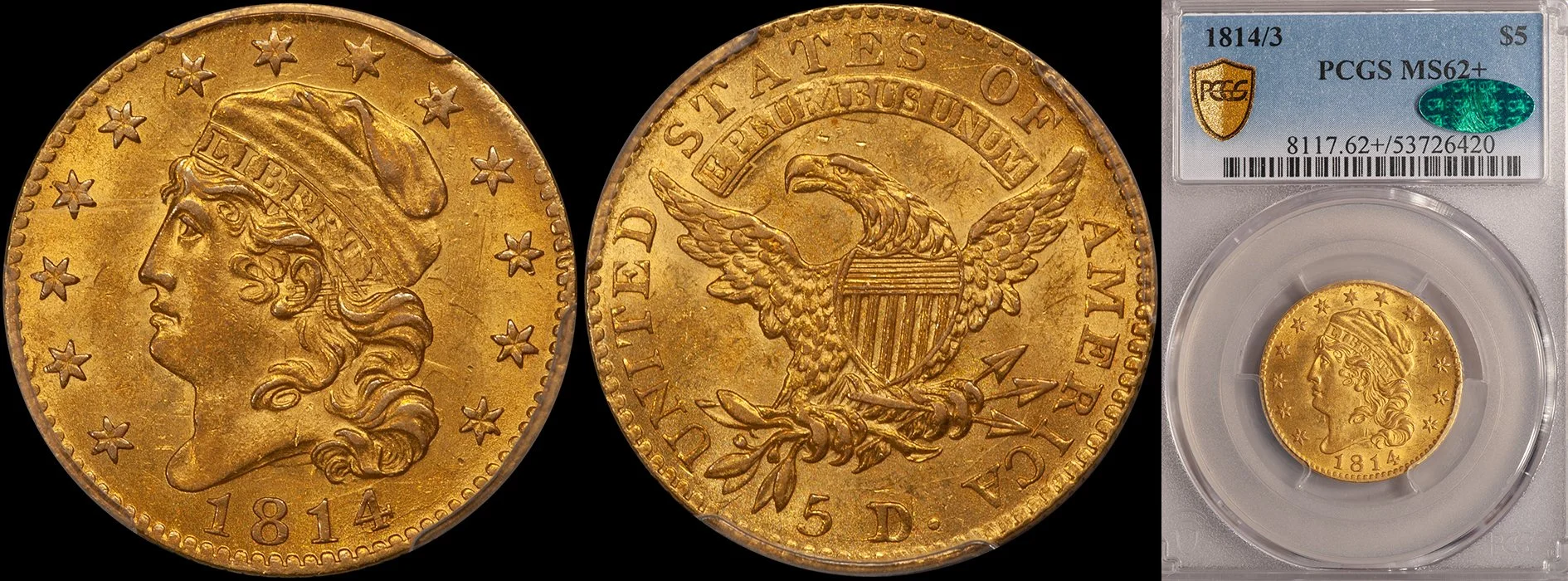
a. Capped Head Left (Large and Small Diameter), 1813-1834

A very small number of Proof half eagles were struck in the 1820's and the 1830's. These pieces are easily identifiable as Proofs as they show exceptional detail and deep, fully reflective fields. In most instances, just a few are known for each date and they are very infrequently offered for sale. Two good places to view comparatively large numbers of Proof early half eagles are the Lilly Collection (in the Smithsonian) and the Bass Collection (currently on view at the ANA Museum in Colorado Springs).

If available, a "real" Proof half eagle of this type will cost at least $200,000-300,000 and a gem could easily sell for double this amount.

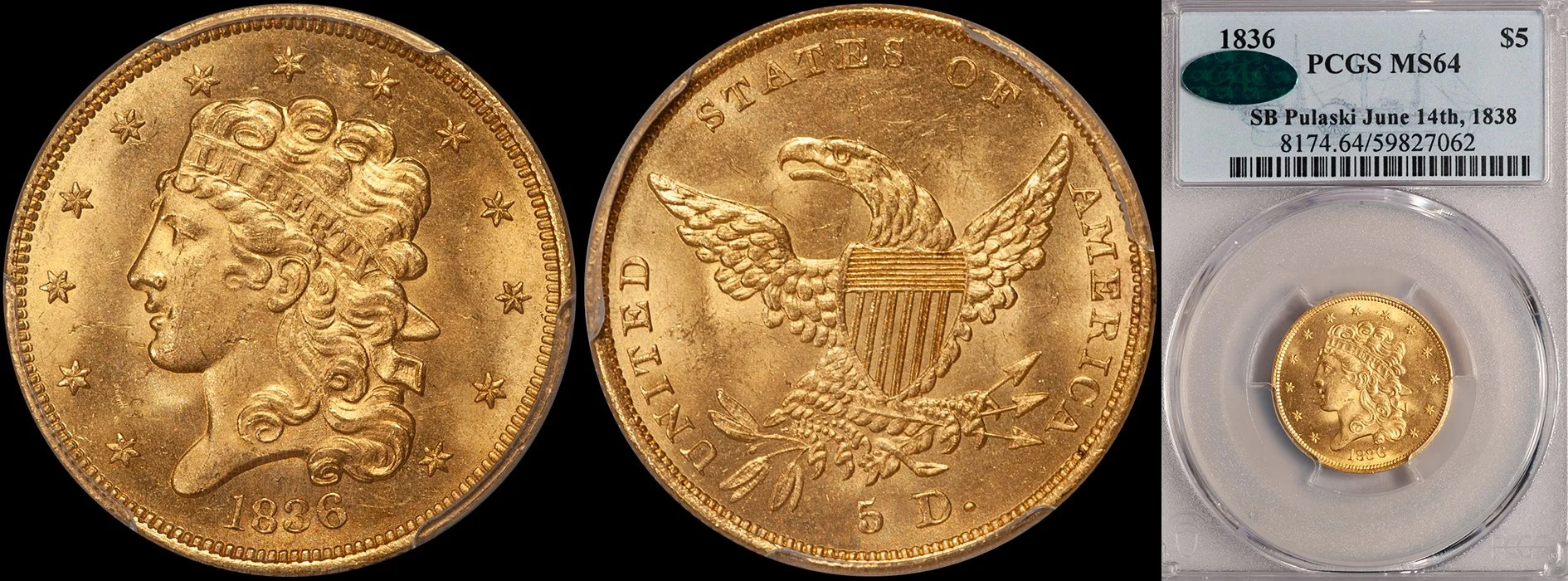
b. Classic Head, 1834-1838

Mintage figures for Proof Classic Head half eagles are also extremely small. There are approximately eight to ten Proof 1834 half eagles known. Some fully prooflike business strikes are seen from time to time and these are often offered as "Proofs." There are three or four 1835 and 1836 Proofs known while the 1837 and the 1838 appear to be unique. The most extensive offering of Proof Classic Head half eagles in recent years was in the Pittman auctions held in 1997-98.

In today's market, a high quality certified Proof Classic Head half eagle is worth $200,000+.

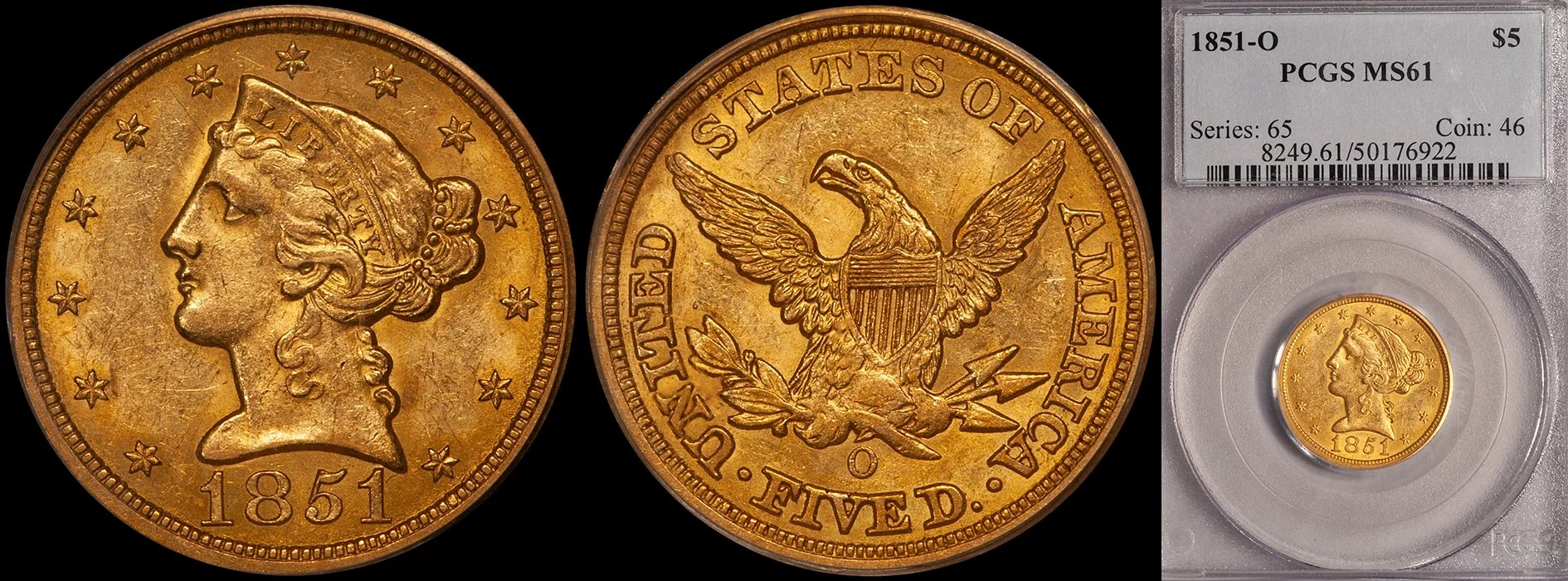
c. Liberty Head No Motto, 1839-1866

Proof Liberty Head half eagles struck prior to 1859 are extremely rare. Many dates are unknown in Proof and others (such as 1843 and 1845) are represented by no more than three or four examples.

The No Motto issues from 1859 to 1865 are all very rare in Proof format. The issues struck from 1859 to 1863 have an exceptionally low survival rate and most have between six and nine known. The 1864 and the 1865 are slightly more available but are still very rare.

A Proof-64 No Motto half eagle (dated 1864 or 1865) is worth $30,000-40,000 while a Proof-65 is worth $60,000-70,000. Proofs of this type are generally only available when major collections such as Bass or Pittman are offered.

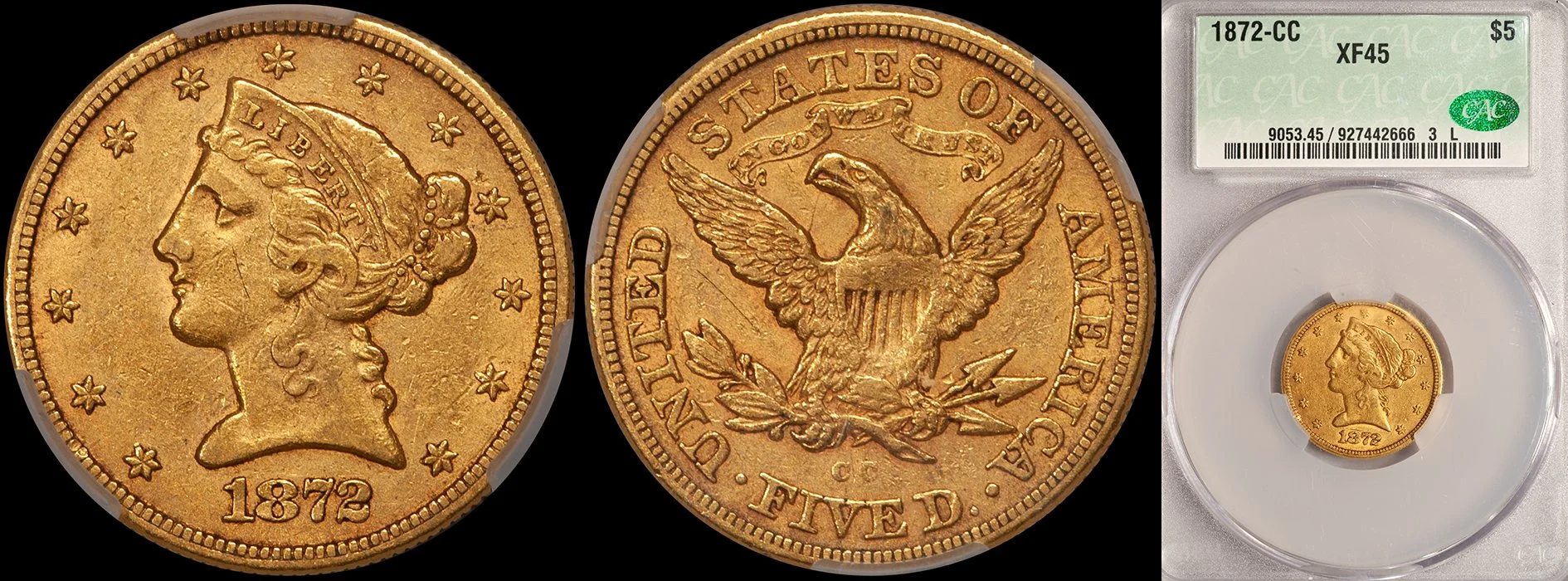
d. Liberty Head With Motto, 1866-1907

Mintage figures for Proof half eagles struck from 1866 to 1881 ranged from 20 to 50 coins. For most of these, the survival rate is around half of the original number struck. The two rarest dates of this era are the 1870 and the 1871, of which five to seven Proofs are known. The most famous (and highest priced) With Motto proof half eagle is the 1875. It is a major rarity in any grade as only two hundred business strikes were produced.

The 1882-1895 proofs are slightly more available than their earlier counterparts. Mintage figures ranged from a low of 48 in 1882 and 1894 to a high of 95 in 1888. The 1896-1907 issues are the most available Proof Liberty Head eagles of this type. They are not hard to locate in Proof-64 and Proof-65 grades, although many have been dipped and now display a somewhat unnatural bright appearance. Any coin that grades Proof-66 or better is, regardless of date, very rare.

The collector who wants to purchase a single Proof for a type set should look for a coin that has nice cameo contrast between the frosted devices and the mirror-like fields. A piece that has medium to deep natural "haze" is preferable to a dipped, bright piece. There have been a number of auctions with nice Proof eagles in the last few years and a coin with a pedigree from one of these name sales would be a good addition to a type set.

As of December 2001, a Proof-64 With Motto Liberty Head half eagle has a value of $13,500-17,500. A Proof-65 is valued at $25,000-30,000.

e. Indian Head, 1908-1915

In 1908, the U.S. Mint switched from the brilliant format to a matte finish. The natural appearance of Matte Proof gold coins is slightly dull with granular surfaces that appear sandblasted.

Proof Indian Head half eagles were struck from 1908 to 1915 in a variety of textures and colors. Those most often seen have either a deep green-gold or rich yellow to orange-gold hue. The Proofs struck in 1908 and 1910-1915 tend to have a coarse sandblast finish while those made in 1909 and 1910 have a finer finish referred to as "Roman Gold."

It is hard to grade Matte Proof gold, due to the fact that its dark coloration and grainy texture tends to mask surface imperfections. It is highly advisable to only purchase PCGS or NGC graded pieces from a highly reputable specialist.

As of December 2001, a Proof-64 Indian Head half eagle is valued at $12,500-15,000 while a Proof-65 is worth $23,500-28,500.

II. EAGLES

a. Pre-1834 Types

There are no Proof eagles dated 1795-1804 that were actually struck in the year they were dated. There are four Proof 1804 eagles known but these are restrikes that were produced in 1834-35 for inclusion in presentation proof sets that were given to dignitaries. These are the same sets that contained the famous Class I 1804 silver dollars.

b. Liberty Head No Motto 1838-1866

All Liberty Head eagles from 1838 to 1859 are extremely rare in Proof and many of these dates are unknown in Proof. The dates from 1860 to 1865 are very rare but are actually seen with slightly greater frequency than the Proof half eagles of this era. Mintage figures range from 25 pieces in 1865 to 69 in 1861. In most cases, only a small percentage of Proofs have survived and most of these are in the Proof-62 to Proof-64 grade range. The population figures at PCGS and NGC for these dates are greatly swelled by resubmissions. There is a large difference in value between Proof-64 and Proof-65 and this means that many high end Proof-64 pieces will get submitted many times in an attempt to "upgrade" to Proof-65.

A Proof-63 of this type, if available, will cost in the range of $30,000-40,000 while a Proof-64 is valued at $45,000-55,000.

c. Liberty Head With Motto, 1866-1907

With Motto Liberty Head eagles struck between 1866 and 1890 are very rare. Most have original mintage figures in the range of 25 to 50 pieces and survival rates in the area of 25 to 50%. The rarest Proofs of this era include the 1867, 1870, 1874, 1875, and 1877. The 1875 is the most famous and valuable of these dates due to the fact that only 100 business strikes were produced.

The issues from 1890 to 1907 have slightly higher mintage figures and are somewhat less rare. Most of the survivors are in the Proof-62 to Proof-64 range and properly graded gem proofs are very rare.

Proof eagles of this type tend to be well-manufactured. Many show attractive cameo contrast between the devices and the fields. It is not uncommon for a Proof Liberty Head eagle to have small mint-made lintmarks or planchet depressions in the surfaces. These are not considered detriments unless they are extensive or situated in prime focal points.

As of December 2001, A Proof-64 Liberty Head with motto eagle is valued at $17,500-22,500 while a Proof-65 is worth $32,500-37,500. In my opinion, these are very reasonable price levels, especially for coins that are original and have good eye appeal.

d. Indian Head, 1908-1915

The comments made above for Indian Head half eagle apply to the Proof eagles of this design.

Mintage figures for Proofs of this design range from a low of 50 in 1914 to a high of 204 in 1910. The survival rate for this design is slightly higher than for Proofs produced in the 19th century. Most dates have slightly more than half the original mintage figure extent, with most of these pieces in the Proof-63 to Proof-64 range. There are a small number of really superb pieces known in the Proof-66 to Proof-67 range but these are seldom offered for sale.

When looking for a Proof Indian Head eagle for a type set, there are a few factors a collector should keep in mind. It is very important to seek a choice, original coin that has not been "doctored." Always purchase a coin that has been graded by PCGS or NGC and learn what the appropriate color and texture for each date should be BEFORE you make a five-figure purchase.

As of December 2001, a Proof-64 Indian Head eagle is worth $19,000-25,000 while a Proof-65 is worth $35,000-40,000.

III. DOUBLE EAGLES

a) Liberty Head Type One, 1850-1866

The first of three of Liberty Head double eagle types, this is recognizable by the lack of the motto IN GOD WE TRUST on the reverse.

Proofs from the 1850's are excessively rare and for most dates do not exist. The 1860-1865 issues are all very rare with original mintage figures ranging from a low of 25 in 1865 to a high of 66 in 1861. Most were melted or spent, leaving most dates with a surviving population of five to seven coins. The few that exist are generally seen in Proof-62 to Proof-64 grades. Gem Proof Type One Liberty Head double eagles are excessively rare.

For a type set, the two dates that the collector is most likely to see offered for sale are the 1864 and the 1865. A Proof-64 example is currently worth in the range of $70,000-80,000.

b. Liberty Head Type Two, 1866-1876

In 1866, the motto was added to the reverse of the double eagle. This short-lived type is very popular with collectors. Proofs all have very low mintage figures, ranging from just 20 in 1875 to 50 in 1867. All Proofs of this type are very rare. Most dates have between six and nine known with the typical examples grading Proof-62 to Proof-64.

In the past decade, a relatively high number of Proofs of this type have been available to collectors. This is due to the dispersal of such great proof gold collections as Bass, Pittman and Trompeter. Many of these coins have now been absorbed into tightly-held private collections.

The current market value of a Proof Type Two double eagles is $30,000-40,000 in Proof-63 and $50,000-60,000+ in Proof-64. Gem Proofs are extremely rare and, if available, would sell for over $100,000.

c. Liberty Head Type Three, 1877-1907

The third and final type of Liberty Head double eagle was created in 1877, when the value was changed from TWENTY D. to TWENTY DOLLARS.

The 1883, 1884 and 1886 issues were only produced as Proofs. Even though they have higher mintage figures than the other Proofs of this era, they are more valuable. The rarest of this trio is the 1884 which is represented by a scant 12 to 15 examples known.

The Proofs from the 1890-1907 era are the most obtainable double eagles of this type. Their mintage figures range from a low of 52 in 1891 to a high of 158 in 1903. The rarest date of this era is the 1893 while the most common (and best for type purposes) are the 1900, 1903 and 1904. It is possible to locate a nice Proof-63 or Proof-64 example of this type but any piece graded Proof-65 or better is very rare.

The issues struck prior to 1900 tend to have more of a cameo contrast than the post-1900 coins. This contrast gives many of these coins superb eye appeal. Both PCGS and NGC currently award such coins either a cameo or deep cameo designation. I would suggest that the collector not pay a large premium for coins with these designations as it is still too early to tell which dates are rare with cameo contrast and which are not.

A Proof-64 Type Three Liberty Head double eagle is currently worth $27,500-32,500 while a Proof-65 is worth $50,000-60,000.

d. St. Gaudens, 1908-1915

A total of 687 Proof St. Gaudens double eagles were struck between 1908 and 1915. Mintage figures ranged from a low of 50 in 1915 to a high of 167 in 1910. There are approximately 200-250 total examples known of these eight issues. The rarest are the 1909 and the 1915 while the most available are the 1908 and the 1910.

When available, these issues are most often found in Proof-64 and Proof-65 grades. Superb pieces that grade Proof-66 (and even Proof-67) are sometimes available but are quite rare.

Proof St. Gaudens double eagles are currently somewhat out-of-favor with collectors are appear to be very good values in higher grades.

A Proof-64 St. Gaudens double eagle is valued at $25,000-30,000 while a Proof-65 is valued at $40,000-45,000.

SUMMARY

For most collectors, a type set of Proof gold is the most practical way to focus on these issues. Suggested types and grade ranges for half eagles, eagles, and double eagles are as follows:

Liberty Head With Motto Half Eagle, Proof-64 to Proof-65

Indian Head Half Eagle, Proof-64 to Proof-65

Liberty Head With Motto Eagle, Proof-64 to Proof-65

Indian Head Eagle, Proof-64 to Proof-65

Liberty Head Double Eagle Type Three, Proof-64 to Proof-65

St. Gaudens Double Eagle, Proof-64 to Proof-65
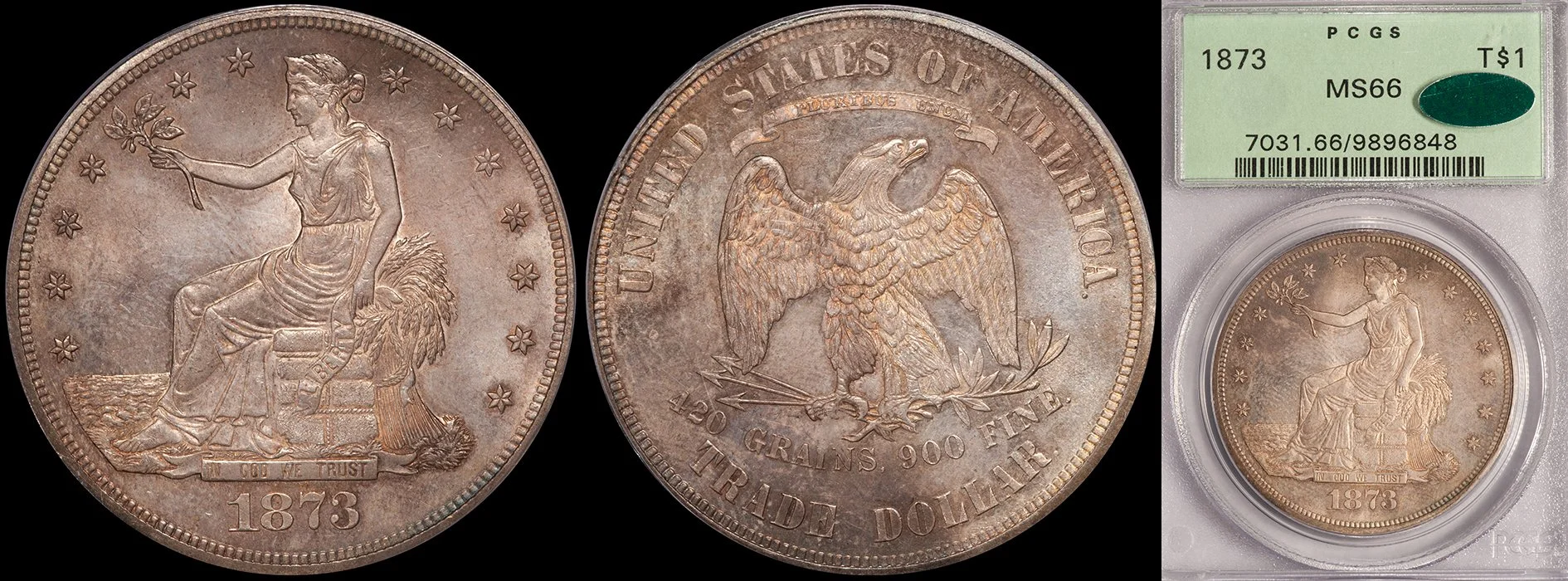
Coloration and United States Gold Coins

In my article entitled "Five Components of Grading" (November 2001), I touched upon coloration and the role it plays in determining the grade of a gold coin. In this brief article, we'll look at the natural coloration found on gold coins from each of the seven mints that produced gold issues in the 18th and 19th century. Carson City

Carson City gold coins can be neatly packaged into three distinct eras: those struck during the 1870's, the 1880's and the 1890's. Some of the gold used to make these coins was from local Nevada mines and it displays a distinctive natural hue.

The coins from the 1870's are usually seen with extremely heavy wear. Half eagles and eagles from this decade often have a dark green-gold or slightly coppery hue. The coins from the 1880's tend to have richer green-gold or orange-gold color. The coins from the 1890's often have very nice shadings with rich green-gold or orange-gold hues. On a few issues, the borders may show a ring of deeper color that nicely contrasts the lighter shades seen in the center.

It is much easier to find coins from the 1890's with pleasing original color than on issues from the other two decades. Many half eagles and eagles from the 1870's are essentially unknown with fully original color. Issues such as the 1891-CC half eagle and the 1891-CC eagle are relatively easy to find with nice color.

Double eagles tend to be the easiest denomination from this mint to locate with good color. This is primarily due to the fact that more relatively high grade examples of this denomination are known than half eagles or eagles.

Due to the popularity of Carson City gold coinage with collectors, good coloration is an important consideration in determining grade and value.

Charlotte

Much of the gold used at the Charlotte mint was mined in western North Carolina. The natural composition of this gold was rich in copper ore. Thus, many Charlotte gold coins (especially those struck before 1850) have a distinctive orange-gold or reddish-gold coloration. On later issues, this color tends to be a more green-gold in hue. This is due to the fact that more gold from California (with a higher silver content) was used.

For some reason, the Charlotte coins with the best coloration are the Type One gold dollars (1849-1853) and the half eagles produced during the early part of the 1840's. It is very hard to locate any of the quarter eagles from the 1850's with attractive, even coloration.

Well over 75% of all Charlotte gold coins have been cleaned or dipped and no longer show any hint of original color. Charlotte gold coins with attractive original color are beginning to command a premium, although not as much so as their counterparts from Dahlonega.

Dahlonega

The gold that was used to make Dahlonega gold coins from 1838 until the early 1850's had a high amount of silver within its natural composition. This provided many of the coins from this era with a distinctive green-gold hue. On issues struck after 1850, more gold from the western deposits was employed and the color tends to show more of a reddish-gold hue.

As with the Charlotte gold coins, Type One Dahlonega gold dollars (1849-1854) and certain half eagles from the 1840's (and even into the 1850's) are more likely to be seen with good color than the other issues from this mint. With a few exceptions (such as the 1857-D), quarter eagles from this mint are very hard to locate with nice color. The same holds true for Type Two Dahlonega gold dollars and three dollar gold pieces. As a rule of thumb, the rarer and more popular a certain date is from this mint, the more likely it is to be found without original color.

Well over 75% of all Dahlonega coins have been cleaned or dipped and no longer show original color. This is a very popular series with collectors and their level of sophistication tends to be higher than other branch mint specialists. Dahlonega coins with pleasing natural color currently command high premiums; more so than from any other branch mint.

Denver

The Denver mint produced gold coins from 1906 to 1931, with the majority of the production occurring in the 1910's and the 1920's. They struck half eagles, eagles and double eagles. For the most part, these coins have a fairly consistent natural coloration. Medium to deep yellow gold shadings with pale rose and orange-gold undertones are most often seen on high grade, original pieces.

The Denver issues that tend to show especially nice color include the 1906-D and 1907-D Liberty Head double eagles and the St. Gaudens double eagles from the 1920's. The half eagles and eagles from the 1910's often have a naturally grainy type of luster and their coloration is slightly more subdued.

It is still reasonably easy to locate Denver gold coins with attractive natural color. There are some exceptions, like the 1911-D eagle, which is an issue that is often found cleaned or dipped. At this point, very few people specialize in Denver gold, so there are no real premiums accorded to coins with superb original color.

New Orleans

Unlike its southern counterparts from Charlotte and Dahlonega, this mint had a very long period of operation (1838-1909). New Orleans coins from fall into two neat categories: Without Motto (struck at this mint from 1840-1861) and With Motto (1879-1904).

Without Motto coins are usually seen well worn and have often been cleaned. Coins with original color often have a distinctive deep green-gold hue. Some issues, such as the 1847-O eagle, are found with bright yellow-gold color while others, such as the 1854-O eagle, have a more orange-gold appearance.

With Motto coins from New Orleans are found with less wear than their Without Motto counterparts. Eagles from the 1892-1904 era are sometimes seen with attractive deep natural color, including medium orange-gold and deeper green-gold.

It is very hard to locate New Orleans gold coins with original attractive, especially those struck prior to 1890. When available, these coins tend to bring premiums among knowledgeable collectors.

Philadelphia

Due to better quality control and more consistent bullion sources, there is less variation seen in the coloration of Philadelphia gold coins than on the branch mint issues.

All early gold coinage (i.e., those issues made before 1834) were struck exclusively at this mint. Early gold is very hard to find with original color as the majority of pieces have been cleaned or dipped. Coins that are original tend to show medium to deep orange-gold hues. They often trade for strong premiums among specialists and type collectors.

Liberty Head issues from Philadelphia are divided into Without Motto (1838-1865) and With Motto (1866-1907) types. The Without Motto coins are more difficult to locate with original color. When available they tend to show green-gold or light orange hues.

Due to larger mintage figures and hoarding, many With Motto issues from this mint are relatively available in higher grades. There are some extremely attractive Philadelphia gold coins from this era and they show hues ranging from green-gold to rose and light orange.

Collectors tend to be more focused on specific rarities or types from this mint as opposed to putting together date sets. On certain rare, low mintage issues such as the 1881 quarter eagle or the 1863 eagle, coloration is important. On other more common issues, coloration is not as significant factor in determining grade and value.

San Francisco

Despite the publicity of the S.S. Central America and Brother Jonathan shipwrecks, both of which contained thousands of San Francisco double eagles, gold coins from this mint are not as popular as those from the southern mints. This is somewhat ironic, given the fact that the quality of the coins from San Francisco far exceeds those from Charlotte, New Orleans, or Dahlonega.

San Francisco gold coins from the 1850's and the 1860's (with the exception of certain double eagles) are usually seen in lower grades and have often been cleaned. The issues from the late 1870's though the early 1900's are seen more often in higher grades. The natural color on these coins is often outstanding. Hues of rose-gold, green-gold and medium orange are often present.

Indian Head gold from this mint also displays a wide range of color. Half eagles and eagles from San Francisco tend to have granular luster which subsequently shows somewhat subdued color. St. Gaudens double eagles, especially those struck in the 1920's, often have rich frosty luster and attractive vibrant rose and orange-gold hues.

Due to a relative lack of collector support, there is not currently a strong demand for San Francisco gold coins with attractive natural hues. Many of the earlier issues from this mint are exceptionally hard to find with nice color and may command a premium in the future.

The Five Components of Coin Grading

A "grade" is a shorthand devised by numismatists to indicate the appearance of a coin. In other words, if one collector tells another that he has an About Uncirculated-50 Charlotte half eagle, both collectors should have an expectation of what the coin should look like, even if one has never seen it, due to the implications of its grade. For many years, there were a relatively small number of adjectival grades. Grading became more "scientific" in the 1940's when the numerical grading scale was invented by Dr. William Sheldon. This scale, which ranged from 1 to 70, was originally devised to ascertain values of 1793-1814 Large Cents by ascribing a basal value to each variety and multiplying this value by the grade in order to determine a price.

The Sheldon grading scale is now used by most numismatists. Newcomers tend to complain that there are "too many grades" but experienced graders appreciate that there can be a huge range in quality between specific ranges.

To better understand coin grading, it is important to study the major components of grade. When I grade a coin, I employ five important individual components which, when taken into consideration as a whole, help me determine my opinion of a coin's grade. These individual components are strike, surface preservation, luster, coloration and eye appeal.

Strike: The strike of a coin refers to the process of stamping a design onto a planchet or a blank. A coin can have either a strong or a weak strike. Much of this depends on a coin's design. As an example, certain designs (such as the Type II gold dollar) have the highest relief element on the obverse directly aligned with the highest relief element on the reverse. This means that weakly struck coins are the rule for these designs. Other designs (such as the Indian Head quarter eagle) may be found with sharp strikes on certain issues and weak strikes on others.

Generally speaking, strike is not a major element in determining the grade of a coin unless it is in a series in which value is related to strike. In a series such as Mercury Dimes, where a PCGS MS-66 1945 dime is worth $15 and the same coin with a full strike (designated in this series as "Full Bands") is worth $7,500, strike is a huge element. In all but a handful of circumstances, strike does not play a critical role in determining the value or United States gold coins.

Surface Preservation: The number of marks on a coin and their placement are important factors in determining grade. There is no set formula that says "X" number of marks on a coin's surface means that it grades "Y." But there are some fairly normalized standards in terms of the importance of an abrasion's location.

If a very nice coin has a deep mark that it is well-hidden on the reverse, it tends not to be severely penalized. But if the exact same mark was located in a prominent focal point on the obverse (the cheek on a Liberty Head double eagle, as an example) it would be penalized considerably more.

Coins that have a very open, uncluttered design tend to show marks more obviously than those with tight, compact designs. For this reason, the intensity of the marks on a Liberty double eagle play a greater role in determining grade than on a Type Three gold dollar.

Certain types of coins are known for showing greater concentrations of marks than others. As an example, the quarter eagles struck from 1821 to 1834 did not see ready circulation. They tend to have reasonably clean surfaces. Indian Head quarter eagles, on the other hand, saw a greater degree of circulation. It is much harder to find examples that do not have the marks, scratches and scuffmarks associated with circulation and/or poor handling.

On United States gold coins, surface preservation is very important in determining grade.

Luster: Depending on the design, mint of origin and the metal used a coin may have a variety of surface textures. These include satiny, frosty, semi-prooflike and prooflike. When analyzing the surface of a coin in regards to grade, there are two things to look for: the amount of the original surface (or "skin") that is intact and the amount (and location) of marks.

There is really not one type of surface that is "better" than another. In certain series, such as Morgan dollars, premiums are paid for pieces with mirror-like surfaces. In most other series, prooflike coins may be regarded as interesting but not necessarily worth a premium.

On 19th century United States gold coins, I am most fond of a frosty texture. This texture can be found on issues from all mints but it is most closely associated with Philadelphia and San Francisco.

Luster is especially important in determining if a coin is Uncirculated or not. A Mint State coin is, technically, free of wear and should not have major breaks in the luster. However, this is often not the case for coins graded Mint State-60 and Mint State-61. These coins will typically show breaks in the luster; perhaps as a result of a light cleaning or "rub" that occurs from improper storage in an album. A coin that is not Uncirculated will show a greater amount of breaks in the luster and, obviously, a smaller amount of luster.

Luster is another very important component in determining the grade of a United States gold coin.

Coloration: Color is the most subjective factor in determining grade. A coin is either well struck or it's not well struck; this is not open to debate. But a gold coin that shows deep green-gold color may be attractive to one viewer and unattractive to another. In my opinion, attractive original coloration greatly enhances the appearance of a coin.

Gold is a relatively inert metal and not subject to as much variance in coloration as silver or copper. However, a wide range of colors may be present on gold coins.

Coins from the Charlotte and Dahlonega mints have very distinctive coloration as a result of the amount of silver or copper that was part of the gold found in these sources. Philadelphia and San Francisco pieces have much different coloration.

The majority of United States gold coins have been cleaned or dipped at one time. As a result, they no longer display original coloration. As collectors become more savvy, they are often attracted to coins with pleasing natural color. In many series, it is almost impossible to find original pieces. In the near future, it is likely that totally original pieces will be accorded a strong premium over "typical" examples.

Color is not as important a factor in determining the grade of a gold coin as it is on a silver or copper coin.

Eye Appeal: The four individual components listed above, when combined, form an all-encompassing component that is called "eye appeal." This is a fairly self-explanatory term. A coin that has good eye appeal may be very strong in one area (excellent luster, for example) and good in another (nice but not great color). If a coin is negative in one area (very heavy marks, for example) but acceptable in all others, it is still likely to be noted as having below-average eye appeal.

The concept of eye appeal seems subjective but it is really not. Most sophisticated coin buyers will agree that a certain coin has good or bad eye appeal. But it does require a certain level of knowledge to make this determination.

There are some specific dates or types that almost always come with poor eye appeal and a coin that is somewhat attractive may be considered to have good eye appeal "for the date." As an example, all known 1870-CC double eagles have heavily abraded surfaces. A coin that has typical marks but none located in very prime focal points may be looked at as having good eye appeal for the issue. But if this were any other date, the exact same coin might be regarded as having poor eye appeal. It takes in-depth knowledge of a specific series to make this determination.

Grading is an important subject and this article could easily have been two or three times longer. If you have any questions regarding the five components of coin grading, please feel free to email me at dwn@ont.com and I will do my best to answer them.

Proof Gold: An Overview Part One Gold Dollars--Three Dollar Gold Pieces

The first Proof gold coins were produced in the early 1820's. Mintages remained extremely limited until the late 1850's and, in most instances, never climbed above more than a few hundred pieces. While out of the price range of most numismatists, Proof gold makes a very interesting area to collect. For all but a handful of individuals, collecting Proof gold by date is not realistic. A collector on a more limited budget might consider assembling a type set of Proof gold. This article contains suggestions on how to accomplish this, as well as an overview of the various types of proof gold issues.

The first of two parts, this article focuses on proof gold dollars, quarter eagles and three dollar gold pieces.

GOLD DOLLARS

a. Type One, 1849-1854

Proof gold dollars of this type are so rare that their very existence is controversial. I have seen a few 1849 gold dollars that I felt were Proofs but cannot recall having seen other dates of this type in Proof. It is a safe assumption that most collectors will never see--let alone own--an example of this type in Proof.

b. Type Two, 1854-1856

An extremely limited number of proof gold dollars were made of the short-lived Type Two design. Interestingly, most of the pieces that exist are quite choice and a few superb gems exist. There are perhaps four to six Proof 1854 gold dollars known plus as many as ten 1855's. When available, these routinely sell for $100,000.

c. Type Three, 1856-1859

For most collectors, the Type Three is the only Proof gold dollar that they will own. The issues produced in the 1850's are all very rare although not extravagantly expensive in Proof-63 or even Proof-64 grades.

The issues from the 1860's and the 1870's were, for the most part, produced in very limited quantities. A typical date from one of these decades has around half of the original mintage figure surviving; usually in Proof-63 to Proof-65 grades. When available, a nice Proof-64 gold dollar from the 1860's or the 1870's costs $6,500-8,500. I think coins such as this are incredibly good values.

The most common proof gold dollars are those produced from 1882 until 1889. A Proof-65 is currently valued in the $7,500-8,500 range while a nice Proof-64 brings $4,500 to $5,500. To my way of thinking, I would spend the extra 50-75% and buy an early date.

II. QUARTER EAGLES

a. Pre-1834 Types

The earliest known Proof quarter eagles date from 1821. During the 1830's extremely limited numbers of Reduced Diameter Capped Bust Proofs were struck. Any pre-1834 quarter eagle is prohibitively expensive and most collectors will not include an example in their holdings.

b. Classic Head, 1834-1839

Proofs are known of all six years of this type with the exception of the 1838. Mintages for each issue appear to be in the range of three to ten coins. There have been some proof Classic Head quarter eagles offered in the Pittman and Bass sales but few others have come on the market for many years. If available, a Proof of this type will grade Proof-63 to Proof-65. A collector can expect to pay $75,000+ for an example.

c. Liberty Head, 1840-1907

Mintages for pre-Civil War era Liberty Head quarter eagles are extremely limited. All dates from the 1840's are extremely rare and, ironically, the most available is the most expensive: the famous Proof-only 1841.

No Proofs are known for any of the dates struck between 1849 and 1855 and the other dates from the 1850's are exceedingly rare as Proofs.

Issues from the 1860's and the 1870's were issued in very limited amounts. With the exception of the 1860 and the 1861, mintage figures ranged from a low of twenty pieces to a high of fifty. As with gold dollars, the survival rate for Proof quarter eagles of this era is generally in the area of 50%. Despite the obvious rarity of these coins, they are still affordable. A Proof-64 is currently worth $10,000-15,000 while a Proof-65 sells for $17,500 to $25,000 depending on the date.

The "common date" Proof Liberty Head quarter eagles begin in the early 1890's and last until the discontinuation of this design in 1907. These issues currently sell for $6,500 to $8,500 for a Proof-64 and $10,000 to $12,500 for a Proof-65.

d. Indian Head, 1908-1915

The Indian Head type has a matte or sandblast finish that is completely different from the brilliant finish seen on earlier issues. Mintage figures and survival rates for Proof Indian Head quarter eagles tend to be greater than on the earlier Liberty Head issues. The most readily available Indian Head issue is the 1908 while the rarest is the 1915. The 1910 is an interesting issue that is available in lower grades but exceedingly rare in Proof-65 or above. It is very important to purchase a Proof Indian Head quarter eagle from a reputable dealer as many pieces have surfaces which have been altered or enhanced. Current price levels for a "common" date are $9,000-11,000 for a Proof-64 and $13,500-16,000 for a Proof-65.

III. THREE DOLLAR GOLD PIECES

This denomination was produced from 1854 to 1889. The 1854 is technically, a one-year type coin as the word DOLLARS is considerably smaller than on other years. Most collectors do not differentiate between the two types and the Three Dollar gold piece is generally viewed as a single type with one coin serving as a representative in a gold type set.

Proof Three Dollar gold pieces from the 1850's are very rare and are usually offered for sale only when major "name" collections appear at auction.

Mintage figures for the issues from the 1860's and the 1870's closely parallel those seen on the quarter eagle proofs of this era. Most dates had original mintage figures between 25 and 50 coins. The survival rate for these is slightly higher than on comparable gold dollars and quarter eagles with 50-70% of the original mintage currently believed to exist. The "typical" date from the 1860-1879 era currently sells for $10,000-15,000 in Proof-63, $17,500-25,000 in Proof-64 and $30,000-40,000+ in Proof-65.

The 1875 and 1876 are especially desirable as they are Proof-only dates with no business strikes produced. The 1875 is a major rarity with sales records exceeding $100,000 for average quality examples. The 1876 is also rare but is not nearly as highly regarded as the 1875.

The Three Dollar gold proofs from the 1880's had higher mintage figures than their earlier counterparts and are much more available. Proof-63 examples are valued at $8,000-10,000, Proof-64 examples are valued at $11,000-14,000 and Proof-65 examples are valued at $20,000-25,000+.

SUMMARY

For most collectors, a type set of Proof gold is the most practical way to focus on these issues. Suggested types and grade ranges for gold dollars, quarter eagles, and three dollar gold pieces are as follows:

Type Three Gold Dollar, Proof-64 to Proof-65

Liberty Head Quarter Eagle, Proof-64 to Proof-65

Indian Head Quarter Eagle, Proof-64 to Proof-65

Three Dollar Gold Piece, Proof-64 to Proof-65

Five Beginner's Mistakes and How To Correct Them

Almost every new collector makes mistakes, no matter what hobby he participates in. After many years of working with collectors, there are a number of common errors that I often see. Assuming that a collector is truly interested in correcting them (some people continue to make these basic mistakes, believing that they are "too smart" to receive constructive criticism), most can be rectified with a combination of time, money, patience, and the desire to learn to collect the "right" way. Mistake #1: A new collector pays too much for coins.

"Paying too much" is a relative term. There is a big difference between paying 5-10% too much for very nice, genuinely desirable coins and paying 50% too much for poor quality, unpopular coins. In the first instance, the passing of time will overcome a slight overpayment as will the fact that truly nice coins always sell for a bit too much money. In the second instance, the collector needs to learn how much nice coins really sell for and where to buy them.

Determining the true market value for coins is not easy. Many collectors (and even some dealers) feel that Greysheet bid or Coin World Trends is the ultimate guide for coin pricing. These guides do not take a number of factors into consideration. As an example, nice quality early type coins generally sell for numbers well in excess of CDN "bid." Conversely, certain gold issues, like high-priced San Francisco half eagles, sell for large discounts relative to Trends.

Correction:

Learn what the true market value for coins is. This can be done by studying auction prices realized, looking at what dealers are offering to sell (and buy) coins for and what other collectors you know have paid for their coins. You should also learn which coins sell for levels over published price guides and which sell for levels under these prices.

Do not be afraid to stretch for truly rare and/or desirable coins. As an example, if you pay 20% over Greysheet bid for a truly choice early gold coin, the chances are good that this "stretch" will be repaid when you go to sell your collection.

Mistake #2: A new collector buys his coins second (or even third) hand.

Many (if not most) new collectors buy coins from brokers. In numismatics, a broker is defined as someone offering a coin for sale which is not from his inventory. There is nothing wrong with coin brokers. But often times buying coins from the dealer who owns them will save a collector from 10 to 30%.

Correction:

The solution for this problem is relatively easy. Buy coins from the people who actually own them. Ask your dealer if he owns the coin(s) he is offering you or if it is from other sources. As you become more involved in numismatics, you'll learn how to see if the dealer you ask this question to is telling you the truth. If, for example, he cannot accurately describe a coin, the chances are good that he has not seen it (and does not own it).

There are circumstances when it is acceptable to buy coins from a dealer who does not own them. A dealer may act as your agent at an auction and bid on coins that are not his. Or, a dealer might call you from a show to let you know he's found a piece on your want list that is from another dealer. In this case, there is nothing wrong in using the dealer as a broker, provided his markup is reasonable. In such a transaction, a dealer generally makes a small (5-10%) profit. Since he does not own the coin and will have no downside risk in sending it to you on approval, he does not merit as large a profit as if he owned the coin and had downside risk.

Mistake #3: A new collector decides he doesn't need a seasoned professional to help him.

Every week I speak with a new collector who tells me how he has spent thousands (or even tens of thousands) of dollars with no professional guidance. Unless he is remarkably lucky, the chances are good that such a person has lost at least 50 cents on the dollar.

Buying rare coins is not easy. If you do not have someone to help you pick the right coins at the right prices, you are likely to be taken advantage of. The solution is easy: choose a reputable, knowledgeable dealer and establish a good rapport with him.

Correction:

Other than the small handful of truly expert collectors who can compete with dealers, it is important to admit that you need sound professional guidance. Few collectors have the time or ability to become experts. It is not a sign of weakness to admit this.

How do you select the "right" dealer? The most important factors to consider are the dealer's professional qualifications and reputation. Choose someone who deals in the area you specialize in. Ask for the names of some of his satisfied customers and speak with them about the dealer. Once you have found the right dealer, reward him with your loyalty. Speaking as a dealer, I can tell you it is hard for me to be loyal to a client who has his want list out with six other dealers and who mostly wants to pick my brain for free information.

Another qualification that, in my opinion, demonstrates the character and level of professionalism that you should be looking for in a dealer includes membership in the Professional Numismatists Guild (PNG). The 300+ members are the PNG represent the upper echelon of coin dealers and I would suggest you stay away from any dealer who is not in this organization.

Mistake #4: A new collector buys unencapsulated coins or third-party graded coins from less-than-reputable services.

With very few exceptions, coins that have not been graded by PCGS or NGC are graded on a standard that is too liberal. Many new collectors do not learn about the pitfalls of buying non-PCGS or NGC coins until after they buy "inferior" third-party graded coins. Not all second-tier encapsulated coins are second rate. There are some that might only be a point off. In such a case, I would suggest that these coins be removed from their current holders and sent to NGC or PCGS.

Another mistake new collectors make is to buy expensive unencapsulated coins. At this point in time, the market for encapsulated coins is so pervasive that any item that is worth more than $500 but not in a PCGS or NGC holder must be viewed with suspicion. Coin World is full of ads offering seemingly remarkable values on "raw" coins. In my experience, nearly all of these are either overgraded or, even worse, cleaned, retoned or damaged.

Correction:

Again, the solution to this problem is relatively easy. Buy coins that have been graded by PCGS and/or NGC and avoid coins graded by other "second tier" services. Purchasing unencapsulated coins, whether through advertisements or auction sales, is best left to experts. If you see raw coins listed in auction catalogs that are of interest, have a reputable dealer view them for you. If this dealer likes the coin, hire him as your agent.

Mistake #5: A new collector does not take time to learn about coins and the coin market.

I have long believed that in numismatics, education is a collector's number one ally. It never ceases to amaze me how many collectors will spend tens of thousands of dollars on coins but not one cent on coin books. At this point in time, there is more good information available to collectors than at any other time in numismatic history. There are well-written guidebooks on almost every major series of American coin and there are dozens of excellent educational websites on the Internet that provide unbiased information. If you have already spent a considerable sum of money on coins but do not own any coin books, spend $500 on a basic library of general and specialized books.

Correction:

Buy a core group of coins books and, more importantly, read them. If you collect gold coins, you should buy my series of books on branch mint issues. If you collect other types of coins, there are many good books available and I would be happy to suggest them to you. For pricing information, I would suggest you refer to Coin World Trends Online (www.coinworld.com). For rarity information, the PCGS Online Population Report is an excellent source (www.collectorsuniverse.com). For excellent photos and information on all United States issues, try www.coinfacts.com.

All beginning collectors make mistakes. Some of these mistakes are costly, some are not. Hopefully, reading this article will make new collectors step back and analyze their numismatic behavior. If you are making one (or more) of these mistakes, do not despair. Instead, think what you can do to correct them and move forward.

Collecting Early U.S. Gold Coinage: Part Two

In the first part of this article, we looked at early quarter eagles and half eagles struck prior to 1813. The second and final part focuses on half eagles struck from 1813 to 1834 and eagles produced from 1795 to 1804. HALF EAGLES (continued from Part One)

A. Capped Head Left (Large Diameter), 1813-1829

The obverse of the half eagle was significantly redesigned in 1813 by John Reich. It featured a corpulent head of Liberty facing left with a liberty cap on her head. The reverse is similar to that seen on the Capped Bust left design of 1807-1812. In 1818, the obverse was slightly modified by Robert Scot. Very few collectors distinguish between the two varieties.

The Capped Head Left half eagles offer an excellent illustration as to why mintage figures are not always good indications of a coin's rarity. By the late 1820's/ early 1830's, the price of gold had risen to the point that the intrinsic value of a half eagle was greater than its face value. Consequently, vast numbers of these coins were melted. Certain issues, such as the 1819, 1825, 1827, 1828 and 1829 had nearly their entire mintages melted and are extremely rare today.

The only issues of this type that can be considered relatively common are the 1813, 1814/3, 1818 and 1820. A pleasing About Uncirculated example of one of these four issues can be purchased for between $3,500 and $5,500. Uncirculated pieces in the Mint State-60 to Mint State-62 range are valued in the high four figure range.

The great rarities of this type include the 1815, 1822, 1828/7 and 1829 Large Date. Each issue is typically offered for sale only when a great "name collection" comes on the market. The 1822 is regarded as one of the great United States rarities with just three known and only one of these not in a museum.

Buying Tips: The 1818 and the 1820 are good type coins as they tend to have better luster and coloration than their 1813 and 1814/3 counterparts. Considering the rarity of these issues, they are extremely good values and the collector should consider adding at least two examples to his collection. An interesting approach to this would be to obtain one issue from the 1810's and another from the 1820's. Always look for coins that have nice luster and color and no serious marks. While examples of this type are rare in an absolute sense, survivors tend to be attractive and relatively high grade. Avoid unencapsulated examples as many of these have rim problems or have been cleaned.

B. Capped Head Left (Reduced Diameter), 1829-1834

In 1829, the design of the half eagle was modified by William Kneass. The diameter was reduced from 25 millimeters to 23.8 while the letter, date and star sizes were made smaller as well.

The small size Capped Head Left half eagle type contains two extremely rare issues: the 1829 Small Date and the 1832 12 Stars. As with the larger diameter issues from the 1820's, the mintages figures of these coins are very misleading. As an example, 193,630 half eagles were reportedly produced in 1833. Today, there are probably fewer than fifty known.

The most likely candidates for a type set are the 1830 and the 1833 Large Date. Both of these are quite rare but are slightly more available than the other dates of this design.

When available, small size Capped Head Left half eagles tend to be in the About Uncirculated-50 to Mint State-63 range. This type did not readily circulate and the few that survived the melting pot tend to have been reasonably well-preserved. A lightly circulated example, if available, is likely to cost $10,000 to $15,000. A coin in the Mint State-61 to Mint State-62 range should cost $20,000 to $30,000. There are some very high quality examples occasionally offered for sale and they tend to be priced in the $50,000-$100,00 range.

Buying Tips: This type will prove very frustrating for the collector on a limited budget as very few lower grade pieces exist. I suggest saving up for a nice About Uncirculated (or better) example. As very few of these are available, do not hesitate if you have the chance to acquire the "right" coin, even if it is priced at a level that seems high compared to published pricing guides.

II. EAGLES

A. Capped Bust Right, Small Eagle, 1795-97

The eagle was the highest denomination coin struck by the United States until the double eagle was authorized in 1849. The ten dollar gold piece was never used as extensively in commerce as the half eagle. The eagle did not match other foreign gold coins in value as did the half eagle and its level of demand was not as a great. As a consequence, the mintage figures for early eagles tended to be comparatively low.

The first design for the eagle was by Robert Scot and it was identical to that on the half eagle. The Small Eagle reverse coins were produced in 1795, 1796 and 1797. The 1795 is the most obtainable of the three dates , especially in higher grades. The 1796 is rare and undervalued with most survivors grading Very Fine and Extremely Fine. The 1797 Small eagle reverse ten dollar gold piece is very rare with an estimated three dozen known.

This is an extremely popular type, for obvious reasons. These coins are among the oldest United States gold coins. Their large size and age make them very appealing, even to collectors who do not ordinarily care for gold coins.

Buying Tips: The 1795 is the most popular issue of this type but the 1796 is a much better value. It is considerably more scarce but only commands a 20% premium in most grades. However, the 1795's significance as a first-year-of-issue ensures its continued high level of demand. Many eagles of this type show extensive adjustment marks. These are mint-made filings on the surface that are the result of overweight coins having excess gold removed by hand. Unless the adjustment marks are extensive and/or situated in obvious places, they are not considered detracting.

Many Capped Bust Right small eagle ten dollar gold pieces have been cleaned. The collector is urged to be patient as this type has survived in sufficient quantity to expect a nice, original piece becoming available at some point.

An Extremely Fine 1795 eagle should be priced in the $15,000-18,000 range while About Uncirculated coins range from $25,000 to $35,000. Uncirculated examples start at $40,000 and run to over $150,000 for the finest available quality.

B. Capped Bust Right, Heraldic Eagle, 1797-1804

The next type of eagle has the same obverse as the last but a redesigned reverse based on the Great Seal of the United States. It was struck from 1797 to 1801 and again from 1803 to 1804. The eagle denomination was discontinued (along with the silver dollar) on December 31, 1804 and it would not be resumed until 1838.

The survival rate of Heraldic Eagle reverse ten dollar gold pieces is considerably greater than for the half eagles described above. This is excellent news for today's generation of collectors. Attractive circulated examples of dates such as 1799, 1801 and 1803 are not hard to locate and they fall within most collector's budgets.

The 1799 has always been a favorite date of mine. It is the most affordable 18th century eagle and it is generally found with a good quality of strike. The 1801 and the 1803 are of similar rarity and are also excellent type coins. But the magical 18th century date of the 1799 has always made it seem like a more interesting issue, in my opinion.

The rarest date of this type is the 1798/7. Two varieties are known. One has thirteen stars on the obverse with nine on the left and four on the right while the other has the stars arranged seven left by six right. There are approximately two dozen known of the former and fifteen to twenty of the latter.

The 1800 is a scarce and underrated date that sells for much less of a premium over the 1801 and the 1803 than it should. The 1804 is scarce in all grades and very rare in accurately graded Uncirculated. A total of four Proof 1804 eagles are known. These have a Plain 4 in the date (unlike the business strikes that show a Crosslet 4). They were struck in 1804 for inclusion in sets presented to dignitaries. One is included in the famous King of Siam proof set.

Buying Tips: This is an easy type to acquire and the collector should be careful and deliberate about a potential purchase. I would suggest looking for a coin that is well struck and original with minimal marks. Many eagles of this type have adjustment marks but it is easier to locate pieces without these marks than on the Small Eagle reverse type. A nice Extremely Fine common date (i.e. 1799, 1801 or 1803) is currently worth $5,000 while a About Uncirculated is worth $6,500-9,500 depending on quality. A piece in the lower Uncirculated grades sells for $10,000-20,000. This type becomes rare and quite expensive in Mint State-63 and higher grades.

A nice addition to a type set would be to purchase two examples of this type: a 1799 and either an 1801 or 1803 to illustrate the two decades in which Heraldic Eagle reverse ten dollar gold pieces were struck.

Collectible Varieties of Dahlonega Gold Coins

Your set of Dahlonega coins is complete or nearly complete. You aren't interested in upgrading what you own but you still want to actively participate in the Dahlonega market. What's a frustrated collector to do? Try collecting the major varieties of Dahlonega coinage. Chances are, you're already doing this, even if you don't realize it. As an example, your set of half eagles probably contains examples of the 1842-D Large Date and Small Date. And the chances are equally as good that you have the 1846-D Normal Mintmark and Repunched Mintmark half eagles.

There are some other significant varieties that should be included in a comprehensive set of Dahlonega coinage. A number are now recognized by PCGS, giving them further cachet among collectors. Here are some of the more interesting varieties, as well as some basic information about them.

1855-D Full Date Gold Dollar

Unlike the other coins listed in the body of this article, the 1855-D Full Date is not a die variety. It is, in fact, a variation in strike; similar to a Full Bands Mercury dime or a Full Bell Lines Franklin half dollar. The 1855-D gold dollar is notorious for its weakness of strike and around 90% of the known specimens are weak on the date. Those that show a full, sharp date (with all four digits clearly visible) are considered extremely desirable by collectors. In fact, sophisticated collectors are now willing to pay a premium as high as 50% for an 1855-D gold dollar with a full, sharp date.

While I am generally opposed to paying premiums for variation in strike, this is one case where I think an added premium makes great sense. In the future, I would not be surprised if the difference in price between typical strike and Full Date 1855-D gold dollars grows even further apart.

1839-D Bold Branch Quarter Eagle

There are two varieties known for the 1839-D quarter eagle. The more common (Winter 1-A) has a weak branch stem that extends to over the upright of the D in the denomination. The rarer has a bold branch stem that is located entirely to the left of the D in the denomination.

This variety is not as likely to be included in advanced collections as the other listed here. But the popularity of the Classic Head series gives it a greater chance than comparable Liberty Head quarter eagles varieties.

1843-D Large Mintmark Quarter Eagle

There are four die varieties known for this issue. Three employ a small mintmark while the fourth has a large mintmark. There were only 3,537 pieces produced with the large mintmark (all were made on October 7, 1843) and this variety can be readily distinguished from its large mintmark counterpart with the naked eye.

As a side note, how does one decide whether or not a variety merits consideration in a collection? I like to use what I call the "Wife Test." If I show my wife Mary a variety and she can easily understand its significance, it passes. If I show her another variety and she looks at me like I'm speaking Greek, it fails. The 1843-D Large Mintmark quarter eagle passed the Wife Test.

1846-D/D Quarter Eagle

The 1846-D Near D (so-called because the original mintmark was punched too far to the left of the regular mintmark) quarter eagle has become very popular in recent years and is now included in most quarter eagle collections. It is actually less rarer than generally believed in Very Fine and Extremely Fine but it is quite rare in the lower About Uncirculated grades, extremely rare in the higher AU grades and currently unique in Uncirculated.

When purchasing this variety, it is important to remember to look for an early die state (as illustrated on page 110 of my book "Gold Coins of the Dahlonega Mint, 1838-1861."). It is my opinion that this will be the most readily accepted Dahlonega quarter eagle variety in the coming years.

1839-D Centered Mintmark Half Eagle

In my opinion, the 1839-D half eagle is among the more interesting Dahlonega issues. It is a distinct one year type coin with a different Liberty Head than that seen on the issues from 1840 onwards. And, it is the only Liberty Head half eagle from this mint with the mintmark on the obverse.

The majority of 1839-D half eagles have the mintmark positioned slightly to the right, over the 39 in the date. The rarer variety has the mintmark more centrally placed, over the 3 in the date. In addition to being rare, this variety is almost always seen with weakness of strike at the central obverse. For some reason, it is exceptionally hard to locate examples of this variety with original color and I have not seen more than one or two that graded higher than About Uncirculated-50.

This variety is slightly more esoteric than others listed here, but I feel that it has a good chance to be recognized as an important addition to a set of Dahlonega half eagles.

1840-D Small Mintmark Half Eagle

The 1840-1843 period saw considerable experimentation at the mint. In the half eagle series, there were experiments with date size, mintmark size and lettering. These varieties form a very interesting group for the Dahlonega collector.

In 1840, most of the half eagles produced at the Dahlonega mint had a tall, medium size mintmark. A less substantial number display a small, more narrow mintmark. This variety is easily recognized by the presence of a reverse die crack that runs through the right diagonal of the V in FIVE up through the right side of the mintmark and into the shield. It appears that the 1840-D Small D half eagle is very rare, especially in grades higher than About Uncirculated-50.

1841-D Medium Mintmark Half Eagle

The 1841-D Medium D half eagle (PCGS designates this variety as the "Tall D") uses the same reverse as seen on the 1840-D Medium D half eagle. It is believed that a total of 4,105 1841-D Medium D half eagles were produced as compared to 25,287 examples of the more common 1841-D Small D. A very interesting late die state exists that shows the obverse heavily shattered by four distinct cracks that converge at the back of Liberty's ear. An example of this variety was Lot 369 in the Bass IV sale. It is now in the Auraria collection of Dahlonega half eagles.

1843-D Small Mintmark Half Eagle

The 1843-D Small D is probably the best known of the three major mintmark varieties seen on Dahlonega half eagles during the early 1840's. It uses the same reverse as on the 1842-D Small Date, Large Letters half eagle. It shares the same obverse as the 1843-D Large D half eagle but in an earlier state, lacking the three tiny die lumps between stars one and two as seen on that variety. The 1843-D Small D appears to be considerably more rare than its Large D counterpart and it is beginning to sell for a premium.

1848-D/D Half Eagle

This is a variety that has become fairly well-known in recent years but it is still misunderstood. Unlike the 1846-D/D half eagle, the 1848-D/D is not easily visible. On the 1848-D/D, the first mintmark is located below the second. Two distinct die states are known. On the rarer of the two, the first punch can be seen with light magnification (see the illustration on page 199 of my book "Gold Coins of the Dahlonega Mint 1838-1861.") The more common late die state shows just a faint trace of the underlying mintmark and, in my opinion, should not sell for a premium.

The "real" 1848-D/D half eagle is rare in all grades and extremely rare in properly graded About Uncirculated-50. I have never seen an Uncirculated example and the majority of the AU's that I have seen were not attractive.

There are a few other varieties that a serious collector might wish to add to his collection.

In the realm of "strike varieties," some of the more interesting ones include the 1850-D Strong Mintmark, the 1851-D Weak Mintmark and the 1854-D Weak Mintmark half eagles.

    Most 1850-D half eagles have a weak to very weak mintmark. It is my opinion that any piece with a strong mintmark deserves to sell for a premium. An advanced set might have a piece with a strong mintmark and an example with a weak mintmark to illustrate the differences.

    One variety of 1851-D half eagle (Winter 19-M; see page 208 in my book "Gold Coins of the Dahlonega Mint, 1838-1861.") is sometimes seen with a faint to very faint mintmark. The same holds true for a number of 1854-D half eagles. I have actually seen a few 1854-D half eagle that had such a weak mintmark that even under strong magnification it was very difficult to see the "D."

    The 1854-D three dollar gold piece is nearly always seen with pronounced weakness on the borders. A few are known that show virtually complete denticles and these are very rare. It is possible that at some point in the future, an 1854-D three dollar gold piece with strong borders will sell for a premium over a more typically struck example.

    Nearly every known 1840-D quarter eagle was struck from heavily cracked dies. A few very early die state pieces are known without cracks. It is conceivable that such pieces will sell for a premium in the future.

At the present time (September 2001), very few of these varieties sell for a premium. The advanced collector of Dahlonega gold should view this as an excellent "window of opportunity" that should be slamming shut in the near future, especially given the fact that PCGS now recognizes and is publicizing these varieties.

Collecting Early U.S. Gold Coinage

Collectors refer to United States gold coins struck before 1834 as "early gold." There were three denominations of early gold coins produced: quarter eagles, half eagles and eagles. Early gold is relatively expensive, so it is difficult to collect by date. But it lends itself nicely to type collecting and there are many very presentable early gold issues that can be purchased for $3,000-5,000. QUARTER EAGLES

A. Capped Bust Right, 1796-1807

The first quarter eagles were produced in 1796. There are two distinct varieties known for this year. A total of 963 pieces were produced without stars on the obverse. The 1796 No Stars quarter eagle is an exceedingly popular coin and one that is somewhat pricey relative to its actual level of rarity. Expect to pay at least $40,000-50,000 for a coin in the Extremely Fine-40 to Extremely Fine-45 range. Later in 1796, there were 432 pieces produced without stars. The 1796 With Stars is rarer than its No Stars counterpart but it sells for less. The two rarest issues of this type are the 1797, which had an original mintage figure of just 427, and the 1804 Thirteen Stars of which a dozen or so are known. The best dates for type purposes are the 1802/1 and the 1807. As a type, the Capped Bust Right quarter eagles are rare and extremely undervalued, especially in relation to comparably dated half eagles.

Buying Tips: Many of these issues are found with very weak strikes so try and find a piece with decent detail in the centers. Avoid coins that are unnaturally bright and/or excessively marked. Many dates of this type are almost never seen in lower grades, so look for a coin in the Extremely Fine-45 to About Uncirculated-55 range (which should cost $5,000-8,000) if you can not afford the $15,000+ that a real Mint State-60 to 61 piece will cost.

B. Capped Bust Left (Large Size), 1808 only

John Reich's new design was adopted in 1808 and a total of 2,710 pieces were struck. This one-year type is very popular and as with most one-year types, it is expensive relative to its rarity. The 1808 quarter eagle is scarce but slightly overrated in lower grades but it is rare in accurately graded About Uncirculated and very rare in Uncirculated. You can expect to pay around $20,000 for an Extremely Fine and $25,000-35,000+ for an About Uncirculated.

Buying Tips: Most 1808 quarter eagles have been cleaned and many are very weakly struck at the borders. Try and find a piece that is original and which has some amount of detail on the stars. Many show mint-made adjustment marks and these are acceptable as long as they are not located on Liberty's face. This date is invariably overgraded, so learn how to properly grade an 1808 quarter eagle before you buy one and only purchase one through as knowledgeable, reputable dealers.

C. Capped Head Left, 1821-1834

i. Large Diameter, 1821-1827

The quarter eagle denomination was not produced from 1809 to 1820. In 1821, a new design was introduced. These employ Reich's Capped Head left design and have a wide diameter. There are a total of five issues known with this design: 1821, 1824/1, 1825, 1826/5 and 1827. The 1826/5 is the rarest with a tiny original mintage of 760. The most available is the 1821. This is an extremely reasonably priced type, considering its rarity in all grades. Currently, an About Uncirculated is valued in the $5,000-6,000 range while a nice Uncirculated piece costs $10,000-20,000.

Buying Tips: This type did not readily circulate so it is very difficult to find examples grading less than About Uncirculated. There are sometimes lower priced pieces available but these often show damage. Such coins should be avoided. Whenever possible, look for Capped Head Left quarter eagles that have original color and nice surfaces. This type is not prone to adjustment marks as found on early quarter eagles.

ii. Small Diameter, 1829-1834

In 1829, the diameter of the quarter eagle was reduced. This type was produced from 1829 through 1834. Most of these issues have mintage figures in the 4,000-5,000 coin range. They are of basically similar rarity with the exception of the 1834 which is very rare in all grades as a result of heavy melting. Most quarter eagles of this type are found in About Uncirculated and Uncirculated grades. They are amazingly good values when one considers their rarity. An About Uncirculated example costs $6,000-7,000 while a nice Uncirculated piece costs $8,500-15,000.

Buying Tips: This is another type that is almost never seen in grades below About Uncirculated, so the type collector on a budget should expect to purchase a coin grading at least AU-50. Many small diameter Capped Head Left quarter eagles have been cleaned or dipped and pieces with nice, original color and very desirable. The relatively short duration of this type (just six issues) make it an interesting possibility to assemble a date set.

II. Half Eagles

A. Capped Bust Right, Small Eagle, 1795-98

The half eagle is, along with the eagle, the oldest United States gold coin denomination. The first design of the half eagle was executed by Robert Scot. Fewer than 20,000 pieces of this design were struck from 1795 to 1798 but it is more available than one might expect. The 1795 is extremely popular, given its status as a first-year-of-design issue. It is reasonably available in Extremely Fine and About Uncirculated grades and even available, from time to time, in the lower Mint State grades. Expect to pay around $10,000 for an Extremely Fine, $17,500 for an About Uncirculated and $30,000 and up for an Uncirculated. The 1796/5 is much rarer than the 1795 but it brings just a bit more. The 1797 is found with fifteen or sixteen stars on the obverse. Both varieties are quite rare. The 1798 Small Eagle is an extremely rare coin with just seven known.

Buying Tips: The 1795 is probably the best choice for a type set, given its relative availability and its fame as a first-year issue. Many are found with mint-made planchet roughness, adjustment marks and signs of cleaning. Nice, original coins are hard to locate and worth a strong premium over current published price guides. Some 1795 half eagles are found with raised die rust on the surfaces. This is not a defect and it does not adversely affect the desirability of such a coin.

According to the editors of the CDN, they "report prices on national dealer-to-dealer buying and selling information. These wholesale prices result from our monitoring all possible sight-seen transactions and offers to buy and sell."

B. Capped Bust Right, Heraldic Eagle, 1795-1807

The 1795 half eagles with the Heraldic Eagle reverse are believed to have been struck in 1798. They are rare but not as much so as the 1797 Heraldic Eagle reverse half eagles. Coins dated 1798 and 1799 are affordable in lower grades and considered very desirable given their 18th century origin. The remaining dates of this type, struck from 1800 through 1807 are quite common in circulated grades and are sometimes seen in grades as high as Mint State-64 to Mint State-65. These coins had relatively high mintages figures (between 30,000 and 50,000) and were saved in much greater quantity than comparable quarter eagles and eagles. Many of these dates can be purchased in Extremely Fine for between $2,000 and $3,000 and in About Uncirculated for $3,000 and $4,000. There are a number of very die interesting varieties known and these are among the most collectible early gold issues.

Buying Tips: The availability of this type means that the collector can afford to be more selective than on other early gold issues. The 1798 and 1799 are interesting type coins due to their 18th century dates and nice examples of either date can be located for under $7,500. The 19th century issues are quite easy to locate in circulated grades. The collector should look for pieces that are well struck, have nice color and surfaces and good overall eye appeal.

C. Capped Bust Left, 1807-1812

This type was designed by John Reich and struck in all years from 1807 to 1812. Mintage figures for Capped Bust Left half eagles went as high as 100,000 coins (in 1810) and this is the most common early gold issue. It is an easy type to assemble by date but there are some very rare individual varieties, such as the 1810 Small Date, Small 5 and the 1810 Large Date, Small 5. A sleeper issue is the 1808/7, which is hard to locate in lower grades and which is very rare in Uncirculated. A nice common date Extremely Fine Capped Bust half eagle costs $2,000 to $2,500 while an About Uncirculated costs $3,000 to $3,500. Uncirculated examples begin in the $4,250 to $4,750 range and rise in price according to quality. This type is generally less popular than the Capped Bust Right half eagles and tends to be easier to locate.

Buying Tips: This is another type that is seen with relatively high frequency, so the collector should be patient. Look for coins that are well struck, free of deep marks and in possession of nice color. Two interesting dates to consider as type coins are the 1807, due to its status as the first-year of type and the 1812 as it was struck during the War of 1812.

Coming in September 2001: Part Two of this article, featuring Half Eagles from 1813 to 1834 and Eagles from 1795 to 1804.

How Rare Gold Coins Are Priced

One of the most confusing areas for a new coin collector to understand is pricing. Many collectors have experience in purchasing stocks and are used to being able to open a daily newspaper and seeing accurate price quotes for a specific item. In most cases, the coin market operates on an entirely different basis. Stocks and bonds are easy to price because they are commodities. Every regular share of IBM is the same and is valued accordingly. Most gold coins are not regarded as commodities due to their rarity and the fact that coins which are graded similarly may have significant differences in value due to their appearance.

The easiest United States gold coins to price are very common issues like Uncirculated St. Gaudens double eagles. As an example, a Mint State-63 1924 is a coin that has a fairly standard value. It may trade on a wholesale level for $375 and on a retail level for $390. In fact, the buy/sell spread of such a coin is generally within 5% and there is little difference in price for these coins among sellers.

Slightly rarer United States gold coins are still relatively easy to price. An example is a common date Mint State-63 $5.00 Indian Head gold piece. This is not a very easy coin to find but it is certainly not a "rare" issue. Generally speaking, an average quality example common date in Mint State-63 sells in the $1,100-1,300 range. But there are exceptions to this rule that may prove confusing to the novice collector.

In an auction, there are two PCGS graded Mint State-63 1909 half eagles. One is a average quality coin and it sells for $1,150. Another is a very high end coin and it realizes $1,800. Why is there such a big difference in price? The answer is simple: at least two bidders felt that the high end example had a good chance of becoming a Mint State-64 if it were removed from its encapsulation and resubmitted. In a Mint State-64 holder, the coin is worth $2,500-2,750. The buyer of this coin is, in essence, gambling that he can upgrade it and, in the process, sell it for a nice profit.

High end or "PQ" coins are anomalies that do not neatly fit into pricing structure. Generally speaking, pricing guides (see below) reflect price levels for average quality pieces.

There are numerous pricing guides for United States gold coins that are available to the collector. There is no one single source that is "the best." Most experts, myself included, use a variety of pricing guides as well as instinct for pieces that are particularly hard to price.

"A Guidebook to United States Coins" (aka "The Redbook")

This is an overlooked but surprisingly accurate pricing guide that is both convenient and reasonably priced. Each edition of this annual publication has suggested valuations for most United States gold coins in four grades: VF-20, EF-40, AU-50 and MS-60.

The valuations include the input of many experts, including myself. These valuations are meant to be "retail" prices for average quality coins. There are good and bad points about the prices in "The Redbook."

The good points include the convenience of this book (it can be bought in any good book store or on-line), the impressive credentials of its contributors and the broad scope of its information. The negative points include the fact that the pricing is done at least a year in advance and there are not enough grades listed for each issue. A problem that I have always had with "The Redbook" is it continues to list prices for coins that do not exist in a specific grade.

Overall Rating: Very good for beginners but probably not likely to be used very often by advanced collectors.

"Coin Dealer Newsletter" Monthly Quarterly Newsletter

The "Coin Dealer Newsletter" (www.greysheet.com) is a pricing guide for United States coins that is published weekly. In addition, its parent organization publishes a more in-depth newsletter, referred to by most dealers as "Quarterly," that focuses on series that are collected by date.

The newsletters that are of interest to United States gold coin collectors are "Quarterly II" which includes pricing for gold dollars, quarter eagles and three dollar gold pieces and "Quarterly III" which has pricing for half eagles, eagles and double eagles. Each issue lists prices for "VF," "XF," "AU", MS-60, MS-63, MS-64 and MS-65 as well as four grades for Proof issues where applicable.

According to the editors of the CDN, they "report prices on national dealer-to-dealer buying and selling information. These wholesale prices result from our monitoring all possible sight-seen transactions and offers to buy and sell."

The best point about CDN pricing is the fact that it is carefully monitored and changed to reflect confirmed transactions. It is also very good for pricing coins that fall into the category of semi-better dates. Another good feature about the CDN is the fact that it lists prices for eleven different grades of Liberty Head gold coinage and eight different grades of pre-1834 issues. Negative points include the presence of just one XF and AU grade (making it especially hard to figure the values for EF-45 and AU-58 coins using these prices) and the fact that these supposedly "wholesale" numbers are available to any "retail" collector willing to subscribe to the CDN.

Overall Rating: An essential pricing source for the advanced collector.

Online Pricing Guides

With the advent of the Internet, a number of online pricing guides have become available to collectors. The best-known of these are Numismedia (www.numismedia.com) and the PCGS Daily Price Guide (www.collectorsuniverse.com).

These are extremely comprehensive price guides that are monitored and updated by knowledgeable consultants. They are meant to be "retail" guides for the collector.

In my experience, the values in these guides are fairly accurate for lower grade rare issue United States gold coins (Very Fine and Extremely Fine) and generic issues but tend to be somewhat inflated for higher grade coins.

At the present time, the jury is still out on these on-line price guides. There is no doubt in my mind that within a few years, one of these guides--or maybe an entirely new guide--will become the accepted industry standard for rare coin pricing.

Overall Rating: Some day, an online price guide will be the industry standard. But not just yet...

Coin World Trends

Coin World is published weekly and it has the largest circulation of any numismatic publication. One of the most popular features of this publication is its weekly "Trends" valuations for United States coins. Prices for United States gold coins are published every three weeks.

"Trends" is a retail guide to coin prices. According to its editors "sources for pricing include actual transactions, public auctions, fixed-price lists and any additional information acquired by Coin World staff." For Liberty Head issues, there are a total of ten different grades, ranging from Fine-12 to Mint State-65.

Most specialists in United States gold coins use "Trends" extensively. If you look at the inventory section in my web site you will note that my pricing is listed in relation to "Trends." I use it extensively when I am buying coins. I rate "Trends" as the most important pricing source for United States gold coins and strongly recommend that any serious collector have a copy of the current "Trends" pricing whenever he is making a purchase.

Overall Rating: Currently the single best pricing guide for rare United States gold coins.

Auction Prices

For certain issues, prices realized at auction is an extremely important way to determine price.

A number of United States gold coins are rare enough that the majority of offerings are at auction. If you do not have this information at hand, it is hard to price such coins. And, more often than not, if you are offered an example of a very rare coin, the chances are good that the exact piece you are looking at was recently sold at auction.

I would recommend that serious collectors receive each catalog issued by Heritage, Bowers and Merena, Superior, Goldberg and Stack's. Make certain that you also receive the prices realized lists issued by these firms a few weeks after the sale.

Overall Rating: A very good secondary pricing source, especially for esoteric, infrequently-traded items.

There are a few important factors to consider when using coin pricing guides. These include the following:

The prices in all of the guides discussed above reflect coins graded by reputable services such as PCGS and NGC. Coins that have been graded by less reputable services are often worth considerably less.

The prices in these sources are guidelines, not offers to buy or sell. In some cases they are too high; in others they are too low. As a collector, it is important to learn which issues are undervalued and which are overvalued.

Prices in the Coin Dealer Newsletter are representative of sight-unseen dealer-to-dealer transactions. In other words, if a published price level for a certain issue is $1,800 in "EF" this value equates to an offer that I would make another dealer without seeing the coin and assuming that it just barely qualifies at that level. A very nice EF-40 example could be worth more and an EF-45 could be worth multiples of this amount. Collectors should not expect to be able to buy many coins at CDN prices.

Unless you (or your dealer) has seen coins from a specific auction, the prices realized can be misleading. High end or "PQ" coins often sell for significant premium at auctions. But not all "PQ" coins upgrade and some turn out to be bad deals for their owners. There are also unique circumstances at auction, such as when two collectors both "have to own" a specific coin and wind up paying an enormous price in a battle of wills.

Coins in "name" auctions (such as Eliasberg or Bass) often bring more than in "ordinary" sales. Just because an 1855-C quarter eagle in EF-45 at the Bass auction sells for 30% over Trends does not mean that you should pay that much for a piece you are being offered.

It is always harder to price esoteric or infrequently-traded items than common issues. It is especially hard to price finest known or one-of-a-kind items. There is not set formula that says, for example, than an AU-55 is worth x% more than an AU-50 and x% less than an AU-58.

There are also no firm "ground rules" in regard to what to pay for a certain coin relative to its value in "Trends." Some coins are worth 65% of Trends while others are worth 150% of Trends. The best ways to determine that you are getting fair value are to establish a good relationship with a reputable dealer and to learn as much as you can about how the series you collect is priced.