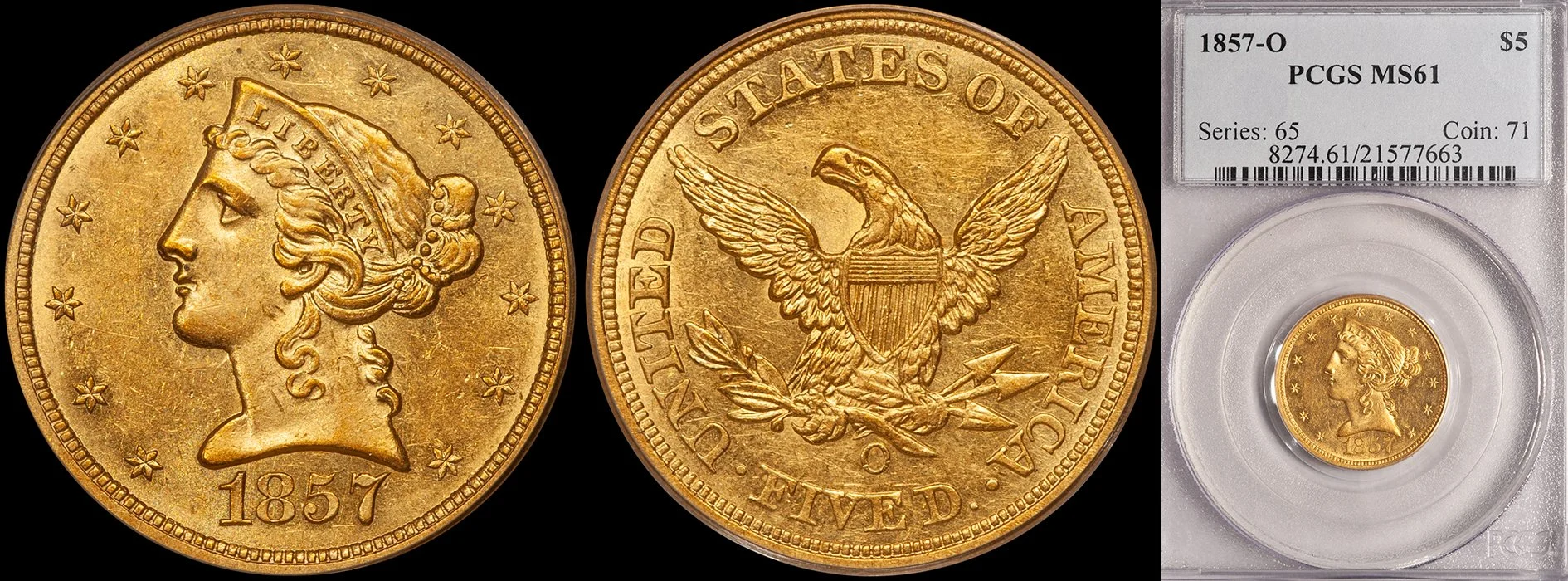
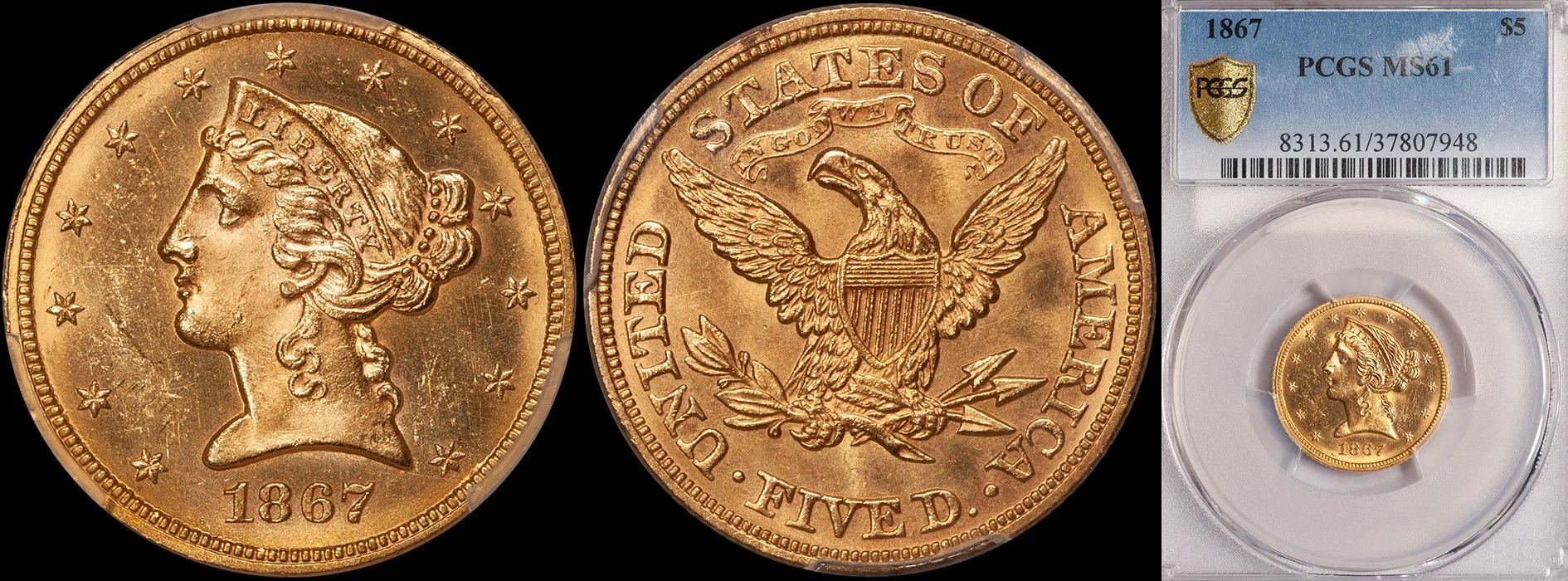
Recently Sold by DWN: 1871-S 25¢, PCGS MS66 CAC

Beginning with this piece, I am initiating a series of blogs that looks at individual coins that I have sold to our clients. Some of these coins were included on my website (www.raregoldcoins.com) while others were not. The prices on these coins range from a few thousand dollars up to hundreds of thousands. All have one thing in common: they are interesting issues with a story to tell.

This first coin might surprise you. I have a well-deserved reputation as a dealer who handles a lot of great 18th and 19th century United Sates gold coins. But I also handle some really interested Bust and Seated coins, including coins such as the featured item in this blog.

I started collecting coins when I was nine years old and one of the first series which I started collecting seriously was Liberty Seated quarters. I have always loved this series and over the years, I’ve handled numerous finest known and Condition Census issues. I’ve always had a soft spot for New Orleans and San Francisco quarters so this Gem 1871-S quarter hit a real nerve for me.

1871-S 25C PCGS MS66 CAC

The 1871-S is a scarce, low-mintage issue which, like all of the other San Francisco quarters of this era, tends to be found in lower grades. There are an estimated 200-300 known with many of these showing extensive wear. A small number of Gems (maybe as many as four or five) are known, and it was likely these were all saved by foresighted collectors or local families.

The present 1871-S quarter is famous within the Seated Liberty collecting community and it is very likely the single finest known. It has blazing frosty luster with surfaces which, except for a small scrape in the right obverse field, are essentially “as made.” The coin has blast white centers with some cinnamon hues at the obverse border; the reverse shows lighter but more extensive color at the periphery.

There are two superb gems known for this date and these are as follows:

  1. This coin, ex Heritage 6/14: 30391 ($30,550), Gene Gardner collection obtained privately from Summit RC in August 2004, earlier from the Stellar Collection and probably ex Eliasberg 2: 1498. Graded MS66 and approved by CAC.
  2. A second coin graded MS66 by PCGS, this ex Stack's Bowers 8/12: 11350 where it sold for $35,938. More extensively toned than coin #1. Graded MS66 by PCGS and approved by CAC. 

The 1871-S was formerly a neglected and overlooked date and it remains somewhat overshadowed by its rarer counterpart, the 1872-S. But it is very scarce in all grades and it is almost never seen in popular collector grades. Its value has risen appreciably over the years in the VF-AU grade range, but like many Seated quarters of this era it is dominated by the famous Carson City issues which are more popular and which have multiple levels of demand.

With Gene Gardner now out of the market, there is really no single collector who is the “go to guy” for Gem Mint State Seated Liberty rarities. In my opinion, when a new collector or two gets into the market and focuses on coins such as San Francisco Seated quarters (and I think this is inevitable, given how popular San Francisco gold from this era has become in the last three years) a coin such as this Gem 1871-S quarter could easily double its current price level.

This coin is a great combination of beauty and rarity, and I was proud to offer it.


What Does a Virtually "Perfect" 19th Century Gold Coin Look Like?

The majority of the coins I deal with are imperfect. They were struck by crude machinery, in often difficult circumstances, by often-times inexperienced mint personnel. If I had to guess, I’d say the average grade of the coins I sell is in the Extremely Fine-45 to About Uncirculated-55 range. I sell coins which are “gently used.”

But every now and then, I handle a coin that is not only “unused,” but it is superb quality. I recently handled a PCGS MS68+ 1884 gold dollar approved by CAC, which was as close to perfect as any 19th century American gold coin I’ve handled in some time. I’d like to share some thoughts about the appearance of this specific coin, discuss it within the context of the Type Three gold dollar series, and share some random thoughts on originality and eye appeal.

1884 $1.00 PCGS MS68+ CAC

The late-date Type Three dollars—those issues struck from 1880 through the end of this series in 1889—share a number of characteristics. They all have fairly low mintages but fairly high survival rates. These issues were not well-circulated and for many of these dates, examples below AU55 to AU58 are all but unheard of.

Of the ten late-date Type Three gold dollars, the rarest in terms of overall rarity is the 1884. It sells for just a small premium over a really common date like an 1888 or 1889 but it is actually much scarcer. Of the 5,230 struck, there are around 500 known with nearly all in the MS62 to MS64 range. In MS65 and even MS66, this date is not a big deal and PCGS has graded enough in MS67 (20 coins as of September 2014) that most any collector who wants one can find one. MS68’s are another story, and PCGS has graded only seven in this grade plus this one example in MS68+. NGC has graded an 1884 dollar in MS69, and I’m sure that coin is amazing, but I’m feeling pretty confident in saying right now that this PCGS MS68+ is the single finest known 1884 gold dollar.

What makes this coin an MS68+? Is it really better than an MS67; enough to justify it being worth close to four times what a nice PCGS/CAC MS67? If so, how, what and why?

I generally avoid buying common coins in uncommon grades, and if I were offered an 1888 or 1889 gold dollar in MS68+ I would likely pass. But I quickly pulled the trigger on this 1884. My decision was made easy by the coin’s appearance. It has eye appeal to spare; a result of its great surfaces, lovely color and the “look” which is hard to put into words but which speaks volumes to me. This coin didn’t have the appearance of a “typical” dipped high grade dollar of this era. It was dark and filmy and I mean “filmy” in a good way; more on this below.

Let’s look at the components of grading which combine to give this coin its Mint State rating and its eye appeal factor. First is strike. Strike shouldn’t be much of a factor on late date Type Three gold dollars as these tend to be extremely well-struck. This coin is no exception, and it is fully detailed at the centers and borders. The second factor is surface preservation. A close examination of the surfaces reveals a single light scrape on the upper obverse below ES in STATES. Other than this, the coin is perfect. The next factor is luster. This coin has amazing rich, thick frosty luster which is unbroken and which clearly has never been tampered with. This issue tends to have very good luster, but even by the standards of 1884 gold dollars, this piece has better than average luster. The fourth factor is coloration. You can see from the attached photo that this coin has very pronounced coppery-russet color, which is deeper at the borders than the centers. The color is “right” for the issue and it has a pattern and hues that is clearly natural.

One thing about this coin which is interesting is its “filmy” appearance. Generally, a coin which is filmy has negative connotations, and this film might be putty or some unnatural, applied chemical. But a number of Type Three gold dollars have what is known as “cellophane” toning from storage in old cellophane holders. These coins were often given as Christmas presents and stored for many years in these clear holders which impart a very recognizable “film” over the surfaces. If I saw this same sort of film on, say, an 1854-D gold dollar, I’d be suspicious. But knowing that this look is not uncommon on high-grade business strike gold dollars from the 1880’s, I regard it as another “plus” factor in this coin’s overall appearance.

As a collector, one of the things you should do is educate yourself as much as possible about the series you collect. Focus less on trying to learn what is the difference between an MS67, an MS68, and an MS69, and more on the characteristics which make a coin special for its respective issue. Learn about things like cellophane-style toning on the surfaces of Type Three gold dollars, and why this is a good thing. Most of all, find a visual “look” which appeals to you and try to stick to this as much as possible when you search for coins.

And whatever became of this 1884 gold dollar? I sold it to a prominent collector who is currently working on the finest-known set of gold dollars, and he is thrilled with his new acquisition.

Do you have questions or comments about this PCGS MS68+ gold dollar? If so, please free to comment below or ask me directly via email at dwn@ont.com.

Do you buy rare gold coins?

Do you have coins to sell?

Would you like to have the world’s leading expert help you assemble a set of coins?

Contact me, Doug Winter, directly at (214) 675-9897 or by email at dwn@ont.com.

Bill Motto: A Memoriam

A good guy passed away yesterday and I’d like to share some thoughts about him. William “Bill” Motto was the CEO of a major Midwestern company, but I knew him as an advanced collector of United States gold coins. I really got to know Bill around four or five years ago when the United States Gold Coin Club was founded. I was vaguely aware of Bill prior to this but he was such a low-key, under-the-radar guy, that it was only at the first few club meetings that we began to talk.

Bill collected great coins. He wasn’t what I’d call a super advanced numismatist and he didn’t pretend to be. As I got to know Bill better, he began to share some of his coins with me and I was blown away by the magnitude of his holdings. I always tried to share pedigree and provenance information with Bill on his key coins, and I could tell that he was genuinely interested that a coin he owned was likely from the famous Parmelee sale of 1890, or from the World’s Greatest Collection sales of 1945-1946.

Bill had a rigorous set of standards he applied to his purchases. He was especially fond of early gold, and we both shared a fondness for the rarer “Fat Head” issues from the 1820’s and early 1830’s. I remember speaking to Bill the day of a major sale and we discussed an important coin that was up for auction. Bill had decided that the coin was worth “X” amount and when I told him he wasn’t likely to purchase it at that price, he wouldn’t be dissuaded. He didn’t buy that coin, and didn’t seem to mind that he let it get away. It was worth “X” and not a penny more, in his mind.

I would see Bill a few times a year; always at the FUN and Summer ANA shows and, on rare occasions, at the Central States show. Bill would arrive at the show with his sons in tow, and visit the small coterie of dealers he was close to; I was proud to be included in this group.

Before one show a few years ago, Bill called me and told me he had a neat deal for me to purchase. I grew excited and wondered what neat coins I was going to get buy: Proof gold? Early gold? Rare Saints? When I saw him he came behind the table (he always had “behind the table” privileges) and proceeded to hand me a group of eight circulated Classic Head gold coins. Nice, yes, but not the $100,000 gems I was hoping for. But the transaction went smoothly and I always was thankful that Bill let me buy his spillage.

Bill and I had a running joke at shows. Bill was one of the most low-key rich guys I’ve ever met but he had one vice: he loved to fly on his private plane. To those of us poor schlubs who fly commercial, private flight is a luxury we can only dream about. Bill would sit down next to me at a show and I’d always tell him how awful my flight was and how I’d be happy to hitch a ride with him in case he was heading anywhere near Portland.

Bill, I will miss you. I will miss your enthusiasm, your love of great coins, and the fact that you didn’t even check your own email. Bill, I hope the time we spent together was as much fun for you as it was for me.

Rest in Peace, my friend.

How To Collect Type One Double Eagles

Type One double eagles have become the single most popular area of collecting in the rare date United States gold coin market. With the discovery of over 10,000 high grade, formerly rare issues in the S.S. Central America, S.S. Brother Jonathan, and S.S. Republic shipwrecks, Type Ones have received tremendous publicity in both the numismatic and non-numismatic press. This is clearly a design type which is destined to remain popular with a number of future generations of collectors.

The 2002 edition of my book An Insider’s Guide to Collecting Type One Double Eagles represented ground-breaking research on the series. I had previously written on New Orleans double eagles in my book New Orleans Gold Coins: 1839-1909 (published in 1992 and revised in 2006). Prior to this, collectors had to rely on the Breen Encyclopedia and David Akers’ trailblazing work on Liberty Head double eagles which was published in 1982. The 2002 edition of this book filled a great, need but it soon became outdated and needed to be revised.

After numerous starts and stops, I decided to revise the book in 2014 but with a twist: instead of publishing it in traditional book form, it will be released as a web-based project, and we will announce its availability (and URL!) later this year. (Here is the new site!) This was done for a number of reasons. The first is flexibility in updating. With a traditional book, updating it is a major chore. With the web-based format, it will be easy for me to continually update things like Condition Census, Auction Price Records, certified population figures, hoards, and important new discoveries. A web-based double eagle book will have a far greater reach than a traditional published book, and this might serve to bring more new collectors into the series. It will also enable me to have interactive features such as a comments section where collectors can add their input to each issue, and expanded potential to include more high-quality color photographs than in a traditional printed book. The possibilities are endless.

Type One double eagles appeal to collectors for a variety of reasons. They are the first type of double eagles produced and the highest denomination struck for circulation. They are large and attractive with a high intrinsic value which appeals to the “gold bug.” They were struck during an extraordinary historic era (1850-1866), and have wonderful back stories. Many issues are available in collector grades and a number of issues can found in presentable grades for less than $3,500 per coin. At the same time, there are a number of rare to very rare dates which appeal to advanced collectors.

There is a host of ways in which to collect this series. I’d like to suggest a few that I have found interesting and add some practical suggestions from years of experience with assisting collectors in this series.

1. Collecting Type One Double Eagles as a Type Coin

Type collectors seek to obtain a representative example of a specific type or design. For Type One double eagles, a type collector would most likely focus on an issue such as an 1856-S or 1857-S from the S.S. Central America, or a non-shipwreck date such as the 1861. A nice SSCA coin can be purchased for $7,500-10,000, while a high-quality circulated 1861 currently is valued in the $4,000-5,000 range.

A type set could be made more interesting by expanding it to two coins: including a common date from the 1850’s and the 1860’s, the two decades in which this design was produced. The most common issues from the 1850’s are the 1851 and the 1852 and, thanks to the shipwrecks mentioned above, the 1856-S and the 1857-S. The two Philadelphia issues can be easily located in all circulated grades and a very presentable example will cost the collector $3,000-5,000. The 1861 is the most affordable Type One from the 1860’s, and the collector can either purchase a pleasing circulated example or an Uncirculated coin in the MS60 to MS62 range.

If you are taking the time to read this article (and are looking forward to the new double eagle website I mentioned above) you are likely to have enough interest in this series that you will be more involved with them than as mere type coins. But if you have decided to participate solely as a type collector, I suggest you spend a bit more money and buy a scarcer date. In my opinion, the issues which offer the biggest “bang for the buck” include the 1854 Small Date, 1855, 1856, 1857, and 1858.

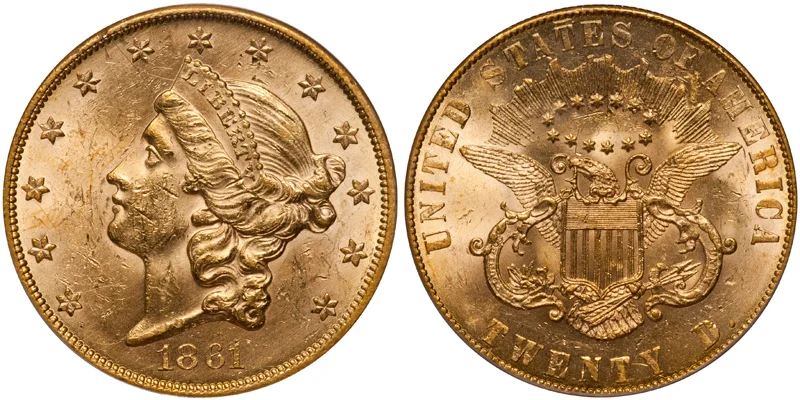
2. Collecting Type One Double Eagles by Mint

Type One double eagles were struck at three mints: Philadelphia, New Orleans, and San Francisco. Some collectors focus on issues from one of these three mints and assemble complete sets of dates and major varieties.

The Philadelphia mint produced 17 collectable double eagles (this figure does not include the 1849 and the 1861 Paquet, but it does include the 1853/2 and the 1854 Large Date). This is not an easy set to complete in circulated grades. The five hardest issues to locate are the 1853/2, 1854 Large Date, 1859, 1862, and 1863. All five of the dates are scarce to very scarce in Extremely Fine and About Uncirculated, and all are rare to very rare in Uncirculated.

In Extremely Fine, this set should run at least in the $55,000-65,000 range, and more if the collector is picky and seeks choice EF45 coins with CAC stickers. An About Uncirculated set (with the five keys in the AU50 to AU53 range and the more common dates in the AU55 to AU58 range) should run in the $110,000-130,000 range, and more if the collector is picky and seeks choice coins with CAC stickers. An Uncirculated set is possible but it would require considerable patience and some of these issues (notably the 1853/2, 1854 Large Date, 1859, and 1862) are very rare and seldom offered for sale in Mint State. A collector can figure on spending at least $300,000 on an average quality set and considerably more if he wants the majority of his coins to grade higher than MS60 to MS61. An Uncirculated set with all the coins having CAC stickers is certainly possible but it might take many years—and a deep wallet—to assemble.

The New Orleans mint produced a dozen Type One double eagles between 1850 and 1861. Two of these (the 1851-O and the 1852-O) are common, two are moderately scarce (1850-O and 1853-O, three are very scarce to rare (1857-O, 1858-O and 1861-O), three are rare (1855-O, 1859-O and 1860-O), and two are extremely rare (1854-O and 1856-O). Many collectors are forced to skip the 1854-O and the 1856-O due to their extreme rarity and prohibitive prices. However, for those fortunate collectors with the means to acquire one or both, history has proven their worthiness as performing assets.

An Extremely Fine set of Type One New Orleans double eagles is the most realistic for most collectors. Excluding the 1854-O and 1856-O, this set costs at least $175,000-200,000. An About Uncirculated set of Type One New Orleans double eagles is extremely difficult to assemble but it can be completed with patience and a deep pocketbook in a three to five year window. To keep costs down, the collector might buy AU55 examples of the moderately scarce to scarce dates and AU50 to AU53 examples of the very scarce to rare issues. Such a set would cost at least $250,000-300,000+. AU50 to AU53 examples of the 1854-O and the 1856-O would add another $750,000-1,000,000. An AU set with all 12 coins having CAC stickers might be possible, but it would require working with a world-class expert as many of these dates have very low CAC populations.

Between 1854 and 1866, the San Francisco mint produced 14 Type One double eagles. This includes the 1861-S and the 1861-S Paquet reverse. With the exception of the 1861-S Paquet and the 1866-S No Motto, all are reasonably easy to locate in circulated grades. Before the discovery of the three shipwrecks cited above, assembling a high grade set of Type One San Francisco double eagles would have been nearly impossible. Today, it is far more realistic. It is still theoretically impossible to finish this set in Uncirculated, as no 1861-S Paquet reverse double eagles have been graded MS60 or higher by the two services as of the middle of 2014.

A complete set of Type One San Francisco double eagles in EF40 to AU50 costs at least $125,000, with around half of this amount dedicated to the 1861-S Paquet and the 1866-S No Motto. An AU55 to AU58 set costs at least $250,000; again with a significant amount of the cost focused on the two rarities. A set with all of the coins grading at least MS60 except for the Paquet (which would grade AU55 to AU58) would cost in excess of $600,000.

If I had to rank the popularity of the three mints as of the middle of 2014, I would list them as follows:

  1. New Orleans
  2. San Francisco
  3. Philadelphia

3. Collecting Type One Double Eagles by Year

A popular way to collect this series is to obtain one example from each year in which the Type One design was produced. In this case, such a set would consist of 17 coins.

In a Type One year set, it is advisable to select the most affordable issue produced during a specific year. For example, three mints struck double eagles in 1861: Philadelphia, San Francisco, and New Orleans. Most year sets include the 1861 Philadelphia as it is easier to obtain than the other issues and it can be found in comparatively high grades for a reasonable sum.

The most difficult (and least flexible) year is 1866. The Philadelphia mint’s production of double eagles in 1866 consisted exclusively of the new Type Two (or “With Motto”) design, while San Francisco produced a limited number of Type One coins before switching to the new design. The 1866-S Type One is exceedingly rare in Uncirculated and very rare in any grade higher than About Uncirculated-50 to About Uncirculated-53.

A complete year set can be assembled in Extremely Fine grades for around $75,000, with at least one-third of the cost going towards an 1866-S No Motto. A set with all of the coins in About Uncirculated can be assembled for $150,000 and up, with around half of the cost going towards the 1866-S. A set with all of the coins in Uncirculated would be very difficult to complete due to the rarity of the 1866-S. It would cost upwards of $425,000-450,000 to complete with, once again, a significant portion of the cost going towards the 1866-S.

4. Assembling a Complete Set of Type One Double Eagles

For some collectors, Type One double eagles become their primary focus and they seek to assemble a complete set. Such a set consists of every issue struck between 1850 and 1866 (not including the excessively rare 1861 Paquet reverse). Including the 1853/2, 1854 Large Date, and the 1861-S Paquet, there are a total of 44 issues.

Depending on a collector’s budget, the grades for a complete set of Type One double eagles will range from Extremely Fine-40 all the way up to Mint State-65. The more common issues are generally represented by coins in comparably higher grades while the rarities are represented by coins in slightly lower grades. The rarest issues in the set include the 1854-O, 1855-O, 1856-O, 1859-O, 1860-O, and 1861-S Paquet. The rarer issues tend to be very difficult to locate and the most available of these six coins are rarely available at prices lower than $40,000-50,000.

There are some practical guidelines which the collector assembling a complete set should follow. A complete set should be as well-matched as possible. The collector should also attempt to obtain coins with as much visual similarity as possible.

A complete set should not be “all over the map” as far as grades are concerned. It makes no sense to assemble a set which has VF30 coins alongside MS62’s

Many Type One collectors are guilty of “overbuying” the common dates and “underbuying” the rarities in order to save money; I feel this is a mistake. Instead of spending $50,000 on a high-grade example of a mundane date such as an 1851, buy a nice coin one grade lower for $15,000, and use the money you’ve saved to put towards a rarity. Conversely, instead of filling the 1854-O and 1856-O holes with “no grades” or problem coins, try to find the best examples of these you can possibly afford. A set of coins is judged on the quality of the rare issues, not by the common ones.

Don’t assemble a set of Type One double eagles with unrealistic expectations. A collector who has previously worked on more common sets may approach Type Ones with the idea that he can race through set in higher grades. Since a number of Type Ones are unknown in Uncirculated and extremely rare in the higher About Uncirculated grades, certain allowances have to be made. The collector must learn what is realistic for each issue. It isn’t realistic to find an 1856-O in Mint State-60. But it is realistic to find an 1856-S in this range or even higher.

In Extremely Fine-40 to About Uncirculated-50, a complete set of 44 Type One Liberty Head double eagles is going to cost a minimum of $1,000,000, and probably quite a bit more once the collector finishes upgrading coins he isn’t satisfied with. If the collector decides to eliminate the 1854-O and 1856-O, at least half of this expenditure will be eliminated. A set which included all the coins in About Uncirculated-50 to About Uncirculated-58 would cost at least $1,500,000. Eliminating the two ultra-rarities would again remove at least half of the cost. A set in which the majority of the coins grade Mint State-60 and above and the rarities grade at least About Uncirculated-55 is going to cost upwards of $2,000,000-2,500,000, and possibly quite a bit more.

5. A Shipwreck "Mini Set"

A number of shipwrecks containing Type One double eagles have been located since the late 1980’s. These are designated by PCGS and NGC, and they are extremely popular with collectors. A shipwreck mini-set most likely would contain just three coins and would be constructed as follows:

  1. S.S. Central America. This is the most famous of the three shipwrecks discussed here as it contains thousands of very high quality coins. Most collectors seek a nice Uncirculated 1857-S, typically grading MS63 to MS65. I have a few buying tips for such a coin. First, only buy a piece in the original gold foil holder. Second, be patient as there are thousands of potential coins for your set. Wait for a coin which appeals to you and look for one with bright, flashy surfaces which lack haze or cloudiness. Third, buy a coin with all the “bells and whistles.” By this, I mean look for a coin that has all its original packaging and which has been approved by CAC as well. Finally, don’t overpay. There are hundreds of auction price comparables for these coins, so you should be able to figure a smart price to pay with relative ease.
  2. S. S. Brother Jonathan. This shipwreck featured Civil War era San Francisco Type One double eagles. The coins tend to be a little less attractive than the S.S. Central America pieces and are harder to locate in the original packaging. The two dates which seem most plentiful from this shipwreck are the 1863-S and 1865-S. The buying tips I mentioned above mostly apply to these coins as well, except original packaging is non-existent.
  3. S. S. Republic. The third shipwreck in the set is the one which is least interesting to me as the quality of the coins tends to be less nice. That said, there are some interesting coins which come to market from time to time with this pedigree.

6. Collecting by Die Variety

For most Type One double eagles, a number of different obverse and reverse dies were used. As one die became worn or damaged, it was replaced by a new die. The different die combinations created various die varieties which range from significant to very minor.

The field of gold coin die variety collecting is fertile. Little has been written about the varieties of United States gold coins, and almost nothing has been written about the die varieties of Type One Liberty Head issues. A number of interesting and potentially rare die varieties exist. Many are discussed in my book(s) on Type One double eagles. Others wait to be discovered by sharp-eyed collectors.

In order to study double eagle die varieties, the collector should pay careful attention to date and mintmark placement and other more subtle die characteristics such as breaks and die scratches.

Collecting varieties of Type One double eagles has become more popular in the last decade, and part of this is attributable to the fact that some of the major varieties are now recognized by PCGS and NGC. In addition to the widely accepted varieties (1853/2 and 1854 Large Date), the following are often collected alongside “regular” coins:

  • 1852 Double Date
  • 1853 Repunched Date
  • 1854 Small Date, Doubled Date
  • 1855-S Small S mintmark
  • 1857-S Large S mintmark
  • 1859-S Double LIBERTY
  • 1865 Blundered date

7. A Civil War "Mini Set"

One of the most popular theme sets in the Type One series is the 11 or 12 coin Civil War set. This includes the following issues, all made during the Civil War years: 1861, 1861-O, 1861-S, 1861-S Paquet, 1862, 1862-S, 1863, 1863-S, 1864, 1864-S, 1865, and 1865-S.

Due to the fact that this set has multiple levels of demand, many of the double eagles from the Civil War have seen considerable increases in price.

There are some difficult issues in the Civil War set. The 1861-O is the only New Orleans double eagle from this period and it is extremely popular. The 1862 is the rarest Philadelphia double eagle from this period, followed by the 1863 and the 1864. The San Francisco issues are more available with the exception of the rare 1861-S Paquet. The price of this variety might cause some collectors to not include it in the set. This makes sense, given that a “normal reverse” 1861-S can be an acceptable substitute.

An 11 piece set in Extremely Fine grades should cost in the area of $80,000. Adding the Paquet reverse would make the set cost over $100,000.

An 11 piece set in About Uncirculated would be challenging but it is completable. It should cost at least $150,000 and could run quite a bit more if the collector seeks choice, original coins with CAC approval. Adding a nice AU55 Paquet will require around a $150,000 commitment.

This set could not be completed in Uncirculated as the Paquet doesn’t exist in this range. However, the rest of the coins do, and here are my suggestions for the best value grade for each date:

  • 1861: MS62 to MS63
  • 1861-O: MS60 (if available)
  • 1861-S: MS61 to MS62
  • 1862: MS60 to MS62
  • 1863: MS61 to MS62
  • 1863-S: MS62 to MS63
  • 1864: MS61 to MS62
  • 1864-S: MS61 to MS62
  • 1865: MS62 to MS63
  • 1865-S: MS62 to MS63

8. Collecting Proof Type One Double Eagles

A tiny number of Proof double eagles were struck prior to 1859. From 1859 to 1865, very small numbers were made. Fewer than 350 proofs were struck for the entire type, and fewer than 75 are known.

The rarity of these coins makes them very appealing to a small segment of wealthy collectors. It might be possible to assemble a complete date run of Proofs from 1859 to 1865. This would require patience, luck, and a very healthy coin budget.

Most of the Proof Type One double eagles which appear on the market are in the Proof-63 to Proof-64 range. Gems are exceedingly rare, and are generally offered for sale at the rate of maybe once per two or three years.

Do you buy rare gold coins?

Do you have coins to sell?

Would you like to have the world’s leading expert help you assemble a set of coins?

Contact me, Doug Winter, directly at (214) 675-9897 or by email at dwn@ont.com.

Two Sales, Three Coins, One Opinion: One Dealer's Quick Take on the ANA Auctions

The ANA week has never been easy for a small numismatic firm like mine to handle, and when I learned that this year’s version included not one but two companies’ auctions I let out an audible groan. This was repeated when I saw the offerings online: both Heritage and Stack's Bowers had impressive sales, and I would need to carefully view them.

I booked flights to Orange County and Dallas to view the sales in person and at my leisure. One thing I have learned about auctions is that viewing conditions have to be ideal. For me this means the following: my special coin lamp, my music played loud over headphones, no distractions, and plenty of time to take notes on the coins I’m most interested in. I can’t do this at a coin show as, by then, my nerves are frazzled and I can’t properly concentrate. And when I don’t pay full attention, I make mistakes. In my level of dealing, a small mistake can equate to thousands or even tens of thousands of dollars so I want to be cautious, careful, and critical.

The sales were very successful for me. I spent in excess of $2 million dollars including a record-setting purchase of the ultra-rare 1861 Paquet double eagle. (But that’s another story.) The tale I want to tell here is about three coins which I have chosen for what I believe to be their overall level of interest to gold coin enthusiasts.

1. The One I Got at My Price

Lot 11077, courtesy of Stack's Bowers

Lot 11077, Stack's Bowers. 1804 Small 8 over Large 8 half eagle, PCGS AU55, Old Green Holder.

A good client of mine has been searching for the “right” 1804 half eagle for the better part of two years. We’ve bid on a few at auction and always come up just a hair short; on others I’ve put the kibosh to the coin due to quality issues. The above referenced coin, after I saw it in person, was exactly what this collector would want and I knew it was a coin he would be excited about.

After we discussed it on the phone, we debated the value. I told him it was a coin I would gladly bid $10,000 on to stock it for my inventory. We decided to go to $11,000 in the sale, and I was told, “Don’t let this one get away.”

The coin opened at $9,000 and another floor bidder jumped in at $10,000. I bid $11,000 and waited to see if my bid would be topped. After a long pause, it wasn’t, and the coin was mine.

The collector texted me about fifteen seconds after the lot had closed and asked, “Was that our bid?” When I told him it was, I got back a short but rewarding text: “YESSSS!!!!!!!” He was happy, I was happy, and the coin now has a great new home where it will be appreciated for years and years.

2. The One I Ripped

Lot 12010, courtesy Stack's Bowers

Lot 12010, Stack's Bowers. 1854-S double eagle, PCGS MS64, ex SS Central America.

I’m going to be honest. It took me longer to “like” the SSCA coins than most gold coin experts. I had trouble with the coins due to the conservation and the lack of “originality.” But as time has marched on, I have come to like these coins, and certain coins from this wreck really excite me. This 1854-S was one coin that truly floated my boat.

This specific coin was the single finest of only 25 examples of this date found on the S.S. Central America. In addition, the 1854-S is a condition rarity in the Type One double eagle series, and it is desirable as the first double eagle from the brand new San Francisco mint. Not to mention the fact in person this coin was outstanding; quite possibly the best 1854-S double eagle I had ever seen and clearly finer, in my opinion, than the PCGS MS65 which sold for $115,000 in the Heritage 10/08 auction.

With this information at hand, I decided that I would bid up to $80,000 hammer on this coin and I might even stretch a bit if I had to. The coin, it turned out, was reserved by the consignor at $57,500. This meant that a $60,000 bid was required for a potential sale. The auctioneer opened the lot, I bid, and in a matter of seconds, it was hammered to me at $60,000, meaning I purchased it all in at $70,500. I considered this to be an excellent purchase and I grinned quietly, waiting for my next lot to come up in a few minutes.

3. The One That Got Away

Lot 4120, courtesy of Heritage

Lot 4120, Heritage. 1865-S double eagle, NGC Improperly Cleaned, Uncirculated Details.

I don’t generally buy “problem coins” and I never, ever, ever doctor said pieces, but this lot was a really big riddle to me. It was the first and only truly Gem example of this date that I had ever seen except for one big problem: it had been lightly cleaned around the date years ago. Without this cleaning, this was a slam-dunk MS65 and, as an example with original surfaces (i.e., not from the Brother Johnathan or Republic shipwrecks) it could easily be worth $50,000++.

I had a dealer friend who is smarter than I am about such coins look at this and he agreed with me that it was a “no grade” now and likely a “no grade” in the foreseeable future. Still, I was haunted by this coin, and I threw in a bid of $5,000 just for the heck of it.

The coin wound up bringing $11,162.50, and I can guess which dealer bought it even without knowing the answer. I will be on the lookout for this coin in the near future and I won’t be shocked if it is in a “regular” MS65 holder and priced at some crazy number.

So there you have it: two sales, three coins, and one very tired dealer’s opinions. I greatly enjoyed my participation in both of these sales, and thanks go to Stack's Bowers and Heritage for putting on such a great group of coin auctions.

Do you buy rare gold coins?

Do you have coins to sell?

Would you like to have the world’s leading expert help you assemble a set of coins?

Contact me, Doug Winter, directly at (214) 675-9897 or by email at dwn@ont.com.

Compromising When Coin Buying: When You Should and When You Shouldn't

Collectors often ask me about my thought process(es) when I make coin purchases. Why do I buy certain coins and pass on others? Why do I stretch for some coins, and make others based solely on a favorable price? These are great questions and I think they are worthy of a blog.

Most coin purchases involve some sort of compromise. Very few coins are “perfect” from an appearance standpoint. A coin may have been cleaned at one time or it may have some weakness of strike or more marks in prominent locations than you would hope for. When should you compromise your standards, and when should you hold fast and true?

A lot of the answers that I would give to these questions depend on what sort of coins you are buying and whether you collect by type or by date. If you are a type collector, it is much easier to, as an example, wait for the perfect AU55 Capped Bust Right Heraldic Eagle ten dollar gold piece than it is to wait for an 1804 eagle in AU55 which is well struck and which has natural color.

Let’s look at some specifics for compromise vs. non-compromise, and use some real world examples.

1. Very Rare Coins Should Be Held to Lower Standards than Common Coins

Intuitively, you would think that the exact opposite should be true in numismatics, but it’s not.

The rarest Dahlonega half eagle is the 1842-D Large Date. It’s the only issue in the series which is genuinely hard to find in EF and higher grades with really good eye appeal. I haven’t handled a truly nice one in years, and I have numerous want lists for this date in nearly any grade. If someone offered me a marginal quality in a 45 holder tomorrow, I would invariably buy it unless it was grossly overpriced or it had some flaw that I just couldn’t get past.

1842-D Large Date $5.00 NGC AU55

The most common Dahlonega half eagle is the 1854-D. It’s kind of a blah issue, but I seldom buy this date unless it is outstanding for the date for one of the following reasons: it's 100% original, it has great color, or it is exceptional eye appeal. In other words, I’m not going to buy an 1854-D (or any other very common Dahlonega half eagle) unless there is something really exceptional about it.

If I hold the 1842-D Large Date to the same standards that I hold the 1854-D to, I’m never going to buy an example. And this is a trap that many collectors fall into.

There are a number of very rare coins that just don’t come nice. A classic example is the 1870-CC double eagle. I’ve seen or owned probably half of the surviving examples and I can’t recall more than two or three that I would regard as “choice.”  The typical example is not only well-worn but it lacks original color and has numerous abrasions. As a buyer who loves original color and tends not to like abrasions, the 1870-CC is problematical for me. Which is why I hold it to an entirely different set of standards than, say, an issue like the 1890-CC double eagle, which I can easily locate with good eye appeal.

2. If You Don't Lower Your Standards on Certain Coins, You'll Never Buy Any

Around a year ago, I began selling coins to a new collector who decided that he wanted to specialize in rare to very rare Liberty Head eagles. His collecting background was with more modern issues such as Walking Liberty half dollars and he was used to big, bright, shiny coins which were just about perfect. I warned him that he would have to use an entirely different set of standards with a coin like an 1860-S eagle; an issue which is not only extremely rare but is one with which rigorous buying standards have to be thrown out the window.

The first two transactions I had with this gentleman were disasters. He returned one very scarce coin (in a PCGS holder and with CAC approval) for having a tiny “scratch” hidden on the reverse, and another rarer one for not being as “dark and dirty” as he thought the photo and description on my website indicated. I don’t have many coins returned due to quality issues, and two have two returned by the same individual in the space of a few weeks…well, let’s just say this doesn’t happen much at DWN.

We spoke on the phone and this is what I learned: since these coins were expensive (high four figures in one case and low five figures in another) he expected them to be superb. I tried to explain to him that what constitutes “superb” in the realm of rare date eagles is entirely different than what constitutes “superb” when looking at MS66 and MS67 late date Walkers. He was using a set of standards that were totally inapplicable to rare date 19th century gold coins that were both conditionally rare and which had very low survival rates. I think we parted friends, but to this day I have never sold him another coin and don’t think he is likely to buy anything from me.

This blog is not meant to be an apology for compromising your standards. In the field of rare date gold collecting there are many coins that you can take a firm stand and not waver from it.

3. When You Want One of Something, You Can Be Fussy

More dated gold collectors are collecting by a type or by “best available neat coin” strategy and wandering from the previous standards of collecting series by date.

Let’s say you’ve decided that you like Charlotte quarter eagles but you want just two examples: a Classic Head and a Liberty Head. You are more limited with the former as there are just two Classic Head issues; the Liberty Head series offers much more flexibility with 18 different issues to choose from.

You’ve saved up and have $3,500 to spend on a really nice quarter eagle. You are someone who really values good strikes and you hate coins which are made on inferior planchets. This automatically eliminates around half to two-thirds of the possible Liberty Head issues from this mint (due to budget constraints, strike problems, or poor method of manufacture) and you can focus on the issues which make sense. The chances are good that the “right” $3,500 coin will show up in a few months; a coin with excellent striking detail, nice surfaces and the original color and surfaces that collectors now crave. It might be a “common” issue such as an 1847-Cl or it might be a scarcer issue such as an 1840-C.

Or you can just buy assorted neat coins in your price range. Let’s say you love dirty, original coins and your price point is $2,500-5,000. It doesn’t theoretically matter if you buy a PCGS AU58 1857-S gold dollar or an NGC AU50 1846-D/D half eaglel as long as the coin has character and its eye appeal “speaks” to you.

4. Be Picky on the Keys (if you collect by date)

I’ve discussed this more than once but most collectors overbuy the common dates in their chosen set(s) and underbuy the keys.

Let me give you an example of the right way to form a set. A very good client of mine has been working on a Dahlonega quarter eagle set for five or six years now. His motivation to begin this set was when I had just bought a great collection of D mint quarter eagles and was breaking them up. It just so happened that the key 1855-D and 1856-D in this collection were wonderful quality for the date: comparatively high grade, nice and original, and well-pedigreed. He realized that by purchasing both coins, he would be off to a great start and that he might not have a chance to purchase such nice examples again.

1854-D $2.50 PCGS AU58 CAC

After buying these two key issues, this collector decided that the other rarities in the set (1840-D, 1841-D, 1842-D, and 1854-D) had to be special coins. And over the course of the next five years, I was able to purchase beautiful AU55 to AU58 examples of each.

As picky as he was on the keys, he was discriminating on the common dates in the set. He bought nice AU examples but resisted the temptation to spend $15,000 on a common 1843-D when he could own a perfectly presentable example for $4,000 and funnel the savings towards another key date, or two to three more nice commons.

5. Be Picky When You Have Options

Let’s say you are a collector for whom strike is a key factor in determining whether or not you buy a coin. On some issues, you are out of luck as all known examples are found with weakness of strike (an example of this would be the 1859-C and 1860-C half eagles). Other issues are found with varieties which are well struck or poorly struck, depending on the die state (examples of this include the 1844-D and 1848-C quarter eagles).

To be a good collector in the area of rare date gold, you have to learn about each issue’s appearance. This is why the books I have written explain factors such as typical strike in great detail.

You are surfing the web and you happen on a nice, crusty 1844-D quarter eagle in a PCGS AU55 holder. It has your “look” and is priced in your wheelhouse, but the strike is very poor. If you know the intricacies of this issue, you know that around 50% of all 1844-D quarter eagles show central weakness. This means that you still have a good chance to find a well-struck example and that you should probably pass on the coin, even if you need it for your date set.

Knowing when to be picky and when to compromise is an important part of the strategies used by sophisticated collectors of all coins; not just dated gold. Do you have any stories to share about being picky or not being picky when you bought a coin? Please share them in the comments section below.

Do you buy rare gold coins?

Do you have coins to sell?

Would you like to have the world’s leading expert help you assemble a set of coins?

Contact me, Doug Winter, directly at (214) 675-9897 or by email at dwn@ont.com.

Douglas Winter Numismatics Sets World Record with $1.645 Million Dollar Purchase

Douglas Winter Numismatics Sets World Record with $1.645 Million Dollar Purchase

There are just two 1861 Paquet Reverse double eagles known and this issue is ranked as the fourth rarest regular issue United States coin, after the unique 1870-S half dime and three dollar gold pieces and the 1873-CC No Arrows dime.

Read More

Are 1870-CC Eagles Undervalued in Comparison to their Double Eagle Counterparts?

Without a lot of fanfare, we have seen the dispersal of one of the most amazing collecting of Western branch mint gold coins in the history of numismatics. So far in 2014, the various sales of the Bently/Nob Hill Collection(s) of US Gold Coinage has seen no less than six examples each of the rare 1870-CC eagle and double eagle with the promise of more to come.

The sale of this quantity of 1870-CC eagles and double eagles has made me reconsider the rarity and price structure of both issues. It has not only allowed me to get an excellent idea of exact valuations for both issues in a variety of grades, it has led me to ask an important question: is the 1870-CC eagle undervalued in comparison to its double eagle counterpart?

Before I attempt to answer this question, let’s take a quick look at both issues.

A total of 5,908 1870-CC eagles were struck. This is the rarest Carson City eagle (although the 1879-CC makes a strong claim to the rarest coin in the series) and there are an estimated 50-60 pieces known with most in the VG-VF range.

There were 3,789 1870-CC double eagles struck. It is the rarest CC gold coin of any denomination and I feel that there are 35-45 known in all grades; mostly in the VF-EF range.

Let’s look at the current PCGS population figures for each issue:

$10.00 G-VF : 23; EF: 18; AU: 10; UNC: 0; Total: 51

$20.00 G-VF : 6; EF: 22; AU: 5; UNC: 0; Total: 33

These numbers tell us a few things. First, as expected, the 1870-CC double eagle is around twice as rare as its counterpart the 1870-CC. Interestingly, the eagle is seen more often in lower grades (the average example grades VF) while the average grade for the double eagle is EF. Both issues are extremely rare in properly grade AU and are unknown in anything close to Mint State.

We might make the quick conclusion that based on rarity alone, the 1870-CC double eagle should be worth around 2x what an 1870-CC eagle is worth in VF, EF and AU grades.

Based on the sales of so many 1870-CC eagles and double eagles in 2014, I’d suggest the following valuations for each denomination:

1870-CC $10.00 PCGS EF45

$10.00

  • VF: $25,000-40,000 (depends on grade/grading service)

  • EF40: NGC $40,000-45,000; PCGS $45,000-50,000

  • EF45: NGC $45,000-50,000; PCGS $50,000-55,000

  • AU50: NGC $60,000-65,000; PCGS $70,000-75,000

  • AU55: NGC $125,000-135,000; PCGS $150,000-175,000

1870-CC $20.00 PCGS EF45

$20.00

  • VF: $175,000-225,000 (depends on grade/grading service)

  • EF40: NGC $235,000-250,000; PCGS $250,000-265,000

  • EF45: NGC $260,000-280,000; PCGS $275,000-290,000

  • AU50: NGC $285,000-295,000; PCGS $310,000-330,000

  • AU55: NGC $325,000-350,000; PCGS $400,000-425,000

Assuming that the price structure for the 1870-CC double eagle is “correct” (and I think it is, based on the number of coins which have sold over the last few years), why is the 1870-CC eagle not priced at around half the level of its counterpart?

I think there are a few answers to this. The 1870-CC double eagle is a more famous coin with a lower mintage. It is larger in size and it is part of a set (Carson City double eagles) which ranks as among the most avidly collected in all of upper-echelon American numismatics.

Double eagle rarities have multiple levels of demand, and the 1870-CC is a coin that often sells to a collector or investor who might not be a tried and true specialist.

I think we are beginning to see a strong shift in the eagle market and this denomination is now gaining in popularity and price. CC eagles aren’t as popular (yet) as double eagles, but the metrics for these series is clearly changing.

My conclusion is that the 1870-CC eagle is undervalued. If a nice quality EF45 1870-CC double eagle is worth in the $275,000-295,000 range, an 1870-CC eagle at $50,000-55,000 seems substantially undervalued. Given that the 1870-CC eagle in EF is pretty similar in rarity to the 1870-CC double eagle (see the chart above), it is hard to believe that it is worth only 1/5th as much. I can easily see the 1870-CC eagle in EF and AU grades doubling in price in the next five years; I’m not sure I can say the same for the 1870-CC double eagle.

What are your thoughts about the price and rarity of the 1870-CC eagle and double eagle? I would love for you to comment below.

Do you buy rare gold coins?

Do you have coins to sell?

Would you like to have the world’s leading expert help you assemble a set of coins?

Contact me, Doug Winter, directly at (214) 675-9897 or by email at dwn@ont.com.
Is it Time to Buy Indian Head Half Eagles?

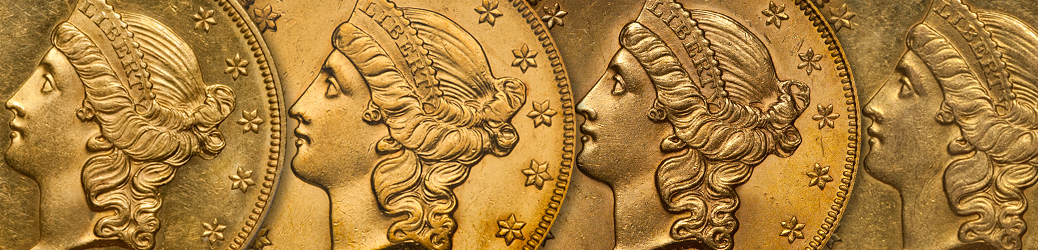
I am generally not a participant in the generic gold market as I tend to favor scarce and rare dates over more common ones. But I like Indian Head half eagles a lot and a recent experience made me ask the question: “is it time to buy Indian Head half eagles?” I bought a nice, fresh deal of Indian Head half eagles about six weeks ago. All were in very old holders and I broke them out and sent them off to grading. My results were excellent and nearly every coin graded MS64 or MS65. As I got ready to cash in on my windfall, I did some price research and was shocked. Unless they stickered at CAC (more on this in a few moments) the levels I was going to have to sell them left me breathless…and not in a good way.

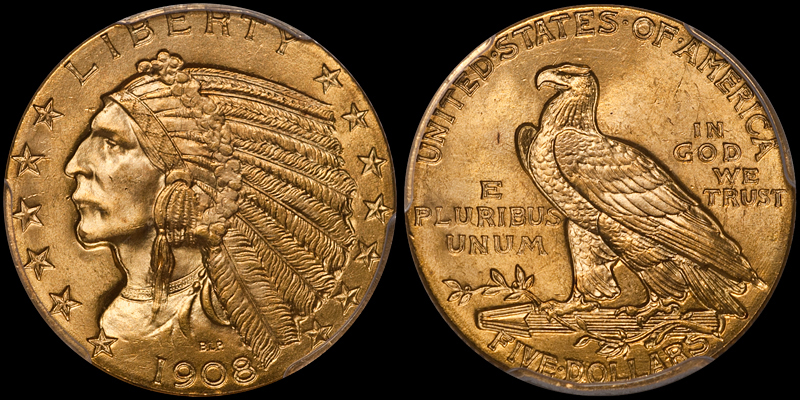
1908 Indian Head $5.00 PCGS MS65 CAC

If you are like me and you don’t really follow the generic market on a day-by-day basis, it can be mystifying to see how cheap most issues have become in the last few years. My non-CAC MS64 Indian head half eagles were worth around $1700 per coin if they were in NGC holders and a bit more in PCGS holders. I was more shocked at how cheap MS65’s have become: around $9,000 for NGC coins and a smidge over $10,000 for PCGS coins. And that’s not to mention the fact that you basically have to twist buyer’s arms to get them to buy any quantity of these even at these cheap, cheap, cheap levels.

Why are Indian Head half eagles so inexpensive in MS64 and MS65? There are a number of answers.

1. Traditional Sellers of Generic Gold Now Sell Other Products

Firms like Blanchard, Swiss America, and Goldline used to sell lots of better quality generic gold coins; items such as MS64 or MS65 Indian Head half eagles. Today, they either sell few generics or if they do, they are focused on those coins with CAC approval. The supply of MS64 and MS65 Indian Head half eagles has stayed consistent as coins are continually found in Europe or upgraded from current holders. The demand has not kept up with the supply, however, and this has resulted in plummeting prices.

1911 $5.00 PCGS MS65 CAC

2. Owners of Generic Gold Don’t Want to Cost Average Their Positions

Let’s say you bought a few nice MS65 Indian Head half eagles for $15,000 each back around 2006-2007. You are clearly not a happy with today’s prices so much lower than when you purchased your coins. But why not by a few more and use cost-averaging to lower your overall price point(s)? This logic makes sense to me, but for most coin investors it is exactly what they do not want to do. They feel “burned” by Indian Head half eagles and probably want nothing more to do with them. This lack of continuity in the generic market, due to poor price performance, has clearly not helped this market.

3. The CAC Effect

One of the primary reasons why CAC was created was to identify those generic gold coins, particularly in series such as Indian Head half eagles, where the perception was that many coins in MS64 and MS65 holders were over-graded or not, at the very least, “solid” for the grade. CAC has proven to be very tough on Indian Head half eagles, and only a small percentage of the MS64 and MS65 coins sent in for approval have received a green sticker. As a result, stickered MS64 and MS65 Indian Head half eagles sell for very strong premiums; in most cases 25-50% over non-stickered coins. The market perception of non-stickered MS64 and MS65 Indian Head half eagles is they are not “good” coins and, as a result, the price gap between non-CAC and CAC stickered generic gold coins is widening. My gut feeling is that non-stickered MS65 Indian Head half eagles could ultimately be worth half as much as their CAC’d counterparts.

4. The Plus Grade Effect on MS64

It is a matter of opinion whether coins graded MS64+ are actually “better” than coins graded MS64, but the market perception is such that plus-graded coins have begun to sell for significant premiums, even in the generic market. If you are a new collector and you are offered a “regular” MS64 Indian Head half eagle for $1,750, or an MS64+ example for $2,250, the chances are good that you will spend the extra $500 and get the “better” coin. This has clearly hurt the market for MS64 Indian Head half eagles, and it is likely that we will see further price separation between MS64 and MS64+ coins.

5. Changing Tastes Amongst Gold Coin Buyers

More than anything else, the generic gold coin market has been hampered by a lack of demand. Past generations of new collectors and investors were introduced to numismatics by the assembling of the basic 11 or 13 coin U.S. gold coin type set. Today, new collectors are more inclined to collect something which is rare. For $10,000, an AU 1864 half eagle (slightly over 4,000 struck and under 75 known in all grades) is a more sensible purchase than an MS65 1909-D half eagle (nearly 3.5 million struck and over 100 graded in MS65 at PCGS alone) in the minds of these new collectors. It will take a large marketing promotion and lots of re-education to get new collectors to re-think this.

1912 $5.00 PCGS MS65 CAC

So what is my conclusion? Is it time to buy Indian Head half eagles in MS64 and MS65? I’d like to say yes, but I think that prices could easily drop another 20-30% on these coins in the next year or two. In my opinion, if levels get down to $1,500 for nice MS64’s and $7,500 for MS65’s, I would jump in the market, likely in a big way. For now, I’d avoid this coin unless you need one for a gold type set or if you are a contrarian with some tolerance for risk.

What’s your take on the Indian Head half eagle series and generic gold in general? I’d love to hear from you and encourage you to add your comment(s) in the section below.


Do you buy rare gold coins?

Do you have coins to sell?

Would you like to have the world’s leading expert help you assemble a set of coins?

Contact me, Doug Winter, directly at (214) 675-9897 or by email at dwn@ont.com.