The Second Annual DWN Art Basel "I Was There" Blog

For the second year in a row, I went to the incredible Art Basel show in Miami Beach. For those of you who are not familiar with this show, it has become quite possibly the leading art show in the world and it turns Miami into the Epicenter of the Art World for a week or two every year in early December. This year's edition of the fair was probably better for me than last year's (which I loved) because of the fact that I knew what to expect, was better prepared and was less overwhelmed. As I did last year, I'm going to share with you a couple of thoughts, using my vast experience in attending coin shows as a basis of comparison. 1.  Your money goes a lot (and I mean A LOT) further at a coin show then at a high end art show. Good art (I'm not even going to approach the subject of great art since it is so far out of my league pricewise) is fabulously expensive and it makes good to very good quality coins seem astonishingly cheap. I think my eye is pretty good when it comes to art and nearly every painting I priced at Art Basel was $100,000 and up. These were for artists that I thought I actually had a chance to buy. For great artists that I recognized (like the stunning Mark Rothko that hung, in its fiery orange glory, in the very first booth on the left as you entered the fair...) I didn't have the nerve to even ask what it was priced at. I know these great museum-quality works of art were going to run in the $5 million to $50 million and, tire-kicker that I was, I didn't want to waste the dealer's time.

2.  Coin dealers are much, much more approachable at shows than art dealers are at fairs. Unless you exude wealth or are known by the dealer, you don't get so much as a nod of recognition at Art Basel. At one booth, I was passed onto the most junior member of the firm when I asked the price of a painting. Sigh... (The real laugh here is that after I was told the painting was sold, the 23 year old junior dealer tried to upsell me to a $350,000 painting that was so large I would have had to hire a semi truck to get it to my house in Portland even if I had the 10,000 square foot house it would have required to show it!) I'm as guilty as any coin dealer of pre-judging someone approaching my table at a show but even if you are dressed in cheap jeans or a t-shirt, you are going to get my attention if you are a) polite b) interested in coins and/or c) knowledgeable about the types of coins I specialize in.

3.  Just like at a coin show, a little knowledge goes a long way at an art fair. Quick story: my fiance Irma saw a painting by an American woman artist named Edna Reindel that she loved at a ritzy New York dealer's booth. She was quoted $95,000. If I had that sort of art budget, I would have given it real consideration. That night, we went back to the room and on my computer, I searched for information about Edna. Within thirty seconds, I found an image of the painting. It had just sold, less than three weeks ago, in an auction for $28,500. Let's say you gave your interior designer a budget of $100,000 to buy "something special" at the show. Then let's say she bought this painting for $80,000, marked it up to $90,000 and hung it over your sofa. Looks great in your living room but how are you going to feel when (or if) you learn it just sold for less than 30 clams? Ouch!!

4.  Ethnic profiling is so fun and easy at these shows. The Italians are all wear bright red pants. The Germans have crazy architectural eyeglasses. The Brazilians (men and woman) are gorgeous. The Russians seem desperate. The American woman all have fake boobs and botoxed lips. Have you ever people-watched at Heathrow Airport in London or JFK in New York? Art Basel is ten times better with the added advantage that almost everyone is either rich or an artist. (Or a rich artist...)

5.  The art market for dead artists makes sense. A painting sells at auction for, say, $50,000 and this sets a level for comparable works by the artist. There are variables: is it a major work or a minor work? Was he in the middle of a glorious love affair with his mistress or had he just broken up with her and was clearly depressed? Is the condition nice or is it ratty?  But the market for living artists--especially emerging ones--is so fraught with variables. I saw one drawing at the show that was priced at $65,000 but I thought it was a great deal given the fact that it took the artist eight months to make (!) and it was staggeringly gorgeous and cerebral. Even without any auction comparables, I saw the value. On the other hand, I saw paintings for $100,000, $200,000 and up that I thought were hokey and derivative. Here's a thought: every generation produces maybe a half dozen truly great artists. Isn't it scary that artists are selling for $1 million and up today are almost guaranteed to be afterthoughts in thirty years (see Schnabel, Julian)? Give me a Dahlonega quarter eagle any day; at least I can figure values in that market.

6.  As with coins, freshness is absolutely essential in the high end art market. If you are a rich newbie at Art Basel, it is a virtual certainty you will be offered stale, overpriced secondary market pieces or B quality works by new artists. This is true even if you have a "consultant" who, in all likelihood, has his or her own agenda. It was interesting how often I heard obviously savvy collectors ask a gallerist at Art Basel about the provenance of a work of art or who it had been offered to already. If a painting had appeared at auction in the last few years and it failed to sell...instant kiss of death. Which is not the case, by the way, in the coin market where an auction dud can still attract interest.

7.  The level of passion for art at Art Basel is amazing. Sure, it's a see-and-be-seen atmosphere and more and more of the attendees are there for the parties. But I'm pretty impressed by the fact that in a single night out in Miami Beach, I ate dinner with a group of people ranging in age from around 30 to around 80 from all over the world wearing clothes that ranged from The Gap to Prada talking passionately about art and the art market. The demographic at a coin show tends to be, how shall I say it, a bit "different" and certainly far less diverse.

8.  Because of its proximity to Latin America and South America, the fairs in Miami tend to have a Hispanic orientation that I find fascinating. There is clearly a rapidly emerging upper middle class in countries like Colombia, Brazil, Mexico and Venezuela. Not only were there a number of dealers from these countries, there were a number of collectors at the fairs buying up a storm. This wealth is almost certain to touch the coin market and if I were a betting man (wink, wink...) I would start buying selected high end coins from these four countries.

9.  Art Basel dealers, I feel your "pain."  Up at 9am. Walk or jog on the beach. Interesting clients to schmooze with all day. Brazilian women. Talk about art. See art. Sell art. Eat great food in Miami Beach. Brazilian woman. Stay at Art Deco hotels. Party 'til dawn at exclusive boites. And then there's my life... delayed flights on glamorous domestic carriers, botched reservations at Westins and Sheratons, crappy convention food, hot spots like Long Beach, Baltimore and Rosemont, fascinating conversation about die breaks on early half eagles. Not a Brazilian woman in sight. SIGH....

10. I had a great time at Art Basel 2012 and hope to be back next year. Its a fascinating week and I think it not only makes me a better connoisseur but a better coin dealer. I'm refreshed, excited and ready for the 2013 FUN show in Orlando in a few weeks.


Buying the Jump Grade

A few recent  coin sales that were made by my firm have given me an idea for a blog that I think is interesting. I've written about this before so I'll try to approach what I think is an important concept from a new perspective. The concept of value is extremely important to me when I buy a coin for my inventory and I try and share this with clients of DWN. In a nutshell, my core belief in coin buying is that, with most coins, there is a point at which you can "overbuy" . There are obvious examples of this and not so obvious ones.

The basis of my concept is what I refer to as the "jump" grade for a coin. The jump grade is the point at which the value spread for a coin becomes out of whack and the higher grade(s) for a coin no longer make sense.

 Let's look at a hypothetical pricing structure for a coin in higher grades:

     MS63:  $2500

     MS64:  $5000

     MS65:  $90000

This seems far-fetched, right? In truth, this is the exact value spread chart for a 1920 St. Gaudens double eagle, an issue that I consider to be the poster child for buying the jump grade which is MS64.

In this case, an MS64 example at $5,000 seems to make alot more sense than an MS65 at $90,000, especially given the fact that the single PCGS MS65 1920 Saint that has ever been graded isn't all that much nicer than a number of the 64's that I've seen or sold. So why would anyone buy a $90,000 version of a coin that can be represented in a set by a nice $5,000 version?

The answer is more complicated than you think. Obviously, part of it is vanity. Very high end collectors demand the finest coins and if a finest known coin jumps nearly 20x in value over the next grade down, that's just the reality of the market. If you are putting together a set of Saints that is competing for the finest in the set registry, the opportunity to add a finest known population one/none better coin (and the huge number of "points" that come with such a coin) is far and few between.

But what about the rest of us; we coin buyers without unlimited funds?

I'd like to share a few of my personal philosophies about value in numismatics.

     1.  Most collectors overbuy common coins and underbuy key coins. This is especially true for gold collectors who focus on 20th century issues. Let me give you an example. If you are collecting high grade Indian Head half eagles by date, why spend $25,000-30,000 on a common date in MS66 when you can buy a perfectly acceptable MS65 for half that amount? I think I'd rather pocket the $12,500-15,000 difference and apply it to a truly rare coin like a 1911-D. Conversely, the same collector who is working on the killer set of Indian half eagles would be foolish to scrimp on a classic issue like a 1929 and buy a "details grade" cleaned example so he could save money.

     2.  Issues with large underlying populations are dangerous purchases. Let me give you an example, along with a chart:

     1879-S Double Eagle

     Grade          PCGS Population          Value Range

     MS61                        225                        4000-5000+

     MS62                         59                          11000-13000+

     MS63                           3                           40000++

This issue actually has not one but two jump grades. For many collectors, the choice will be clear: buy an MS61 because in MS62 the price of this issue jumps almost threefold. An important point to consider is how many of the 225 coins graded MS61 (the actual number factoring in resubmissions is probably still 125-150) could become MS62 someday? Even if the number is just 10-20% percent of the total, that's still potentially as many as 15-30 new MS62 coins. Is the market deep enough to handle that high an influx and still maintain current value levels?

But for collectors with deeper pockets, MS62 is the jump grade for this issue, especially given the fact that they are unlkely to have the chance to buy an MS63 ( considering that the PCGS population is just three  and none have traded at auction since 2006). My personal choice would be a nice MS61 but I would buy a high end MS62 at, say, $15,000 if it were an obvious "just miss" coin.

3.  "Boring" coins deserve "boring" grades in most sets.  To me, a coin like a Dahlonega quarter eagle is interesting. That's why I don't think you can really "overbuy" in this series. There are very, very few D mint quarter eagles graded MS65 (or even MS64) and just about any coin graded as such, unless its horribly overgraded, is worthy of consideration for an advanced Dahlonega specialist.

But a coin like an 1898-S half eagle is boring. There were nearly 1.4 million struck, thousands and thousands exist and most range from nice to very nice. I have a hard time getting excited about a nice 1898-S half eagle; even the direct-from-the-mint to-John Clapp piece, now graded MS68 by PCGS. This coin last sold for $81,600 and I can think of alot of U.S. gold coins at this price point that I'd rather own. The only real "function" that this MS68 example might properly serve is as a type representative in a knock-your-socks off set.

4.  Type collecting looks at jump grades differently than date collecting.  Type collectors just buy one example of a specific design unlike date collectors who buy numerous. So a type collector will look at a jump grade differently. Going back to our earlier example of the Indian Head half eagle, for type purposes an MS66 might make sense and this becomes the jump grade; given that the next grade up (MS67) is likely to cost $70,000 or more.

5. You can throw the book away when it comes to dual rarities.  There are coins that are rare because of their grade and there are coins that are rare because few are known. Then there is the "rarest of the rare." These are coins that I refer to as "dual rarities" because they check boxes on both sides. An example of a dual rarity is a coin like the Byron Reed 1864 quarter eagle, which is graded MS67 by NGC. This is a coin that is not only very rare in any grade, it is an amazing piece from a condition and appearance standpoint.

I'm going to write an article on dual rarities and it should appear in the next few days on my website www.raregoldcoins.com.

Whether you have a coin budget of $1,000 or $1,000,000, you want to get the best value you can every time you make a purchase. Understanding the concept of the jump grade can help you as you mull decisions for your collection.

The Vasquez Rocks Collection: Dahlonega Gold Dollars

In the last blog in this multi-part series, I talked about the Philadelphia gold dollars in the Vasquez Rocks Collection. In this second installment, I'm going to focus on a group of coins that are near and dear to me: the Dahlonega gold dollars. The Dahlonega mint began production of gold dollars in 1849. They produced six Type One issues (from 1849 to 1854), a single Type Two (in 1855) and six issues that featured the Type Three design (from 1856 to the closing of the mint in 1861). For all three types, the estimated total mintage is fewer than 75,000 coins.

The individual who formed the Vasquez Rocks collection did something amazing: he formed a complete Uncirculated set of gold dollars from this mint. To the best of my knowledge, the only other collections that had a complete set of Dahlonega gold dollars in PCGS/NGC holders were Duke's Creek (sold by Heritage in April 2006) and Green Pond (sold by Heritage in January 2004 and assembled by me). This statement, of course, doesn't take into account older specialized gold dollar collections such as Ullmer, McNally, Miles and Pierce which were also complete in Uncirculated but which were formed before the days or third-party grading.

Before I get into specifics about the gold dollars in the Vasquez Rocks collection, here are a few interesting facts to ponder:

  • Of the 13 coins in the set, ten have been graded by PCGS and three have been graded by NGC.

  • The highest graded Dahlonega gold dollar in the set is an NGC MS64 (1853-D) and the lowest grade is a PCGS MS60 (1856-D).

  • Two coins (the 1851-D and the 1858-D) have been awarded "plus" grade designations by PCGS.

  • The average grade of a Dahlonega dollar in this set is 61.92; this figure is arrived at by giving the plus coins an extra half a point (i.e, 63+ is figured as 63.5)

  • Coins in this set have pedigrees from such famous collections as Chestatee, Green Pond, and Pittman.

Now, let's get a bit more specific and discuss the coins, type by type.

I.  Type One

There are some outstanding Type One Dahlonega gold dollars in the Vasquez Rocks collection. A complete list is as follows:

  • 1849-D, PCGS MS62

  • 1850-D, NGC MS63

  • 1851-D, PCGS MS63+

  • 1852-D, PCGS MS61

  • 1853-D, NGC MS64

  • 1854-D, PCGS MS62, ex Pittman Collection

It's hard for me to pick a favorite coin from this group, but the piece that I like the best is the 1851-D in PCGS MS63+.

The 1851-D is the second most common Type One gold dollar (after the 1849-D) and there are as many as 20 known in Uncirculated. However, it is very rare in MS63 as evidenced by the PCGS population of four (with only two better). The Vasquez Rocks coin is the only MS63+ currently graded by PCGS and it is a magnificent coin with a bold strike, rich yellow-gold color and delightful frosty luster. It would make a perfect type coin for the collector who is seeking a single higher grade Type One gold dollar from Dahlonega for his collection.

1851-D $1.00 PCGS MS63+

II.  Type Two

The Dahlonega mint produced Type Two gold dollars for just one year. The 1855-D had an original mintage of just 1,811 and there are fewer than 100 known, mostly in lower grades. This is the single rarest gold dollar from this mint in higher grades and there are exactly four known in Uncirculated.

The coin in the Vasquez Rocks collection is graded MS61 by PCGS and it is the fourth finest known 1855-D dollar. It is one of two Uncirculated 1855-D dollars that were once in the Green Pond collection and it has been off the market since early 2004 when it was acquired from the auction by the owner of the Vasquez Rocks collection for $46,000.

Only a small number of 1855-D dollars are known with sharp strikes and an even smaller number have a full date. The Vasquez Rocks coin is exceptionally well struck; so well struck, in fact, that PCGS has designated on the holder that it is a Full Date. Of the four Uncirculated 1855-D dollars, only one other (ex Duke's Creek/Bass) has a Full Date.

In addition to its exceptional strike, this 1855-D has great eye appeal for the issue with a good deal of luster seen on choice surfaces. Both sides have pleasing color and if you have seen many examples of this date, you'll know that it is seldom found with this degree of good looks!

III.  Type Three

The Type Three design was introduced in 1856 and the Dahlonega mint produced six issues before it was closed in 1861.

The Type Three D mint dollars in this collection are as follows:

  • 1856-D, PCGS MS60, ex Chestatee collection

  • 1857-D, PCGS MS61

  • 1858-D, PCGS MS62+

  • 1859-D, NGC MS62

  • 1860-D, PCGS MS62, CAC approved

  • 1861-D, PCGS MS61

Again, it is hard to focus on one coin, given how many outstanding pieces are in this set. I'm sure you expect me to focus on the 1861-D but I'm actually going to discuss the 1860-D, a coin that, to me, is clearly a highlight of this set.

Only 1,566 gold dollars were struck at the Dahlonega mint in 1860 and this is a rare issue in all grades. A dubious distinction held by this date is the fact that it is the worst struck gold dollar from this mint. The coin in the Vasquez Rocks collection, while showing the familiar weak U in UNITED, is among the best made examples of this date that I have seen. It is of just two graded MS62 by PCGS with a single coin better (an MS63 that should be deleted from the population report as it now appears as an NGC MS64). It is nice enough for the grade that it was approved by CAC and it is one of just two examples of this date in MS62 to have received a CAC sticker.

1860-D $1.00 PCGS MS62 CAC

I am hoping that I will be able to keep the Dahlonega dollars from the Vasquez Rocks collection intact and they will be offered, at first, as a set. If no one purchases them intact, the coins will be broken up and, I assume, they will sell quickly.

For more information on the coins in this collection, please feel free to contact me by email at dwn@ont.com. I expect the full Vasquez Rocks collection to be available for sale in a few weeks.

The Vasquez Rocks Collection: Philadelphia Gold Dollars

I am proud to announce that I will soon begin selling the exceptional Vasquez Rocks Collection of gold dollars. This is one of the finest collection of these coins ever formed with virtually every piece grading MS60 or better and many Condition Census examples included. To get you ready for this epic sale, I'm going to produce a series of blogs that deal with the coins on a mint-by-mint basis and which discuss the highlights of the collection. First, let's look at the gold dollars made at the Philadelphia mint. Philadelphia gold dollars were struck without interruption from 1849 through 1889. Three distinct types are known and these are as follows:

  • Type One, 1849-1854

  • Type Two, 1854-1855

  • Type Three, 1856-1889

Let's look take a brief overview of each of these three types and then discuss them relative to the Vasquez Rocks collection.

Type One gold dollars were made at the Philadelphia from the introduction of this denomination in 1849 until the changeover to the Type Two design in 1854 (in 1854, both the Type One and Type Two designs were produced). Type One Philadelphia gold dollars were made in great amounts and they tend to be common, even in higher grades. These issues are popular with type collectors as they tend to come very well struck and nicely produced. Some dates, notably the 1852 and 1853, exist in grades as high as MS68 or MS69(!) and only one, the 1850, is considered to be scarce in Gem.

The highlight of the Philadelphia Type One gold dollars in the Vasquez Rocks collection is a superb PCGS MS66 example of the 1849 Closed Wreath. It has a population of just three in this grade with one finer and the best graded at this service is an MS66+. The Vasquez Rocks coin, shown below, has a razor sharp strike and amazingly clean surfaces with nary a mark visible to the naked eye.

1849 Closed Wreath $1.00 PCGS MS66, Vasquez Rocks Collection

In 1854, the Mint made the decision to change to the Type Two or Small Indian Head design. This proved to be a disaster from a quality standpoint as the design was hard to strike. Many Type Two gold dollars are seen with poor design details at the centers and this is one of the hardest post-1838 United States gold types to locate in MS65 and above.

1854 and 1855 Type Two dollars from the Philadelphia mint are known. These are very common in circulated grades and available without much of a problem in the lower Uncirculated grades.

The 1854-P Type Two dollar in the Vasquez Rocks Collection grades MS61 while the 1855-P Type Two grades MS62. Both have been encapsulated by PCGS.

The Type Three coins begin in 1856 and extend through the end of this denomination in 1889. The Type Three dollars are a fascinating series to collect. While there are no real rarities, many dates are very scarce to rare in higher grades. The key dates are the 1863 and the 1875.

There are a number of highlights among the Philadelphia Type Three dollars in the Vasquez Rocks Collection. A few of the coins that I especially like are as follows:

  • 1856 Slanting 5 PCGS MS66+. One of six graded in MS66 (with two in MS66+) and only four finer.

  • 1857 PCGS MS67.  One of six graded in MS67 with just a single coin finer.

  • 1859 PCGS MS66+. One of seven graded in MS66 (and the only one in 66+) with five finer.

  • 1863 PCGS MS65. One of five graded as such with just two finer. The rarest gold dollar from this mint.

  • 1867 PCGS MS66.  One of three graded as such with one better.

  • 1868 PCGS MS68.  One of two graded as such with one better.

  • 1875 PCGS MS65. One of seven graded with three finer. Only 400 business strikes produced.

  • 1886 PCGS MS67.  One of five graded as such with none finer.

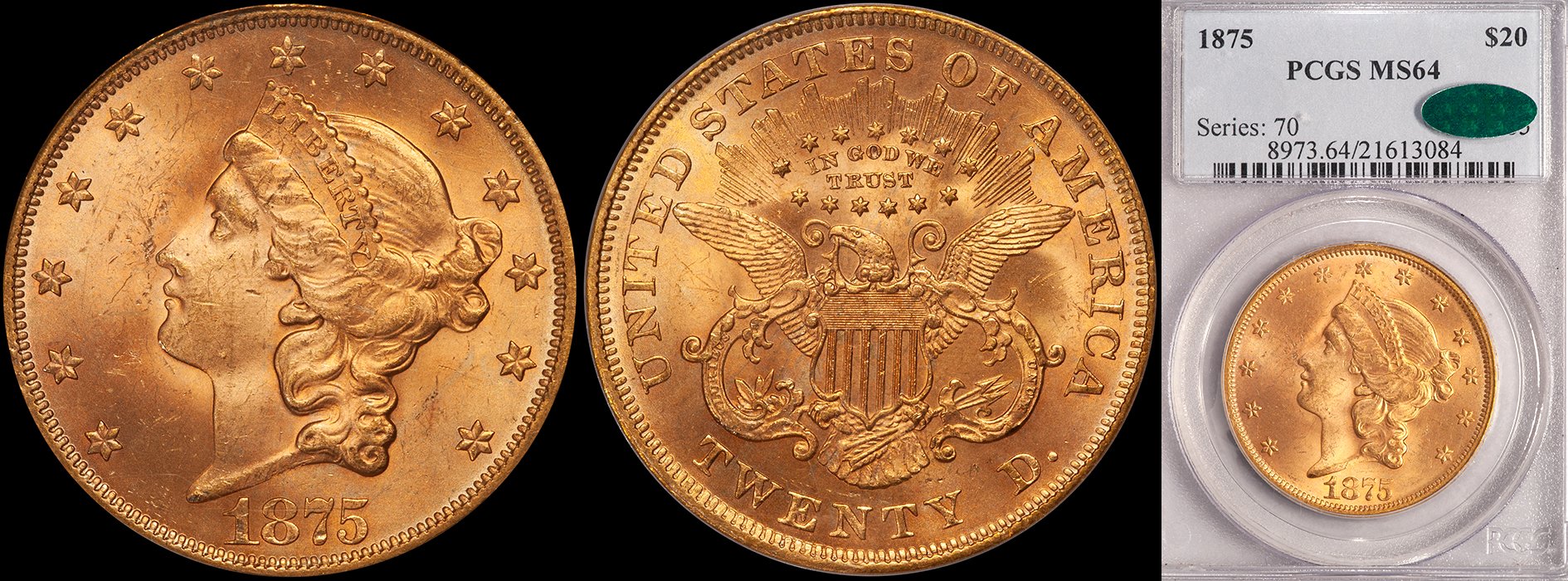
The Type Three coin I'd like to focus on for a minute is the 1875, graded MS65 by PCGS. This is a legendary date for US gold collectors with many of the Philadelphia issues having absurdly low mintages. The 1875-P gold dollar has a tiny mintage of just 400 business strikes and it has been recognized as a key issue for well over a century.

The Vasquez Rocks coin is housed in an old green label PCGS holder and it has dazzling fully Prooflike fields on the obverse and reverse that make it resemble a Proof. It shows the diagnostic thorn-like projection extending down from Liberty's chin that is seen only on business strikes. The coin in this set, which is shown below, is one of the few true Gems that I have seen and it is clearly the nicest that has come onto the market since the  Heritage 2/10: 1427 coin, graded MS66 by PCGS, that brought  $109,250 in furious bidding.

1875 $1.00 PCGS MS65, Vasquez Rocks Collection

The Vasquez Rocks Collection includes many coins that are fresh to the market and it was begun back in the 1980's when superb quality Philadelphia gold dollars were more available than they are today. There are numerous wonderful Gems included and the selection of Type One, Type two and Type Three Philadelphia issues should prove very tempting for the date or type collector.

For more information on the Vasquez Rocks Collection, please contact me via email at dwn@ont.com. I will be sending out notices by email to preferred DWN clients by email, and I anticipate that the collection will become available in around three weeks.

A Neat Dahlonega Knick-Knack

As you become a more passionate collector, "oddball" items become more appealing. I refer to these as knick-knacks and, as you can guess, this is a pretty broad term. For the coin collector, knick-knacks become more appealing as they become more relevant to your collecting specialty. As an example, a collector of Morgan Dollars will be more excited by a canvas silver dollar bag from the Philadelphia mint dated 1885 then I would. To me, this is a neat item but not one that gets my numismatic juices really flowing. I probably shouldn't admit this but there is one area in numismatics that I love above all else: the coinage of the Dahlonega mint. There is something about the coinage from this southern branch mint that appeals to me a little more than any of the other mints. And as someone who loves Dahlonega gold coins, I am always on the lookout for interesting Dahlonega-related knick-knacks.

The problem is that there just aren't many interesting contemporary items from this mint. Sadly, while the Dahlonega mint has left a fascinating legacy of coins for collectors, there are very few items like patterns or mint records or drawings or items from the original mint left for collectors. Around ten years ago I was able to purchase a bullion receipt dated 1856 from the mint (a very rare item and, until a small group of these was found a few years back, one of just two that I had ever seen) but my Dahlonega knick-knack collection was pretty slim.

Until recently, that is.

At the Dallas ANA show, I purchased an item that I think is extremely cool  and probably very rare: a contemporary counterfeit 1842-D Small Date half eagle (shown below) that is the first counterfeit gold coin from this mint that I have ever seen:

A contemporary counterfeit 1842-D Small Date half eagle.

The coin was made in brass and later gilt plated. It shows extremely good work, especially on the reverse. It is the proper size and weight (22 mm in diameter and a bit over 8.2 grams) and, as you can see, it appears to have seen a small amount of circulation.

If you think about it, a contemporary counterfeit Dahlonega half eagle makes sense, especially in 1842 which was just the third year in which the new Liberty Head half eagle was produced. For many people, especially those who didn't live that close to Dahlonega, there was not much familiarity with the new coins from this mint and a reasonable facsimile stood a decent chance of entering circulation and staying there.

But, there were other reasons why a coin like this is an amazing anomaly. It was die struck, and someone with real artistic sensibility took the time to create the obverse and reverse dies. A goodly amount of artistic and technological sophistication was required and this doesn't seem to be something that was found in excess in North Georgia in the early 1840's. Also (and I don't know this for sure) the penalties for counterfeiting in the South during this time period had to be excessively harsh. Someone was taking a huge risk to produce counterfeit gold coins in Georgia in the early 1840's, and you have to wonder how many were actually made let alone how many entered circulation.

So, why is this item special to me and why does it now hold a place high in my personal collection of knick-knacks? As someone who is a major dealer in Dahlonega gold, I won't collect the coins from this mint because I don't want to compete against my clients. So this is the closest thing to a "real" piece of D mint gold that I can hope to own. But beyond that, I love the rarity and the history of this piece.

How rare is it? I have never seen another and I'd like to think I've got the inside track on any pieces that would have come onto the market in the past two+ decades. How historic is it? A contemporary counterfeit 1842-D half eagle that is well-designed and which still retains much of its original gilt finish clearly has an incredible story to tell, although I may never know exactly what it is.

Getting back to the original point of this blog, items like this are what make collecting really fun. Regular issue coins are great and there is certainly a huge amount of pride-of-ownership to have a great 1842-D half eagle in your set. But the really esoteric items in the Dahlonega market--or in any other market--really appeal to me. Be they catalogs, original papers, plaster molds...anything that gives me deeper insight into the coins that I love add a lot of value to my personal holdings.

Why Are Nice Coins So Hard to Find?

When I'm at shows or talking to collectors and dealers over the phone, I hear a common refrain: nice coins are very hard to find. This appears to be the case in nearly all strongly collected series, be it Indian Cents, Civil War era gold or Morgan Dollars. I have a few theories about this which I'd like to share. The first is simple: not everyone has the same concept of what is a "nice" coin. I like dirty, original 18th and 19th century gold and a coin with the aesthetics that I find appealing is clearly not going to be the same for someone who likes coins that are bright and shiny.

I don't think the moaning about a lack of nice coins is new and I'm guessing that collectors in 1912 were complaining in some of the same ways that collectors in 2012 are.

Let me share a theory with you that is basically speculative but which I think has some real merit. As I have stated many times, grading is a continuum. A "grade" is actually a range which can be expansive. As an example, let's look at the MS63 grade.

Assuming that you agree that grading is a continuum, you'll agree with me that MS63 is actually a series of grades that begins with MS63.0 and ends with MS63.9. I would further describe these ranges as follows:

63.0-63.3: coins that are low end or which barely qualify as this grade. I estimate that for the typical series, around 40-45% of the MS63's fall into this range.

63.4-63.5: coins that are decent and which would easily re-grade as a 63 if resubmitted to PCGS or NGC. I estimate that for the typical series around 30-35% of the MS63's fall into this range.

63.6-63.8:  coins that are high end for the grade and which are now (sometimes) designated as "+" or "*" coins by the services. I estimate that for the typical series maybe 10-15% of the MS63's fall into this range.

63.9:  coins that are exceptional for the grade and which are almost assuredly going to upgrade to MS64 at some point. I estimate that for the typical series maybe 5% (and probably less) of the MS63's fall into this range.

If my theory is correct, this mean that at least 70-80% of all MS63 coins are below-average to average in quality. The best of these "average" coins (a coin that I regard as being a solid, commercial example) is likely to get strong consideration for approval at CAC but the majority of them will not be stickered. These not-so-great or just-OK coins are the ones that are generally seen on E-Bay or in Heritage sales, and these are what many collectors are exposed to on a regular basis.

So what about the 20-30% of the MS63's that range from being really nice to exceptional? Where are they and why are they so hard to find? I think the answer(s) are simple.

In many series, there is huge financial motivation to upgrade an MS63 to an MS64. As an example, an 1812 half eagle in MS63 is worth around $22,500-25,000; the same coin in an MS64 holder is worth $35,000-45,000. If I own an 1812 half eagle that I regard as a 63.7 or a 63.8, doesn't it seem obvious that I'm going to go to great lengths to get the coin in a 64 holder and possibly have a $10,000 to $20,000 pay day?

Which brings me to this point: virtually all the high end MS63 coins are in MS64 holders or trying to get there. The MS63+ coins (which translate to the 63.6 to 63.8 pieces described above) are therefore the best available coins and they are typically sold by good retail dealers to their best clients. The typical collector either never gets to see these PQ coins or if he does, often in an auction environment, he has to compete with sophisticated buyers of high end coins.

Another point: I think there are more high end coins around than most collectors (and dealers) realize. It's just that we don't see them as often and much of what we do see on a day-by-day or show-by-show basis is uninspiring.

Now that you've mulled over that theory, I have another one to share with you. Next time you wonder "where are all the nice coins" consider the following fuzzy math.

If a coin is 150 or so years old, it has been collectible for 100 or so years. If the typical coin is owned around five years (and yes I am aware that there are many coins that are in "strong hands" and don't trade until they are held for fifteen or twenty years) that means that the coin you just bought may have had as many as twenty previous owners.

Think about this: that means some or maybe even all of these twenty owners have shipped the coins through the mail in flimsy holders/cleaned the coins/mishandled the coins/stored the coins in PVC flips/stored them loose in cabinets/dipped them and forgot to rinse them/etc. For a coin in nearly any grade to have survived generations of overzealous collectors without having had something bad done to them...well, that just about boggles my mind. And that, in a nutshell, is another very good reason why nice coins are so hard to find.

Are you in the market for nice coins? Send me an email at dwn@ont.com and I will try to hook you up with some very nice coins for your collection!


Dallas Texas and the History of American Coin Collecting

I am headed to Dallas later this week to attend the upcoming ANA National Money show. Going to Dallas is always a little bittersweet for me. I lived in The Big D for a significant portion on my adult life (a little over twenty years, in fact, with a few diversions), and it's where I met my late wife and essentially learned to be a coin dealer. Dallas doesn't have the long numismatic history that New York, Boston and Philadelphia have but despite the fact that it is a comparatively new city, I'd venture to say that it is the epicenter of the modern coin market. The two most important coin dealers of all-time were located in Dallas and at least three to five of the greatest collections of American coins ever formed were created in Dallas as well. A little history follows...

B. Max Mehl, located in Dallas' sister town of Ft. Worth was unquestionably the most important coin dealer in America during the first half of the 20th century. What is so remarkable about Mehl was that he was an immigrant from Lithuania who despite no formal numismatic training (and, in all probability, a lack of all but the most basic English skills for the first part of his career) managed to build a dynamic coin business thousands of miles away from the traditional Eastern hub of the business.

Mehl built his business around clever promotions, self-promotion and using direct mail and advertising at a time when no other coin dealers were doing this, let alone doing this successfully. It is said that his advertising budget in the 1930's and 1940's approached $1 million per year and that at one time a significant portion of the daily mail that arrived in the city of Ft. Worth was addressed to Mehl.

Mehl was not a sophisticated numismatist but he was a wonderful popularizer of the coin hobby and I doubt if anyone who began collecting coins in the era between WW1 and WW2 didn't own at least a few of his catalogs and/or do business with him from time to time. If I'm not mistaken, his old building is still located in downtown Ft. Worth.

Heritage Rare Coins, located in Dallas, is to the 21st century coin market as Mehl was to the market in the first half of the 20th century. The internet has surely been one of the major factors in the changing of numismatics in the last decade and no one has capitalized on the new web-based technologies more than Heritage.

At this point, the rare coin market is as close to a monopoly as it has ever been and I attribute this to Heritage making many very smart decisions in the last fifteen years and their competition conveniently making many dumb decisions. Heritage now completely dominates the American numismatic auction business and they have essentially eliminated their competition save for Stack's Bowers. It is hard to remember that as recently as a decade ago there were at least five thriving competitors in the coin auction business.

The brilliance of Heritage's marketing strategy was to realize before anyone else the impact that the internet would have on the coin market and how being transparent would create a more comfortable bidding and buying environment for collectors. So many of the things that we as a hobby take for granted now (safe online bidding, a database of coin prices and populations, high quality digital images, etc) were either pioneered or perfected by Heritage.

As I mentioned above, many of the greatest coin collections ever assembled have been formed in the Dallas/Ft. Worth area.

The first great local coin collection in the Metroplex was formed by Amon Carter Sr and his son Amon Carter Jr.  The bulk of this collection was sold at public auction by Stack's in January 1984. I didn't attend this sale but the story behind it, as I recall, was that the weather in New York was awful and that it was not as well-attended with out-of-town buyers as it should have been due to this. The Carter sale was one of the really great auctions of the era even though it is not as well-remembered as Norweb, Garrett, etc.

The best-remembered coin from this sale was the finest known 1794 silver dollar which is now believed to be the first example struck. But there were many great gold coins in the sale including very high quality Liberty Head double eagles (Proofs and business strikes) that would generate considerable interest today if offered for sale.

The next great Dallas collection is a name better-known to gold coin collectors: Harry W. Bass. The Bass collection, which was mostly sold in a series of four auctions conducted by Bowers and Merena between 1999 and 2001, contained the most comprehensive date and variety set of Liberty Head gold coins ever assembled.

Bass became a serious collector of U.S. gold in the early-to-mid 1960's. This was an era in which gold coins were plentiful, inexpensive and under-researched and through hard work and good connections with dealers (primarily Mike Brownlee, Stanley Kessleman, John Rowe and Julian Leidman) Bass put together a really remarkable collection.

I attended the Bass II, Bass III and Bass IV sales in New York in 1999 and 2000 and, even then, I think I was sufficiently aware of their significance. In some ways, these sales were the defining moment of the end of the old-school coin market; the point in time just before the internet took , when dealers still attended sales in person and when a gigantic event like Bass II (over 2,000 lots and with thousands and thousands of interesting individual and grouped coins) could be "carved up" by groups of dealers and dominated by six to eight buyers.

There are two currently active collections in Dallas/Ft. Worth that deserve mention and they are clearly among the five greatest American sets ever formed. The first is the Pogue family. This set is not all that well-known outside of the "inner circle" of dealers and collectors but it is incredible. The scope of the collection is Gem quality U.S. coins struck from the 1790's until around 1900 with an emphasis on Gem early silver and gold.

I have never had the good fortune to view this collection in its entirety but I have had the chance to view it in dribs and drabs. The Pogues got really serious about coins during the Eliasberg sale in October 1982 and they bought heavily out of what was arguably the greatest collection of U.S. gold ever formed. They continued to buy aggressively in the 1980's and 1990's with the guidance of David Akers, Larry Hanks and others. I have had to compete against the Pogues at a number of auctions and when they want a really great coin, needless to say that are formidable competitors. From what I know about this collection, it is the single greatest set of its type ever assembled and it is certainly the one set that I would pay to be able to view it.

The other great collection in located in Ft. Worth and it belongs to Bob Simpson, the current owner of the Texas Rangers baseball team and the former CEO of XTO Energy. Simpson is much newer to the market than the Pogues but he has assembled an amazing, comprehensive collection in less than a decade. To his credit, he has done this in a highly competitive environment in which information is more accessible than ever, few coins sell under the radar and the average "Simpson-esque" coin is far more expensive than in past decades.

Before I end this blog, it wouldn't be right not to mention a few more of the great dealers and collectors from the Dallas/Ft. Worth area. Some of the dealers who I regard as major players in the market (past or present) include John Rowe, Mike Brownlee, Mike Follett and R.E. Wallace. You couldn't list four more different guys but each, in his own way, had an impact on the coin market that extended far beyond Dallas or Ft. Worth.

And no blog about Dallas/Ft. Worth numismatics could be complete without mentioning William Phillpot (a great paper money collector), R.E. Schermerhorn (one-time owner of an 1849-C Open Wreath gold dollar), John Murrell (owner of the greatest unknown collection of U.S. gold coins ever assembled) and others.

Se you at the show at Tables 217-219!

Guess Who's Back?

Between being sick for a week (and don't think I don't know who you are Mr. Boston Red Sox hoodie in seat 14C) and having web hiccups as the new site was introduced (how do you like it?) the raregoldcoins.com was not its usually chipper self for close to two weeks. But here we are in October and, as I write this, I feel better and I feel that we are going to have a great month. And I'm not even going to brag about the amazing Indian Summer we are having in Portland... So what's upcoming and why should you be as excited as I am? Well, for starters, the Clyde Collection of Charlotte half eagles is coming up for sale and it should be posted and ready to go on Wednesday October 3. There are a number of terrific coins in this set and some of the highlights include:

  • 1838-C $5.00 graded VF35 by PCGS. A pleasing example of the most popular half eagle from this mint.
  • 1843-C $5.00 graded AU55 by PCGS and approved by CAC.  Choice and original!
  • 1844-C $5.00 graded AU58 by PCGS and approved by CAC. A superb example of this rarity.
  • 1852-C $5.00 graded MS62 by PCGS. Lustrous and choice with great color.
  • 1854-C $5.00 graded MS61 by PCGS. Very rare in this grade.
  • 1860-C $5.00 graded AU58 by PCGS and approved by CAC. As nice an example as you are likely to find.
  • 1861-C $5.00 graded AU53 by PCGS. Popular Civil War issue.

In addition to Clydestock, you can look forward to over a dozen interesting new coins that will be added to the site over the next few days.  Whether you collect early gold, branch mint gold, Proof gold or big, rare gold there will be something for you.

The only show I'm going to this month is the Fall ANA in Dallas. Having lived in Big D for many years, I'm looking forward to going back to the Ol' Stompin' Grounds and I hope to see many of the collectors in the Metroplex who I have done business with over the years. I will be sending you emails in the coming days about my table location, when I will be there and how you and I can get together toether to do a little business in Big D.

The spike in gold prices is starting to have an impact in the rare gold market. I have noticed increased demand for interesting coins in the last few weeks, especially in the ten dollar and twenty dollar denominations. Other areas that seem to be strong now include nearly all Civil War issues, traditionally scarce/rare coins and early gold with CAC approval.

If you collect Dahlonega gold, you'll be happy to know that I have finally finished my manuscript for the third edition of Gold Coins of the Dahlonega Mint, 1838-1861 and it is at the printers even as we speak. Its going to be a 225+ page epic chock full of great color photos and a huge improvement over the last edition (which was also way out-of-date, having been published back in 2003. I have some great projects I'm working on right now that involve my books, the website, apps and more and I urge you to check the site on a regular basis for updates.

Thanks for your patience the last few weeks and please feel free to contact me to let me know what we can do the website to make it even better.

Grade Distribution

There are essentially two types of rarity: absolute (a coin that is rare in all grades; an example of this would be an 1842-O half eagle) and conditional (a coin that is rare based mainly on grade; an example of this would be an MS63 1892-O eagle). What can we learn about rarity based on distribution--i.e., if the number of coins known for an issue is 300, in what grade range are these coins found? The answers are interesting. It is fairly obvious why a coin is an absolute rarity. Generally, the best reason for this is low mintage. Obviously, a Proof gold coin from the 1870's with a mintage of 25-35 is going to be rare; even if the survival rate is 50% or so, you are still not talking about many coins. But many issues have an uncommonly low survival rate to to heavy use in commerce and a high degree of meltings. Examples of this include No Motto half eagles and eagles from the Philadelphia mint. It is not uncommon for issues of these types to have fewer than a dozen known in Uncirculated even with original mintages of 200,000 to 500,000 or more coins. Let's use current PCGS population statistics to look at a specific example: the 1849 eagle; an issue with an original mintage that tops out at 653,618.

To date, a total of 361 1849 eagles have been graded by PCGS. The breakdown is as follows:

Mint State= 30 coins About Uncirculated= 128 coins Extremely Fine= 149 coins Very Fine and below= 54 coins

Breaking this down further, we see that around 8% of all 1849 eagles graded by PCGS are Uncirculated while close to 80% grade Extremely Fine and About Uncirculated. Given the fact that the Uncirculated numbers are inflated by resubmissions, the percentage of 1849 eagles that grade MS60 and above is probably less than 5%.

There are, of course, coins with high mintage figures that are actually quite rare due to excessive meltings. A good example of this is the 1819 half eagle. There were 51,723 of these made but nearly all were melted by 1834 due to a change in the weight of gold coins which made these old tenor issues worth more than face value. Today there are, at most, thirty known 1819 half eagles. And the grade distribution of this issue is bizarre with virtually every known example grading MS60 or better.

Why is this the case? In addition to the heavy meltings above, a little history will show that this type barely circulated at all. Five dollars was a lot of money in 1819 and since the half eagle was the largest denomination made in the United States, these coins were basically storehouses of value. For the entire Capped Head Left half eagle type of 1813-1829, only two or three dates are seen with any degree of frequency in circulated grades and only one (the 1813) is more readily available in circulated grades than in higher grades.

Remember the 1849 eagle that I just mentioned above? There are some coins that are almost exactly the opposite when it comes to grade distribution. There are, for example, many gold dollars from the 1880's that are virtually unknown in circulated grades but common in Uncirculated. Let's look at the 1886 as an example.

A total of 5,000 business strikes were made. The most current PCGS numbers show a total of 354 examples having been graded. Of these, 331 (or 93.5%) have been graded MS60 or better. In theory, an 1886 gold dollar in AU55 is rarer than one in MS65 (although, of course, the MS65 is still worth considerably more).

Why is this the case? A little basic research shows that, by the late 1870's, the gold dollar denomination had been made redundant by the new Morgan dollars. Mintages were small and the demand was even smaller. The gold dollars didn't circulate and there were enough dealers and hoarders saving them that Gems (MS65 and finer) are plentiful.

What this means is that the 1886 gold dollar is a coin that is much less rare than its low mintage would suggest and hundreds are known in high grades (PCGS alone has graded 61 in MS65 or higher). If you were to graph the grade distribution of this issue, it would skew well towards higher grades. If you were to graph the distribution of the 1849 eagle, it would skew towards lower grades with most survivors grading EF-AU and very few in the Uncirculated grades.