How To Become A Coin Kingpin

Deciding what to collect can often be a case of deciding what not to collect. This zen-like statement actually makes a lot of sense once you get over the initial "huh?" Let me explain. Anyone with a more-than-casual interest in coins wants to be a force within the series he collects. By this, I mean he wants to be known as "the CC half eagle guy," or "the face of the Ten Indian market." So how do you get to be "the man" or, better yet, "the kingpin" of the area that you have chosen to specialize in? I think the answers aren't necessarily as intuitive as you might think they are.

1. Suss Out the Competition: Let's say that you've decided to collect Carson City eagles in very high grade. You research the market and determine that these coins are very rare and even though they are expensive they seem within your budget. You still need to find out who your competition is and how far along they are.

Let's say that your major competition in this series is a Texas billionaire with a virtually insatiable demand for the finest known. And he still needs many coins in the set. In this case, you have a problem unless you, yourself, are a billionaire and you are content with knowing that every coin you purchase is probably going to break a record for the date/series. This is discouraging.

But let's say that your major competition--said Texas billionaire--is virtually complete with this particular series and he has shown that he isn't likely to upgrade his Carson City eagles unless they are very, very special coins. In this case, you might not be as discouraged.

Or, you can be creative and look at it this way...

2. Be Adaptable: Just because the series you want to collect has a roadblock like a super-wealthy collector at the top end of the market, this doesn't have to stop you. Instead of buying the finest known Dahlonega half eagles or Charlotte gold dollars, what about a "gem slider" set of choice, original AU58 coins? Or what about putting together a set that features pedigreed coins? Or a set with nicely matched colors? Or a "sharp strike set" in which every coin represents as sharp a strike as possible for a specific issue? The options can be nearly limitless.

3. Timing is Everything: I'm not a huge fan of Gem Saint Gaudens double eagles as I don't think that they necessarily offer the same degree of value as much rarer 19th century gold issues do. But they are currently a comparably good value because of a unique set of circumstances. As recently as five years ago, there were a number of wealthy collectors in this arena and many of them needed the same six or seven rare coins in order to finish their set. When any of these coins came up for sale, it was going to be a Clash of the Titans and a bidding war was certain to erupt.

But just like magic, nearly all of these collectors went poof at the same time. Some lost interest, some completed their set, and some were hurt by the Financial Meltdown of 2008 and had to sell their coins. What this means, a few years later, is that there is now an excellent opportunity for a new collector to become a Kingpin of Saints.

Let me give you two examples. In the Saint series, the 1921 is recognized as one of the ultimate condition rarities. In November 2005, a beautiful PCGS MS66 example sold at auction for $1,092,500. The same coin sold for $747,500 in January 2012. In September 2007, a PCGS MS65 example of this same date sold at auction for $1,012,000. In August 2012, another PCGS MS65 sold for $587,500. Why did these coins--both were very rare and all were very nice--sell for such discounts? Because the top of the Saint Gaudens double eagle market lacked the multiple buyers that it had in 2005 and in 2007. But if you add two or three big players into the mix, I can just about guarantee you that the next nice quality PCGS MS65 or MS66 1921 double eagle that is offered will sell at levels close to--if not at--previous market highs. It has happened before and it is inevitable that it will happen again.

4. It's All About the Relationships. Unless you are willing to devote almost all of your free time to studying about coins and pursuing what you need, you are going to have to establish a relationship with a dealer (or two) who is a well-connected specialist within your intended field of Kingpin-dom.

Let me give you a pertinent example. I recently handled an extremely rare No Motto New Orleans half eagle. This is a coin that I could have sold to a number of collectors. But I chose to sell it to a collector who has nurtured a close relationship with me over the years. He's a terrific guy; sophisticated, well-read on the subject of New Orleans gold, and always ready to buy an important coin that will improve his collection. Because he has been such a pleasure to deal with over the years he was able to purchase a coin which gave him a complete set of New Orleans half eagles in Uncirculated; quite possibly the first such set ever completed.

There's something else about our relationship, though, that transcends coins. A few years ago, someone very close to me was sick and needed immediate care. I called this collector for a reference and within a few minutes I was able to make an appointment with a specialist who was very difficult to see due to his busy schedule. Like I said, it's all about relationships...

5. What's Old is New Again. If you want to be the Kingpin of your series or collecting area(s) you can focus on coins that are traditionally obscure and lack collector interest as a result. Or you can focus on coins that have traditionally been popular but for some reason are currently out of favor. (And, yes, this point is fairly closely related to point #3, above).

For many years, Charlotte gold was as popular as Dahlonega gold and it was certainly far more popular than New Orleans. But Charlotte gold has become the least popular of the three southern branch mints. Lower prices and availability of some great coins in the past five to ten years have meant that at least one or two collectors could have put together fantastic, world-class set; and at comparably reasonable prices as well.

My point here is this: just like with the Gem rare date Saints that I discussed above, Charlotte gold is a proven area of the market with a good reference book and a long collecting history. Values peaked for these coins around 1999-2000 and, in some cases, Condition Census coins are selling for less than they were nearly a decade and a half ago. These seem to be a surer bet than something like high grade With Motto San Francisco eagles from the 1880's and 1890's that have never really been popular and possibly never will be.

What are some areas of the numismatic market in which it is still possible to be a kingpin? A few of my suggestions are as follows:

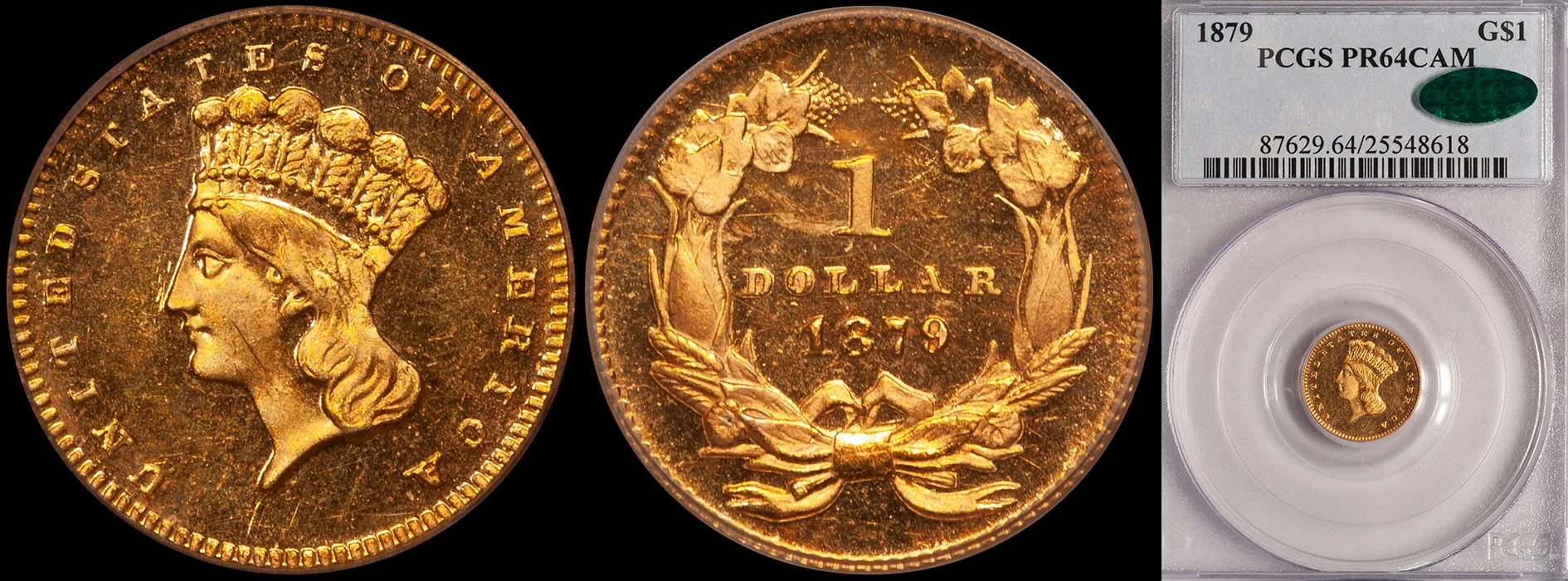
1. Gold Dollars: There are two or three collectors competing for finest known coins at the very top end of the market but this series offers a lot of opportunity for the kingpin-in-training.

2. Better Date San Francisco Gold Coins, 1854-1878: There are pockets of strength in this market but there is no one collector who I'd consider The Man when it comes to very high end SF gold.

3. Type Two Liberty Head Double Eagles: This is an area of the market that remains pretty calm after being in the spotlight for much of the 1990's and early 2000's. When really special coins become available (which is not all that often) they seem to bring considerably less than I think the are ultimately worth.

4. Indian Head Half Eagles: This is a series that tends to have periodic flares in popularity but then it grows dim for years. There is currently some rumbling in the higher end but The King of Five Indians seems to still be waiting to claim his crown.

Do you need help to become a Coin Kingpin? If so, please contact Doug Winter by email at dwn@ont.com.

Ten Things I Did at ANA: A Follow Up to "Ten Things I Want to Do at the 2012 ANA Show"

The last blog I wrote was about ten things I wanted to do at the then-upcoming 2012 Philadelphia ANA show. So did I fulfill my numiswishes? Yes and no. I didn't do everything I wanted but I got a lot done, including buying oodles and oodles of good coins. Let's compare what I did to what I wanted.

1. Meet a Mystery Guest. I didn't see anyone who made my jaw drop (at least at the show) but I did have a few cool table visits. I'd say the most interesting was a collector of branch mint gold who I had sold some great coins to about twenty years but who fell out of touch. Yes, the first question out of my mouth (after "How's the wife and kids?") was, "Do you still have your coins and would you like to sell?"

2. Attend the Battle Born Sale. For collectors of Carson City gold, the sale of the Battle Born collection was a highlight of this or any show. I did attend and it was an event. Prices ranged from kind of reasonable to nuts. I'm going to write a detailed coin-by-coin analysis in a week or so, after I am caught up with listing new coins, sending coins in for grading, making deposits, and the dozens of paperworky things that I have to do after any ANA.

3. Have Something Great Walk Up to the Table. At the last Philadelphia ANA, I met a collector who sold me some great coins and I have since spent over a million dollars with him, purchasing some amazing items. I had hoped that I would have something comparable walk up to the table this year but no luck. I asked other dealers if they had the little-old-lady-with a-box-of 1880's Proof Sets scenario that I hoped against hope for. No one said they did. But one dealer made a point that I thought bears repeating: the hotel buyers that have invaded nearly every city in the U.S. have made these sort of deals even more unlikely to find.

4. Wear Nice Clothes in Very, Very Humid Conditions. Every time I ask myself "why did I move to the Pacific Northwest," all I have to do is spend a summer week anywhere other than Portland. Virtually every day of the show saw 90+ degree weather with brutal humidity. I would have been sweaty even in my typical shorts and t-shirt summer garb; in a tie and jacket it was just brutal. My dry cleaner would likely give Big Ups to Philadelphia's weather but I was dying...

5. View Exhibits:. I'm embarrassed to admit that not only did I not view the exhibits, I don't think I even made it across the room. That's what happens when you work your fanny off for ten hours a day in a room that's about the size of a football stadium.

6. See the Barnes Collection. I went to the Barnes Museum on Monday and it was without a doubt the highlight of the trip. Utterly fantastic and a collection that has amazing lessons to collectors of everything, even coins. In fact, I am going to write an article soon about "what I learned from the Barnes collection." If you are ever close to Philadelphia I urge, urge, urge you to see this amazing museum!

7. Eat at Reading Market I did. Every day. Sometimes for breakfast and lunch. I ate Amish doughnuts. I ate Italian sammies. I had clams. I had pizza. I gained weight. But it kept me sane and kept me away from the convention for a few minutes every day. It was great.

8. Restocking Inventory. I wound up buying over 100 new coins and spent more than a million dollars. The first group of new purchases are up and listed on my website (www.raregoldcoins.com) and the next wave will hit in about a week. How was buying at the show? Brutally hard. It was a ton of work to find these coins but I am proud to offer some great fresh pieces in price ranges that go from cheap (around $1,000-1,500) to expensive ($25,000 and up).

9. Experience the ANA Buzz. Was it a great show? Yes and no. It was well-located, well-run, and massive. I'd go back to Philadelphia for another show although I much prefer New York or Boston for an eastern location. My biggest complaint was that it was too long. With the pre-show (and I could make a great argument for nuking it) and the regular show it was a very long week. I got so tired one night at the auction I actually had to go outside and get fresh air, fearing that I was about to have an out-of-body experience. ANA Week is clearly a marathon and, I'm afraid, I've become more of a middle distance kinda guy in my middle age.

10. Leaving the Show. I was supposed to leave the show on Friday but my flight was cancelled and I had to stay until mid-day on Saturday. It worked out just fine in the end but, yes, it was great to get home except for the fact that I have been working ten+ hour days since then catching up.

How was your ANA experience? Did you find what you were looking for? Contact me by email at dwn@ont.com and let me know.

Ten Things I'm Looking Forward to Doing/Seeing at the Philly ANA

The annual Summer ANA show is a highlight on any collector's or dealer's calendar. This is my 30th in a row to attend and I am very much looking forward to the show, especially as it appears to be the last ANA that will be held on the east coast for many years. Here's a list of at least ten things that I'm excited about doing and seeing next week in Philadelphia: 1. Having a Mystery Guest Sighting: Without fail, every year at ANA always brings out at least one "mystery guest." Typically, it's a dealer who left the market and have been unseen for years or it's a collector who I haven't seen since the late 1980's who has decided to wander in because he heard that the ANA show was close to his house. I wonder who it will be this year?

2. Attending the Battle Born Sale. I'm very interested in this sale for a number of reasons. I sold many of the coins to the owner and am curious to see how they do at auction. I am excited to go "head to head" with the sharpest rare date gold buyers in the business as we compete to buy coins for clients and for stock. In the not so distant past, it wasn't uncommon to have big specialized sales like this that all the big players attended in person. I'm hoping that during this sale I'm able to see who I am bidding against, and it will go a long way to answering my questions about the State of the Market for Carson City coinage.

3. Having Something Great Walk Up to My Table: Every dealer hopes this will happen at an ANA show: a well-dressed man walks up to the table with a run of 19th century proof sets that he wants to sell for his elderly parents or a little old lady walks up with an original roll of Saints. These things DO happen from time to time and the fact that we are in Philadelphia, the cradle of American numismatics, bodes well for something exciting walking into the show. So if you are reading this blog, great-grandson of James Longacre, please come to tables 805-807 first and ask for me by name!

4. Wearing Nice Clothes in the 95 Degree/100 % Humidity Philly Summer As excited as I am to spend a week in Philadelphia, I'm going to miss the nearly perfect summer we've had so far in the Northwest. It's been under 80 degrees nearly every day here and I haven't had the air conditioner on once. While I'd like to attend the ANA show in my typical Portland Summer Uniform of polo shirt, shorts and sneakers, I feel this wouldn't be appropriate and will, instead, be suited-up every day. Sigh...

5. Viewing the ANA Exhibits. One of my favorite things to do at the show every year is to take thirty minutes off and go view the competitive and non-competitive exhibits. I still am eager to learn about areas of numismatics I know little about, and to see great U.S. coins that I haven't viewed before. It is always fun for me to do this and I always learn which dealers are true coin weenies when I get a text(s) during the show telling me "you have to see (such and such) coin at the Smithsonian or ANS exhibit."

6. Going to The Barnes Museum. Is it wrong for me to admit that I'm actually more excited to see this art museum than I am to attend the coin show? If you have a teeny iota of interest in great 19th and 20th century art, you need to go.

7. Eating Breakfast and Lunch Every Day at Reading Market. Two words: Amish Breakfast. And I can already taste the Italian sammies I'll be chowing down on every day. Sure beats typical coin show food! (Let's not even begin to talk about Philly cheese steaks, South Philly noodles and gravy, the Belgian mussels and frites place I went to the last time I was in Philly, cheap and good Chinese food, etc. etc.)

8. Restocking My Depleted Inventory. Back in the day, I would save coins for the ANA show because June and July were typically dead months. Now, with the internet 24/7/365 having taken over all retail businesses, I typically go to ANA with very few fresh coins due to the fact that there is essentially no summer break for the coin market any more. I had an atypically busy July and am now in dire need to buy coins. As are, I would assume, most other dealers. That fact, combined with strong metals prices and a great east coast location, lead me to think that this year's show will be a very good to excellent one.

9. Experiencing the ANA Buzz. To use a sports metaphor, the ANA is the Super Bowl of coin shows. It's a whole lot more exciting for a dealer to be at the ANA for a week than its is to spend three days trapped in the purgatory of a slow regional show where you've realized within thirty minutes that there is nothing to buy but your airline wants $1,000+ to change to an earlier flight. (Note to self: continue to pay the change fees and chalk it up to mental health benefits...). Even though I've been doing this show for 30 years and it has becoming a bit of grind, it is still exciting for me every day to walk in, see the hundreds and hundreds of tables and wondering what will happen, good or bad, on this particular day.

10. Leaving the Show. As I hinted above, the ANA is a lot of work, especially when you are doing the majority of the buying/selling/bidding/schmoozing/running around/answering calls/scheduling...let's just say I stay busy pretty much every minute of the day from 8am until 10pm (or later on some of the big auction nights). I like the action and I love the up-side, but it is very tiring and I have to tell you that when my plane lands in Portland, I might be doing the Pope-kissing-the tarmac routine. Except for the fact that the Saturday, Sunday, and Monday after the show are all 12+ hour days...

See you in Philadelphia!

ANA (Mis) Adventures: 1982

As I get ready to head to Philadelphia for this year's ANA, I'm in a reflective mood. This is my 30th consecutive year of attending this show and my thoughts go back to my first ANA as a professional: Boston 1982. Let me set the scene for you. Although I had attended two ANA shows before (the hometown New York edition of 1976 and the New Orleans version in 1981), the 1982 ANA was my first show as a full-time professional numismatist. Bright-eyed and eager, I had recently moved to Dallas, TX to start work for Steve Ivy Rare Coins. My first task in Dallas was to help write the catalogs for the ANA auction; Steve Ivy Rare Coin Auctions had been awarded the official sale and put together a sale that, while not well-remembered today, was replete with amazing quality coins and numerous rarities.

What a lot of people forget about the coin market in 1982 is that it was dismal. After the amazing precious metals price run-ups in 1979 and 1980, the market crashed in 1981 and by 1982, you literally couldn't give coins away. More on that in a second...

Steve Ivy Rare Coins (which was to soon merge with Jim Halperin to form Heritage Rare Coins) was a great example of just how badly the coin market had been devastated. In 1979-1980, I believe that there were close to 200 people working at the firm. After the market tanked in 1981, most of the staff was let go. When I was hired, I think there were something like a dozen people on the staff. Amazing as it seems today, this small group of employees was tasked with the responsibility of putting together an ANA sale, selling the coins and collecting the money; not to mention the normal buying and selling associated with the show.

I vaguely remembered thinking that Steve would be relying very heavily on me at the show. I was certainly going to help with the auction and I assumed that he'd have me run around and buy coins for him.

Just before the convention began, I met with Steve and he gave me an idea of what my main goal for the show was. To say that my balloon was quickly deflated is an understatement. But let me set this Ego Affront up better so the punch line will make more sense...

As I mentioned above, the coin market in 1982 was appallingly bad. There were tons and tons of great coins around and, compared to the heady days of 1979 and 1980, prices were cheap; sometimes as low as thirty or forty cents on the dollar. The problem was that no one had any money or any confidence in the market.

But, there was, it turned out, one person who was buying coins. His name was Hugh Sconyers.

Hugh wasn't a real numismatist; he was involved in the investment world and he was known as being one of the smartest people to ever walk a bourse floor. He represented a group of investors who thought coins, in 1982, were cheap and he set out to buy millions of dollars of choice and rare United States pieces. His buying would peak at the Eliasberg sale in October 1982 where he spent millions of dollars on amazing coins.

I never really knew Hugh that well; just mostly by sight and by reputation. I was told his checks were good (no simple feat in 1982...), he was at the show solely to buy coins and this made him The Most Wanted Man at Boston ANA. There was a bit of a problem though. Hugh was a "personality buyer." What I mean by this is that Hugh bought coins mostly from people he knew and trusted. This meant that a number of dealers who would have given their first born child to have an hour with Hugh at the table buying their coins would never have the opportunity.

As soon as Steve Ivy found out about Hurricane Hugh, he called me over and gave me a new job at the show. The conversation, which lasted about thirty seconds, went like this:

Steve: I want you to stop whatever you are doing and follow Hugh Sconyers around the show and take notes about what he's buying. I want to know who he buys from, what he's buying, and how much he's paying. What are you waiting for? Go!

Me: Uh, OK.

So my first day at my first ANA show as a professional coin dealer went like this: I had a note pad and a pen and I followed Hugh from a distance. Let's say he stopped at Joe Flynn's table. I figured my job was to get just close enough that I could spy on Hugh and give a detailed report to Steve. So as Hugh was flipping through Flynn's double row boxes, I was at the next table pretending to look at coins out in the nearby case(s). Or something like that...

I think I did this for about thirty minutes until Hugh turned around and stared at me while he was at another dealer's table. He had to be thinking at this point: "who is this kid following me and what does he want?"

I don't remember how much longer I bird-dogged Sconyers or how my report to Steve Ivy went later that day. I do remember that something else came up within an hour or two that was even more potentially life-changing for the company and I was sent on my way to put out the fire.

Did Hugh ever come over to buy coins from Steve Ivy at the 1982 Boston ANA? I don't know the answer to that but I'd like to think he did. And I've got to think he was happy that the strange kid in the ill-fitting suit who was following him earlier in the show had disappeared.

David Akers: An Appreciation

My interest in United States gold coins began early and, as a result, Dave Akers was one of my first numismatic heroes. I somehow managed to scam my way onto the Paramount mailing list back in the early-to-mid 1970's and I can remember being enthralled with Akers' style of cataloging. He clearly knew his coins inside and out and the information that he was willing to share was inspiring for an aspiring gold coin specialist like myself. In later years, as I began to catalog and write myself, I freely "borrowed" from Dave. The first time I saw Dave in action was at the Stack's 1976 ANA sale. I had a few thousand dollars to spend and this was my first big-time auction to attend in person. I remember Dave buying some of the high end, esoteric 18th and 19th century gold pieces and thinking, "Someday, I want to be a big shot dealer who walks into an ANA auction, buys the four or five ultra-cool coins he really wants, and then gets up and leaves."

I opened my own coin business in 1985 after working for another firm for my first three years in the business. Around a month before the beginning of Auction '85 (the four-firm sale he did every year with RARCOA, Stack's and Superior) I called all four firms trying to get credit established so I could bid in the sale. Two of the firms never bothered to call me back and one offered me something like $5,000 credit if I left a kidney on deposit. But Dave called me back personally, talked to me for about ten minutes (telling me about some of the more interesting lots in the sale) and gave me a credit line at the sale that was around triple what I had hoped for.

Then, in 1986, I started working on my first coin book: The Gold Coins of the Charlotte Mint, 1838-1861. I asked Dave if he would look at the manuscript, which he did, and he gave me a tremendous amount of input. This made the book better and it inspired me to write other books. As always, I "borrowed" freely from Dave, especially in the format that I adapted.

Dave's books on United States gold coins were a tremendous inspiration to me and they actually served as a template for the way I built my company. Dave understood "branding" before this term even existed in the sense that we know it today and his books helped him create one of the best rare coin businesses ever established. To many collectors and dealers, Dave Akers WAS rare date U.S. gold.

As I became more successful, I got to know Dave better. We never really did that much business but he would come to make table at nearly every show and either hand me an incredibly cool coin or pull a piece or two from my case and proceed to tell me its pedigree and give me some insight into the significance of the issue.

Dave Akers knew more about United States gold coins than anyone I have ever met. I would have loved for him to have written more books or to have recorded what he knew onto video or audio. Dave was one of the last of the great scholar-dealers from the 1960's and 1970's, and with his passing we lose a lot of very valuable information about coins and the history of the market.

Dave's greatest success in the coin business and what he is likely to be remembered for was the cataloging and sale of the Pittman collection in the 1990's. This was a staggering amount of work and the catalogs that he produced rank as some of the greatest work in the history of numismatics; if not in any collectibles field. I was able to actively participate in both of the Pittman sales of U.S. coins and these are some of the most memorable moments for me in my entire numismatic career.

During the last few years, I became friendlier with Dave through our mutual friendship with Steve Duckor. I think Dave gave Steve--and all the collectors he worked with--the sort of training that no amount of time or money could replicate today. He shared his knowledge and his passion and helped Steve--and other collectors--build some of the finest sets of U.S. coins ever assembled.

I will miss Dave. I will miss seeing his displays of outrageous coins, I will miss his stories of the "old days" in the coin business and I will miss the kindness he had shown me for close to three decades. Dave, you were one of the all-time greats.

David Akers, image courtesy of PCGS

Factors That Influence Coin Prices: The Not-So-Obvious

Coin prices are impacted by a number of factors. The most obvious of these are supply and demand. Simply put, if a coin has a greater degree of demand than available supply, the price is going to be strong. But what are some of the not-as-obvious factors that impact coin prices? Here are some observations. 1. Quality of Demand. There are different levels of demand for any rare coin. There's "I'm sort of kicking tires and I'm wondering if you might have the following D Mint quarter eagle," and there's "I've been looking for a nice 1840-D quarter eagle for five years, its the last coin I need to finish my set and I have to have it!" The latter is, obviously, a higher quality of demand and this buyer would be willing to pay a significantly higher price than the lukewarm, casual buyer.

While this example is deliberately extreme in its contrast, there are clearly different levels of demand that impact coin prices. Another factor is venue.

I am very interested in marketing and branding and one of the things that interests me is creating demand for new products. Brands now do "mash ups" where a hot young designer of furniture, as an example, designs a limited edition sneaker design for Adidas or Nike. Only 500 might be released and collectors will pay a significant premium for this because of its perceived scarcity. And, it might be offered only at a "pop up" venue where you have to wait for an hour to just see the sneakers and where's there is no time to sit and ponder if you will or won't make the purchase. You are pre-sold and you represent a high quality of demand.

I see this sort of collector behavior for coins at auction. The major firms do a great job of creating an environment that fosters competition and turns a coin purchase into blood sport. As an example, how many times have you, as a bidder, placed an on-line bid and received an outbid notice only to say "I know I shouldn't this but I'll be damned if I'm going to let myself get outbid on this D Mint quarter eagle?" At a live auction, it is even easier to lose control when bidding (which is why I suggest hiring an agent, but that's another story...) and I can recall numerous incidents when bidding has turned into a ego-fest between collectors or dealers.

2. Promotions. A decade ago, when large-scale telemarketers seemingly controlled the coin market, having information about the next coin or series that was going to be promoted could make or break a wholesale dealer. As an example, I can remember at least a few times that Commemorative Gold coins were about to be pushed, and quietly buying coins at pre-promotional levels so that I could sell into a potential rising market.

This isn't the case so much in the 2012 coin market due to the Democratization of Information as a result of widespread web access. But rare coins are still being promoted and this can be a subtle factor in price increases.

In December 2010 I wrote a blog entitled "Which Civil War Gold Coins Will Be Promoted in 2011," which represented my unbiased opinion(s) that the upcoming 150th anniversary of the beginning of the Civil War was a good opportunity for someone to promote Civil War gold coins. It seems that at least a few people read this blog, as I know of two marketers who, perhaps as a result of my suggestion, began promoting the exact coins I suggested in the article. Plus, said article inspired me to become a more active buyer of high end Civil War gold coinage and to write a major four part series in 2012 about collecting these coins:

Part I Part II Part III Part IV

3. Registry Set Collecting: In many series of coins, the passion of Registry Set collectors results in amazing prices for the right coin(s). This hasn't impacted 18th and 19th century gold coins all that much as there is little Registry Set collecting for early gold and Liberty Head issues (although I wouldn't be surprised if we begin to see serious registry collecting in popular areas like CC double eagles or Dahlonega half eagles in the very near future).

The areas in the better gold coin market that seem most likely to be impacted by Registry Set collecting in the immediate future are 20th century issues. I find it very surprising that dealers or marketers who specialize in series like $2.50 Indians haven't seriously promoted the Registry as a way to impact the demand on rarer dates in high grades. For a while, there were a small but dedicated number of Registry Sets in the St. Gaudens double eagle series that were highly competitive and which greatly influenced the prices of high grade better date PCGS encapsulated Saints. My guess is that this will happen again in the not-so-distant future.

4. Pushing Hot Buttons. Most collectors of high(er) dollar coins are Baby Boomers. And I believe that a major part of the strong, strong market in key date American coins in the past decade has been the ability of these coins to push the hot buttons of buyers. Let me explain:

Just the other day, I got back a coin from PCGS that hit my nostalgia button as hard as any has in some time. It was a perfect, even-brown VF30 1877 Cent. When I was a wee lad, I collected Indian Cents and the 1877 was a mythical rarity that I could only dream of owning. Today, this is a coin that I can easily afford and the $1,500-1,750 that this coin would cost me, as a collector, would exorcize some of the oh-why-can't -I-fill-that-1877-hole frisson that haunted me when I was eight or nine.

There are, of course, other hittable hot buttons for gold collectors as well. Cool design? That's an affirmative, High Relief double eagle. Great background story? Hello, Carson City double eagle! The "neatness" factor of owning an 18th century issue? That would be you, 1799 eagle.

5. Historical Significance. As numismatics becomes less about investors and more about collectors, I am finding the historic significance of certain issues are becoming more available because of their historic significance. This includes a number of factors, a few of which include the following:

-Background Story: I don't think its a coincidence that coins like 1861-D gold dollars and half eagles or 1861-O double eagles have become much more in demand due to their fantastic background stories. -Provenance: This may not be the case for all collectors but for some of us (and you know who you are...) the allure of an Eliasberg or Norweb pedigree is a definite factor that influences the price that we pay for a neat coin. -"The Look:" As the internet has (re)proven, numismatics is very visual. Coins that have a great appearance (such as wonderful deep coloration or lots of dirt clinging to the recessed areas) are pieces that a certain type of collector will pay a premium for.

There are other not-so-obvious factors that influence what collectors will pay for a coin. What are some of the ones that went undiscussed in this blog that impact you?

Pricing "Difficult" Coins: A Real World Model

I have written a number of blogs in the past few years about how I price rare coins. Despite this, I still get many questions from new and experienced collectors about pricing. I'd like to share a specific coin that I recently handled and explain how I came up with buy/sell prices. As I have written, I find many of the published price guides to be of little or no use when it comes to complex, infrequently traded coins. When I make decisions at shows, in my office, or in the auction room on what to pay for a coin, I tend to put a lot more credence in auction records. So, if you'd like to play at home, I suggest that you follow along with the PCGS auction archives on pcgs.com as this is a major source of information for me when I make pricing decisions. Here is a "real world" model and the thought process(es) that went along with my pricing decision.

1863 $5.00 NGC MS60 CAC

1863 Half Eagle, Graded MS60 by NGC and CAC approved

This is a coin I handled earlier this year and it is one of the first pieces in a while that, as soon as I saw it, I said "I have to own this." Before I discuss my thoughts about how to price it, let me discuss a little about the issue and about the coin itself.

Only 2,442 business strikes of this year were made and my experience is that the 1863 half eagle is rare in all grades, especially in AU50 or better. I jogged my memory and couldn't recall having seen an example I thought was better than AU53 to AU55 in more than a decade. And, I remembered that this was an issue that typically comes with zero in the way of eye appeal. A quick look online showed me that the PCGS population was none for Uncirculated coins and five for AU58; NGC had graded two in Uncirculated (an MS60 and an MS61) and five in AU58. At the time, CAC hadn't approved a single 1863 in any grade; a good indication that the eye appeal of the typical example was not good.

(How can you, even without my experience, make the same conclusions? Look at the pictures of the 1863 half eagles sold at auction during the last ten years. Are the coin fresh and original or are they bright, abraded and processed? Then, look at the number of auction records. A quick scan of the PCGS archives showed a total of 30 records since 1941. What was immediately impressive to me about this figure was that the highly-regarded 1864-S half eagle had 32 auction records in that time period!)

Of course, all these statistics are just gobbledygook if the coin itself isn't "all there." As you can see from the photo above, this coin had really good eye appeal. In fact, my first question was "why is this only in a 60 holder?" (I recently overheard heard a wholesale dealer, who I regard as one of the top three graders in the world, refer to the MS60 grade as "dumb" and that he "hated it." I tend to agree with him but, in this case, I was smitten with the coin; even it was in the funkiest of all Mint State grades.)

So, at this point I was sold. What would I pay?

With no auction records for an Uncirculated coin, I looked at AU58's. The two most recent sales were $14,950 by Stacks Bowers in August 2012 and $14,375 by Heritage in May 2010. A quick look at images for both coins showed two pieces that were no better, in my opinion, than AU53 to AU55. So, after digesting this, I decided that I would pay at least $17,500-20,000 for a coin that was a real, CAC-quality AU58 (the last "real 58" I had seen was the Bass II coin which sold for $13,800 back in 1999...).

Having concluded that a "real" AU58 was worth as much as $20,000, I figured it would be OK to pay at least $30,000 for a really nice MS60. I wanted confirmation and then decided to see if there were comparable coins that had recent auction records in this grade. Back to the archives I went.

I didn't really find any good comparables for the 1864-P and 1865-P, two dates that I regard as somewhat similar to the 1863; at least in terms of overall desirability. I then looked at the 1863-S; an issue with 17,000 struck but a low survival rate. I believe that this date is about twice as available as its Philadelphia counterpart but, like the 1863-S, it is extremely rare in AU58 and above.

In their June 2011 auction, Stacks Bowers sold a nice NGC AU58+ 1863-S for a remarkable $25,875. This was the single best example of the date that I had seen in years and I thought the price realized would be strong but I was clearly not expecting a winning bid of over $25,000. But this was as good a comparable as I could find and it made me think that if a "gem slider" 1863-S half eagle was worth nearly $26,000 then a somewhat nicer example of a decidedly rarer date (the 1863-P) had to be worth at least $30,000-32,500.

After negotiations, I was able to purchase the 1863 half eagle in this price range. I sent it to CAC where it was approved, thus becoming the first and only stickered example of this date. I listed it for sale in the mid-30's and within a few hours I sold it to a specialist who had been looking for a high grade 1863 half eagle for many years.

And what exactly does this all prove? Here are a few thoughts that I gleamed:

1. With CDN Monthly Summary showing a "bid" of $20,000 for this date in MS60, I knew that I wasn't going to get any help from published price sheets. But that's not a surprise, given that no MS60 coin had ever traded.

2. A few things convinced me to stretch on this coin: its true rarity in all grades, its Civil War date of issue and its great eye appeal. But if I had been offered an 1863-P half eagle in MS60 that was ugly and processed, I might not have figured it for much more than the $20,000 or so that I decided a properly graded, attractive AU58 was worth; maybe even less, in fact.

3. When you are contemplating a purchase of a coin such as this 1863 half eagle, you have to be prepared to stretch. My quick analysis made me think it was a great deal at $25,000 and probably too much of a stretch at $40,000. So, at $30,000 I was still all in and at $35,000 I probably would have been as well but not without some complaining to the seller.

4. How effective is the comparable method I mentioned above for determining value? It can be very effective but it is fraught with potential landmines. Let's say there was just one comparable and it was from over a decade ago--would that be effective? Or what if there were three records and one was 100% higher for a comparable coin) than the other two--would you, as an informed buyer, know the circumstances behind this sale? Is it effective to compare a coin like an 1863 half eagle to, say, an 1863 eagle? Or is this too much of an "apples to oranges" scenario.

5. The bottom line is that no matter how pseudo-scientific we as dealers or collectors try to make pricing, a lot of the numbers that get placed on really rare coins are instinctual. If you are knowledgeable, you'll have a gut feeling that the price is "right" or its "wrong."

Would you like to read more about my thoughts on coin pricing? If so, feel free to email me at dwn@ont.com and fire away with some off your questions.

10 Ways to Become a Better Collector

As a dealer who works with collectors who range in experience from total beginners to full-on experts, I have a fairly good idea what separates the masters from the wanna-bes. Experience, obviously, is part of the equation; but some of the best collectors I have ever seen are fairly new to the game and their skill is largely intuitive. Here are some suggestions and observations I'd like to share with you that might just make you a better collector. 1. Don't Spread Yourself Too Thin: I've seen this happen many times before: a newbie gets bitten hard by the coin bug and becomes a collector of everything. You can't fault a bright eyed and bushy tailed collector for being overly enthusiastic, but this is certain to be a pocketbook drain, and it is likely to result in a confused mess of a collection. It's likely that your first choice (or choices) of what you collect will change over time but try to reign in your "I must have it all" sentiments and replace them with a little more control. If you can't stand the down time between purchases, choose a secondary collection that is inexpensive (paper money, tokens, circulated Liberty Seated silver) to fulfill your compulsion to make a purchase.

2. Become A Student Of Your Series: The collectors who impress me the most are the ones who have become specialized in a certain series and who have studied it to the point that they are as knowledgeable about it as possible. This study can take many forms. Some collectors are interested in the history of the coins they collect, while others are more interested in rarity and availability of coins. A collector might select a series to specialize in where there is little written and become the author of a book or a web-based guide. My take on studying a series is that for every hour you put into this, your reward is many times the effort.

3. Establish A Good Relationship With At Least One Or Two Dealers: I don't think I've ever seen a really great collection that wasn't the result of a joint effort between a collector and a dealer. If you collect something like Dahlonega half eagles in crusty About Uncirculated grades, or varieties of Type One Liberty Head double eagles, you just aren't going to have access to enough good coins unless you have a solid relationship with a dealer. Sure, you can find most of the coins that you need on E-Bay, or bidding sight-unseen at a Heritage sale, but my guess is that when you are done you are going to have a set of coins with more problems in it as good pieces. If you collect something like modern coins you don't really need a dealer; this is as close to be a self-service area as there is in numismatics. But if you are a new collector who thinks he can build a complex set without some help...

4. If You Are An Investor, Think Like A Collector: One of the oldest Doug Winter cliches: numismatic investors almost never make money but good collector often makes money in spite of themselves. Think about this for a second: coin investors inevitably buy the wrong coins at the wrong time from the wrong people. Typically, they buy high and sell low. Collectors, on the other hand, buy coins because they love them, hold them for a long period and often see a fairly good return on their "investment" even though they weren't buying to make money. If you are someone buying coins who has no interest in them...stop immediately. Sell what you have and switch to bullion. You'll save yourself a headache or three when its time to liquidate.

5. Buy With Eye Appeal In Mind: Unless you are a specialist who has to buy a certain coin because it is so rare that he can't pass on it, never buy coins that aren't good looking. There are relatively few exceptions to this rule. I would still buy an ugly 1864-S half eagle as this is an in-demand issue that seldom is found at all, let alone with good eye appeal. But if we're talking an issue like an 1864-S double eagle (a reasonably available coin that can be found with good eye appeal if the collector is patient) it is a huge mistake to jump at a coin that is just so-so. This harkens back to #2 listed above: by learning about the coins you collect, you'll learn which can be found nice and which are almost never seen with good eye appeal. Here's a word to the wise: ugly coins are hard to sell unless they are very rare and even then, prepare to steel yourself to a lot of "that's ugly but..." comments.

6. Pay Up For Quality: Another numismatic cliche: "good coins aren't cheap and cheap coins aren't good." In this day and age, it is certainly possible to get fair value when you buy a coin. But with a real shortage of good to great coins in the market right now, it is very unlikely that you are going to be able to buy good coins at auction with low-ball bids or from cash-strapped dealers who have to sell the best pieces they have to pay the bills. The laws of supply and demand have become pretty simple in the coin market in the last five or so years. For every really nice coin, there tends to be multiple buyers. If you aren't willing to step up to the plate, you will not only miss out on them, you probably won't be offered any. I'm not implying that you grossly overpay for coins. Just consider your opportunity costs and consider if your stretch at the time of purchase will be rewarded when its time to sell.

7. Trust Your Instincts: Nearly every numismatic mistake I've made has been the result of not trusting my first instinct. If you have to force yourself to like a coin, it is probably not the right coin for you. If, after doing your research, you think a coin is well overpriced, don't buy it (you might make an exception for that choice 1864-S half eagle you've been looking for since 1998...). Another instinct to trust has to do with a potential dealer. If the guy offering you coins over the phone makes the little hairs on the back of your neck stand up, don't deal with him.

8. Learn How To Price The Series You Collect: Most new collectors either dramatically under-price or overprice coins they are offered. With the online auction prices realized archives that PCGS, NGC and Heritage offer, there is no excuse for most collectors to not have a decent idea of how to price frequently traded coins. Really rare coins, like our friend the 1864-S half eagle, are a different matter and this topic has been discussed by me in previous blogs; read them to see what my thoughts are on this topic.

9. Be Patient! Let me give you a true-life example that illustrates why patience is a numismatic virtue. I met a collector about a year ago who was wanting to collect early gold. I sold him a coin or two and he was hooked. He sent me coins to sell for him to raise money for another purchase. He was self-admittedly impatient and was used to collecting coins that could be found with relative ease. It took me over six months to find him the "right" coin but when I did, it was a total home run; a coin that exceeded his expectations and made him realize that his patience had been more than rewarded. If you want to collect really rare and/or really nice coins, you have to be patient, especially in this market.

10. Don't Bother Learning To Grade: When I had kidney stones two months ago, I didn't take a crash course in how to become a urologist, I just went to the best available doctor and was treated. And it isn't likely that you are ever going to have the time to really learn how to grade; certainly not to the point that you can tell an MS62 from an MS63. But, you can learn how to determine if a coin has real color, if the surfaces are original, if it is well-struck for the issue, if it is new or not new, etc. I used to think it was a good idea to tell collectors to learn to grade and now I realize that it is naive. You can learn to grade to a point but, mainly, learn how to choose coins that are in the top 5-10% for the grade.

If some of these suggestions hit home a little bit hard, don't fret. This blog wasn't written with any specific people in mind and these are mistakes that I have seen made by beginners and sophisticated collectors alike. If you can follow a few of these from time to time, you are likely to enjoy rare coin collecting more and to become a better long-term numismatist.

20 Popular 19th Century US Gold Coins Priced Below $10,000

There are dozens of United States gold coins that are accorded a high degree of value for various reasons: first-year-of-issue, low mintage figures, beautiful design, strong collector appeal, etc. These are not always the "rarest" coins in a series and when the value-conscious collector looks at the numbers they don't always make sense. But coins like the ones listed below are great additions to any collection. Let's look at a list of 20 gold coins from the 19th century priced below $10,000 that would be welcome in any collection. 1. 1849-D Gold Dollar: The first gold dollar from this mint and an affordable, well-made issue. An easy coin to obtain in the $2,500-5,000 range.

2. 1855-O Gold Dollar: The only Type Two gold dollar from New Orleans and the final issue of this denomination from this mint. $3,000-5,000 will buy you a nice piece.

3. 1875 Gold Dollar: Just 400 business strikes were made, yet this issue is affordable.

4. 1838-C Quarter Eagle: The first quarter eagle from Charlotte and a popular two year type. Becoming harder to locate for less than $7,500 but be patient and you'll find one.

5. 1839-D Quarter Eagle: The mate to the 1838-C and an issue that is both first-year-of-type and a one -year emission. Another coin that is becoming hard to find at under $10,000 but not impossible.

6. 1845-O Quarter Eagle: Only 4,000 were struck and this is by far the scarcest quarter eagle from this mint. Still available for less than $10,000 but getting more expensive every year.

7. 1875 Quarter Eagle: If you own the dollar, why not the quarter eagle? Another super-low mintage issue; just 400 struck. Decent pieces can be had for $7,500-10,000.

8. 1854-O Three Dollars: A first-year issue and a one-year type in one affordable package. $5,000-7,500 will buy you a very pleasing example.

9. 1881 Three Dollars: Just 500 business strikes were made and this is a scarce coin in all grades. This date always sells quickly for me. $7,500 will buy you a nice one.

10. 1813 Half Eagle: One of the more common coins on this list but its the most affordable example of the legendary Fat Head type. Nice pieces can still be hard for less than $10,000.

11. 1838-C/1838-D Half Eagles: Both are first year issues and one-year types. Both are very popular and becoming increasingly hard to find at under $10,000. These have great appeal beyond branch mint specialists.

12. 1839-C/1839-D Half Eagles: Two more one-year types. Neither are really rare (except in high grades) but they are well-made, oh-so-popular and can still be purchased in the $5,000-10,000 range. A four coin set that had the 1838-C, 1838-D, 1839-C and 1839-D half eagles would be a great addition to a collection.

13. 1861-C Half Eagle: Final year of issue, possible Civil War issuance and cheap...what's not to love about the 1861-C half eagle? I just sold a nice EF40 for a shade over $5,000 and received multiple orders for it on my site.

14. 1870-CC Half Eagle: You can't buy a really nice example of this date for less than $10,000 anymore but if you stretch a bit you'll own a true piece of history. By a large margin, this is the most affordable first-year CC gold coin.

15. 1838 Eagle: This is another formerly affordable coin whose levels have shot up in the last five years. It's scarce in all grades (only 7,200 were made) and it is the first Liberty Head eagle.

16. 1854-S Eagle: The first San Francisco eagle and a true Gold Rush artifact. Very affordable with very nice pieces still available for around $5,000.

17. 1857-S SSCA Double Eagle: I thought twice about adding this to the list but how can you not love a coin with this much history and cosmetic appeal? MS63's at $9,000 or so seem like fair value right now.

18. 1874-CC Eagle: To me, the thought of owning a Carson City eagle from the early 1870's is pretty exciting and the 1874-CC is the most common. Nice coins can be had for $6,000-8,000.

19. 1861 Double Eagle: An affordable Civil War double eagle that is well made and available. A great starter coin for the collector and always an easy coin to sell. You can buy nice examples for $3,000-5,000 and up.

20. Carson City Double Eagle: I didn't mention a specific date as I am viewing this as a type purchase. What could be more popular than a big, pretty coin like this? You can still purchase an excellent example for $4,000-7,000.

So what coins did I leave off the list that you have in your collection and which do you agree with? Email me at dwn@ont.com and let me know!