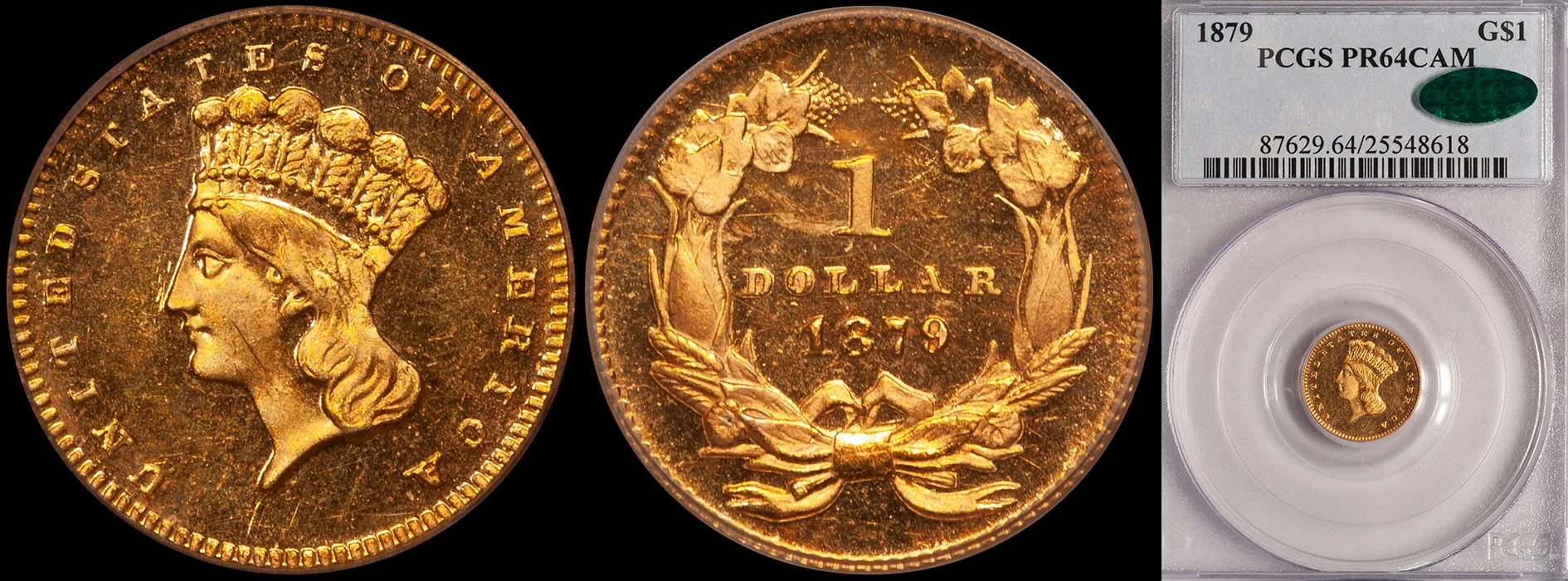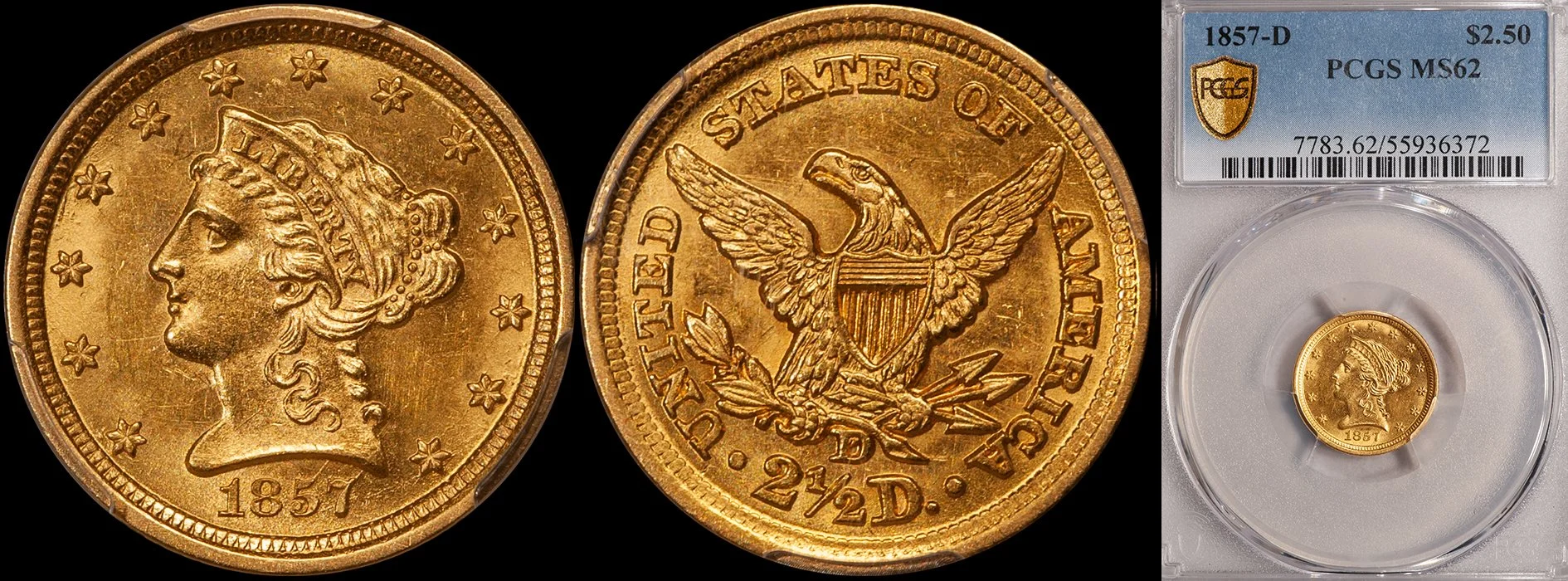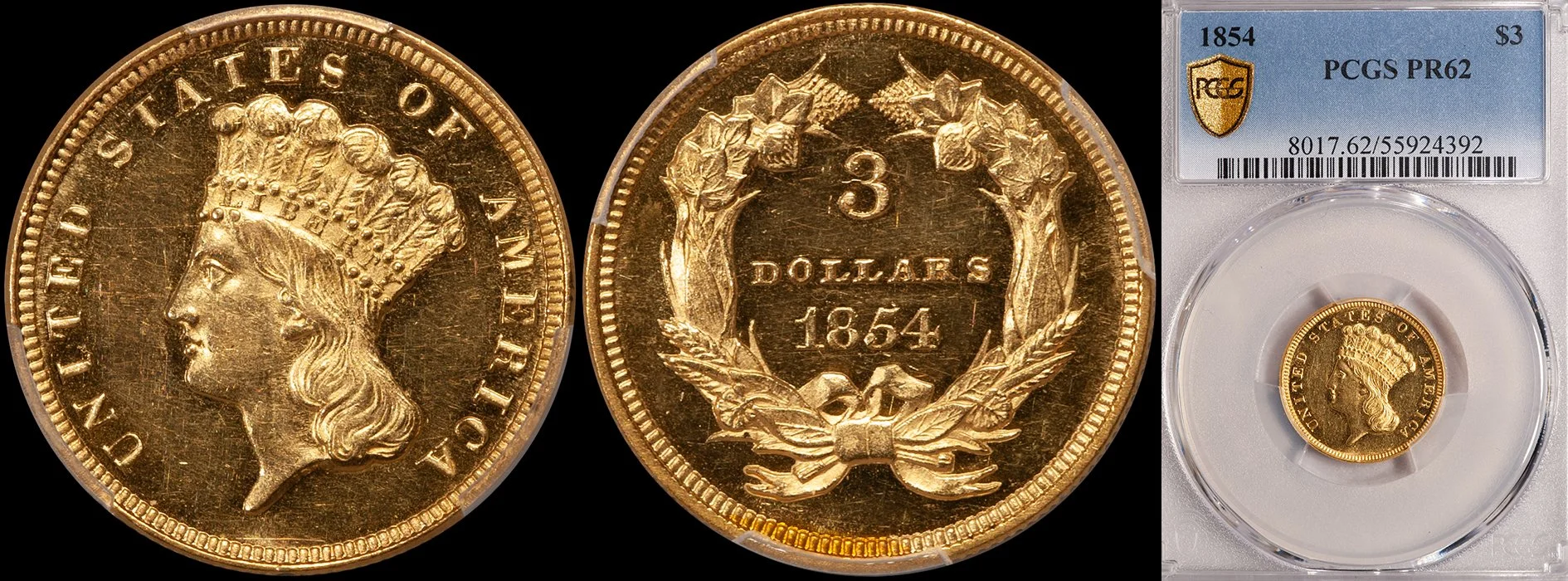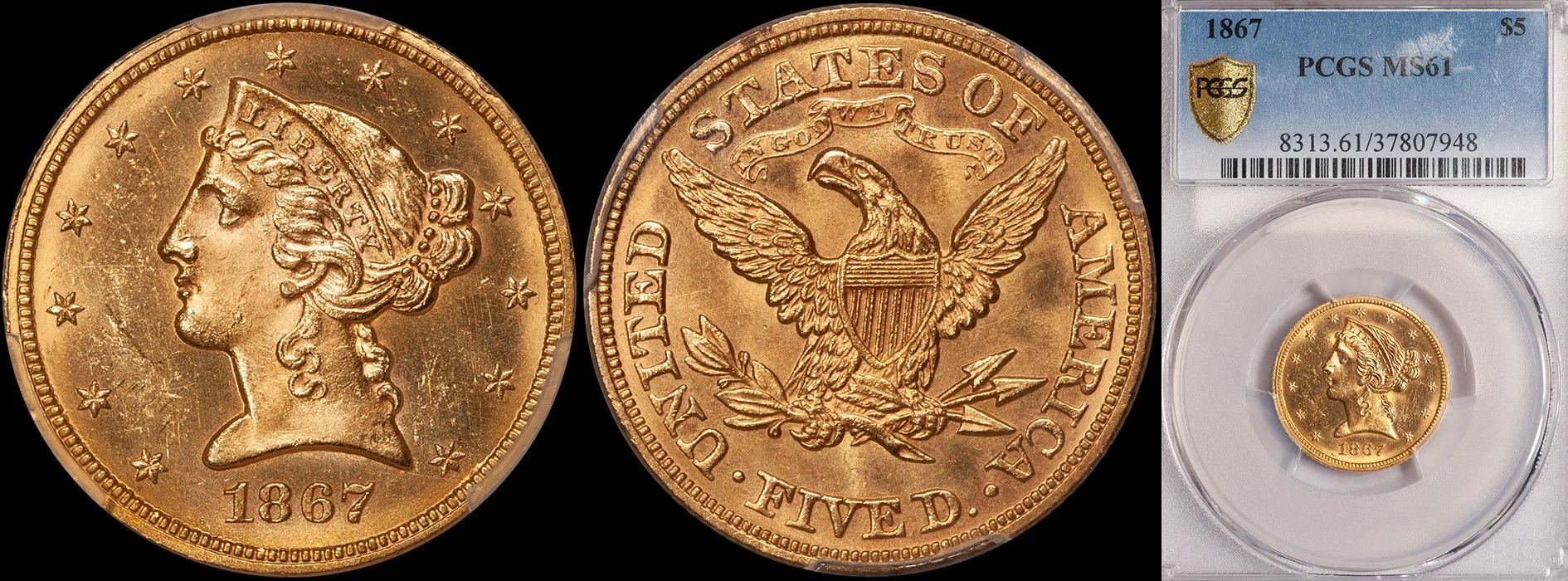
Coins I Never See With Good Eye Appeal Part One: Gold Dollars

As I was viewing auctions lots for Heritage's 2012 FUN sale in Dallas the other day, I got to thinking about a topic that I think most gold coin collectors will find interesting: which issues are really hard to find with good eye appeal. I've decided to begin a multi-part study of this and the first featured series is gold dollars. Eye appeal is a combination of factors that makes a coin visually pleasing. These factors include strike, luster, color and surface preservation. For some collectors, original color is the key component; for others it is a sharp strike. But no matter which component is deemed most important, most sophisticated collectors will be able to agree if a coin has good overall eye appeal or not.

The concept of eye appeal doesn't necessarily go hand in hand with rarity. You can have a rare or very rare coin that, when available, tends to come with good overall eye appeal (an example of this would be an 1828 half eagle). Or, you can have a coin that is merely scarce but which, for a variety of factors, is seldom seen with good eye appeal (an example of this is a 1796 eagle).

Let's take a look at some of the gold dollars that, in my experience, are very difficult to find with good appeal.

In the Type One issues (produced from 1849 through 1854) there are a number of coins that are seldom seen with good eye appeal. The first that comes to mind is the 1852-D. Due to die clashing, this issue is frequently seen with multiple clashmarks that develop into a very "busy" area in the left obverse field. In addition to this phenomenon of strike, most 1852-D gold dollars have been cleaned or processed. I can't recall having owned more than a handful of 1852-D dollars that were cosmetically appealing.

Another Dahlonega issue that is very hard to locate with good eye appeal is the 1854-D. In the case of this issue it is not so much strike as it seems that nearly all known examples have been cleaned or dipped. I would be surprised if as many as ten nice examples were known and I have seen just a few in the last decade.

The Charlotte and New Orleans Type One gold dollars are easier to locate with good eye appeal than their counterparts from Dahlonega. The hardest Type One dollar to locate from Charlotte with good eye appeal is the 1850-C. While relatively well struck and well made, it seems that nearly every piece that I see offered either has inferior luster, "chewy" surfaces and poor color from having been recently cleaned or dipped.

The New Orleans Type One dollars tend to be well made and boldly detailed. Locating examples of virtually all the dates isn't a problem although finding a choice, orignal 1850-O with very good eye appeal can be somewhat of a challenge.

While issued only from 1854 to 1856, the Type Two issues tend to be hard to locate with good eye appeal. This is more true for the branch mint pieces than for the Philadelphia coins.

The 1855-D is the rarest Type Two gold dollar from a rarity standpoint but I have actually seen more nice 1855-D dollars in all grades than I have the 1855-C. The 1855-C is typically found with numerous planchet imperfections, poor strike and bright surfaces from dipping. In the Heritage sale, I saw a nice PCGS AU58 example (which was, in fact, sort of the impetus for the theme of this series of blogs...) and it got me to to thinking how long its been since I'd seen a nice, crisp, wholesome example. I'm not certain I have the exact answer but I do know that the 1855-C dollar in any grade with truly good eye appeal is a rare coin indeed.

The Philadelphia coins of the final type of this denomination (known to collectors as the Type Three) are generally seen with good eye appeal. There are a few issues, though, that can prove to be tricky to find as such.

The 1863 is an issue that was melted extensively. When found in circulated grades, survivors almost always seem to have poor eye appeal. There are a small number of really superb pieces known (around a half dozen Gems that grade MS65 to MS67) but these are off the market in tightly held collections.

While not as well known or as highly valued as the 1863, the 1865 is another issue that is not readily encountered with good eye appeal. As with many of the smaller denomination gold issues of this era, the 1865 typically comes either really nice or really wretched and coins that fall into the latter category seem to be what's available to collectors these days.

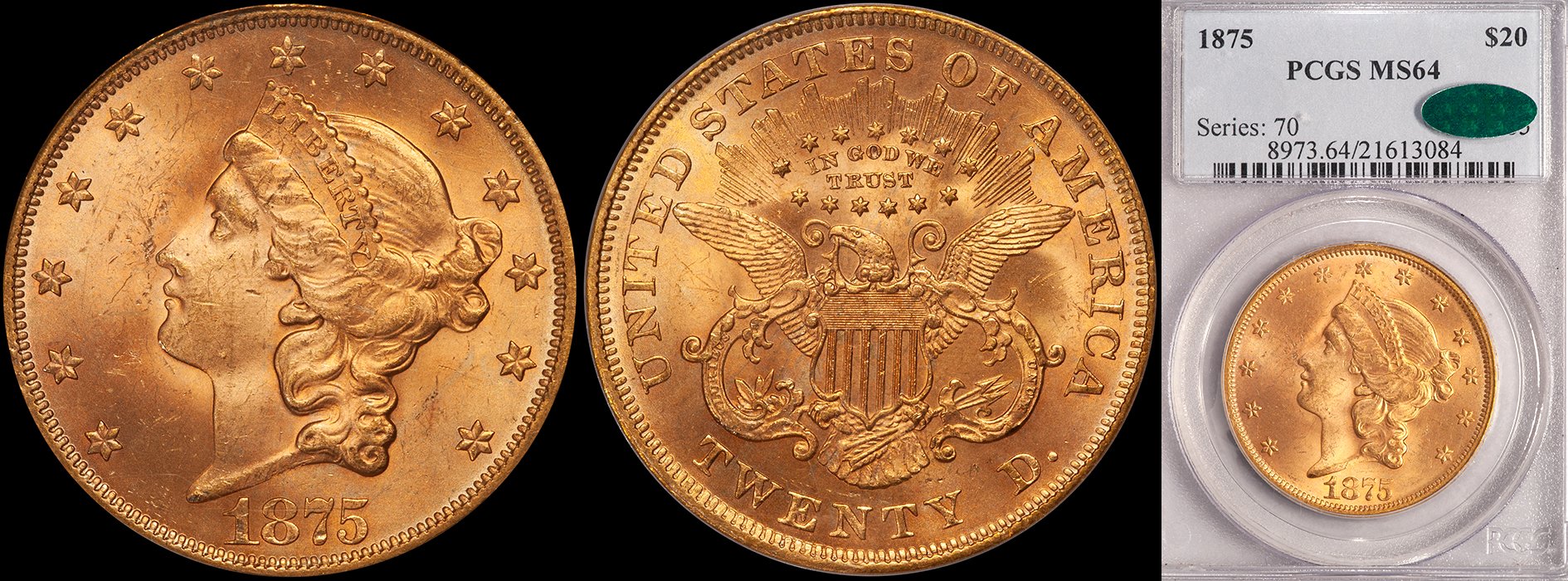
The 1875 is a date that most collectors believe is very rare and, from the standpoint of availability (or lack of it) I couldn't argue. But this is an issue that tends to have good eye appeal when it is available. Due to its low mintage figure of just 400 business strikes, all 1875 dollars are seen with prooflike surfaces. If an 1875 dollar hasn't been harshly cleaned or mishandled, it will have great eye appeal due to the depth of its reflectiveness and bold details.

The hardest Type Three issues to find with good eye appeal are, as one would expect, the coins from Charlotte and Dahlonega.

Only two Charlotte gold dollars were struck during this era (the 1857-C and the 1859-C) but both are hard to find with good eye appeal. This is especially true for the former as this is an issue that is typically seen with planchet waviness, roughness as made and really bad overall eye appeal. I recently sold an NGC AU58 with CAC approval to a collector and, as I told him, it was just about the only really attractive example of this issue that I could recall having seen.

Nearly all of the Type Three gold dollars from Dahlonega are hard to find with good eye appeal but I think the two that are the hardest are the 1857-D and the 1860-D. The former is hard to find due to a combination of quirky strike and hard commercial use. The latter is a much scarcer coin but it is almost always found softly struck and with poor, unnatural coloration.

The San Francisco Type Three issues are short-lived but do not lack for difficultly to locate with good eye appeal. I personally find the 1857-S and 1858-S to be the two hardest dates to find with good eye appeal. Both are typically found with a fair amount of wear and seldom show good color. I haven't seen or handled a nice Uncirculated example of either date in years.

Unlike other series, there are no impossible coins to find in the gold dollar denomination (not counting, of course, the excessively rare 1849-C Open Wreath), there are a number of specific issues that are extremely hard to find with good eye appeal. I'd say that the five toughest to find, in chronological order, are as follows:

-1850-D -1852-D -1854-D -1857-C -1860-D

The next article in this series will focus on Liberty Head quarter eagles. Pre-1834 and Classic Head issues will be covered in another article that focuses on early gold in all denominations.

Any questions about eye appeal and gold dollars? I can be reached via email at dwn@ont.com

Blanchard Sells a Brasher Doubloon for $7.4 Million

While skimming Yahoo yesterday, an interesting coin story caught my eye. And, for once, it didn't involve a coin dealer being shut down by the Feds or a firm being blasted for overcharging its clients. The story involved the sale of a unique variant of the legendary Brasher Doubloon which was just sold by the New Orleans firm of Blanchard and Company for just a shade under $7.4 million dollars. As far as I know, this is the single highest price ever paid for a single United States coin via private treaty and it becomes the second most expensive coin ever sold after the 1933 double eagle that realized $7.59 million at auction in July 2002. The buyer of the coin is currently anonymous but I remember reading that it was a "Wall Street investment firm."

I think this is a very important transaction for a host of reasons, some of which I will discuss here. Before I forget, I'd like to congratulate Blanchard on a fantastic sale and John Albanese in particular for putting together this deal.

In no order of importance, here are some thoughts about the transaction.

1. This sale shows that there is really exceptional strength at the very top of the market. There are not many million dollar coins currently available but I'm willing to bet there are two, three or even four buyers for every seven figure coin that is either available now or potentially available soon. This appears to be the case is nearly all collectibles fields right now. The very best has never been more in demand than it is now and it never has been less available.

2. I find it interesting that the buyer appears to have bought the coin solely as an investment and not as a collector. We have read about Wall Street being interested again in rare coins for a few years now. While the sale was not mentioned as being part of a Wall Street rare coin fund, perhaps it is time to put some more credence in the rumor-driven world of impending (or existing) coin funds.

3. I'm sort of surprised that the final price wasn't set with the thought to eclipse the 1933 double eagle. If you pay $7.4 million for a coin, why not "stretch" a bit and go up to $7.6 million so that you can state that you just set a world record for any coin? Seems like a no-brainer for all sorts of publicity.

4. A Brasher Doubloon is a very esoteric coin despite its fame and I'm pretty surprised that this was the coin that set a record and not something like a 1913 Nickel or an 1804 Dollar. Perhaps the reason that the Brasher sold was that it was the only "big" coin available at a point in time that the client who bought it was looking for a mega-rarity.

5. If this Brasher Doubloon is worth $7.4 million dollars, imagine what some of the other mega-rarities are now, in theory, worth. I have always felt that the single most valuable United States coin was the unique J-1776 MCMVII Indian Head pattern double eagle. My gut feeling was that this coin was worth around $15 million. Now, I think it might be worth $20 million or even more. And the finest known 1804 Class I silver dollar that is owned by the Pogue family? This suddenly seems like a $15+ million dollar coin.

6. As a dealer, I'm now pretty convinced that the theory of "buy a few great coins, price them for moon money and wait until the ultimate client comes along" makes a lot of sense if you have very deep pockets. Its worked twice this year for the dealer who sold the Brasher Doubloon to John Albanese. This same dealer had another seven-figure payday when he sold his 1794 dollar earlier this year. (He and another dealer had bought the Brasher together out of a Heritage sale a few years ago for around $3 million).

7. It will be interesting to see what if any impact this sale will have on Wall Street awareness regarding coins. Will the buyer use it to promote coins as an investment or will it be quietly out away? Will it be shopped for a quick sale or held for years? Will it be motivation to put together a great portfolio (or collection) of coins or viewed as just another item in a pool of investments?

Again, my congratulations to all parties involved in this historic sale.

The Art Basel Fair Versus The FUN Show: An Analysis

I recently returned from a week long trip to Miami where I attended the Art Basel art fair. I went primarily to look at art and to purchase some pieces for my collection but I also went to closely observe what has become the most significant art fair(s) in the world. For a person like myself, who attends many coin shows each year and who had never been to Art Basel, I found the contrast to be both educational and totally fascinating. I thought it would be interesting to compare and contrast the annual Art Basel show with the upcoming FUN convention that will also be held in Florida. For those of you who aren't familiar with Art Basel, I think a little background information is in order. This was the 11th annual edition of Art Basel in Miami and this show is a spin-off of the original fair that is held each year in Switzerland. The main Art Basel show was held in the Miami Beach convention center and it featured virtually all of the leading dealers in the world. I believe there were in the area of 400-500 dealers and I saw booths hailing not only the United States but from all over Europe, Latin America, South America and the Far East.

I could go on and on about comparing/contrasting Art Basel with the FUN show but I will keep the points to a manageable number and try to be as relevant as possible.

*Art Basel is a far more international fair than any coin show I have ever attended. The FUN show is not an especially international show and a better comparison is the NY International show which, ironically, is held at exactly the same time as FUN and which, therefore, is now impossible for me to attend. At various times at the fair, I felt like English was a second language. It was an interesting polyglot of Spanish, Italian, Portuguese, Chinese, Russian and more. The international scope of the attendees and the material at the fair was really, really exciting.

*Art Basel has thematic dealer exhibits; something that is not typically done at a coin show. Because of the theme(s), some dealers at Art Basel had very challenging exhibits (bananas in cars, scattered boulders on the floor, odd video, etc). This was a definite contrast to the FUN show which is more straight-forward.

*A table at the FUN show for the average dealer costs around $1,500-2,500. At Art Basel, I was told that for most dealers, a table was upwards of $50,000 and that some of the prime tables were $250,000 and up. When you combine this along with the cost of attending the show, crating and uncrating the art, setting up and breaking down the booth and countless other expenses, the cost for a dealer to attend Art Basel is staggering. Thus, prices were reflective of this (more about this in a minute...)

*At Art Basel, if you weren't Puffy Combs, an A-list collector or introduced/escorted by a well-known dealer, forget it. I was ignored for three days at the main fair. At the FUN show, the average collector isn't ignored and if he is lucky, he can interact with such luminaries as Q. David Bowers, Mark Salzberg and David Hall. At Art Basel, dealers like Larry Gagosian or Edward Acquavella wouldn't have thrown water on my if I was ablaze (unless I was about to set one of their works on fire; then they would have sent an assistant to douse me).

*The iPad is clearly changing the way collectors and dealers buy and sell art. I noticed that most booths no longer had exhibit catalogs but now used an iPad to show collectors images of artists whose art wasn't on the walls or of paintings they might have had in stock but which they didn't bring. On at least two occasions, I searched for quick information about a specific artist I liked but wasn't familiar with on my iPad. You are starting to see iPads at coin shows but they seem to be more the province of dealers than collectors.

*I paid careful attention to which artists were common at the show and which were not; just like I do at a coin show. I noted an abundance of Leger, Miro, Dubuffet and Picasso. These are artists whose works typically sell for high six figures to well into seven figures. They are the art world's equivalent of High Reliefs or Stellas: expensive, beautiful and with a sexy back story but ultimately common and typically available except in the highest grades.

*Art Basel is a show that celebrates dealers and the relationship between the dealer and the collector. There are no auctions taking place during the show and it is not like FUN that sometimes seems like a huge Heritage auction with the bourse floor thrown-in as an afterthought. Art dealers have strange, conflicted relationships with auction houses and for good reasons. Sotheby's and Christie's are not only openly competing for clients but they also have retail departments, trust and estate planning services, consultation services and offer financing. This situation is a bit different in the coin markets where dealers tend to be able to co-exist, more or less, with the two major auction firms.

*I was surprised at how out-in-the-open deals were at Art Basel. I expected deals to be done in secret areas of each booth or, more likely over dinner but I saw collectors openly writing checks.

*I was also surprised at how poorly marked most booths were at the fair. I didn't expect most paintings or sculptures to have clearly marked price tags but I was very surprised at how few pieces had name tags. I was able to identify some paintings I saw but others, especially those that were from new artists or foreign painters, were unidentifiable. And there were definitely times that I didn't want to ask...

*It was hard to tell how well the art was selling. For whatever reason, many of the A-level dealers appear to think it is tacky to stick a red-dot (equating something is sold) on a $5 million dollar painting. I can certainly see their point but the dealer in me was hoping to have a vicarious thrill or two see a $5 million dollar painting with a red dot next to it.

*One of the major differences between Art Basel and the FUN show was the level of enthusiasm exhibited by collectors at the former. At a coin show, buyers seem excited to be there but at Art Basel the adrenaline level was palpable. Maybe Picassos are just sexier than Dahlonega quarter eagles or maybe I've been to so many coin shows that it's become hard for me to be excited but the buzz at Basel, especially as the week wore on, was great.

*To me, probably the most impressive thing about Art Basel was how it literally changed the entire city of Miami for a week. There were tens of thousands of people at the show and they were not bashful about booking the best rooms in the best hotels, the best tables at the best restaurants and generally pouring money into the local economy. I don't know what the impact of the FUN show is on Orlando but the average person at Art Basel, independent of his or her art purchases, was a lot more lavish than at FUN (where I have seen collectors who spend $25,000 on a coin balk at spending $250 on a nice room).

In case you can't tell, I came away very impressed with Art Basel. It was well-attended, very entertaining (unbeatable people watching!), extremely well promoted and it seemed flawlessly run. The FUN show, in my opinion, is about as good as it gets in the numismatic world but it seemed like a bake sale compared to the fair!

Are Gem Type Two Gold Dollars Underpriced or Overpriced?

I recently bought and sold a coin that I hadn't handled in quite a few years: a Gem Type Two gold dollar. For those of us of a certain age, this is an exciting coin and one that got me to thinking: is this a type that is underpriced or overpriced? My thoughts on this subject follow. Back in the 1980's, my mentor in the rare coin business, Paul Nugget, told me an interesting story about Type Two gold dollars. He said that in the 1970's, Type Two gold dollars were essentially unknown in Gem Uncirculated and were very hard to locate even in what, today, would represent the MS63 to MS64 grade range. I have always found it curious that this once-rare type became so much more available in the ensuing years; a subplot to this story that I'll touch on in a moment.

For those of you who are wondering "what is a Type Two gold dollar," it is a short-lived design type of gold dollar that was introduced in 1854 and replaced in 1856. It features a small Indian Princess portrait on the obverse and it is a type that is notorious for strike-related problems such as clashmarks and weakness at the centers as a result of a flawed design that made it nearly impossible to fully strike up.

The two issues of this design that are seen most often are the 1854 and 1855 Philadelphia dollars. When people refer to "Type Two dollars" as a specific type coin, it is likely that they are speaking about one of these. Type Two dollars were also made, for one year only, in Dahlonega (1855-D), Charlotte (1855-C), New Orleans (1855-O) and San Francisco (1856-S). The branch mint issues are scarce to rare and remain very popular with collectors.

When collecting gold coins by type was in its heyday, the Type Two dollar was the single rarest and most expensive member of the twelve-piece type set. I can remember Type Two gold dollars in MS65 trading for over $50,000; in some cases as much as $55,000 to $60,000.

Today, the same coin is worth $30,000 at most (if the coin is really nice, in a PCGS holder and CAC approved) and more likely around $27,500.

What happened?

As far as I can tell, there were at least four things that occurred, all of which conspired to really hurt this market. The first is gradeflation. When Type Two gold dollars were worth $50,000+, they were superb coins. Today, I see many (if not most) Type Two gold dollars graded MS65 and I go "meh..." The coins range from not-so-nice to decent but very few are what I feel are Gems. This lessening of standards has clearly hurt the market for this type.

The second factor is a change in collector taste. In the 1980's and 1990's, many rare coin firms encouraged new collectors and investors to assemble twelve coin gold type sets. When these sets were in vogue, the Type Two dollar was the key issue. But these firms have stopped selling Gem U.S. gold for type sets and the whole concept has, for all intents and purposes, fallen off the map. When no one is collecting gold type sets, the demand for Gem Type Two gold dollars drops appreciably.

The third factor is an inversion of the classic supply and demand ratio for these coins. A decade ago, there were always people looking for Type Two gold dollars in Gem for their sets but very few coins around. Today, there are few people looking for them but a reasonably large supply. As I write this article, PCGS and NGC have combined to grade 149 Type Two gold dollars in MS65. Even factoring in resubmissions, it is still likely that as many as 90-110 Gem Type Two gold dollars have been graded, not to mention another 37 combined by PCGS and NGC in MS66. Clearly there are not 100 collectors who want Gem Type Two gold dollars.

(Interestingly, the level of demand for branch mint Type Two gold dollars has soared in the last decade. By virtue of being scarce, interesting and numismatically significant due to theit status as one-year types, coins like 1855-C and 1855-D dollars have risen in value--dramatically in the case of the latter--and are far more in demand than high grade examples from the Philadelphia mint).

I think there is one more factor that has hurt the value of this type: its small size. Let's face it, coin collectors are not getting any younger and the typical demographic of collectors who can afford a $30,000 Type Two gold dollar is over 55 and unable to see a coin this small without strong magnification.

Before closing, I'd like to address one point I raised earlier in this article. I mentioned that there is an aura of mystery around Gem Type Two gold dollars. How did a type that was virtually unknown in Gem thirty years ago become a coin that is featured for sale in every major auction these days? Part of it is certainly gradeflation but I think the answer is deeper than this. I don't know for certain but I think there is/was a hoard of high quality Type Two dollars that was quietly and brilliantly released into the market, a few at a time, for years. I don't know the specifics about it but how else can you explain a coin going from virtually unknown to nearly ubiquitous?

So what's my conclusion? Are Gem Type Two gold dollar undervalued or overvalued? Given the current state of the market, I'd have to pick overvalued. At $30,000 or so for a real Gem, they just don't seem like a good buy to me. At $15,000 for an MS65 I am certainly a buyer and maybe even at $20,000 for the right coin. But at $30,000 I'd rather have a nice, well struck 1855-D dollar in Choice AU or a properly graded MS63 1855-O dollar.

Some Thoughts on Proof Gold Survival Rates

As someone who handles a decent amount of rare and interesting Proof gold coinage, I've been thinking about survival rates. I'd like to share some thoughts about typical survival rates and why certain issues don't comply with the "basic laws." First, a little background. The United States mint struck proof gold coins as far back as the 1820's, but production became more established by the 1858-1860 era; which neatly coincides with the beginning of coin collecting as a hobby in this country. Production of most proofs remained small until the early to mid-1880's, when collectors and dealers became more interested and a decent-sized mania for Proofs began to take hold.

For most United States Proof gold coins, I believe that the following survival rates are pretty consistent:

*Pre-1870 gold issues, with exceptions, appear to have a survival rate of around one-third of the original mintage.

*Issues from around 1870 to around 1890, with exceptions, appear to have survival rates of around half of the original mintage.

*Issues from 1890 until the end of the Liberty Head design (1907) typically have survival rates that range from one half to two-thirds of the original mintage.

Let's now take a look at some of the factors that influence survival rates of Proof gold coins. Please note that these are not listed in order of importance.

1. Original Mintage Figures. This seems pretty obvious but it is an important factor that needs to be discussed. A gold issue with a low mintage (say 25-50 coins) tends to be rarer than an issues with a relatively high mintage (100 or more).

However, there are some notable exceptions to this rule.

There are some years that mintage figures are incorrect. An example of this is the 1861 gold dollar with a reported mintage of 349. This figure has never made sense to me and given the small number of survivors (two to three dozen) and the unlikely scenario that nearly all of the supposed "349" struck were melted.

The opposite situation exists with Proof Three Dollar gold pieces dated 1875 and 1876. These are Proof-only issues; i.e, they were made only in a Proof format with none made for business strike purposes. The reported mintage figures for these two dates are 20 and 45, respectively.

But there are probably more than 20 and 45 known of these dates. As an example, looking at the PCGS and NGC population data for the 1876 three dollar, we see that eighty examples have been graded. Even if we discount, say, 30 of these as resubmissions, this still means that 50 examples may have been graded.

It is my belief that both the 1875 and 1876 three dollar gold pieces were restruck, in order to fill a demand among collectors, either later in the year(s) or, perhaps, a year or two later.

2. The Size of the Coin. Small sized Proof gold (i.e., gold dollars and quarter eagles) tends to have a higher survival rare than larger sized coins.

The reasons for this are fairly obvious. The face value of a small gold coin means that it was more likely to survive the Depression era where a number of larger Proofs were spent or melted by collectors because of their high face value and low numismatic value.

3. The Era in Which it Was Struck. I mentioned above that proof gold from the 1890's was saved with greater regularity than those issues from the 1860's.

In the 1890's, coin collecting was a well-developed hobby. But in the 1860's, there were far fewer collectors. It is a known fact that many Proofs struck in the 1860's and 1870's went unsold to collectors and were later melted by the mint. Even if the number melted was not great (say five or ten coins) with issues that mintages of just 25-50 coins, this small number becomes significant.

As far as we know, proofs were still melted up to the early 1900's but not as often as with earlier issues.

4. Economic Issues I mentioned meltings during the Depression in the second bullet point above. This is an important factor, worth repeating.

As remarkable as it seems today, a Proof double eagle in the early 1930's had very little numismatic premium. For some collectors, it made more sense to spend a Proof double eagle from the 1880's then it did to try and sell them to a coin dealer or place them in an auction. Many higher denomination proofs (specifically eagles and double eagles) were lost in this fashion. Some were melted while others circulated so much that they are barely recognizable as Proofs today.

There are other issues that were produced during years in which the economy suffered. The Panic of 1893, while not as well known as the Depression, was a short-lived but highly significant downturn in the economy. It is likely that proof gold coins from 1892-1894 were unsold and melted due to collectors suddenly not being able to afford luxuries such as coins.

5. Contemporary Hoarding Not unlike with today's modern coins, dealers and collectors speculated with smaller denomination proof gold in the 1880's and early 1890's. If you look at mintages for gold dollars, they increased dramatically in the 1880's: from a low of 36 in 1880 to a high of 1,779 in 1889. This was due to significant demand from hoarders and speculators; a situation not all that much different than what we see in 2011 with the hoarding of the 25th anniversary ASE sets!

These issues that were hoarded tend to have higher survival rates than earlier issues, due to the fact that they went into numismatic channels.

How exactly does a collector determine the survival rate of a proof gold issue he is contemplating buying? I think the best way is to study auction appearances over the years. A close study will often reveal interesting anomalies. An example: I recently bought an 1870 gold dollar in PR65. I did a little research and realized that I had only handled one example in twenty+ years and not an especially nice one at that. A study of auction records showed that only a few Gems have ever been sold and nothing better than PR65. My sort-of-cool coin suddenly seemed very cool, not to mention exceedingly rare.

The NFL GM's Theory of Coin Buying

Is it possible that a strategy used by the General Manager of your favorite National Football League team can be applied to building your collection? This might not be as much of a stretch as you are, no doubt, thinking - and I invite you to read this blog and give my theory some thought. Have you ever wondered why some NFL teams select a linebacker in the first round of the draft even though they already have three excellent starters in their line-up and some good backups as well? What were they thinking? They were probably using the "draft the best available athlete" strategy and this can, in my opinion, be applied to your coin collection.

First, a little background is in order here. Some coin collectors have a very clearly defined focus to their set(s). They might collect something like Charlotte quarter eagles by date and they know exactly what they need to complete the set. But many other collectors are not this focused and I frequently get emails from collectors or calls from existing clients asking me "Doug, what set should I be focused on?"

The key word here is "focus" and I feel that focus is something that's very important for a new or advanced collector. Having a focus gives you a sense of purpose as a collector and allows you to see a beginning and an end of your endeavors.

But "focus" means one thing to one collector and another thing to another. Some collectors are exceptionally focused and are excited by the thought of collecting every known die variety and die state of 1798 half eagles; for others this would be torture. So how exactly can the "NFL theory" work for the collector who knows he needs some sort of direction to follow but who doesn't want to follow an overly-narrow course?

Remember what I said earlier about drafting the best available athlete? Well what if a collector's focus was the "best available coin?" This might mean that he wasn't buying a certain Charlotte quarter eagle because it fit into a date set but rather because it was scarce or had a great "crusty" look or it was low population (or a combination of all these factors).

Most collectors have laid some basic ground work for their collections. They might buy just gold coins, as opposed to coins in all metals. Taking this further, what if the collector then decides to specialize in gold coins struck between 1800 and 1900? There are a number of things this collector can now decide to become more focused without becoming too much of a specialist. Some examples might include the following:

-Buying coins priced between $2,500 and $5,000 -Buying coins with a certain sort of "look" -Buying coins with original mintages of less than 10,000 -Buying coins that are in the top 10% of all those graded for the date -Buying coins from branch mints -Buying coins not from branch mints

Its my belief that too many collectors worry about being over-specialized and that, in order to deal with DWN they have to be specialists. This isn't the case.

Coin collecting should be about buying what interests you and what makes sense for your budget. I know of many collectors who are, in a loose sense of the word "specialists" but not in the traditional sense.

Two Cool Proof Civil War Gold Dollars Sold by DWN

1862 graded Proof-64 Deep Cameo by PCGS, CAC approved

Douglas Winter Numismatics recently sold two very rare and very beautiful Proof gold dollars from the Civil War era. These were an 1862 graded Proof-64 Deep Cameo by PCGS, and an 1864 graded Proof-66 Deep Cameo by PCGS. Both coins had also been approved by CAC. I'd like to share some information about these pieces with you and discuss very rare but comparatively affordable Proof gold from this era as well.

The rarity of Proof 1862 gold dollars is not widely recognized, probably due to the fact that business strikes are very common and were minted to the tune of 1.36 million pieces. Proofs are another story with just 35 coins struck for collectors. On the PCGS website, it states that "between 18 and 25 are known," but this number seems high to me given the typical survival rate for small-size gold proofs of this era. I believe that the number known is more likely in the area of 15 to 18, with the average piece grading PR64 to PR65.

As of the end of October 2011, PCGS has graded a total of 17 Proof 1862 gold dollars. This includes seven in PR65 and two in PR66 with no adjectival modifier(s), as well as two in PR64 Deep Cameo and two in PR65 Deep Cameo. NGC has also graded 17 Proofs for this date. Included in this number are four in PR65 and two in PR66 with no modifiers, as well as two in PR66 Ultra Cameo and a single coin in PR67* Ultra Cameo. I believe that these numbers are significantly inflated by resubmissions, especially in PR65.

The finest known Proof 1862 gold dollar is clearly the NGC PR67* Ultra Cameo that was last sold as Scotsman 10/08: 790 ($51,750). It was earlier ex Eliasberg: 50 and it is one of the nicer Proof gold dollars of this era that I have ever seen.

A number of Proof issues of this denomination are challenging to distinguish between Proof and business strike manufacture. This is not the case with the earlier Type Three Proofs. Business strikes from the 1856-1872 era tend to seldom come with the deep, reflective surfaces that are seen on the 1872-1889 issues and these early Type Three Proofs have an overall "look" that is totally different from business strikes of this era.

The 1862 dollar that is illustrated above is a choice enough coin for the grade that I think it merits a paragraph or two to discuss why it is "only" a PR64.

While not necessarily clear on the image, there are a few very light hairlines on the obverse that very narrowly preclude a PR65 grade. How hairlined can a Proof gold coin be to still garner a PR65 grade?

Back in the early days of PCGS and NGC, the grading services were extremely strict when grading Proof gold. A coin with any signs of friction or hairlines (even hairlines that were not from past cleanings) was automatically knocked out of the Gem level and this meant that larger denomination Proofs (specifically eagles and double eagles) were almost never seen in PR65 and were essentially unknown above this.

In today's market, a Proof gold coin can have a few very light hairlines and still grade PR65. But in order to garner a PR66 or higher grade, a coin has to be exceptional. And what about lintmarks or other mint-made features on the surfaces? Lintmarks (which are cause by polishing the blank planchets before striking in order to attain a highly reflective surface) are generally overlooked in the grading process unless they are extensive or they are situated in extremely obvious focal points such as the cheek of Liberty or exposed in the left obverse field.

1864 graded Proof-66 Deep Cameo by PCGS, CAC approved

In 1864, mintages of Proof gold coins actually increased to 50 pieces. Given the severe economic climate of the war-ravaged country, this seems like wishful thinking on the part of the U.S. Mint, and it is likely that at least some of these coins went unsold and were melted.

PCGS estimates that "17 to 22 examples survive." As with many of their estimates, I find them a bit on the high side. My guess for total number known is around 14 to 18, and this is based on the fact that there are only 12 auction appearances for Proof 1864 gold dollars dating back to the early 1990's.

The 1864 gold dollar is rarer than than the 1862 in high grades with at least a few pieces known in the PR62 to PR63 range. It is extremely rare in Gem, and there appear to be around four or five known that grade PR65 and higher grades.

As of the end of October 2011, PCGS had graded seven in all. The best non-cameo was a single PR66, while the best Deep Cameo was the PR66 DC shown above. NGC shows a very inflated population of 16 in all grades. The single highest graded was a PR67 Cameo. They have also graded two in PR66 Ultra Cameo.

The aforementioned NGC PR67 Cameo has never appeared at auction and I have not seen it. The record price at auction is $32,200, set by Heritage 10/11: 4625, which sold for $32,200. This is the exact coin shown above. I bought it for a client in an NGC PR66 Ultra Cameo holder, crossed it to a PCGS PR66 Deep Cameo holder, and received approval at CAC.

This coin has terrific overall eye appeal with deep, reflective fields that are strongly contrasted by the devices. There are a few very small lintmarks (as made), but no hairlines.

It is interesting to note that the collector I purchased this coin for has been working on an 1864 gold proof set for a number of years. The gold dollar was the last coin he needed and the set is now complete. I find this to be a real endorsement of the rarity of the 1864 gold dollar in Proof; given that this collector was able to find the rare (and expensive) eagle and double eagle of this year before he could locate the humble (and more affordable) gold dollar.

Which brings us to the final topic of this blog: it has been said again and again that Proof gold is the "caviar" of American numismatics. There is no question about the fact that Proof gold is an expensive area to collect and that specializing in this area of the market is ambitious, to say the least.

But within the area of Proof Gold, there are pockets of value. I have always liked the smaller-size (dollar and quarter eagle) issues with mintages of 50 or fewer in PR63 to PR65 grades. As an example, the 1862 dollar that I discussed above was a beautiful PCGS PR64 Deep Cameo example with CAC approval. Without knowing the market, would you care to venture a guess of this coin's value? $20,000? $30,000? More?

Surprisingly, I listed and sold this coin in the mid-teens.

Say a collector had a budget of $30,000-40,000 to spend each year on Proof gold. Would he be better off buying a few relatively common coins in exceptional grades (an example of such a piece would be a 1902 quarter eagle in PR67 cameo) or a few very rare coins in choice but not as spectacular grades?

Being someone whose numismatic decisions are typically based around rarity, I'd go with two very rare low mintage coins in the $20,000 range as opposed to one more common but spectacular coin in the $40,000 range. The exception would be if I were putting together a type set of Proof gold and I needed just a single example of each type. Then, I would tend to go with a coin like an 1886 gold dollar in PR66 as opposed to, say, an 1866 gold dollar in PR64.

Do you have questions about Proof gold? Feel free to contact me via email at dwn@ont.com and I would be happy to answer them for you.

Rare Liberty Head Quarter Eagles in the Heritage October 2011 Sale: An Analysis

In their recent October 2011 Pittsburgh auction, Heritage Auctions sold a comprehensive collection of Liberty Head quarter eagles. This collection contained many of the rarities in this series and I'd like to take this time to analyze the coins themselves and the results that they garnered. One of the rarest collectible Liberty Head quarter eagles is the 1841. It has now been decided with near-certainty that this issue, formerly believed to have been Proof-only, was struck in both Proof and business strike formats.

I am of the opinion that the 1841 quarter eagle is still an undervalued coin. There are fewer than 20 known, and it is clearly among the rarest individual dates in this series. If the Liberty Head quarter eagle series were to become more collected by date, I could see a nice example in the PR50 to PR60 range range having a base value of $250,000+, given what other less rare U.S. gold coins are currently selling for.

It was hard to determine if the 1841 in the Heritage sale (graded PR55 by NGC) was a business strike or a Proof, as it had been fairly harshly cleaned at one time and most of the original surface had been stripped away. I actually thought the coin might have been a Proof but would need to see the coin out of its holder to be more certain.

This coin sold for $132,250 including the buyer's premium. I thought that this was a reasonably strong price, considering that the coin was really not attractive. The last example to sell was Heritage 7/09: 1230, graded NGC PR58, which was considerably nicer.

There were some interesting Dahlonega quarter eagles in the sale. The most interesting was a really nice 1854-D graded MS63 by PCGS. It is the second finest known of around five or so in Uncirculated, and this is a date that is scarce in all grades with an original mintage of just 1,760.

This exact coin had appeared in Heritage's June 2004 Long Beach sale (as Lot 6200, in a PCGS MS62 holder) where it brought $34,500. It then appeared as Bowers and Merena 3/10: 3623, in a PCGS MS63 holder, where it sold for $63,250.

I was bidding on this coin in the Heritage sale for a client and before the sale began, I estimated that it would bring around $50,000-55,000. Shortly before the sale began, I realized that this range was too low and I raised my bid accordingly.

I wound-up being the underbidder on the coin, and it sold for a record-setting $86,250. The previous high for this date was $80,500, set by the Duke's Creek: 1511 coin (which I purchased), graded MS64 by NGC and the finest known.

The Heritage sale showed me that the market for very high quality Dahlonega quarter eagles is quite strong. But the market is also very discerning and more sophisticated than in the past. An 1844-D quarter eagle in NGC MS63 was impressive if you look at the numeric grade assigned the coin, but it was softly struck and over-graded in my opinion. It sold for just $18,400; a far cry from the $30,800 it had brought back in May 1998 when it sold raw in the Pittman auction.

I also thought that the nicer New Orleans quarter eagles in the sale did well. A sharply struck 1840-O graded MS62 by PCGS realized $17,250, a softly struck but fresh-looking 1846-O in an NGC MS64 holder was bid to $23,500 and a decent quality but not especially choice 1847-O in PCGS MS63 brought $14,950.

Another major rarity in the collection was a PCGS VF35 1854-S. This coin has the distinction of being the rarest regular issue Liberty Head quarter eagle with an estimated 12-15 survivors. Unlike other very rare issues, the 1854-S is nearly always seen in low grades with only one known in AU (an NGC AU53 that is ex Bass II; 472) and two or three in EF.

I spoke with a number of knowledgeable dealers about the 1854-S in the sale and the reaction was mixed. Nearly everyone agreed that the coin wasn't attractive, and that if it weren't a rarity like an 1854-S quarter eagle it might not have been graded by PCGS. But I think they are missing an important point: very rare coins have always been given certainly allowances by collectors and dealers alike, and in the world of 1854-S quarter eagles, this coin was better than most.

The coin in the October 2011 Heritage sale brought $253,000. This is almost exactly what I expected it to bring.

A damaged "no grade" 1854-S in the Stack's Bowers 2011 ANA sale had just brought $201,250, which meant that the coin in the Heritage sale was a shoo-in to sell for more than this. The best comparable result for an 1854-S was the Heritage 2009 ANA: 224 coin, graded VF35* by NGC, which was sold for $253,000.

If the Heritage 10/11: 4692 coin had been a nicer piece for the grade and still in a PCGS holder holder, I think it would have sold for over $300,000. Its scratched surfaces and lack of overall eye appeal held back the final price realized but, as I said, above this is such a rare coin that eye appeal is not as big a factor as on more common issues.

That said, the NGC EF45 Lee coin (ANR 9/05: 1128) that I purchased six years ago for $253,000 is now looking like a very, very good value.

One final rarity in the sale that I though was interesting was Lot 4716: an 1864 graded AU58 by NGC. For years, the 1864 was perhaps the single major "sleeper" issue in the Liberty Head quarter eagle series. Only 2,824 were made, and business strikes are extremely rare with fewer than three dozen known.

I didn't like the coin in the Heritage sale. In fact, I thought it was an Impaired Proof that had been misidentified as a rarer business strike. The coin brought $40,250 which I thought was a pretty lackluster result, given that Heritage had sold another NGC AU58 for $46,000 as Lot 5333 in their April 2011 auction.

Their were a few other things I noticed about the sale. The first was that the CAC coins typically brought significant premiums over the non-CAC coins. The coins that had CAC stickers were generally nicer than their non-CAC counterparts, and assuming that Heritage sent all the coins to CAC, it wasn't hard to figure which coins were the "best." There were exceptions to this. The aforementioned 1854-D, which should have been stickered as it was really a nice coin, did fantastically and some of the rarities mentioned above (1841 and 1854-S) did just fine without them.

But there some examples of coins in this collection whose value was greatly improved by the presence of a CAC sticker. I'll give you a few examples. Lot 4714 was an 1862-S graded AU58 by PCGS and approved by PCGS. This coin sold for $8,625. In their October 2010 sale, Heritage sold the same date in the same grade but without a CAC sticker for $6,900.

Another strong CAC-generated price was realized by Lot 4715, an 1863-S graded AU58 by NGC. It sold for $9,775. Compare this to the $6,900 that Heritage 12/10: 4325 brought (it was non-CAC stickered) and you'll see the value of the "green bean" to certain buyers.

My overall take on the sale was it did well but was not a "run-away." There were some coins that flew under the radar but very few bargains were to be had. The coins that appeared to sell for low prices weren't very nice. What I found surprising what that some of the coins that were nice but which were "hard sells" seemed to do just fine, even though there are not all that many end-users for them.

Where the %$#@ Are All the High Grade Dahlonega Half Eagles?

As I was reviewing my notes on Dahlonega half eagles this morning, I was struck by something very interesting as I updated Condition Census information: many dates haven't had a significant example sold in three, five or even eight years. This, in turn, made me ask out loud where the (naughty word) are all the high grade Dahlonega half eagles? Hence, the topic of this blog. Of the three primary denominations struck at the Dahlonega mint, half eagles are the most popular with collectors. It is easy to see why. The coins are comparatively large, the series is reasonably short and there are no impossible rarities to stop the collector of average means from attempting to complete a set.

As you might expect, even the common date Liberty Head half eagles from Dahlonega are rare in legitimate Uncirculated grades. If you discount the marginally Mint State coins that pop-up and the few higher grade common dates that have been available, the pool of available coins sold during the last few years has been shallow, at best.

Let's look at a few dates.

The 1841-D half eagle is a rare coin in high grades. There are around a dozen known in Uncirculated. Given that number of coins--and given the fact that this isn't an incredibly popular or numismatically significant issue--this would make you think that higher grade 1841-D half eagles should be available from time. Is this true?

Looking back at auction records from the past few years, the last high grade 1841-D to sell was Heritage 6/11: 4626. Graded MS63 by NGC (and approved by CAC) it brought $27,600. To find another high grade 1841-D (not including a few marginal MS61's and an S.S. New York example graded MS61) you have to go back to the Heritage 2008 ANA: 1965, also graded MS63 by NGC, that sold for a reasonable $18,400. And before this, you need to go back another three years to the Bowers and Merena 12/05: 2685, ex Bowers and Merena 1/05: 1554 coin, graded MS63 by NGC, that sold each time for $25,300.

And what if you only bought PCGS coins? How long has it been since a nice PCGS 1841-D half eagle was sold at auction? You'd have to go all the way back to the Green Pond: 1041 coin sold by Heritage in the 2004 FUN auction for $32,200. That's closing in on eight years (!)

Let's look at another date: the 1849-D. There are fewer than a dozen examples in Uncirculated and if you discount the marginal MS60 and MS61 pieces, the number of possible coins a high grade collector could pursue is around five or six.

The last significant 1849-D half eagle to sell at auction was the Bowers and Merena 2/08: 2544 coin, graded MS62 by PCGS, that sold for $24,150. Before this, there were two PCGS MS62 sales in 2004. Three coins in five years seems like a decent amount of availability UNTIL you do a little research and figure out that the 2004 appearances were the same coin and this piece was reoffered in 2008.

Here is one last example: the 1855-D half eagle. This is a tougher date than the 1841-D and 1849-D in higher grades, but it still isn't recognized as a rarity. There are around six or seven in Uncirculated.

There was a flurry of activity for this issue in high grades around 2004-2005. In fact, there were four auction trades for high grade pieces (three in PCGS MS63 and one in MS64) between the 2004 FUN show and the 2005 Summer ANA. That should have been a great opportunity for collectors, right?

Well, not really. You see, all four records are for the same coin and in the final appearance (Heritage 2005 ANA: 10356, at $38,813) the coin had now upgraded to MS64 (and lost its lovely original color in the process, but that's another story...)

But I digress. This blog isn't about coins re-appearing at auction. Its about coins not appearing for sale with much frequency.

So why don't nice Dahlonega half eagles show up for sale more regularly? I have a few suggestions as to why this is the case.

1. With few exceptions, really "new" Dahlonega half eagles are rarer than you think. You can throw-out the numbers in the population reports (especially NGC) as there are many resubmissions of these coins in Mint State. There isn't a single Dahlonega half eagle that isn't truly rare in MS63 and above and most are very rare even in properly graded MS61 and MS62.

2. The few nice coins that exist are in strong hands. The downward trend in the economy since 2008 hasn't brought more than a handful of significant Dahlonega half eagles onto the market. Clearly, these coins are owned by serious collectors who don't plan on owning their coins for a few years and then "flopping" them. And, surprisingly, this appears to be the case for both date and type collectors.

3. No great collections of Dahlonega half eagles have hit the market in at least five years. In fact, unless I'm forgetting something, the last really great collection to hit the market was Green Pond in January 2004. Contrast this with the prior seven to eight years, when you had James Stack, Milas, Pittman, Bass, North Georgia, Chestatee, Miller and others. Looking back at 1995-2003, this was probably the single most fertile time in the history of numismatics for advanced collectors of Dahlonega. Since 2004, we've seen almost nothing in terms of specialized collections.

(Oops. I am forgetting something: the Duke's Creek collection sale in 2006. But this was only dollars and quarters eagles, not half eagles. So my point #3 is still valid, at least as far as half eagles is concerned.)

4. As the supply of great coins has dried up, the number of avid collectors has increased. I can't think of any time that there was more serious collectors of Dahlonega half eagles than there is now. Clearly, the supply is not nearly enough to meet the current demand.

5. Dahlonega gold is one area where the auction companies haven't completely dominated the market since the mid-2000's. I've sold via private treaty considerably more high quality Dahlonega gold coins than what has appeared at auction. But in the case of half eagles graded MS62 and above, this is still isn't a ton of coins.

6. As I've stated countless times, the price reporting mechanism for rare date gold coins is broken and needs to be fixed. In most cases, published prices for higher grade Dahlonega half eagles are down since 2004 despite what most experts believe to be a strong(er) market. This is partly due to certain schlocky, overgraded coins dragging down levels on specific issues and partly due to published references being unable to keep up with the market.

I don't think we're likely to see many changes in the Dahlonega half eagle market, at least not if prices stay unrealistically low. There aren't a lot of good coins around to begin with and I see no hugely compelling reason(s) right now for owners of such coins to sell them.

So what do you do if you are a collector who is specializing in high grade Dahlonega half eagles? Be patient; the right coins will turn up sooner or later. And when they do, be prepared to pay up for them.

Do you have more questions about Dahlonega half eagles? If so, please feel free to contact me via email at dwn@ont.com.