Some Thoughts on PCGS’ New Secure Plus Program

PCGS recently released the details on their new Secure Plus program. Instead of summarizing it here, I’d suggest that your go to their website and play the video link that will explain their interpretation of the new program. I’d like to share with you some of my thoughts and feelings about it. You can essentially split this new program down the middle and look at it as two distinct facets. To me, the “Secure” aspect is a no-brainer. In a nutshell, PCGS has basically harnessed the technology that will enable them to make a record of all the coins that are submitted to them under this new program. They claim it will end coin doctoring and stop gradeflation in its tracks.

As someone who has been pretty public in his disgust with coin doctoring for many years, I’m glad that PCGS is instituting this program. By the same token, it seems sad to me that a) this had to happen and b) that it took as long as it did. In some areas of the market, there are barely any “original” coins left. PCGS’ step is sort of like making a decision to preserve Bison in 1937: great idea but a little late in coming.

I have always partially attributed coin doctoring, to some degree at least, on PCGS and NGC. If these services had rewarded originality from the beginning and had been really, truly consistent this would have eliminated a lot of the doctoring that has occurred for the last twenty+ years. In the area that I specialize in, United States gold produced from 1795 to 1900, “bright and shiny” has always trumped “dark and crusty.” The irony here is that, finally, dark and crusty is becoming in style. After decades of coins being dipped, dunked, doctored and debilitated (catchy, no?) the coins with character that many people want are exceptionally hard to find.

While PCGS is not really publicizing this, I think the security aspect will be very important in their future efforts to fight counterfeit coins and holders coming in from China. I can’t possibly imagine that some clever guy in Shanghai isn’t already coming up with remarkably good quality early type coins or better date dollars. All it takes is a good distribution system for these to flood the market and by PCGS making it harder for these coins to make it through, that has to be a big positive.

One thing I am a little baffled about is what are we to make of the millions and millions of coins already graded by PCGS? Obviously, the nicest coins are going to be placed into the new Secure Plus holders. But what about the 1% or 2% of the coins that are outright mistakes? What about the coins that people, for whatever reason, decide not to resubmit/regrade? This is going to create a number of secondary markets and it will be certain to cause confusion.

The “Plus” aspect of this new PCGS service is more controversial, in my opinion. What the plus grades will do is to take an area that is already subjective and make them even more so. Now this isn’t necessarily a bad thing. PCGS is essentially decimalizing grading (a subject that I wrote about a number of years ago) and this is something that I believe that very good graders can do. But it puts a lot of pressure on PCGS (and NGC’s) graders to be very consistent and very accurate. Will a PCGS grader who is rushing through a cart full of coins to grade be able to figure whether an early type coin is a 63.8 and follow this coin up with a Saint that he has to determine if it’s a 65.8? It can be done but not easily.

The pricing of Plus coins is going to be very interesting. I’ve written extensively on how broken the price reporting mechanism in the coin market is and how badly it needs to be fixed. So, if we can’t accurately get the value for an MS63 Charlotte half eagle, how are we going to get the value for a 63+? And how consistently graded will the Plus coins be? Will one MS63+ Charlotte half eagle be a 63.7 while another is a 63.9? PCGS expects there to be sight-unseen trading for these coins so I’m hoping they will be graded with enough consistency for this to occur.

Getting back to the pricing issue for a second, it will be very interesting to see how the market values Plus coins in split grades where there is a huge difference in values. As an example, a common date Indian Head half eagle in MS64 is worth around $3,500. An MS65 is worth around $15,000. What does that make a 64+ worth? $4,000? $6,000? 9,000? Until there have been a few hundred Indian Head half eagles graded 64+ by PCGS and they’ve traded I’m not sure that will be a good answer.

It’s been sort of lost in the hype that NGC is working on a plan of their own. I am pleased that NGC is adopting the same plus system that PCGS is. Can you imagine how confusing it would be to have two different grading services using two different grading standards?

I’ve seen a lot of changes in the rare coin market in the last few decades and, for the most part, I’ve been an early adapter to those changes that I liked and believed in. I’m taking a bit of a wait and see approach with PCGS’ new system; mainly because I’d like to see a significant number of newly-graded coins. If I like the system, I will become an enthusiastic convert. But from what I can tell so far, these changes are being done with good intentions and they are destined to have a major impact in 2010 and beyond.

Are Auction Prices Wholesale or Retail?

Until a few years ago, the vast majority of coins that sold at auction were purchased by dealers. It was a safe bet to say that the prices realized at auctions were wholesale and collectors could assume that they would typically pay 10-20% more than what coins were selling for at auction. But this has all changed. One of the key elements to Heritage's rousing success in the coin auction business has been to make sales more collector-friendly. Today, a sizable amount of the coins that sell at auction are going directly to collectors. So, are auction prices now representative of the wholesale or retail markets? The answer is not as easy as you might think...

The answer is actually, as you might have, guessed, "answers." Nothing in the coin market is cut and dry anymore and the new auction market and the prices that coins fetch in an auction conducted in 2010 can have a broad range.

The first thing that has to be analyzed is what coin is being sold. If it's something that's extremely collector-friendly (like a rare date Type One Liberty Head double eagle) the price realized is likely to represent a retail level as it is likely to have been sold to a collector. If it's a widget or a low-end coin that sells cheaply we can assume that a bottom-feeder dealer bought it and the price it brought is clearly at the wholesale level.

The next thing that has to be gauged is the quality of the sale itself. One of the most amazing things about the Bass sales, in my opinion, was the fact that virtually all the coins were bought by dealers. If the Bass sales were to be held today (and conducted by a technologically savvy firm like Heritage) I would venture to guess that over 50% of the coins would be sold for retail as opposed to wholesale prices.

Is the coin in an auction a grading play? (In other words, is it an AU58 in an older holder that would upgrade to MS61 to MS62?) In this case it is a virtual certainty that the coin sold to a dealer. But there is an immediate asterisk that must be applied to the sales price. If the coin is worth $5,000 in AU58 and $13,000 in MS62, it is highly possible that at least two ramblin' gamblin' dealers would pay $10,000-11,000 for the coin. In such an instance, the collector needs to be careful not to assume that just because one AU58 coin sold at auction for $10,000-11,000, the next one(s) will as well.

Auction records are most useful when they occur with some degree of frequency (two or three examples per year) and when any anomalies can be discarded.

Let's say, for example, that a certain Charlotte quarter eagle in AU55 has sold at auction five times since 2007. The prices realized have been $3,500, $3,750, $2,650, $8,000 and $4,000. We can pretty much immediately boot the $8,000 auction record as we can assume that this was a severely under-graded coin with a large spread to the next highest grade(s). We can also boot the $2,650 record as this may have been for an extremely low end coin or it may have been in a "bloodbath" auction that, for a host of reasons, saw very low overall prices in specific areas of the market. This leaves us with three prices: $3,500, $3,750 and $4,000. A quick assumption can now be made that this AU55 Charlotte quarter eagle has a value in the range of $3,500 to $4,000. Another way of looking at this is that the wholesale value might be $3,500 while the retail value might be $4,000.

I have a theory that auction firms give collectors just enough information to do damage to themselves. They provide an archive of auction prices which show what coins have sold for and with a little bit of digging, the collector can determine if the coin sold on the floor, over the phone or to an Internet bidder. But unless someone really follows the market carefully, all of this "information" can do little more than serve as an easy way for the neophyte to make major mistakes. I have long said that hiring an auction representative for 5% is far and away the best value in all of numismatics. This fee (which amount to a whopping $250 on a $5,000 coin) is a small price to pay to have a specialist explain to you why a certain auction record is valid or not valid.

So 700+ words later, I'm back to my basic question: are auction prices wholesale or retail? As you can plainly see, there is no quick answer to this and I urge collectors, new or experienced, not to be lulled into a false sense of security based on what seems like unquestionable information.

America's Forgotten Rarities: The 1842 Quarter Eagle

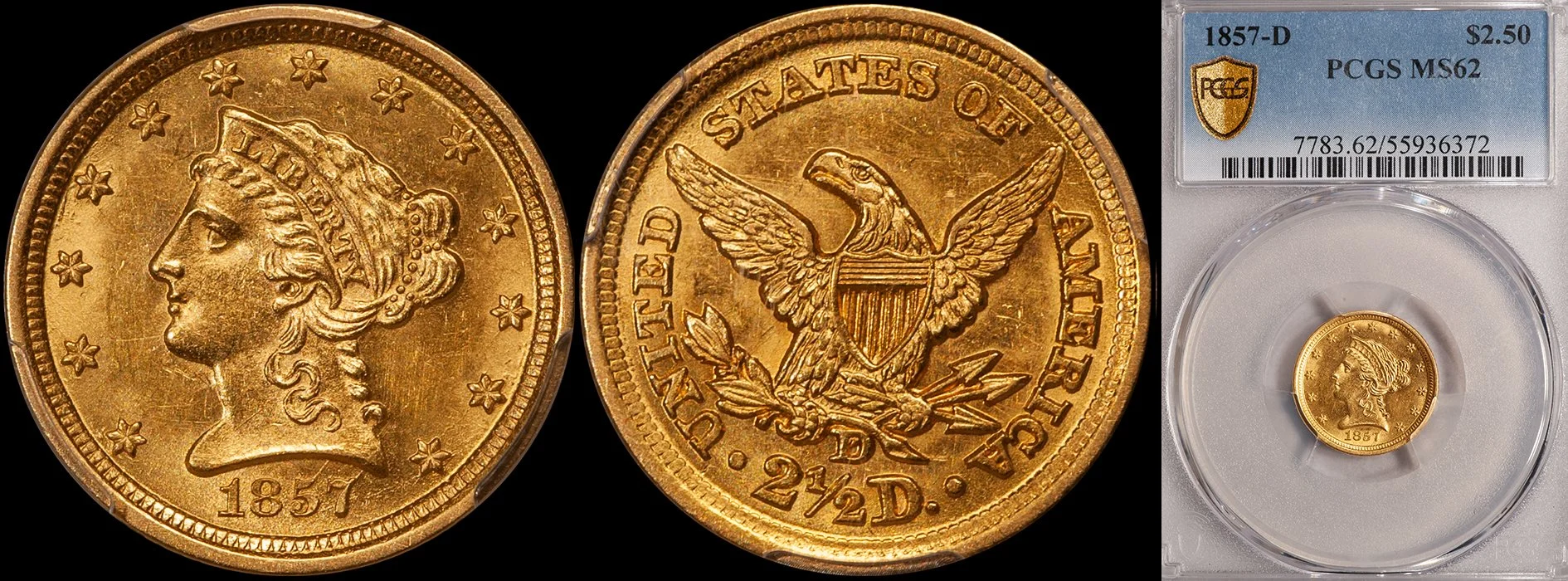
In the second part of this series on coins that I believe are truly rare but not fully appreciated I am turning my focus on an issue that is very interesting to me: the 1842 quarter eagle. 1842 is, in general, an interesting year for quarter eagles. Four mints produced these coins: Philadelphia, New Orleans, Charlotte and Dahlonega. The mintage figures ranged from a low of 2,823 at Philadelphia to a high of 19,800 at New Orleans. With the exception of the 1842-O, all four are quite scarce in any grade and each is very rare in high grades.

Although it is not the most highly valued quarter eagle dated 1842 (that honor goes to the 1842-D), the 1842 is the rarest, both in terms of overall and high grade rarity. There are an estimated 35-45 known in all grades with most in the Very Fine to Extremely Fine range. I believe that there are six to eight in properly graded About Uncirculated and I think this date is unique in Uncirculated.

The most recent PCGS/NGC population figures show a combined total of fifty graded. This includes two in Uncirculated (more on these in a moment...) and eighteen in About Uncirculated. The population figures are, as usual, inflated, especially the AU coins listed by NGC.

This is generally a well made issue which shows good overall detail at the centers and borders. The luster tends to be semi-reflective but most 1842 quarter eagles are either worn to the point that they show no luster or they have been stripped and display little if any original surface. Most of the pieces I have seen have been abraded and at least a few are either damaged from having been scratched or show evidence of rim filing. The natural coloration is a bright yellow gold.

The finest known 1842 quarter eagle is a piece in a Midwestern collection that has been graded MS62 by PCGS. It first came to the market as Superior 9/99: 1863. I bought it for $31,050 and immediately sold it to a collector in Nevada. A few years later, when I handled the sale of his collection, I placed it privately with the Midwestern collection referenced above.

A few quick words about this PCGS MS62 1842 quarter eagle. I think this is one of the truly great Liberty Head quarter eagles of any date. No, its not a Gem. But it is so head and shoulders better than the next finest piece that it is an unbelievably important coin and certainly one of the less well-known but really significant pieces known from this era. Not to mention the fact that it is choice, original and very attractive as well.

There are two nice AU 1842 quarter eagles that come to mind. The first is ex Bass II: 340 where it was graded AU55 by PCGS and it sold for $13,800. I known that this coin subsequently upgraded to AU58 when it was sent to NGC; I am not aware what its current grade is. The other is ex Pittman II: 1736 where it was conservatively graded "XF" by David Akers. It sold for $12,100 and was later graded AU58 by NGC.

I believe that this date is extremely undervalued. The most recent Trends prices are $3,250 in EF40, $5,000 in EF45, $6,250 in AU50 and $10,000 in AU55. As befits a coin of this rarity in high grades, there is no published valuation over AU55.

A quick check of my records shows that I have handled a whopping three 1842 quarter eagles in the last five years with the most recent being a PCGS EF45 that I sold a few months ago to an advanced collector.

I doubt if this date will ever get the attention it deserves. Its a quarter eagle, its a Philadelphia issue and its too rare to ever promote. That said, the 1842 quarter eagle is a coin that I have great respect for.

1842 $2.50 PCGS EF40

America's Forgotten Rarities: The 1863 Eagle

Beginning with this article, I'm going to focus, from time to time, on issues that I regard as "forgotten rarities." These are coins that are truly rare but which, for a variety of reasons, do not get the fanfare that they deserve. I plan on featuring a selected gold rarity once every month or so. The first issue that I want to discuss is the 1863 eagle. I'm going to try to avoid "condition rarity" issues in this series. In other words, I'm featuring coins that are rare in the most absolute sense of the word. And I think the 1863 eagle has this concept of rarity absolutely nailed.

There were only 1,218 eagles produced at the Philadelphia mint in 1863. For all denominations other than the double eagle, mintages were extremely low this year, which makes sense given the economic conditions of the Civil War (at the beginning of the year it was still not readily known if the Union forces would prevail). The low mintage of this issue, combined with a generally low survival rate for gold coins of this era, meant that the 1863 eagle was a rarity from the time it was struck.

I regard the 1863 as the third rarest business strike issue in this entire series, trailing only the 1875 and the 1864-S. I believe that there are around 30-35 known in all grades. As of March 2010, the combined total of coins graded at PCGS and NGC was 37 but this figure is clearly inflated by resubmissions; NGC, as an example, shows eight coins alone in AU58.

The surviving examples tend to be in the VF-EF grade range. Eagles of this era were clearly used in commerce and those that were not later melted tend to show numerous abrasions and signs of rough handling. I can't recall having seen more than three to five 1863 eagles that had original color and reasonably clean surfaces. Many have been cleaned or processed and properly graded AU examples are very rare.

Since 2000, there have been only six auction records for 1863 eagles that have not been damaged, harshly cleaned or ungradable by PCGS and NGC. The most recent record of note was Heritage 1/05: 30496, graded AU58 by NGC, that realized $28,750. This coin was not choice for the grade, in my opinion, yet it was still a bargain given its rarity and comparatively high degree of preservation.

1863 $10.00, courtesy of Heritage

The finest known 1863 eagle is a coin that has been graded MS63 by both PCGS and NGC and it appears in both firms population reports as such. The coin was last sold as Bass IV: 683 for $52,900 in 2000. Harry Bass purchased it out of the 8/91 Mid American sale where he paid a then-strong $104,500. It is one of the very few coins in the Bass collection that was sold at a significant loss and, in retrospect, it was one of the single best values in any of the four Bass sales conducted between 1999 and 2000.

There is a second Uncirculated 1863 eagle. It has been graded MS62 by NGC and it was uncovered in the treasure of the S.S Republic.

The valuation of the 1863 eagle is way off the mark, in my opinion. The most recent Trends shows values of $9,000 in EF40, $12,000 in EF45, $17,500 in AU50, $25,000 in AU55 and $32,500 in AU58. Given the paucity of recent trades, it is hard to state with certainty exactly what this issue is worth. But it seems to me that $12,000 for an EF45 example of a coin as rare as this is very good value, especially when compared to other less rare eagles of this era.

One of the ways that I can determine the true rarity of a coin is by how many that I have handled in the last few years. After checking my records, I see that I have not handled an 1863 eagle since 2005 and I've only had a total of two in the last dozen years. Considering the fact that I've handled probably a dozen 1870-CC eagles in the last decade (if not more), this shows me that the 1863 eagle is an incredible rarity.

I'd love your suggestions about which gold coins are "forgotten rarities." If you have any suggestions for future pieces in this series please email them to me at dwn@ont.com.

Value Compression: A New Trend in the Dated Gold Market

In the past few years, I've noticed an interesting trend in relation to the pricing of rare date gold coins. I refer to this as "value compression." Let me explain what I mean. When I mention this term I am referring to a small price premium between grades. The classic value-compressed issues have long been the Iowa and Roanoke commemorative half dollars. According to the most recent CDN Greysheet , the difference in value between an MS60 and MS65 Iowa half dollar is a whopping $12 (!) while a Roanoke shows a value increase of just $70 between MS60 and MS65.

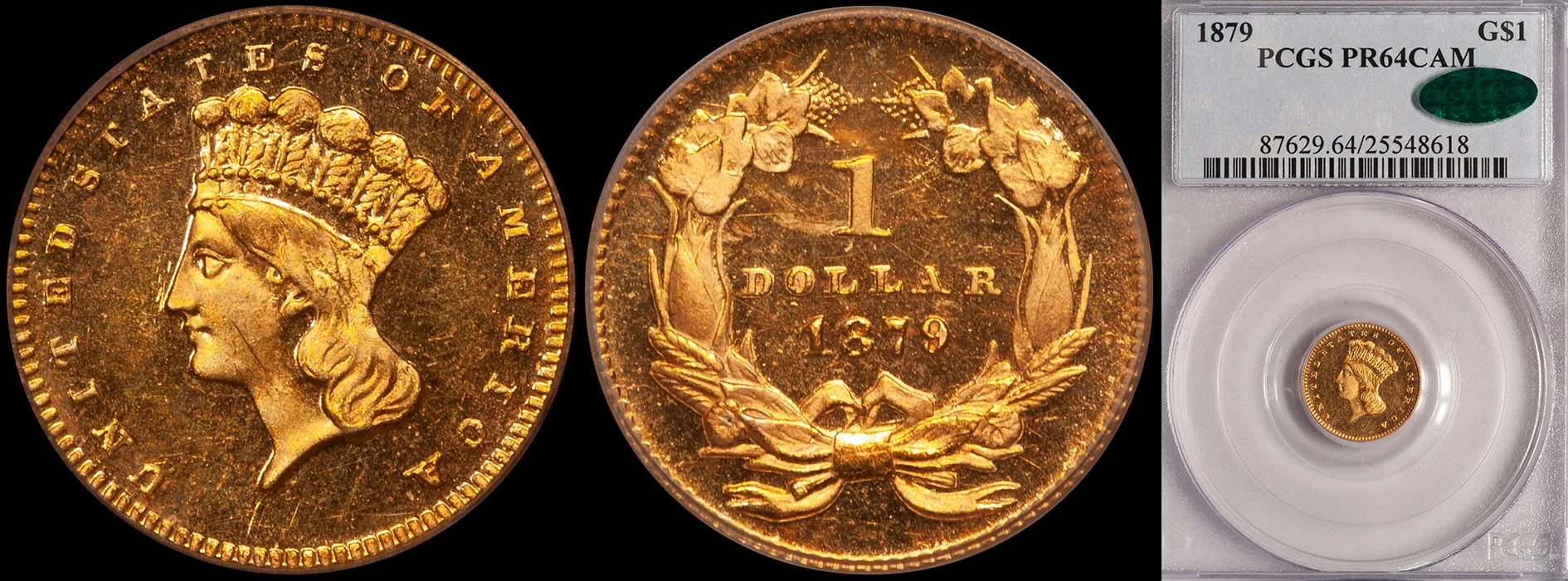
This phenomenon has begun creeping into the United States gold market as well. Areas which appear susceptible to value compression include common date St. Gaudens double eagles, gold dollars, lower grade Carson City double eagles and early gold in the EF45 to AU55 grade range.

Why do values compress in certain series? The most basic explanation has to do with current grading standards and appearance; a secondary reason is based on the actual design and size of a coin.

As an example, an 1851-C gold dollar is a $1,250-1,350 in EF45 in today's market. In AU53 it is worth in the area of $1,500-1,600. Why is there such a small difference for what should be a pretty hefty increase in grade? This is mainly due to the way that these coins are now graded. There is no longer much aesthetic difference between an EF45 and an AU53 gold dollar and the market recognizes this by compressing the price spread between these two grades. In the case of the 1851-C dollar, the value is even more compressed between an AU50 and an AU53 or an AU53 and AU55. Simply put, if a collector can see no discernible difference between two grades, then why pay a premium.

In no series is this compression more evident than with common date St. Gaudens double eagles. If you take a random sample of freshly graded MS62 coins and freshly graded MS64's, there is probably going to be little difference. In fact, the 62's might even be nicer than the 64's. This inconsistency of grade is why an MS62 is currently worth $1,450 and an MS64 is worth just $1,600. Back in the days when there was an appreciable difference between the two grades, there was an appreciable price difference.

I mentioned above that there were other reasons besides current grading conditions that influenced value compression. Two of these are a coin's size and a coin's design. Small coins are hard to see and harder to appreciate differences in quality. It makes sense that gold dollars, as an example, are a series in which values are likely to become more and more compressed as collectors become older and less likely to be able to see a small mark in the obverse field or a tiny reverse dig. Certain coins have designs which makes subtle grading differences very hard to detect. The Iowa and Roanoke half dollars have extremely busy designs which make it hard to detect marks. An example of a gold type with a "complicated" design is an Indian quarter eagle. There are still fairly good-sized price spreads between grades in this series (especially in MS63 to MS64, MS64 to MS65 and MS65 to MS66) but the spreads between lower Mint State coins are small and getting smaller.

I mentioned two other areas that are showing value compression: lower grade Carson City double eagles and early gold. These are interesting case studies for two different reasons.

For an 1875-CC double eagle, the current Trends values for lower grade coins are as follows: VF20 is $1,750, EF40 is $1,850, EF45 is $2,000 and AU50 is $2,250. Think about this: only a $500 spread between a VF20 and an AU50! No matter how sloppy grading gets, there will always be an appreciable difference between the VF20 and the AU50; certainly enough to justify paying an extra $500 for the higher quality coin. I think the value compression is related to two factors. The first is that Trends is behind the market on CC double eagles. The second is that the collector base for an 1875-CC tends to favor an EF or AU coin and shies away from the VF, making for a small demand factor for the low end coin.

Early gold is a bit more interesting to look at. I recently purchased an 1805 half eagle in an old green label PCGS AU50 holder. It was a lovely coin with original color and surfaces and a "lock" AU55 in today's environment. I had to pay $9,250; a strong price but one that I was comfortable. If I broke the coin out of its old holder and it regraded AU55 it would have been worth around $9,500-10,000. Which basically meant that I had around $250-500 upside. My ultimate decision? I left it in the old holder and sold it "as is" for $9,750.

Why are the values of early gold becoming so compressed? I'd have to say its a function of inconsistent grading, especially in the AU grade range. I often see recently graded AU50 or AU53 Capped Bust Right and Capped Bust Left half eagles that appear essentially no different to me than coins in AU55 and AU58 holders. Clearly, other players in this market agree with me and they have adjusted their buy levels up for nice AU coins and down for schlocky ones. Others areas in the early gold market that appear to have the same thing happening are small size Capped Head Left quarter eagles (1829-1833 issues) and Capped Bust right eagles (1799-1803 issues). In the case of the former its a size and design issue; in the case of the latter its clearly a function of grading standards.

My guess is that for the time being you'll see more and more value compression and in some areas that formerly seemed "uncompressable." I already note areas like Charlotte and Dahlonega half eagles where I'll pay more for a really nice crusty EF45 common date than I will for the same issue in scrubbed-up, ugly AU50.

Looking at PCGS/NGC Population Figures of Type Two and Type Three Dahlonega Gold Dollars

A few weeks ago, I wrote an article that analyzed the recent population figures for Type One Dahlonega gold dollars. As I've done more research on gold dollars for my upcoming third edition Dahlonega gold book, I thought I would share the findings for the Type Two and Type Three issues. Read on for some interesting findings. 1855-D: I had originally estimated that 70-80 pieces were known to exist. I think this number may be just a touch on the low side but not by much. There are four Uncirculated examples known to me. Interestingly all of them have seen their grade change by at least one point (in some cases by two) since I wrote the second edition of my book in 2003. The Duke's Creek/Reed Hawn coin has gone from PCGS MS63 to NGC MS63 to NGC MS64 to PCGS MS64. It remains the finest known. A second coin has also been graded MS64 by NGC (ex Duke's Creek and Bass II: 102). Unfortunately, the dealer who owned this coin a few years ago has failed to turn in the extra tags and the NGC population currently shows three examples in this grade.

It is also interesting to note that both the aforementioned examples have shattered the magical six-figure mark at auction. The Hawn coin brought $143,750 in Stack's January 2009 auction while the Duke's Creek/Bass coin sold for $149,500 as Goldberg 2/07: 2094.

1856-D: If anything, I may have overestimated the total number known when I suggested that 80-90 1856-D gold dollars are extant. The grade distribution has changed but this is due to gradeflation and not a result of new coins coming on the market. Many of the four dozen or so coins I estimated to exist in EF grades have no morphed into AU's. I do know that at least one or two fresh Uncirculated coins have turned-up since 2003 including one nice PCGS MS62 that I was offered privately in around 2005.

My estimate of four to five Uncirculated 1856-D gold dollars is probably just a hair too low and today's number is more like six. I have seen three different coins in PCGS MS62 holders but at least one of these (probably the Duke's Creek: 1488 example) has magically become an NGC MS63. The best I've seen remains Green Pond: 1009 which still holds the all-time auction record for this date at $47,150.

1857-D: I'm not certain why but this date seems more available today than it was a decade ago, especially in About Uncirculated grades. My 2003 estimate of 120-130 known in all grades now seems pretty low; especially given the fact that the combined PCGS/NGC population is 189 as of the end of February 2010. Remarkably, the two services show no less than 28 (!) pieces in Uncirculated with twelve in MS62 and another eight in MS61. I think these numbers are quite inflated but I have seen at least five different PCGS MS62 1857-D dollars.

I'd say that the number of truly Uncirculated 1857-D gold dollars has climbed to six to nine based on today's grading. The best appear to be Duke's Creek: 1489 and Heritage 1/04: 1010 (ex Green Pond). Both are in PCGS MS62 holders.

1858-D: My original estimate of 125-150 known was way too low and the actual number is probably close to double this. The PCGS and NGC population figures seem insnaely high in AU and Mint State grades. NGC, as an example, shows 66 in AU and another 35 in Uncirculated while PCGS has a population of 62 in AU and 25 in Uncirculated.

There is some confusion at the higher end of the Condition Census as well. NGC shows two coins in MS66; one is Duke's Creek: 1490 which was previously graded MS65 by PCGS. There is one other superb coin known, ex Heritage 2/99: 6121. I'm guessing that this, too, has found its way into an NGC MS66 holder. PCGS shows two pieces graded MS65. I would assume that they are the two coins listed above in earlier incarnations and needing de-listing although I don't know this for sure. Remarkably, PCGS shows a population of eight in MS63 while NGC shows another seven in this grade. These figures seem very high as do the 21 graded by PCGS/NGC combined in MS62.

1859-D: My estimates on the 1859-D were too low as well although not as dramatically as for the 1858-D. I think there at least 200-250 known and maybe even as many as three hundred total in all grades. Gradeflation has made many of the old EF coins become AU but my numbers for Uncirculated coins hold up reasonably well. I had estimated that 12-17 were known in Uncirculated. I think the number today is somewhere in the range of 15-25.

Unlike with the 1858-D, there are still no Gem 1859-D dollars known. NGC has graded a single MS65 but it is a former PCGS MS64 and the current PCGS MS64 (ex Heritage 9/05: 4258 and Heritage 1/05: 8482) doesn't seem likely to gain further points on the grading ladder (although you never know...) The current PCGS population figures in MS62 are very inflated and all of the NGC figures from MS61 through MS64 are inflated as well.

1860-D: I still believe the rarity of this date has been overstated. My previous estimate was that 90-100 were known and it is possible that even this range was a bit on the low side. It is possible that as many as 100-125 are known. Many of the coins that used to be regarded as EF's are now AU's (this is a very hard issue to grade properly) and the combined PCGS/NGC figures for AU's is an aggressive eighty-four. In my opinion, this figure is way inflated.

I used to regard the Duke's Creek 1860-D as the finest known. It was in a PCGS MS63 holder back in the early 2000's. It later became an NGC MS64 and when I last saw it in 2007 it looked liked it had mingled with a bag of Cheetos as it was flaming orange in color. This coin still shows up on the PCGS report as an MS63 and twice on the NGC report as an MS64 and I don't think it is either. My old estimate of six to seven known for this date seems accurate to me, even in 2010.

1861-D: My estimate of 55-65 known might be just a bit on the low side. There could be as many as 75 known when you factor in the damaged, cleaned or "no-grade" examples that exist. I had tried to figure these in before with the coins I called "VF" (virtually no problem-free 1861-D dollars exist in grades lower than EF45) but I think the number includesd as many as ten extra problem coins. PCGS and NGC have combined to grade thirty in Uncirculated which makes my estimate of ten to twelve in Mint State seem low. The revised number will have to be raised; maybe even as high as fifteen to twenty.

When I did my last Condition Census for this date in 2003, PCGS had graded five in MS63 and one in MS64. These numbers are remarkably consistent today. There is a second MS64; which was earlier an NGC MS65 and before this a PCGS MS63. The NGC numbers are, as usual, a mess.

In my next article on PCGS/NGC population figures for Dahlonega gold coins I'll be focusing on quarter eagles.

"Hey DWN, Why's Your Inventory So Small...?"

I recently received an email from a new collector with a subject line that was similar to the quotation that I titled this blog. At first I thought the question was obnoxious. Then I pondered it a little and realized that it was actually a pretty good question after all. So why is my current on-line inventory so small? I can give you the standard ten word answer but since this is my forum and I'm assuming you actually care about these things I'm going to give you the long, drawn-out multi-part answer.

I own considerably more coins than what you see for sale at any point in time on my website. Colns that aren't on www.raregoldcoins.com might not be listed for a number of reasons. They may be out at PCGS or NGC being graded. They might be at CAC awaiting a blessing from John Albanese. I may have decided to sell them somewhere else other than my website (sometimes for stealthy reasons and sometimes not) or I may have offered them directly to a collector with whom I have an established relationship with.

There are a small number of boutique retail operations (of which I proudly count myself as one) that handle really nice, really rare coins. I'm guessing that most of them are experiencing the shortage of good coins to buy right now that I am. I've already explained, ad nauseum, my reasoning for the current Coin Drought and I won't repeat my reasons here. But I'd be wary of any firm right now with hundreds and hundreds of seemingly cool coins in stock at this point in time. If you are a choosy, fussy buyer like I am, there is no way that you'll have a ton of good coins in stock right now.

Even if we weren't in the midst of Coindroughtapoolza I'd still never have what would be considered a vast, deep inventory. The coins that I specialize in are genuinely rare and that fact, coupled with my personal fussiness, means that I am likely to pass on 95+% of the coins that I see in other dealer's inventories. I promise you that for every Charlotte half eagle in Extremely Fine or Dahlonega quarter eagle in About Uncirculated that I pull the trigger on and buy, I've passed on alot of other pieces that aren't "DWN Quality."

I have always been attracted to rarity and there are not many common or semi-scarce coins that I will buy. This has changed a bit in recent years as I've had to expand my definition of what makes a coin cool enough for me to write a check for it. As an example, No Motto Philadelphia gold coinage has become interesting to me in recent years. The main reasons why this is are that a) the coins are actually available from time to time b) they seem like really good values and c) choice, original examples with nice color and surfaces are more plentiful than, say Charlotte or Dahlonega coins of this era which are often vile and not interesting to me at any price.

There's another reason why I don't want 500 coins in stock at any given time. I am very controlling when it comes to inventory control (sorry for the bad pun...) and I want to know about every coin that I own. I can always tell you what I paid for a coin, where it was bought, its pedigree and anything else interesting about it; without having to look up this information on my computer or having to refer to a spreadsheet. If I had hundreds or thousands of coins I obviously would not be able to do this. As a collector this might not be important to you. But I think it's kind of neat to deal with someone who is really aware of every coin that he owns.

Another reason why I don't list a ton of coins on my website is that I want it to be very user-friendly and easy to navigate. If I had a thousand coins listed at any given time on www.raregoldcoins.com it would become far less simple and elegant to use than it currently is. There is a reason why it is easy to find things on my site. I deliberately don't want you to have to click three links and pull down two scroll-bars just to find Liberty Head quarter eagles. I've designed the site to be exactly what I personally want when I'm looking for things on the web. And there's nothing I had more than cluttered, confusing websites.

So for those of you who want to be overwhelmed by coins on a website, you've come to the wrong place. If you value quality over quantity, I think you'll find my site to be the number one resources for rare United States gold coinage. I look forward to your visits to the site and welcome feedback to make your experience(s) more enjoyable.

Deciding What to Collect

During the last few weeks I've had a similar conversation with a few new and more experienced collectors: what should I be collecting? I've found all the conversations that I have had with these collectors to have a similar unifying theme; at least from the standpoint of the collectors. My observation is that everyone takes the "what should I collect?" question a bit too seriously and expects there to be a rigorous set of rules that they have to follow. I personally think they are forgetting the fact that coin collecting is more about having fun than following a set of rules. If you are reading this on my website, you've probably already decided that you want to collect United States gold coins. Taking this a step further, if you are a brand-new collector (or you are at least new to gold coins) how do you decide specifically what to focus on? Or do you need to focus on anything at all?

There are a number of considerations that come into play. The most obvious of these is your budget. If you are currently comfortable spending $2,500 on a single coin than you should probably recognize the fact that you are eventually going to be comfortable at a higher level; let's say $5,000 or so per coin. If this is your comfortable level, then you have to be practical when choosing an area to collect. Early gold, as an example, will not work for you as very few pieces are available in the $5,000 range. Look at auction records, dealer websites and pricing guides to help select an area that you can afford.

Do you have to put together a set? That really depends on an individual collector's perspective. A few decades ago, nearly everyone collected specific sets by date. But coins were a lot cheaper back then so it was not impractical to decide to assemble a full date set of Dahlonega quarter eagles or San Francisco eagles in high grades. Today, rare coins are expensive and for many collectors it isn't practical to assemble a date set. Or, they may have to settle for very low quality examples of the rarities within their selected set.

But where is it written that you absolutely have to complete a set? Let's say you really like Dahlonega quarter eagles and you've been able to purchase six or seven really nice About Uncirculated common dates over the years. As you draw closer to completion you come to the realization that you are never going to be able to afford the key issues such as the 1855-D or the 1856-D. I look at sets of coins on a regular basis and, to be honest, I'd be a lot more impressed with a partial set of ten Dahlonega quarter eagles that contained very nice coins than a complete set of twenty that had a damaged 1856-D, an 1855-D that was harshly cleaned and a few other pieces that stuck out like a sore thumb.

Something that I recommend to certain collectors is what I call the "best available coin" strategy. This requires thinking outside the proverbial box a little bit but it makes sense to me. Let's say that you've decided on some basic parameters on all the coins you'll be buying. You want all the coins to be gold, you want them all to be dated prior to 1880, you want them all to have original mintage figures below 25,000, you want them all to have PCGS populations of less than 150 in all grades and you want them to grade at least AU50. If you've established these parameters, why limit yourself to coins from a specific mint or denomination? If you see a coin that is choice and original and which fits most (or all) of your strategic parameters, buy it; it doesn't matter if its a San Francisco quarter eagles, a Philadelphia half eagle or a Carson City eagle.

Earlier, I mentioned personal preference and I think this is an extremely important factor in deciding what you want to collect. Buy what appeals to you, not because a dealer is touting a coin or because there is a promotion trying to convince you a series is undervalued. Some people don't like small coins. If you are in this camp, that's fine; stay away from gold dollars and quarter eagles. Some people like big, hefty coins; if this describes you than you are going to naturally be attracted to eagles and double eagles.

There are other factors that relate to personal preference. You may or may not be attracted to a coin because of its design. I personally do not find the Liberty Head gold series to be dramatically attractive from an artistic point of view so I do not derive aesthetic satisfaction from specializing in these coins. Gold coins struck between 1795 and 1900 appeal to me more as a result of their historic significance than their beauty.

As someone who buys millions of dollars of coins every year, I find myself more and more value-conscious all the time. Many coins strike me as poor value. Why? Generally because, in my opinion, I feel that they do not meet the supply/demand ratio that makes sense to me. I find it hard to rationalize getting excited about a $10,000 coin that I can find at any coin show (sorry, Mr. 1911-D quarter eagle...). I like coins that I can only find from time to time and I like coins that have two or three or four eager collectors waiting for each one that comes available.

Popularity is an important factor in deciding what to collect. I'm not saying that you should collect generic St. Gaudens double eagles in MS63 because they have a very high level of demand. But I'm saying that you should be careful about focusing on a seemingly undervalued issue that is a good deal mainly because no one cares. Yes, you might be a brilliant contrarian and you might have stumbled on the next Three Dollar gold piece series circa 2003-2004 (an undervalued series on the cusp of dramatically expanding in popularity) But you may have also found an area that is a marginal deal because no one is likely to care any time soon. Ask a trusted dealer or collector friend what he thinks about your decision(s).

The most important message that I'd like you to take from this is that collecting should be fun and that you should collect in order to satisfy yourself and not others. Sure, I'd like every upscale collector in the United States to collect Charlotte and Dahlonega gold. I'd get to be King of the Market for a few years, retire and start work on that great screenplay I've been kicking around for years. But I respect the fact that C+D gold isn't for everyone. Find what you love, learn as much as you can about it and have fun. After that, it's all easy...

Some "Secret" Varieties of Early U.S. Gold

There are a few relatively unknown but numismatically significant varieties of early United States gold coinage that I think are likely to be included in comprehensive collections of these issues as they become more popular with collectors. Here are a few of the "secret" varieties that I would suggest collectors be on the lookout for. 1798 Close Date and Wide Date Quarter Eagles. Despite this date's low mintage figure, it remains undervalued in comparsion to the other 18th century quarter eagles. There are two distinct varieties known. The more avilable and better known of the two is the Wide Date (BD-2) on which the four digits in the date are quite widely spaced. An easy way to distinguish this variety is by the presence of five berries on the reverse. There are an estimated four to five dozen known in all grades.

The "secret" variety for this year is the Close Date. This variety has only four berries on the reverse. It is very rare in all grades with around two dozen or so known.

1825 Close Fraction and Distant Fraction Quarter Eagles. There are not many die varieties in the short-lived Capped Bust Large Size type of 1821-1827 but there are actually three varieties for the 1825.

Two of the varieties show a distant fraction on the reverse with the numerals relatively far from the fraction bar. The more common (BD-2) has a 5 in the date that leans far to the left and which is placed below the 2. The rarer variety (BD-1) and the 5 more upright and even with the 2. There are as many as 90-100 known of the former while the latter remains very rare and apears to have fewer than ten accounted for.

The third variety of 1825 quarter eagle (BD-3) has the same reverse as seen on the 1826 quarter eagle with a very close fraction where the numerals touch the fraction bar. It is also very rare, although not as much so as BD-1. I would estimate that around a dozen exist.

In the half eagle series, there are many interesting "secret" varieties; enough so that I am only going to mention a few here.

1795 Small Eagle Half Eagles. There are no less than dozen varieties of 1795 Small Eagle half eagles known. To me, the most interesting are the blundered reverse with the the final S in STATES erroneously punched over a D. There are two die varieties known that have this impressive reverse.

The first variety, BD-5, is recognizable by the left side of the 1 in the date touching the curl. It is extremely rare with fewer than ten known. The second variety, BD-6, has the date free of the curl. This is a much more available coin with as many as 75-90 pieces known. The S/D in STATES half eagles do not generally sell for a premium but they have a very high "coolness" factor due to the spectacular blunder on the reverse that is easily visible to the naked eye.

1798 Half Eagles. The 1798 Large Eagle half eagles are fertile ground for variety collectors. There are coins with a Small or "Normal" 8 in the date as well as those with a Large 8. The Large 8 coins exist with thirteen and fourteen stars on the reverse.

The "secret" variety is the 1798 Large 8 with fourteen reverse stars. While this variety already sells for a premium over the more common Large 8 with thirteen stars, what makes it interesting is that there is only one die variety known (BD-3). Only three dozen or so exist in all grades and the importance of this coin as a distinct naked-eye variety is only now being understood by specialists.

1799 Half Eagles. This is another very fertile year for variety collectors with an amazing nine varieties known. Seven of these have small reverse stars while two have large stars on the reverse.

The "secret" variety for 1799 half eagles is the large reverse stars. There are two die varieties known. The first, BD-5, is easy to recognize by the last 9 being too high and recut to the right. There are two to three dozen known. The second, BD-8, has the last 9 even with the first and there is no recutting. This variety is slightly rarer overall and it appears to be extremely rare in high grades.

There are a number of varieties in the half eagle series produced from 1800 through 1807 but these tend not to generate as much collector interest. In a future blog, I will be discussing the ones that have the greatest appeal to me.