The Evaporation of the Premium Factor in the Carson City $20 Market

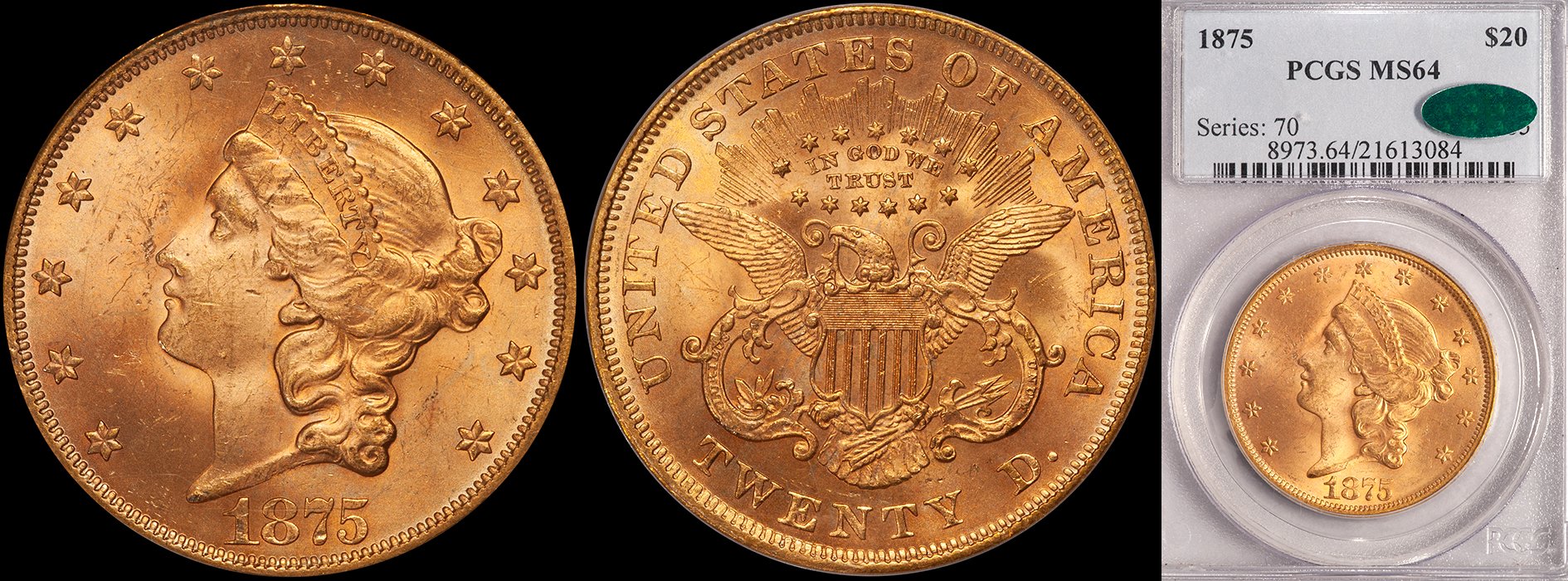
One of the many interesting facts about the rare coin business at this point in time is that the focus in the gold market is clearly on generics and semi-numismatic items and, at least for the time being, off many rare coins. How has this shift of focus affected the Liberty Head double eagle market and, more specifically, the market for common date Carson City issues? I look at common CC double eagles as a sort of bellwether for the dated gold market. The most common Carson City issues (such as the 1875-CC, 1876-CC, 1883-CC, 1884-CC, 1890-CC and 1892-CC) are affordable, exist in enough quantity that they are subject to occasional promotional activities and have a good enough background story that they are easy to sell to beginning collectors.

Traditionally, the price ratio for Extremely Fine and About Uncirculated Carson City double eagles versus generic common dates of this design was around two to one for XF coins and around three to one for AU coins.

A year ago, well before the current soaring gold market, a common 1904 double eagle in Extremely Fine was worth in the area of $700-800 and not an easy issue to sell. The same coin in About Uncirculated was worth just a bit more; say $750-850. At the same point in time, an 1890-CC double eagle was worth around $1,400-1,600 in EF and $2,000-2,250 in AU. This meant that the price ratio for the two issues was approximately 2x in EF and 3x in AU.

Today, this premium ratio has changed, primarily due to the fact that the price of gold has risen to nearly $1,200 per ounce and the demand for nondescript bullion-related double eagles is at an unprecedented high. Right now, a 1904 double eagle in Extremely Fine is worth around $1,500-1,600 while an AU is worth around $1,550-1,650. The market for an 1890-CC in these grades has risen as well, just not as dramatically as a seemingly mundane common date.

In Extremely Fine the current market value for an 1890-CC double eagle is around $2,000 while an AU50 is worth in the area of $2,500-2,750. This means a price ratio of about 1.3x for an Extremely Fine and in the area of 1.7 to 1.8x for an AU.

Why have the premiums for the Carson City double eagle(s) evaporated as much as they have? The answer is simple: the demand for double eagles is at unprecedented levels but the buyers of these coins tend to be unsophisticated investors who want anonymous, cheap coins with as small of a numismatic premium as possible. Even the most Carson City double eagle, like an 1890-CC, is still a numismatic coin and it is hard to convince a dispassionate investor that he should pay a 1.3 to 1.8x premium for two little “C’s” on the reverse.

If the price of gold continues to stay at its current level and demand for common issues remains as strong as it currently is, I do expect a small amount of this frenzy to spill over into coins such as Carson City double eagles. It is likely that the marketers who are selling bulk lots of 1904 double eagles in EF and AU are likely to attempt to “up sell” new investors into the rare coin market as these coins provide greater markups and more profit.

At this point in time I would have to say that common date CC double eagles are a pretty good value and if the price of gold continues to rise, it seems like they are a pretty good “double play” that incorporates the value of nearly an ounce of gold with some real numismatic scarcity. It will be interesting to see where the market premium factor for these coins are in another year.

The Rare and Undervalued 1826 Quarter Eagle

In my opinion, the 1826 is one of the rarest and most underrated early quarter eagles. Most every “fact” that is traditionally associated with this issue is incorrect. I recently purchased a lovely PCGS AU55 example (see the photo below) from the Bowers and Merena Baltimore auction acting as an agent for a collector who is attempting to put together a high quality date set of early quarter eagles. It had been quite a while since I had owned a nice 1826 quarter eagle and this inspired me to gather some facts about this issue. 1826 Quarter Eagle

For many years, the 1826 quarter eagle has been called an “1826/5” overdate. This is clearly wrong and there is a very easy way to prove this. The 1825 obverse die employs large stars while the stars on the 1826 are far smaller. In addition, there is no evidence of an overdate when the date is examined with light magnification. I believe there is either some minor recutting or a small die defect. This issue should more properly be called an 1826/6.

The mintage figure has long been reported to be just 760 coins. Given the fact that around thirty or so exist, I feel that this figure is incorrect. It is probable that some of the quarter eagles struck in early 1827 were dated 1826. The actual mintage figure is more likely in the area of 1,250-1,500; possibly as many as 1,750.

One thing that is certain about this date is its rarity. It is the third rarest early quarter struck after 1797, trailing only the extremely rare 1804 13 Stars and the 1834 No Motto. As I stated above, there are an estimated thirty pieces known. Most are in the lower AU grades, indicating that this issue did not see much actual circulation. I am aware of two or three Uncirculated pieces and none of these, with the possible exception of one coin, appears to be finer than MS61.

The finest known 1826 quarter eagle is in the Harry Bass core collection at the American Numismatic Association. It has an incredible pedigree (Garrett 2: 746, ex Appleton, Mickley) and it sold for $75,000 back in 1980 which remains an auction record for this issue. I estimate this coin’s grade to be at least in the MS61 to MS62 range. The second highest price that I am aware of is $69,000 for a PCGS AU58 sold by Stack’s in their November 2008 auction.

I have personally handled one Uncirculated example, a PCGS MS61 that I sold to a specialized early gold collector around three or four years ago. In all, PCGS has graded fifteen 1826 quarter eagles including three in Uncirculated (an MS60 and two in MS61). NGC has only graded seven in all including six in AU58. It is very likely that this includes a number of resubmissions.

To put the rarity of this issue in better perspective, the 1826 quarter eagle is a considerably scarcer coin than the 1796 No Stars or the 1808. It is clearly not a more valuable coin as both the 1796 and the 1808 are distinctive one-year types that are very desirable as such. The 1826 is clearly the rarest of the five Capped Bust Large Size quarter eagles produced between 1821 and 1827. But, the type collector is likely to select one of the more available dates (like the 1825) which means that the 1826 will probably remain undervalued for the foreseeable future.

The Very Rare 1821 Half Eagle

The Very Rare 1821 Half Eagle I recently purchased an 1821 half eagle graded AU53 by PCGS and I’d like to share some information about a coin that ranks as one of the rarer numismatic items that I have handled in some time. This piece was Lot 3684 in the recent Bowers and Merena November 2009 Baltimore auction where it realized $112,125 including the buyer’s charge. It is now owned by an East Coast specialist who is assembling a set of early gold by date.

The mintage for the 1821 half eagle is recorded as 34,461 but it seems likely that at least some of the coins struck during this year were actually dated 1820. Today, there are probably no more than 15 1821 half eagles known. Two die varieties exist with two different obverses sharing a common reverse (which is also seen on certain varieties of 1820 half eagle). The more common of the two (BD-1) has the final star on the obverse close to the back curl. The rarer (BD-2) has this star distant from the curl and placed higher up in relation to the back curl.

Why is the 1821 half eagle such a rare coin? The answer, as with virtually all half eagles of this type, lies in the fact that nearly the entire mintage was melted by 1834 after the weight of gold coins were reduced. The old tenor half eagles were suddenly worth more than their face value and this led to wholesale meltings. In the case of some dates (like the 1822) virtually the entire mintage was wiped-out. In the case of the 1821, nearly all of the coins were melted as well but a few of the survivors appear to have been set aside intentionally.

PCGS has graded a total of eight 1821 half eagles. This includes three in Uncirculated: MS62, MS63 and an amazing MS66. NGC has graded seven with three in Uncirculated as well: an MS61, an MS63 and an MS66. The PCGS and NGC populations are virtual mirror images of one another and we can assume that there are a number of duplications. Obviously, the MS66 is the same coin and I believe that the MS63 is the same as well.

There are two superb business strike 1821 half eagles known. One is in the Bass core collection at the American Numismatic Association’s museum and it is estimated to grade MS65 or better. It was obtained from Stack’s in October 1971. The other is the Amon Carter: 659 coin that last sold at auction in January 1984 for $24,200. I believe that it is the one graded MS66 by both services.

Remarkably, there are two Proofs known as well. One is in the Bass core collection and it has an impressive pedigree: Norweb I: 773, ex Farouk, Green, Newcomer, Woodin and Randall. It is estimated to grade PR63 and it brought an impressive $198,000 in 1987. The other is in the Smithsonian collection and it is part of a complete 1821 proof set that has been part of the Mint’s collection since it was placed in the Smithsonian in 1838.

The 1821 half eagle that is illustrated above, as I mentioned earlier, has been graded AU53 by PCGS. It is conservatively graded in my opinion and I regard it as at least an AU55 with some claims to an AU58. It is from the Globus collection and it was obtained by this collector via private treaty (probably from Stack’s) at least three to four decades ago. I have not had the opportunity to perform pedigree research on this 1821 half eagle but I am assuming it can be traced to an auction sale from the 1960’s or 1970’s.

The coin has wonderful coloration with rich orange-gold and medium greenish hues that are accentuated by deep coppery hues at the border. There are a few light marks visible including a small semi-circular scrape to the left of Liberty’s eye.

The all-time auction record for a business strike 1821 half eagle remains $155,250 which was what an NGC MS62 brought the Superior 5/06 sale.

It is always a pleasure for me to handle great numismatic rarities such as this 1821 half eagle in PCGS AU53.

Coins with Character

In 2010, you will see a new slogan on the homepage of my website (www.raregoldcoins.com). Besides being catchy, “Coins with Character” represents a philosophy that guides me as a buyer and which I try to impart to collectors. Let me explain what, in my opinion, this expression means. Before the recent November Baltimore coin show, I sat down and made a list of the sort of coins I wanted to make an extra effort to purchase. These were coins that I didn’t already have in stock and given their popularity and ability to sell it made sense to me to reload.

High on this list were nice, affordable Dahlonega coins in the EF40 to AU55 grade range. My parameters were that the coins were choice, original and, in some way, “special.” In other words, I was looking for coins that spoke to me; coins with character.

After a lengthy search through the various auctions, dealer inventories and private collections that I encountered in my three days in Baltimore, I was able to acquire a whopping total of four Dahlonega coins that I felt had character: one gold dollar, one quarter eagle and two half eagles. Was I surprised that my quest would prove so fruitless? Not really. I was, of course, disappointed. But given my parameters for “coins with character” I wasn’t surprised.

I generally try to purchase coins that I believe are in the top 5% known for a particular issue. This doesn’t means that they are necessarily in the top 5% as far as grade goes. What I am looking for are coins that because of one or more reasons would rank among the most desirable survivors of a specific issue.

There are a number of things that give a coin “character.” These include the following:

-Attractive natural coloration. Coloration is a major factor in valuing copper and silver coins but it has been undervalued when it comes to gold coins. This has never been the case for me. I personally love gold coins with attractive natural hues; especially rich rose, green or orange shadings. Now this does not mean that I like every toned gold coin. I see dark, dirty double eagles from time to time that are unattractive and which, quite frankly, I’d probably dip or bathe them in soap and water if I purchased them.

I readily dislike bright, shiny, “processed” coins. To me, a coin that is bright and shiny lacks soul. I like attractively toned coins because of their individuality.

One of the reasons that I don’t buy as much Proof gold as I used to is the fact that most pieces have been conserved and they all look the same. Here’s what I mean. Take a coin like an 1880 quarter eagle in Proof. Only 36 were minted and this issue’s rarity and relative affordability makes it very intriguing to me. But I’ve passed on the last three that I have been offered because they were all bright, monochromatic and character-free. They were the Stepford Wives of Proof gold. Conversely, if I were offered a Proof 1880 quarter eagle with nice original hazy golden-orange color, I’d almost certainly buy it; even if it were “only” a PR63 with signs of a light old cleaning.

-Uncommonly Sharp Strikes and/or High Quality of Manufacture: As someone who buys and sells quite a bit of early gold (i.e., U.S. gold produced prior to 1834) I am pretty knowledgeable about how certain issues are supposed to look. As an example, most 1796 eagles have surfaces that appear pockmarked. This is mint-made but it means that the majority of 1796 eagles are not very attractive. So when I see a 1796 that has smooth, non-pocked surfaces I get excited. On an issue that is typically seen poorly made, a well-made example has “character” in my book.

I feel the same way about strike although I readily admit that strike is not extremely important when it comes to pre-1900 gold coins. But when I see an issue that is notorious for a poor strike with above-average detail, this imparts character as well.

-Important Provenance: The history and romance of collecting is, in many ways, just as interesting as the history and romance of coins. It means a lot to me that an 1838 eagle or a 1797 quarter eagle that I buy has an illustrious pedigree. I have owned coins that have traceable pedigrees dating back to the middle of the 19th century and I find it very exciting that I am able to add my name to the list of illustrious and not-so-illustrious individuals that might have been in a coin’s pedigree chain.

One of the reasons that I really respect collectors of early copper and Colonials is that they value pedigree more than nearly any other segment of the market. It certainly helps that there have been active collectors in these market areas dating back to the 1850’s whereas in an area like branch mint gold, specialized collection began far later.

Would I pay extra for a coin with a great pedigree? For the most part I would. Of course, a lot depends on the coin. I doubt I’d pay any extra for, say an Eliasberg quarter eagle that was an overgraded common date or even a scarcer date that had been dipped or processed after it had appeared in the Eliasberg sale and which now lacked character.

-Coins That Break the Mold: Every dealer has a list of “pet dates” that he or she just can’t resist buying. For some dealers it might be an issue that triggers a sense of nostalgia. For others it might be a date that they have traditionally bought and sold with ease in the past. A pet date for a collector is more likely to involve his perception that an issue is undervalued or it has important historical associations.

I won’t bore you with the full list of dates that I’m a sucker for (there are lots of them, I’m afraid...) but these are coins that I tend to be a little more lax about when it comes to the Test of Character. As an example, I actually bought a damaged 1864-S half eagle earlier this year. It was the first “problem coin” that I have ever listed on my website and if it wasn’t for the fact that it was so rare, I would be never bought it and listed it for sale.

-Coins with Original Surfaces: I thought I would save the best for last. I like original coins (or at least what I perceive to be original coins). When I say “original” I am referring to coins that appear to have not been dipped, processed or harshly clean in recent years. A coin that I describe as “original” could very well have been cleaned fifty or a hundred years ago but it has subsequently acquired natural second generation that might mask underlying hairlines.

Why do I like coins with this sort of look? It all goes back to the original thread of this blog: they have character. It is hard for me to get excited about a 150+ year old gold coin that is bright and shiny. It is hard for me to pinpoint the exact reason why I prefer the original look but suffice to say I do and I will continue to buy coins with character for my inventory.

What Does An Original Early Gold Coin Look Like?

As you no doubt know, I am pretty obsessive when it comes to "original" gold coins. I like coins that have an appearance that suggests that they haven't been fooled with. I recently bought and sold an early gold coin that, in my opinion, was the epitome of an original piece and I'd like to share a photo and some descriptive information. The coin in question was an 1814/3 half eagle graded MS62 by NGC and later approved by CAC.

There are a few things about the color of this coin that are a give-away for its originality. The first is the glow that this particular hue of coppery-orange shows. It is the result of over a century's worth of toning and mellowing of the surfaces. This sort of color just can't be reproduced by artificial means. When chemicals are applied to gold coins in an attempt to recapture a reddish-orange hue, the result is usually a shade that I refer to as "Cheeto Orange." In other words, the orange is just too intense to look real and there is no gradiation or seperation of the hues.

You may also note that the coloration is different in hue in terms of configuration and intensity on the obverse and reverse. On this early half eagle, there are areas in the obverse fields that are dark and somewhat discolored. I'm not exactly certain what caused this but if I had to guess it would be contact with another source like a coin album or some other sort of sulphur-impregated display. Most recolored coins look similar on the obverse and reverse.

Another thing that I have noticed on original early gold coins is that the color seems to become deeper towards the edges. This isn't always the case but this color scheme is hard to reproduce and many of the coin doctors who play with early gold are not sophisticated enough to know that this is the sort of color that develops of a long period of storage in an album. If you pay particular attention to the reverse of this coin, you will note that the golden-orange hue at the center changes to a deeper reddish-orange at the border. If you experienced at looking at early gold you will recognize this pattern as being "right."

Note as well the underlying surfaces on both sides. There is a good deal of luster and the luster still exists in a circular pattern. When a coin has been cleaned, the luster is generally broken and the natural cartwheel that is found on unadulterated coins disipates. When this 1814/3 half eagles is rotated, the luster swirls and it does not "break up" like it would on a coin that has been cleaned and later recolored. A good giveaway for artificial color is when there is a splotch of deep color in a specific area on the surfaces. This is often applied in an attempt to hide a problem in this specific area.

How unusual is it to find an early gold coin with color like this 1814/3 half eagle? Obviously if this were an everyday experience, I would not be writing a blog about it and showing the image of the coin as a textbook illustration for originality. There are an estimated 100-125 known examples of this date and if I had to guess, I'd say there are maybe ten known that fit my standards of "originality." The number of coins with the degree of eye appeal that this shows is another story and I'd be surprised if more than two or three existed.

The Pittman I Sale: Twelve (!) Years Later

One of the most significant auction sales held during the 1990’s was the John Jay Pittman Collection. Conducted over the course of three years and held in three different sessions in Baltimore, the sales were conducted by David Akers and featured an amazing array of United States and foreign gold, silver and copper issues. The first Pittman sale was held in October 1997. It’s hard for me to believe that the twelve year anniversary of this auction just passed as it really seems like it was just yesterday that I flew to Baltimore to examine the coins, bid on the lots and compete against most of the major collectors and dealers in the United States. It was an intense but fun four or five days in Charm City.

Dave Akers astutely concluded that it would be more interesting (and profitable) to split up the Pittman United States issues into two segments and the gold denominations that were featured in the first sale included dollars, half eagles and double eagles. Not including a group of Proof Sets that had gold coins, there were over 500 lots of gold, most of which hadn’t been offered since the 1940’s or the early 1950’s.

I remember viewing the lots and being extremely impressed with the quality. I hadn’t really known much about the Pittman collection except that I had seen his displays of early Proof coins at various coins shows in the 1970’s and 1980’s. I was expecting some very impressive Proof gold (and wasn’t disappointed). It was the business strike issues, though, that intrigued me most and which offered some of the biggest surprises in the days that lay ahead.

The first gold dollar that really caught my eye was lot 863, a superb gem 1854-S that even the notoriously conservative Dave Akers called “Gem Uncirculated” in the catalog. I graded the coin MS66 to MS67 and was amazed by the quality. It sold for $33,000 to a tall dealer from Oklahoma.

The most impressive Proof Gold Dollar was a nice example of the very rare 1854 Type Two which, according to Akers, was one of just four known and one of just two not impounded in museum collections. It brought $176,000 and I graded it a solid PR64. This was one of the coins that Pittman became famous for employing his aggressive bidding technique at the Melish sale in 1956. Legend has it that for this coin (and the Proof 1855 that followed), he went to the podium as it was being sold as raised his arm like the proverbial Statue of Liberty. His strategy proved to be lucrative as he was able to buy the coin in 1956 for just $525; a pretty decent return on investment over a forty-year hold.

My favorite early half eagle in the sale was, without a doubt, the amazing Proof 1833 which was one of just two known and the only one available to collectors. I graded it PR66+ and described it as follows in the catalog: “INCREDIBLE!!!!” It sold for $467,500. In January 2005, the same coin, graded PR67 by PCGS, sold for $977,500. I still regard this as one of the single greatest early gold coins I have ever seen. Just as an FYI, Pittman bought the coin from the Farouk sale in 1954 and paid all of $635.

There were two Proof Classic Head half eagles that weren’t far behind the 1833 on the DW cool-o-meter scale. The first was an 1835 (one of three known and one of two owned by Pittman) and an 1836 (one of three known). The 1835 sold for $308,000 while the 1836 brought $198,000. In January 2005, the 1835, graded PR67 by PCGS, sold for $690,000 while the 1836, as far as I know, has not traded at auction since the Pittman sale.

There were some amazing Liberty Head half eagles in the collection and, interestingly, nearly all of them came from the same source(s): the Farouk sale of 1954 with earlier ownership by Col. Green.

Some of the coins that I remember most include an 1840-C that is now graded MS64 (it has sold at least three or four times since the Pittman auction and is easily the finest known), a superb MS63 1840-O (I have handled it twice since Pittman and it is among the nicest New Orleans half eagles of any date), a killer MS62 1842 Large Letters and an MS64 1844-D (now in the Duke’s Creek collection and easily the finest known).

One really controversial coin in the half eagle section was Lot 981, an 1847 that was essentially perfect but which had a HUGE (and I mean huge!) copper stain on the reverse. Some people absolutely loved the coin while others couldn’t stand it. In the end the “lovers” won out as it brought an amazing $110,000.

Perhaps the number one “sleeper” coin in the half eagle section was Lot 984, an 1847-O half eagle that was graded “Extremely Fine to About Uncirculated” in the catalog. I thought the coin was a nice AU55 and felt it was the second finest I had ever seen, after the Eliasberg/Milas coin. I wound up bidding $18,000 and lost out. It brought $24,200 and was later graded MS61 by NGC where it remains the only example graded Mint State by either service.

One last coin, then we’ll end this overlong remembrance. Lot 1022 was an 1859-D half eagle that I graded MS64 to MS65. I recall speaking with the late Jack Hancock before the sale and discussing this coin. He didn’t say much about it (I knew he loved it as much as I did) and I knew he had a customer who would pretty much pay whatever it took. Jack wound-up paying $60,500 for the coin which is still in the Duke’s Creek collection and which was graded MS64 by PCGS after the auction.

The first session of the Pittman sale brought $11,820,512. I can recall thinking the coins brought “all the money” at the time but looking back at the catalog today I’m struck at how reasonable many of these irreplaceable coins were. What is most stunning, though, is to see the prices that Pittman paid in the 1940’s, 1950’s and 1960’s. If there was ever proof that really good coins held for a long time are really good investment, it was the Pittman sale!

The 1859-S Half Eagle

The date run of half eagles produced at the San Francisco mint from 1858 through 1864 includes some of the rarest and most overlooked gold issues ever manufactured at any of the various branch mints. These were issues that had limited production runs and which were eagerly absorbed into commerce by the booming local and regional economies. I recently had the good fortune of handling one of just two known 1859-S half eagles in Uncirculated (an NGC MS61) and now that I am no longer actively marketing the coin, I thought it would be interesting to take a more in-depth look at this issue and what made it such a special coin.

There were 13,220 1859-S half eagles originally struck. In the October 2008 web article that I wrote entitled “The Ten Rarest Liberty Head Half Eagles,” I ranked the 1859-S as the ninth rarest issue overall of the entire design type and called it the third rarest half eagle from this mint, trailing only the exceedingly rare 1854-S and the 1864-S.

I went on to state that there are only 50 or so known examples of the 1859-S half eagle. I believe that this is a fairly accurate number and I can further state that the survival breakdown by grade is as follows:

Uncirculated: 2 About Uncirculated: 6-8 Extremely Fine: 11-14 Very Fine (and below): 25-30

The PCGS and NGC population figures would have you believe that AU’s are more available than I suggested above. I believe these numbers are inflated on account of resubmissions and I think some of the coins in AU50 and AU53 holders are optimistically graded. In my experience, a real AU 1859-S half eagle is very rare and I have seen many examples that were heavily worn; even down to the point of Very Good to Fine detail.

The two known Uncirculated 1859-S half eagles are an interesting story and I’d like to discuss them in greater detail.

The finest known 1859-S is the wonderful PCGS MS62 example (which also appears in the NGC population report as an MS62) that I first saw in the Milas sale that Stack’s conducted back in 1995 where it brought $34,500. At the time it was in a NGC MS62 holder and while I don’t know the previous history of the coin, I do know that it was a piece that Ed Milas was especially proud of. It was purchased by a dealer agent for Harry Bass who, in retrospect, was the ideal new owner. It remained in his collection until he died and was later sold as Lot 1118 in the Bass II auction where it realized $30,800. The coin bounced around for a few years and was last sold as B+M 1/02: 694 where it garnered a reasonable $25,300.

The second Uncirculated 1859-S half eagle is an NGC MS61 that I just sold to a private collector. I acquired it from a collector at the ANA show in Los Angeles this summer. The background of the coin is interesting.

According to the collector, it was bought over the counter at a coin shop and was accompanied by a small envelope of the sort that used to accompany gold coins when they were given as Christmas presents. The collector first showed me the coin around three years ago and asked me if I was interested in obtaining it. I replied that I was. It wasn’t going to be an easy transaction, though, as the collector wanted to trade it for something “really special.” I saw the coin once a year in the interim and the collector continued to hold out for the right coin in trade.

I finally bought a coin this summer that excited the collector and, luckily for us, we were able to agree on respective valuations. He walked away with an amazing one-of-a-kind piece for his type set while I was able to procure one of the more exciting No Motto San Francisco half eagles that I’ve handled in a number of years. It seemed like a “win-win” deal for both of us.

Given the relative unpopularity of San Francisco gold, this incredible Uncirculated 1859-S half eagle will likely never receive the attention that it deserves. But it is a truly remarkable coin and, as I mentioned above, one of just two known in Uncirculated. I was excited to handle it and it makes me realize that, every now and then, a truly great gold coin does, literally, come out of the woodwork!

The Great Branch Mint Gold Popularity Contest of 2009

I realize that the title of this blog sounds like an outtake from the Dukes of Hazzard but I thought it might be an interesting topic to take each branch mint and analyze it in terms of its popularity. Then, for the icing on the proverbial cake, I thought it would also be interesting to name the five or so most in-demand issues from each mint. Just as an FYI, I am not including Denver among the five branch mints as it is relevant only to 20th century issues and this article is primarily focused on 19th century gold coinage.

1. Dahlonega: At this point in time, I’d have to rank Dahlonega as the single most popular of the branch mints. I am basing this on the following observation. Dahlonega coins, at least for me, seem to be as easy to sell now as they were a few years ago. There are certainly exceptions to this rule; namely overgraded examples priced in the $10,000+ range, high grade common date gold dollars priced at $10,000 and above and virtually any coin in any price or grade range that is not at least fairly original and appealing. But nice, properly graded and fairly priced D mint remains a best-seller for my firm.

I would have to rank half eagles as the most popular coins from Dahlonega right now, followed closely by quarter eagles. The price range that seems most in-demand is $1,500-5,000 but expensive Dahlonega gold will sell if it is a scarce, popular issue or if the coin is very high end. Coins with good pedigrees are popular right now and this is clearly an area in the market where many collectors are searching for CAC-quality coins.

The Five Most Popular Dahlonega Gold Coins in 2009: 1861-D gold dollar, 1854-D three dollar, 1838-D half eagle, 1839-D half eagle, 1861-D half eagle.

2. Carson City: As recently as a year or so ago, I would have placed Carson City as the number-one most popular of the branch mints. I’ve noted a slight slippage in popularity in this mint, especially at the high end. I think the reason for this is that a few of the collectors who were buying the five-figure rarities and condition rarities a few years back are less active. Another thing which has hurt this segment of the market is the number of extremely overgraded higher grade coins that have been floating around from auction to auction for what seems like an eternity. The problem with these coins is that when they do finally sell, they sell cheaply and this drags down the price of nice coins.

Carson City double eagles remain the most popular denomination from this mint, followed by eagles and half eagles in that order. Coins that are attractive and original and priced at $5,000 and under are the quickest movers while expensive Carson City coins, unless they are fresh to the market or really exceptional, tend to be harder to sell right now.

The Five Most Popular Carson City Gold Coins in 2009: 1870-CC half eagle, 1870-CC eagle, 1873-CC eagle, 1870-CC double eagle and any common date or slightly better date double eagle in the AU58 to MS62 range that is choice for the grade and priced below $10,000.

3. New Orleans: There’s no doubt in my mind that New Orleans gold is no longer “up and coming.” It is clearly a very popular segment of the branch mint market and I think there are probably just about as many collectors working on specialized sets of New Orleans gold as there are in any other area of 19th century American gold.

Double eagles were, until recently, the clear favorite among the many gold denominations from New Orleans. I think the popularity of this denomination has faded just a bit in the last year, mostly due to the prohibitively high price of the rarities in the series. That said, these are still the most popular New Orleans gold coins, followed by eagles, half eagles, quarter eagles, three dollars and gold dollars.

There are many New Orleans issues that can still be purchased in relatively high grades (EF and AU) for less than $5,000 and these are increasingly popular. The major rarities from this mint remain in demand, especially in the eagle denomination.

The Five Most Popular New Orleans Gold Coins in 2009: 1839-O quarter eagle, 1841-O eagle, 1883-O eagle, 1856-O double eagle, 1861-O and 1879-O double eagle (tie).

4. Charlotte: In my opinion, demand for most Charlotte gold coins is fairly light right now. There are exceptions to this. Attractive, lower priced half eagles (in the $2,000-4,000) range seem to be selling nicely and very high end half eagles with a great appearance are selling as well. The area that is weak in this end of the market is the bright-n-shiny AU55 to MS62 coins. No surprise, there....

Quite frankly I’m a little perplexed that this area of the market has remained soft for the better part of a decade. There are very few major Charlotte collectors from this part of the country and this was the case even a few years ago when the banking industry was booming in Charlotte. When I released the third edition of my Charlotte book a few years ago this gave a bit of life to the market but it still lacks the overall enthusiasm seen in the Dahlonega market.

The Five Most Popular Charlotte Gold Coins in 2009: 1838-C quarter eagle, 1838-C half eagle, 1839-C half eagle, any very original crusty XF common date half eagle priced below $3,000.

5. San Francisco: Every time I undertake an article like this that ranks the branch mint’s popularity, poor San Francisco always seems to finish last. This doesn’t make total sense to me. The city of San Francisco is by far the most upscale and “art/collectibles-friendly” of the branch mint locales, the coins are interesting and there is some real value for the money within this collecting area.

There are certainly some bright spots in this area. Type Three San Francisco double eagles are very actively collected and many of the Type One and Type Two issues from this mint are still in demand as well. I think two factors have combined to work against this mint in terms of its popularity: the lack of a good standard reference book and the fact that the various shipwrecks found in recent years have scared people away from purchasing high end coins from this mint.

The gold coins from this mint that seem to be in the highest demand right now are 1854-S quarter eagles (a Classic Rarity that has finally been appreciated), choice and rare issues from the Civil War era and better date eagles grading AU50 and above.

The Five Most Popular San Francisco Gold Coins in 2009: 1854-S quarter eagle, 1864-S half eagle, 1864-S eagle, 1854-S double eagle, 1861-S Paquet double eagle.

As you can well see, there is a pretty common theme with each of these mints. In 2009, most of the collectors of branch mint gold are sophisticated and they are back to buying real coins; not just the plastic that houses them. Collectors want coins that are either choice for the grade or rare enough that they know their opportunities to find another will be limited.

The 1810 Half Eagles

In a recent blog about undervalued early gold issues, I mentioned that the half eagles of 1810 were confusing enough (even to a specialist such as me) that this tends to suppress values for some of the rare issues that are known from this year. Let’s take a more in-depth look at the various 1810 half eagles. There are no less than four varieties known for the 1810 half eagles and each is distinctive. Two are reasonably available, one is very rare and the fourth is an extreme rarity.

1. 1810 Small Date, Tall 5. BD-1, Breen-6462, Miller-114. This is the second most available variety of the year. Dannreuther estimates that there are 150-225 known from an original mintage of approximately 20,000-30,000 coins. I think his number extent may be just a bit on the low side. This variety is reasonably easy to locate in all circulated grades although choice AU’s with original color and surfaces have become quite scarce. In Uncirculated, the 1810 Small Date, Tall 5 is quite scarce with an estimated five to six dozen accounted for. The finest known is a coin graded MS65 by PCGS that I have not personally seen. There are four to six known that grade MS64.

The Small Date variety can quickly be identified by its having the flag of the 1 in the date being at a steep angle that points downwards. The overall date size is also noticeably smaller than the Large Date. On the reverse, the 5 is placed low in the field and it appears to rest on the denticles. The three denticles below the 5 appear to be shortened and this exact reverse is found on the 1811 BD-1 half eagle.

2. 1810 Small Date, Small 5. BD-2, Breen-6461, Miller-111. This is the second rarest variety of the year. Dannreuther believes that 25-30 are known from the original mintage of approximately 2,000-4,000. Based on the total number that have appeared at auction during the last decade as well as the total number graded by PCGS and NGC (a combined eight coins with definite duplication) I would have to think there are fewer than this. The 1810 Small Date, Small 5 is very rare and much underappreciated. It is generally seen in lower grades and I am aware of a handful that are either damaged or have problems severe enough that they cannot be graded by PCGS or NGC. The probable finest known is an NGC MS62 that is ex: Stack’s 6/08: 2077 where it brought $138,000. PCGS also shows an MS62 having been graded; this may well be the same coin.

The obverse of this variety has previously been described as being the same as on BD-1 but it is slightly different. On this, the 1 is centered over the space between two denticles; on BD-1, the 1 is centered just about over a denticle. On the reverse, the 5 is distinctly smaller than on the Tall 5 variety and it is far from the denticles. The exact same reverse is found on the 1810 Large Date, Small 5 (BD-3)

3. 1810 Large Date, Small 5. BD-3, Breen-6460, Miller-110. This is by far the rarest of the four varieties and it is among the rarest early United States gold coins. Dannreuther estimates that just four to six are known from the original mintage of approximately 500-1,000. I agree with his numbers. On this variety, the configuration of the 1 in the date is different than on the Small Date. The Large Date has the flag of the 1 almost at a horizontal point. The date is also considerably larger with the 181 appearing to be equally spaced but the 10 looking closer. The reverse is the same as on BD-2 and is described above.

Recent population data for the 1810 Large Date, Small 5 confirms this coin’s extreme rarity. NGC has not graded a single example while PCGS claims to have graded two (both MS63) but I, for one, am highly skeptical that there are two known in Uncirculated.

If the Capped Bust Left half eagle series were better known and more widely collected, this coin would almost certainly have acquired semi-legendary status at this point. As it is, the 1810 Large Date, Small 5 is a coin that specialists regard as one of the most important rarities of this era.

4. 1810 Large Date, Large 5. BD-4, Breen-6459, Miller-109. This variety is the most common of the four 1810 half eagles. Dannreuther estimates that 500-750 are known from the original mintage of approximately 75,000-90,000. It appears to be at least three to four times more available than the 1810 Small Date, Tall 5.

This variety has the same obverse as the very rare Large Date, Small 5. It has a different reverse and the designation of this reverse has been the cause of a great deal of confusion over the years. The 5 in the date is actually less tall than on the Tall 5 (BD-1) but it certainly can’t be called a “Small” 5 given its size. Harry Bass referred to it as a “Fat” or “Squat” 5 and this is far more accurate.

There are a few really superb examples known. PCGS has graded an example in MS66 as well as an MS65 while NGC shows two in MS66 and five in MS65. I believe that there are as many as 250-350 known in Uncirculated with most in the MS60 to MS62 range.

To the best of my knowledge, the only collectors to have ever assembled a complete set of 1810 half eagles are George Gozan and Harry Bass. Remarkably, Bass had two examples of the ultra-rare 1810 Small Date, Small 5.