"I Know What I'm Going to Collect. What's Next?"

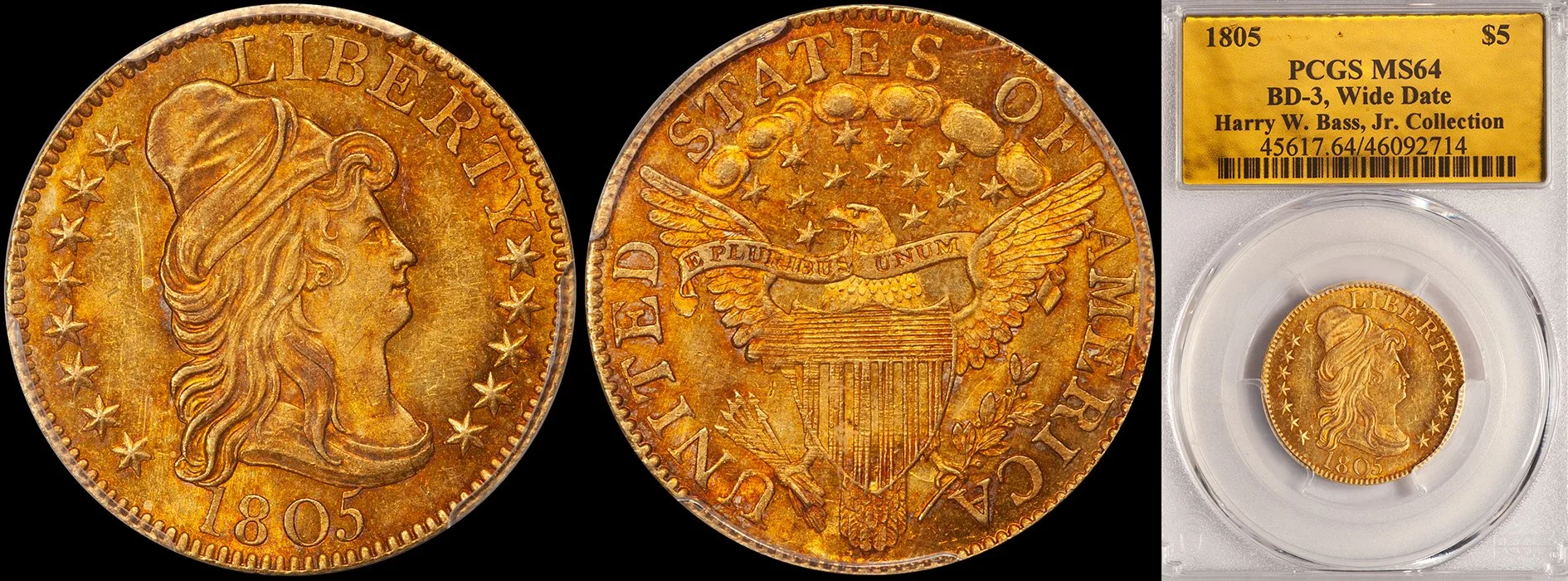
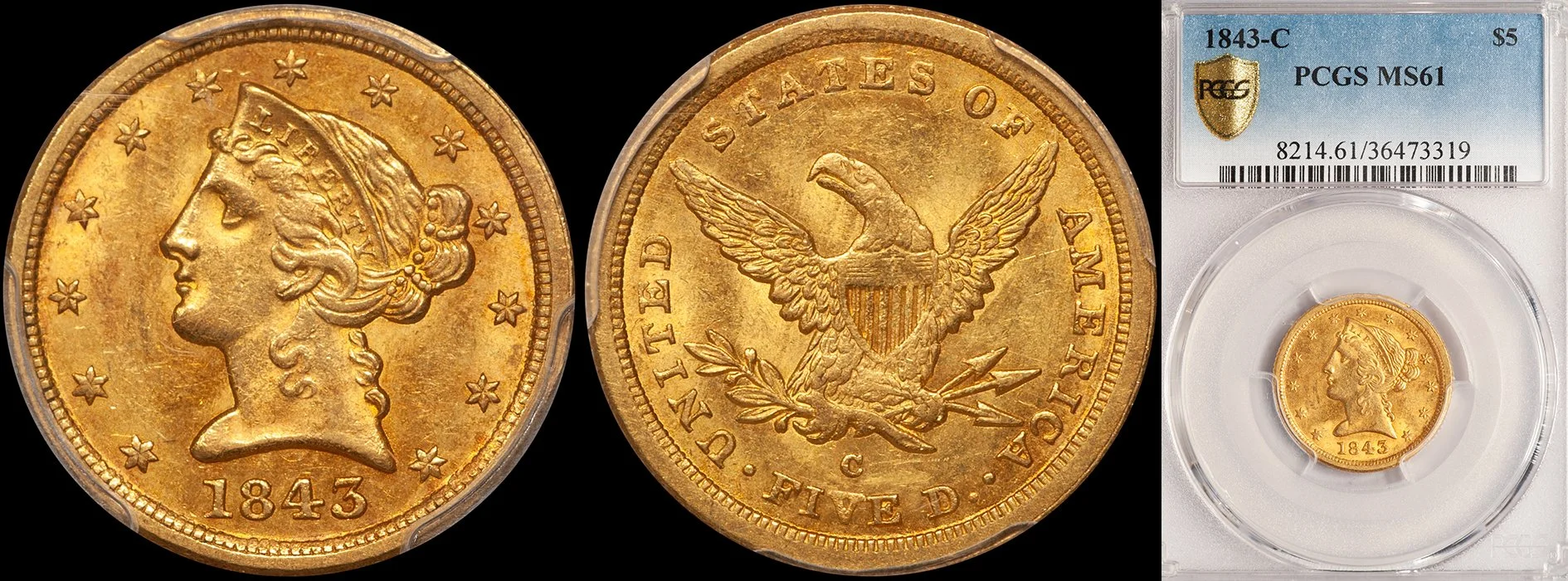
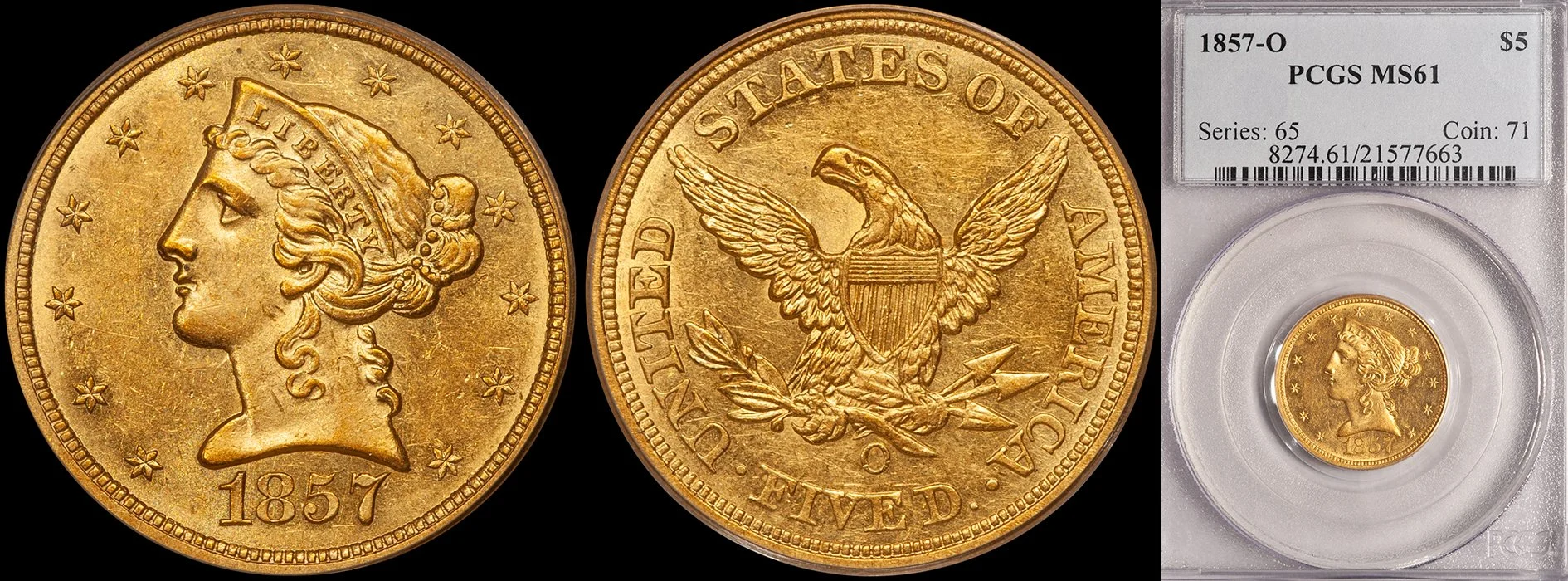
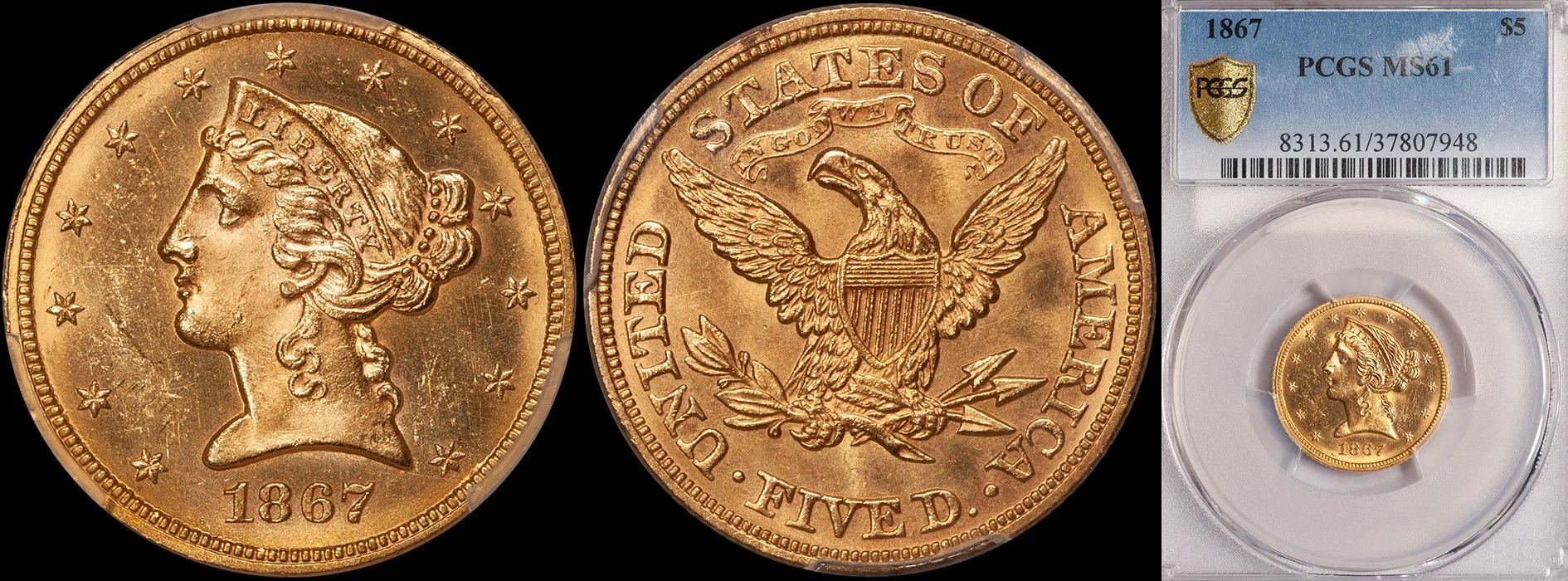
So you've made the decision that you are going to collect a specific series. What are the next step(s) that you should take? If you are going to form a serious, high-end collection one of the first things that you need to do is to examine comparable collections. As an example, if you have decided to assemble a set of Liberty Head eagles, it would make sense to know the grades of other sets that have been put together.

When it comes to 19th century gold, some of the old stand-bys are the Norweb, Eliasberg and Bass collections. It is very instructive to compile lists of the coins in these three collections as they pertain to what you are planning to collect yourself. For example, if you have decided to assemble a set of high grade New Orleans half eagles, you can make a spreadhseet of the relavent coins in these three collections.

Luckily, this information is reasonably easy to access. (Thank you, Internet...) On the PCGS website, the Set Registry pages list the "probable" grades of the Eliasberg and Bass gold coins (not to mention another pretty decent set, that found in the Smithsonian). The grades of the coins in the Norweb collection can be found in the three sales of this collection that were conducted by Bowers and Merena back in the mid-1980's.

Knowing what quality coins were owned by a great collection is important informantion for a new collector. As an example, let's sat you are being offered an MS63 example of a specific Liberty Head eagle. If the best piece Bass owned was an MS61 and Eliasberg only had an AU55, then the chances are good that this is a significant coin.

There are exceptions to this rule, however. Let's say that the MS63 Liberty Head eagle mentioned above is from a small hoard that was discovered after Bass or Eliasberg stopped actively buying coins. In this situation, the significance of the Bass and Eliasberg holdings are not as great. An example of this would be an 1894-O eagle in MS63. This date was essentially unknown in Uncirculated when Eliasberg was buying and very few examples better than MS60 were available to Bass. Today, because of hoards found overseas, this issue is scarce but not impossible to find in MS63.

If the series that you are goping to collect has a number of active Set Registry collectors, it is important to study the top sets that are on both the PCGS and NGC websites. Let's say that you are focusing on St. Gaudens Double Eagles. Without being congnizant of the best active sets in the Registries, you won't have a good idea of what grades you'll need to make your set competitive.

But there is much more to assembling a high-quality set than checking out Set Registry information. I'd strongly suggest that before you buy any coins for your new set that you invest a few hundred dollars in books and auction catalogs. There is no more important guide for the new collector than important specialized auction catalogs. I have written articles on which catalogs are important for the gold coin specialist to own and won't be redundant be listing them again; use the search function on my website to look for these.

One other thing you need to decide is just how high-end you want your set to be. If you have deep pockets and lots of patience, you will probably want to purchase coins that are either the finest known or which rate high in the Condition Census. If you are have a more modest budget, you will want to stick with coins that are above-average for the issue but not necessarily in Uncirculated grades. Learning the quality of other specialized sets will give you a good idea what the best grades for each specific issue are.

No Motto Philadelphia Half Eagles and Eagles: A New-Found Appreciation

A few months ago, I decided to start focusing more on No Motto half eagles and eagles from the Philadelphia mint than I had in the past. Formerly, I had sort of pooh-poohed these coins as being “boring” but the more I’ve studied these series, the more I think they may be one of the true Final Frontiers of the rare date gold market. As a buyer, one of my major criteria for making a purchase is the fundamental rarity of a coin. By this, I am referring to the availability of a coin in all grades. Virtually all Charlotte and Dahlonega gold has a good degree of fundamental rarity, meaning that a specific issue is hard to locate in any grade, not just in Gem. This isn’t the case with No Motto Philadelphia half eagles and eagles. Or is it?

The more I began to study these two series, the more I realized that many of the issues that I formerly thought were common in circulated grades were just not as available as I presumed. Let’s say that I decided that I was going to promote Philadelphia eagles from the 1840’s in AU grades. If these coins were as available as I had felt, I probably would be able to accumulate fifty or even a hundred coins over the course of a six month period; certainly enough to make the promotion worthwhile.

You can probably guess where this is going. I did make a decision to do this very promotion and after searching for nice, crusty coins in the AU55 to AU58 range I was able to come up with exactly eight pieces. And this is after five months of pretty intensive searching. Given the fact that my per-coin cost basis was in the $1,000 range, I became more and more intrigued. Clearly, my epic promotion wasn’t going to happen. But in the course of planning it, I became smitten by No Motto half eagles and eagles from the Philadelphia mint.

Let me give you a couple of reasons why I think these coins are interesting:

1. There are no true “stoppers.” Virtually every branch mint series has a few issues that are extremely rare and expensive. In the Philadelphia No Motto half eagles from the 1840’s and the 1850’s, there are no impossible coins. In fact, with the exception of a small number of coins (1842 Small Letters half eagle, 1858 eagle) nearly all of the issues can be found in either the very high circulated grades or even in Uncirculated.

2. The per-coin cost basis in these series is far lower than for branch mint issues. If you want to collect Dahlonega half eagles in AU grades, every coin you buy is going to cost at least $3,000-4,000. You can purchase many of the more available Philadelphia half eagles for around $1,000 per coin and many of the eagles are $1,250-1,500 each in very presentable condition.

3. For someone like myself who loves choice, original coins there are a lot more nice Philadelphia half eagles and eagles available than branch mint pieces. Because of the fact that there is a big value spread for the branch mint issues between EF45 and AU55 (or even AU55 and MS61) there is tremendous financial motivation to scrub original coins. Many dealers have made a career out of taking an AU50 Charlotte quarter eagle that they bought for $3,000, processing it, getting the coin into an AU55 or AU58 holder and selling it for $5,000, $6,000 or even more. The financial motivation to destroy a nice, original AU55 Philadelphia half eagle is currently not that great and, ironically, a greater percentage of the coins remain intact.

4. Since very few people currently collect these coins, you have less competition and an easier shot to buy the nice pieces without having to pay nutty money.

So does this blog signal an end to my love affair with branch mint gold issues? Hardly. I still am a strong buyer of all nice Carson City, Charlotte, Dahlonega and New Orleans gold coins (from dollars through double eagles) and will continue to be so as long as I am a professional numismatist. But I’ve become much more appreciative of No Motto Philadelphia half eagles and eagles and you will see more of them appear for sale on my website in the future. Will I write a book on them? Probably not. I will, however, probably write in-depth features in my monthly web articles that discuss these coins on a date-by-date basis.

The New Rules: Coin Buying In 2009

The realities of the new coin market are such that I have refined and revised my buying strategies for 2009 and, most probably, beyond. I think my “dealer strategies” can be easily applied to “collector strategies” and they are useful for most people. My first strategy isn’t so much “new” as it is a refinement of an existing strategy. I have always considered myself to be a fussy, critical buyer with what I believe is one of the better eyes around when it comes to originality. Well now I’m even fussier than before. If a coin isn’t all there, I don’t want to buy it; even if it is a special date that I have a soft spot for.

Let me give you an idea of how this strategy works. At the recent FUN show, I saw two comparably high grade examples of the 1856-O half eagle. This is a scarce issue that I really like and it has always been a good seller for me. I generally would have no problem with owning two (or even three) pieces simultaneously. The first example I saw was an NGC AU58. It was priced fairly but it really wasn’t very nice for the grade with little of its originality intact. This is a coin that I might have bought a few months ago, given that it was fairly priced and really rare in this grade. A few hours later I saw an NGC AU53 example of the same date that was choice and fully original. I bought it without hesitation. In this market, it pays to be a fussy buyer. If I were a collector of New Orleans half eagles, I would personally rather have a choice, original AU53 than a not-so-choice and not-so-original AU58. Even though the holder says that one of the coins is five points “better” than the other, my eyes told me that the lower grade coin was aesthetically superior.

My buying guidelines have always been that I want a coin that is in the top 5-10% for the grade with choice, original surfaces, nice color and good eye appeal. I want the sort of coin that will get a sticker when I send it to CAC. In the new coin market of 2009, I am repeating this to myself every time I look at a coin (be it at auction, in another dealer’s inventory or when a collection is sent to me by a specialist-collector). I’m being ultra-careful not to slacken on my quality standards and neither should you.

Another thing that I am focusing on is a lower price point. Some dealers are still able to sell coins priced at $10,000 and up. I find these pretty hard to sell right now unless they are extremely special. Generally speaking, I’d rather have ten interesting $5,000 coins in stock than one not-as-interesting $50,000 coin.

There are exceptions to this. Obviously, if I want to participate in the early gold market, I’m not going to go very far if I limit myself to $5,000 coins. And I would without a doubt be a buyer of a $25,000, $50,000 or even $100,000 early gold coin if it met the following parameters: really choice, really original, really rare and really saleable. But expensive “product” is an area of the market that has already begun a significant downwards correction and I think such coins could go a lot lower in the coming months.

How does this apply to you? If you are a high-end collector who purchases expensive coins I am certainly not telling you to stop (in fact, I’d be thrilled to sell you all the expensive coins you’d like right now...just call me on the phone to discuss this!). What I am saying is that the expensive coin market has shifted from a seller’s market to a buyer’s market. You might be able to buy a coin that was $35,000 a few months ago for $30,000 today; maybe even a hair cheaper. If this is your price point, though, I think it is more important than ever to be hyper-critical about every potential new purchase you contemplate making.

Which brings me to another point: buying the right coins. When the market is on an unstoppable upwards course, you can make sloppy decisions and the greater fool theory will inevitable rescue you. How many collectors made poor buying decisions in 2005 or 2006 and were saved by putting lemons in an auction and having their mistakes become lemonade? This is unlikely to happen in 2009, 2010 and beyond. You want to be really careful with what you buy. Collectors with short attention spans are going to find it hard to get rid of pieces that they lose interest in after a few months because something else has captured their fancy. My suggestion is to buy every coin like you are going to keep it for five or ten years.

Another decision that I am going to try to rigorously adhere to in 2009 involves over-expanding my numismatic horizons. In years past, I dabbled in areas that I really didn’t know that well because they “seemed cool” or I “thought they were good value.” In 2009, I am going to stick with what I know best. That doesn’t mean that I’m going to stop buying bust silver coins or rare date Seated quarters and half dollars. I like these coins and I know these areas of the market well enough not to make dramatic mistakes. But I am definitely establishing a stronger “comfort level” this year and will likely coinslap myself anytime I am tempted to stray from it.

One last strategy I am zealously adhering to seems like a no-brainer but I think it’s important enough to bear repeating. I am going to try very hard to have an inventory that is full of popular “bread and butter” coins like nice 1854-O three dollar gold pieces and 1839-O quarter eagles. These aren’t necessarily the rarest coins but they are very popular and have multiple levels of demand. Liquidity is a key factor for collectors and dealers alike in the New Market.

Are there coins that I haven’t really specialized in the past that I will be buying more of in 2009? I anticipate buying and selling more No Motto Philadelphia half eagles and eagles in the AU55 to MS63 range because I think they are great values. I’ll probably buy more non-New Orleans Type One double eagles because this is an active market and a number of the dates are still undervalued, in my opinion. And I think I’ll start moving back into the Three Dollar gold piece market again because I like these coins at current levels.

2009 FUN Show Report

As I stated in my last Market Report (and you have no doubt read on many other numismatic websites) the 2009 FUN show promised to provide interesting insights into the State of the Coin Market in 2009. What happened and what numistidbits did I glean from my week in Orlando?I decided to arrive a day and a half earlier than usual this year for two reasons. The first was to get out of the awful weather we’ve been having in the Northwest and to get a little Florida sunshine and the second was to give myself a bit more time to get prepared for the show. When I arrive the night before an East Coast show starts it’s hard to face the first day of trading when I’m still on West Coast time and have woken-up at the equivalent of 4 a.m.

I went to the pre-show for little more than a cameo appearance and found it extremely depressing. I hate the FUN and ANA pre-shows because I think they mentally drain dealers. I understand why they exist. Wholesale-oriented firms like these shows as it gives them an opportunity to engage in some serious dealer-to-dealer trading. The problem is that encourages dealers to leave the “real” show early. For one-person operations like myself, the thought of attending a two to three day pre-show and following this up with a four to five day regular show is a bit of Numismatic Hell that I’d rather not subject myself to.

I also made a cameo appearance at the Stack’s sale and noted what seemed to be an inordinate amount of buybacks (i.e., coins not meeting their reserves and going back to their owners). I don’t attribute this to a weakness in the market as much as I do the auction firm not vetting the reserves as well as they should have. There were some great coins in the sale but many of them had been in other auctions within the last year and were reserved for numbers higher (or even much higher) than their last sale. In this market, that dog ain’t gonna hunt...

The show opened to dealers and collectors with early admissions badges on Wednesday. These opening hours were an interesting buyer vs. seller dance. Most dealers seemed unwilling to pull the trigger on any interesting coins but, conversely, there didn’t seem to be much available to buy and the consensus seemed to be “let’s wait until the Heritage auction(s) occur to see exactly how bad the market is.”

On Wednesday night, Heritage sold the Quellar-Lemus collection of Pattern coinage. While I don’t really deal in patterns anymore, I did attend the sale for a few hours mostly for educational purposes. I thought this was an important auction for a few reasons. It was a “fresh” deal, it was a highly specialized collection and it involved very rare coins in a very thinly traded market. The results were extremely impressive. The collection brought at least 20-30% over pre-sale estimates and the bargains that many bidders thought they’d be able to find in pre-sale discussions were, for the most part, non-existent. Something that I found especially interesting was the activity for the extremely rare but very esoteric patterns. There were a number of issues that weren’t especially attractive or historically important but they were R-8 (meaning that an estimated one or two were known) and buyers had to pay record-smashing prices for these. This proved to me that the market is still there when it comes to seemingly irreplaceable coins.

Thursday was the opening day for the public and, at least for me, I found it to be the slowest first day at FUN that I could remember. That’s the bad news. The good news is that the crowds were excellent and collectors were most definitely out in full force. The feeling I got from most of my encounters with collectors and dealers during the early part of Thursday was that their buying was curtailed but not necessarily for the “right” coin.

Something interesting happened to me later that day while I was looking through a dealer’s boxes. I pulled out about six or seven coins to ask for prices. As he was figuring out levels he said to me: “You’re one of the few people all day that has actually pulled out anything numismatic. It seems like all everyone wants to price is cheaper stuff.” This made me reach a conclusion: if this is indeed the case, the current market malaise is tailor-made for collectors who still appreciate rarity.

The Thursday night Heritage Platinum sale was interesting as it contained a mix of coins that ranged from fresh and highly desirable to not-so-fresh and not-so-desirable. For the most part, I’d say the prices and the sell-through rate were about what I expected. Coins that I knew had sold within the last year or so generally brought around 10-20% less this time. Expensive faux-rarities did better than I would have expected (these same coins were very, very hard to sell on the bourse floor). As recently as a few weeks ago, I had wondered if the Platinum Night session was going to be an unmitigated disaster. Because of Heritage’s exceptional Internet presence I’d have to say it was better than I would have imagined although still not the blockbuster extravaganzas of FUN 2006 or FUN 2007.

Friday was my last day at the show. And for some reason, the vibe seemed a lot more upbeat. I sold three expensive coins to collectors and had a few nice wholesale transactions. I left feeling a lot better than I had when I left the show on Wednesday and Thursday.

So what was my overall take on FUN 2009? I’d say that it was bit better than expected. All markets are psychological in nature and as long as the participants in the coin market are relatively upbeat, the market will be OK. Until the economy turns around (and I think we are looking at another year of Recession) people will likely cut back on their coin purchases. But most collectors are unwilling to totally give up their purchases. The bottom line was that at FUN, collectors were active but more selective than I can remember.

What sold and what didn’t sell at the show? For me, interesting coins in the $5,000 and under range were good sellers as was anything with choice, original surfaces. I noticed strong demand for CAC-stickered coins. And I was surprised at the number of people looking for New Orleans gold. Expensive coins were hard to sell. This wasn’t always the case at the auctions but on the bourse floor you literally had to plead with dealers to look at your “big boy” coins. I expect that this will continue for the next few shows as well, if not longer.

Pre-FUN Observations

I think this year's FUN show will reveal alot about the direction of the market for the year. On Wall Street, it's a known fact that if January is strong, the rest of the year is as well. I can't state this with total certainty as far as coins go but my experience is that a strong FUN generally means the rest of the year will be good as well. Early reports from the pre-FUN show (which I am not attending) are interersting. Some dealers clearly "get" the fact that the market isn't as strong as it was and that their coins need to be repriced to sell. Others appear to be in strong denial mode. If you notice minimal changes in your favorite dealer's inventory after this show, you'll quickly figure out if he or she "gets" it or not.

For me, a problem at past FUN shows has been a lack of material. I'm not sure this will be the case this year. I've already bought some pretty outstanding new coins and I have the feeling that buying this year will not be as hard as in the past. Plus there is always the looming specter of $100 milion+ in coins at the auctions.

Someone asked me the other day what the keys will be to a dealer's success (or lack of it) in 2009. I think it boils down to three simple things: ample capitalization, having good clients and having established programs to sell into. Any dealer who is weak in at least two of these three areas is in for a long year.

I'm not totally certain that the rare date gold market is going to be as easy to analyze post-FUN as is, say, the type coin or widget markets. None of the major auctions are especially strong in any of the important areas of dated gold. Early indications appear that nice pre-1834 gold seems to be doing fine, particularly if the coins have been approved by CAC. The Heritage sale contains an important collection of Indian Head eagles so we will, no doubt, get a feel for what gem examples of the rarities in this aerea are worth. But I'm afraid that areas like C+D gold, TYpe One and Two double eagles and Carson City issues won't be as easy to gauge; at least not for the next month or two.

What's Hot/What's Not: End of 2008 and Beginning of 2009

What a difference a year makes. I can remember sitting down in December 2007 to compile my annual What’s Hot/What’s Not list for 2008 and thinking “every area in the market is so strong right now, what am I going to force myself to list as ‘not hot?” Fast forward to December 2008 and now it seems like I have to pull ideas out of the hat like Numismatic Rabbits to come up with areas that are hot while the “not so hot” areas seems a lot easier to ponder. But perhaps I’m being a little harsh here. Just as in late 2007 where the real truth of the market was not as obvious as it seemed (in retrospect maybe not every single facet of the market was so strong...) perhaps the real truth today is that while some areas of the market do seem poised for major corrections, others will probably hold out better than eternal pessimists like myself might presume.

OK, enough of the prelude. Let’s get to the heart of the matter and discuss the Hot/Not Hot list of 2009.

I. Hot Series in Late 2008/Early 2009

a) Great Coins

My guess is that really great one-of-a-kind, super-duper, unforgettable types of coins will do well in the coming months. Obviously, only a small number of coins qualify as such. What would a few examples of these be? Taking the Heritage 2009 FUN Platinum Night sale as a base, I think examples would include the ex: Garrett 1815 half eagle graded MS64 by NGC (Lot 4062), one of two known 1842-C Small Date half eagles (this one is a PCGS MS62 and is Lot 4069) and the uber-cool NGC PR64 1842 half eagle (lot 4078) that is one of just two known and has a fantastic pedigree that goes back over a century. The market for coins like these is limited but the buyers who are likely to purchase any of these have deep pockets and are probably a bit more Recession-proof than Joe Collector.

b) Solid Collector Coins in Strongly-Collected Markets

To use a non-gold coin series as an example, take a look at the prices that interesting Large Cents have been bringing at auction in the past year. There are three different collector bases for Large Cents (early dates, middle dates and late dates) with very little overlap but similarly zealous enthusiasm. This will be severely tested in 2009 when the Naftzger middle dates, Dan Holmes and March Wells collections all go on the auction block. Will this be a scenario like the Southern Gold Tsunami of 1999-2000 when three major collections flooded the market and effectively killed it or will it foster new collectors and inject even more life into this area of market? I tend to former the later scenario.

To further add to this point, I think the collector-oriented gold coins that are the strongest right now are those in the sub-$10,000 range. The air is a little thin for coins priced above this unless they are very fresh, very choice and very interesting.

c) Type One Double Eagles

This area is strong for two reasons. The first is the good ‘ol double play impact. With any Liberty Head double eagle worth at least $1,000-1,100 in XF grades, this added value and demand for the boring, lower-grade common issues. The second is continued collector demand for higher grade and rare issues. As an example, the key 1854-O and 1856-O remain in great demand and both set record prices in 2008 at auction. I can think of at least six other dates off the top of my head (1854-S, 1855-O, 1859-O, 1860-O, 1861-O and 1863) that also set price records in 2008 whether at auction or via private treaty. I believe that demand will remain very strong in 2009 for interesting Type Ones.

II. Not Hot Series in late 2008/early 2009

a) Schlocky Overgraded Coins in Nearly Any Series

Let’s face an unavoidable truth: there are a lot of really junky coins overhanging the coin market right now. If you look on many dealers’ websites (or in their cases at a show like FUN) you are going to see some familiar faces. You know what I mean: coins that have been around for months (or years in some instances) because they are too dark or too bright or have some sort of problem that makes them low-end for the grade. In the past, there were always bottom feeder collectors and dealers who would buy low-end “stuff” at the right price but many of these individuals have been Slapped by the Recession already and are not as active as they were. Until much of this stuff leaves the market (and there are hundreds of millions of dollars worth of coins like this out there right now) expect to see them languish in dealer’s inventories (or go unsold at auction) and drag values down in the published price guides.

b) Unpopular Coins With Questionable Market Premium Factors

If a coin in a largely unpopular series is currently selling for a 10-30% premium because of a low mintage figure or a slightly low PCGS/NGC population, it is likely that it will lose much (or all) of its MPF. Some examples of these coins are a number of the quarter eagles from the 1880’s and 1890’s, certain lower mintage Three Dollar gold pieces from the 1880’s and many of the San Francisco Type Three double eagles from the 1890’s and early 1900’s in grades up to and including MS63.

c) Crappy, Processed Charlotte and Dahlonega Mint Gold As someone who is pretty widely-known as a leading dealer in Charlotte and Dahlonega gold, it pains me to look at a majority of the coins on the market today. Overgraded junque is, I’m afraid, the rule rather than the exception and a considerable amount of said material overhangs the market. Until recently, there were always bottom feeders who bought the nastiest C+D rejects at the right (read: c-h-e-a-p) price but many of these Numismatic Catfish have current cashflow crises to deal with. Personally, I’d like to take the 300-400+ truly vile C+D coins that travel like gypsies from auction to auction and inventory to inventory and melt them. This would allow the nice, original coins (which still have solid collector demand) to regain their place in the sun.

d) Indian Quarter Eagles

Dead as a doorknob. Sleeping with the fishes. Circling the drain. Numismatic Cannon Fodder. Muerto. Did I mention that this series is pretty slow right now?

The Great RYK/DWN Mashup Part Two: Twelve Overvalued United States Gold Coins

A few weeks ago, I published an article written by collector Robert Kanterman that discussed U.S. gold coins that he regarded as good values. Along with each of selections, I posted my comments. Some of them were in agreement with Robert, others were not. The response to this blog was exceptional and I believe it was among the most popular of the nearly 250 that I’ve written since I began this feature around two years ago.

Robert must have received a Big Box of Motivation for the holidays because he became inspired to write the natural counterpart to the last article: a feature on gold coins that he regards as being “overvalued.” Naturally, I am pleased to publish it and am responding with my comments for each of his selections.

One quick word before we begin. What does “overvalued” mean to the gold coin collector? There is no definite answer to this important question and I’m not 100% certain that if you asked this question to Robert and I independently if we’d agree. My perception is that an overvalued coin is an issue that has a pricing premium that, in the current market environment, is difficult to justify. This parameter is not indelible and it can change, given the conditions of the market and the circumstances of the individual collector.

And away we go....

RYK: Here are my 12 overvalued and/or overpriced rare date gold coins. I would only qualify this group of selections by saying that there is nothing inherently wrong with any of these coins (I have owned several in the past). I just do not agree with how the market values them.  I will be interested in reading DW's rebuttals.

1.  1854 and 1855 Philadelphia Type II Gold Dollars, Especially in MS-62 and Higher

This is actually one of my favorite designs across the U.S. gold series, but just because I like the coin, does not mean I like the value it offers. The MS coins are hardly scarce, yet they sell for several thousand dollars and up. I personally have trouble believing that there are that many people who "need" high grade examples for a type set. I would be happy to settle for a nice AU-58 for under $1000 and use the difference somewhere else.

DW: It’s hard not to agree with RYK on this one. I also love the Type Two gold dollar. I love the design, dig the history and like the fact that it is a short-lived issue. But I have a very hard time justifying the current price levels for examples graded MS62 and higher; even though these levels are significantly reduced from past highs. Currently, a common date Type Two gold dollar (i.e., an 1854 or an 1855) is worth $17,000 in MS64 and around $40,000 in MS65. The current PCGS population figures for Type Two gold dollars are 418 in MS64, 87 in MS65 and another 28 in MS66 and above. Unless there are significantly more collectors assembling high grade gold type sets than I’m aware of, these price levels seem inflated.   2.  1840-D, 1841-D, and 1842-D Quarter Eagles

After the 1855-D and 1856-D quarter eagles, this trio is next in line for scarcity, filling out the top five.  Perhaps unfairly, I tend to group these together when considering them, but I see them with about the same frequency as one another, and there is a significant rise in availability of Dahlonega quarter eagles after this date.  In AU-55, these are $12,000-20,000 coins, which seem like a lot for a series that has as limited an audience as this one does.

DW: I don’t totally agree with RYK on this selection. If you are a date collector of Dahlonega quarter eagles, these are important issues (if you are a type collector, these issues, I realize, are meaningless). Something that’s hurt the reputation of the 1840-D, 1841-D and 1842-D quarter eagles is that there are a lot of lousy examples in third-party holders. In properly graded EF and better, all three are genuinely scarce and in AU55 or better they are very rare. Given the value levels in this series, I don’t think that any of the three are overvalued.

3.  So-Called Better Date Quarter Eagles After 1885

When one looks at the Redbook, there is a string of quarter eagles with very low mintages in the later years of the series. I think that these are often sold to collectors as better dates, but the auction records and the frequency with which these are sold do not support this. With the exception of the 1881 and the 1885, it's probably best to put away the books and consider these as generics.

DW: I agree but not with a lot of enthusiasm. The dates that Robert refers to are a classic example of Market Premium Factor. In a good market, an issue like the 1886 or 1894 gets a significant premium due to its low mintage and relatively small PCGS/NGC population figure(s). In a weaker market, this MPF tends to evaporate and a coin that once sold for a 10-30% premium becomes obtainable at levels closer to common date status. Given the fact that very few people collect late date Liberty Head quarter eagles by date, most of these probably do not merit a premium. In higher grades, however, certain of these are genuinely rare and I would be happy to buy all of RYK’s 1894 quarter eagles in MS64 or MS65 for common date prices!

4.  1911-D $2.50

The 1911-D quarter eagle is the most overrated and overpriced dated gold coin in the US series, bar none. I understand the argument that it is the key date of the most collectible gold series, but I have a very hard time believing that there are enough collectors of the series to support the obscene price of the fairly common issue. (I was going to add that it is the 09-S VDB Cent of U.S. gold coins, but I think that it would give this coin more credibility than it deserves.)

DW: Ouch! Do you have the feeling that Robert isn’t going to be inviting a 1911-D quarter eagle to the prom? But who am I to argue, given the fact that I’ve already accused the 1911-D of being one of the leading Faux Rarities in all of American Numismatics. This is clearly one key date that is priced too high and I would not be surprised to see its price plummet in the coming months. At least until the next time the Indian Head quarter eagle series gets (re)promoted...

5.  1857-S $3   I must admit that I was struggling to pick a selection from the $3 gold series, not because these coins are all undervalued, but because so few stand out from the pack. I chose this issue because I felt that the premium attached to this issue for being a branch mint issue seems out of proportion to its actual scarcity. Stated more succinctly, it's twice as common as the historic 1865 $3 (one of the keys to the series), yet sells for about the same price in AU-55. Look yourself at the population spreads and accompanying prices on the PCGS site, and you will see exactly what I mean.

DW: Here’s another issue which I am in partial agreement with the Good Doctor. (I’ve always wanted to write the expression “the Good Doctor” in a blog!) When you compare it to the 1865, the 1857-S is an overvalued issue but this isn’t totally fair because the 1865 is probably the most undervalued coin in the whole Three Dollar series. Just as with the 1840-D/1841-D/1842-D quarter eagles, the population figures for the 1857-S don’t tell the complete story. Most every 1857-S I see in AU55 is (cough, cough) “enthusiastically graded” and choice, crusty examples in EF45 and higher are awfully scarce. If I had to pick an overvalued issue in the Three Dollar series, I’d select the 1854-O or the 1885. But that’s another story. Or another blog.

6. 1879 Flowing Hair Stella $4   This is a coin that I dreamed of owning as a young collector and one that owes its popularity and high price to its capricious inclusion in the Redbook. There are four offered in the upcoming FUN sale, and I have long said that you can't swing a dead cat at a major show without hitting at least a couple of these. These days, $150,000 buys an ugly, much-too-bright  Stella. So much for my dream coin.

DW: The 1879 Flowing Hair Stella was one of my primary “faux rarities” in my infamous blog of a few months ago, so no one is going to be surprised when I say that I agree fully with RYK on this one. Prices on this issue are going to drop in the coming months and it will be interesting to see where they settle. Maybe RYK will be able to afford his “dream coin” after all!

 
7. 1842-C Small Date $5

I think that Doug has commented on this in the past, and as a devotee of the southern branch mint $5's, this issue always stood out to me as one that was more common than believed and consistently overpriced. When I was active in C and D $5's, the ones that were on the market seemed to stay on the market a very long time (or jump from auction to auction), so I think that the collector market agrees with me.

DW: I still regard this as a rare date. The problem with the 1842-C Small Date, however, is the fact that not everyone regards it as essential for “completeness” in the Charlotte half eagle series. Another problem is that Trends values are way too high for the 1842-C Small Date. This is compounded by the fact that many of the AU examples in third-party holders are pretty gnarly. As a value buyer, I’d still give strong consideration to a crisp, crusty EF example but I’d pass on an AU until levels come down.

8. 1860-D $5   For some reason, the price guides have always treated this Dahlonega $5 as a better date.  Doug ranks it #16 out of 26 Dahlonega $5's in overall scarcity (I rank it 17th), and it warrants no premium over the "common" Dahlonega $5 (i.e. 44-D, 45-D, 47-D, etc.). There is no logical reason why this coin is priced as a better date among Dahlonega half eagles.

DW: I can’t argue with this choice. This issue somehow started selling for a premium a few years ago despite the fact it is no rarer than the 1858-D or 1859-D. I’m not sure that I’d single it out as one of Baker’s Dozen most overvalued U.S. coins but I do think it should be priced as a common date.

9. 1799 $10   This is the most common 18th century U.S. gold coin with large numbers in PCGS and NGC holders and large numbers in lower tier holders and raw (or raw equivalent). They are big and beautiful coins, but they are everywhere. $30,000 for an AU-55 seems like a lot of money when a considerably more scarce 1799 $5 is about half the price in the same grade.

DW: I strongly agree with this choice despite the fact that I really like everything about the 1799 (except its current market valuation). I can remember not so long ago when a nice fresh AU 1799 eagle was an easy coin to find at $13,000-15,000. Today, they are double this amount and the typical coin is apt to be processed and unappealing. If you really want to own a 1799 eagle (and I think a nice early ten is an integral part to any potential collection of U.S. gold) I’d probably wait a while and see if prices retreat back to the levels of five-seven years ago.

10. 1851-O and 1852-O $20   Several years ago, I thought these were really good values, when they could be purchased for a small premium over the majority of the Philadelphia Type I $20's. At $5,000 or so for an AU-50, when a more scarce Philly issue like an 1855 sells for about one-third of the price and a considerably more historic and scarce 54-S sells for about $3,000, the value of these two is no longer apparent.

DW: I have mixed feelings on this choice. Having very much helped to create the market for Type One New Orleans double eagles, I am pretty stunned to see nothing-special examples of the 1851-O and 1852-O selling for $5,000-10,000. This does seem like a lot of money for nothing all that special. In the defense of these two dates, remember that they are the most available double eagles from this popular mint and there is very strong collector demand for said coins. But I do agree with Robert that your $3,000 is better spent on a nice 1855.

11. High Relief Saint   The High Relief Saint is arguably the most beautiful U.S. coin (gold or otherwise) ever struck by the U.S. Mint. One can also make the argument that based on its availability that it is significantly overpriced. I would love to own one but not at these levels.

DW: Agreed. Next....

12. Hoarded 1920's Branch Mint Saints   I was discussing the possible auction purchase of a 1920's branch mint Saint with a wise coin dealer (who happens to be a specialist in rare date gold) when he turned  to me and said, "You have to be careful with these hoard dates—the ones from the 1920's that are being slowly released into the market."  He then rattled off a few of these dates. Sure enough, when one tracks the auction records for these, there appear to be several dates undergoing quiet distribution at prices that are not supported by their level of availability.

DW: I’m going to waffle a bit on my answer to this one, even though I am (I think...) the supposedly wise coin dealer who made the comment cited above. I do think you have to be careful buying many of the mintmarked Saints from the 1920’s. You have to be careful for three reasons. The first is that some dates do exist in hoard quantity and it’s important to pay careful attention to the PCGS/NGC population figures. Secondly, the quality of these coins is all over the map. I’ve seen 1926-S double eagles in MS65 holders that were true Gems and I’ve seen 1926-S double eagles in MS65 holders that I wouldn’t break out of an MS64 holder. Unless you are an expert grader, you need to work with an expert in this area. Finally, the market for dated Saints can change quickly based on the number of active collectors. What seems undervalued today can seem overvalued in a few months (and vice-versa) if the market loses (or gains) participants in the high-end arena.


Bonus:  Anything Overgraded, Especially XF coins, dipped and in AU Holders   It goes without saying that processed and/or overgraded coins are generally not a good buy, especially when they are premium priced. That said, I am going to be a bit of a contrarian. There may be opportunities that arise when the collector can recognize the overgraded coin and pay the appropriate price while others simply pass because the coin is overgraded. One of my best acquisitions was made precisely under these circumstances.

DW: I disagree with Robert here that “opportunities may arise” when it comes to buying overgraded coins and paying the appropriate price. I’m not sure why you’d ever want to buy an overgraded coin. But if a dealer will sell you an EF45 in an AU50 holder for an EF45 price, then I guess this makes sense (huh??)

Bonus II: Many Shipwreck Coins, Especially 1857-S SSCA $20's   For the sake of this discussion, let's limit our focus to the Brother Jonathon, the S.S. Central America, and the S.S. Republic coins. I am a big fan of shipwreck gold coins—I love the history, the exploration, the retrieval, and the science of conservation. I think that there is nothing more fascinating than holding a coin in your hand that sank to the bottom of the ocean in a storm 150 years ago, was found buried in sand in deep water 145 years later, and conserved to look like it did the day it left the Mint. However, the shipwreck premium, in many cases, is well beyond reason. I will concede that for some better dates, there is some logic to the shipwreck premium, but certainly not for the 1857-S $20 from the S.S. Central America. These are readily available in quantity in any major auction or coin show.

DW: In theory, Robert is right. What he doesn’t realize is that there are a number of large retailers who can sell the heck out of these shipwreck coins and that the demand is generally well in tune with the supply. While I agree with Robert that the price levels seem out-of-whack with the populations, what he needs to realize is that these shipwreck coins are, in a way, a distinct “mini-market” within the broader market. The history and neatness factor of these shipwreck double eagles makes them unfair to compare with other, less active segments of the coin market.

So there you have it: the Numismatic Dan Ackroyd and Jane Curtin of this generation (for those of you too young to get this reference, look it up online) have, I hope, given you plenty of numismagrist to chew on this holiday season.

An Amazing Gem 1869 Half Eagle

If you are a regular reader of my blogs, it’s a pretty safe assumption that you are interested in United States gold coins. And if you like U.S.gold, I don’t think I’m going too far out on a limb to state that you probably like to see photos of and read about special pieces. Well, I’ve got the skinny on one of the more amazing 19th century issues I’ve seen in some time; a one-of-a-kind coin that recently passed through the portals of Douglas Winter Numismatics. The coin in question, shown below, is an 1869 half eagle that has been graded MS64* by NGC. I’m going to start out by giving you some background about this issue, then about the specific coin and, finally, some thoughts as to how and why this remarkable coin exists.

I think the 1869 half eagle can best be described in two words: “forgotten rarity.” There were a scant 1,760 business strikes produced of which perhaps as many as four dozen are known. This issue is generally seen in the EF grades and it is rare in properly graded AU50 or better. I believe that there are around a dozen known in AU. PCGS has graded a total of thirty-three with the finest a single coin in AU58; NGC has graded a total of thirty-five with two different coins in Uncirculated: the present example and another, which grades MS64PL.

The present example was first offered at auction in the October 1999 Bass II sale where it brought $33,350 as Lot 1166. At the time, it was housed in a PCGS MS64 holder and according to my notes in the original catalog I called the coin “amazing!” Harry Bass had purchased the coin via private treaty from a source identified in the catalog as N.K.S. on June 8, 1971. He had kept his ownership of it a secret as it was unknown to both Breen and Akers when they wrote their books on, respectively, United States coins and half eagles.

The Bass 1869 half eagle next appeared for sale as Heritage 5/00: 7668 in an NGC MS64 holder where it brought $22,425. After this, it was sold into the Ashland City collection where it remained until it was offered as Heritage 1/03: 4815 (still in an NGC MS64 holder) realizing $28,750. I recently resubmitted the coin to NGC where it was given a star designation because of its exceptional eye appeal. I also had NGC delete the Ashland City pedigree and reinstate the Bass pedigree as I felt it was far more appropriate to a coin of this stature.

If you study the photo above, you will note that the quality shown by this 1869 half eagle is quite amazing. The surfaces are mostly prooflike with more than enough frost to clearly indicate that this piece was made for commercial usage. It is extremely well struck and attractively toned in light orange-gold hues. A few small scuffs can be seen in the left obverse field with the primary identifying mark being a tiny mint-made strike-through near the southeastern point of star four.

How does such a remarkable 1869 half eagle exist? There were no date collectors of business strike half eagles in 1869 and any well-heeled collector of this denomination in the 19th century would have preferred a Proof to a business strike. My theory is as follows.

Every year, the Assay Commission met in Philadelphia to examine a group of current coins to determine whether or not they conformed to legal requirements. Although I can’t prove this for a fact, my belief is that, from time to time, someone on the Assay Commission (of which there were approximately two dozen members) saw an interesting coin and decided to “keep it” as a souvenir. I am assuming that if a commissioner chose to, he could trade an older “used” half eagle for a brand new one. There are a small number of gold coins from the 1860’s and 1870’s that are just so much nicer than any other example from this date/denomination that it seems highly possible that they originate from the Assay Commission.

There is another possibility, although it is not as glamorous as the one posited above. It is possible that this 1869 half eagle might have somehow been “put away” by a Philadelphia area collector or non-collector in 1869 and through random chance been passed down through generations without having been melted, sold, cleaned or lost. I have handled spectacular gold coins that have been rediscovered by a family member after fifty or a hundred years and I know that these things happen from time to time.

The Bass 1869 half eagle is a beautiful and fascinating coin that deserves more attention than it has received in the past. I know that collecting Philadelphia half eagles by date is not “fashionable” but it seems hard to believe that this coin is worth about the same as a High Relief double eagle in the same grade range despite the latter coin being dirt common in comparison.

Is Collecting by Date a Thing of the Past?

Is the age of collecting by date or variety over? Have coins become so expensive and collecting so complex that it is inevitable that new collectors will focus solely on type coins? As a dealer who sells rare gold coins to both highly specialized date collectors and to sophisticated type collectors I think numismatics is definitely going through a change but that collecting by date remains (and will continue to be) very popular with a certain type of individual. To collect a series or a mint by date requires a type of mindset. I think of date collectors as being more patient than type collectors and probably a bit more research-oriented. To a generalized, type-oriented collector, there is no difference between an 1848-D and an 1858-D half eagle. To the date collector, there is a significant amount of difference between these two coins; be it strike, appearance, coloration, etc.

I don’t think there is a “right” or a “wrong” way to collect. I admire the highly specialized date collector who takes years to assemble a set of Charlotte half eagles or Liberty Head eagles. During the process, he is probably learning more about the specific series that he is collecting than most dealers. He “gets” the difference between the 1848-D half eagle and the 1858-D half eagle and does not have to have it explained to him.

But I can absolutely see the reason to collect by type as well. Not everyone has the patience to assemble a long set of coins and most series have one or two (or more) stoppers that make completing a set impossible. And there is clearly something cool about the fact that a type collector buys something different every time he makes a purchase. Anyone can tell the difference between an 1838 Classic Head half eagle and a 1910 Indian Head half eagle; most people see an 1848-D and 1858-D half eagle and they see essentially the same coin(s).

To the coin market gurus who emphatically state that collecting by date or variety is a dying endeavor, I would answer that this is not the case. To refute this, one need only look at the fact that in this golden era of numismatic publishing, there continues to be a run of titles that deal with specific series but virtually none that deal with type collecting. In the area of gold coins, in the last few years we’ve seen titles about gold dollars, 20th century issues, three dollar pieces, Charlotte and New Orleans issues, etc.

Not only is collecting by series alive and well, specialization seems to be doing just fine, thanks. In the recent Bowers and Merena Baltimore auction, the seventh known example of the 1795 Liberty Cap with Reeded Edge Cent brought an astonishing $402,500. What’s even more incredible about this figure is the fact that the coin is only graded Good-4 by PCGS and it clearly isn’t going to win any beauty contests. However, it is an extremely rare variety in an extremely popular series (early Large Cents by Sheldon variety). As we all know, it just takes two to tango and if two well-heeled collectors decide to butt heads on a coin that they know they might not get another chance to own, the final price realized is often jaw-dropping. Weak economy or not, many highly specialized collector series remain as strong as ever.

What does the future hold for date collecting? I see a few possible scenarios.

There are some series that are so long and so challenging that they will never attract more than a handful of date collectors. As an example, Liberty Head eagles are so tough that it is hard to imagine more than three to five people at one time competing against each other to form a set. But, on the flip side, when you have as many rare dates as the Liberty Head eagle series does, a sudden onslaught of demand would be untenable.

Other series that were once popular to collect by date are likely to become less popular due to the vicissitudes of taste. A century ago, virtually no one knew what a branch mint gold coin was, let alone collected them; today these are more popular than issues from Philadelphia. What is popular today could become forgotten a generation or two from now.

If well-written reference books on a formerly-overlooked series are released, date collecting can gain appeal. I’d like to think that the publication of my New Orleans gold coin book in 2006 spurred a number of people to collect by date. Newly released books on Colonials/Early American coins and Peace Dollars could have a huge impact in these two markets as well.

Something that we are likely to see in the future is a hybridization of collecting tastes. I wouldn’t be surprised if date and type collecting become more finely synthesized. As an example, someone might decide he doesn’t want to collect a full date set of Charlotte half eagles. But he likes the series enough that he wants to do more than collect the three types. He might become an “advanced dabbler” who doesn’t feel compelled to complete the series but who decides to own five or six or even seven different dates because he feels that Charlotte half eagles are really interesting.

One thing we are destined to see in many series if prices go down is the shrinking of the Market Premium Factor. In series that are not terribly popular, coins that formerly sold for a 10-30% premium over a common date are likely to lose this premium and retract down to a common type coin level. We are already seeing this in some of the 20th century series and I wouldn’t be totally shocked to see this in the early gold and Liberty Head gold markets.

Another point to address: how will key dates fair in series that become less popular with date collectors? The answer depends on whether or not there are multiple levels of demand for this coin. As an example, the 1873 three dollar gold piece is a key date but if the three dollar series becomes less popular, its level of demand will shrink. The 1854-D three dollar is likely to lose less value in a declining market because there are a broader range of collectors who want this coin: not only specialists in the series, but Dahlonega collectors and one-year type collectors as well.