The Great RYK/DWN Mashup: Robert Kanterman’s Twelve Undervalued Gold Coins Priced Below $5,000

At the end of my last blog I said that I’d like to hear from collectors about which coins they believe qualify as undervalued sub-$5,000 U.S. gold coins. Robert Kanterman responded with this thoughtful list and I thought I’d publish it along with my comments (which are in italics at the end of each of his paragraphs). Without further ado, take it away RYK... Doug Winter has challenged me to identify 12 gold coins that are under $5,000 that are relatively good values. As a hobbyist, I am not nearly as knowledgeable and up-to-date in pricing, availability, and recent transactions, as Doug is. Most of my information is from sources like Heritage's auction archives, Coin Values, and the PCGS price guide and population reports. Each of these resources has its inherent flaws and weaknesses, yet each represents a sizable block of information, as well. I will also add that as a collector, I am often willing to dip down in grade level to a point that is lower than Doug typically does. This allows me access to some rare coins that I might otherwise not be able to afford. I would also stress that my selections below all are for coins that are original and attractive for the grade. On this website, that goes without saying.

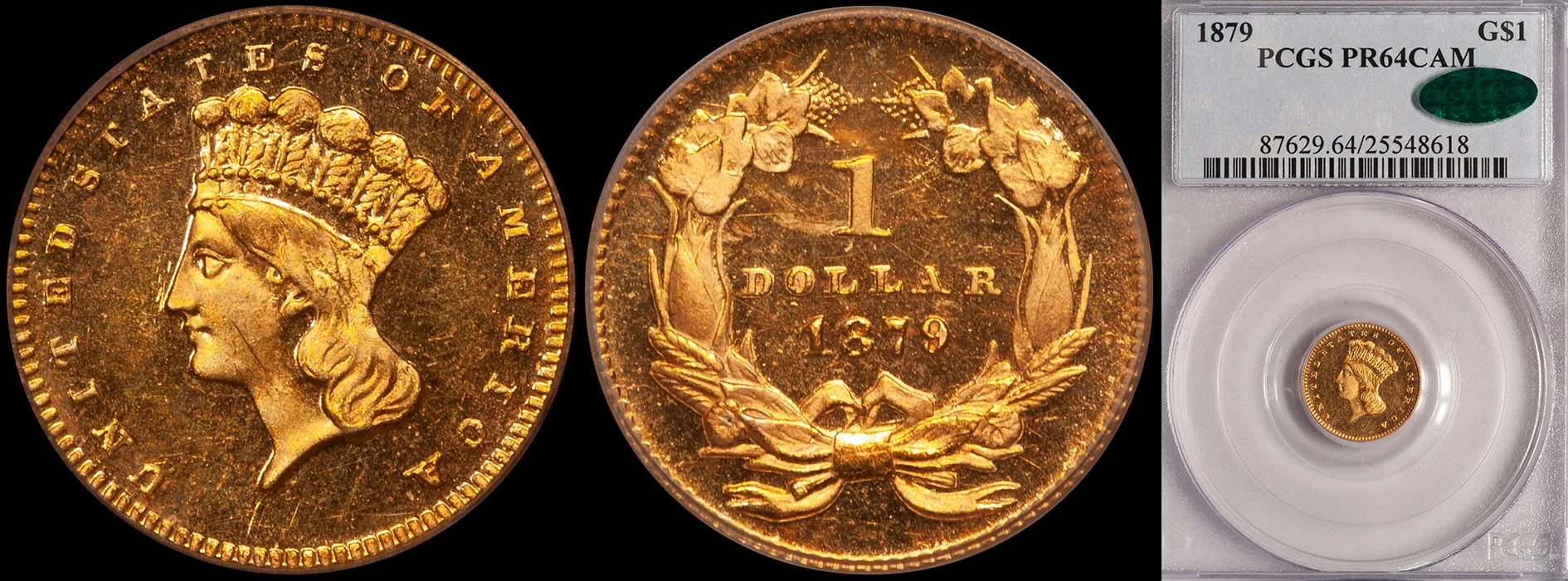
1. 1854-S Gold Dollar in MS-62

I am always attracted to better date coins that have a historic or numismatic significance. The 1854-S dollar is important as it is the first year of operation of the San Francisco Mint, and it is the only SF mint gold coin that can be purchased in MS for under $5,000, with an MS-62 running in the $3,000-4000 range. This is definitely an issue that flies under the radar screen.

DW Comment: Nice choice. I had actually considered this for my list. This is a historically significant issue with a high “neatness” factor. I think a properly MS62 at $3,500-4,000 is a wonderful value. Just as an aside, I think all of the SF gold dollars are exceedingly good values and I have written previous articles on them which detail each issue.

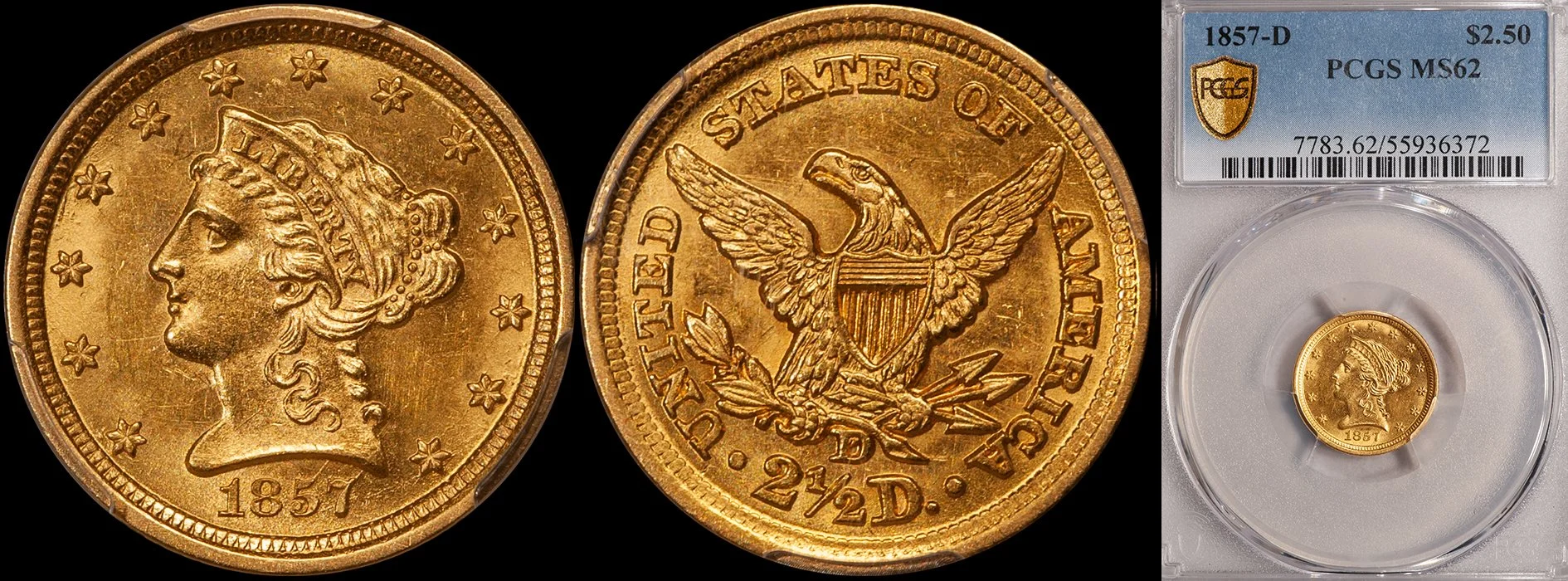
2. 1857-D, 1858-D, or 1859-D Gold Dollar in AU-50 to 55

The combined mintage of these three issues is about 12,000 coins--yes, I said combined--and they can be had in AU-50 for $4,000 or less and a little more for choice AU. These are all charming, scarce, and historic. Within four years of the earliest of the trio, the Dahlonega Mint was overrun by the Confederates, who struck the gold dollars for the last and most famous issue of the series--the 1861-D. Of the three, the 1858-D gold dollar typically comes with the best strike.

DW Comment: Having owned dozens and dozens of each of these three dates I tend to overlook them but I think RYK has raised a good point. All three are scarce in the true meaning of the word. If I were able to choose just one date out of the trio, I would pick the 1857-D as I think it is considerably scarcer than the 1858-D and 1859-D. A caveat: many of the AU50 examples I see in holders are poor quality, so be patient and wait for the right example to come along.

3. 1839-C and 1839-D Quarter Eagles in XF-40+

I do not see much value in the classic head series, in general, but compared to the rest, the branch mint issues from Charlotte and Dahlonega seem to still have some value. Neither is especially rare, but with MS graded coins pushing into the high five figures, a dirty, original mid-circulated grade coin for $5,000, give or take a few, in a very popular series, seems like a pretty fair deal.

DW Comment: Nice choice, RYK. Even though properly graded EF examples of these two dates have probably doubled in price in the last few years, they are still good overall value. I’m not certain I would call them “undervalued” but the important thing to remember is that coins like this are in great demand and many collectors can’t afford the higher grade pieces that seem so readily available. I would personally choose the 1839-D over the 1839-C if I had to buy just one.

4. 1881 Quarter Eagle in AU-55

I hope I do not get bounced for saying this here, but after 1865 or so and with the exception of the 1875, the Liberty coronet $2.50 series becomes a long, boring series with few coins of interest to all but the diehards of the series. 641. What's that number? That's the original mintage of the 1881 quarter eagle for circulation strikes. If I were going to own one late date coronet quarter eagle, this would be the one.

DW Comment: At first I was going to heartily disagree with this choice but the more I got to thinking about it, the more I realized that at $3,500-4,000 for an AU50, this date is pretty good value after all. I do disagree with RYK that the post-1865 quarter eagles are a “long, boring series...” but you don’t expect me to agree with everything he says, do you?

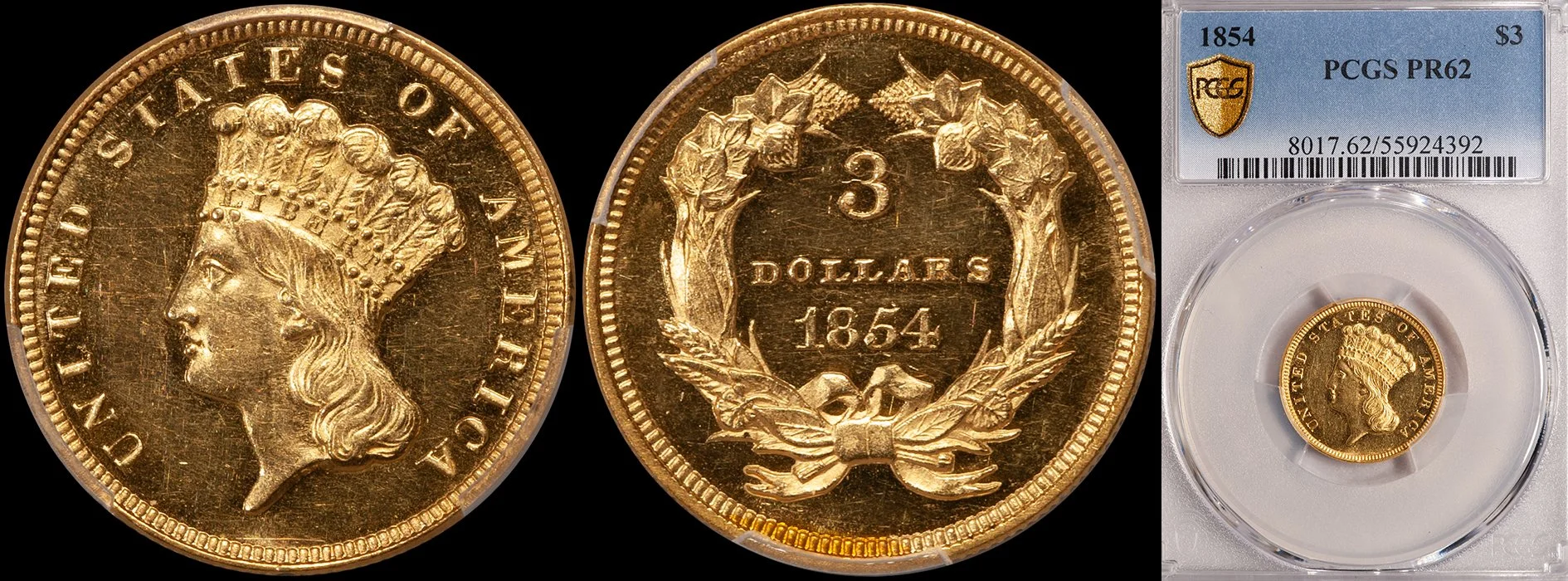
5. 1864 Three Dollar in AU-55 or 58

The Civil War dates in many series are becoming the focus of collectors, and this is no exception for the $3 gold series. The 1865 $3 gets all of the credit for being low mintage (1,140), low pop, and one of the handful or so better dates of the entire series. The 1864 $3, however, has a mintage of 2,630, with a survivorship of a little under twice that of the 1865 and a price tag less than half of the 1865. Additionally, there is no apparent premium when compared to the higher mintage and more common 1861 through 1863 $3's. By all metrics, it is the best value among Civil war date $3's.

DW Comment: This is a really good choice. I probably see three 1861, 1862 or 1863 three dollar gold pieces for every 1864 despite the fact that the latter gets very little price premium in circulated grades. You have to like the history of any gold coin dated 1864 and most Philadelphia coins from this year were extensively melted.

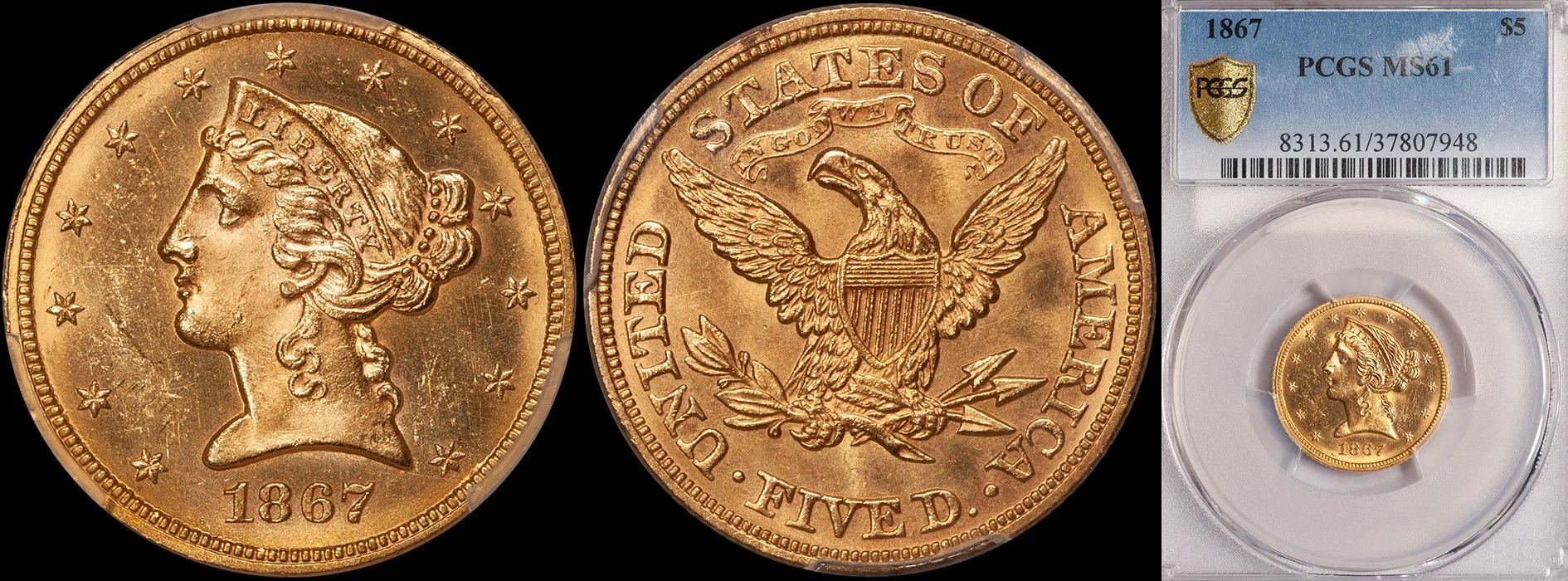
6. Bust Right (or Bust Left) Early Half Eagles in XF-40

This is a personal favorite and may not be right for all collectors, but there is recent auction data to back this selection up. When AU coins are regularly selling for nearly $10,000, a nice original, piece with a bit more circulation in the $5,000-6,000 range seems like a better buy.

DW Comment: I love this choice except for one problem. Finding a crusty, original EF bust right or bust left half eagle is going to be a real chore as most of the real EF45 coins are now in AU50 or AU53 holders. When I do see EF examples they tend to be net graded AU’s—in other words, they have the details of an AU50 but have been cleaned at one time. That said, I agree with RYK that a crusty, attractive EF45 at $6,000 makes more sense for most collectors than a marginal, bright AU55 at $10,000.

7. Dahlonega Half Eagle Varieties in XF or AU

There are a number of scarce, easily recognizable varieties of Dahlonega half eagles (1840-D Small D, 1843-D Small D, 1848-D D/D, etc.) which can be purchased for little and often no premium to the more common variety. The grading services and astute collectors are only starting to recognize them, but they are well-documented and described in Doug's book, “Gold Coins of the Dahlonega Mint.” Instead of buying the common example for the date in which 150 pieces are known, it makes sense to seek the one in which only 15 or so are known.

DW Comment: On this choice, I believe that RYK was “overthinking.” While I love the concept of buying a very rare die variety for little or no premium over a common one, the problem with these is that only a handful of collectors care. The 1840-D Small D half eagle is, as an example, a truly rare coin but I doubt if more than half a dozen collectors would pay a premium for it. My feeling is that the collector should learn these varieties and try to cherrypick them if possible but that there are just a small handful of Dahlonega half eagle varieties (most notably the 1848-D/D) that (currently) merit a premium.

8. Pedigreed Coins Better Date Gold Coins Under $5,000

I am a big fan of pedigreed coins, and I know that Doug is, as well. When I talk about pedigreed coins, I am generally speaking of the Big Three (Eliasberg, Garrett, and Norweb), but for rare date gold, there are others of significance, including Bass, Milas, Dallas Bank, to name a few. I am not talking about hoards like Wells Fargo, shipwreck coins (because they tend to be overpriced), or dubious pedigrees like Rainy Day. Often, the best way to buy pedigreed coins is to rediscover them yourself. Failing this, dealers like Doug Winter will often sell these with little or no price premium. I have found that while I enjoy owning them, selling them is usually painless as there seems to be quite a few collectors out there who also desire these. I make sure that I do not compromise my standards for quality for the grade and still seek good value.

DW Comment: I love this choice but would change the Big Three to the Big Four as I consider the Bass pedigree to be every bit as important as Eliasberg, Garrett or Norweb. RYK makes a great point when he suggests that the best way to find coins from these sales is to do some leg work. If you collect quarter eagles, make sure you own all of the major quarter eagle sales. If a coin has a distinguishing mark it may be reasonably easy to pedigree it.

9. 1870-CC Half Eagle Up To VF-20

Here is a coin that Doug Winter would not typically purchase for inventory, but I think is good value for the money. 1870 was the first year of the Carson City Mint and the 1870 gold issues are all the rarest in their respective series. The 1870-CC $5 is the most common of the three gold denominations and the only one that can be purchased in any form that resembles a coin for under $10,000. VF-25's have recently sold publicly for $6,000 or so, so it might require a drop in grade to F-15 or VF-20 to acquire this popular, historic, and legitimately scarce coin.

DW Comment: Actually RYK is wrong about me not typically buying a nice VF 1870-CC half eagle (or eagle or double eagle, for that matter...) for my inventory. I have actually owned three or four 1870-CC half eagles in lower grades and have always found them to be popular and readily liquid. On a rare, historically significant issue like the 1870-CC, I know I am willing to compromise my standards a bit. This would be a great addition to any collection.

10. 1838 Eagle in VF

Here's another coin that might be a bit lower in grade than what Doug might purchase for inventory, but when you consider that these coins actually did circulate (like the 1870-CC $5), it make sense to buy one that did circulate. This is a legitimately scarce, first year of issue, with a somewhat different design from the rest of the long series, and the first eagle struck for circulation in 35 years. A crusty, older holder example sold earlier this year in VF-25 for $4,000, which seems like a pretty good deal to me.

DW Comment: I wasn’t planning on including this issue in Part Two of my article but I like this choice. I am generally a big fan of first-year-of-issue coins, especially if they are genuinely scarce like the 1838 eagle. I would warn the potential buyer of this issue that Trends and CDN Bid tend to be unrealistically low in all grades and there are not many that can be bought in the sub-$5,000 range.

11. Any With Motto 1860's Eagles (except 1868-P) in XF-40 Through AU-50

The Liberty $10 series is chock full of scarce dates that fall below the radar screen of most collectors, even those who are active in rare date gold. From 1866 through 1869, there are multiple legitimately scarce dates that can be had in XF to low AU for under $5,000, but they do not come available very often. Omit the 1868 Philadelphia issue, as it is the most common of the group.

DW Comment: I couldn’t agree more with this choice although I might not necessarily single out the 1868 as the one “do not buy” coin from this era. These dates all have low mintages and low survival rates. They tend to be extremely expensive in AU and higher grades bit are surprisingly affordable in VF and EF.

12. 1850 Double Eagle in AU

I generally have difficulty finding good value in the $20 gold series (Liberty and Saints). I chose the 1850 $20 among the 1850's Philadelphia issues because it is the first year of issue, and it often comes nice. If you like the value in this one, you would probably like the some of the other 1850's Philadelphia $20's because they are even less expensive. Big pieces of 150+ year old gold are impressive now and will remain so for the foreseeable future.

DW Comment: I’m going to disagree with RYK on this one. At one time, I was a huge advocate of this date and I even included it in an article I wrote about “A Dozen Cool U.S. Coins” a number of years ago. But that was before prices shot up and population figures in AU soared. While this date has the cachet of being the first collectible double eagle, I think dates like the 1855, 1856, 1857 and 1858 in nice AU55 to AU58 are much better values than the 1850.

I’d like to give a shout-out to Robert Kanterman for his exceptional list of undervalued coins and I hope I haven’t embarrassed him to the point that he’ll never participate in the new interactive raregoldcoins.com blog again. So, who is next??

ValueQuest 2009

I have the feeling that the Numismatic Buzzword for 2009 is going to be “value.” If you are like most collectors, your purchases in the coming year(s) are not going to be as extensive as they were in the past. If you are buying fewer coins, you’ll want to stretch your coin purchasing dollars and look for pieces that offer the biggest bang for the buck. I have a few suggestions, which are mainly conceptual in nature, to guide you along the Value Trail. Regardless of series, date or mint, coins that have a nice, original appearance are very rare. My definition of “original” is a coin that appears to not have been cleaned, dipped, processed or otherwise enhanced in recent generations. In many series, especially ones like early gold and southern branch mint gold, truly original coins probably represent less than 5% of the available population. If you don’t believe me, take a look sometime at a large auction that is held in conjunction with a major convention. Assuming that you know what you are looking for, my guess is that you’ll see coin after coin that is too bright or bleached out or bedecked with “unusual” coloration. In some sales there may be thirty or forty early gold coins and only a small handful that fit my criteria of originality.

It makes sense to me that if you are going to buy fewer coins in 2009 (or, who knows, maybe you won’t buy fewer coins, just less expensive ones...) you should be buying prettier, more aesthetically appealing ones. And one of the things that I am continually amazed about in the rare date gold market is that, when they are available, choice, original pieces tend to only bring a small percentage (10-20% at most) over the typical “schlock” that is usually offered.

Another important point to consider when purchasing coins with a newfound appreciation for value is current market price versus prices in 2002-2003. I use 2003 as the point in time that prices in many gold series began to rise significantly. As an example, many early gold coins that were worth $6,000-8,000 in 2002-2003 had been at that level for quite a few years. Today, these same coins may be worth $10,000-12,000 or even more in some cases.

If you own stocks, you are probably well aware of the fact that the drops in the market since early September have basically eroded all stock profits achieved in the last five years. While the coin market has, so far, held its value far better than I would have expected, it is certainly a possibility that today’s $10,000 coin could certainly drop to $6,000 in a fairly short period of time. By studying the past history of specific subsections of the market, the value- conscious collector should have a clearer idea of potential downside.

There are actually a number of rare date gold coins that are worth the same today as they were in 2002-2003. Examples include very high grade Charlotte and Dahlonega issues (in this case MS63 and above), many San Francisco issues from the 1850’s, 1860’s and 1870’s and even a number of New Orleans gold coins. The reasons for this range from the market being damaged by too many overgraded coins in holders (in the case of Charlotte and Dahlonega pieces) to collector indifference (in the case of the San Francisco coinage) to poor reporting of prices by Trends and CDN (in the case of New Orleans issues).

Just because a coin was worth $5,000 in 2003 and it is worth the same today does not mean that it offers the “best” value to a buyer in 2009. But, it is interesting to ponder if coins such as this might have less downside than areas of the market that have shot up considerably.

Which brings us to the third and final point to consider in our Valuequest 2009. Liquidity is likely to be a huge factor in the coin market in the coming year(s). This is probably no time to be “cute” when it comes to your coin purchases. My guess is that coins that had limited appeal and liquidity issues in the good market of 2003-2008 might have virtually no appeal and liquidity in the potentially-not-so-good market of 2009 and beyond. In other words, key dates may drop in price somewhat but they are still likely to have a lot of collector demand. And to use an analogy from the non-gold coin market, series such as Three Cent Nickels, Shield Nickels and Liberty Nickels have and will probably always be also-rans because they are just not especially interesting in the opinion of most collectors.

So, in summary, I believe that three of the key elements that will drive the market in 2009 are originality, current price levels versus pre-bull market prices and liquidity/popularity. These were obviously key elements in years past but with the market euphoria of the past not likely to be seen for awhile, I think they will be more important than ever.

Baltimore Show Report

I went to this the November 2008 Baltimore show with limited expectations. Having spoken with a number of dealers whose opinions I respect, I knew the buzz wasn’t exactly encouraging. I would say that my overall impression of the show was that it was a little better than I expected but had I gone with normal expectations I would have returned disappointed. You can’t fault Whitman for anything that went wrong as the show was very well run (as usual). But collector attendance was unquestionably lower than what I would have expected for the last major show of the year and many familiar faces were either absent or were speed-walking through the aisles trying not to be tempted by the coins in the cases.

What was most noticeable at the show was dealer uncertainty and a clear dichotomy in market savvy. While most dealers did want to purchase coins, they were extremely cautious with their purchases. If a coin was fairly priced, something out of the ordinary or appeared on a valid want list, it probably sold. If it was priced at summer levels, not especially attractive or rare and not terribly desirable, it might have been used as a Numismatic Frisbee.

I mentioned a “dichotomy” among dealers. What exactly does this mean? There are a number of dealers (currently around 20-30%) who understand that the economy is lousy and that coins are harder to sell and have adjusted their prices accordingly. But there are still many dealers who appear to be in denial and are either not willing to sell old inventory at lower prices (and take losses) or are pricing new coins based on what a comparable piece might have brought at auction earlier this year. These dealers will either learn the hard, cold realities of a new market or they will be supersizing your value meal by the spring.

How much is the market down since the heady days of late spring 2008? I’d say in many cases between 20% and 30% and in some cases a bit more. But not all coins are down. In fact, I think there are areas of the market that are just fine. As an example, I would be happy to purchase as many nice EF40 to AU50 No Motto New Orleans half eagles and eagles as I could find at levels comparable to what I was paying four or five months ago; as long as the coins are choice, attractive and dates that I consider to be desirable.

Clearly, the real test of the market is going to be the 2009 FUN show. It looks like a potential perfect storm where there are going to be a bazillion coins for sale at the various auctions, numerous cash flow issues with dealers, a clearly Recessionary economy, a new Presidential administration and a clear schism between those dealers who “get it” and those that do not.

My November Baltimore show was, as I mentioned above, not really all that bad. I was able to purchase some really exceptional coins, all of which are already posted on my website (www.raregoldcoins.com). My wholesale sales were lower than usual for a Baltimore show but I did sell three mid-five figure coins and have strong interest from dealers in two other relatively expensive pieces. I should also point out that I was extremely selective with which dealers I showed coins to as there are certain firms whose checks seem potentially bouncy to me and the last thing I want to do over the Thanksgiving week is explain to my banker why so-and-so’s check was returned for insufficient funds.

As I was flying back from the show, I read the New York Times. It’s probably a real sign of the times that we live in that instead of turning right to the sports section, I read the business section first. One story, in particular, made my neck hair stand-up: a report that the stock market is experiencing its worst year since 1931. Most blue chip stocks are down 40% and many have lost 60%, 70% or even 80% in value. This really makes me believe that collectors who have a little discretionary cash right now might do a whole lot worse than considering buying a few nifty coins. My guess is that the really neat stuff is going to remain hard to find and it won’t be a whole lot cheaper than it was a few months ago but the level of competition among buyers has certain dropped, creating an excellent opportunity.

Hopefully you have had a chance to check out all the new features of my improved new website. I would greatly appreciate your feedback and am always looking for ways to make your web experience with DWN more pleasant and user-friendly.

Have an excellent Thanksgiving holiday!

The New PCGS "Genuine" Holder and my Feelings on Damaged Coins

PCGS recently announced that they plan to begin encapsulating coins that would have formerly been “body bagged” in the past for reasons such as damage, cleaning, and artificial toning. How does this affect the day-to-day operations of my firm and inventory and what are my personal feelings about such coins? The new PCGS “genuine” holders will have zero impact on DWN. My orientation has always been towards choice, problem-free coins and it is highly unlikely that I will be selling coins in “genuine” holders or even recommending them to my clients. If any of my submissions to PCGS wind-up in such holders (and hopefully this will not occur very often!) such coins will either be consigned to auctions, wholesaled to other dealers or, in the case where I think PCGS was wrong, resubmitted.

How do I feel about PCGS deciding to offer this service to their customers? I am assuming they made this decision because of considerable feedback from collectors (and dealers) who felt that a genuine-only holder was important, especially given the success of such a product at NGC. My feelings about the holders are mixed. I feel that they slightly dilute the PCGS brand in terms of non-problem coins but I think they offer collectors a degree of safety regarding the authenticity of rare issues.

Will the PCGS genuine holders have an impact on the market? I believe that they will. Some of this impact will be good and some, I think, will be not so good.

The positive impact that the genuine holders will make is that they will help to quantify value on problem coins. Problem coins are exceedingly hard to ascribe value to and by having slabbed problem coins trade more regularly, collectors will get a better idea of what they are worth. As an example, if three 1795 half dollars in “genuine only” holders trade at auction for $3,500, $3,850 and $3,350 a collector can get a pretty good idea of the value range of a similar coin. The bad news here is that no-grade coins are not as readily quantifiable as problem-free coins. If a coin is no-graded because of “scratches” how do you value it versus the same coin that is no-graded because of a harsh cleaning?

The negative impact that the genuine holders will have on the market is that they will encourage collectors to think like bargain shoppers. I would look at a damaged 1795 half dollar as the “Wal-Mart” version of this issue. In other words, a collector will be attracted to such a coin because it is a cheap version of a non-damaged 1795. As I will explain a bit further into this blog, I am a big advocate of original coins and I think collectors are doing themselves a disservice if they buy a $3,850 scratched 1795 bust half dollar because it seems “cheap” in comparison to the same coin without scratches.

One unintended consequence of the genuine holder is that it will spawn a new class of “crackout” dealer: the person who sees a lightly scratched or mildly cleaned coin in a genuine holder and feels that it is actually no worse than a regular quality piece in a PCGS (or NGC) holder. I already know dealers who have had some big hits cracking coins out of NCS “cleaned” or “damaged” holders and getting them into regular NGC (or PCGS) holders. I have no doubt that this will happen with the PCGS genuine holders.

As I mentioned above, I do not personally like damaged coins and I try to stay away from them unless it is an issue that is so incredibly rare that I basically have no other choice. An example of this might be an extremely rare Colonial coin variety of which there are just three known. Am I going to pass on an example because it is on a pitted planchet or it has scratches or because it’s been harshly cleaned? Of course not. But for every instance like this, I can think of a dozen reasons why I would pass on the aforementioned 1795 half dollar with scratches at $3,850.

So what are some of the reasons that I dislike damaged coins? First and foremost, they tend to be ugly. Once I see a big scratch on a coin, I see it magnified every time I view it. Secondly, coins like this are hard to sell. If you don’t believe me, assemble a collection of PCGS (or NGC) genuine slab coins and take them to a coin show. My guess is that they aren’t going to generate much interest. Thirdly, they are the antithesis of what collecting is about, at least to me. I buy specific coins because they are rare, attractive and high quality; not because they are unattractive but a good deal relative to undamaged coins.

To me, the bottom line about collecting is this: if you are pursuing a series that is beyond your budget and you have to cut corners to participate than its time for a reality check. Look, there’s nothing wrong with owning up to the fact that you’ll never be able to afford a nice 1794 dollar. But I would contend that the $75,000++ it will take to purchase a problem-riddled example of one could be much, much better spent on choice, original coins; either within the Bust Dollar series or in another series where the key issues are within your budgetary restrictions.

I touched on one thing earlier in this blog that I do think is important about the PCGS genuine slab. The no-grade market right now is sort of like the Moroccan Bazaar of numismatics. A coin like a cleaned 1916-D dime with VF detail might or might not be genuine. The PCGS genuine holder will, at the very least, separate the real examples from the plentiful fakes and this is good for the collector (or dealer) who is unable to distinguish between the two.

The Liberty Cap Collection of Early U. S. Coins

Douglas Winter Numismatics is proud to announce that we have been chosen to sell yet another high quality collection of United States coins. This assemblage, formed by an astute specialist in Texas, is known as the Liberty Cap Collection of early United States coins. It features exactly twenty different coins (plus one early American medal) ranging in value from a few hundred dollars to over $50,000. The collection is being imaged and cataloged by DWN and is expected to be posted on the www.raregoldcoins.com website around November 18, 2008. The collection is known as the Liberty Cap Collection because of the fact that a number of the coins have designs that feature a prominent Liberty Cap. Examples of coins in this collection with a prominent Liberty Cap design include a rare 1783 Libertas Americana medal in Copper (Betts-615) graded MS62 by NGC, an 1836 Pattern Gold Dollar (Judd-67) graded PR66 Ultra Cameo and an extensive date run of branch mint Classic Head quarter eagles and half eagles.

There are many highlights in this collection but I’d like to focus on three that I think are especially worthy of attention. Please note that full descriptions and images of each will be available on my website within a few days.

1838-C Half Eagle, Graded MS60 by NGC. The 1838-C is the most historically significant half eagle from the Charlotte mint. It is the only Classic Head design for this denomination and it is the very first half eagle produced in Charlotte. It is not really a rarity from the standpoint of total known but it is very rare in the higher AU grades and excessively rare in Uncirculated. Only two or three are known in Uncirculated. The finest is the superb PCGS/NGC MS63 example formerly in the Bass collection and now owned by the Pogue family. The second finest known was the NGC MS62 coin formerly owned by Paul Dingler but this coin was improperly cleaned and is no longer in a Mint State holder. This leaves two 1838-C half eagles in Uncirculated holders: an NGC MS61 that I have never seen in person and the NGC MS60 in the Liberty Cap collection.

In addition to this impressive rarity, the collection also contains a choice, original NGC MS62 example of the rare but slightly less well-known one-year type: the 1839-C half eagle.

1824/1 Quarter Eagle, Graded MS62 by PCGS. The Capped Head Left quarter eagle type was made from just 1821 to 1827. Only five single issues are known and each is very scarce. The 1824/1 is among the rarest of these with an estimated 60-70 known from the original mintage of 2,600. In fact, PCGS has only recorded twenty-one in all grades including a single example in MS61 and just three better. The finest known business strike is a single MS64 at PCGS and it is unlikely that more than ten or so exist in the various Uncirculated grades. The coin in this collection is probably within the tail end of the Condition Census and it is one of the best that I have seen with excellent color, surfaces and luster.

I have long been an advocate of the early quarter eagles as I think they represent exceptional value in the arena of early United States gold coinage. The owner of the Liberty Cap collection agreed with me and purchased some exceptional pieces in his years of collecting. Also included in the collection (and available for sale) are an 1831 in NGC MS60, an 1832 in NGC AU58 and a choice NGC AU58 1833.

There aren’t many silver coins in this collection (just one that is being sold at the present time) but it’s a doozy: a lovely 1836 Gobrecht Dollar in PCGS PR63.

1836 Gobrecht Dollar Original, Graded PR63 by PCGS. The lovely and enigmatic Gobrecht dollar has been a favorite with collectors for over a century and with good reason. The design is among the most attractive ever created on a United States coin (especially the famous starless obverse of 1836) and the limited number of coins struck has always ensured a strong demand.

After many years of speculation, research has shown just which Gobrecht dollars were made as originals in 1836 and which were restruck. In my opinion, this has made the 400 Originals produced in late 1836 the most desirable of the Gobrecht dollars.

These Originals are easily detectable by the alignment of the dies (the head of Liberty is aligned opposite the O in DOLLAR) and the lack of a die scratch above the top wing on the reverse.

In my experience, Proof 1836 Gobrecht Dollars generally come one of two ways: either dipped-out and Impaired or well-preserved but with funky and/or unappealing coloration. The coin in the Liberty Cap Collection is remarkable in that it is exactly how you’d want a PR63 Gobrecht Dollar to look: fully reflective, attractively (and originally) toned and free of significant numismatic or non-numismatic impairments. The collector who assembled the Liberty Cap collection was extremely picky and particular when it came to acquiring a Gobrecht Dollar and his patience paid off when it came to this lovely piece.

If you’d like more information on the coins in the Liberty Cap Collection, please feel free to call me before the collection is posted on my website around November 18, 2008. I can be reached at (214) 675-9897.

Are Early Gold Coins Overpriced?

A good client of mine recently asked me the question “are early gold coins overpriced?” As with most intelligent questions, I don’t think that this one has a pat answer. My feeling is that some early gold coins are poor value at current levels while others are good to very good values. Read on for my take on the current early gold market and my suggestions of where the best values are. Appearance and eye appeal are, obviously, critical factors in determining the desirability of any coin. In the area of early gold, I think these factors are especially important. The reasons are fairly obvious: these are hand-made coins that vary in quality literally from year to year, many survivors have been cleaned, abused or damaged and the third-party services tend to be inconsistent (to say the least) when it comes to grading early gold.

A fairly general statement that I think can be made about the early gold market is that only a small handful of the coins that exist have good eye appeal and a pleasing overall appearance. I personally feel that virtually every early gold coin that is choice and original remains a good value while most every good early gold coin that is low end for the grade and unoriginal is poor value. But this observation is fairly simplistic and needs to be expanded.

As with most markets, early gold issues can generally be divided into three categories: common or “generic” dates, better dates and rarities. And in the case of early gold we might even be able to create a fourth category: the “super-rarity.” How are each of these categories doing?

Even if you know very little about early gold, you might guess that the area most prone to showing weakness in a downward market turn would be the common dates. An example of what I would term a “generic” early gold coin would be an 1806 Round 6 Half Eagle. There are as many as 1,000 examples known of this issue and it is fairly readily available in grades up to and including MS63 to MS64.

If you go to a major national coin show you are likely to see a decent number of 1806 Round 6 half eagles. These would generally be available in the AU55 to MS62 grade range. (Lower grade 1806 Round 6 half eagles are difficult to find because the nice, affordable examples tend to be closely held by collectors; the very high end MS63 to MS64 tend to either show up at auction or they are placed in tightly-held, high end collections and do not trade with frequency). The examples available for sale tend to be low end and unattractive. At current price levels, I think they are not especially good values. Why is this?

As recently as five to six years ago you could buy a nice, fresh AU 1806 Round 6 half eagle for $5,500-6,000. At this affordable level, this coin was a good value, despite the fact that it wasn’t really “rare” in the sense of most early gold. Today, a similarly graded coin will cost you at least twice this amount. The problem is that these coins now tend to not be nice for the grade and the new price range of $11,000-13,000 no longer qualifies as “affordable.” Are coins such as this overpriced? If they are typical low to middle quality coins, the answer is a fairly resounding yes. If they are accurately graded and solid, choice pieces I would say that they are really overpriced but that they are relatively marginal values at these levels.

An example of an early gold coin that I regard as a “better date” would be a 1799 half eagle. This issue is not truly rare but it is available with far less frequency that an 1806 Round 6 half eagle. I think the market for an issue like this has held up rather well; even if a 1799 half eagle in, say AU55 is currently valued at least twice as highly as it was five or so years ago. Collectors still expect an AU55 example of this date to have good eye appeal and ugly examples are harder to sell than they might have been a year ago but I think this area of the market is solid. Are coins like this overpriced? I would say, pretty resoundingly, in fact, that they are not; especially in the solid collector grades of EF40 to AU55.

A “rare date” early gold coin would be, as an example, an 1826 half eagle. This popular Fat Head issue has a surviving population of maybe three dozen and it tends to be offered for sale at the rate of one or two coins per year. This is another issue that has seen significant price increases in the last five years but the fact is that the supply of 1826 half eagles in virtually all grades is nowhere near the (current) demand. Yes, coins like the 1826 half eagle are currently expensive. But given their unquestionable rarity I would have to say that coins like this remain fairly priced.

And what about our fourth and final category—the so-called “super-rarity?” An example of this would be an 1815 half eagle; an issue that is extremely rare in all grades and which typically appears for sale at the rate of approximately once per three to five years. My gut feeling is that these major rarities, in all the various early gold series, are still reasonably priced. There is an 1815 half eagle coming up for sale in the 2009 FUN auction (graded MS64 by NGC and pedigreed to the Garrett collection) that is almost certain to shatter all price records for this date and which could be one of the highlights of the 2009 Numismatic Year.

What about issues like the 1796 No Stars quarter eagle or the 1808 quarter eagles; coins that aren’t “rarities” in the classic sense of the word but which are exceptionally popular and numismatically significant? I think, in theory, that these are overpriced given their big-picture rarity. Given their strong level of demand I would still buy them for inventory. However (and this is a BIG however) I think the market has become far more selective on coins like this. If they are not CAC-quality, they have become hard to sell unless discounted in price. And this scenario is likely to continue as long as decent 1796 quarter eagles command prices in excess of $125,000-150,000+.

The Proof 1844-O Eagle Returns Home

After a probable absence of over a century, perhaps the most important New Orleans gold coin in existence is coming back to its ancestral home. My friend Paul Hollis, a coin dealer from Metairie (a suburb of New Orleans), has arranged for the unique Proof 1844-O eagle to be placed on exhibit at the New Orleans mint. This coin, with an estimated value of $2.5 million, goes on public display November 1 and will also be taken around Louisiana on tour by Hollis.


IMAGE COURTESY PAUL HOLLIS


The New Orleans Mint began producing coins in 1838. The very first issue struck by this mint was a group of 20 half dollars to inaugurate coinage and a small group of Proof half dollars were made in 1839 (plus at least one Dime dated 1839-O is known that has been designated a “Specimen” by NGC). So, we know that the New Orleans mint had experience with making Proof coins and that the quality of these was comparable to that seen at the Philadelphia mint.

In 1844, the New Orleans mint produced at least one example of a Proof half eagle and eagle. Remarkably, both still exist and, even more remarkably, both are superbly preserved. Why were they produced and who were they struck for?

Unfortunately, contemporary documentation does not exist that gives the definitive answer to these questions, so we have to make some assumptions. I think it’s safe to say that the Proof 1844-O gold set was struck in commemoration of either a special event or, more likely, a visit to the Mint by some special VIP or dignitary. My guess would be that they were made for personal presentation to President John Tyler.

What is interesting about these 1844-O Proofs is that there were no other Proof gold issues produced at the branch mints until 1854 when San Francisco struck a double eagle in this format. But in the case of the 1854-S double eagle, the reason for producing the coin is obvious as it was made to commemorate the opening of the new mint. One would think that if New Orleans were to have made gold Proofs, they would have struck a small number of Proof quarter eagles in 1839 or half eagles in 1840. But if these were ever made, they have disappeared without a trace.

The earliest numismatic reference to the 1844-O Proofs appears to be in the Seavey descriptive catalog that was published in 1873. In 1890 when they were sold as part of the famous Parmelee collection the eagle sold (as Lot 1151) for the princely sum of $16 while its companion half eagle brought just $9.50. It was next seen in the collection of William Woodin who was famous both as a coin collector and as Secretary of the Treasury for Franklin D. Roosevelt in 1933.

Woodin sold his primary collection at auction in 1911 but I am not aware if the Proof 1844-O set was included in either of his two sales (it would be easy to check these in the sale catalogs but my library does not contain them). It is documented that Woodin also sold many of his coins privately to the leading collectors and dealers of the day. I do not know this with certainty but I surmise that the 1844-O Proofs went into the Brand collection.

From here on, the pedigree chain for the 1844-O half eagle and eagle gets murky. In fact, I think it is possible that the coins were split up when the Brand collection was being sold in the 1920’s and 1930’s.

The half eagle was in all likelihood sold to Waldo Newcomer and then likely went into the Colonel Green collection. From there it is believed to have been sold to King Farouk and remained in this collection until it was forcibly sold at auction in 1954. It was later sold to a prominent Texas collector (not Harry Bass, by the way...) by Abe Kosoff in 1959. I was shown the Proof half eagle in the early 1990’s by the Texas dealer Michael Brownlee. It was still in the original flip with Kosoff’s writing on it. I used it as the cover coin of the first edition of my New Orleans book. The coin is a superb Gem.

Brownlee told me soon after showing me the Proof 1844-O half eagle that he believed the Proof eagle existed but he didn’t know where it was. In fact, he claimed, he had been searching for it for many years as he desperately wanted to reunite the two coins in the prominent Texas collection (which he had built and was, rightfully, very proud of).

If Newcomer did, in fact, buy both the half eagle and eagle, it is not likely that Col. Green would have purchased the eagle as he was not specializing in this denomination. What would be interesting to learn was, if the coins were indeed split up, in which collections did it reside between the 1920’s and the 1990’s.

Did Brownlee know where this coin was all along? I have my theories but won’t expound on them here. I will say, however, that his search for the elusive Proof 1844-O eagle was rewarded when, in the late 1990’s, he announced that the coin was “rediscovered.” It was sent to NGC where it was ultimately graded PR66 Cameo. Then, it was offered for sale by dealer Robert Leece at various price levels for a number of years.

Finally, the coin was sold to a Florida collector in 2006 by Louisiana dealer Chuck Bloomfield. The price was reported to be $1.5 million.

I have had a chance to examine the Proof 1844-O eagle and it is a simply amazing coin. It is 100% unquestionably a Proof with incredible cameo contrast and a deep “black and white” appearance that one wouldn’t expect to see on a Proof gold coin from this era, let alone one from New Orleans.

If you are going to be in the New Orleans area in the coming months, I urge you to take a look at this great coin and to visit the New Orleans mint.

Mark Goodman: Numismatic Imaging Jedi

I’m going to turn this blog over to Mary Winter. For those of you who are not aware of this, my wife is the numismatic imager, par excellence, whose coin photos are part of what makes raregoldcoins.com, in my opinion, a very special numismatic experience. Mary recently had a training session with Mark Goodman whose coin photography skills are quickly becoming legendary with collectors all across the US of A. Take it away, Mary...

I have a confession to make. All I know about coin imaging I learned from Mark Goodman. No, let me rephrase. All I know about GREAT coin imaging I learned from Mark. I have been DWN’s coin photographer since raregoldcoins.com became a website in the mid-1990’s. I was initially self-taught…and it showed.

Anyone who has ever tried on their own to take a photo of a slabbed coin knows how hard it can be to have an image turn out decent, let alone good. After years of trying everything I could think of, the Numismatic Gods (NG’s) smiled on me and quite serendipitously, one of Doug’s customers mentioned a man he knew who was an excellent coin photographer. Desperate and intrigued, I got the contact information on this person and emailed him straightaway.

As I recall, I initially just asked him questions by email. It became quickly apparent that he knew his stuff – and was self-taught to boot….gulp. But I swallowed my pride and continued to ask questions. I found he was not only extremely talented, but willing to share his expertise.

Once DWN relocated to Oregon in 2006, the NG’s smiled once again as Mark Goodman is also located in Oregon, within traveling distance of our office. I asked him if he would ever consider training me in person – and he agreed. That was perhaps 1.5 to 2 years ago. After my initial training, I saw quite a difference in my photography. But there was more to learn…

This year Mark wrote a book, “Numismatic Photography” (available for sale at www.zyruspress.com) which is a must-have for anyone wanting to improve their coin imaging skills. Doug “suggested” I study it…ALOT. I was blown away at the amount of research Mark had put into the book, as well as its ease of use for the layman. And his color photographs tell it all. I was once again humbled and knew I needed more help.

Hat in hand I contacted Mark again. He was as gracious as before and willing to help me again. I sent him a request for further training and he agreed. This session went levels beyond where I was before and I hope my photography from here on out will do him justice.

As I said, and can’t say enough, thank you Mark Goodman – everything I know about great coin imaging has come from you!


Before Goodman.....D'oh!


After Goodman.....Aaahh!

Baltimore Collection Shows Strength of Double Eagle Market

To paraphrase that esteemed numismatist Mark Twain, the reports of the death of the coin market seem greatly exaggerated. That is, at least, if you take a look at the prices that Heritage got for a nearly complete set of Liberty Head double eagles that was sold at their Dallas auction on October 24. As anyone who even remotely follows the dated gold market knows, Liberty Head double eagles have been one of the most solid performers in the coin market during the bull market run-up of the past few years. This market has proven to have more depth than I would have ever imagined and there are, clearly, more advanced collectors assembling comprehensive specialized sets of these coins than in probably any other area of the 19th century gold market.

The question I was asking myself a few days ago, though, was: would these collectors still play in this market after the Economic Malaise of the past month? The Type One, Type Two and Type Three sets are full of many big, macho “stoppers” and I was very interested to see how these coins would do.

The two key collectible Type One double eagles are the 1854-O and the 1856-O. These have appreciated in value more than virtually any other United States gold coin in the last five to seven years and, certainly, the New Market wouldn’t be able to continue its frantic pace when it came to these two issues, would it? The 1854-O in the sale was a PCGS AU55 and it sold for $603,750 which is an all-time auction record for the date. The 1856-O was graded AU58 by NGC. I thought it was comparable in quality and appearance to the PCGS AU55 example that I had sold earlier this year and the Heritage coin brought $576,150 which is the second highest price ever at auction for this rarity.

The second-tier New Orleans Type One issues were extremely strong as well. An 1859-O in PCGS AU58 brought $97,750 which is a record price at auction while the 1860-O in PCGS AU58 sold for an identical price and, again, set what I believe to be a record at auction. One coin that I thought would be a real litmus test for the O mint double eagle market was the 1861-O in NGC AU55. This is a date that seems to have really come out of the woodwork in recent years and Heritage had sold a comparable coin in their January 2008 sale for $46,000. The one in the Dallas sale was bid all the way up to $57,500; a price that I thought was pretty remarkable.

My single favorite Type One double eagle in the sale was a PCGS MS65 1854-S. As I have written in the past, this date is very rare and much undervalued in Gem and the example in the Baltimore Collection was one of the two best I had ever personally seen. This was a coin that I felt certain I would buy, and I was willing to stretch quite a bit in order to procure it. I stretched and stretched and still came up short as it sold for a staggering $115,000.

Even the boring dates in the Type One series did quite well and most of the lots sold for levels exceeding what I would regard as “retail” numbers for these dates.

The Type Two double eagles in this collection were relatively uninspiring as it appeared that the Baltimore collector focused most of his energies on the Type One and Three issues. A not especially nice 1870-CC in VF30 with a large natural planchet flaw on the reverse sold for $230,000. I think this is a pretty reasonable amount for this in-demand rarity but I think it was more a reflection of the coin’s lack of eye appeal than it was a softening of the market. Many of the other scarce Carson City issues in the sale did well, including an 1871-CC in NGC that was bid to $66,125, an 1872-CC in PCGS AU58 that brought $23,000, an 1878-CC in PCGS AU58 that hit the $25,300 mark and an 1879-CC in NGC AU58 that brought $21,850. My take on these prices is that they were pretty much exactly what I would have expected these coins to sell for before the economy went south and that I would have expected them to sell for 10-20% less in these Troubled Times.

The Type Three rarities in the Baltimore Collection were impressive but I was unsure if the market for these issues would remain as strong as it had been. The first test was the 1879-O in PCGS AU58. I expected it to bring in the $50,000-55,000 range but it raced up to $74,750. The very rare 1881 was a PCGS MS61 that I did not like as a result of its funky color and surfaces but it brought $138,000 which is exactly the same price it sold for when offered as Heritage 1/07: 3203. An 1882 that was graded AU58 by ICG but which appeared to have a problem on the cheek of Liberty that was not mentioned by the grading service still managed to garner a bid of $63,250.

For many years, the 1885 was the most affordable of the very rare Type Three dates. The NGC AU58 in the Heritage sale brought $48,875 which I am reasonably sure is an all-time record price for a circulated example of this date. The 1886 in PCGS AU55 sold for $86,262.65. This exact coin had brought $24,150 when it was offered as Lot 7437 in the Heritage 2004 FUN sale. The previously-overlooked 1891 appears to have captured the attention of most specialists in this area and the PCGS AU58 in the Heritage sale realized $48,875.

There are three very rare Proof-only dates in this series and the Baltimore Collection was missing the very rare 1883. It did, however, have an 1884 graded PR64 by PCGS. This coin had sold for $126,500 when it was last offered as Heritage 6/04: 6376. Four years later, it was bid up to $207,000 which I thought was an exceptionally strong price. The 1887 was a PCGS PR64 Deep Cameo and it sold for $155,250. This is almost the same amount as the far superior Heritage 1/07: 3145 (graded PR65 Deep Cameo) realized a year and a half ago.

All in all, I would say that prices were anywhere from 10-30% higher than I would have expected. I was really surprised at the prices that the dozen top coins in the collection brought, given that the economic climate doesn’t dictate large purchases right now and given that Heritage conducted this sale without the benefit of a concurrent convention to attract much floor action.