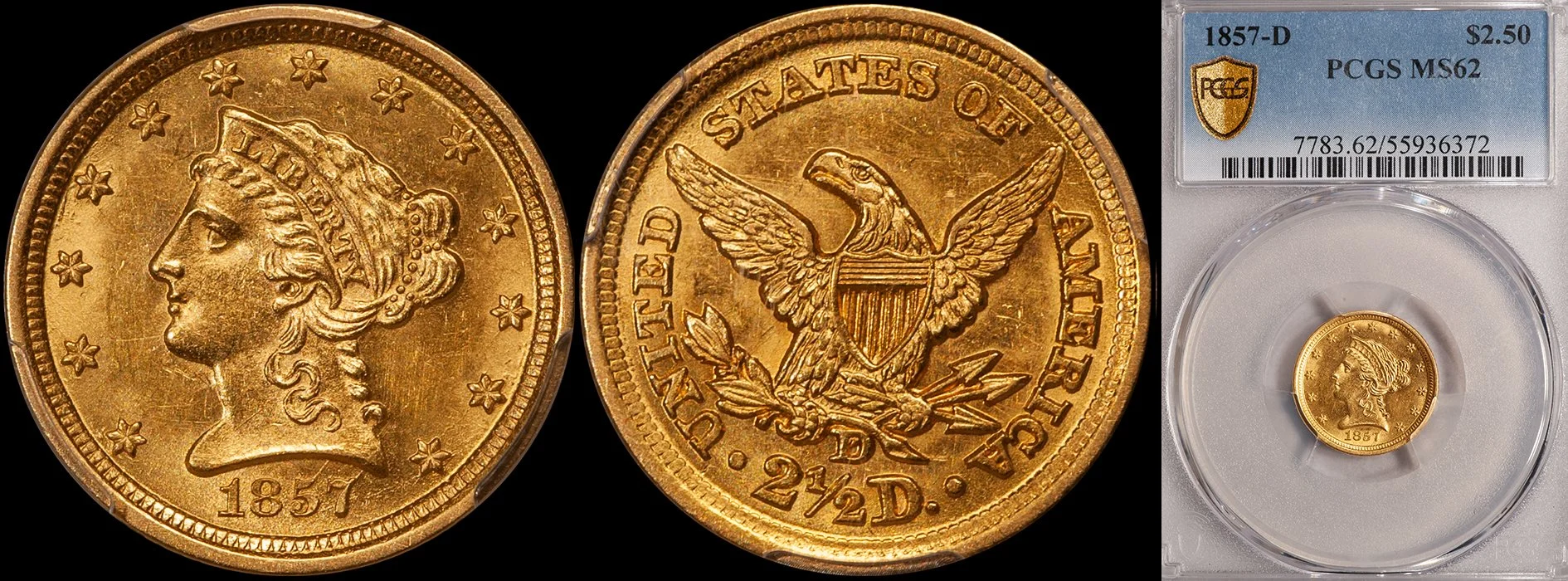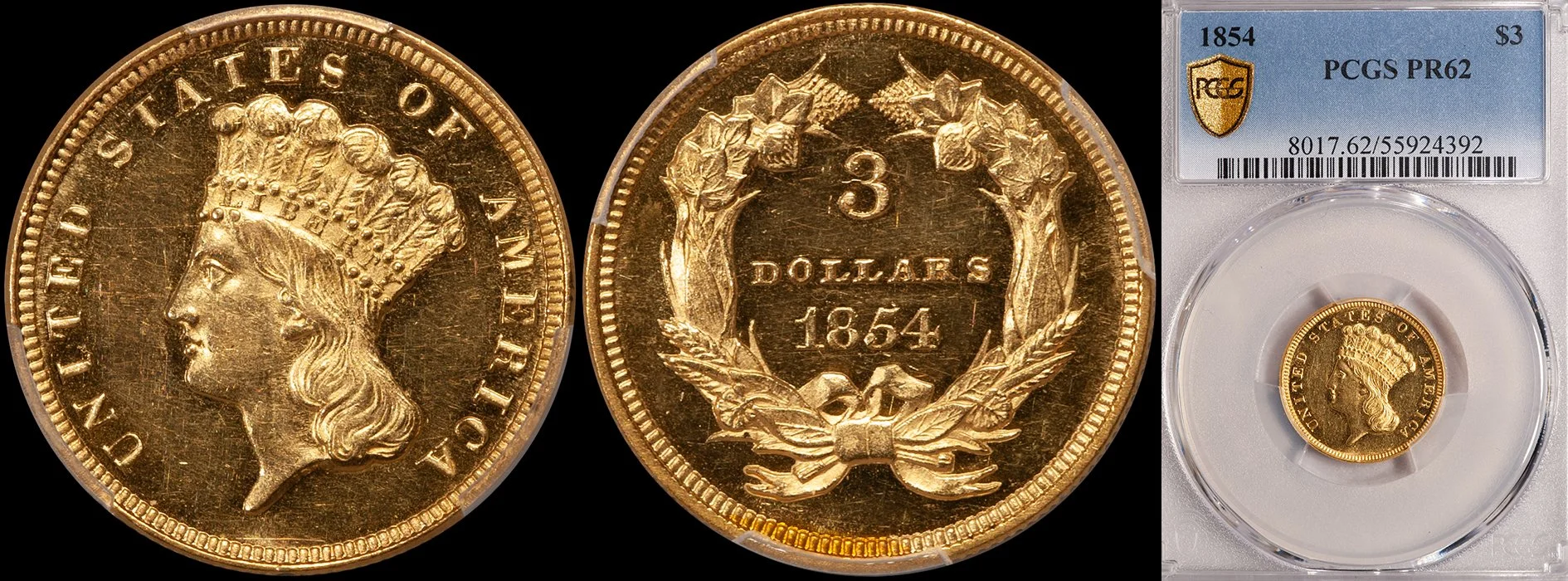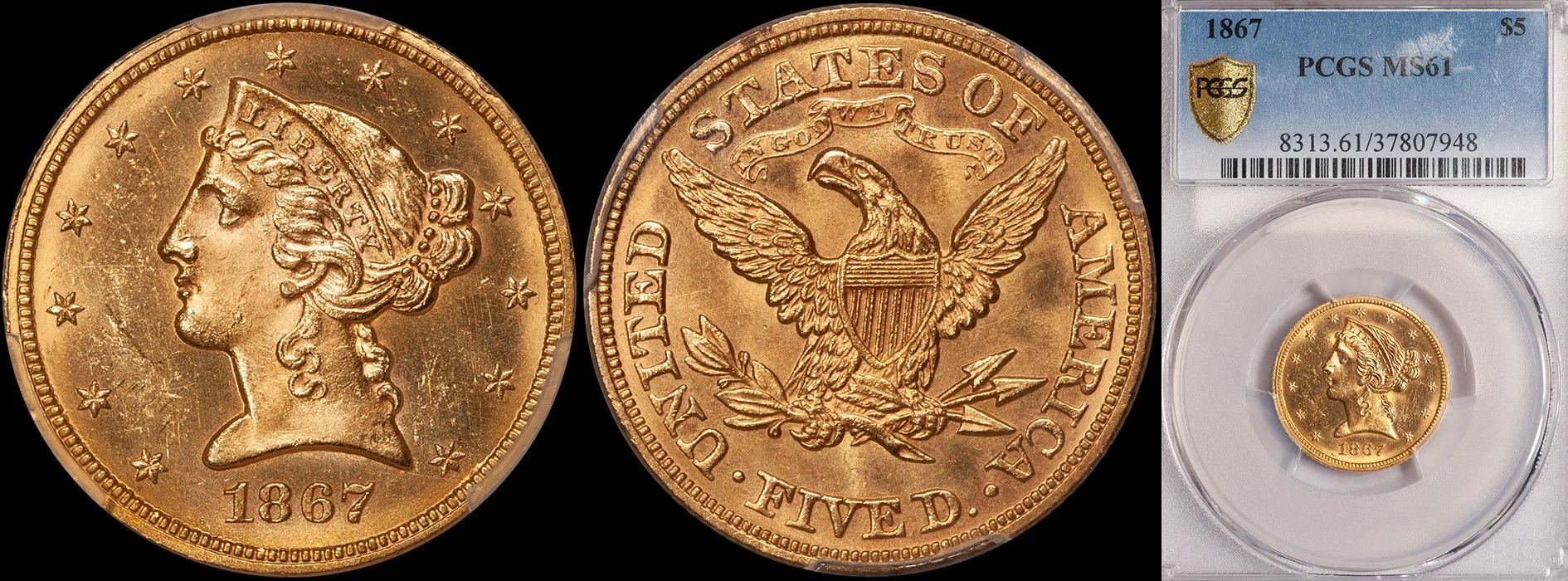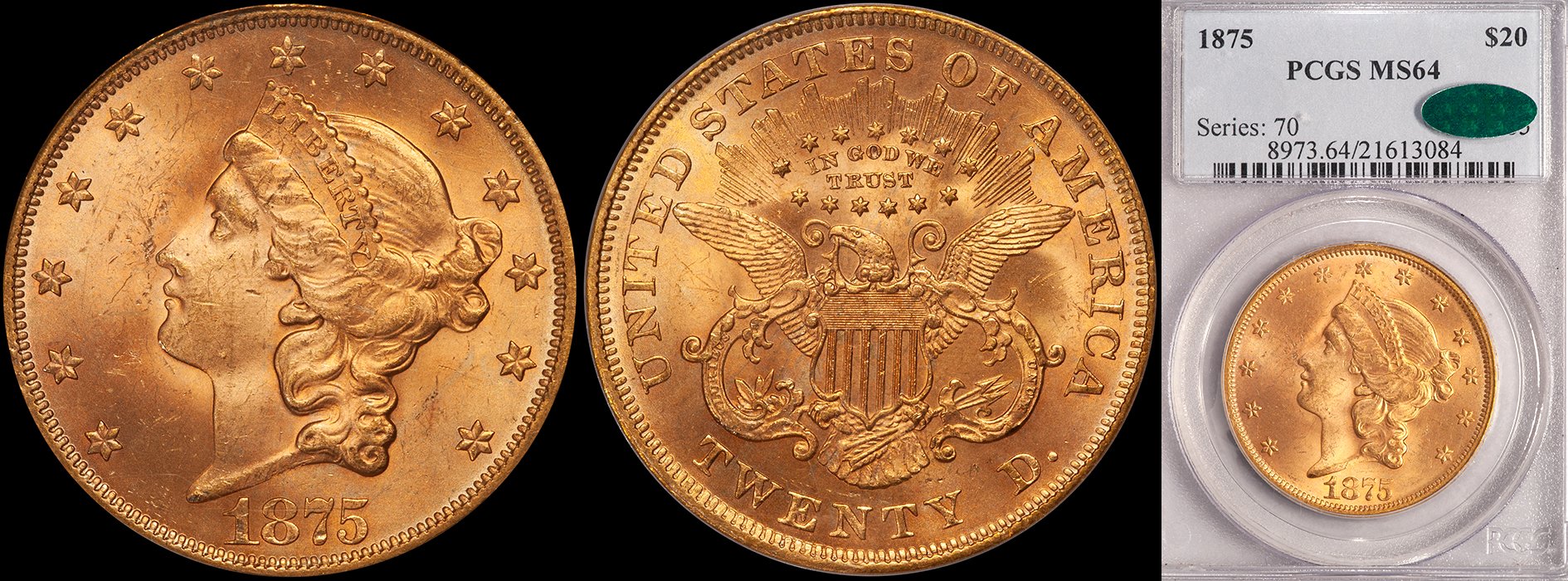
Eliasberg 1842-C Large Date

Most collectors (and dealers) have never seen a Gem Uncirculated Charlotte half eagle. I recently had the pleasure of handling one of the finest known Charlotte half eagles of any date—the Eliasberg 1842-C Large Date—and thought it would be interesting to readers of this blog. This 1842-C Large Date half eagle has been graded MS65 by NGC. It is one of just a small handful of Charlotte half eagles of any date that have ever been graded MS65 (or better) by the services. In fact, as of March 2008, PCGS had only graded a single Charlotte half eagle in MS65 (1847-C) while NGC had graded four individual coins including this one in MS65 (the others are an 1846-C, 1852-C, 1855-C and 1857-C) plus a single coin in MS66 (1849-C).

Before we discuss the specifics of this coin, let’s look at some of the background about the date. The 1842-C Large Date has an original mintage of 23,589. An estimated 90-110 are known including as many as seven to nine in Uncirculated. The present coin is, obviously, the finest. There are also two graded MS64 by NGC and a pair graded MS63 by PCGS. I rank the 1842-C Large Date as the fifth rarest of 24 Charlotte half eagles in overall rarity and the seventh rarest in high grades.

This particular coin has a long and illustrious pedigree. It last appeared at public auction in Stack’s 1995 Milas Collection sale where it brought $44,000 in an NGC MS64 holder. Prior to being in the Milas collection, it was Lot 421 in the October 1982 Eliasberg sale where it brought $17,600. It has been acquired by Eliasberg from the Clapp collection in 1942 and before this it was sold to John Clapp, Sr. by the dealer Elmer Sears in 1920.

The first question any smart collector should ask about this coin is "is it really an MS65?" Despite the fact that it once resided in an MS64 holder (albeit way back in 1995...) I would resoundingly say "yes, it is unquestionably a Gem by today’s standards."

1842-C $5.00 NGC65

When you look at the photo of this coin, there are a few things that immediately stand out. The first is this coin’s exceptional luster. Yes, I realize that you can not accurately capture the true essence of luster in an image but on a coin like this-that is literally dripping with original mint luster-you can get a pretty decent idea of it. The second thing that is apparent is this coin’s amazing color. Both the obverse and the reverse have fabulous intense yellow gold hues that are accentuated by the full, unbroken frost. Even from an image, you can detect that this coin is original and has never been dipped or "improved."

Some collectors might look at this coin and say that it can’t possibly grade MS65 because it has marks visible in the obverse fields. I would respond to this as follows. First, the current standards of the MS65 grade do not imply that such a coin is perfect. An MS65 will show some light, unobtrusive marks; primarily in the most open part(s) of a coin design. Secondly, some allowance must be made for the fact that this is a branch mint coin from the 1840’s. Sophisticated graders of coins realize that you can’t take the standards of a Philadelphia half eagle from, say, the 1890’s and apply it to a Charlotte coin from 1842. But that said, I honestly believe that even if this exact coin was a common Liberty Head half eagle it would still be assigned an MS65 grade.

The most important thing about grading a coin like this is to consider its overall eye appeal. This 1842-C Large Date half eagle is absolutely beautiful with great detail, superb luster, splendid color and very nice surfaces. These individual factors make it far too nice to assign an MS64 grade to it. Another way of looking at this coin is to ask the question, "would I sell this in an MS64 holder?" If an exact twin of this coin came up to my table at a coin show in an MS64 holder (and it was priced like an MS64) I would write a check in about five seconds and have it cracked out and ready for regrading in about fifteen seconds. And if it didn’t grade MS65 right away, I would continue to try to get this grade.

In my opinion, the Eliasberg 1842-C Large Date is among the best No Motto half eagles of any date that I have seen in many years and it is certainly among the best half dozen half eagles known from this mint. Even a Jaded Dealer such as me gets a tingle out of coins like these and I’m sure it will be a long time before I handle another Gem Charlotte half eagle.

Gaping Holes in Gold Coin Literature

A few years ago, I wrote a blog about coin books that needed to be written for United States gold coin collectors. A few of what I considered to be the gaping holes in gold coin literature have been filled but others remain. Here, again, are some of my “dream books” and the reasons why I think they would be important. 1. A Collector’s Guide to Classic Head gold coinage. It’s been rumored for years that John McCloskey was going to be producing a book on this subject and I have seen references to his die variety numbering system as far back as the Bass II catalog from 1999. But there is still no collector’s guide to this series.

I personally think that Classic Head gold coinage is one of the most collector-friendly series. The quarter eagles and half eagles from 1834 to 1838 have a charming design, are very short-lived and lack the extreme rarities (and ultra-expensive issues) found in the Liberty Head series. And, as Dr. McCloskey has shown, there are a number of extremely interesting naked-eye varieties.

A few of the topics that I’d really liked to see covered in a future Classic Head book would include die characteristics of Proofs (it can be extremely difficult to tell a true Proof from a Prooflike business strike), a detailed history behind the establishment and abolishment of this design (this period in American coinage history remains under-researched and not well understood), a detailed explanation as to why these coins tend to show poor strikes and a date-by-date analysis as to the rarity and collectability of the Classic Head quarter eagles and half eagles.

This wouldn’t be a very long book (I’m guessing 125-150 pages tops) and it probably wouldn’t be a best-seller but it would stimulate what I think is one of the most interesting United States gold coin series.

2. An Encyclopedia of Proof Gold Coinage. The knowledge that most collectors have about Proof gold is sketchy at best. The Breen Encyclopedia and the Akers books contain population estimates about many Proof gold issues but the numbers are typically at odds with each other.

Here’s what I’d like the definitive book on Proof gold to contain. First, I’d like pictures of all the known Proof issues. Secondly, I’d like diagnostic criteria for all proof gold coins. Thirdly, I’d like Condition Census information (where possible). Fourth, I’d like an explanation of the manufacturing process of Proof gold and some detailed information on things like why Three Dollar gold pieces tend to show intense orange-peel texture or why certain issues come with heavy cameo contrast and others do not and to mention, once and for all, accurate information on the Matte Proof manufacturing process.

The problem with such a book is that it would be very expensive to produce (especially with attractive pictures) and I can’t imagine more than a few hundred copies would ever be sold.

3. A high quality “coffee table” book about collecting United States gold coins by type. This topic has sort of been covered by the Garrett/Guth gold coin book and the new book on gold coin collecting by type written by Jeff Ambio. What I’d like to see is a book that takes the design and the scope of the former and weds it with the depth and clarity of the latter.

As more and more new collectors decide to focus on gold coin collecting by type, I think the importance of producing a well-written, easy to use and superbly illustrated book on every major United States gold type becomes more and more critical.

I’d like this book to have information about the how’s and why’s of type collecting, suggestions of what dates work best for type collecting, etc. I’d also like to see really good color photos of every major design type.

This is a book that I can actually see selling quite a few copies and I could imagine the format being spun-off to encompass silver and copper as well.

4. A book on San Francisco gold coinage. If you think about it, there is no real reason for San Francisco gold being less popular than the Southern branch mints other than the fact that there is (currently) no standard reference available to collectors. It has been proven, time and time again, that previously unpopular areas of the market invariably get a shot in the arm when a good book is published.

The reason that I have never written a book about San Francisco gold coins isn’t that I don’t care about the subject; I actually like San Francisco gold quite a lot. My biggest drawback has always been the fact that there are an awful lot of individual issues from this mint and that many of the post-1880 coins just aren’t all that interesting.

If I could ever find the right person to help me with this project, I would consider getting involved.

5. An in-depth collector’s guide to early gold coinage. The recent Dannreuther book on early gold is a fantastic reference for advanced collectors and for collectors who are focused on die varieties. But it lacks basic information for newer collectors that I’d like to see in a book on early gold coinage.

I’d like to see this book in a similar format to the one that I use for branch mint gold, with information about strike, surfaces, luster, color and eye appeal for each issue as well as important die characteristics, rudimentary die variety information, auction price information, a roster of finest known coins, etc.

And I know exactly the right person to write this book. So if you are reading this blog, Paul Nugget, write the book on early gold that could be your legacy and prove to everyone (other than me who already knows it...) that you are the world’s greatest expert on early gold!

1857-S Gold Dollar

One of my favorite under-the-radar U.S. gold issues is the 1857-S gold dollar. This is a coin that is really hard to find yet nice examples can still be purchased for less than $2,000. Read on for some “need to know” information about this interesting issue.

San Francisco only produced gold dollars for a total of seven years. The 1856-S is probably the best known of these issues due to its being a popular one-year type but, ironically, it is probably the most common gold dollar from this mint. The 1870-S is the rarest of these in terms of its overall availability but it is actually more obtainable in Uncirculated than generally realized. The dates that are the hardest to locate in higher grades are the 1857-S, 1858-S and 1859-S and it is my belief that the 1857-S may be the toughest of the three.

A total of 10,000 1857-S gold dollars were struck of which I would estimate that 150-200 are known. This date is seldom found below EF40; this is due to the fact that the small size of the gold dollar did not make it a coin that could easily circulate for many years and subsequently become heavily worn. Most of the survivors are in the EF45 to AU55 range. The 1857-S becomes scarce in properly graded AU55 to AU58 and it is quite rare in Uncirculated.

As of March 2008, PCGS has graded seven 1857-S’s in Uncirculated including one in MS64, two each in MS63 and MS62 and another two in MS61. NGC has graded sixteen in Uncirculated with one each in MS64 and MS63, two in MS62, nine in MS61 and one in MS60. I believe the NGC figures are inflated by resubmissions and I also believe that the NGC MS64 and PCGS MS64 are the same coin. In my best estimation, there are around ten to fifteen truly Uncirculated 1857-S gold dollars with most of these in the MS60 to MS62 range. I know of only two really choice pieces:

      -Bowers and Merena Bass II: 121 (10/99) @ $16,100. This coin was graded MS63 by PCGS in the Bass sale and I believe it may be in an MS64 holder today.

      -David Akers Pittman I: 880 (10/97) @ $13,200. I purchased this coin in the Pittman sale and it graded MS62 at PCGS; I believe that this coin is in an MS63 holder today.

The 1857-S is generally a well struck date, as are all of the San Francisco gold dollars. There are some pieces known that show weakness on the curls below LIB in LIBERTY and the date can occasionally show light weakness on the tops of the 85.

The quality of the surfaces for this issue tends to be somewhat below average. I have seen a number with mint-made lintmarks and others that show die deterioration at the NI in UNITED and/or the C in AMERICA that weakened these areas.

The luster is most often satiny with a slightly grainy texture. A few are known with semi-prooflike luster but this tends to be on circulated coins with abrasions, resulting in sub-standard eye appeal.

The natural coloration ranges from rose-gold to orange-gold and I have seen some 1857-S gold dollars with very attractive color. As one might expect, such coins are becoming harder and harder to find as more are being dipped and/or brightened.

As I mentioned above, I feel that this is a considerably undervalued coin. In fact, I think all of the Type Three gold dollars from this mint are great value in comparison to Charlotte and Dahlonega gold dollars. As an example, I recently sold a nice PCGS AU55 1857-S gold dollar (the coin imaged above) for less than $2,000; the same price level I would have gotten for a far more common 1851-C in a lower grade.

Uncirculated examples of this date are remarkable good value in my opinion. An MS61 is likely to trade in the $5,000-6,000 range while an MS62 would bring around $7,000-8,000 if available. Again, in comparison to the more popular C & D mint gold dollars of this era, the 1857-S seems like really good value to me.

MPF For St. Gaudens Double Eagles

One of the consequences of the soaring gold market is the evaporation of the Market Premium Factor (or "MPF") for certain semi-scarce dates in the St. Gaudens double eagle series. This scenario presents the savvy collector with what appears to be an interesting short-term opportunity. The term Market Premium Factor was invented, as far as I can tell, by my friend the newsletter writer/publisher Maurice Rosen. It refers to the premium that a better date coin sells for versus a common date. If a common date in a series is worth $1,000 and a slightly better date sells for $1,200 it has an MPF or 20%.

In the wake of the Great Saint Malaise, some dates that were formerly accorded market premium factors of 10-30% are suddenly selling for generic prices or just a bit more. There are a number of reasons why the generic double eagle market is currently as weak as it has been in recent memory. With gold blasting through the $1,000 mark, the gold content of a $20 Lib. or a Saint is enough that it becomes a sizable outlay of cash for the typical collector or investor; especially if being purchased in bulk quantities. Many new collectors and investors who are purchasing gold are buying modern U.S. mint products and eschewing older American gold. And many of the large-scale marketers who sold vast quantities of $20’s in the past are turning their focus to areas of the market where the profit margins are greater. These are the coins that, it seems to me, are good value right now.

Let me give you some examples of semi-better date Saints that are selling for the same price as generics but which are a lot scarcer (and, by the way, just in case you think I happen to have a double row box of these sitting in the back of my safe, I don’t...)

The 1910 is a date that I’ve always thought was pretty tough to find in properly graded MS64 and it is genuinely scarce in MS65. According to the most recent PCGS population figures, there are 1,057 graded in MS64 and 158 in MS65. Compare this to the common 1924 that has a current population of 60,451 in MS64 with 38,752 in MS65. In theory, the 1910 is 57 times scarcer in MS64 than the 1924. I’m not saying that the 1910 should sell for an enormous premium over the 1924. But in stronger markets, I can remember getting a decent premium for this date in grades as low as MS62.

Some of the other semi-better dates that have had good MPF’s in the past but which are currently selling for generic price levels (or close to generic levels) include the 1907 No Motto, 1908-D No Motto (in MS63 and below), 1909-S, 1910-D, 1912 and 1913 (in the lower Uncirculated grades) and 1920 (again, in MS63 and below).

Before you run out and buy a bunch of these, I have a caveat for you. One of the reasons that the MPF has evaporated many Saints is because of loose grading. I’m guessing that if you can find CAC approved 1910 double eagles in MS64, they ARE going to sell for a premium; as well they should. If you look at the price structure for many of the more common Saints graded between MS61 and MS64 you’ll note very small price spreads. One of the major reasons for this is that there is often very little difference in quality between these grades (!).

That said, I still like the idea of buying a group of 1910 Saints in PCGS MS64 for common date prices if you have the opportunity. At these levels, you have very little downside other than the price of gold dropping and with the current state of the United States economy I don’t foresee this happening anytime soon.

2008 Baltimore & Phoenix Show Reviews

Two weeks. Two shows. Too much? Read on for a quick overview of the recent Baltimore and Phoenix coin conventions.

I love the Baltimore show. Unlike some conventions that feel like they are in a death spiral, you can clearly sense that this show is fresh, healthy and on the upswing. And this year’s first edition was excellent.

The only negative about this show, at least for me, is the epic day-long schlep that entails getting to Baltimore from Portland. If anyone reading this would like to exchange trips on their private jet for U.S. gold coins please feel free to propose a trade immediately.

I spent two full working days in Baltimore. The first, a Thursday, was essentially a wholesale-only day. As you will probably guess, the usual “it was hard to buy and easy to sell” mantra held to form. Except that this time it was exceedingly hard to buy and really easy to sell. Every dealer I chatted with, even those with reputations for exaggeration confirmed this. In the world of nice, interesting coins it’s as dry as the Mojave on the bourse floor!

My second day, a Friday, was more of a retail day. From the opening of the show until the end of the day I had a constant stream of serious buyers at my table. Most walked away with a new purchase or two and most seemed very enthusiastic about the show.

If I had to make one negative comment about this Baltimore show it would be that, while full of the usual Cast of Collecting Characters, there didn’t seem to be many new faces. I’m guessing that this can be attributed to the fact that many of the new breed of upscale collectors do not attend shows and acquire coins primarily through auctions or via the Web from dealers such as me.

The Bowers and Merena sale conducted at Baltimore had some nice gold pieces and prices for the most part seemed to be quite strong. My two favorite gold lots were a really fresh 1840-O quarter eagle in an old green label PCGS MS62 holder that sold for $20,700 and a seemingly way undergraded 1843-O Large Date quarter eagle graded MS61 that brought a robust $17,940.

What was hot at the show? Early gold and Proof gold were in great demand, particularly nice quality material. I noted a lot of demand for interesting, choice items in the $1,500-7,500 range but even in bad markets coins like this is always easy to sell. Without a doubt the weakest area of the market was low end generic gold. In fact, price premiums are so low on coins like AU55 to MS61 common date $20 Liberty gold that there is a strong possibility that people will start melting these soon.

After what seemed like 45 minutes at home I turned around and went to Phoenix to attend the Spring ANA. Note to ANA Officials: great choice of venue but bad choice of dates. If you want more dealer enthusiasm for this show in the future DO NOT hold it the next week after Baltimore.

Because of the fact that most major dealers had recently attended Long Beach and Baltimore, the Phoenix show had many no-shows from the East Coast. Not only was there little enthusiasm, there were almost no fresh coins. Which meant that I wasn’t able to buy much and which meant that I had minimal enthusiasm.

I wound-up leaving the show early due to a combination of boredom, fatigue and the fact that I am preparing to fly out of town to pick-up a nice collection that I just bought. This collection has nice runs of Carson City double eagles, New Orleans eagles and Three Dollar gold and I expect to begin listing these coins on my website within a week or so.

There are no other coin shows of note between now and the Central States show in mid-April so I expect that demand for nice coins will be extremely high within a month and that the result will be an exceptionally good show in Chicago.

1993 Stetson Collection Sale

One of the more interesting (and lesser known) gold coin auctions that I’ve attended was the sale of the Stetson Collection which was conducted by the old Bowers and Merena in May, 1993. This was an instance where the back story (or stories in this case) was nearly as interesting as the coins themselves.

Beginning in 1992, an amazing hoard of gold coins started to quietly enter the market. This hoard consisted of tens of thousands of coins dated from the late 1830’s through, I believe, the 1920’s. It included large quantities of semi-key St. Gaudens double eagles, extensive runs of Carson City eagles and double eagles, large quantities of New Orleans eagles from the 1880’s through the early 1900’s, sizable quantities of San Francisco rarities and much, much more. It has never been revealed where these coins came from (although it is widely rumored that they came from an Eastern European central bank; given the time they were sold it would suggest that they were dispersed by a former Soviet bloc country in an attempt to infuse some Western capital).

This incredible hoard was dispersed over a number of years in a quiet, orderly fashion. Some of the coins went to dealers who sold them to marketers or specialists. Other coins were sold at auction. The first group of these coins to sell at auction was at the aforementioned Bowers and Merena sale and I can remember being extremely excited to have the chance to purchase some very important and very fresh coins.

Before I discuss the sale (and some events leading up to it) I’d like to discuss the appearance of the coins themselves. Because of the massive size of this hoard (and the intelligence of the individual who was masterminding its dispersal) these coins were, for the most part, kept original and dirty. Many of them had the prototypical “euro-Grime” appearance which I describe as follows: extremely deep almost brassy orange-gold toning with a noticeable two-ton e appearance from blackish grime or dirt on the high spots. This appearance was almost certainly the result of the environmental conditions in which these coins were kept. On some coins, the look was very attractive. On others, it was pretty ugly and the coins needed to be dipped (or washed with soap and water at the very least).

When I learned about the sale I thought it was important enough to fly up to Wolfeboro, New Hampshire to view them in person. I made the flight arrangements, booked a room at the Wolfeboro Inn and set off to the Granite State. My flight from Dallas wound up getting into Boston late and I missed my connection to Manchester, New Hampshire so I wound up renting a car and driving. As I made my way up I-93 to New Hampshire it started to get extremely foggy and by the time I was within an hour of Wolfeboro, it was dark and almost impossible to see more than ten feet ahead of me.

Following the instructions I had received from Chris Karstedt (remember, this is many years before MapQuest or a GPS in the car) I slowly made my way across New Hampshire and finally made it onto the road that took me directly to Wolfeboro. About two miles from the town, I saw a very large and very dead deer in the middle of the road with a pool of blood surrounding it.

As I arrived at the Wolfeboro Inn, the first person I saw was dealer Ron Karp and he had a large ice pack clutched to his wrist. Ron, it turned out, had accidentally struck and killed the deer I had seen on the road a few minutes earlier and he was clearly in pain. As I recall, Ron would wind-up going to the emergency room of the Wolfeboro Hospital where he had his wrist (which was clearly broken) in a cast. For many years, every time I saw him, I thought of that dead deer splattered in the middle of the road...

The rest of the lot viewing session was less eventful and involved no dead deer but I do remember really liking the coins. My thoughts were that they were very undergraded in the catalog (and all were sold raw) and that a number of the coins were, at the time, Condition Census.

Two of my personal favorite coins in the sale were the 1849-O eagle graded “EF45” by B&M (this exact coin is currently in an NGC MS61 holder) and an 1852-O eagle graded AU55 (currently in a PCGS MS60 holder). I purchased the former for $6,875 which I thought was pretty reasonable and was ready to buy the latter for around $7,500-8,500. When it wound up bringing $22,000 I knew that I was in for a long night (incidentally this exact coin came up for auction in the 1999 ANA sale where I was able to buy it for $14,835. Sometimes, good things come to those that wait...)

The Liberty Head double eagles in the Stetson sale included some of the best Carson City pieces I have ever seen as well as some great Type One coins. I remember an incredible 1866-S No Motto that was graded AU53/55 in the catalog and which, by the conservative Doug Winter Standards of 1993 I called AU55+. This was back before most people knew just how rare this coin was in higher grades and this piece remains one of the two best 1866-S No Motto double eagles known. It brought a whopping $17,600 and would be worth around ten times this amount today.

Another coin that I’d love to turn the Way Back Machine to 1993 for was a nice Extremely Fine 1870-CC (graded VF35 or finer in the catalog) that sold for $57,200. I know this coin was graded EF40 by PCGS right after the sale; I’m guessing it would be at least a 45 today. The 1873-CC in the sale was incredible by the standards of this date and would grade at least MS62 today; it brought $34,100 in the Stetson sale and this was a record price for the issue that stood for many years.

I can remember purchasing an 1879-O double eagle in this sale that later graded AU55 at NGC for $12,100; today this same coin is easily worth 6 to 7 times this amount. A few of the other great double eagles in the sale that I didn’t purchase included an 1881 that I graded MS61 for $31,900, an extremely rare 1886 that I graded MS60 or better for $30,250 (this is a $100,000+ coin today) and a really nice AU58+ 1891 for $13,750. You need to realize that these were huge prices for these coins at the time and the very rare Type Three Philadelphia issues would remain significantly undervalued well into the late 1990’s/early 2000’s.

One other double eagle I remember fondly from this sale was a 1913-S that I graded “Superb Gem best I’ve seen!!!” according to my catalog notes. This coin sold for a then-remarkable $37,400 and I’d be curious to know what holder it resides in today.

After the huge success of the Stetson sale in May, the owner of this hoard placed more great coins in the B&M Tower Hill sale in September. This group included a nice date run of Liberty Head half eagles featuring some exceptional San Francisco pieces. These also sold for very strong prices although, as I recall, the sale itself lacked the electricity of the Stetson sale earlier that year.

The gold coins from this hoard continued to appear on the market in small to medium sized groups for another few years. I’m guessing that most have been dipped or changed so that they are no longer recognizable but if you own a nice New Orleans eagle from the 1850’s or a high grade CC double eagle, the chances are good they may have come from this hoard.

Advice for Long-Term Collectors

There is no doubt that we are currently experiencing a very good coin market. Many areas have increased exponentially in price in the last three to five years with the top end of the market now out of reach for most collectors. And this has created a market that has proven very frustrating to long-term collectors. Let’s say that you are a collector who has focused on early gold for the last decade. In the past, your biggest worry was probably finding coins. If you collected, say, early half eagles, you were able to find the more common issues pretty easily and had steeled yourself to waiting quietly for your chance to buy the rare issues.

But in this very strong market, there is an “X” factor. New, well-heeled collectors have come into the upper echelon of many series and made life difficult for more established collectors. The early half eagle collector who had been waiting three years to buy an 1827 in nice Uncirculated all of a sudden has a number of loose cannons to compete against who may take the attitude “I don’t care what it sells for, I want it.”

This has to be frustrating. I was speaking to a collector the other day whose area of specialization has gone crazy (price-wise) seemingly overnight. He had been able to pretty much have his way in his series for a few years but now he’s frustrated because the coins he needs are either going to sell for more than he can afford or these new Mega Collectors are going to be offered the coins privately before he is.

As I told him, this isn’t necessarily a totally bad problem to have. In theory, the rare coins he already owns should be worth more money. But he’s frustrated because he doesn’t want to sell; he’d rather complete his chosen set and then worry about what to do with it.

This tale of woe got me to thinking: what are some gold series right now that a collector whose isn’t a Zillionaire could still be the Master of His Domain and collect very high quality coins without having to pay insane prices?

One series that comes to mind is business strike Type Three gold dollars. I personally love the series and if I were a collector looking for a challenge, I’d work on a date set of Philadelphia issues from 1856 through 1889. All of these can be obtained in Uncirculated and a wide variety of collecting budgets can be accommodated. One of the real beauties of these coins is that nearly all of the dates exist in Gem Uncirculated and if you haven’t seen an MS66 or MS67 gold dollar from the 1860’s or 1870’s, you are in for an aesthetic treat.

Another series that I think would be very challenging but a lot of fun would be the San Francisco quarter eagles struck from 1856 through 1878 (I’m not including the extremely rare 1854-S in this set since I’m assuming that most collectors are not going to be able to spring for the six-figure price that it would take to procure an example). The rarest collectible issues in this series are the 1862-S and 1863-S. Neither is incredibly hard to find in nice AU grades but if this set were going to be assembled in Uncirculated, both issues are extremely rare. What really intrigues me about these coins is the fact that they are genuinely rare in Uncirculated and they seem like pretty good values in comparison to the southern branch mint coins. I’m not so certain that they will ever become popular but the good news is that if you decide to work on a high grade set, you are not likely to be confronted by the dreaded Zillionaire Collector Who Has To Have It.

If a collector with a decent-sized budget wants to have his way in the Three Dollar gold series, he has an opportunity right now to buy some pretty interesting coins. I’ve seen some interesting dates in the MS63 and MS64 range sell for approximately 20-30% less than what they were bringing a few years ago and I’ve found the grading standards of these coins to be—of late—pretty tight in comparison to a few years ago. I would contend that the Three Dollar series is more popular right now than generally believed but it is not the Darling of Telemarketers that it was for a brief and shining moment in 2005-2006.

One other area that the prudent gold coin collector could do some serious damage in right now is No Motto half eagles and eagles from Philadelphia. You don’t see a ton of these on the market but when you do they generally do not incite Auction Frenzy like some of the Seated Liberty silver coins from this era. I have bought some really interesting No Motto Philadelphia eagles from the 1840’s and 1850’s in the last 90 days for less than $20,000 and even some very pleasing pieces in the $2,500-5,000 range. I’ll let you in on a little secret: these are some of the final gold coins of this era that have not been destroyed by coin doctors and if you like pretty, original pieces you are far likely to see a great looking 1847 Philadelphia half eagle than one from the branch mints.

So if you are being driven crazy by Insane Zillionaire Collectors who are making the top end of your series go nuts don’t despair. I’m guessing that 90% of these guys will go away in a few years and your series will go back to less frothy days when they leave. In the meantime, look at this as a good time to take a break, find a new series and once again become The Man.

February 2008 Long Beach Show Review

As I left for Long Beach last week, I wondered if this edition would be different from the last few Long Beach shows I have attended. The answer—and some random observations about the market—are included below. Unlike some of my competitors, I have made the decision not to attend the various and sundry pre-Long Beach auctions. I figure that at this point in my life I do not need to be spending an extra three weeks each year at Long Beach sales that are full of mostly uninteresting (to me) coins. This year’s sales did have a few interesting individual consignments including a nice run of Proof Bust Dimes at Superior and some better gold at Goldberg but, again, I was gearing up for the actual show itself.

On the Winter Show Grading Scale (WSGS) I would give the recent Long Beach convention a “B” which is actually better than I thought it would be. I did not bring many coins to sell and was more interested in buying new inventory. It was a struggle to find coins (surprise, surprise...) but some neat material did surface and I was pleased with what I purchased. Some of the highlights are:

-An original, evenly matched 1860 Proof Set graded PR64 to PR66 by PCGS

-An incredible NGC PR67 CAM 1904 half eagle

-A lovely Condition Census 1847-C half eagle graded MS62 by NGC

-An 1857-C gold dollar in PCGS MS61; the highest graded example of this date

-A number of crusty, original Southern gold coins in the $1,500-5,000 range

On at least three occasions I saw really interesting coins in another dealer’s case and asked to see them and a price quote. The price that I was quoted was so over-the-top outrageous that I wasn’t sure if I had been quoted in Dollars or Rupees. When I’m quoted $95,000 on a coin that I think I’d be seriously stretching on at $70,000 this means one of two things: either I am totally out of touch with the market or dealers are very, very proud of their very, very good coins right now and you have to pay very, very dearly at the absolute top end of the market.

Of course I didn’t expect to see many interesting coins just sitting out in dealer’s cases. At this point in time, if you do not have a special relationship with at least a few dealers, you aren’t likely to be offered anything very special. This is as true for a long-time dealer like me as it is for a collector.

My general observations about the market based on the Long Beach show are as follows:

*Many of the interesting coins from the FUN auctions are already gone. It is easy to sell choice, interesting coins right now and most dealers are able to move their best pieces much easier than in the past.

*Most of the recently graded coins I saw were more original in appearance and seemed “fresher” than in the past. I think this is as a result of both NGC and PCGS starting to crack down on coin doctoring. I’d like to think that we can thank CAC for this.

*Speaking of CAC, I saw many more stickered coins than I have before. I am not certain if they are selling better than non-stickered coins but a random inspection showed me that the typical CAC has nicer overall eye appeal than the typical non-CAC coin.

*Early gold is as hot right now as I can ever remember. If you bought nice quality early gold at least two or three years ago, you are currently looking like a genius. My gut feeling is that all the attention being focused right now on early material means that there are some great values in the Liberty Head series.

*When a market area gets hot it is amazing how fast coins disappear. I can’t remember seeing more than a handful of interesting rare Seated Liberty coins at the show and despite an intense search for interesting New Orleans half eagles and eagles, I came up nearly empty-handed.

Heritage had an extremely important specialized collection of Large Cents that brought amazing prices. The Husak Collection could serve as an absolute textbook model on how to properly assemble an in-depth specialized collection. The coins were exceptional, the presentation of the catalog was exceptional and the level of interest generated by the combination of the two was even more exceptional. Collectors realize that they do not have many chances to obtain truly special coins and there were dozens of coins in the Husak collection that, once they were sold, would be essentially impossible to replicate.

The gold coins in the Heritage sale were not quite as exciting but there will still some neat pieces. I loved the 1854 Type Two gold dollar graded MS68 by NGC and it brought a healthy $149,500. I was amazed that the 1863 gold dollar in NGC AU58 brought $6,900 which is almost double AU58 Trends; I assume that collectors have finally learned how rare this coin truly is in all grades.

The supposedly weak Three Dollar series saw some very strong prices. An NGC AU58 1854-D brought $54,625 and an AU58 1854-O in an old green label PCGS holder sold for an exceptional $34,500. A nice run of early Half Eagles saw some very strong prices including $40,250 for an NGC MS63 1804 Small 8 and $71,875 for an 1806 Round 6 in NGC MS64 with a CAC sticker. I really liked the NGC MS65 1810 Large Date and it sold for $92,000. An 1837 Classic Head graded MS66 by NGC sold for $94,875 which I actually thought was pretty reasonable as a PCGS MS66 example of this date brought $97,750 back in 1999 (but was considerably nicer, in my opinion). Some of the more interesting Liberty Head half eagles included a PCGS MS63 1857-O at a record-setting$50,025, an NGC MS61 1879-CC at $21,850 and a superb PCGS MS66 1886 at $21,850. Notable Eagles included an 1882-O in PCGS MS61 for $8,625 and a PCGS MS64 1897-O for $12,650. The two most significant double eagles in the sale were an 1860-O in NGC AU58 that was bid to $80,500 and a nice NGC AU53 1861-O that sold for $48,875. One coin that amazed me from a price standpoint was a nice PCGS EF40 1850-O in an old green label holder that sold for $10,350; if this coin doesn’t upgrade to at least AU53 then the new owner is well upside-down.

With major shows in Baltimore and Phoenix occurring in the next three weeks, it will be interesting to see if the momentum generated at Long Beach continues into the Spring.

No Motto Half Eagles

I’ve recently had the opportunity to sell some high grade No Motto half eagles and this got me thinking about the rarity of this series in higher grade. I thought it would be interesting to look at the populations of the No Motto half eagle series and to give them a bit of statistical analysis. I also thought it would be interesting to take the No Motto eagle series and compare these numbers as the two series offer a good contrast. The No Motto half eagle and eagle series were produced between 1838 and 1866 with the eagles beginning in 1838 and the half eagles beginning in 1839. The No Motto type includes a one year subtype in the half eagle series (1839) and a two year subtype in the eagle series (1838 and 1839) that are collected alongside the issues produced in 1840 and later and whose numbers have been combined throughout the course of this study.

Mintage figures for both No Motto half eagles and eagles can be somewhat misleading. Some of the Philadelphia issues from the 1840’s and 1850’s have mintages that approach 1 million. All told, 9,114,483 No Motto half eagles were struck as well as 5,259,528 eagles. Given these figures, you would expect No Motto half eagles and eagles to be somewhat common. This is most certainly not the case, however, primarily because of massive meltings that began as early as the Civil War and which continued up through the 1960’s. In my experience, the survival rate for No Motto gold is well below 2% and in the case of high grade coins, it is a fraction of this.

In preparing this analysis, I’ve decided to use PCGS’ figures exclusively. I’m not endorsing one grading service over the other but merely feel that PCGS has a “cleaner” population report with more accurate figures. That said, it should be stressed that the figures used below include a number of resubmissions and they tend to become less accurate as grades increase (and values grow in spread). I will make note of this as we look at the numbers.

I. No Motto Half Eagles

Total Graded: 11,213 Circulated Grades: 9,952 (88.75%) Uncirculated Grades: 1,261 (11.24%) MS60 to MS62: 870 (7.75%) MS63: 230 (2.05%) MS64: 136 (1.21%) MS65: 19 (0.16%) MS 66 and better: 6 (0.05%)

So what can we learn from these numbers? The first thing that I find interesting is that only 11% or so of the No Motto half eagles graded by PCGS are Uncirculated. When we factor in resubmissions, the actual number is probably quite a bit lower; probably around 8% or so of the total coins. Given my experience, this makes sense. In comparison to early half eagles and the later With Motto Liberty Head issues, a very small percentage of the No Motto coinage survived in comparatively high grades.

The next thing that is noticeable is how the numbers drop off once the MS63 level is reached. PCGS has graded 391 No Motto half eagles in MS63 or better (just 3.47% of the total population graded) and my guess is that once you factor in resubmissions and other anomalies, the total number of PCGS graded No Motto half eagles in MS63 or higher is more likely 250 or so pieces.

These numbers get more interesting when we look at them a bit more carefully and note that three dates (the 1847, 1852 and 1861) have a combined population of 137 in MS63 and better. This works out to over 35% of the total population of all higher grade No Motto half eagles. If you remove these three dates from the total population, suddenly all No Motto half eagles in MS63 seem a lot scarcer.

The specific grade that I think is most inaccurate in the PCGS population report is MS64. In looking through the report, I see such figures as eight 1841’s having been graded, eight 1845’s, eight 1858’s and forty (!) 1861’s. Given the fact that a PCGS MS64 1861 half eagle is worth around $12,500 and an MS65 is worth over $30,000 it is no wonder that at least a few very high end coins have been resubmitted over and over in an attempt to graduate to a higher grade. My guess is that the PCGS figure in MS64 (a total of 136) is inflated by at least one-third and that the actual number is more likely in the 75-95 range.

Ironically, I think the PCGS MS65 and MS66 numbers are pretty accurate. Once someone gets a No Motto half eagle in an MS65 or MS66 holder it is clearly to their benefit to get the population figure accurate for a specific date. There are supposedly three 1847 half eagles graded MS66 by PCGS and I think this seems high by at least one but I can account for nearly every other MS66 and most of the 19 coins graded MS65 as well.

Now, let’s look at the figures for No Motto eagles:

II. No Motto Eagles

Total Graded: 7,155 Circulated Grades: 6,832 (95.48%) Uncirculated Grades: 323 (4.51%) MS60 to MS62: 236 (3.29%) MS63: 46 (0.64%) MS64: 34 (0.47%) MS65: 3 (0.04%) MS 66 and better: 4 (0.05%)

Given the ratio of original mintage figures, the total numbers graded for the two No Motto types makes sense. It also makes sense to me that well over 90% of all No Motto eagles are circulated. In fact, I think that once you look at the resubmission factor for this type, the actual number of unique PCGS graded Uncirculated No Motto eagles is less than 250 coins. And when you take this a step further and consider that many of the coins graded MS60, MS61 and even MS62 show rub and may not be considered “new” by conservative specialists, you are probably talking about a pool of 125-150 No Motto eagles in PCGS holders that are unequivocally Uncirculated.

I have long believed that virtually any No Motto eagle is rare in Uncirculated. Take a coin like the 1847. This issue has a mintage figure of 862,258. I personally doubt if more than 1,500-2,000 are known but the great majority are well-circulated. PCGS has graded twenty-six in Uncirculated but five in MS60 and four in MS61 (grades that may or may not be truly Uncirculated) as well as thirteen in MS62 (which is clearly inflated by resubmissions). This supposedly “common” coin is actually quite rare in Uncirculated. I doubt if more than four or five are known that accurately grade MS63 or better.

In MS63 or better, No Motto eagles are very rare; far more so than their half eagle counterparts. My best estimate is that only a few dozen are known in properly graded MS63 and MS64 combined. Gems are incredibly rare. PCGS has graded just two coins in MS65 and another three in MS66 (remarkably, each of these is an actual coin and not just a bunch of resubmissions!). In my experience, No Motto eagles (and half eagles) are rarer in MS63 and higher grades than Heraldic Eagle reverse issues of these denominations.

I also think that high grade No Motto gold coinage is extremely cheap right now, especially when compared to the older half eagles and eagles. As an example, you can buy a nice common date PCGS MS63 half eagle from the late 1840’s or early 1850’s now for around $7,500-8,500. A common date MS64 should be available for $12,500-15,000. No Motto eagles in this grade range are more expensive but they are still not out of the price range of many collectors. A PCGS MS63 “common date” should be available for $15,000-20,000 and an MS64 will run $25,000-30,000+. When you look at what other far less rare types are selling for these days, I think these levels seem very reasonable!