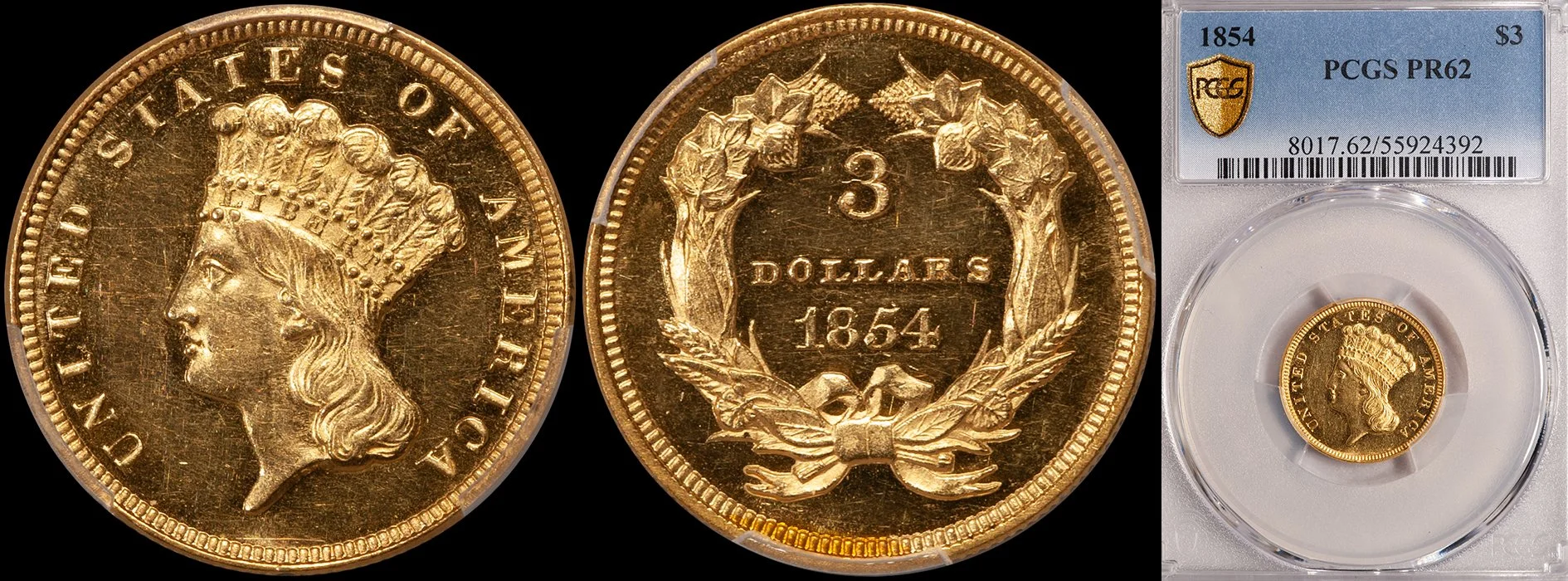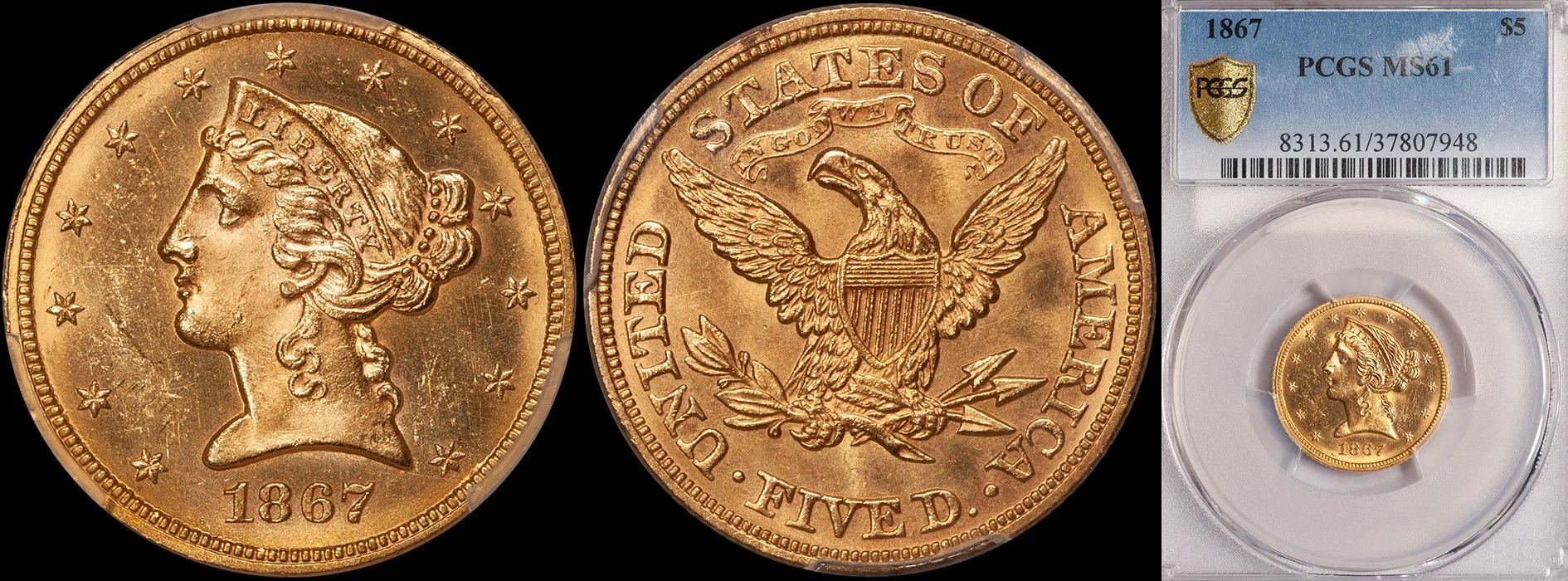
Charlotte Half Eagle Rarity

As I’ve been working on the updated third edition of my Charlotte book, I’ve had the chance to make some interesting observations regarding the rarity of Charlotte half eagles. The overall rarity of most Charlotte half eagles has changed. In nearly every instance, this has meant an increase in the total number known for a specific issue. As an example, I estimated in the second edition that 70-80 examples of the 1840-C half eagle existed. My revised estimate, in the third edition, is 80-100.

The increased populations are a result of a number of factors. After nearly twenty years of grading Charlotte coins, the PCGS and NGC populations represent significantly large percentages of the known total for every specific issue. So, these population figures carry more weight with me than they did ten years ago (and, yes, I have figured regrades/resubmissions prominently as a factor of total populations from both services).

I believe that my second edition estimates were also a bit on the low side when it comes to lower grade coins. While I knew of nearly every high grade 1840-C half eagle that exists (now or when the last edition was written) I tended to underestimate the low grade coins. My new estimates try to take into account these pieces.

There are changes in the population estimates for EF and AU half eagles because, let’s face it, the EF45 of ten years ago is, in most cases, an AU50 (or higher) today. I’ve tried to factor in gradeflation into my estimates and I tend to discount some of the slabbed AU50 or MS60/61 coins as, in my opinion, they do not meet my personal grading standards.

One thing my updated research has reinforced is that really choice Charlotte half eagles (MS63 and better) remain genuinely rare. While many of the coins listed in the Condition Census of my second book have changed owners and, in many cases, holders, they remain coins with pedigrees that I am able to trace back to the 1990’s or earlier. I’ve also noticed that the grading services have done a good job (most of the time) at holding the line on higher grading Charlotte half eagles. While a few MS63’s have become MS64’s or MS64’s have become MS65’s, many of the coins that were grading MS64 or MS65 back in the mid-to-late 1990’s have remained consistently graded.

The Bass sales, held from 1999 to 2001, had a huge impact on the third edition of the book. Many of the coins that I speculated about in the first two editions but were unaware of their location/grades were in the Bass collection. They now appear in the third edition; complete with accurate pedigrees and current grades.

What are a few other things that I have learned about Charlotte half eagles that will be reflected in the new third edition of the book?

* I’ve learned that some of the die variety information for issues such as the 1849-C, 1850-C, 1853-C and 1854-C was wrong and it has been corrected.

* I’ve learned the value of good pictures and the crappy old black and white images that appeared in the first two editions will be replaced by useful color plates.

* I’ve learned that people generally liked the format and design of my second edition of the New Orleans gold book that I published last year and so this format will be adapted to the upcoming Charlotte book.

* Finally, I’ve learned that Charlotte coinage for me is like the numismatic equivalent of “home cooking” and when I’m feeling cranky or burned-out, nothing is more numismatically soothing than a dose of Charlotte half eagles.
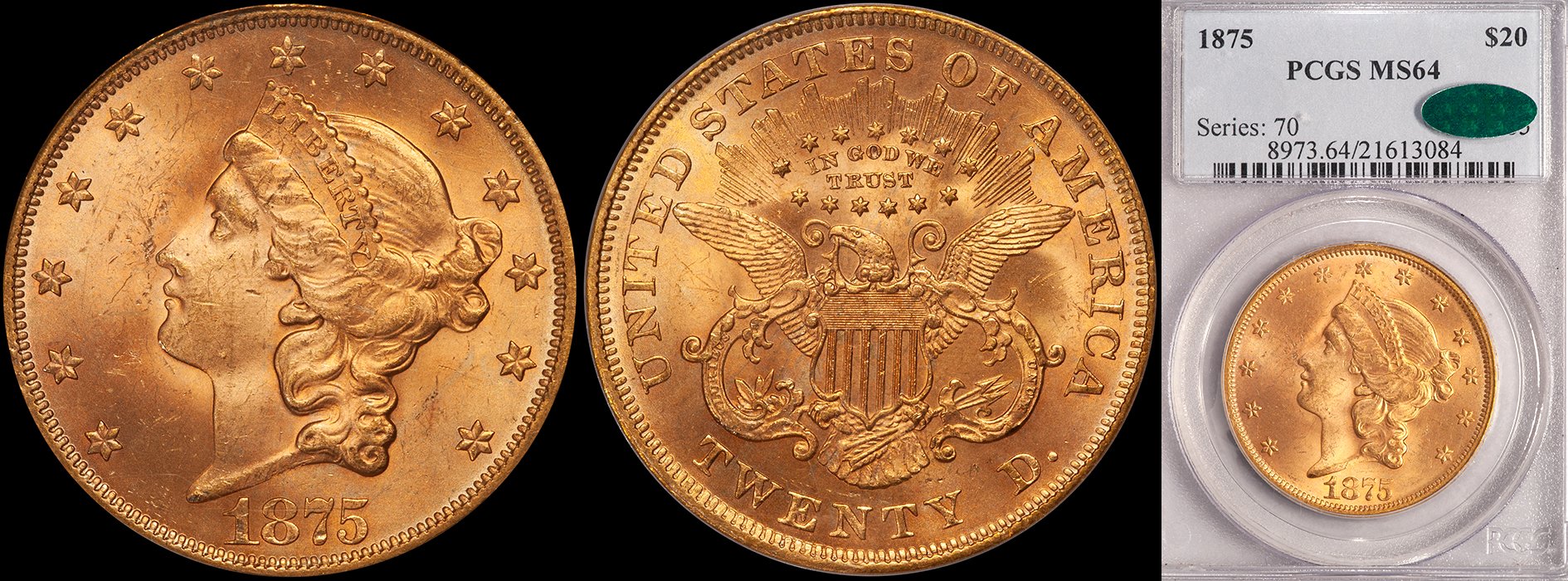
The 1854-S Type One Double Eagle

One of the more interesting and most misunderstood Type One double eagles is the 1854-S. This is an issue whose seemingly high population of Uncirculated coins belies the fact that it is actually extremely rare in higher grades. Read on for some more information about this interesting issue. The 1854-S double eagle is a historically significant coin as it is the first double eagle produced at the new San Francisco mint. Unlike the quarter eagle and half eagle of this year, it is a relatively obtainable coin as one would expect from its original mintage of 141,168. PCGS has graded a total of 148 while NGC has graded a total of 158. In my book “An Insider’s Guide to Collecting Type I Double Eagles” I suggested a total population of 325-425+. I believe that this figure remains accurate.

What is especially interesting about this date, however, is its population in Uncirculated. Looking at the PCGS and NGC populations, one might think that the 1854-S is only moderately scarce. After all, PCGS has seen 52 in all grades of Mint State while NGC has recorded 68.

But the population reports fail to explain an important fact about the 1854-S double eagle: virtually every coin in a PCGS or NGC Uncirculated holder has matte-like surfaces as a result of exposure to seawater.

Seawater Uncirculated 1854-S double eagles come from no less than three sources:

The wreck of the Yankee Blade which sank off the coast of Santa Barbara in October 1854. It is believed that somewhere between 100 and “a few hundred” coins with Uncirculated sharpness were recovered.

The wreck of the S.S. Central America which sank in 1857. It is believed that 20 or so 1854-S double eagles were salvaged from this ship and this includes some with Uncirculated sharpness.

The wreck of the S.S. Republic which sank in 1865. There were eight 1854-S double eagles salvaged from this ship including five that were graded by NGC and three which were “no grades” due to problems. Seawater Uncirculated 1854-S have a matte-like surface texture due to exposure to the oceanic environment in which they rested for over a century. But there are also a few other interesting tell-tale signs that they show.

As mentioned above, the majority of the seawater 1854-S double eagles are from the Yankee Blade shipwreck. These coins (as well as the ones that I have seen from the S.S. Central America) have die cracks on the obverse and the reverse which are easily identifiable. On the obverse, there is a crack to the left of the 5 that runs from the rim to the truncation and which branches off to the right over the 4. Another crack begins at the left side of the coronet and runs up to the space between stars six and seven. The reverse shows a large crack from the first T in STATES out into the field below the UN in UNITED. I have never seen a seawater 1854-S double eagle in any grade that did not have these cracks.

What’s interesting about the non-seawater coins is that they do not show any of the cracks described above.

There are some other minor diagnostic differences between the seawater and non-seawater coins as well. On the former the 54 in the date are very close and the top of the mintmark is firmly embedded in the tail feathers. On the latter, the 54 appears to be less close and the mintmark is a bit lower.

I first learned about the rarity of high grade 1854-S double eagles with original surfaces around fifteen years ago and have searched for Uncirculated pieces for many years. The finest that I have ever seen is a piece that was recently sold as Lot 61779 in Heritage’s November 2007 sale where it brought $21,850; it had earlier been in the Bass collection and it sold for $10,925 when offered as Bass III: 781 in May 2000. The only other example I can recall having seen with claims to an Uncirculated grade was Heritage 1/05: 9473 ($5,175). This coin was in an old holder and it might grade MS60 or better by today’s standards. It is now owned by a collector in Connecticut.

So where are all of the high grade 1854-S double eagles without seawater surfaces? My guess is that a considerable number were melted. This seems more likely when one takes into account the fact that the vast majority of the 325-425+ pieces known lack original surfaces. My best estimate is that only 25-50 are (currently) known from non-shipwreck sources. It is my opinion that these should command a strong premium over seawater coins in all grades.

What Will It Take To Jumpstart The Charlotte Gold Market?

In the last few months I’ve been asked a similar question by at least three collectors: what will it take to jump start the Charlotte gold market? This is an excellent question and I’d like to raise a few points that I think will explain what possible scenarios could affect these coins and the impact that they might have. Before delving into these specific points, I think a little background is in order. Charlotte gold coinage has been in a price and popularity slump for the last five or so years. I attribute this to the following reasons:

There are a lot of really low quality coins in PCGS and NGC holders on the market. When one sells for a low price at auction it tends to drag down the nice examples of this issue along with it.

My book on Charlotte gold coins is out of date and scarce. An updated third edition should be ready by the spring of 2008.

A few of the larger marketing firms who traditionally have sold Charlotte coins (both high end and low end pieces) have shifted their focus to other areas of the rare date gold market.

There haven’t been any really interesting collections of Charlotte coins that have come onto the market for a number of years. Often times, when a neat, fresh collection is offered for sale at auction, this generates new collector interest.

Many of the long-time specialists in this field have completed their sets and are not currently in the process of upgrading. This fact, combined with a relative lack of new collectors, has caused the supply of Charlotte coins to outstrip the demand.

I do not mean to give the impression that the Charlotte market is totally dead because it isn’t. I have personally had a good amount of success selling Charlotte coinage in the past few years but I have become extremely selective with what I buy. I will only purchase choice and original coins and I am probably less willing to make a slight allowance for “off quality” as I am in a more popular area such as Dahlonega gold or New Orleans double eagles. I know for a fact that there are a number of collectors working on VF-EF date sets in all three denominations and I have had a relatively easy time selling any very high quality (MS63 or better) pieces I find which have great color and eye appeal and/or which have a great pedigree.

Now, for some answers.

There is absolutely no question that the Charlotte market is not being helped by the existence of some really piggy coins in holders. I think this problem will be helped by the CAC stickering of nice coins which will generate new interest by collectors and dealers alike. New collectors will be helped by the fact that they can determine which coins are believed to be nice for the grade.

From my experience, a new (or updated) book on any subject generates a lot of interest. I can’t imagine that an improved and easily available Charlotte book won’t get a few new collectors interested. It will probably also motivate a few marketing firms to start selling Charlotte coins as they will have a guide to send collectors and to assist their sales force in making presentations.

The combination of CAC stickers, a new book and available product would certainly be good motivation for said marketing firms to sell Charlotte coins again. This might help remove some of the lower end and very high end pieces from the market which will leave the middle to upper middle end coins for collectors. When the Charlotte market was at its healthiest stage in the 1990’s, strong interest was seen not only in the collecting segment of the market but in the mass marketing segment as well.

In their January 2008 FUN sale, Heritage is going to sell a wonderful, fresh group of Charlotte coins called the Carolina Circle collection. This will be one of the first really important groups of Charlotte coins to be offered at auction since the incomparable run of collections sold at auction between 1995 and 2002 (Pittman, Bass, North Georgia, Miller, etc) and I would not be surprised if this creates a few new collectors.

The economics of any market are very simple. If the demand exceeds the supply, prices go up. Prices for nice EF40 and EF45 Charlotte coins have doubled in the past five or so years because there is a strong collector demand for these. Prices for overgraded, unattractive AU55 and AU58 coins have actually dropped (in some cases considerably) in the past five years because collectors do not want them and demand is—rightfully—very low for said items.

Personally, I think the sweet spot of the Charlotte market right now is nice AU55 and AU58 coins. These are, in most cases, very scarce but premiums are much lower than in the past. As an example, around five years a common date Charlotte half eagle in EF was worth around $800-1,000 while a common date in AU55 was worth $3,000-4,000 (or approximately 4x the price of an EF). Today, the EF is worth around $2,000-2,500 while the AU55 is still worth $3,000-4,000 (or approximately 1.5-2x the price of an EF).

How are problem coins valued?

I’ve discussed many times the process in which how nice coins are assigned price levels. But how are problem coins valued? This is an interesting question and one which is becoming a bit easier to answer since NCS coins have become a well-accepted part of numismatics. (Before I begin, I should state here that NCS or Numismatic Certification Service is a division of NGC that certifies and encapsulates “problem coins” which NGC does not see fit to put in their regular holders. This includes coins that are harshly cleaned, polished, heavily scratched, rim filed, etc. NCS only uses adjectival grades—i.e., they would call a coin “AU details” as opposed to “AU55 details.”)

The reason why non-problem coins are easier to value than problem coins is, well, because they don’t have problems. There is a greater degree of consistency of appearance between an 1830 half eagle in PCGS AU55 (or NGC AU55) than there is with this same issue when it has the details of an AU55 but it has been cleaned.

Let me explain what I mean by this. If you were to call me up and offer me an 1830 half eagle in PCGS AU55, I would have a decent idea of what to expect. I’m figuring that it has light wear, a decent amount of remaining luster, maybe a few scattered marks in the fields and probably a pretty good overall appearance. But if you call me an offer me an 1830 half eagle in an NCS holder that states the coin has “AU details” but has been “cleaned,” I’m not sure what to expect. Has it been lightly cleaned or harshly cleaned? Does it have an acceptable appearance or does it look overly shiny from having been polished or perhaps whizzed?

From my experience with viewing NCS coins, there is a very wide range of coins in these holders.

I’ve seen coins that NCS has called “cleaned” that look pretty acceptable to me; not very different, in fact, from coins encapsulated by both NGC and PCGS. I’ve also seen coins placed in NCS holders that had planchet flaws or mint-made surface that, in my opinion, could just as easily be in “normal” NGC or PCGS holders.

But back to cleaned coins and how to value them. As a general rule of thumb, I think that if a coin has been lightly cleaned it is worth around half of what a non-cleaned example would be worth. The NGC or PCGS AU55 1830 half eagle that I mentioned above is a $60,000 coin if it has a decent, original appearance. In an NCS “AU details—cleaned” holder it’s more likely worth $30,000 or so. And if it’s a very harshly cleaned AU coin with some damage as well it is more likely worth in the area of $15,000-20,000.

This brings me to a philosophical question. Would I, as a collector, want to own a very rare but very ugly coin that costs $20,000 or $30,000? I do not personally like problem coins even though I can understand their value and why certain collectors would want, say, an “affordable” example of a desirable coin like an 1808 quarter eagle. But I would rather spend my $20,000 or $30,000 on a coin that was less rare and more aesthetically pleasing. If my budget for a very rare coin like an 1808 quarter eagle was only $20,000-30,000 I would re-examine the “need” for this issue to be in my collection and would spend the money on something nicer.

Remember what I said above about the varying degrees of “cleanedness” or damage seen on NCS coins? I might actually not mind owning an NCS encapsulated 1808 quarter eagle with VF or EF details that had been lightly cleaned and which had a good appearance. The thing to consider, though, is that many other collectors feel the same way and such a coin might actually sell for a value level not much less than a VF or EF that was in a regular NGC or PCGS holder. The real question is would I want to own an 1808 quarter eagle that looked like it was run over by the proverbial train. And if I did, what would I pay for it?

Carolina Circle Collection of Charlotte Gold Coinage

I recently completed cataloging the Carolina Circle Collection of Charlotte gold coinage for Heritage. This collection, which was primarily formed in the 1970’s and 1980’s, is going to be sold by Heritage during their 2008 FUN auction. It is a virtually complete collection, missing only the 1849-C Open Wreath gold dollar and it contains some of the nicest—and freshest—coins from Charlotte that I have seen in some time. I have known the owner of this collection for a number of years and when he made the decision to sell, I suggested that he place the coins in the 2008 FUN auction. About 40% of the collection is housed in very old PCGS and NGC holders and I suggested to this individual that he keep the coins in these old slabs; despite the fact that many of them appeared to be significantly undergraded by today’s standards.

What I really like about this collection is the originality of many of the coins. Almost all of them are in the EF40 to AU58 range and a number are notable for their superb original color and unadulterated surfaces. There are a few individual coins that I think rank as among the most attractive Charlotte gold coins I have ever seen; regardless of date or denomination.

My two favorite gold dollars in this collection are an 1849-C Closed Wreath and an 1850-C. Both are in old PCGS AU58 holders and both, in my opinion, grade considerably finer by today’s standards. I think both coins have great eye appeal and would make excellent additions to a date or type set. I also like the AU55 1857-C gold dollar in this collection. It, too, is in an old green label holder and it seems very choice for the date and grade.

The quarter eagles in the Carolina Circle Collection are outstanding and include a number of Condition Census pieces. Even though it “only” grades NGC AU53, the 1839-C Repunched Date is a lovely original coin and is housed in an old “fatty” holder certain to attract attention. There are PCGS AU55 examples of the 1840-C and 1844-C, both in old green label holders, that are also extremely choice for their designated grade levels. The 1846-C and 1849-C quarter eagles are both also graded AU55 by PCGS.

There are two quarter eagles in this collection that I think are absolutely wonderful coins. The 1852-C is in an old green label PCGS AU58 holder but it appears far choicer than this. I absolutely love this coin’s coloration and I personally regard it as the third finest known for the date, trailing only the Bass II and Elrod coins.

I also really like the 1855-C in this collection. I had never seen or heard of this coin before I went to examine this group a few months ago and I’m sure I let out a big gasp when I first saw it. It is currently in a PCGS MS61 holder but I personally feel it is nicer than this. What I like best about this coin is its freshness as evidenced by its glowing frosty luster, lovely rose-gold color and extremely clean surfaces. It is probably the third finest known example of this rare date and it is the nicest 1855-C I have seen since the incomparable Bass coin was first sold in 1999.

The half eagles in this collection are complete and include a number of important and choice pieces. One that is certain to capture a lot of viewer attention is an 1838-C in PCGS AU58. While reasonably common in lower grades, this date is rare in AU and the current PCGS population is just three in AU58 with a single example higher.

The 1840’s half eagles in the Carolina Circle collection are, for the most part, very nice coins and this includes solid AU examples of the 1840-C, 1841-C, 1844-C and 1846-C. There is an 1842-C Large Date in an old green label PCGS AU55 that seems extremely choice for the grade, in my opinion.

The half eagle in this collection that will probably generate the most interest is the 1842-C Small Date. It is currently housed in an old ANACS AU50 holder but it appears to be considerably nicer than this. As you may or may not know, this is the rarest collectible issue from this mint and the typical piece is well worn with poor eye appeal. The example in this collection is lightly marked, well struck and original with good color and a very pleasing naked-eye appearance.

There are other less glamorous but very attractive half eagles in the Carolina Circle collection as well. An 1847-C in an older PCGS holder has superb color and great eye appeal. The 1851-C, graded AU50 by PCGS many years ago, seems to be way undergraded and it has an exceptional strike for the issue as well as superb deep yellow-gold color. The 1853-C, housed in a green label PCGS AU58 holder, is also attractively toned in rich, natural shadings.

If you follow the rare gold coin market you know that Charlotte coinage has been somewhat out-of-favor for the last few years. I predict that this collection will help to jumpstart this market. It’s been a number of years since this many fresh, attractive pieces have been offered for sale and, typically, when collection like this are sold, new collectors become interested in getting a set started.

For more information on this collection, feel free to contact me and I also suggest that keep an eye on Heritage’s website. I expect that the lots for the FUN sale will be posted sometime around the middle of December.

November 2007 Whitman Baltimore Coin Expo

Even though it involves a schlep of Biblical Proportions, I really enjoy the tri-annual Whitman Baltimore Coin Expo. I can count on three shows each year that will be professionally run, well-attended and extremely active from both a wholesale and retail perspective. In many ways, Baltimore is the new Long Beach. Prior to the beginning of the show, Stack’s conducted an impressive 3,800+ lot auction. I made the decision not to attend this sale in person as I did not want my Baltimore Experience to stretch into a nearly one week marathon. I did have a Trusted Agent look at a small number of coins for me and I placed a group of what I thought were strong bids. And I proceeded to get blown out of the water. While I can’t comment on the entire auction, the coins that interested me went for numbers that were pretty insane, to say the least.

The first day of the Baltimore show (Thursday) is dealer-only and, to tell you the truth, I like this very much. Having only wholesale business on this day let’s me get more done and it lets me focus strongly on buying.

But because of the fact that I had some interesting fresh coins with me, I spent most of Thursday selling. And selling. And selling some more. I had around fifteen CAC-stickered type coins and with the exception of two that I was asking very strong prices for, they all sold quickly. I can’t say for certain that it was because of the CAC stickers or because type coins are suddenly in demand. My guess is that it is a combination of the two.

So what sold? As I mentioned above, type coins that were attractive or scarce dates or, better yet a combination of the two were in great demand. I would look for this to be a very strong area of the market in 2008. I sold a number of great Carson City coins at the show including two nice AU 1870-CC half eagles, a Condition Census 1871-CC, a solid AU 1875-CC and a really cool secret coin from the 1880’s that I promised the dealer I sold it to that I wouldn’t tell anyone. I also sold a few big-time early gold coins, two proof gold coins and a group of New Orleans gold including some scarcer date eagles.

Generic gold was very active at the show. From what I could tell, demand was high but prices were quite volatile. As an example, at the beginning of the show on Thursday, MS65 Saints were bringing $1,400. But after a few people were short, prices slowly climbed and by the end of the show they were bringing $1,475.

The doors opened to the public on Friday and a Thundering Herd of Serious Collectors stampeded through the doors as the clock struck 10:00. OK, maybe it wasn’t a stampede but the room crowded up quickly and I ran into a majority of the serious collectors from the East Coast that I know by the early afternoon. People at this show definitely come to buy and not to tire kick and I sold a number of very interesting coins.

I typically leave a Baltimore show on Friday but business was so brisk that I rebooked my flight and stayed for the rest of the day. I continued being busy right up until the end of the day and left the bourse floor tired but very satisfied.

The good news about this show, as I mentioned, was that my sales were pretty exceptional. The not-so-good news is that my buying was good but not great. I loved what I bought but I would have liked to have spent a lot more money.

For me, the year is essentially over. I will still be buying and selling coins but my travel is done with the exception of a quick trip to Dallas before Christmas to view Heritage 2008 FUN sale auction lots.

My guess is that from now until the end of the year, things will be reasonably slow in Coin Land although if gold continues its upward ramble towards the $1,000 mark we might see some surprise rare coin activity.

U.S. Coin Pricing Guides

When someone really, truly figures out how to properly compile and market an accurate, real-time pricing guide for United States coins, they are going to become very wealthy and very popular. Because, at this point in time, the pricing mechanisms for most rare United States coins are a mess. Let me explain what I mean. Let’s say you want to buy an 1858-C half eagle graded AU55 by PCGS or NGC. You do not have the coin in hand but you have seen an image of it on a dealer’s website or in an on-line auction. What’s your next step?

You’ll probably do one of two things. If you are a specialized collector you’ll look up its valuation in Coin World Trends or in the CDN Quarterly Summary. The former shows its value to be $5,000. The latter, unfortunately, does not list values for AU55 coins—only AU50 and AU58, so in this particular case it is essentially useless.

What, you ask yourself, does this value of $5,000 actually mean? If you read the fine print in a copy of “Coin Values” you will see that Coin World considers its publication to be a retail price guide. It also states “values are listed for coins that are strictly graded in each grade category according to current market standards.” So does this mean that the collector should expect to pay $5,000 for an 1858-C half eagle in AU55? Unfortunately, Trends is not really clear in explaining this.

The next step for most collectors is to search an on-line database of prices realized at auction. The Heritage Auction Prices Archives, as I have pointed out many times before, is an incredible resource with over 1,125,000 auction lots listed.

In looking up the 1858-C half eagle in AU55, a few things become apparent. The first is the frequency with which this date appears at auction. There were a total of nine different auction appearances in 2006 plus another five in 2005. Even if we assume that some were the same coin(s) sold more than once, fourteen appearances in two years is a high degree of frequency. Thus, we can make the assumption that this coin isn’t really that rare from the standpoint of total number known and it should, therefore, sell at a discount relative to Trends. The fact that it is not a terribly popular or “important” issue (like the 1838-C or 1839-C half eagles) probably would increase this discount relative to Trends.

The next thing I would look at is the most recent auction records for AU55’s. They are as follows: $3,220, $2,990, $5,750 and $5,175. Clearly, this is a huge range and this is where I think using auction price data without proper interpretation can be very misleading for the collector.

Looking back at my catalogs for each of these four AU55 coins, my notes stated the following. For the coin that brought $3,220 I felt it was decent for the grade and I think the buyer got a pretty good deal on this. The coin that sold for $2,990 was “very ugly” in my opinion and even though this was very cheap, it is a case of getting what you pay for. The coin that sold for $5,750 was in an old green label PCGS holder and I graded it “58+,” meaning I thought it had a good shot to grade Uncirculated if resubmitted. And the coin that realized $5,175 was, I felt, “very choice and original” and would upgrade to AU58.

Four coins, same date, same grade...but prices that range from a low of $2,990 to a high of $5,750.

What pricing sheets do not help the collector with is the diversity of quality within a specific grade. These prices tell me that a really lousy 1858-C half eagle in AU55 is probably worth around $3,000; or 60% of Trends. A coin that is decent for the grade (not spectacular but not something that you look at and go “yuck”) is worth around $3,250. A coin that is very nice for the grade (not an upgrade candidate but a piece that has attractive natural color and surfaces) is worth $3,750 or so. And a really high end coin (one that is a seeming candidate to upgrade to AU58) is worth anywhere from $4,500 to $5,500.

Confused yet?

No commercial pricing sheet is going to be able to give you four different quality levels for each grade. We’d be talking about a massive undertaking and a project that few people are qualified to undertake. But it can be done. Collectors of Large Cents rely on a pricing guide called CQR which gives three price ranges for a host of grades for every die variety from 1793 to 1814. This is clearly a labor of love (I can’t imagine that the publishers are getting rich publishing CQR!) but it provides advanced collectors with a set of pricing applications that, within a highly specialized series, makes sense.

What if this specialized pricing were to be applied to various other series? What if some clever entrepreneur got together a group of leading experts and had them be in charge of detailed pricing for a highly specialized market segment? As an example, you could have Stewart Blay, David Schweitz and Andy Skrabalak collectively create and maintain a database for Mint State and Proof Lincoln Cents. If I were a collector of these coins, I think I would pay $100 per year to have access to this pricing that might not be available anywhere else. By charging this amount, the owner of the pricing service could at least defray some of his expenses.

I would expect that as the coin market evolves in the future, we will start seeing some experiments with specialized pricing. I could see this idea working very well for popular series like Bust half dollars and Indian Head cents and I don’t think it would be hard to create categories of quality for popular series such as Morgan dollars (by this I mean an “A” level for extremely nice coins, a “B” level for average to above average coins and a “C” level for below average coins). Most experts, myself included, already grade coins by category and quantifying this information would be relatively simple.

Civil War Gold Coins

In the last few years, a number of Civil War coins have greatly appreciated in value and have become among the most sought-after United States gold issues by collectors. These include the 1861-D gold dollar and half eagle and the 1861-O and 1861-S Paquet Reverse double eagles. But, for some reason, the 1861-C half eagle has not achieved the cult status of these other issues from 1861; despite the fact that it is rare, interesting and historical in its own right. The 1861-C half eagle is the final coin produced at the Charlotte mint. It is the only Charlotte coin which bears the magical 1861 date and it has an original mintage of just 6,879. It is believed that 887 were struck in May, 1861 under the supervision of the Confederacy. If it were possible to determine with certainty which coins were struck by the Confederacy, I believe that they would among the most valuable and desirable of all the coins produced at this mint.

According to one theory, the coins produced by the Confederacy show a relatively extensive die crack on the reverse which begins at the rim over the first A in AMERICA and travels from the left serif of the M in AMERICA through the tops of the lettering to the middle of the I and then into the rim. These late die state coins also show scattered areas of rust on the reverse.

I have kept careful records of this date and in the past fifteen years or so, I have seen around 75 different pieces. Of these, I recorded ten that had this late state of the die break as well as die rust. Given that fewer than 10% of the original mintage are Confederate strikings, this survival rate is fairly plausible although by no means definitive.

As I mentioned above, the 1861-C half eagle has lost some of its appeal in the past decade or so. At one time it was considered to be one of the key dates in the Charlotte half eagle series and it was priced at a level fairly comparable to the 1861-D half eagle. Today, the 1861-D trades for considerably more and it appears on many more want lists. In my opinion, the 1861-C is now undervalued.

I estimate that there are around 125 or so known with most in the VF to EF range. I think there are 25-30 properly graded AU pieces and most of these grade AU50 to AU53. The 1861-C becomes very scarce in AU55 to AU58 and it is extremely rare in Uncirculated. I have only seen two or three that I regard as true Mint State coins. The finest is the ex: Elrod coin that has been graded MS63 by both PCGS and NGC. It last sold for $59,800 in the Heritage 2000 FUN sale and is owned by an Alabama collector.

The 1861-C half eagle is found with a good quality of strike which is interesting when one considers that the two half eagles made prior to this (1859-C and 1860-C) are the two worst struck coins ever produced by this mint. The reverse is the same as that used to make the majority of half eagles struck in 1858-C and it lacks the clogged appearance and extensive die damage seen on the 1859-C and 1860-C reverse.

The surfaces on most 1861-C half eagles are quite heavily abraded, leading me to think that nearly the entire mintage went directly into circulation and that most were used extensively in commerce. A number also show mint-made planchet flaws. The luster on higher grade 1861-C half eagles is mostly frosty with some satiny texture. It is almost impossible to find a piece that has original undisturbed luster due to the aforementioned surface abrasions as well as the fact that many have been dipped or cleaned over the years. The coloration seen ranges from deep green to a lighter yellow-gold shade. Very few remaining examples have natural color. Locating an 1861-C half eagle with good eye appeal is extremely difficult.

The population figures from PCGS and (especially) NGC appear to be highly inflated by resubmissions. NGC shows 23 (!) coins in AU58 as well as another 15 in AU55 while PCGS’s figures of nearly 50 coins in the various AU grades seems heavily inflated as well.

As I mentioned above, at current price levels the 1861-C half eagle appears to be good value. A nice EF coin, if you can find one, is going to run in the $4,500-5,500 range. I think the best value grade for this date is an AU53 which is worth around $8,000-10,000. In the higher AU grades, price levels jump to $12,500-15,000 for an AU58. I am aware of a few examples graded MS61 by NGC that have traded in the $30,000-40,000 range. I think a no-questions-asked Uncirculated example is a great value at this level but, as I mentioned above, I haven’t seen many in MS61 holders that I thought were legitimately “new.”

I’ve got to think that when (notice I didn’t say “if”) Charlotte gold coinage becomes popular again, the 1861-C will regain its place among the pantheon of popular Civil war related issues which are in great demand among collectors. It is a personal favorite of mine and it is an issue that I actively look to purchase when I am coin shows or examining auction listings.

The Milas Collection of No Motto Half Eagles

One of the most ambitious collecting projects ever undertaken was the No Motto half eagle set assembled by Chicago dealer Ed Milas. Not only did Mr. Milas attempt to assemble a complete set of these rare coins (struck between 1839 and 1866) but he did it, for the most part, in the highest grade possible. After working on this set for the better part of two decades, Milas sold his coins at auction through Stack’s in May, 1995. The Milas set included 98 coins and was lacking only the 1842-C Small Date, 1854-S, 1863 and 1864-S to be totally complete. The coins ranged in grade from mid-AU to MS66 and included a host of individual pieces that were either Finest Known or high in the Condition Census for that specific issue. I would still rate this as one of the single greatest specialized U.S gold collections ever formed and it was one of the most interesting auctions that I ever attended.

I had seen a number of Ed’s coins on a piece-meal basis and had even sold him a few high-end Charlotte and Dahlonega coins indirectly. But it was with real excitement that I went to New York to view a collection that had attained true cult status among rare gold coin collectors and dealers alike.

I remember being very surprised to see that the Milas Collection had been sent to NGC to be graded. Stack’s, in the mid-1990’s seemed to sell far fewer encapsulated coins than their competitors and my initial reaction on viewing the coins in their holders was that NGC had gotten a little bit carried away in grading them. Of course today, these same coins in the same 1995 holders would seem almost quaintly undergraded.

What I remember most about this collection, nearly a decade and a half after the fact, was the wonderful quality of the coins. They were the sort of No Motto mint half eagles that you almost never see today. Most had wonderful original color, blazing luster and had never been enhanced. A number traced their origin to famous collections that had been sold in the 1980’s and early 1990’s including Eliasberg, James Stack, Jimmy Hayes, Bareford and Garrett.

From the standpoint of appearance and overall grade, the Philadelphia half eagles were the highlight of the collection. Coin after coin graded MS63, MS64 or even MS65 and I remember a number of the ex: Eliasberg coins having absolutely sensational fiery orange-gold coloration. Two coins that I really loved were the 1850 (graded MS65 by NGC) that was so amazingly fresh and crisp in appearance it looked like it had been made last week and the MS66 1852 that, to this day, rates as one of the single finest No Motto half eagles of any date that I have seen. As I recall, many of these Philadelphia pieces were purchased by dealer Steve Contursi.

The Charlotte and Dahlonega half eagles in the Milas collection included some of the most famous (and most mind-blowing) high grade pieces known. It’s hard for me to pick a favorite as there were so many fantastic single coins. I remember the amazing MS65 1841-D that Ed Milas had bought a year earlier out of the James Stack collection for a record $88,000. In the Stack’s sale, a year later, it went for a relatively low $68,750. The Dahlonega half eagle in the sale that I liked the best was an 1853-D in MS64. While this date is relatively common in Uncirculated, this particular example (ex: Auction ’84 and Bareford) had absolutely superb color and surfaces. It brought $55,000 which I remember being a TON of money at the time. Most of the Dahlonega coins in the sale (as well as a majority of the Charlotte pieces) were purchased by dealer Winthrop Carner. Ironically, Carner ran into financial problems soon after the sale and many of the Milas coins were re-offered at the Numisma ‘95 auction where they brought considerably less than what Carner had paid for them earlier in the year.

The one Charlotte coin that everyone wanted to see in the sale was Milas’ 1859-C which NGC had graded MS66. Formerly from the Eliasberg collection, this coin remains the only Charlotte half eagle ever graded above MS65. I remember being a bit underwhelmed by the coin when I first saw it in 1995 (I saw it again a few years ago and was blown away by it...) and thought it had been the beneficiary of a push by NGC. It sold for $104,500 and it became the first Charlotte gold coin to eclipse the six-figure mark at auction.

What really excited me in this collection, though, were the New Orleans half eagles. They were amazing; probably the finest set ever assembled. The one coin that I really, really wanted to buy was the 1842-O graded MS63 by NGC. It is the finest known of three examples in Uncirculated and it has a fantastic pedigree (ex: Eliasberg and Earle collections). This was a rare instance where I liked a coin so much that I wanted to buy it to stash it away. In the end, I was the underbidder and it brought $31,900 which seems very, very reasonable today. I was able to purchase a number of the other New Orleans half eagles in the sale and I’ve handled a few of these two, three or even four times since the Milas auction in 1995(!)

If someone wanted to replicate this collection today, I’m certain it could not be done. Many of the Milas coins have, in the ensuing years, been processed and no longer show the superb, original look they had back in 1995. The number of very high grade, totally original Charlotte and Dahlonega half eagles has greatly diminished since 1995 and I’m not certain that many of the high quality Philadelphia and San Francisco half eagles in the Milas collection could be replicated today either.

I hate to sound like Grandpa Winter but they just don’t have sales today like they did with the Milas collection back in 1995...