2006 Denver Summer ANA Show Preview

If you only attend one coin show per year, the summer ANA is probably the biggest bang for your buck. Every major dealer in the United States attends this show as well as leading dealers from Europe, Japan and Latin America. The fact that this year’s edition is in the great city of Denver (which is generally a nice spot to be in mid-August) makes the 2006 convention a must-attend for the collector. If you have just 48 hours to “do the Denver ANA,” what is the best way to do this? My advice would be to arrive in Denver on the evening of Tuesday, August 15. Get a good night sleep because you are going to be a busy guy if you take the Winter Tour of the ANA bourse on Wednesday.

The show opens to the public on the morning of Wednesday, August 16th at 10 a.m. I’d suggest having a good breakfast and using the early morning to plan a strategy. You might want to go on the ANA’s website (www.money.org) and look at the map of the convention floor and the list of dealer’s tables. You’ll want to highlight your favorite dealer’s location but you should also consider visiting tables that contain coins that you don’t collect but which are of interest. As an example, I always like to visit the British dealers’ tables and look at their stock, even though I don’t collect these coins.

When the doors open, I’d recommend promptly going to your favorite dealer’s tables and asking what coins, if any, are available in your field of collecting. If you see something that is really interesting, I’d recommend making a quick decision. At a major show like ANA, you can’t really expect a dealer to put a coin on hold for you for more than an hour or two; especially not at the beginning of the show. Assuming you have a fixed amount to spend at the show, don’t be nervous if you spend your whole budget at the first table you go to; we can assume you went to the “best dealer” first and he is most likely to have exactly what you want.

I’d suggest you spend another three or four hours scanning tables and meeting dealers before breaking for lunch. Generally speaking, convention center food is awful and leaving the bourse for an hour to eat a good meal will prove to be an excellent strategy.

When you return to the convention (remember to save your badge!) I’d suggest you head over to the auction viewing lot area and spending a few hours looking at coins. Even if you aren’t going to bid in an auction, ANA auctions are a wonderful place to see exceptional coins and to study them. Just remember not to hog the lots as you may be sharing them with fellow viewers who are going to bid on them. One thing I would suggest you do is makes notes about the coins you like and the ones you don’t and then monitor them to see what they sell for later in the week.

I would then suggest finishing the day with another two or three hour promenade around the bourse floor. I’d recommend leaving around 6 p.m. (the show closes at 7 p.m.), heading back to your hotel and capping the night off with a good dinner in downtown Denver.

On Thursday the show opens to the public at 9 a.m. It’s a good idea to get there a bit after this as many dealers aren’t really up and running until 9:30 or even 10. I’d suggest spending the morning hitting the dealers you didn’t see yesterday and returning to the dealers you like. Ask to see any of the new purchases that they have ready for sale or ask them if any interesting coins are back from grading at PCGS and NGC and if these are available.

What if you haven’t purchased anything yet and you are starting to panic? At this point in time, an impulsive or forced purchase is just about the worse decision you can make. While it is likely that you will have already found something to buy, if you don’t spend your money at the ANA, it’s not a crime.

There is likely to be an auction session during the day or in the evening and it is interesting to attend, if only to see how the dynamic of live auctions work. You are not likely to see much in the way of compelling drama unless you have the good fortune to attend the sale of a major collection.

If at all possible, try and attend one of the lectures that the ANA schedules throughout the show. In the past, there have been numerous interesting subjects and many of the speakers are world-class experts.

Another thing I’d suggest you do at the show is look at the competitive exhibits. At last year’s ANA in San Francisco I was amazed at the quality of these exhibits and found myself spending time absorbing them nearly every day.

Assuming that you have a few hours left, I’d complete the day with another go-round the bourse floor and, perhaps, a final purchase or two.

The most important thing to realize about the ANA show is that it’s a remarkable opportunity for the beginning or expert collector to see coins he won’t be able to see anywhere else, make potentially valuable contacts and, most importantly, to come away with knowledge that will increase his ability and comfort level. It really is the Super Bowl of Numismatics and if you have a chance to attend this year, please don’t forget to stop by tables 523/525 and say “hi.”
2006 Summer Baltimore Show Recap

There are three Baltimore coin shows held each year. It is a general consensus that, of the three, the summer edition is, by far, the least active. This year’s summer Baltimore show held true to form and, was for the most part, sparsely attended and void of much activity. To be honest, the only reason I went to this show was the fact that I was very low on inventory and hoped to buy a few new pieces. From this standpoint, I was not unhappy with the show. I attended it for only a day and a half and didn’t have a table or anything to sell.

Here are some observations from the show:

As I stated in my recent newsletter, many dealers are using this current lull in the market as an opportunity to recharge their batteries. Many of us have worked virtually non-stop for the past two to three years and a slow period lasting a few weeks is not a bad thing.

As usual, there was a conspicuous lack of interesting, fresh material in most dealers’ inventories. I looked at just about every dealer’s inventory at the show and was amazed at just how few nice coins there are available. That said, I was able to buy a few really interesting new coins which are, shameless plug, listed in my current inventory with descriptions and images.

My gut feeling is that the next few weeks will continue to be slow but that things will pick up steam at the ANA and the pre-show which occurs right before it. It will be very interesting to see how the escalating tension in the Middle East will affect the economy and the coin market. With oil prices soaring and the stock market getting pummeled, will gold and silver be strong or will they be dragged down as well? The next few weeks are going to be very revealing, to say the least.

While I was at the show, I was able to view the lots in the forthcoming ANR auction. There are some very interesting gold coins in this sale including the Old West collection of Carson City half eagles and eagles, a superb run of Territorial gold and a large selection of Charlotte and Dahlonega coinage of all denominations. I will be going to Dallas early next week to view lots for their August auctions. I urge you, if you would like me to represent you in these sales, please contact me as early as possible.

I am always looking for suggestions for blog topics (it can be hard to come up with three or four interesting topics every week…) and welcome your input.

Grey Area Gold Coins

What do you call a gold coin that is too scarce to be regarded as a generic but is not rare enough to be called a rare date? I have always called these grey area gold coins “unusual dates” and was recently asked by a collector if they are a) good deals and b) good investments. Yes and no.

Let’s use the $10 Liberty Head series as our guide and let’s use the 1901-S eagle as our baseline. The 1901-S is the most common date in this series with a total population of nearly 13,000 graded at PCGS. This coin has a June 2006 Trends value of $500 in AU50, $575 in MS60 and $650 in MS62.

Now let’s randomly choose two “unusual date” $10 Libs. and compare populations and prices.

First, we’ll look at the 1856. This is a No Motto coin that is considered to be relatively common but its total population of 160 graded at PCGS is about 1/80th the number of 1901-S eagles graded. Trends on this coin is $600 in AU50 and $1,100 in AU55 (we won’t compare its price in MS60 to the 1901-S due to a huge difference in rarity between the two dates).

At a $100 premium in AU50, the 1856 seems to be a fantastic deal. And it is. It has a population of just 35 coins in this grade with 74 better at PCGS. But here’s the rub. There are not many collectors of $10 Libs. by date and the collectors who do want an 1856 probably are looking for a coin that’s at least an AU58 to MS61. So the 1856 is essentially an outcast that is unloved by the generic market and unwanted by the rarities market. Hence, its extreme lack of demand and its low price.

Let’s now look at another date, the 1895-S. I’ve always regarded the San Francisco eagles from the 1890’s to be the poster children for the Lost Cause of Unusual Date Gold. PCGS has only recorded 221 in all grades with just seventeen of these better than AU58. Trends for this date is $1,500 in AU58 and $2,500 in MS60. In MS60, this is a date with a PCGS population of just four with a scant nine graded higher. At $2,500 it has to be a total rip, especially with a common date 1901-S valued at $575. Right?

Absolutely. It’s a total rip. In fact, it’s such a fantastic rip that I’ll buy exactly none for my inventory in the next year. Not because I can’t find such a coin; I’m probably going to be offered one or two in the coming few months. No, I’m passing on this coin because I won’t be able to sell it. There’s just nobody that wants a coin like this with the possible exception of a telemarketer who may resell it to an unsuspecting investor. Except the problem is that this telemarketer will want to pay $1,500 for the coin, he’ll take three months to pay and when I get his check it will probably bounce.

Gold coins are expensive and the Liberty Head series go on and on for decade after decade. This is why Philadelphia and San Francisco Liberty Head gold aren’t popular. Who wants to collect an expensive series that is seemingly never ending? And, conversely, this is exactly why Carson City, Charlotte and Dahlonega gold are popular. They are short-lived and, with a few exceptions, don’t contain any daunting, ultra-expensive stoppers which make assembling a set out of the range of most collectors.

So, you still don’t believe me and are still convinced that coins like 1856 eagles in AU50 and 1895-S eagles in MS60 are a great value? Go look at auction prices from five or even ten years ago and see how these coins have done versus “common rare date” coins like EF45 Charlotte and Dahlonega half eagles or AU55 Carson City double eagles. Coins like the 1856 eagle and the 1895-S eagle have been among the very worst performers in the single all-time greatest price run-up in numismatic history. Not exactly a very compelling endorsement, eh?

St. Gaudens 100th Anniversary

Next year marks the 100th anniversary of the introduction of Augustus St. Gaudens incomparable Indian Head eagle and double eagle designs. Assuming that this is an anniversary that will be met with much fanfare (and accompanying numismatic promotion) how can the savvy collector or investor take advantage of this? In my opinion, it would seem that the most obvious target for a promotion would be the High Relief double eagle. The reasons are obvious: its the first year of issue for the largest gold denomination, it’s a gorgeous design and a popular low mintage coin that, while scarce, can be accumulated in a large enough quantity to promote. This is a great theory except for one flaw: High Reliefs have been actively promoted for the last two or three years and are at historic all-time price highs.

But does this mean that High Reliefs are not a good investment at this point in time? If I were buying a High Relief strictly as an investment, I think I’d look at it as a very short term hold—like maybe a year or so. One of the nice things about these coins is that they tend to have very tight buy/sell spreads and even if your coin does not appreciate much in value, you’ll probably have minimal downside. From a long term standpoint, I’d probably pass on a High Relief and wait until prices come down.

How about the “regular relief” 1907 Saint—do these have a good future from an investment standpoint? I would say that yes, they do. But I wouldn’t mess with them in grades lower than MS65 due to the fact that they are very common. In MS66 I think this variety is a good value and an MS67 is a great addition to your collection if you can find one.

The Indian Head eagles are a very intriguing group of coins. There are three varieties known: the Rolled Edge, The Wire Edge and the No Motto.

The Rolled Edge is, in theory, a regular issue even though only 48 are believed to have been struck. This is one of the most attractive United States gold issues and it is going to cost you over $200,000 for an MS64 example.

A coin that is also attractive but a little less rare is the Wire Edge 1907 eagle. It has an original mintage of just 500. Curiously, this rare coin hasn’t seen much in the way of promotion in the past few years and, unlike its counterpart the 1907 High Relief double eagle, it has remained pretty flat (pun intended…) from a price standpoint. I am a big fan of the Wire Edge $10 in grades from MS63 to MS66 and I think this issue will see a big price increase in the next few years.

What about the more plebian 1907 No Motto eagle—will this issue be promoted and will it see price increases? I would say yes on both accounts. I’m sure you’ll see lower end Uncirculated coins peddled on a mass-market scale. I would stick to examples that grade MS64 and above. I really like this coin in MS66 and MS67 as it is a short-lived two year type and it is an extremely attractive coin in higher grades.

So, getting back to our original question, how can the investor best capitalize on what may be a 100th anniversary craze for the 1907 St. Gaudens eagles and double eagles? The way I see it, there are four ways of reacting:

    Go a bit crazy and buy a nice High Relief and a Wire Edge. Even if they don’t show strong short-term appreciation, you’ll still own two very liquid blue chip coins that will be cornerstones of your collection.

    React with moderation and buy nice MS64 to MS66 examples of the 1907 “regular issue” eagles and double eagles. Again, you’ll own two neat coins which you’ll enjoy.

    Do nothing and grumble about yet another pesky coin promotion.

    Decide to beat the crowd to the next promotion: the 100th anniversary of the Bela Lyon Pratt design Indian Head quarter eagle and half eagle. A nice matched set of MS64 or MS65 coins might make a great way to welcome in 2008.

Fab Five St. Gaudens Double Eagles

For many people, the name the Fab Five refers to the starting players for the famous University of Michigan basketball team in the early 1990’s who played for the national championship in 1992 and again in 1993. But for the collector of United States gold coinage, this term refers endearingly to the five St. Gaudens double eagles produced between 1929 and 1932. The Fab Five are, more specifically, the 1929, 1930, 1930-S, 1931-D and 1932 double eagles. All of these are far rarer than their mintage figures would suggest. Recent research has shown that most of the late date Saints were never released for circulation and that a great majority were subsequently melted.

So what’s the story behind the Fab Five and why have they become so popular with collectors?

Other than the catchy marketing name, these coins have a lot going for them. As I mentioned above, all five are quite rare. But unlike a number of the other rare issues in the popular St. Gaudens series (such as the 1920-S, 1921, 1924-S, 1925-S and the 1926-D) the Fab Five tend to come very nice when offered for sale. In fact, you will rarely see an example of the Fab Five in grades below MS63. All of these dates tend to come with very good luster, sharp strikes and rich multi-hued coloration. They are popular because they are truly rare coins that come with really good eye appeal. And they are in demand because they are the last dates in this series you can (legally) own…for now.

The rarity levels of the Fab Five have often been misunderstood. In my opinion, the correct order of availability from rarest to most common is as follows: 1930-S, 1931-D, 1929, 1932 and 1931.

The 1930-S is easily the rarest of these, both in terms of overall and high grade levels. There are probably no more than three or four dozen known with most in the MS62 to MS64 range. There were two MS66 examples in the Morse collection which sold for $253,000 and $207,000, respectively, in 2005. I am aware of two or possibly three other examples that grade MS66.

Because of its status as the only Denver coin in the Fab Five, the 1931-D is very popular. The population figures at both PCGS and NGC are greatly inflated by resubmissions and this date is actually very rare in any grade. There are two known in MS66: an example in the Duckor collection and the Morse 11/05: 6713, Thain Price coin that is now in the Kutasi collection.

The 1929 is a greatly misunderstood date. Its population figures in MS63 and MS64 are tremendously inflated by resubmissions. In Gem, this is among the rarest of the Fab Five and there are only three in MS66 including a piece in the Duckor collection.

The 1932 is a curious issue. A greater percentage of the surviving coins are known in high grades (i.e. MS63 to MS65) than for the other Fab Five issues. When available, this issue tends to have excellent color and shows fewer deep marks than the other dates of this era but the luster, which has a semi-matte texture, is not as flashy as on the other Philadelphia pieces. There are six pieces graded MS66 by PCGS and this includes an example from the Morse collection that sold for $138,000 in November 2005.

The most obtainable Fab Five issue is the 1931 of which perhaps as many as 125-150 pieces are currently known. This is another date that, like the 1932, tends to come with excellent eye appeal when it is offered for sale. Most pieces I have seen grade MS64 to MS65 but MS66 examples are very rare with just eight graded by PCGS. There is also a single example known in MS67 which sold for $264,500 in the Heritage November 2005 Morse collection auction.

As the popularity of the St. Gaudens series has increased over the past few years, prices for these five dates have risen dramatically. In most cases, they have doubled in the past three to five years but this is understandable when one considers the high level of demand and the small supply. I expect the Fab Five to remain some of the most popular 20th century United States gold issues in the coming years.

1907 High Relief Double Eagle

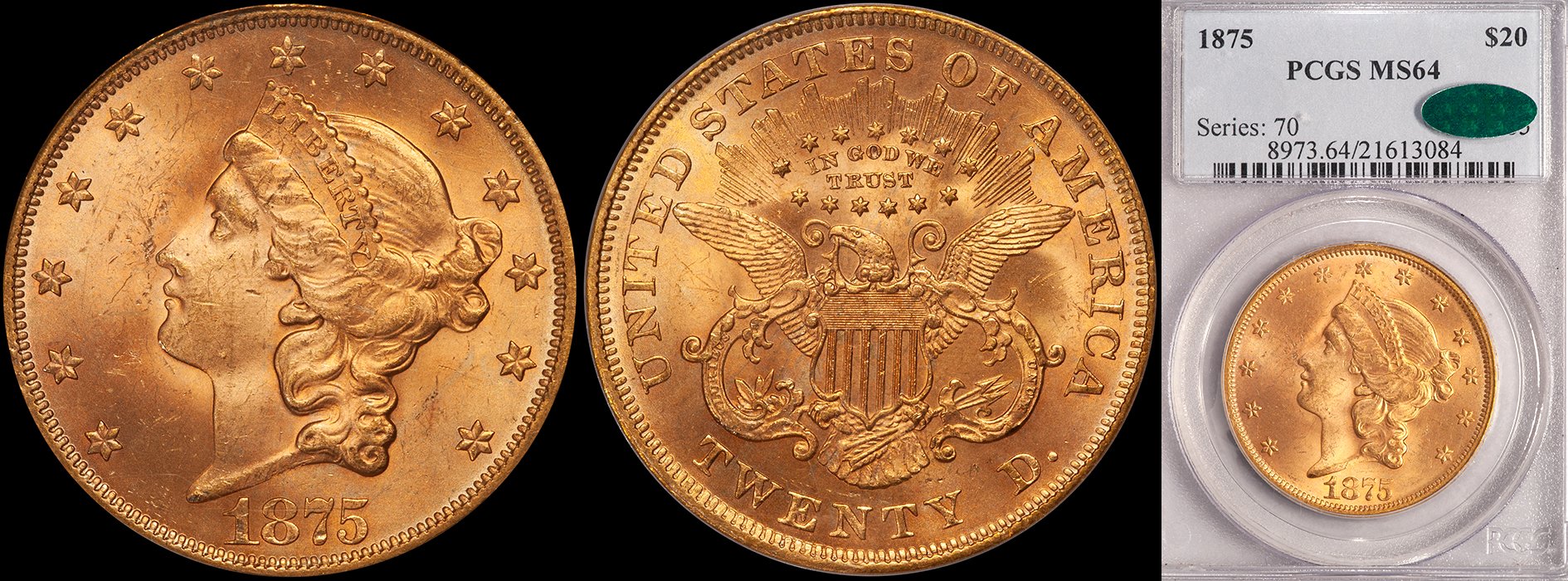
If there is a more popular United States gold coin than the 1907 High Relief double eagle, I’ve yet to encounter it. This is a coin that just about everyone aspires to own. It is beautiful, historic and, in its own way, extremely desirable. The story behind this issue is interesting. I won’t go into the full detail here (it would take many pages to be properly told). Theodore Roosevelt hated the Liberty Head design and secretly hired the famous sculptor Augustus St. Gaudens to redesign the larger gold denominations. St. Gaudens produced what is now regarded as easily the most spectacular imagery ever seen on a United States pattern issue (the Ultra High Relief of 1907).

This design proved to be impossible to strike and it incurred the wrath of the Mint Engraver Charles Barber who felt slighted that an outsider was hired to design a United States coin. He eventually “improved” the design in such a way that the final product in 1907 barely resembled the majestic Ultra High Relief that St. Gaudens produced.

The “normal” High Relief coins also proved to be very difficult to strike and, of course, met with strong opposition from Barber. There were 11,250 examples produced before the design was changed again later in the year. A remarkably high percentage of these coins have survived. PCGS shows over 4,000 graded as of the middle of 2006 and, in my opinion, there are as many as 5,000-6,000 High Reliefs known.

There are two varieties of High Reliefs. The more common is the so-called Wire Edge. The Wire Edge coins were the first High Reliefs struck and they show excess metal on the edge which produced a sort of “fin.” This problem was later corrected and the final High Reliefs struck are known as “Flat Edge” coins. In my experience, the Flat Edge coins are about four or five times scarcer than the Wire Edge coins. The Flat Edge coins sometimes bring a 5 to 10% premium but, more often than not, they do not command a premium. I think they are excellent value, especially if priced as a “common date.”

NGC has designated a number of High Reliefs as Proofs. While there are unquestionably such things as Proof High Reliefs, it is my opinion that the coins marked as such by NGC are NOT actual Proofs. The coins in NGC proof holders clearly have a number of raised die swirls on the surfaces and are probably among the first pieces struck. But they have the same edge as a “normal” High Relief and the true Proofs have a noticeably different edge with different shaped and positioned edge lettering.

In recent years, prices have shot up for High Reliefs. This has been the result of a number of well-managed promotions. But High Reliefs, if you think about it, are coins that sell themselves and it is inevitable that in a strong coin market, they are the sort of coin that is likely to show a strong level of appreciation. New collectors and investors are always attracted to High Reliefs and I expect that prices for these coins in MS60 and higher will continue to be strong for some time.

When buying a High Relief, there are a few things I would suggest you look for. First and foremost is coloration. An original, untampered-with example should display very rich green-gold or yellow-gold color. Look for a piece that has even color with similar hues on the obverse and the reverse.

You should also avoid pieces that show obvious friction on the relief details but you need to understand that because of the nature of this coin’s design, most examples do show some “rub” on Liberty’s and the eagle’s breasts. Finally, you need to look carefully at the surfaces and make certain that the High Relief you are being offered does not have any serious marks or prominent abrasions. This is a coin that is common enough that if you do not like what you see, be patient and wait for the right example.

Currently Popular Gold Coin Rarities

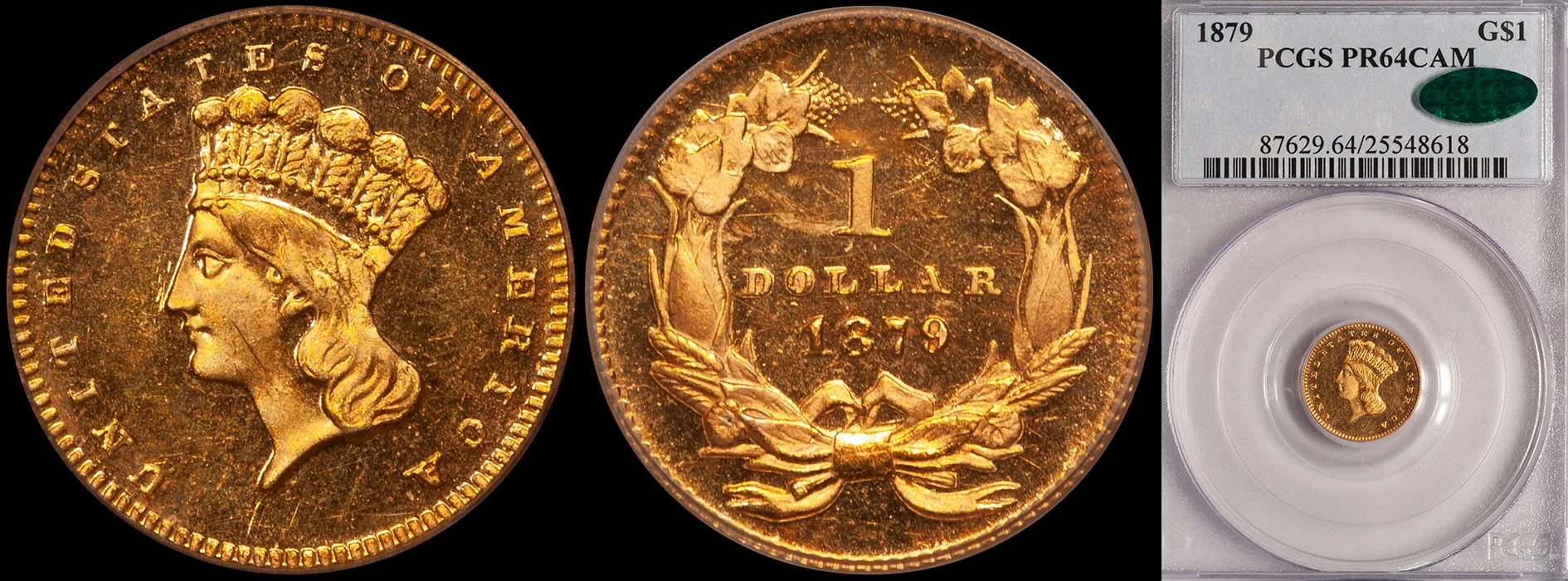
A reader recently asked me an interesting question: “…can you name some currently popular gold coin rarities that might suffer the same fate as the (once popular but now forgotten) 1858 $10?” This is an excellent question and it got me thinking. I have identified a few potential popular-now-but-potentially-forgotten-in-the future gold issues. Type Two Gold Dollars, MS63 and better. Another dealer (someone whose abilities I really respect) told me an interesting story. Back in the 1970’s, when he was handling every conceivable rare United States gold coin, he never saw nice Type Two gold dollars. Today, they seem to be everywhere. Open any major auction catalog and you’ll see a number of Type Two gold dollars in the higher Uncirculated grades.

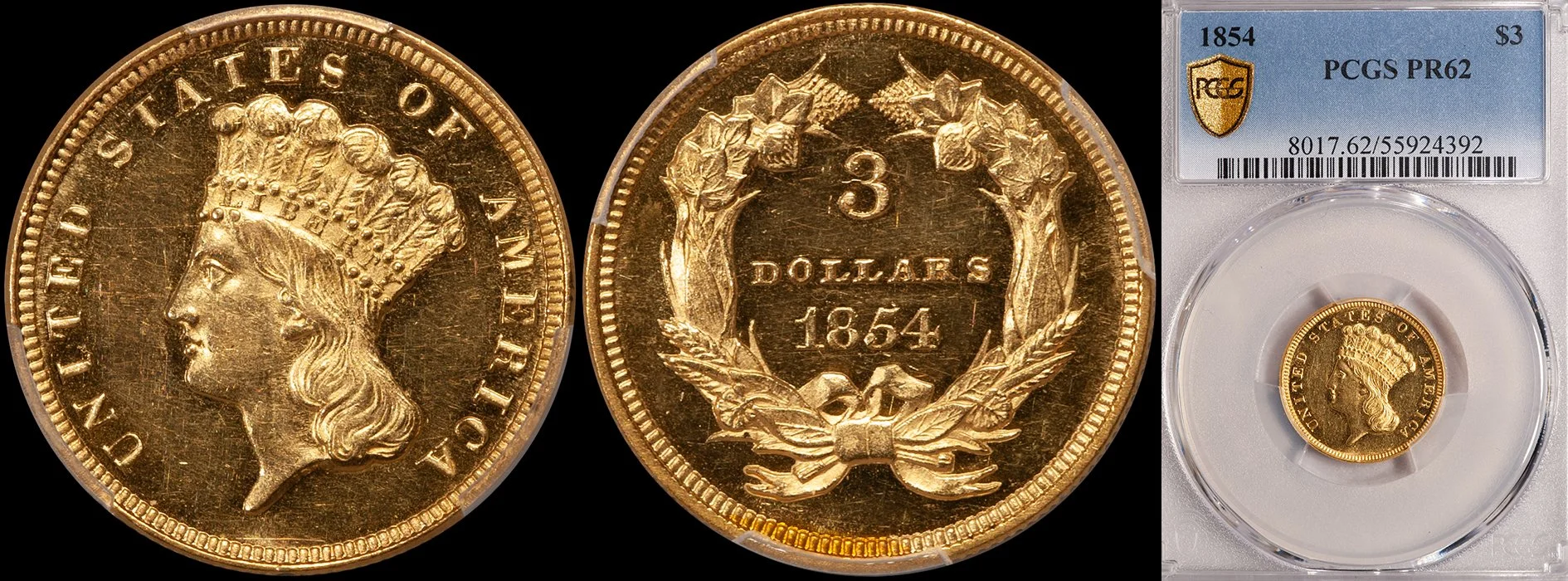
Despite the relative availability of these coins (PCGS has graded nearly 500 examples in MS63 and nearly 400 in MS64) prices for these issues remain high. In the most recent issue of Coin World Trends, the suggested price levels for 1854 and 1855 gold dollars are $15,000 in MS63 and $20,000 in MS64. Given the fact that there are nowhere near 900 people assembling sets of high grade gold type coins, I would contend that the supply of MS63 and MS64 Type Two gold dollars far exceeds the supply. Unless this type is actively promoted again, as it was back in the 1990’s, I would not be surprised if price levels dropped appreciably.

1842-C Small Date Half Eagle. The 1842-C Small Date is the key date Charlotte half eagle. It became popular in the 1970’s and prices rose considerably through the 1980’s and the early 1990’s. But the 1842-C Small Date half eagle hit the wall a few years ago. I think there are three reasons for this.

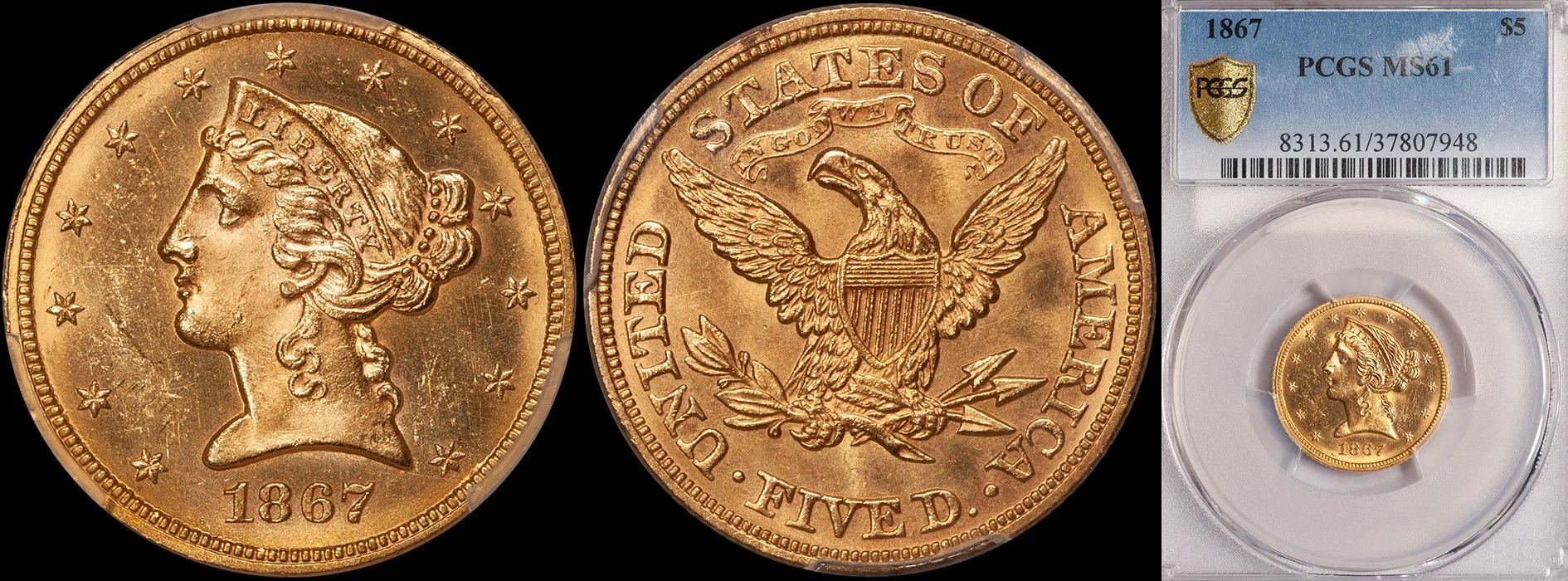
The first is that Charlotte coinage has (temporarily) fallen out of favor. The second is that this coin is, in all honesty, well overvalued in current price guides. Coin World Trends shows values of $55,000 for this issue in AU50 and $100,000 in AU58. A quick perusal of recent sales at auction will show that a number of 1842-C Small Date half eagles have sold for less than half of Trends value. The third is that this date can be filled in a set of Charlotte half eagles by an 1842-C Large Date which is considerably cheaper (around $5,000 for a nice AU). I would not be surprised to see prices and collector interest for this issue to continue to fall in the coming years.

1887 Half Eagle. This is one of a handful of Proof-only 19th century issues. Unlike some of its counterparts like the 1883, 1884 and 1887 double eagles, it suffers from being a member of a relatively unpopular series that lacks the strong collector support of Type Three double eagles.

Despite the fact that only 87 examples of this date were struck there are enough Proofs to go around that the few collectors who focus on Proof Liberty Head half eagles are able to easily locate an example of this date. The 1887 currently has a premium of close to 5x in PR63 and 4x in PR64 (i.e., it sells for around four times the price of a common date Proof Liberty Head half eagle in this grade) but I don’t personally see it having anywhere near four or five times the demand level or collectability of a common date Liberty Head half eagle. I personally like this issue but wouldn’t be shocked if it attains “forgotten rarity” status in the coming years.

July 2006 Coin Market Assessment

When’s the last time you a coin dealer told you the market was going to be slow for a while? Take a deep breath…July is going to be a slow month. I think a short-term slow-down in the market is actually much needed and will, in the long run, be good for everyone’s mental health.

Just think about it. For the last few years nearly every month the coin market has seen never-ending auctions, continual shows and intense flurries of activity. I, for one, am tired. I’m not asking for this paragraph to be accompanied by strings but I could use a break. And you know what? I’m going to take it easy for the next few weeks.

A number of factors are conspiring to make the upcoming four to six weeks a slow-down period. First of all, with the exception of the Baltimore show (July 13-16), there are no significant conventions. Secondly, there are (as amazing as it seems…) no major auctions until the middle of August. Thirdly, the slowdown in metals prices has brought some activity to a halt. And, finally, it’s the summer. People are taking vacations and enjoying the nice weather.

Now I know some dealers just never slow down and they will tell you that they’ll be as busy as ever in July. Don’t believe them because they won’t be. There are just not a lot of coins available now and even the seemingly-insatiable demand of early 2006 has slowed down.

Will this fallow period last long?

Nope. Be prepared for a very active August as the pre-ANA and ANA auctions come around and then the ANA convention takes place. I personally think this year’s ANA will be a true barn-burner and am bracing for one of the busiest shows of my professional career.

I’m told that between the auctions being conducted by Superior, ANR, Bowers and Merena and Heritage that there will be well over 10,000 lots with a value of over $50 million available for sale. Am I worried if the market can absorb them? Not really. This has now happened for the past three or four summers and every year, despite dire end-of-the-world prognostications from certain quarters, the market seems to be doing just fine, thank you.

What really worries me is how I’m going to physically handle viewing four auctions, attending God knows how many sessions, being at the coin show for four or five days for ten hours each day and, gasp, having to wear nice clothes for a week.

I’m planning on enjoying my new place of residence (Portland is phenomenally nice in the summer, FYI), working on a top-secret new book project and getting a tan so I look spiffy in those nice clothes that you’ll see me in Denver this August.

The Four C's of Successful Collectors

There is no blueprint as to what makes a successful collector. But I have noticed some characteristics that a number of the most successful collectors share. In order to give this article a cute hook, I’ve named them the “4 C’s.” Catchy or not, these traits are worth a closer look. 1. Courage: It takes guts to be a great collector. To buy the best coins you often have to overpay. In a strong market, great coins are especially expensive. If you are a slave to price guides or are afraid to stretch for important, key issues then you will never assemble a good collection, let alone a great one. Look at all of the important collectors past and present. Many of their canniest purchases were coins that seemed insanely expensive at the time. Guess what…in the long run these decisions often proved to be brilliant. Bottom line—if you want to put together an impressive collection of coins you need to have the courage (and vision) to think big. Let me begin by saying that I personally love Proof gold, especially Liberty Head issues struck prior to 1900. I love the fact that most of these coins have original mintage figures below 100, I love the dazzling appearance that nicer pieces possess and I love the excellent value that many of these coins represent in today’s market.

2. Contacts: With virtually no exceptions, I can’t think of many collectors who have successfully assembled a sophisticated collection without some degree of assistance from a professional. This comment may seem self-serving. In a way it is. But think about this. The typical high-end coin dealer looks at far more coins than the typical collector, reads a lot more about coins than the typical collector and make more decisions regarding buying and selling than a collector does. If you want to assemble a great coin collection, you are going to have to have a few strong dealer connections, whether they are wholesale, retail or in the auction segments of the business. The Proof gold market changed radically in the late 1990’s. After the Bass, Pittman and Childs holdings were sold at auction between 1995 and 2000, there was an exceptional amount of Proof gold on the market. I can remember certain dates in the quarter eagle and half eagle series that were really rare (i.e., with surviving populations of fewer than 20 pieces) having multiple examples available simultaneously. This gave the market a somewhat warped perspective. At the end of 2000, I owned three very nice Proof 1886 quarter eagles at the same time. In the ensuing years I haven’t owned a single example and don’t think I’ve seen more than one or two.

3. Communication: Great collectors do not exist in a vacuum. They read books about coins. They spend time in chatrooms, look at website every day, attend conventions, speak with other collector, join local coin clubs, attend seminars, meet knowledgeable dealers and obsess over the PCGS/NGC population reports. Collectors who spend ten minutes a week on their collections do not expand their knowledge base. Collectors who spend an hour a day getting smarter become more intelligent and their ensuing decisions generally become much more confident.

4. Connoisseurship: If you want to be a great collector, you have to think like one. In the realm of coins, this means avoiding shortcuts in the creation of your collection. If you have to pay more money for a certain Carson City half eagle because of the fact it displays a great strike, then pay the money. If you have selected a series that contains a number of expensive key dates (like New Orleans double eagles) and you don’t feel comfortable spending six figures on these coins, then choose another area of specialty. Being a connoisseur is a state of mind. You can go on vacation and get a room for $45 a night at a motel or you can spend $450 a night for a room with great amenities with a lovely view. (Being a cheapskate doesn’t factor into this equation…) There are no shortcuts to assembling a great collection.