Proof Gold Coins

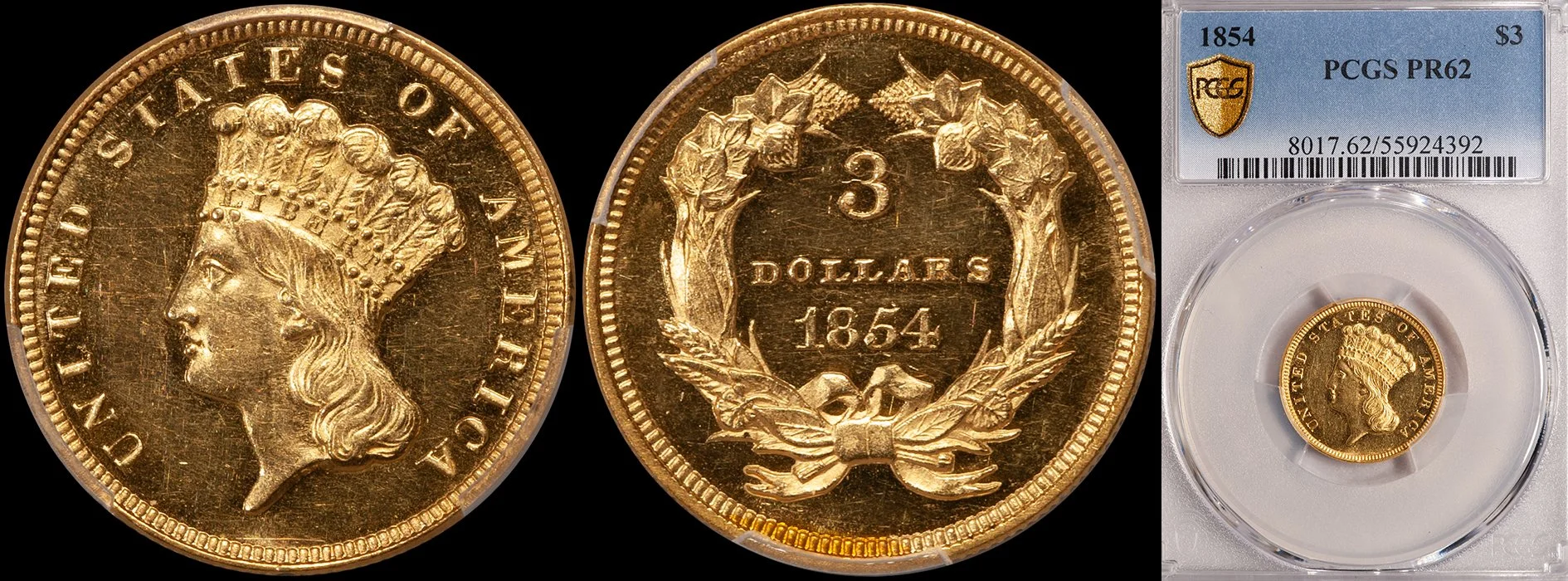
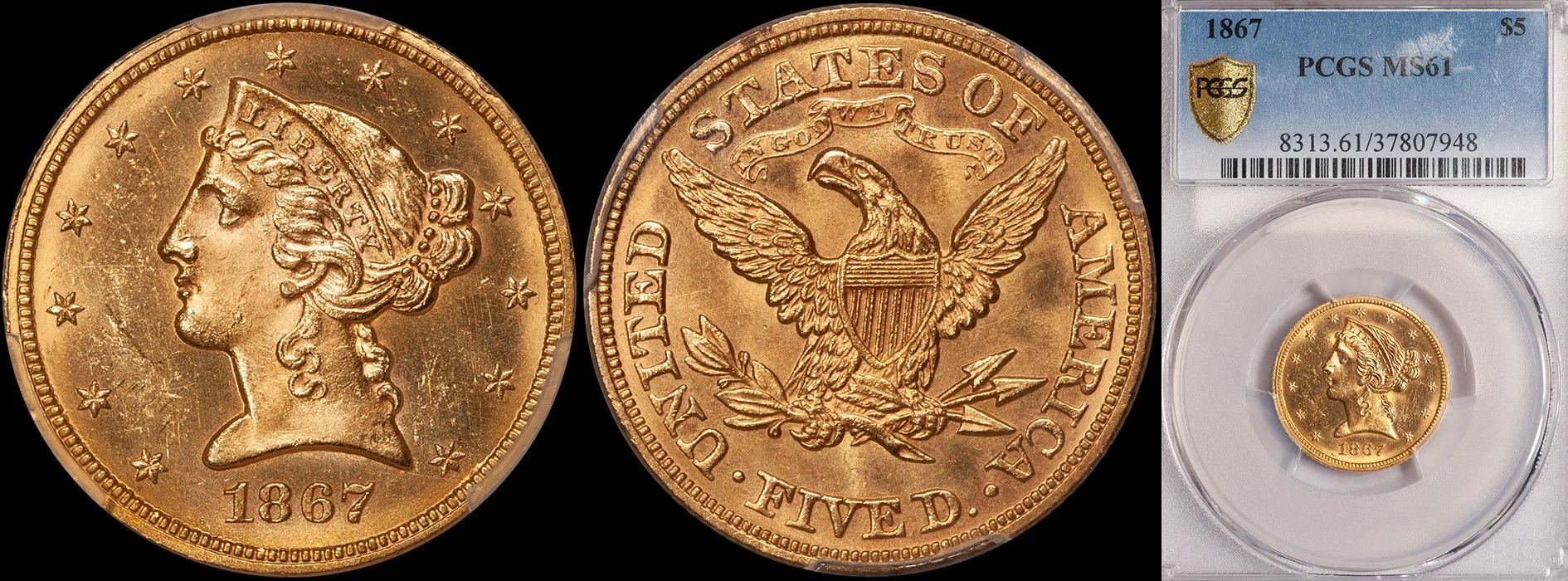
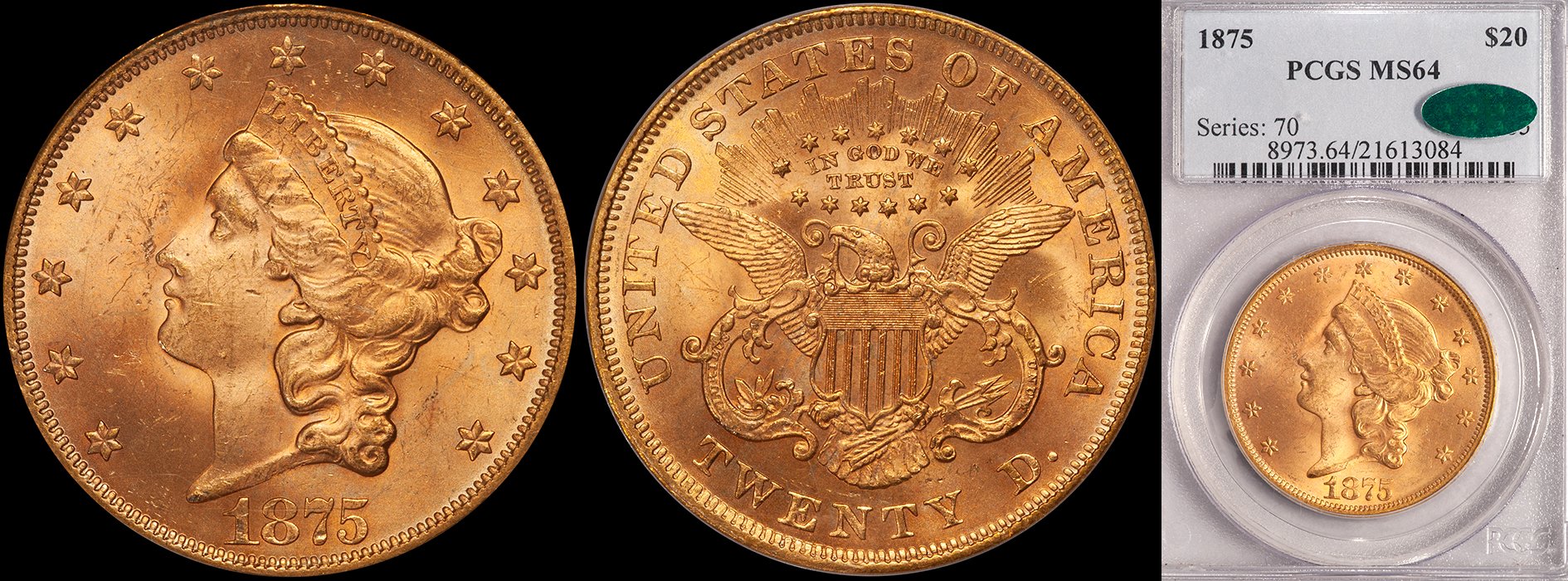
We are now on raregoldcoins.com Blog #50 for the year and I’ve just realized that I’ve yet to write anything on Proof gold coinage. It seems to me that a quick overview and a few passing thoughts on the subject are well overdue. Let me begin by saying that I personally love Proof gold, especially Liberty Head issues struck prior to 1900. I love the fact that most of these coins have original mintage figures below 100, I love the dazzling appearance that nicer pieces possess and I love the excellent value that many of these coins represent in today’s market.

The Proof gold market changed radically in the late 1990’s. After the Bass, Pittman and Childs holdings were sold at auction between 1995 and 2000, there was an exceptional amount of Proof gold on the market. I can remember certain dates in the quarter eagle and half eagle series that were really rare (i.e., with surviving populations of fewer than 20 pieces) having multiple examples available simultaneously. This gave the market a somewhat warped perspective. At the end of 2000, I owned three very nice Proof 1886 quarter eagles at the same time. In the ensuing years I haven’t owned a single example and don’t think I’ve seen more than one or two.

A few very major buyers of Proof gold coinage emerged around 2001-2002 and they have quietly put away large amounts of these coins. I can think of at least two buyers that have each taken over 100 pieces of Proof gold off the market and it is likely that these coins will not reappear for quite some time.

Something that has changed considerably in this market since the late 1990’s is the market premium factor. I can remember that during the Childs and Bass sales, it was possible to buy some incredibly rare Proof issues from the 1870’s and 1880’s for just a small premium over the much more available dates from the 1890’s and 1900’s. When a coin like an 1879 half eagle (original mintage: 30) was selling for just 20-30% more than a common date like a 1900 half eagle (original mintage: 230) it was hard not to absolutely love the value that the former represented. Today, a coin like the 1879 now sells for a much greater market premium factor—and deservedly so.

Grading standards for Proof gold coinage have unquestionably changed since the mid-1990’s to early 2000’s. I notice the biggest change in the PR63 to PR64 range. At one point in time, coins in this grade range were actually relatively attractive. They generally showed a few light hairlines in the obverse fields and had Gem quality reverse. Today, many Proof gold coins graded 63 and even 64 show clear signs of having been aggressively cleaned at one time and tend to have dense hairlines on both the obverse and reverse.

As far as finding truly original Proof gold coins…you can just about forget ever seeing these anymore unless “old time” out-of-the-woodwork collections surface at auction. If you go through the Childs and Bass catalogs, you’ll see photos of wonderful, deeply toned Proof gold coins. Today, essentially every Proof gold coin you see looks like it is fresh from the Gallery Mint’s coining press with ultra-bright surfaces.

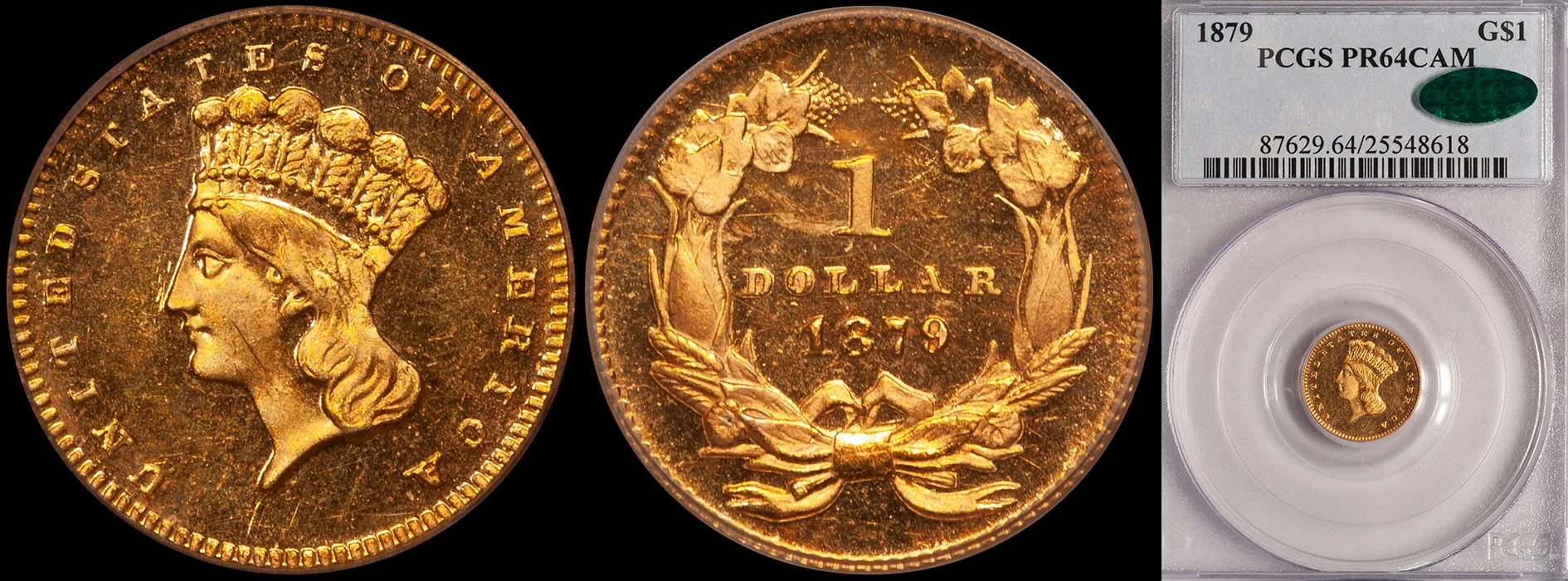
I think the best value in proof gold right now is in the smaller denomination coins. As an example, I think many Proof gold dollars and quarter eagles are very well priced in relation to the larger denominations like eagles and double eagles. I especially like any Proof gold coin with an original mintage figure of 50 or less in PR63 or higher grades. In the smaller denominations like gold dollars and quarter eagles, it is sometimes possible to purchase truly rare and very attractive coins for below $20,000 and, in some cases, for less than $10,000.
First-Year-of-Issue Gold Coins

In this strong market one of the areas that has performed best are first-year-of-issue gold pieces. Coins like the 1839-O quarter eagle, the 1854-D and 1854-O Three Dollar gold, the 1838 eagle and the 1850 double eagle have appreciated greatly in price. But there are a few first-year-of-issue gold coins that have fallen through the cracks. Three of these are the 1840 quarter eagle, the 1839 half eagle and the 1839 Type of 1840 eagle. All three are scarce and important issues that I feel are undervalued. The 1840 quarter eagle is the first Philadelphia mint Liberty quarter eagle. There were a total of 18,859 examples produced of which an estimated 70 to 80 coins exist. This date is typically seen with a considerable degree of wear and probably 75% of the known examples are in the Fine to EF45 range. In AU, the 1840 quarter eagle is scarce and it is quite rare in Uncirculated. Until a few years ago, this date was essentially unknown above AU but a small group of nice Uncirculated coins were found around 1993-94 and were subsequently sold in a Superior auction a few years later. The 1840 quarter eagle can sometimes be found in nice AU for under $5,000. I recently purchased a lovely NGC MS64 example, which is among the finest known, for a touch over $17,000 and this seemed to me to be a great deal. Interestingly, PCGS has only graded 51 examples of this date in all grades compared to 88 examples of the 1840-C and 63 of the 1840-O. The very highly regarded 1840-D, with a tiny original mintage of 3,532, has a total population of 47 and it is generally priced at two to three times more than the 1840 quarter eagle in EF and AU grades.

I’ve always really liked the 1839 half eagle. It’s not a really rare coin given that the original mintage is 118,143. But it has a great design and it is historically significant as the only Liberty Head half eagle from this mint struck in the 1830’s. It is generally very well made and can be found with nice color, luster and surfaces. There are probably 200-300 pieces known and they can be found without a great deal of effort in VF and EF grades. Nice AU’s are moderately scarce and I would estimate that somewhere in the area of 15 or so are known in Uncirculated including four or five in MS63 and better. You can sometimes find nice AU pieces for sale for under $4,000 and I think this is a very attractive price for a coin that is as scarce and historically significant as the 1839 half eagle.

Two types of eagle were struck in 1839. The first (and more common) shows the same obverse as the 1838 eagle. The second has the same design as the 1840. The so-called 1839 Type Of 1840 eagle is an extremely scarce coin and one of my favorite sleepers in the entire Liberty Head eagle series. Of the 12,447 produced, only 45-55 are known and most grade EF40 and below. This coin is extremely scarce in AU and I can not recall having seen more than five or six properly graded AU pieces in the last two decades of specializing in 19th century gold. In Uncirculated this is an excessively rare coin with perhaps three known, the finest of which is the incredible Pittman coin which is now in an NGC MS64 holder. Of the three coins mentioned in this article, the 1839 Type of 1840 eagle is the most expensive but it probably has the most upside potential for the future.

I could easily have chosen another three (or more) examples of first-year-of-issue dates that are much undervalued. You’ll note that the ones I selected are all from the Philadelphia mint but I can think of a number from San Francisco (the 1854-S eagle comes to mind) and New Orleans (the 1841-O eagle is an obvious selection). With a little research, the collector should be able to figure out some pieces that offer excellent future potential and which will be nice additions to a collection of 19th and 20th century United States gold coinage.

Purchasing PQ Coins

Is it worthwhile for the collector to purchase PQ coins? I think it most assuredly is but my answer is tempered by two major “buts.” Namely: are the PQ coins you are buying really PQ and are you going to hold your coins long enough for their “PQ-ness” to matter. If you scan the ads in Coin World, you will note that many coins are given a PQ designation by their owners. It is my belief that nearly every coin listed in a retail ad in a publication like Coin World is not PQ. In fact, most of the coins in these ads are very low end for the grade.

As a dealer who prides himself in selling very nice coins, I do handle a number of pieces that I consider to be PQ for the grade. What exactly is my definition of a PQ coin? I view a PQ coin as one with very good eye appeal for the date and grade. It is a coin that is nice enough that I might have tried a few times to upgrade it. Any dealer who claims that his PQ coins are a “lock” to upgrade is either a liar or a fool. If they are so confident that their coins will upgrade then why aren’t they already in a higher grade holder? But there could be a legitimate reason why a certain coin does not work for a certain dealer. As an example, he might not be submitting it with the right coins or to the right service. I am good at getting coins to upgrade but I have seen, more times than I care to admit, a PQ coin that I sold to another dealer because I couldn’t get it to grade properly in a higher grade holder in someone else’s inventory.

Most smart dealers do one of two things with their really PQ coins. They either put them in auction and hope someone else pays too much money for it or they sell them to their best and most loyal customers. I have handled a number of coins three or four times over the past decade and each time I pass it forward to a collector who I like and who will, hopefully, sell it back to me when it comes time to move it.

As a collector, how much extra should you pay for a coin that you think is really PQ? This depends on a number of factors. How rare is the coin, especially in the next grade up? What is the price spread between the current grade and the next grade? Let’s say you are being offered a really nice coin in an AU50 holder that is worth $5,000 in this grade and $9,000 in AU55. If the coin is being priced to you at $8,000 this is clearly too much. At $6,000 the coin is a no-brainer. I’d say that $7,000 is probably an ideal price.

I mentioned above that PQ coins need to be looked at as long-term holds. Generally speaking, if you buy a PQ coin, do not expect to flip it to another dealer in a year for a big profit. If it were that easy, the dealer who you bought the coin from would have done it himself. The best strategy is to put your really PQ coins away for five years and then consider getting them regraded. Whether PCGS and NGC choose to admit it or not, grading standards do change over the long haul and a nice group of fresh-looking PQ coins could do very well if submitted at the right time.

If you are a bargain hunter or are the type of collector who is not loyal to one or two dealers, the chances are remote that you will buy PQ coins. The really nice PQ coins you see at auction are going to sell for more than you think they are worth (they’ll wind up being bought by a “crackout” dealer who is much better at grading then you are). And the really nice PQ coins that the dealer you shop with are going to be sold to the customers they regard as the most loyal. You’ll wind up with a bunch of pseudo-PQ coins that will not garner the enthusiastic response you hoped for when you try to sell them to the next generation of collectors.

Factors in Coin Purchase Decisions

A collector recently asked me an interesting question: “what makes you to decide to buy certain coins and to pass on others?” The factors that I use in deciding what to buy for my inventory are actually quite similar to the factors that a good collector should use in deciding what to buy for his set.

The first thing I consider is if I like the actual coin itself. In most situations, I try to buy nice coins. By “nice” I mean a coin that has good overall eye appeal and one that I would rank as being in the top 10% for the grade. But there are situations where I might buy a coin that I regard as being “average” quality for the grade or one that I know has been dipped or which seems a bit enthusiastically graded. These situations, which are pretty rare for me, tend to occur when I am offered a date that I really like or a coin that I think is really undervalued. As a collector, I do not suggest you indulge in this compromise behavior very often.

As a dealer, liquidity is very important to me. I like to sell my coins quickly and I try to buy coins that I know will move in a few weeks. I carefully monitor my inventory and if I see that a certain coin gets a lot of attention when I post it on my website, I try to buy other examples of this date. The liquidity factor of a coin should also receive consideration from a collector. You never know how quickly you might have to sell your coins down the road and you will generally find that having coins that are easy to sell are a lot more enjoyable than owning coins that take forever to get rid of.

I try to buy coins that are good values. This does not necessarily mean that I think a coin is undervalued. What it means is within the context of a specific series I like the value that a coin offers. As an example, I like virtually all New Orleans eagles from the 1850’s. If I am offered nearly any reasonably attractive, fairly priced piece from this era, the chances are good that I will buy it. I also like all higher grade New Orleans eagles from the 1890’s and early 1900’s. But there are specific higher grade coins that I will pass on because I feel that the premium over the next grade down is way too high. As an example, I recently bought a nice PCGS MS62 1892-O for under $2,000. I also had a chance to purchase a piece graded MS63 but it would have cost more than triple the price of the MS62. Even though the higher grade coin had a very low population and seemed interesting I didn’t like the level of value it provided. Therefore, I passed.

I try to purchase coins that are popular but not necessarily too popular. It can be hard to define the line between popularity and “too popular.” An example of a coin that I will always buy because of its popularity is the 1861-D gold dollar. But I tend to shy away from higher grade examples of this date because I am not sure that I believe that a decent Uncirculated 1861-D is now worth close to six figures.

This is a fine line that smart collectors and dealers always have to walk. You want to be somewhat “cutting edge” when you buy coins and find a market that is undervalued. But by the same token, you don’t want to be the lone voice in the wilderness buying a series that only you feel is undervalued.

So, in summary, I’d say that the things that mean the most to me when I buy a coin are the following:

    Is the coin nice?

    Is the coin relatively easy to sell?

    Do I like the value that the coin represents?

    Is the series that this coin is included in currently undervalued or have values peaked?

Importance of Expert Assistance During Auctions

A recent auction experience reminded me why it is so important to view coins in the proper condition(s) and why it is so important for collectors to have an expert look at auctions lots for them. At the 2006 FUN show I was walking by the table of a West Coast auction firm who happened to have a group of coins on display for future sales. Included in this group was an early gold coin that was a major rarity and which had an excellent pedigree. I excitedly called a client of mine who I knew would be interested and told him about the coin. I hurriedly viewed it without magnification and using harsh convention center lighting. It looked magnificent to me and I relayed this to my client.

At another show a few months later, I looked at the coin again. It still appeared to be nice.

Prior to the June Long Beach sale, I touched base with my client and reminded him about the impending sale of this coin. Was he still interested? Very. Was he willing to pay what I felt he would have to in order to own this great coin? He said he was.

I viewed the coin again but this time with a 5X glass and using my special coin light that I bring with me to auction viewing rooms. As I tilted the coin into the light and rotated it on its axis, something looked wrong. I checked the coin again and realized that it had, in fact, been subtly wiped many years ago. To the naked eye, the coin looked like a virtual Gem and I had wondered why it was only in an MS62 holder. And given its impeccable pedigree, it had to be a great coin. Right?

Well it was a great coin. But it wasn’t going to upgrade and it did have a subtle but definite problem that might well have made it difficult to sell down the road. And I shuddered thinking about what would have happened if my client bought it and had me crack it out in an attempt to upgrade it. The coin might have wound up in an MS63 or even an MS64 holder. Or, it might have no-graded and we would have had a five-figure problem.

What’s the moral of this story? There is no possible way that the problem that this coin had could have been determined without seeing it in person. And even seeing it in person, it was very hard to detect the wipe lines with a good glass, a good light and an expert’s eyes looking at it. Considering that this coin was worth well north of $100,000 it presented a unique set of circumstances that I feel could only have been properly handled by a very knowledgeable dealer.

May 2006 Long Beach Show Report

The Summer Long Beach show went pretty much as I expected. It started slowly, got exciting in the middle and finished with a whimper. My week began with the Goldberg and Superior sales. I was not hugely impressed with either of these auctions from the standpoint of quality but was able to purchase a few choice pieces including one of the finest known 1840 quarter eagles, a superb Gem 1851-O gold dollar, a glorious Gem 1915-S Panama-Pacific Octagonal $50 and a small group of reasonably crusty southern gold.

This was followed by the usual hum of activity in the pre-show hotel room circuit down in Long Beach. I looked at a ton of coins and was significantly underwhelmed by what I saw. I was, however, able to sell a number of coins including some tired pieces that I was not unhappy to get rid of.

Dealer set-up on Wednesday was a chore to slog through as most people’s attitudes were not great and few coins were available. I was able to find a few interesting pieces here and there, many of which are now listed for sale in the inventory section of my website.

Things picked up considerably when the show officially opened on Thursday. I was able to buy more coins and my wholesale sales were extremely strong. Some observations: scrubby, overgraded C&D gold was everywhere and it was generally hard to sell unless it was priced at big discounts relative to Trends. New Orleans gold was very hard to find. I was not able to find many pieces that qualified as Finest Known or Condition Census examples but I did locate some nice mid-level pieces in the $1,000-$5,000 range. I saw more Three Dollar gold pieces than in quite some time. With the recent price increases in this series there is some profit taking occurring. Early gold was also a bit more available than usual although most of the pieces I saw were common dates in the EF40 to AU55 range.

I was very surprised by the strength of the gold coins in the Heritage sale. Coins that I felt were relatively nice for the grade often sold for more money than I would sell them for retail and most of the old holder upgrades I saw went for exceptional prices. I was able to buy a few goodies but most of the lots that I liked the most went for a lot more than I was willing to pay. My favorite coin was an 1893-CC eagle in NGC MS62 that was extremely fresh and had great coloration and surfaces. I figured it would sell for around $15,000; it brought over $30,000 with the buyer’s premium.

The show slowed down considerably on Friday as many of the major dealers left and gold prices took a major hit. By Friday afternoon, it was officially done, although I did stay until Saturday in a last-ditch attempt to buy some more coins.

I found grading at the show to be pretty realistic. Both NGC and PCGS appeared to be trying to “make” some coins and most of the submitters I spoke with were a bit happier than usual. In my own experience, I was quite pleased and I made some impressive coins, most of which were quickly placed with clients who had want lists on file.

What did the Summer Long Beach show prove? The market is still strong but some areas are showing definite signs of profit taking. The recent ups and downs in the gold market are being reflected in the prices people are paying for generics. At the show, MS65 Saints dropped over $100 per coin. I would urge caution playing this market unless you are very knowledgeable and have a strong constitution.

My next show isn’t until mid-July when I attend the Summer Baltimore convention. I expect activity between now and then to slow down from the frenetic pace of the first five months of 2006. But I expect things to pick back up in August and think that the ANA show in Denver will be superb. I remain convinced that this market still has a long way to go.

May 2006 Long Beach Show Forecast

This should be a very active week for the numismatic industry. The week kicks off with auctions being conducted by both Goldberg and Superior. The Goldberg sale contains an interesting group of high grade Charlotte and Dahlonega gold coinage. The Superior sale is also interesting as it contains some nice fresh early gold (including a splendid 1821 half eagle graded MS62 and pedigreed to the Eliasberg collection) and a run of Proof gold ranging in grade from PR60 to PR65.

Heritage has their usual 5000+ lot sale beginning on Wednesday. There is a considerable amount of gold being offered including some fresh Carson City material, a run of nice Indian Head eagles, a superb set of Commemorative gold plus plenty of other coins in all shapes and sizes.

I do find it interesting that despite the very hot coin market, most of the auctions that are being held these days contains lots and lots and lots of boring, generic United States gold. One really has to wonder, what will it take to get some interesting fresh material out on the market?

The Long Beach show opens on Wednesday. I expect it will be a decent show with some relatively active trading. As usual, most dealers will leave disappointed as they will not be able to buy nearly enough interesting fresh material to satisfy the demands of their customers. A key to the show will be if PCGS and NGC decide to “make” any coins. If the Gods of Grading open the gates, then the show could actually be quite strong. If they are tight, expect much grumbling from dealers.

I have had a very busy past week. I sold two major classic rarities which I will describe in greater detail in the near future. I have also secured a great run of better date Three Dollar gold pieces in circulated grades. If you have a want list for Threes, make sure I know what you need as I expect many (if not most) of these coins to sell at Long Beach.

Someone asked me the other day why the Long Beach shows seem to have lost some of the sparkle they had in the 1990’s. I would have to say the answer is twofold. When California enacted their brutal new tax laws a few years ago, the show seemed to have been dealt a blow from which it has not fully recovered. I also think the whole Long Beach week is too heavily front-loaded. There are just two many auctions that take place before and during the show and this seems to act as a diluting agent. Between Bowers & Merena, Goldberg, Superior and Heritage there are well over 10,000 auction lots being sold in California and this has to take away some of the sizzle.

I am still available for auction representation at the Heritage auction but if you wish to have me bid for you, call me by Wednesday. As I mentioned above, I am looking at the gold lots on Wednesday (and possibly Thursday) and the sale takes place on Friday. The best way to reach me is by email at dwn@ont.com.

"Cornering the Market" on Specific Gold Issues

Does it ever make sense to attempt to “corner the market” on a specific gold coin issue? I have seen a number of collectors and dealers do this over the years. Some of these attempts were spectacular successes while others failed miserably. Anyone who collects coins is probably a little eccentric in the first place. Deciding to focus on one or two specific dates and to hoard these isn’t necessarily more eccentric…just a bit, how should I say this, more “compulsive.”

Collectors decide to hoard a specific date for a number of reasons. A student of varieties like Harry Bass owned multiple examples of certain dates because each represented a specific variety or die state that he was researching. A speculator might find a date that he feels is undervalued, buy up all the pieces he is able and have price levels rise due to continually paying more at auction. An example of this was recently accomplished with 1843 quarter eagles in which a clever dealer accumulated a few dozen of these, made prices rise significantly and then sold into a stronger market. Other collectors just fall in love with a specific date, for whatever reason. I remember helping a collector assemble a hoard of 1888-O eagles in Uncirculated that grew to over 100 pieces before he passed away.

If I were going to hoard a specific issue, I would choose one that does not have an unlimited supply. The gentleman who decided to hoard 1888-O eagles eventually came to realize that he was going to have to buy hundreds of pieces to have an impact on the supply. His decision was made more difficult by the fact the fact that this wasn’t a hugely interesting issue.

I would also look to hoard an issue that was relatively cheap. The decision to hoard 1843 quarter eagles made sense because most of these were available in the $500-$2,500 range.

Most importantly, I would choose an issue that had numismatic significance. Back in my collecting days, I was attracted to 1822 Dimes. I thought this date was much undervalued given its rarity and price structure. It was a key date in a reasonably popular series; another important factor to consider. I eventually owned fifteen or so examples but my relatively small budget meant that most of these were in the Good to Fine grade range.

If I were going to focus on a specific issue today, I might look at something like the 1845-O quarter eagle, a coin with a very low mintage figure, a relatively high level of collector demand and its marketability as the key issue in the short, highly collectible New Orleans quarter eagle series. Or, I might focus on the 1841-O eagle, a date with a very small mintage figure and the numismatic significance of being the first Liberty Head eagle produced at the New Orleans mint.

You can also own a couple of examples of one of your favorite issues without being a hoarder in the classic sense of the word. If I owned a nice 1861-D gold dollar and I had the chance to buy another that was equally nice, I might consider salting it away. This coin could be used as an interesting piece of trade bait at some point in the future.

One final suggestion. If you are hoarding a specific issue (or issues) have an intelligent exit strategy. An investor who put together a very large position of circulated 1893-S dollars recently decided to sell them. The good news was that he ran prices up considerably and that, at least on paper, he made a lot of money. The bad news is that he basically decided to dump them all at once and there are now dozens and dozens of examples on the market. This will probably erode a good portion of his profits.

The Market for New Orleans Gold

How has the market for New Orleans gold changed in the decade and a half since the first edition of my book on the subject was written? I can think of a number of changes including the following six: 1. Very few No Motto half eagles and eagles have changed in terms of comparable rarity, especially in higher grades. The one exception is the eagles and, to a lesser degree the double eagles, that were found in the S.S. Republic treasure.

I would have expected a good number of half eagles and eagles from the 1840’s to have been graded MS60 to MS62 in the past few years. Even with the obvious Gradeflation that has occurred between the early 1990’s and the present, the certified populations of Mint State No Motto New Orleans half eagles and eagles is incredibly low. Clearly, these coins are genuinely rare.

2. All of the post-1883 New Orleans eagles are far less rare in Uncirculated than once believed. However, all of these dates remain very rare in MS64 and above and a number are still unknown in this grade.

Hundreds and hundreds of baggy Uncirculated New Orleans eagles from the 1890’s and early 1900’s have turned up in Europe in the past decade. But because they were shipped overseas and roughly handled, very few of these are likely to grade higher than MS63. Virtually no previously unknown Gem New Orleans eagles from the 1888-1906 era have turned up in the past fifteen years. I find this a bit of surprise and would have expected at least a few to have been discovered.

3. I greatly underestimated the overall rarity of certain very popular issues like the 1839-O quarter eagle, 1854-O Three Dollar and 1909-O half eagle, especially in lower grades.

Man, are these dates common in lower grades. When estimating populations, it is easy to predict rarity in high grade but lower grade pieces are hard to account for. In virtually every major auction there are multiple examples of these dates in the VF-EF range. Clearly, they are much more common then I originally estimated.

4. New Orleans gold from the 1840’s and 1850’s is generally rarer than comparable Charlotte and Dahlonega in terms of high grade rarity and is far rarer in terms of the total number known.

The typical New Orleans half eagle from the 1840’s has around 100-125 pieces known while the typical Charlotte and Dahlonega half eagle from this era has around 175-225 known. The real difference in rarity is in the Uncirculated category. Many New Orleans issues of this era (both quarter eagles and half eagles) have fewer than a dozen known in MS60 and better grades while the numbers for Charlotte and Dahlonega issues tend to be considerably higher.

5. Surprisingly few great collections of New Orleans gold have been assembled and even fewer have been sold in the last fifteen years. Clearly, the Bass, Pittman and Milas collections were superb and contained a number of great coins. But during the past decade and a half there have been at least eight to ten major collection of Charlotte and Dahlonega sold and at least that many (if not more) that focused on early gold. Does this mean that relatively few people have assembled O mint gold sets or do the people assembling them have greater staying power than those people doing C&D mint sets?

6. Who would have ever thought that 1854-O and 1856-O double eagles would have been selling in excess of $250,000 for average quality examples? Fifteen years ago, you could buy these dates for $20,000-30,000 a piece. Today they are ten times as much and, interestingly, almost none have come up for sale in the past two years.