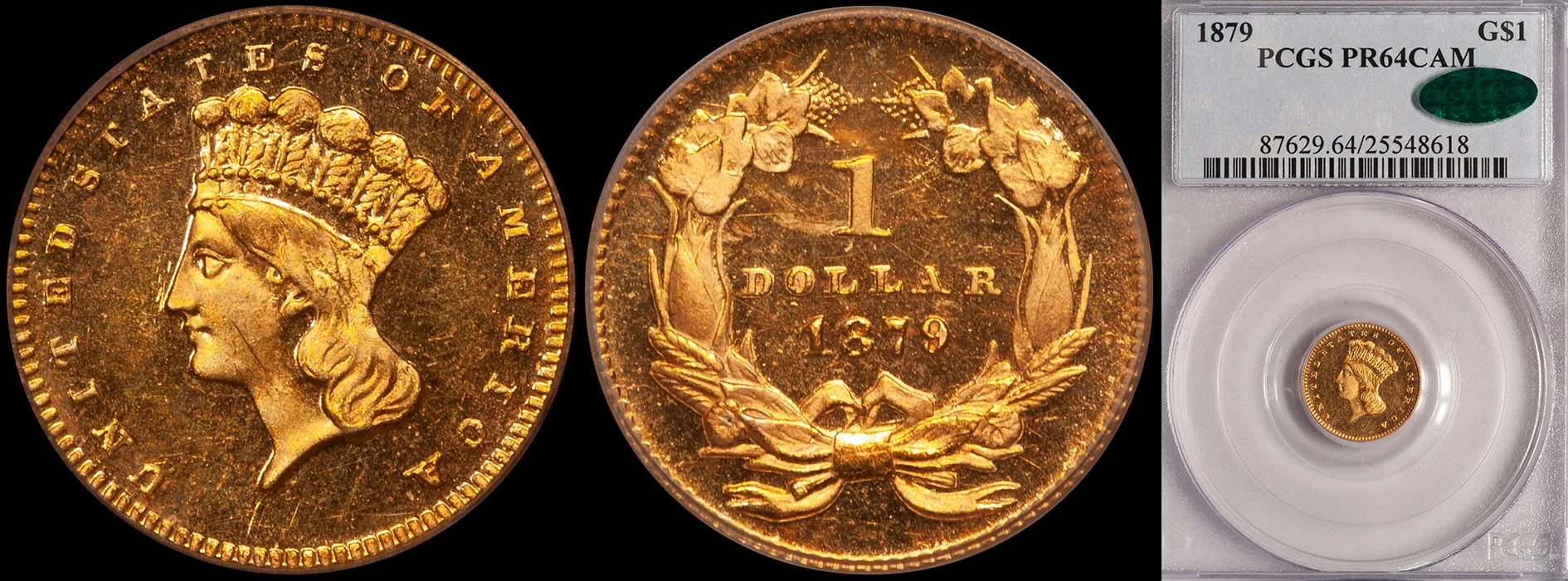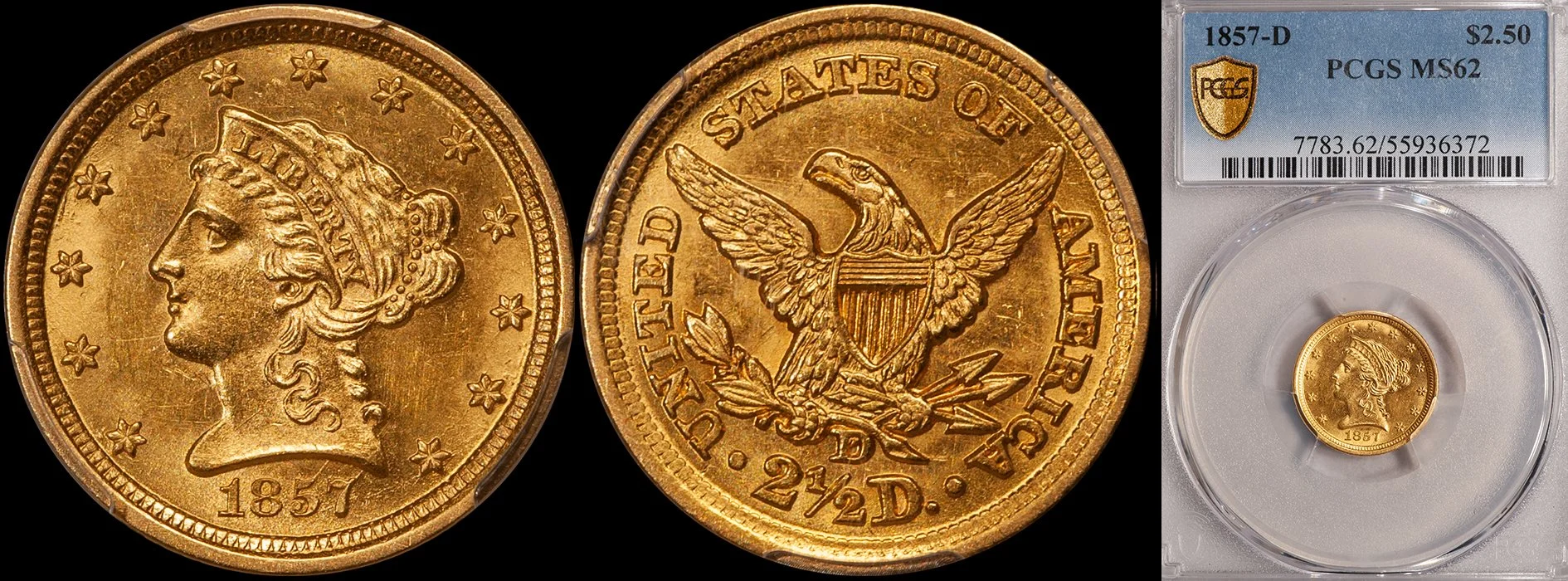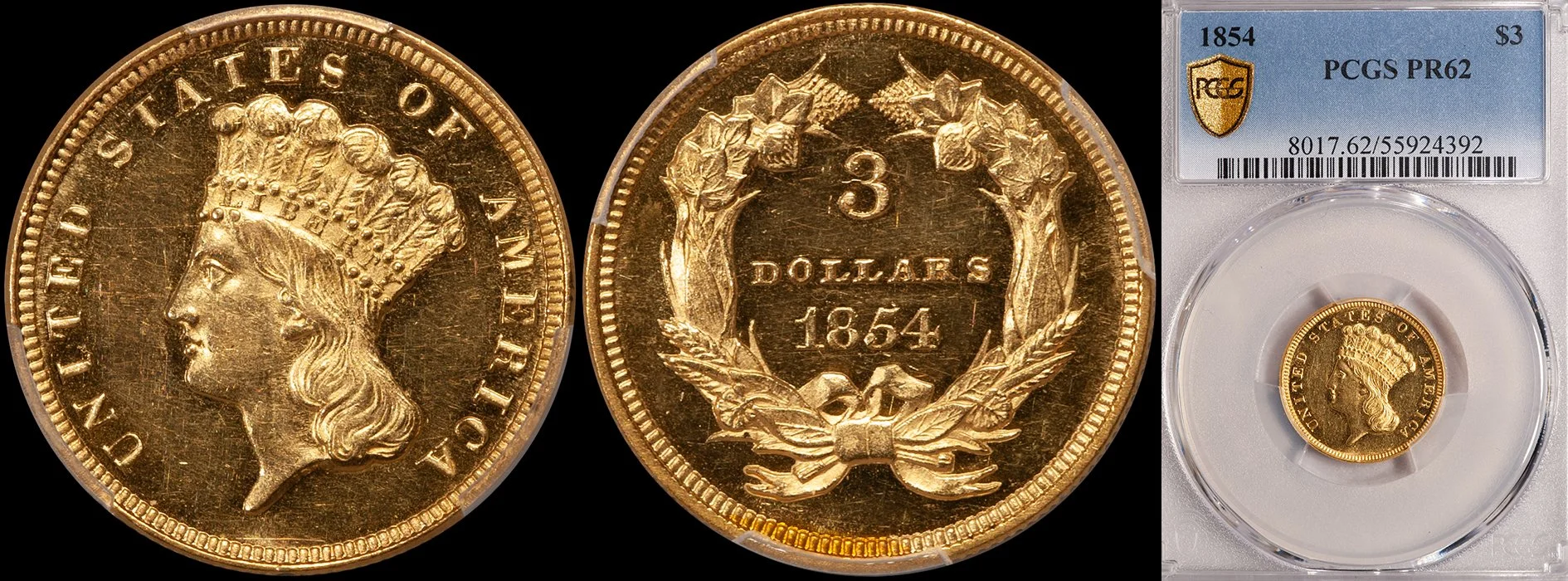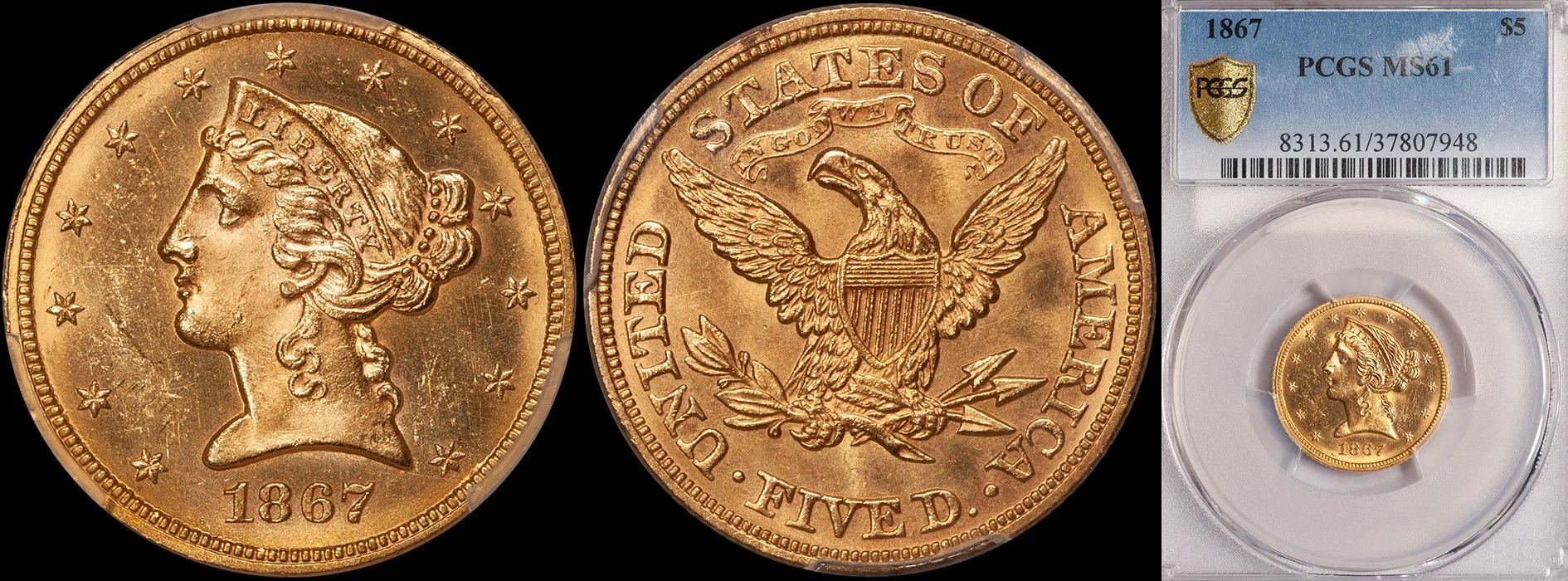
12 Undervalued, Affordable 19th Century Liberty Head Gold Coins: Part I

It’s been a while since I’ve written a blog discussing specific undervalued, affordable gold coins. This is a topic which has proven popular in the past and, unless I’m mistaken, some of my suggested sleeper issues have grown dramatically in popularity—and price—in the last few years. Due to space limitations, I’m keeping this list down to a manageable number but it could easily be doubled—or even tripled—in size.

1. 1865 Gold Dollar

In the past, I have focused on various Civil War gold dollars, usually the 1863 which is the rarest of these issues. The 1863 has become well-known but the almost-as-rare 1865 remains an excellent value for the astute collector.

1865 $1.00 PCGS MS65 CAC, ex Bass

A total of 3,700 business strike examples were produced. This issue appears to have seen little circulation as it is almost never found in grades below MS60. As an example, PCGS has graded a total of 48 with 38 of these (over 79%) in Uncirculated grades. Interestingly, Uncirculated 1865 gold dollars are seen more often in Gem (MS65 and above) than in the lower grades (MS60 to MS62) and this suggests that a small hoard existed at one time.

The current Coin World Trends valuation for this date in AU55 is $900 and $1,100 in AU58. I’d contend that if you are able to find a PCGS or NGC AU55 or AU58 for anywhere near those kind of numbers, you have just stolen a coin and you can pat yourself on the back.

2. 1867 Gold Dollar

In 1867, the mintage of gold dollars “soared” to 5,200 business strikes. The 1867 is more available than the 1865 but not by much and it is less widely known or regarded.

1867 $1.00 PCGS MS66 CAC, ex Bass

The current population for this date at PCGS is just 64 coins in all grades with 46 of these (or 71.87%) grading MS60 and above. You can find the 1867 with more ease than the scarcer Civil War dates but what I like about this date is its current affordability. I have sold some nice higher end AU examples in the last year for around $1,000 and I have sold nice Uncirculated coins in the MS63 to MS64 range for $2,000-3,000.

This list is about “affordable” and, in my opinion, coins like the 1867 gold dollar check all the boxes: scarce in all grades, not terribly expensive even in higher grades, occasionally available and historically interesting.

3. 1844 Quarter Eagle

I’ve discussed this issue before so it’s not really a “secret date.” But the 1844 quarter eagle remains curiously undervalued. Of the 6,784 struck, there are under 100 known. PCGS has graded just 39 examples in all grades and this includes only three in Mint State.

1844 $2.50 PCGS AU58 CAC

So why is this date seemingly a permanently undervalued issue and why has it shown virtually no price appreciation in the past decade? I’d say the answer has a few components. Firstly, the 1844 quarter eagle doesn’t fit into any neat compartments. It doesn’t have a mintmark so it isn’t a branch mint coin. It doesn’t have any historical significance or anything else to give it a level of demand; let alone multiple levels of demand. What it does have going for it is its unquestionable value.

You can buy a very presentable AU 1844 quarter eagle for $2,000-3,000. The same coin with a C or D mintmark would easily be double the price. This fact, in and of itself, may be all the impetus this date needs to become better appreciated in the future.

4. 1846-D/D Quarter Eagle

I’m going to go out a limb here and add a variety to this list of undervalued 19th century gold coins. I know the reaction that some readers will have: “what, there aren’t enough overlooked regular issues? You have to get esoteric on us and add a variety? Seriously?”

1846-D/D $2.50 PCGS AU58

The 1846-D/D quarter eagle is a well-established variety that has an important place within a very popular series. Although it is still not recognized by NGC or listed in the Redbook, it is well-known within the specialist community and recognized by PCGS. This has made it better-known than any of the other Dahlonega quarter eagles.

There are an estimated 40-50 pieces known with most in the EF40 to AU50 range. The 1846-D/D is not an inexpensive coin. You are looking at $4,000-6,000 for a nice AU, unless you are able to cherrypick an example. Put another way, the 1846-D/D is about as rare as the 1855-D quarter eagle from the standpoint of overall rarity but at a fraction of the price.

5. 1855-S Three Dollar Gold Piece

The 1855-S is an issue which should receive a lot more attention from non-specialists than it does. It is more of a Condition Rarity than nearly any issue in this group of undervalued issues and as many as 300-350 are known from the original mintage of 6,600 coins.

1855-S $3.00 PCGS MS61

Here’s why I think the 1855-S is a good value and why it is underappreciated: like the 1854-D and 1854-O it is a first-year-of-issue within the three dollar series. But unlike these two issues, the 1855-S is not a “one and done” coin. In other words, the Dahlonega and New Orleans mints both made three dollar gold pieces for just a single year while the San Francisco mint made them again in 1856, 1857, 1860 and in (sort of…) 1870. Plus the two southern mint threes have the branch mint cachet which its Western counterpart lacks.

As I mentioned above, this is a very rare coin in higher grades. An accurately graded AU55 with good eye appeal is about as nice an example as you are going to find. Such a coin, if available would cost around $9,000-10,000. Back in the heyday of three dollar gold pieces (around 2005-2006) the same coin would have cost $13,000-15,000.

6. 1842 Large Letters Half Eagle

There are two varieties of half eagle dated 1842-P: the Small Letters and the Large Letters. Both are rare, both are undervalued and both probably deserve to be included in this list. But I’m going to go with the Large Letters which is rarer.

1842 Large Letters $5.00 NGC AU58

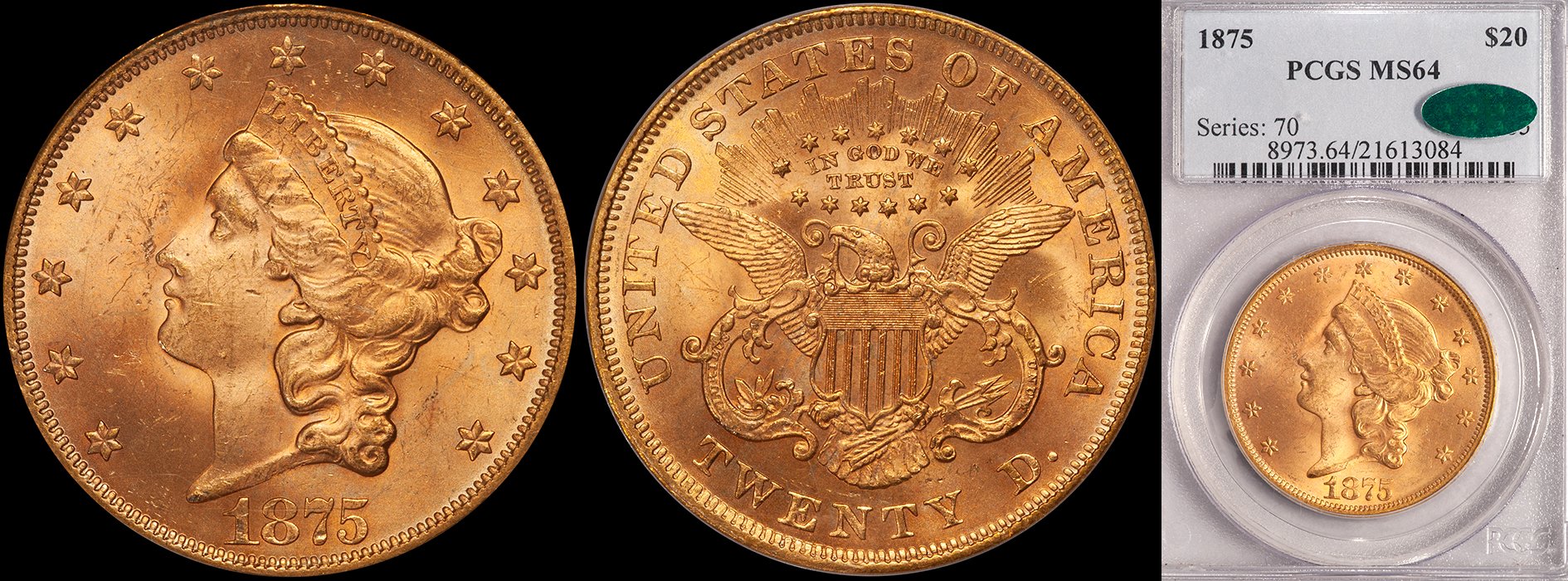
This is the fourth rarest Liberty Head double eagle from Philadelphia after the 1875, 1863 and 1865. There are around three dozen known including three in Uncirculated; the finest is a PCGS MS64.

Despite the unquestionable rarity of this issue, it is still very affordable. A nice quality EF 1842 Large Letters still can be found in the $2,000-2,500 range while an AU example would cost $4,000-5,000+. In my opinion, this is extremely good value in comparison to the branch mint issues of this era.

7. 1864 Half Eagle

It’s widely known that the Civil War half eagle from both Philadelphia and San Francisco are rare due to their low original mintages and their low survival rates. The 1864 is more available than the 1863 and 1865 but it is a scarce issue in its own right. There are an estimated 50-60 known from the original mintage of 4,170 business strikes. When seen, the typical 1864 half eagle is apt to grade in the EF40 to AU50 range.

1864 $5.00 PCGS AU53

I could have placed any one of at least ten other half eagles in this list of undervalued coins but I selected the 1864 due to its multiple levels of demand. Civil War gold coins have become very popular with collectors in the last few years and the 1864 half eagle is a relatively affordable issue in EF and even AU grades.

I sense the “affordable” aspect of this issue beginning to wane, though. As recently as a few years ago, it was possible to find a nice EF example for around $2,000-2,500 and an AU for a bit more than double this. Today, the collector will probably have to spend closer to $4,000-5,000 for a presentable 1864 but I still think this is reasonable for a coin with this degree of rarity and this much historic association.

Should You Buy Very Rare Coins in Low(er) Grades?

As recently as a few years ago, if you asked me "should I buy very rare United States gold coins in low(er) grades" I would have resoundingly answered "no!"  But, as with so many things in life, perspectives change and my answer to this question has as well.

A piece of advice I had often given new collectors is that you shouldn't buy gold coins that grade lower than EF40. That is still a cut-off grade for me and, for many issues, I still recommend sticking with EF and finer coins. But I now will sometimes buy certain very rare issues in grades as low as Good to Very Good. What exactly made me change my mind?

I came to a conclusion a few years ago that just because someone doesn't have a $5,000 or $10,000 per coin budget doesn't mean that they don't appreciate truly rare coins. Nor should they be shut out from the potential of buying a few coins, now and then, that can be genuinely tagged as "rare" or even "very rare." I'm a coin snob who is trying to become more inclusive, I guess...

A few coins that I recently sold on my website raregoldcoins.com illustrate this belief. In the past two months, I handled a pair of 1870-CC half eagles, graded Good 6; one encapsulated by PCGS and the other by NGC. These were coins that I probably wouldn't have bought a few years ago but the New Doug Winter bought them and was pleasantly surprised at how quickly they sold; not to mention how much attention they generated.

Here's my way of thinking about a coin like an 1870-CC half eagle in very low grades. This is an issue with strong Multiple Levels of Demand. It is rare in all grades, it is the rarest half eagle from this mint, it is a first year of issue and it is the only quasi-affordable gold coin dated 1870-CC. In other words, it is a coin that's "got it all." But it is very expensive in EF and AU grades and not every collector who is sophisticated enough to want one can plunk down the $25,000-50,000+ it takes to buy a nice one.

So what's wrong with a well-worn but very problem-free example of this date in a Good 6 holder? Actually nothing; a fact that was lost on me until recently.

When you think about it, a Good 6 1870-CC half eagle is a pretty darn cool coin; certainly one of those "if it could only talk imagine the stories it could tell" kind of coins and probably more so, in some ways, than the same date in EF45 or AU50.

By the same token, I don't automatically think every CC half eagle from the early 1870's in lower grades is a cool coin. In fact, the chances are good that if I were offered a decent quality 1872-CC half eagle in Good or Very Good I would pass. Why? It is clearly a rare coin but it doesn't have nearly the cool factor that the 1870-CC not does it have the strong multiple level of demand. My grade cut-off for the 1872-CC half eagle is more like EF40.

What are some of the parameters that I would employ when choosing to purchase a very rare coin in low(er) grades?

First, just as with a very rare coin in higher grades, I would avoid any piece which has been harshly cleaned or which has poor eye appeal. A coin in Good 6 doesn't necessarily have to be CAC-quality but make sure it has reasonably good overall eye appeal.

Second, I would look for coins which are not only very rare but whose high price point in higher grades eliminates a large pool of potential buyers. As an example, I recently sold a VG8 example of the very rare 1865-S/186 Inverted Date eagle. Not only was it a decent looking coin, it was priced at less than $3,000 which is tons cheaper than the next semi-available grade point (VF/EF) for this issue. From an economic standpoint, this coin made a lot of sense to me.

Third, I wouldn't go overboard with buying very low grade gold coins. In other words, you don't want a collection which features nothing but coins like 1870-CC half eagles in Good 6. A few coins like this are cool pieces to sprinkle in your set. A lot of coins like this are, well, a collection of very low grade coins...

Fourth and final, my sudden admiration for lower grade coins is, as I've tried to make clear, highly selective. Remember: 1870-CC half eagle in Good 6, si....  1872-CC half eagle in Very Good 8, non.....

For more information on how to put together a great collection of United States gold coins, with or without very rare coins in low(er) grades, please feel free to contact me by email at dwn@ont.com.


Collecting United States Gold Coins by Type

In the world of rare American gold coins there tends to be two distinct camps: date collectors and type collectors. I have traditionally been a date collector and tend to value scarce/rare issues as opposed to more common issues in higher grades. But I'm beginning to become more interested in the type collecting option and can see how, for a collector without the desire to become a date collector/specialist, collecting by type can be rewarding. Basically, a type collector buys one higher grade example of a specific design or variety as opposed to a date collectors who tries to complete a set of a specific design. There are some interesting ways to collect by type and I thought I would share a few with a particular emphasis on United States gold.

The most basic--and inexpensive--way to collect by type is to assemble a denomination set. This set would include one example of a gold dollar, quarter eagle, three dollar gold piece, half eagle, eagle and double eagle. Many of these denominations contain multiple types, which range from common to very rare. A basic denominational type set would focus on the most common types in a grade range which makes sense to the collector.

In this set, I would choose a Type Three gold dollar (struck from 1856 to 1889), a Liberty Head quarter eagle (struck from 1840 to 1907), a Three Dollar gold piece (struck from 1854 to 1889), a With Motto Liberty Head half eagle (struck from 1866 to 1908), a With Motto Liberty Head eagle (struck from 1866 to 1907) and a St. Gaudens double eagle (struck from 1907 to 1932). With the exception of the Three Dollar, all of these types are reasonably affordable in MS64 to MS65 grades and some are even available in MS66.  At the MS64 level, such a set could be completed for around $15,000; certainly within reach of most collectors. In MS65, the cost doubles.

A standard six coin gold type set is a bit boring, though. What are some of the things that can be done to spice up such a set? In many of these types, it is possible to purchase dates which are scarcer for little or no premium. When the market for MS64 and MS65 gold type is strong (which it currently is not) there are dates which can bring a 10%-30% premium. When the market cools off, many of these issues lose their market premium factor and can be bought for little or no premium. They may or may not regain this market premium factor in the future but when they can be bought as common dates, why not?

Or better yet, consider a legitimately scarcer date which makes sense. As an example, in the Type Three gold dollar series, all of the 1879-1889 issues are available in MS65 for around $2,000. For $3,500 or $4,000 you might be able to buy a very scarce gold dollar from the 1868-1878 range in this grade.

How important is it for all the coins in this set to have been graded by one service (NGC or PCGS) and to have CAC verification?

I believe that both NGC and PCGS do a good job grading MS64 and MS65 gold type. One service might be a little tighter than the other on small coins but, for the most part, there is not much value differential between the two when it comes to coins like a 1901-S Liberty Head eagle in MS65.

I would recommend CAC approved coins for most gold types. In the case of certain series like Type Three gold dollars in MS65, the premium is very small but probably worth it. In the case of a popular coin like a St. Gaudens double eagle in MS66, the premium is significant from a percentage basis but from what I've seen, a CAC-approved MS66 Saint tends to be a very high. By the same token, the standard of quality for CAC approved MS66 Saints is very high and these coins are generally far nicer than "standard" MS66 coins.

The standard gold type set consist of twelve coins: the Type One, Type Two and Type Three dollars, the Liberty Head and Indian Head quarter eagle, the Three Dollar, the Liberty Head and Indian Head half eagle, the Liberty Head and Indian Head eagle and the Liberty Head and St. Gaudens double eagle.

In this set, the key issue is the Type Two dollar and, for most collectors, this is usually the lowest grade coin included in a gold type set. As an example, the typical twelve piece type set contains coins in the MS63 to MS65 range (sometimes higher and sometimes lower) but due to cost prohibitions, the Type two tends to be at the lowest end of this range. I have always thought that this was an overvalued type in MS64 and MS65 as these pieces always seem to be available yet are priced in five figures. When gold type set collecting was more popular, Gem Type Two gold dollars traded (infrequently) for $50,000 and up. Today, coins graded MS65 tend to bring closer to $30,000. This is due partially to a diluting of grading standards but mostly due to reduced demand.

The other two coins in this 12 piece type set which are elusive in MS65 are the Three Dollar gold piece and the Indian Head half eagle. The former sells for $12,500-15,000 today, well off its former high of $20,000+. In MS64, the price drops to $7,500 or so, making a nice example within reach of most budgets.

The Indian Head half eagle is probably my single favorite individual type in the 12 coin set from the standpoint of potential appreciation. These have dropped in price in recent years down to $12,000 or so for a non-CAC coin and $15,000 or so for one with CAC approval. Not that many years ago, these coins were selling wholesale for $17,500-20,000. If a large marketing firm were to quietly buy 50 or 75 MS65 Indian Head half eagles and then run up prices, we could easily see levels back where they were a few years ago.

If you are assembling a 12 piece type set of U.S. gold, I think it is worth the premium you will have to pay to acquire high end CAC coins. In many cases, you are looking at paying an extra 25-35% but this appears to be money well spent when it is time to sell the coins.

Should you pay extra money for slightly scarcer dates? In this market, as I mentioned above, you can buy a scarcer coin in many series for little or no premium. I wouldn't suggest paying a small premium for a marginally interesting date. What I would suggest is doing the full 12 piece set with significantly better dates. Instead of choosing an 1878 in MS65 as your Three Dollar gold piece, choose an ultra-low mintage date from the 1880's. Study the population figures for Indian Head half eagles and you will quickly see which dates are far scarcer than the 1908 or 1909-D yet do not command a huge premium.

You can add a few more basic types to make the 12 piece set more complete and more challenging. Five which come to mind are the No Motto half eagle, the No Motto eagle and the Type One and Type Two Liberty Head and High Relief double eagles. These are quite rare and expensive in MS64 to MS65 but can be found in the MS60 to MS63 grades for less than $10,000 in many cases.

What if you have a limited budget and can only spend $2,000-2,500 at most. Is a type set a good option?

I think the collector on a limited budget has some great options. Let's take gold dollars as an example. I would suggest buying a nice MS63 or MS64 Type One  which will cost $1,000 to $1,500. For the Type Two, the smartest option might be a "super slider" AU58 which will cost $1,000 or so. For the Type Three, I'd go with an MS64 which will cost $1,000 to $1,250 depending on the date and the quality for the assigned grade.

The thing I like most about collecting by type is that every purchase you make for the set brings a whole new design and a whole new series to explore and research. If you are a true collector, you like to learn about new coins and the thought of studying about a new coin such as a Three Dollar gold piece is, in my opinion, pretty interesting.

It's funny how tastes change among coin collectors. In the 1980's and early 1990's, everyone wanted Gem Type. Today, people prefer rarity. Perhaps a combination of the two--type sets which contain scarce to rare issues--might be the collecting wave of the future.

Some Recent Trends in the Rare Coin Market

If you are a reasonably long-term participant in the rare coin market, you may not have recognized the fact that the market has changed in a huge way in the last five to ten years. Walking around the  floor at a show, you may not notice this (many of the same dealers are buying and selling coins) but the collectors and dealers who are really "in the know" are aware that things are irrefutably different.

How so?

Let's take a look at a few of the ways the rare coin market is far, far different in 2013 than it was in 2008 or 2003.

1.  CAC becomes a force. Five or ten years ago, CAC didn't exist and the major services didn't have someone "checking their work." This led to some sloppy grading and clearly the existence of CAC has tightened standards. Does this mean the services (or CAC) are perfect? Most clearly not but I think grading is more consistent now than in the past and this is evidenced that fewer dealers are making a living solely as "breakout" specialists.

I see a big change in the market from another CAC-related perspective as well. In some series, if a coin doesn't have a CAC sticker, this can mean the kiss of death. I think this is an unfortunate circumstance and I'm guessing this wasn't something that John Albanese had in mind when he established CAC. But as of the middle of 2013, we can look at auction prices and dealer sales and gauge that a CAC sticker clearly increases liquidity and in some cases it increases prices by a significant amount.

2.  Interesting coins outperform all others.  In the rare date gold market, the coins which are clearly in the highest level of demand are those which are interesting to multiple groups of collectors. As an example, a coin like an 1855-O gold dollar has multiple levels of demand because it is a distinct one-year type coin while an 1850-O gold dollar (which is three times as rare in Uncirculated but priced at about one-third to one-half as much) is of interest mostly to a smaller group of specialists.

This isn't to say that people deliberately sought "boring" coins before. But in 2013 (and beyond) it seems clear to me that people want coins with an interesting story behind them.

Some examples of interesting branch mint gold coins include 1855-D gold dollars, 1861-D gold dollars and half eagles, 1839-O quarter eagles, 1854-D three dollars, 1838-C and 1838-D half eagles, 1838 eagles, 1861-S Paquet double eagles. Coins like this have at least a few things in common: they are either one-year types or first year of issues or they have very interesting back stories which appeal to a wide variety of collectors. I call these coins "multiple level of demand" issues and they are clearly in vogue right now.

3.  Pricing Becomes Complicated.  A decade ago, rare coin pricing was fairly simple. You had a coin--let's say an 1885-CC double eagle--and it was graded AU58 by PCGS. You looked at the Greysheet and saw that Bid was $10,000. The coin was pretty decent, it was a popular, low-mintage CC issue and, therefore, it was worth 10% over Bid. You priced it at $11,000 and if it didn't sell quickly, you lowered the price to $10,500. Simple.

But today, there are countless variations of 1885-CC double eagles. It could be a PCGS coin or an NGC coin. It could have a CAC sticker or not have a sticker. It could have a "+" designation or a "*" designation (or even both). It could be in an old green label holder. The possibilities are literally endless.

Suddenly, many significant coins have four, five, six or even more potential variations and just as many possibilities when it comes to pricing. The 1885-CC double eagle in AU58 could be worth $20,000 or it could be worth $25,000 or it could even be worth $30,000. And that's not taking into consideration the possibility that it's an upgradable coin and it is worth $35,000 or more.

Unfortunately, the Greysheet has not kept up with this widening range of prices. Today's collector has to be very nimble or very well-connected to know the price differences between a PCGS/CAC and an NGC/non-CAC coin in his series; especially if he specializes in something like St. Gaudens double eagleswhere the variation(s) in prices can be dramatic.

4.  Every Picture Tells a Story.  As I have written about before, the advent of the internet has made numismatics an increasingly visual hobby. With most collectors making their purchases solely based on images from dealer or auction websites, the visual appeal of a coin has become paramount. Unless a coin is very rare, in today's market it is visual appeal which sells a coin more than almost anything else.

This tends to be less true in the branch mint gold area than in silver coins where superb color can mean staggering premiums. But, as I have noted in the past, how a coin will look on my website once it has been imaged is a major consideration in the process I use to determine if I will or won't buy a coin.

Which brings us to the next point.

5.  In Crust We Trust.  After years and years of beating the "buy original coins" drum, it looks like many collectors of branch mint and early gold have begun to listen to me. This has been reinforced by the emergence of CAC (see above) who tends to appreciate originality and rewards coins which have not been dipped or processed.

The change of taste towards "dirty original gold" has no been without consequence(s). The first I've noticed is that both PCGS and NGC now sometimes over-reward originality. How ironic is this? For years, the services tacitly endorsed the dipping of coins to make them bright so that they would achieve the highest possible grade. By now, so many coins have been ruined by this that when a nice original AU50 is sent in, the chances are good that it will grade AU55 or even AU58 just because it has original skin.

Another consequence is that collectors who want original surfaced coins typically mistake so-so or ugly coins with some color for nice coins with really nice color. This is understandable. Let me give you example. At a recent show, a collector showed me a group of coins which he had purchased through auctions in the last three years. He wanted me to verify that they were all "crusty and original." The coins ranged from not even remotely original to reasonably original but were not attractive. I thought they were clearly nicer than the bright, dipped out junque which he might have bought a few years ago but he still didn't fully "get" the concept of crust. And I'm not sure many collectors--or dealers--do. And this is what, in my opinion, makes the whole 'dirty original gold" craze somewhat ironic.

6.  True Rarity Becomes Appreciated.  Because of the preponderance of numismatic information, collectors are a lot smarter in 2013 than they were in 2003. Many collectors have access to information which, a decade ago, was only accessible to real students of the hobby.

One consequence of this is that you don't have to "convince" collectors that a certain issue is rare. You can prove how rare a coin is by how often it does--or doesn't-- appear at auction and how high--or low--the populations are at PCGS and NGC.

This has made tastes change in recent years. As an example, I just sold a very, very cool San Francisco eagle which was one of the two or three finest known for the date. Ten years ago, I would have bought this coin and my reaction would have been "cool item but who the heck am I going to sell this to?" Cut forward to 2013 and not only did I pay a very strong price for the coin with no hesitation but my reaction was "cool item; I better not put it on my website because so many people will want this that I'm going to anger the collectors I don't call about it."

I see this trend intensifying in the coin market in the coming years. Whether you are spending $1,500 or $15,000 do you want to own a coin  which is hard to find or one which is rare? And what if rarity can now be quantified due to the number of coins which have been graded by PCGS and NGC and the auction archives which Heritage and PCGS make readily available?

What are some of the recent trends in the coin market which you find interesting? Feel free to leave your comments about this topic in the space below or email me at dwn@ont.com to continue this discussion.


"Why Can't I Find Coins to Buy at a Coin Show?"

"Why can't I find coins to buy at a coin show?"

That was the exact question Collector X asked me, in a somewhat whiny manner, at the recent Central States coin show.  But you know something?  I can understand his disappointment. He had taken three days off from work, spent thousands of dollars on a plane ticket, hotel and meals, only to come home from the show empty-handed. He's a coin junkie and I'm sure he won't be boycotting this summer's ANA convention but his question got me to thinking...

Why has it become so hard to find the coins you want to buy at coin shows?

As I told Collector X as we spoke at CSNS, he's not the only one who is having this problem. I've been going to coin shows for three decades and I've noticed them becoming more and more dry in the last few years. Here are some theories of mine as to why.

1. Heritage: The 900 Pound Gorilla In The Room

All you have to do to see the reach of Heritage is to look and the size and scope of their major auctions. With thousands and thousands of lots worth tens of millions of dollars, these auctions are like vacuums that pull a tremendous amount of material of the bourse floor. Some of the coins in the Central States sale(s) were dealer retreads and some of the coins were low end but there were hundreds and hundreds of choice, high end pieces. This includes many fresh coins that, in the past, might have wound up entering the market through dealer's inventories instead of through auction.

You know that zombie movie when an army of hungry, brain eatin' dudes keeps coming and coming at the heroes? That's sort of like Heritage. Last time I checked they employed just a few zombies but they are extremely formidable competition for small dealers like me and a lot of the coins that formerly would be offered directly to me show up in Heritage sales. And I don't think I'm the only small dealer who has this perspective.

As Heritage has grown and grown it has created a strange reality in the market. At this point, the coin market is essentially a duopoly (Heritage and the various Spectrum organizations) with a huge degree of separation between the Big Two and nearly everyone else. Since neither of these firms is retail friendly, they use auctions as a way to sell coins directly to collectors.

2. The Coin Show Circuit is Diluted

There are way too many coin shows. I go to between 15 and 20 per year and this is nothing compared to the really hardcore wholesale guys who go to 30 or 40. At this point in my life, I'd rather be going to fewer shows and doing the bulk of my work in my office where its more comfortable and I'm three times more productive.

But its a Catch-22 situation for me. If I don't go to all of these shows, I become less competitive with the five or six sharp guys who I know are going to be in on every single coin that I'm not going to get offered if I'm not going to be at a show.

But I'm not writing this to gain sympathy from you. You want to know how this dilution of shows affects your ability to buy. Here's one way which I bet you don't know.

3. The Shadow Coin Show

Collector X was one of the first hundred people through the door when Central States opened to the public. Yet, unknown to him, a "shadow coin show" had been going on for at least two days before where many of the nicest, freshest coins traded hands.

Not only is the coin show circuit diluted, it puts unrealistic expectations on dealers. Let's take my schedule at Central States as an example. I arrived on Tuesday and started a frantic search for coins literally as soon as I arrived. But this was already a day later than some dealers. So if I had arrived on Monday (ugghhh...) it meant a full-week commitment to Central States. I'm OK with this amount of time for FUN and Summer ANA when there are fresh coins available to buy, but it's impossible for me to commit this much time ten to twelve times per year.

Back to the Shadow Coin Show theory. There are now many dealers who arrive two days before a show opens to the public and leave Thursday morning; just when many collectors are arriving. With these two different schedules going on, everyone in the long run suffers.

4.  Many Dealers Don't Show New Coins at Shows

Before I had an effective website, I would show many of my new purchases at a show. Today, I almost never show them. There are many reasons, good and bad, for this. I'm not alone in doing this.

  • I spend a lot of time and money on my site and I find it to be a good way for me to sell.

  • I have very limited amounts of time available at shows and it is more effective for me to use them to buy than it is to sell.

  • I like Collector X and I value his business. A lot. I feel better knowing that he was able to buy a few coins as soon as I listed my new purchases.

One more thought. Many of the dealers who had tables at CSNS are not really "retailers" per se. They may have some coins laid out in their cases but they are primarily wholesalers who lack: a) time b) couth c) desire to sell to people like Collector X. As I walked around the floor at CSNS, a thought hit me: there really aren't a lot of tables at the show with nice coins on display.

Which brings me to my final point...

5.  If You Don't have a Relationship With a Dealer You Might Be Wasting Your Time at a Show

I must have seen Collector X walk by my table ten times during his time at CSNS and he must have stopped by three or four times asking me if I had anything new to show him. I felt kind of sorry for him as making the endless shuffle up and down the concrete floors (the Coin Walk of Shame?) couldn't have been all that much fun. And he was there to have fun, right?

If you don't have a tight relationship with a few dealers, you aren't going to see squat in the way of good coins at a show. There. I said it.

1861-D $5.00 PCGS EF45 CAC

Let's say I buy an 1861-D half eagle in Extremely Fine. Unless Collector X is specifically looking for this coin (or it's one of the few shows in the year that I commit the time and resources to being able to invoice, process, and price my new coins) it's going to be hidden in a box in my safe or in my back case, and I'm not going to show it. To Collector X or Dealer Y. And I think this is the case with most other dealers.

Hopefully Central States wasn't a total waste for Collector X. He got to see the Newman coins (I told him to carefully study the patterns if only to see what true originality looked like), he schmoozed with a few of his numis-buddies, he got to breathe coins for a few days, and he probably learned that next year he'll skip Central States and keep his powder dry to the Summer ANA show. Or better yet, he'll let me do the heavy lifting and he'll find a few new items for his collection from my post-CSNS new purchase listings. (Shameless plug, I know...)

How a Coin Gets Bad Karma--And How It Can Regain Its Mojo

I recently sold an interesting coin (details to follow) and the entire process, which was reasonably quick  and painless for both myself and the buyer, got me to thinking: can a coin get bad karma and if it does what does it take for it to regain its mojo? The coin in question has to remain anonymous but it was a very rare silver piece, dated in the 1820's, which was both a condition rarity and an absolute rarity. The trouble with the coin was that a few factors had combined to give it a bad reputation within the specialist community. Was this reputation deserved? Partially; but not really because of the coin itself, more because of a number of external factors. The collector who bought the coin from me saw through its bad karma to realize that, at its new price level, it would be a great addition to his set. And I have to say, I think it was a pretty savvy move on his part.

So how exactly does a coin get bad karma?

I can think of at least five ways and I'm sure that other dealers/collectors can double the size of this list.

1. A Coin Is Perceived To Be Overgraded.

Grading is subjective but there are some big-ticket coins in third-party holders which have acquired a reputation for being overgraded. I can think of a certain 1804 dollar whose grade has inflated many times over the years. I'm not certain that the concept of "grade" applies to a seven-figure rarity like an 1804 dollar but the perception that it is more-than-fully graded has circled this coin for years and it might scare off a few potential buyers.

Why would a coin be overgraded by one of the services? It could have been part of a fresh deal that excited the graders and the final grades were on the high side. It could have been the "right" coin submitted at the "right" time and it acquired a grade during the submission process that probably would never be equaled again if it were to be re-submitted. Or perhaps it was doctored and a substance which was applied to the surfaces changed the appearance and the coin is now overgraded. There are many coins in holders which simply don't look properly graded (even though they might be) and their slab is an albatross.

If the coin in question has a value of $100 and the perceived grade is off by a point, it isn't saddled with bad karma. If the coin is worth $10,000 or $100,000 or $1,000,000 than the perception of whether or not the grade is accurate is very important. In the case of the coin I sold, the grade was probably off by just a point. But with an expensive coin, a point can equal tens or hundreds of thousands of dollars.

2. A Coin is Overexposed.

This is not something new. While doing pedigree research on branch mint gold coins, I have found specific pieces which appeared in four or five Thomas Elder sales during a five year period in the 1920's or five Stack's sales within five years during the 1970's. The problem was Tom Elder's sales weren't on-line and the PCGS auction archives doesn't list all the Stack's sales from the 1960's and 1970's as they do with today's auctions.

For a number of reasons, a coin can be overexposed and become tired. It might go unsold in three consecutive Heritage or Stacks Bowers auctions before it finds the right buyer. Or, it might bounce around between three or four major dealers and be advertised on different websites. An internet-related phenomena is when the same coin appears on five different dealer"s websites over an extended period. It's only one coin but to the new collector, it looks tired.

In the upper end of the coin market, the perception of freshness is incredibly important. For many of the top buyers, be they dealers or collectors, if a coin is not perceived as being fresh, its can become extremely hard to sell; even if the coin is accurately graded and reasonably fairly priced. For these buyers, nothing can kill a sale faster than finding out that not only are they not getting first shot but the coin recently went unsold in two consecutive Heritage auctions.

3. A Coin is Overpriced.

As a buyer of high end, rare coins I am sometimes offered pieces which are so insanely priced that they almost immediately are Bad Karma Candidates. I'm not talking a $50,000 coin which s priced at $55,000; I'm talking about a $50,000 which is priced at $100,000 or more. This sounds hard to believe but it happens more often than you think.

I'd like to think I'm a pretty savvy buyer and the owner of a great coin is certainly entitled to take an epic shot at me when he is pricing it. I try not to take this personally and I try not to hold it against the coin if it mysteriously is offered to me again later at a show for a number which is more in line with what I'm thinking.

Collectors tend to be more emotional and if a $50,000 coin which is priced to them at $100,000 might no longer be worth $50,000 if it is reoffered under different conditions.

4. The Coin Has an Evil Owner.

As a dealer, I find myself buying coins from people who I don't really care for. They may be Red Sox fans or they might have political views that don't mesh with me.  But collectors are able to be a little more discriminatory.

Funny story. The upper-end Dahlonega gold market is small and when a new player enters the market, the other big fish tend to approach the new player with suspicion. Around 20+ years ago, a new Dahlonega collector burst on the scene and he was, to put it kindly, lavish with his spending and harsh with his criticism of other people's coins. After he had pissed off one of my other Dahlonega clients for the third or fourth time, I got a call which basically told me to "never, ever offer me a coin again which Collector X has owned, even if it's a great deal."

Today, in this internet-driven world of numismatics, I think this is still the case. Don't you have a nemesis who you dislike and whose coins you don't want despoiling your collection?

5. Bad Pedigree

I've written a number of articles about coins with good pedigrees. But there are coins with bad pedigrees.

I'm not going to slam any specific collections here; that's not a cool thing to do. In my many years of specializing in branch mint gold, I've come across collections which had bad reputations. They may have been filled with overgraded coins or they might have had a number of recolored/doctored pieces. Perhaps they were assembled by a dealer with a bad reputation and the perception, deserved or not, was that the collection became a burial ground for some unfortunate individual.

So, there you have some of the ways a coin can acquire bad karma. How can a good coin shed this bad energy and get back its mojo?

1. Time Heals Most Wounds

Most dealers and some collectors have great memories. But its funny how some coins which were perceived as being overgraded ten years suddenly don't look so bad today. Stories about a "bad" coin can be forgotten or conveniently lost/overlooked and the Bad Karma 1847-D quarter eagle of the late 1990's becomes a decent coin in the market environment of 2013. Trust me, it happens more than you think...

2. Coins Are De-Pedigreed and Re-Holdered.

You take a coin with a bad pedigree in a scratchy holder and make a few changes...send it to the grading service of your choice, remove the pedigree and put it in a spiffy new pronged holder. Voilà, new coin. Well, maybe not a "new" coin but one whose bad karma might suddenly go away.

3. The Right Owner Buys the Coin.

I saw plenty of sketchy coins in the Bass sales but once you slapped that Bass pedigree on the coin and put it into a PCGS holder, I didn't mind that Bass bought the coin from a dealer I know was a sleaze ball or that it was in six Stack's sales between 1968 and 1973.

4. Downgrade the Coin. 

You see a coin in an MS67 holder that pretty amazing but your perception is that its just an MS66 at best. If you run the numbers and it makes financial sense, why not send it to PCGS or NGC and downgrade it a point? Sounds crazy, I know, but it is a trend which is rapidly gaining traction amongst smart dealers and collectors.

5. Keep the Coin Off the Market For a Generation.

Every collector makes mistakes. But as I said in #1 above, time heals most wounds. I guarantee you that Bass, Norweb and Eliasberg made plenty of mistakes but they overcame them by holding the coins they bought for many years.


Do you think a coin can get bad karma? If you do, how can it get back its mojo? Add your comments below or contact me by email at dwn@ont.com.


What Gives a Coin the "Wow" Factor?

At shows or while viewing auctions, I look at a lot of coins. Most leave no impression, some make me pause for a moment before I resume looking at more coins and a small number get me to stop everything else I'm doing (I'm a notorious multitasker), exclaim "wow" and get my thoughts immediately oriented towards "how do I buy this coin and what will I have to pay for it." There are not alot of coins with this "wow" factor but I find that nearly all the coins that excite me have one or more things in common. What are some of the things that make a coin special for me and how do they affect my decision to purchase them?

1.  Great Scarcity.  I deliberately didn't say "great rarity." Obviously, if I'm looking at lots in a Heritage sale and I see an 1854-S quarter eagle which looks like it was run over by a train, I'm still going to stop, look at it carefully and probably figure a bid. But I'm more likely to be impressed by a coin with great relative scarcity within a series. In other words, if I see a real Uncirculated 1870 quarter eagle (a date which is almost never available in true Mint State), I'm likely to be "wowed." This isn't necessarily an expensive coin but I'm more likely to be stopped in my tracks by a CAC-quality MS62 1870 quarter eagle than I am a far more expensive but far more often seen issue.

As you become more familiar with a series, you learn what dates are seen with regularity (even if they are perceived to be "rare") and which just don't turn up very much. As an example, I was at a show recently and was offered a Proof example of a date which I hadn't remembered seeing in some time. I did a quick search through auction records and noted that this date became available at a rate of about once every four or five years. The coin itself wasn't a Gem but it had a decent appearance and it was priced fairly. I was happy to buy it for my inventory.

  2.  Great Eye Appeal.  Eye appeal is best defined as a combination of factors (strike, luster, color, preservation of the surfaces) which combine to make a coin attractive. Most savvy buyers have one or two hot buttons which, if they are pressed, have a greater impact. For me, these tend to be thick, frosty luster and deep, rich even coloration.

Luster is the reflection of light from the surface of a coin. When a coin is worn, dipped, cleaned or processed, the luster is impaired and the eye appeal is impacted. As I look through coins at shows and at auction, few have nice original luster and, as a result, when a coin with "booming" original mint frost is available, it tends to look great.

But part of a weakness for luster is also knowing the series which you collect. As an example, 1847-C quarter eagles are sometimes seen with thick, frosty luster and higher grade pieces can have really good eye appeal as a result. An issue such as an 1848-C quarter eagle is not known for good luster and I can't recall having seen more than two or three coins which had a "wow" factor as a result of good luster.

I can love a coin if it isn't sharply struck or if it shows an average number of non-detracting bagmarks but I have a hard time with coins that have bland, washed-out color. To me a coin with no definable color has no character and this sort of "blah" appearance is hard for me to embrace.

As with what I mentioned above for luster, the same is true with color: as you learn your area of specialization, you learn what color(s) a coin should show. As an example, the proper color for an early date Dahlonega half eagle is much different than that for a date from the mid-1850's. But when coins have been processed, they tend to look alike; meaning an 1841-D half eagle will look virtually the same as an 1858-D. And this is why that when I see an 1841-D with the "right" shade of green-gold color, I get excited and it gives me the wow factor.

3.  Great Pedigrees.  I'll come right out and admit it: I'm a sucker for a great pedigree. A few weeks ago, I started to read the auction descriptions for the Eric P. Newman coins which are going to be sold in a few weeks by Heritage at the 2013 CSNS auction. The coins were impressive, the grades were impressive. What excited me most about this deal, though, was the pedigrees which many of the coins have. As an example, the star in this first group of Newman coins is an 1852 Humbert $10 graded MS68 by NGC. Not only has Mr. Newman owned this coin since the 1920's, it came from the famous Zabreskie sale of 1907 and, even more impressively, has a direct pedigree that goes back to Augustus Humbert's estate. In other words, this coin belonged to the man who struck it. How cool is that?

Not every pedigree means that much to me. There are a few which have personal significance and I will stretch to buy nice coins from these collections even if they are a bit "out of the box" for me.  Amongst sales from my lifetime,  the ones which impact me the most are Bass, Eliasberg, Milas, Norweb, James Stack, Duke's Creek, Green Pond and Dingler.  Just about any coin from a Chapman Brothers sale (with a verifiable pedigree) would have a high wow factor for me as would coins from "name" collections sold prior to 1945.

4.  Great Historical Significance.  As a child, my interest in coins was predicated on my love of history. As an adult, this has, if anything, intensified. A coin with Wild West association is of interest to me and that's why a nice CC double eagle from the 1870's has more of a wow factor for me than a nice CC double eagle from the 1890's. Others historic eras which send a shiver down my numismatic spine? Certainly the Civil War and, a bit less so, World War 1. I'd also give high wow marks to San Francisco gold coins from the 1850's and antebellum New Orleans issues from the 1840's.

Numismatic significance goes hand-in-hand with historic significance. Sure, I'm a coin weenie but I will admit that factors like a coin being a first-year-of-issue or a one-year type excite me.

Another dimension which can increase the wow factor of a coin for me is its age. An eagle dated 1799 just seems Older" (and therefore cooler) than one dated 1800 or 1801 and this tends to get my attention when I'm looking at coins. I think this is the case with most collectors. A nice coin dated in the 1790's has more appeal than just about any other American issue, regardless of denomination.

5.  Great Backstory.  I'm a sucker for a coin with a great backstory. Let me give you an example.

Perhaps you've seen the small red presentation boxes which people used to give gold coins in as Christmas gifts. They were typically for gold dollars and quarter eagles and they were reasonably common from the 1880's until the 1920's. On a few occasions, I've had people email photos of otherwise-common Liberty Head or Indian Head quarter eagles which are housed in these boxes. Sometimes, the boxes are inscribed and sometimes they come with letters which feature ornate notes from a grandmother to her grandson/granddaughter. I like the sentimental value that these have and because of the backstory, I will always buy them and sell the peripherals alongside the coins to add to the wow factor.

A few months ago, Heritage sold a Gem gold dollar from the 1880's (I think it was either an 1885 or an 1887) which came in a lovely little presentation box with a beautiful, ornate inscription inside of it. I didn't buy it but the dealer who did (hint, he's tall, from Oklahoma and his last name rhymes with Barter...) is someone who is as easily swayed by a coin's backstory as I am.


What is it about a coin that gives you the "wow" factor? I'd love for you to share this with me and invite you to add a comment to this blog. Are you interested in acquiring coins for you collecting which have a strong wow factor? if so, please contact me via email at dwn@ont.com.


The PCGS Set Registry for 19th Century Gold Collectors: Part One

This week the DWN Blog welcomes guest blogger Robert Kanterman.

I'd like to thank long-time DWN client and personal friend Robert "RYK" Kanterman for writing this excellent study on some of the potential avenues for the PCGS Set Registry which are available to collectors of 19th (and early 20th century) gold coinage. Robert's suggestions are followed by some of my own observations/comments. Please note that my comments appear in italics throughout this blog.

As a collector, I am always look for new ways to enjoy coin collecting, new directions to explore, and ideas to share with others who are similarly searching for collecting themes, especially when they are interested in collecting gold coins. In this two-part blog, I will discuss some gold coin collecting ideas offered by PCGS's very successful registry program, some of which are probably unknown to many gold coin collectors.

I will not be discussing the Indian gold series or Saint Gaudens double eagles, but will instead focus on 19th century gold and especially Liberty head series, 1838 through 1908. I am also going to focus on sets that do NOT require the purchase of coins that cost more than my first car (a 1984 Honda Accord - $9,700 in 1984; no 70-CC $20, or even 70-CC $10 or the like).

I will disclose that I have no financial affiliation with DWN or PCGS and that I have active registry sets in some of those that I will be discussing.

I.  Charlotte Basic Type Set: a gold dollar, quarter eagle, and half eagle. This trio can be completed in XF condition, with nice original coins, for much less than the price of my 1984 Honda. If you have deeper pockets or want to go further, expand to the three gold dollar types, two quarter eagle types, and three (or four) half eagle types.

I agree with RYK and think that the simple three coin denominational set from Charlotte is a great place to begin with branch mint gold collecting. For less than $10,000 you can purchase nice AU examples of the three denominations. To "spice up" the set, look for scarcer dates. As an example, instead of the 1851-C for your gold dollar, choose a scarcer but still affordable issue such as the 1853-C.

II. Liberty Head $5 Gold Date Set, Circulation Strikes (1839-1908). The set includes one half eagle from each date (any mint) of this very long series, none of which are real stoppers, unlike the $10 and $20 series. That said, there are a total of 70 coins, and this can take a long time to assemble and significant resources, especially if you demand AU or higher condition examples for the better dates. The 1862-65 and 1875 dates are going to be the toughest.

I'm a huge fan of Liberty Head half eagles and I especially like the pre-1880 dates. To me, the one flaw with RYK's choice of this set is the fact that while the earlier dates of this denomination are interesting, the later dates are sort of monotonous.  You can get around this, to a degree, by focusing on the CC or O mints in the 1880's and 1890's slots but this still leaves you with the task of buying a lot of generic issues for your set. If it existed, I'd rather work on a No Motto date set of half eagles with one from each year, 1839-1866.

III. Liberty Head $5 Gold Mintmark Type Set (1839-1908). Sticking with the popular Liberty $5 series, the Liberty $5 gold coin is the only coin in the US series that was struck at all seven operating US Mints (Philadelphia, New Orleans, Charlotte, Dahlonega, San Francisco, Carson City, and Denver). This set therefore requires inclusion of one coin from each of these seven mints and was a popular collecting challenge in the pre-certification era. It was a stock product for Capital holders, long before anyone heard of PCGS.

I do not completely agree with the weighting (for example why is Philadelphia worth twice Denver?), but it is an enjoyable collecting challenge that can be completed in a variety of grade and price points. To maximize your resources, pick the 1893-O $5, the ubiquitous 1891-CC $5, 1899 and 1901-S $5's, and the 1907-D $5. To make it more interesting and challenging, pick No Motto San Francisco, Philadelphia and New Orleans $5's, a Carson City $5 pre-1879, and the 1906-D $5.

Ah...the seven mint set of Liberty Head half eagles. This may be dating myself but I used to assemble a lot of these in the pre-PCGS/NGC days and sell them, in Capital plastic holders, to marketers. I agree with RYK's suggestions regarding "spicing up" your seven coin set with more interesting dates. You might not be able to afford a nice pre-1880 CC half eagle but don't settle for an 1891-CC; buy a coin like a nice AU55 1882-CC or an 1890-CC in MS61 to MS62

IV. Classic Head $5 Gold (1834-1838). This popular series has a significant following, with some choosing to pursue the minor McCloskey varieties. The basic set, however, has 8 coins - 5 reasonably easy to find and three that are more difficult: 1834 Crosslet 4, 1838-C, and 1838-D. If you stick to EF coins, you can stay under our budgetary requirements. If you wish to compete, you will have to go AU and higher. What I like about this set is that you get a popular Redbook variety (the Crosslet 4) and two great first year southern mint coins.

I'm a huge fan of Classic Head half eagles (and quarter eagles as well). To me, these coins bridge the gap between early gold and the more modern Liberty Head issues and they have a "handmade" charm which the latter issues don't show. As RYK pointed out, the 1834 Crosslet 4 and the 1838-C/1838-D issues can be stoppers for the collector on a tight budget but affordable examples do exist so they are not an unrealistic goal. If you are strict about not buying any coins which are more expensive than RYK's Honda Accord, you might have a problem with the 1838-C and the 1838-D in higher grades as properly graded AU and better coins are probably going to exceed Accord Value.

I can also see collecting Classic Head gold by die variety. A list of all the varieties can be downloaded from the Heritage website and many of these can be cherrypicked from dealers (including myself) who don't take the time to identify the scarce and rare varieties. Collecting gold by die variety has never been popular but if any series were to become the standard for gold coins, it would likely become the Classic Head half eagles.

V. Complete Liberty Head Gold Type Set (1838-1907). I am not sure who came up with this idea, but I really like it! This set requires one coin of each type of the Liberty head gold era. As someone who is prejudiced against smaller coins (sorry, SD!), only requiring two mini coins (Type 1 gold dollar and any Liberty quarter eagle) allows the collector to focus on the bigger coins (three $10's and three $20's). The stopper is the "Type 1" or "Covered Ear" No Motto $10 from 1838 and 1839. I recommend having some fun and sprinkling the set with branch mint gold, if you can. With the exception of the stopper, every coin can be purchased in XF or better condition for under $2,500.

This set seems a little gimmicky to me but, that said, I'm in favor of any sort of set that turns "accumulators" of coins into "collectors."  The stopper which RYK refers to (the 1838-1839 $10) isn't hard to locate and a nice EF40 to EF45 1839 Head of 1838 eagle is affordable and available. And I really like the idea of sprinkling some branch mint coins in this set.

VI. 20th Century Gold Liberty Head sets (1900-1907/8, quarter eagles through double eagles). I am not sure if Doug is going to like this one, and that is why I placed it at the end. Let's tackle each one individually. The quarter eagle set (1900-1907) contains eight coins, all Philadelphia Mint, and probably will not keep the interest long of anyone who has read this far into the blog.

  • The half eagle set (1900-1908) contains 18 coins,  including many common coins, some surprisingly uncommon, and one relative stopper (1904-S). The set could be completed with AU and/or lower MS coins for around $12,000 or less, though better coins will certainly cost more.

  • The eagle set (1900-1907) includes 21 coins with three relative stoppers (1900-S "the silent stopper"--if you don't believe me, I challenge you to find one, 1906-O and 1907-S). This set affords you the opportunity to buy coins from four mints (Philly, Denver, New Orleans, and San Francisco), and even the more common coins can be expensive in higher grades.

  • Last, but not least, is the $20 Lib 20th century set (1900-1907), a total of 18 coins, that range in difficulty, from the most ubiquitous Liberty head gold coin of all, the 1904 $20 to the challenging about AU 1902 and 1905 $20's. Because each coin contains nearly an ounce of gold, the basal value of even the most common coins will approach $2000.

RYK was right about me not really being a fan of these sets. For every interesting issue like the 1900-S eagle (yes, it is a tough coin in Uncirculated,  by the way) there are five which are little more than generics and I think your money is spent better on really scarce or rare issues. For the price of, say, a 1905 double eagle in AU, you could buy a much more interesting (and rare) coin which will perform better and give you more pleasure in the long run (at least in my opinion...)

There you have it, six (or nine) collecting ideas for those interested in starting a US gold collection or those already collecting who wish to move in a new direction.

Part Two will discuss some collecting ideas not in the PCGS registry that I would like to see taken up by PCGS and some collecting ideas offered by the NGC registry. As always, contact Doug at DWN@ont.com, if you would like to talk coins and add some of the coins discussed here to your collections (new or old). Contact me at ryk@blackandgoldcoins.com if you just want to talk coins.


Why Do San Francisco Gold Coins Get No Love?

The City by the Bay gets my vote as by far the nicest city in which the U.S. Mint ever struck coins.

San Francisco is a cultural hotspot with museums galore and a long history of supporting the arts. It relishes its history, isn't afraid of it's somewhat sketchy past, and is home to more upscale, artsy residents per capita than probably anywhere else in the country. It should be a hotspot for collecting and its 19th century gold coinage should be as — or more popular — than its Podunk Western cousin, Carson City, right?

Actually it's not. San Francisco gold gets (relatively) no love from coin collectors. It's not a great coin town and, curiously, there are far fewer collectors for San Francisco gold coins than one would expect. This market is finally beginning to show some legs but it is still far less popular than I think it should be.

Why?

I think there are a lot of reasons. some clear and obvious, some far-fetched and obtuse. Let's look at a few reasons why San Francisco gold coins aren't that popular (yet), what the current trends in the market are and what the future holds for these issues from the Barbary Coast.

1. There Are "Too Many" Issues

San Francisco produced gold coins with virtually no interruptions from 1854 through 1916 and, sporadically in the 1920's and early 1930's. This is the longest production run of any branch mint and only the Philadelphia mint struck more coins during this time period.

Clearly, there are a lot of gold coins struck at the San Francisco and not all of them are "interesting." This is a contrast to the southern mints of Charlotte and Dahlonega which had shorter production runs and from which every coin has some degree of numismatic scarcity and desirability. The pre-1879 San Francisco Liberty Head gold coins tend to be far more interesting than their post-1879 counterparts and, admittedly, these later issues tend to be viewed as a group which sort of just drags on and on.

This plethora of issues tends to intimidate the novice collector. To state, "I'm a collector of San Francisco gold," entails denominations ranging from gold dollars to double eagles and, quite frankly, this is intimidating. It is important for the potential San Francisco collector to immediately become a specialist and focus on either one denomination or a subset (i.e., No Motto half eagles from this mint).

Which brings us to the all-important point number two...

2. There's No Reference Book on San Francisco Gold Coinage

Reference books exist on virtually all the mints that struck U.S. gold coins and specialized books by Bowers, Dannreuther, Akers, Goe and others cover early gold, certain non-southern branch mints. But, to date, there is no single specialized reference work on San Francisco gold.

For years, I've given this project strong consideration but the amount of work it will take to write a San Francisco gold coin book is staggering. And it's a real Catch-22: the market will be jumpstarted by said book but who wants to spend the time, effort and money to undertake this project when it will probably sell 500 copies and go overlooked? It's truly a labor of love and the handful of dealers that I think are qualified to write such a book (myself included) are probably too busy buying and selling coins to pen a 400-500 page opus on SF gold. 

Until a good standard reference book on these coins is published, the market is destined to trail areas such as Carson City, Charlotte, Dahlonega and New Orleans.

3. There's No Marketmaker(s) In This Series

If you want to buy a nice Dahlonega half eagle, there is a small but stable core of suppliers that collectors know where to turn to. Same with Type One double eagles, Proof gold and early gold, to name a few. But who is an iconic marketmarker for San Francisco half eagles; a dealer you know is always going to have a nice date run of Civil War era coins or some Gem semi-scarce issues from the 1880's and 1890's? At this point, there is no one dealer who is "Mr. San Francisco gold."

1861-S Paquet $20.00 NGC AU53

Ironically, there has been some exceptional marketing in one area of the San Francisco coin market: Type One and Type Three double eagles. The former has been the domain of a West Coast firm for over a decade and it began as an off-shoot of the S.S. Central America shipwreck. They had a brainstorm many years ago which proved prescient: you buy a gorgeous 1857-S double eagle in MS64 or MS65 and you get hooked; the next logical step is a date set of Type One double eagles from this mint. That's why coins like the 1854-S, 1861-S Paquet Reverse and the 1866-S No Motto have tripled in value in the last decade.

If this West Coast marketer started to focus on San Francisco gold which complimented its double eagle focus, it might be a huge shot in the arm for these coins. If a collector bought a nice 1857-S double eagle, wouldn't he want to assemble a date set of 1857-S gold? In theory yes but there is one problem. While there are thousands of Gem and Superb 1857-S double eagles available, all the other denominations from this year are rare to very rare in Uncirculated and non-existent in Gem. How do you explain to a new collector that the AU58 1857-S eagle he is being offered to go with his 1857-S double eagle in MS65 is the best available coin for that denomination?

4. Modern Coins Have Hurt the "Unusual Date" San Francisco Market

A coin like an 1864-S eagle is clearly a "rare date" issue with an avid collector base. And a 1901-S eagle is clearly a "generic" issue which is bought and sold like a commodity by investors and investor-collector hybrids. Then there coins like, say, an 1883-S eagle which is not really a rare coin but is clearly not a common generic issue. I sort of jokingly refer to these as "unusual dates."

Before modern coins became popular, "unusual date" San Francisco gold was popular with marketers and it might sell for a 20%, 30% or even a 40+% premium over common dates. The sales pitch was easy to make: here is a coin which is fifty times more rarer than a generic issue for just a 30% premium. It made sense.

But today, most of the firms that would sell these "unusual dates" are focused on moderns where the supply is unlimited and the margin are consistent. And this has not only destroyed the market premium for a coin like an 1883-S eagle in MS62, it has hurt the ability for a coin like the 1883-S to be used an entry portal into the rarer coins from this mint, like the 1864-S eagle.

If a few of the firms which used to sell "unusual date" San Francisco gold would resume their programs, this might be good for the long-term health of the market.

5. One Of The Horses Has To Finish Last In The Race....

If we throw out Denver as a branch mint (because it's my blog, I get to make the rules) that leaves us with five branch mints. One has to be the most popular (I'm going to give that honor to Carson City although I could see a case for Dahlonega and one has to be the least popular. To paraphrase the immortal words of my high school baseball coach, "in a horse race, one of the animals has to finish last."

But if one branch mint has to finish last in a Numismatic Popularity Contest, why San Francisco? With all the newly created wealth in Northern California from nerd-centric professions such as engineering, entrepreneurship, social media, etc. one has to wonder if the time is coming for San Francisco gold coins.

Interestingly, a few of my newer clients are in their 30's, have made a good deal of money from Internet or tech-related businesses and are from the bay Area or Silicon Valley. They are very attracted to SF gold and when they "run the numbers" (as you would expect a Tech Wonk to do) they quickly conclude that these issues seem like great value when compared to southern gold.

So could this be the future of the San Francisco gold market? Hard to say but if these few new collectors are any indication and at least one or two of the problems listed above is addressed, than we may be seeing a strong new market developing right before our very eyes.

Are you interested in San Francisco gold coinage? Would you like to assemble a world-class collection of gold from this mint? Whether you are Mark Zuckerberg or Mark the Dude from Around the Block, I can help! Please feel free to email me directly at dwn@ont.com to discuss your new San Francisco gold collection!