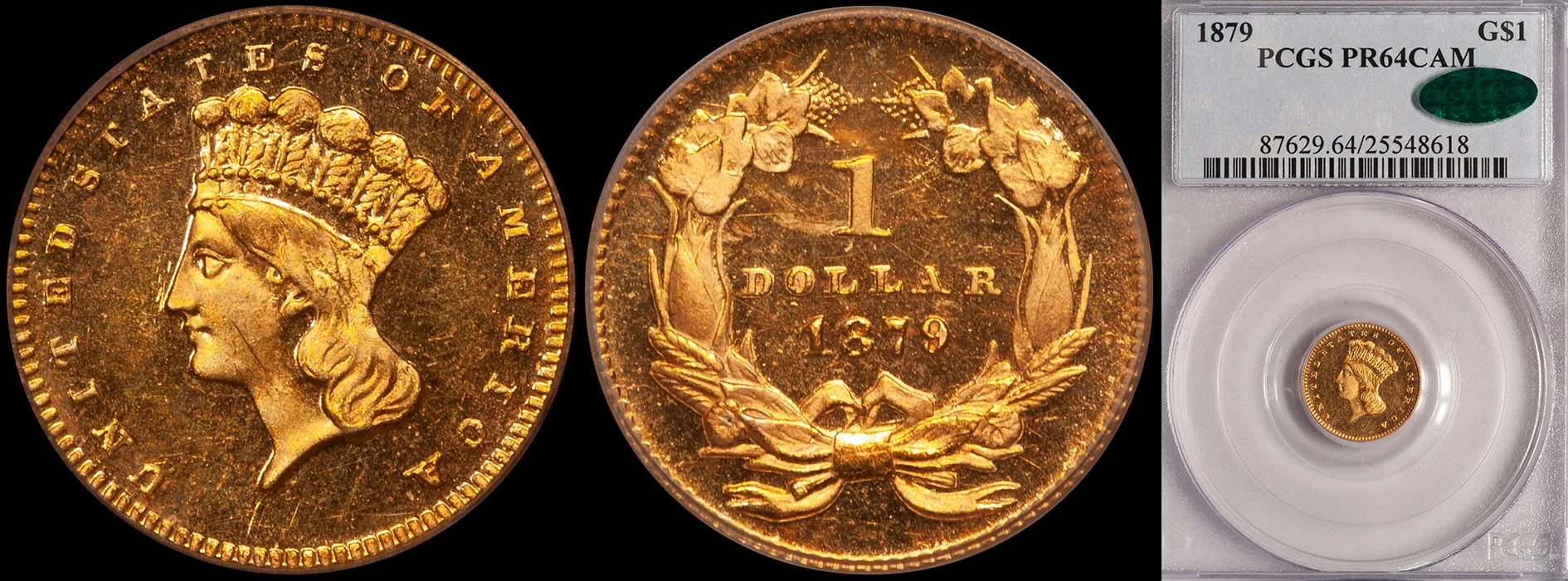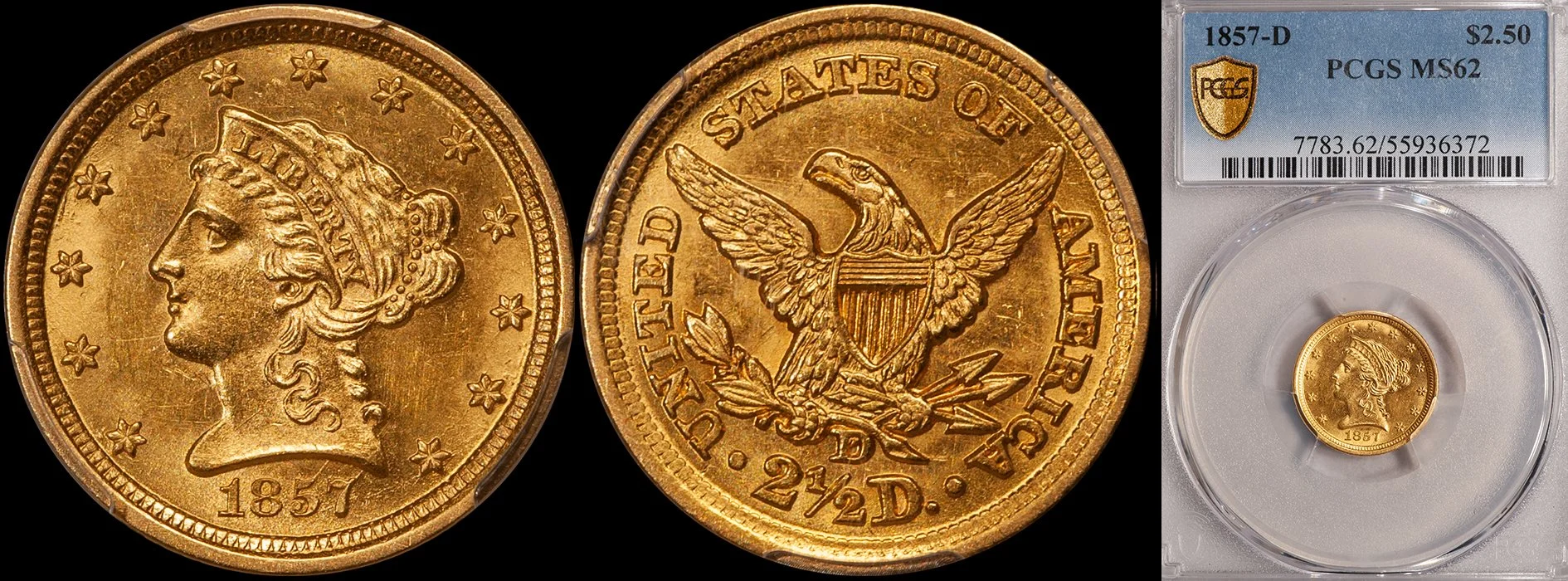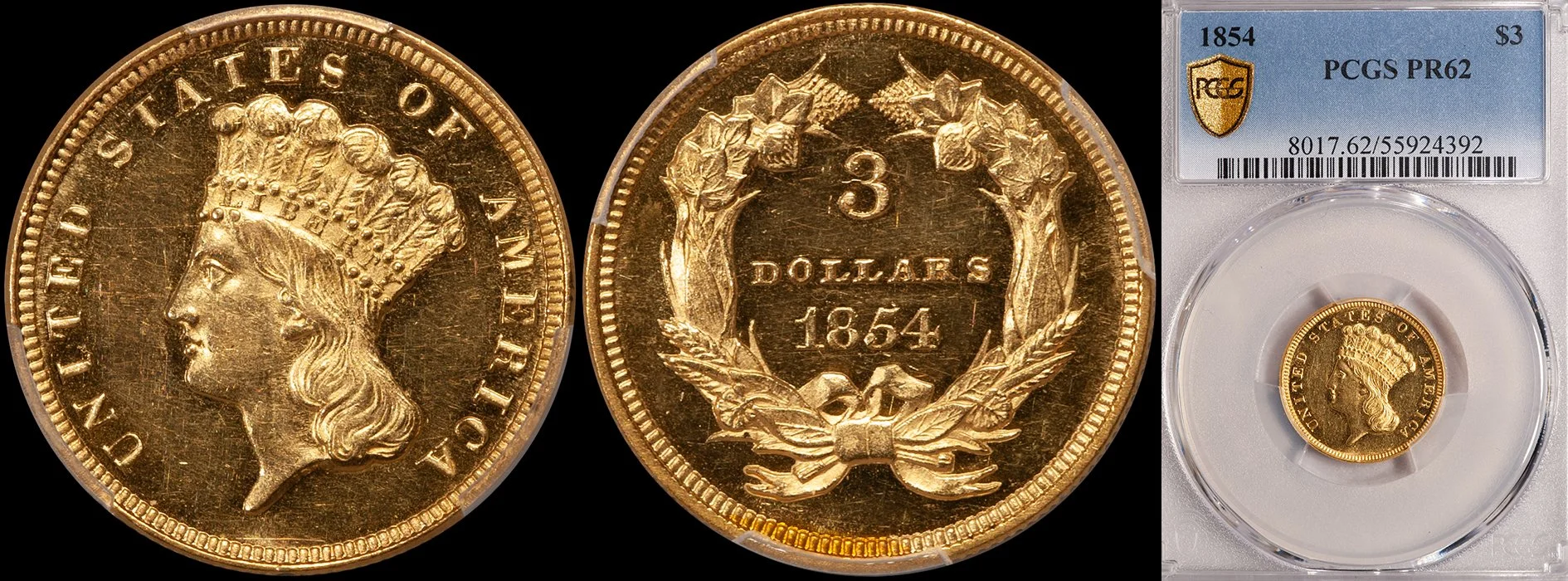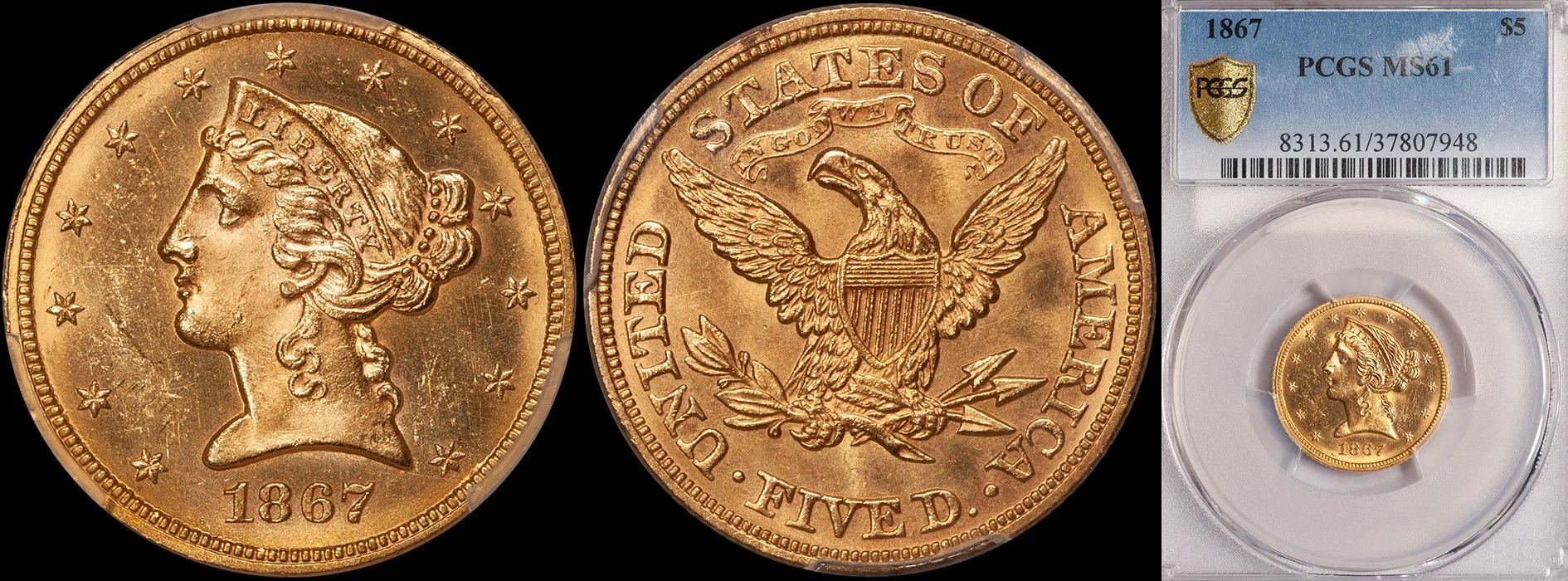
Grade Distribution of 19th Century Branch Mint Gold Coins

For many 19th century gold issues, it is as important to know the grade distribution as it is the overall rate of survival. In this blog, let's look at grade distribution; namely how the surviving examples of a specific issue are distributed along the lines of grade. It is natural to believe that for the typical mid-19th century issue grade distribution, if plotted on a graph, would resemble a bell curve. If, say, 100 examples of a specific issue are known, it is likely that few survivors would be in very low grades (i.e. VF and below) and few would be in high grades (i.e., Mint State), with most clustered in the middle grades (i.e., EF and AU). To some extent this is true but there are a number of scenarios that can make the grade distribution skew more towards the low end or the high end.

Grade distribution can cluster towards the low end for a number of reasons. One has to do with the need for coins in a particular geographic region. The gold coins from Carson City were eagerly received by citizens of the western states from 1870 through 1874 due to a pressing need. As an example, nearly every known 1873-CC half eagle and eagle grade Extremely Fine or below, indicating that these were issues that saw considerable use in circulation.

There are other issues that tend to be found in lower grades due to heavy use in circulation. These include the Charlotte and Dahlonega quarter eagles and half eagles from the first few years that these mints were open (1838 to around 1843), San Francisco half eagles and eagles from the late 1850's through the mid-1860's and New Orleans half eagles and eagles from the mid to late 1850's.

You will note that all of the issues that I have mentioned so far tend to be medium to larger sized; they don't include gold dollars, quarter eagles and double eagles. For various reasons, these denominations do not necessarily show the same grade distribution pattern as do their larger-sized counterparts from the same era.

Grade distribution tends to be a size-related phenomenon. Because of their size, Double Eagles did not to circulate as much as half eagles or eagles and because of their intrinsic value they were melted to a greater extent in later years. With the exception of certain rare dates like the 1854-O and 1856-O, most double eagles of the Type One design are seldom found in grades below EF.

The same is true with gold dollars. Because of their small size, the likelihood of a gold dollar circulating all the way down to the VF grade range is improbable.

Let's go back to two issues I mentioned above and look at their grade distribution.

The 1873-CC half eagle is an issue that saw heavy circulation in the local economy and, as a result, is typically seen in low grades. PCGS has graded a total of 65 examples of which only 7 (or a shade over 10%) grade above AU50.

Now compare this to the 1893-CC half eagle, a more common issue but one that saw very little circulation in the local economy. PCGS has graded a total of 364 in all grades of which a whopping 283 (or over 80%) grade AU50 or better.

This situation also exists for the 1873-CC eagle. PCGS has graded a total of 52 of which just 14 are considered high grade coins (i.e., AU50 and above). Compare this to the 1881-CC eagle, an issue that saw little local circulaton and is now often repatriated in groups from Europe. This date has a a total population at PCGS of 264 with 137 of them, or more than 50%, in high grades.

Certain rare date 19th century gold coins have a grade distribution that makes sense because of very low original mintage figures. As an example, well-known rarities such as the 1864 quarter eagle, 1875 half eagle and eagle and 1883-O eagle are very rare in higher grade because they have tiny original mintage figures. The likelihood of a coin surviving in higher grades with an original mintage of 100 or 200 (the 1875 eagle and half eagle, respectively) is, obviously, very slim.

But mintage figures alone do not act as a predictor of a coin's rarity. There are certain later 19th century issues, such as the Three Dollar gold pieces from the 1880's, that have very low mintage figures but high survival rates. These issues were saved by collectors, dealers and speculators when they were struck and not only do they exist in far greater percentages than their counterparts from the 1860's and early 1870's, but in higher average grades as well.

What about low mintage issues that are more available in high grades than expected due to hoards? A good example of this is the 1857-D quarter eagle. With a mintage of just 2,364 you would expect this to be a rare coin in all grades. Most Dahlonega quarter eagles have a survival rate of around 3% of the original mintage. This is not the case with the 1857-D.

According to the most recent PCGS population figures, a total of 67 have been graded. Of these, no less than 57 have been graded AU or higher. How can we explain this anomaly?

If you are a student of Dahlonega quarter eagles, you are aware of the fact that most 1857-D quarter eagles (at least the ones that are original) have a similar look: softly struck, very frosty and toned in a rich yellow-gold hue. This similarity in appearance suggests that a hoard of 1857-D quarter eagles existed at one time and has been dispersed.

The grade distribution of an issue can change quickly due to hoards. A great example is the 1857-S double eagle. At one time, this issue was typically seen in EF and AU grades and was actually quite scarce in Uncirculated. But after thousands of high grade examples were located in the S.S. Central America treasure, the grade distribution of this date changed radically. Now, the 1857-S double eagle is seen more often in higher grades than it is in lower grades. The result of this was a radical compression of value. In MS62 or MS63, this date is only worth around three times more than it is in AU55 to AU58. Prior to the discovery of thousands of Uncirculated examples, this ratio was more like ten to one.

I believe that it is important for the student of United States gold coinage to study the grade distribution. By learning how rare a specific coin is in higher grades, the collector can identify the best values in the area(s) in which he collects. Because of third-party grading certification data, this is better possible than ever before.

Some Interesting New Coins That DWN Has Recently Sold

Unless you check my site regularly, there are probably some interesting pieces that fall though the cracks. They might be very rare and very desirable, but they often sell so quickly that if you don't check the website every day, chances are good that you will miss them. The common theme here is the half eagle denomination, and the coins that I have sold in the last 30 days that I think are worthy of closer examination are: a 1799 Small Stars in PCGS MS62 (with CAC approval); an 1827 graded MS62 by PCGS (and approved by CAC); an 1871 graded MS61 by PCGS and approved by CAC; and an 1874 graded MS62 by PCGS which wasn't sent to CAC, but which would almost certainly being approved if it was.

Let's take a look at each coin, learn a bit about each, and discuss what makes each of these coins so special.

1799 Small Stars $5.00 PCGS MS62 CAC

This coin was one of my favorite purchases at the Chicago ANA and it was obtained in a private treaty sale with a leading wholesaler who, to be honest, I don't generally do that much business with. But I saw this coin in his case, immediately fell in love with it, and bought it for what I thought was a fair price.

The 1799 is among my favorite 18th century half eagles. It has a reported mintage of 7,451 but I think this figure is a bit on the low side and some coins dated 1799 were struck in 1800 and later. The probable mintage figure is more likely in the 10,000-12,500 range but this is still a scarce issue in all grades.

For variety collectors, the 1799 is a very interesting year with no less than nine varieties known. Most show small stars on the reverse. The variety illustrated here is BD-2, which has an estimated surviving population of fewer than 50 in all grades.

As a date, the 1799 is scarce but it becomes quite rare in Uncirculated. This coin was the first 1799 in PCGS MS62 to be made available to collectors since ANR 11/09: 3667 (which sold for $43,700 and was slabbed by PCGS). The only finer example to sell in the last five years is Heritage 5/07: 2278, graded MS63 by PCGS, that brought $63,250.

As you can see from the photo, this 1799 half eagle is a really attractive coin with semi-prooflike fields covered with splashes of reddish-gold and orange color. It is well struck, well-made, and high-end with just a few marks in the obverse fields keeping it from a higher grade.

1827 $5.00 PCGS MS62 CAC

I purchased this 1827 half eagle via private treaty at the Chicago ANA convention. It came from a good supplier of mine and, as far as I can tell, it is fresh to the market.

While 24,913 half eagles were produced in 1827, virtually all were melted by 1834 when the intrinsic value of the Capped Head Left type exceeded the actual face value. As a rule, the half eagle from the 1820's and early 1830's are very rare, and the 1827 is no exception with an estimated three dozen or so pieces known to exist.

Nearly every 1827 half eagle that exists is in Uncirculated due to the fact that this issue saw virtually no commercial use. The few that weren't melted were saved and eventually came into the possession of collectors. There are a few really superb examples known including an NGC MS66 that sold for $322,000 in the Stack's 2008 January auction.

For the grade, this 1827 half eagle is extremely pleasing. As always, the luster is a blend of prooflike reflectiveness and satiny texture. The detail is very sharp and the only noticeable mark on the coin is a small, curving line on Liberty's face that is as made.

After all these years of specializing in rare US gold coins, I still get a thrill from Fat Head half eagles like this and I was pleased to sell this 1827 in MS62 to an advanced collector who appreciated its beauty and rarity.

1871 $5.00 PCGS MS61 CAC

This next coin is an 1871 half eagle graded MS61 by PCGS and given CAC approval.

The 1871 is a scarce and under-appreciated date. There were only 3,200 examples struck and well under 100 are known with most in the EF40 to AU50 range. This date is characterized by heavily abraded surfaces and the marks on most of the known examples are amplified by semi-prooflike reflectiveness.

There are two examples of this date graded MS61 by PCGS and none finer; NGC has graded three in MS61 with none better. The present example is the only Uncirculated 1871 half eagle that has been approved by CAC and it shows wonderful natural orange-gold color atop frosty, lightly abraded surfaces. The other PCGS MS61 last sold as Heritage 7/06: 11559 where it brought $10,063; there have been four NGC auction records for MS61 coins since August of 1996 with prices ranging from a low of $8,625 to a high of $9,488.

I purchased this coin from another dealer at the recent Long Beach show and was pleased to place it with a collector who is working on a set of high quality Liberty Head half eagles. It is quite possible that this piece is the single finest known 1871 half eagle.

1874 $5.00 PCGS MS62

The last of the four interesting half eagles that I have sold recently is an 1874 graded MS62 by PCGS. This coin was never sent to CAC for approval, but I imagine it would garner a sticker as it is extremely choice for the grade with lovely color and choice, frosty surfaces.

As with the 1871, this date is overlooked by most non-specialists. Only 3,488 were struck and well under 100 exist in all grades. The 1874 is probably just a hair more available in Uncirculated than the 1871. I believe that there are as many as three or four Uncirculated 1874 half eagles known as compared to two or three (at most) of the 1871.

As I stated above, this coin was graded MS62 by PCGS and it had a wonderful appearance. The only example I know of that is finer is a PCGS MS63 that is ex Heritage 11/06: 2229 (at $20,700) and was earlier Bass II: 1194 (at $20,125).

I was fortunate to handle these four great half eagles in August and early September 2011. If these are the sort of coins that you collect and you were either not aware of them or we are not currently doing business, please feel free to email me at dwn@ont.com and we can discuss your collecting goals.

Back From The Dead: Formerly Unpopular Gold Coins That Have Become Popular

As recently as five years ago, most of the rare date gold coins that I sold were from the Southern branch mints; pieces from Charlotte, Dahlonega and New Orleans. But today, these coins make up a smaller percentage of my inventory and my sales. I now find myself making a market in coins that I formerly considered very difficult--if not impossible--to sell. What are these "back from the dead" coins and why are they suddenly popular? The Poster Children for impossible-to-sell rare date gold coins used to be expensive Philadelphia and San Francisco issues from the late 1850's, 1860's and early 1870's. These coins have now garnered a small but growing following. After years of being unsalable they can now find homes BUT only if they a) are choice for the grade and have good eye appeal (CAC verification helps) b) are larger denomination coins (a half eagle or larger) and c) are either low mintage issues or are from the Civil War era.

I was going to add one more point: relating to price. But the more that I think about it, the more I realize that the "right" coin of this type doesn't necessarily have to be affordable (i.e., below $10,000). In fact, I can now sell $25,000 or $50,000 coins that I regarded as formerly illiquid if they have one thing going for them.

And that's rarity.

Let me give you an example of what I'm talking about. A few weeks ago, I bought an 1874 half eagle in PCGS MS62. It was a great coin: fundamentally rare, beautiful, and very low population. A few years ago, this is a coin that I would have passed on by rationalizing that "it was cool but how could I possibly sell it?" But I took a chance on it because it was a coin that I thought "if I was a collector, I'd want this coin in my collection."

Within three hours of posting the coin on my website, I had four serious inquiries about it. Two of the inquiries were from collectors who are working on sets of Liberty Head half eagles. But the other two were from collectors who liked the concept of this coin. It wasn't cheap (around $15,000). But it was the second or third finest known of probably no more than five or six that exist in Uncirculated and it was a coin that is actually pretty rare in all grades. In comparison to Southern branch mint, a coin like this nice Uncirculated 1874 half eagle suddenly seems like a heckuva deal.

So why are coins like this becoming more popular?

I have a few theories. Here are a few of them.

1. Trends Has Come Down. In the past, Trends was too high on some of these coins. Certain Trends values have come down, in some cases substantially, making these coins look like better values at the new, lower numbers.

2. Rarity Is In Vogue. For a number of reasons, new collectors are more attracted to really rare coins than common coins in uncommon grades. A coin like, say, an 1862 half eagle or an 1863 eagle is really rare in any grade and this appeals to this new, sophisticated breed of collector/investor.

3. Half Eagles and Eagles Are Being Collected by Date. Both the Liberty Head half eagle and eagle series are now being seriously collected by date. This makes certain formerly unpopular semi-key issues (I'll throw out one as an example: the 1876-S half eagle) more popular if the coin is right.

4. Auction Prices Are Nutty. When you see auction prices like an 1875 eagle in PCGS AU53+ for $345,000 this drives the market. It suddenly becomes a lot easier to sell an 1862 eagle in nice AU55.

5. Collectors Crave Value. "Value" is the new mantra of the coin market. Collectors seek coins that have price levels that make sense. The factors that I listed above combine to make coins like 1864 half eagles or 1867-S half eagles seem like good deals.

6. Not All These Coins Have Been Ruined. Something that has hurt the Southern gold market is the relative unavailability of choice, original coins. Certain P+S mint issues have been spared the processing/doctoring that has beseiged C+D gold due to their relative obscurity.

So does this mean that I am done with Southern branch mint coins and, from now on, want to be known as Mr. P Mint half eagle? Certainly not; I love Southern coins and will continue to specialize in them. But I do note a renewed interest in non-Southern coins and I think that this is excellent for the overall health of the rare date gold coin market.

Coinapedia Update

One of the truly great features on the DWN website (www.raregoldcoins.com) is the Coinapedia. Many collectors now use this site as a reference--some even daily--but others aren't familiar with it. The reason that I started the Coinapedia project last year was simple: I don't think there is enough high quality non-commercial information available for the collector of United States gold coins. So I decided to create an online coin encyclopedia that would, eventually, feature pictures and descriptions of nearly every issue of United States gold coin produced between 1795 and 1933.

Here's the catch: the coins that are pictured are ones that I have sold within the last two or three years. Instead of just cutting and pasting images from various websites and online resources, I wanted to use the talents of my assistant Jenna Van Valen, whose work is the best in the coin industry. I wanted the images to not only be good but to be consistent.

The descriptions of the coins are taken from the descriptions on my site when they were listed for sale. But I've tried to take out all commercial references and focus on the "meat." This makes Coinapedia a real on-line reference, not just fluff for my firm.

So where do we stand with Coinapedia as of the end of the Summer of 2011?

Gold Dollars are a strong area on the site with no less than 52 different images and descriptions. I anticipate that most of the branch mint gold dollars will be present within the next year or so. The common dates from the 1880's might actually be the last coins added as I rarely handle these.

There are now 95 images and descriptions of quarter eagles on Coinapedia, and I would expect that by the end of the year we will have well over a hundred different issues included.

Three Dollar gold pieces, despite being a favorite series of mine, are probably the weakest part of the Coinapedia site right now. There are just 30 issues represented. I hope to be up over 50 by the Spring of 2012.

By far the strongest part of the site are the half eagles with no less than 145 (!) images and descriptions included to date. While this denomination will, obviously, never be complete (I doubt that I will be handling an 1854-S any time soon...) it is, nonetheless, the best on-line reference for this denomination that currently exists.

The eagle denomination is shaping up nicely with 84 different issues currently included in Coinapedia. I expect this to become a very strong area of the site as eagles are a series that I actively buy and sell. There will be one area of weakness: the common With Motto issues from 1880 to 1907 aren't likely to be included as I seldom--if ever--handle these.

Given the fact that I am one of the leading market makers in double eagles, I expected there to be more than 76 issues represented by this time. The problem with this denomination is that many of the better double eagles that I buy get shipped out to buyers so quickly they never make it onto Jenna's camera stand for imaging. I promise to slow the process down a little bit and to make certain more of the prized Liberty Head double eagles that come through DWN are imaged for future reference!

I hope you will give the Coinapedia a try and see if you don't think its an invaluable reference. I would love your input about it and welcome emails to me at dwn@ont.com.

Was This 1875 $10.00 Worth $345,000?

With more than $75 million dollars in rare coins having sold at the pre-ANA and ANA auctions, it is inevitable that some amazing individual pieces might have been lost in the shuffle. One coin that hasn't received much publicity is the 1875 eagle in the Stack's-Bowers sale (lot 7732 and graded AU-53+ by PCGS) that brought $345,000. 1875 $10.00 PCGS 53+, lot 7732, image courtesy of Stack's-Bowers

As far as I know, this is by far a record price for the 1875 eagle at auction, and I believe it is also an all-time record price for any business strike Liberty Head eagle.

Was this coin a good value?

When I first saw that this coin was reserved at $300,000 (meaning that you had to bid at least this amount, plus the 15% buyers premium) I was pretty aghast. This exact coin, then graded AU53 by NGC, had last sold for $41,400 in the Heritage 2001 ANA and the last auction trade of relevance was $74,750 for an NGC AU55 in the DLRC Richmond I sale of July 2004. My initial reaction was, "this coin will never sell and the consignor is being unrealistic."

But A LOT has changed in the coin market since 2001 and 2004. For one, the formerly-unpopular Liberty Head eagle series has become a collector favorite. I have written in the past that it only takes a small number of wealthy, passionate collectors to turn a formerly-overlooked series into one that is "hot." And this is exactly what has happened with Ten Libs. In a few minutes I made a quick 180 degree turn from "it will never sell" to "hmmm...it might actually sell."

Before we discuss the market for the 1875 eagle, I think its a good idea to talk a little about the issue itself.

With a mintage of just 100 business strikes, the 1875 is the undisputed key to the series. I believe that fewer than ten business strikes are known. Most of the 1875 eagles, like the one is the Stack's-Bowers sale, aren't especially attractive. This date tends to come with heavily abraded surfaces and since all the known examples are prooflike, these marks tend to be magnified. And this is further compounded by the fact that most 1875 eagles have been cleaned or dipped and do not have nice, warm color.

Here's another way of thinking about this issue. Let's say there are actually nine business strikes known. Of these nine, at least six or seven are off the market in tightly-held collections. This suddenly leaves us with maybe two or three examples that might be for sale. Of these two or three, at least one is going to be a coin that even by the standards of this date is going to be ugly enough that a wealthy collector will not want to use it to fill a hole in his set. That leaves serious collectors of Liberty Head eagles with very few chances to purchase the "right" coin.

Which is why this 1875 was being sold at a perfect time.

There were a few others factors working in this coin's favor. For one, it was in a PCGS holder and any of the Registry Set collectors thinking about this coin would have preferred it to its previous NGC holder. Secondly, it was a "+" coin, meaning that the graders thought it was above-average quality for the grade. I'd have to agree with them. For an 1875 eagle in AU53 it was actually a decent coin (though certainly not a "pretty" one in the true sense of the word) and I don't think the grade was pushed because of the Great Rarity factor.

The major factor was timing. Selling it at the ANA was a good decision and there was the X factor of wealthy collectors looking for places to put their money in these uncertain times.

But I think the numismatic significance of this sale is not fully appreciated by many dealers and collectors.

Only recently, circulated rare date 19th century gold coins were popular issues but they were never really the "big buck" coins that 18th and 20th century issues--typically in high grades--were. Until recently, the rap on coins like the 1875 eagle were that although they were really rare, collectors weren't sophisticated enough to pay huge premiums for rarity over condition. There were exceptions to this maxim (the 1854-O, 1856-O and 1870-CC double eagles, for starters) but these exceptions were almost always big, popular coins like double eagles.

I think the argument for rarity over condition grew louder a few years ago when coins like the 1854-S quarter eagle began to sell for $250,000+ in EF grades.

You can make the case that the 1875 eagle is a "better" coin than the 1854-S quarter eagle for a number of reasons. Firstly, its rarer. There are as many as 15 examples of the latter known and many are in wretched condition. Secondly, the 1854-S is a smaller coin, size-wise, and, as we all know, size does matter when it comes to value. Thirdly, the Liberty Head eagle series is probably more popular with collectors at this point in time than the quarter eagles of this design.

Coincidentally, in the same Stack's-Bowers sale there was a no-grade example of the 1854-S. It wasn't a "sort-of" no-grade; it was a total, absolute no-grade, and it still brought $201,250.

Using this sale as a measuring stick, I think the 1875 eagle was good value.

If that's not a compelling enough argument for the 1875 eagle, then how about this? In the Stack's-Bowers sale there was a Proof 1975-S "No S" Dime that sold for $345,000. It is (currently) a major modern rarity with just two known and its the first one ever to come up for sale.

But its a frickin' Roosevelt Dime...and a coin that half the dealers at the ANA (myself included) probably wouldn't have been "smart" enough to have paid $25,000 for if it had walked up to our table(s).

Using that sale as a measuring stick, the 1875 eagle might have been more than a good deal; it might have been a great one.

I remember talking to David hall a few years ago about the 1875 eagle. He was still collecting this series and he hadn't yet purchased this date. I remember him asking me what I thought he'd have to pay for one (I think I said around $100,000 at the time) and I remember him, presciently, asking me, "Why isn't this a half a million dollar coin?"

His question seemed sort of goofy then. It seems really smart now.

Some Post-ANA Show Thoughts

You've no doubt read a dozen ANA Show Reports already and I swore I'd never write one again. But I did want to give some thoughts about the recently-concluded ANA show in Rosemont as I think a good understanding of what happened there is essential to understanding the market. I had a very good show. Not a "great" show or an "all-time" one as I've read a few people write. But I can summarize the show with two statements. First, I wrote so many invoices (from buying and selling) that I ran out of them on Thursday and had to creatively make new ones on a Xerox machine. I've only run out of invoices one other time in 30+ years of going to coin shows.

Secondly, I generally don't put my new purchases out in the case at shows and offer them for sale. I figure that they will sell on my website when I get back home and that giving everyone an equal "shot" ay my newps is the fair thing to do. I made the decision to put them all out in my cases on Wednesday because, quite frankly, they were selling so well. By Friday morning, I had sold so many new purchases at the show that I decided to quietly put many of them away in the safe so I could come home with good coins to sell on the site.

The show itself was an epic. I was there for eight days and I know some dealers were there for 10 or 11. By Thursday, most of the dealers were absolutely exhausted (I know I was) and it proved to me that, as a collector, if you come too late to an ANA show you might as well not come at all.

It was huge as well. I don't know if it was the biggest convention hall I've ever been in for a coin show but I know I walked an average of six or seven miles a day and that there were nooks and crannies of the room that, by Friday, I still had not made it to.

In fact, the room was so huge that it was difficult to figure how crowded the room actually was. My impression was that the show was "fantastic" from a wholesale standpoint but only "good" from a retail standpoint. I sold quite a few interesting gold coins to collectors at the show but it tended to be to pre-existing clients and mostly coins under $5,000.

I had a feeling that there would be good buying opportunities for dealers at the ANA and I was not disappointed. I spent the most at this show that I have at an ANA since 2006 and I loved what I was able to buy. As usual, I bought coins in small groups; one here and one there. Very few dealers had "deals" or collections to break up; the days of the ANA show being THE source for great coins is over. Today, many of the fresh coins find theirway to auction.

There were two massive auctions in conjunction with the show. The Heritage sale was held prior to the regular ANA and it was more interesting for non-gold than gold. That said, prices were extremely strong and most dealers I spoke to had the same success rate with their bids: they generally bought less than a quarter of the lots that they bid on and what they did buy was invariably at their absolute top bid.

I thought the Stack's-Bowers sale was going to be a better opportunity to buy in for a number of reasons. The sale was huge and I thought it was possible that some coins would fall through the cracks. There were a ton of fresh coins including many that had been off the market since the early to mid-1980's. Most importantly, Stack's-Bowers doesn't have the retail bidding that Heritage has (yet) and I figured that I might not have to compete with end users on every last coin.

Prices in the Stack's-Bowers sale ran the gamut. There were some good deals, some coins sold for the "right" price and a number of the really high end, really fresh coins brought a fortune. I do think that Stack's-Bowers made a real statement to Heritage regarding their viability as a competitor. The auction business needs competition and two strong companies is better, in the long run, than just one.

I've been a big supporter of CAC since it began (disclosure notice: I am a shareholder in the company) and I noticed more collectors asking for CAC approved coins than I can remember. Amongst dealers, CAC still has a mixed reaction. Honestly, it seems to me that the dealers who are real connoisseurs sell CAC coins and the dealers who don't have a good eye don't bother. I have the feeling that after a dealer has sent fifty coins to CAC for stickering and had a 15% or lower success rate, he or she probably just gives up. It takes a really good eye to have a 50% or 75% success rate.

One thing that disappointed me about the show was the lack of interesting fresh material from the public that I was offered. Perhaps all the great gold coins went somewhere else but this wasn't a show where I was able to buy Proof gold coins or cherry, original branch mint gold as I have in many of the past ANA events.

While I hated the fact that we were trapped in the suburbs for a week, Rosemont is clearly a good location given the fact that it is convenient to nearly every location (except Portland, of course...). It helped that the weather was gorgeous, and my hotel was lovely. However, I ate so often at Gibson's across from the convention that I was on a first-name basis with the waiters by Thursday.

I finished the show with a nice event: the bi-annual meeting of the 20th century Gold Coin collector's club. (Held, of course, at Gibson's...) I generally don't go for numismatic schmoozing but this is a great group of collectors and dealers and interacting with everyone there is a blast. The featured speaker was dealer Kevin Lipton who told his numismatic life-story, in progress, from the 1970's to the present. Kevin is exactly the same age as I am and grew up in the same part of the country, so it was fun listening to him tell stories about shows on the east coast back in the day.

If we had a chance to get together at the ANA show, thanks. I saw so many people and had so many conversations that its all a blur at this point. A quick note: I have posted many new purchases from the show on my website and invite you to take a look at what I bought; they can be found at www.raregoldcoins.com.

ANA Show Predictions: 2011

If you had asked me just last week how this year's ANA show was going to turn out, I'd have told you it was going to be an unqualified success. But with the recent topsy-turvy (to say the least...) state of the stock market and economic fears in general, I'm afraid I may have to temper my earlier views. Somewhat. I still think this year's ANA is going to be successful. No, I don't especially like the location (being so close yet so far to downtown Chicago is sort of heartbreaking for me) but it makes sense and I like the fact that O'Hare airport (and the show) is within a three hour plane ride from just about any location in the country. Unless I'm mistaken, I think the attendance at this show will be excellent.

I've read in other blogs/newsletters about the show that Chicago is a "great coin town." While I can't argue with the long and glorious numismatic history of The Windy City (Hello Virgil Brand!), I've never had a great coin show in all of the major conventions that I've attended in Chicago. Frankly, I wish all ANA shows were in New York City as the two best ANA's that I've ever had, by a huge margin, were the last two held in The Big Apple. But I digress...

Back to the predictions.

Based on my sales so far this summer, which have been better than I would have expected, I think the coin market is reasonably healthy. But it is more two-tiered right now than at any time I can recall and it is clearly biased towards gold coins.

Which is good if you are a rare gold coin specialist.

There are some very odd dichotomies in the economy and the coin market right now. The first has to do with the spending habits of the very wealthy versus everyone else.

I read an article the other day in the New York Times that discussed spending on luxury brands like Gucci and Louis Vuitton versus spending at Wal-Mart and Costco. The luxury retailers have had amazing years so far and are raising prices. $1,250 shoes are flying out the door and there are waiting lists for trendy $8,000 coats. But at Wal-Mart, prices are being cut and already-stretched paychecks are having trouble buying essentials by the end of the month.

We are seeing a sort of microcosm of this in the coin market. Super high-end coins are very strong right now and I think you'll see some amazing prices in the pre-ANA and ANA sales for great coins. Expensive coins that are off-quality or not especially interesting have been weak sellers for the last few years and I expect this segment of the market to get hit hard at Chicago and beyond.

But the collector market remains very strong and, based on my personal experience, should continue as such for a while.

I'm not noticing the sense of fear that pervaded the economy in 2008. In September 2008, it was nearly impossible to sell any coin, no matter how great it was. This time around, I get the sense that in September 2011, collectors WILL be receptive to making purchases. But I think these purchases will be even more selective than in the past.

The run-up in gold prices isn't really fueling interest in the rare coin market the way I'd expect it to but I anticipate that this will change in the near-future. If even 1% of the new gold buyers become interested in rare gold coins, this surge of demand could have a real impact.

Will we feel this in Chicago? Probably not. I can't imagine that there will be packs of gold bugs roaming the aisles looking for Proof Liberty Head eagles. But I would be pretty surprised if there weren't a number of potentially serious newbies who've made the decision to go to ANA.

A few weeks ago I would have predicted that on the DWN-o-meter, this year's ANA would have been at least an A- show and it had the potential to be an A. Now, I'm thinking it will be a solid--if unspectacular--B show with the potential to maybe attain a B+ if the stars align properly.

Unlike other ANA shows in the recent past, I think there will be a decent supply of nice coins available for collectors and dealers to buy. The auctions are full of interesting, fresh material and I have the suspicion that some cool, fresh coins will appear on the floor as well. And I have the hunch that, in spite of economic fears, these good coins are going to bring very strong prices.

How Will $2000 Gold Impact Rare Gold Coin Prices?

A few years ago I had a hard time believing that gold would ever cross the $1000 threshold. Today, it exceeded $1700 per ounce before retreating, and it seems inevitable that it will break the $2000 mark sometime this year. What impact will this record-shattering price have on the rare gold coin market? I see the impact of high-priced gold in a number of ways. With gold increasing so rapidly, it has gained a tremendous amount of publicity around the world. I feel this locally as well. My neighbors--at least the ones who know what I do for a living--are frequently asking me about gold prices and just today a teller at the bank had a long list of gold-related questions as I made my deposits.

People are buying gold coins and it is inevitable that a small percentage of them will eventually wind up in the rare gold coin market. I'd say that for every 1000 people who buy an American Eagle or a gold Buffalo today, maybe one or two of them will transform into buyers of coins like Type One Liberty Head double eagles or Saints.

For many rare gold coins, gold could rise to well over $2000 per ounce and the intrinsic value of the coin itself will not really be affected. An 1860-D gold dollar in EF45 or a 1907 Wire Edge eagle is a collector-based coin whose value is impacted by demand; not the rise in gold prices. So, I think it's important to remember that skyrocketing gold's greatest impact is on potential demand; not by increasing existing value(s) based on intrinsic worth.

One subtle but dramatic impact on rare gold is dealer profits. Let me explain: when a large wholesale firm makes tons of money in the bullion market (as they should be now) it is likely that they will reinvest a percentage of their profits in the rare gold market. A coin that a firm might not have bought when they were not making profits from rising gold could enter their inventory when they are making lots of gold profits. And the same goes with dozens of other dealers; big and small.

One huge impact on the rare gold coin market is in entry level pricing. When gold was under $1,000 an ounce, coins like Liberty Head double eagles in EF and AU were relatively small purchases; items that collectors didn't think twice about at $1,250 a pop. But now with gold at close to $2,000 even a common date Type One double eagle will have an entry level price at $2,250-2,500. Suddenly this is a lot of money and it might not be considered an impulse purchase anymore for the middle-class collector.

I think this is an important point to consider. I read an interesting article the other day in the Los Angeles Times where downtown LA jewelers were complaining that the high price of gold was hurting their business. The typical jewellery store client was now a seller instead of a buyer and the low end/middle end lines of merchandise that they carried were not selling due to the high price of gold. Could this carry over to coins?

I am not seeing a huge increase in demand on my website regarding gold coins right now. I'm assuming that's because I have the reputation as a dealer in rare gold coins and not in gold bullion or semi-numismatics. I'd be interested to know if the bullion-based gold traders have their phones ringing off the hook today. I'm assuming that they are very, very busy.

I will also be interested to see the impact of $1700+ gold on the ANA convention which begins in just a few days. I'm going to assume that there will be a lot of people at the show looking to buy gold coins. But will they be looking for American eagles or rare date Liberty Head eagles?

There are tons of interesting rare and high quality U.S. gold coins in the two auctions before and during the show. How will $1700+ gold impact them? This will be very interesting to monitor as well.

A Basic Guide to Detecting Doctored Gold Coins

There is no getting around the fact that doctoring of rare United States gold coins is a problem in the market. Doctoring is not new. I've heard stories of American collectors and dealers "messing" with coins as far back as a century ago, and I have no doubt that the problem dates back even further in Europe. But it is really only the last decade or two that we've seen increasingly sophisticated doctoring done in an attempt to fool the grading services. At first, I thought about using lots of photos to verify what I am going to discuss in this blog, but I don't want to taint specific coins that don't belong to me by pointing out obvious doctoring. So I am going to be as descriptive as I can be without using images. Hopefully, this will work.

For me, one of the most obvious ways to detect a doctored gold coin is by looking at its coloration. One of the reasons that I spend a significant amount of time describing the coloration of specific coins in my books and on the descriptions of coins in my inventory is so that collectors will become familiar with what natural color is supposed to look like.

Once a collector becomes familiar with the way a coin is supposed to appear, it becomes easier to detect coins that don't look the right way. For instance, the early date Dahlonega half eagles have a specific deep green-gold color that is easy to appreciate. Conversely, an issue from this era with the "wrong" color will not look right to a collector who is familiar with the series.

Many of the people who doctor gold coins aren't great numismatists, so they don't necessarily know the right color for an 1840-D half eagle or an 1878-S eagle. Becoming a knowledgeable numismatist within your field of collecting will put you in a far better position when it comes to determining whether or not a coin has been doctored.

There are a number of different types of artificial coloration that are found on gold coins. These depend on the specific chemical that is applied and how the process is undertaken.

Typically, chemicals placed on gold coins break down after they have been on the surface for a period of time. When you see a gold coin that has crazy color in a PCGS or NGC slab, this color didn't exist on the coin at the time it was graded; it changed within the slab.

One color that doesn't naturally exist on gold coins is deep orange or what I refer to as "Cheeto Orange." Think of that crunchy corn snack and the color it left your hands after you ate a few handfuls. I see many United States gold coins in holders that have this flaming orange hue. In 100% of the cases that this color is present, it is artificial,

Another color that indicates a coin that has been doctored is deep reddish-gold. There are many gold coins that have natural reddish-gold hues, but the hues that they possess are subtle and tend to deepen towards the borders. Coins with fake red color almost look like they've bled as the result of being stabbed. This deep red color doesn't exist on natural, original coins.

I see 20th century gold coins from time to time that have a bluish or purple tint and this is the result of the surfaces having been heated; probably in an attempt to remove spots. Back when copper spots were not considered a detriment, you never say any U.S. gold coins that had blue hues. Today, with copper spots being the numismatic equivalent of melanomas, you see fewer gold coins with these spots and more with funky heat-produced hues.

Many of the U.S. gold coins that have been doctored have had substances put on the surfaces in an attempt to hide hairlines or marks. Often times, substances such as auto body putty or dental wax are lightly coated on the surfaces.

Why are these substances not detected by the services when the coins are submitted? Some are, but on other coins, the application is light enough to not be easily detected. After a period of time, the putty begins to break down and it turns cloudy or even white.

Putty that has broken down is easy to spot. How can a collector spot fresh putty on a coin? It's not easy; it can fool both the services and savvy dealers, myself included. In this case, I think its as important to "buy the dealer" as it is to buy the coin.

Certain dealers have reputations as people who doctor coins. As you become more experienced in your area of specialization, try to learn what dealers have these bad reputations. If this isn't realistic, study the coins on their website. Do they show signs of having been puttied?

This very problem is a reason why coins in old holders have become so popular with collectors. The chances are good that a coin slabbed by NGC or PCGS in the early 1990's is not going to change dramatically in appearance if it hasn't already in two decades within a slab.

I'd suggest that whenever you do get the chance to study coins that are 100% fresh (from old collection, in old holders, etc) you pay careful attention to the quality of the surfaces. What is a gold coin that hasn't been doctored supposed to look like? Make mental notes of original surfaces and use this as a comparison for coins in your collection or those you are thinking of buying.

A less innocuous type of doctoring involves artificially brightening a coin by stripping its surface. The most common way to do this is by placing a coin in a solvent such as Jewelustre and "dipping" it.

While I am much more of a purist than most dealers, I do not have an issue with gold coins that have been carefully dipped. Of course I would rather see coins that are dark and crusty, but a lighter coin with mostly full "skin" is commercially acceptable. On certain coins, like Brilliant Proof gold, it has become the rule rather than the exception and many collectors of Proof gold have literally never even seen a truly original example.

There are other ways of brightening coins that I personally do not care for. At one time, it was common to see gold coins that had been "baking soda-ed" in a way to simulate mint luster by making them bright and shiny. Unfortunately, many gold coins with this sort of appearance were graded and encapuslated (and often "maxed out" from a grade perspective, in my opinion).

Coins with this sort of appearance have fallen out of favor and the services have become much better about putting such coins in overgraded holders.

How do you tell a gold coin that has had this done? Often the appearance is grainy in texture and the color is drab and almost monochromatic in hue. Also, the surfaces will lack any cartwheel luster, although this may be difficult for a new collector to determine. The best thing is to, again, learn what original surfaces look like.

To me, the worst type of doctoring is the sort that involves moving metal on the surfaces. This is deceptive and dangerous to the hobby. Luckily, the grading services are extremely good at detecting coins that have had this done, and for most collectors this will never be a problem unless they move out of their comfort zone and purchase raw coins from non-reputable sources.

If you do purchase raw coins, there are a few things to check. Collectors often forget about a coin's rim and should remember that this is the third side of a coin. Some 18th and 19th century coins have been cleverly rim filed in an attempt to remove old bumps and bruises.

Other raw coins have had scratches or marks removed. Often, it is easy to detect this as they will show smoothed areas in the fields. The grading services are extremely good at detecting this and I can't recall having seen many gold coins in holders that had scratches or marks removed but missed.

Will the coin doctoring problem that we are facing go away any time soon? It is doubtful but as a consumer, you can do your share in eradicating the problem by becoming knowledgable. If coin doctors lose their audiance for doctored coins, they will stop (or at least cut back) on their work. This sounds naive, I know, but in this case an educated consumer is one solid way to begin eradicating this problem.

What are your thoughts on coin doctoring? Leave a comment after you've read this blog and let's begin a discussion.