"What Coins Have You Not Handled?"

It's time for another question, this one from reader D.J. of Santa Barbara. D.J. asked the following question: "I know you've handled a ton of coins in your career. What are some of the coins that you haven't handled?" Ahh...thanks, D.J. Make me look like a rookie and tell you what I haven't handled; not all the great coins I've handled! But it's a good question and one that I think will be informative for collectors trying to determine what's really rare. Not to mention the fact that it will prove impossible for me not to brag a bit and list some of what I have handled!

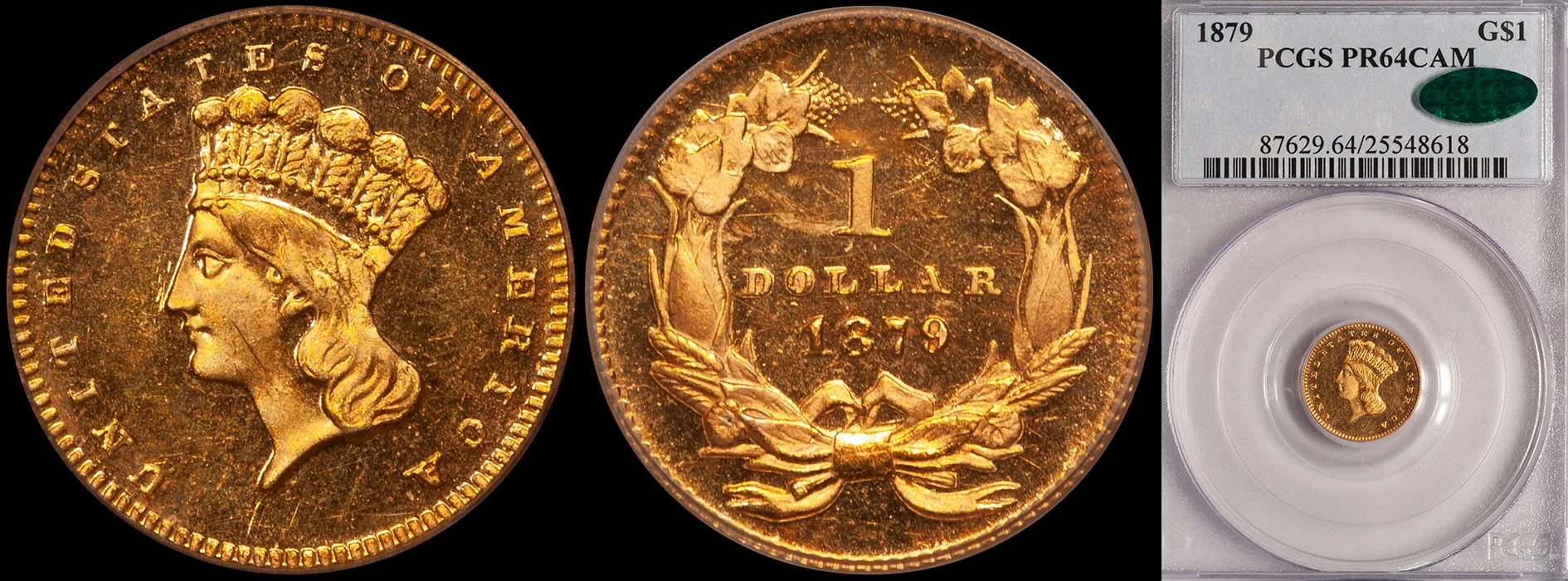
Looking back over the years, I've pretty much done it all, seen it all, and sold it all in the area of gold dollars. There are no business strike issues that I haven't owned, and I can't think of more than one or two dates that I haven't had multiple owned Proof examples.

The Big Kahuna amongst gold dollars is, of course, the 1849-C Open Wreath of which just four or five are known. I have owned two of these including the second finest and the worst. The most famous gold dollar is the 1861-D. I'd say that I've handled at least 20 (I once owned three at one time!), including a number in Uncirculated.

There are a few gold dollars that, as condition rarities, have proven to be elusive. I don't think I've owned more than two or three really nice 1854-S dollars, and the same holds true with the overlooked San Francisco issues from 1857, 1858, and 1859.

The highest-grade gold dollar that I've owned is MS68; I've seen a few MS69 pieces but have yet to own one and have never been lucky enough to "make" one when submitting coins to PCGS or NGC.

I've had the honor of working on a number of great quarter eagle sets over the years, so this is a denomination that I've handled every single issue.

There are some really rare early quarter eagles and the rarest is the 1804 13 star reverse. I bought what is among the finest known out of auction a few years ago and this was the first example of this variety that I had handled. Two other issues that I haven't owned more than a few of are the 1806/5 and the 1834. According to my records, I've owned just three of the former and two of the latter.

There are three great rarities in the Liberty Head quarter eagle series: the 1841, the 1854-S, and the 1863. I've been fortunate to own lots of these; more than just about any other coin dealer, in fact.

Of the 15 or so known 1841 quarter eagles, I have owned five or six different coins, including two of the rare Proofs. I have always loved the 1854-S and can think of at least five different examples that I've owned out of the 13 to 15 known. The Proof-only 1863 has a surviving population of maybe 20 or so pieces; I can remember five different pieces that I've owned ranging in grade from PR60 to PR66.

There are actually a few Liberty Head quarter eagles that I've never owned in Uncirculated. One is the 1840-D, another is the 1855-D. Surprisingly, I haven't had an 1862-S in Mint State either. However, I have owned two of the three known 1864's in Uncirculated, and two of the rare 1865's as well.

I have a few gaps in the Proof Liberty Head quarter eagles. Other than the 1841, the earliest Proof Liberty Head I've owned is an 1858. There are probably two or three dates from the 1860's and 1870's that have eluded me; not necessarily because they are extreme rarities but more out of circumstance. One of these is the 1861 and another is the 1872.

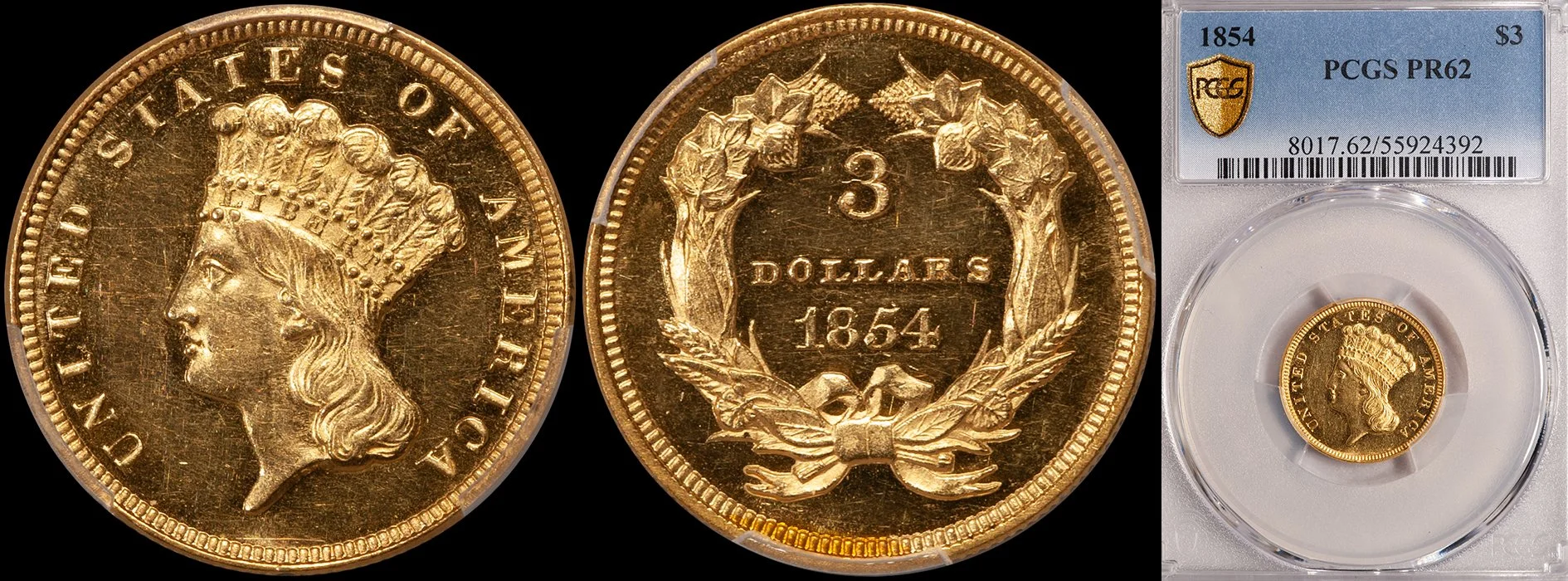
I've liked Three Dollar gold pieces for many years and between the Jewell Collection, Horseshoe Collection, and South Texas Collection, I've owned many Condition Census pieces.

There is one date that I've not owned: the 1870-S which is unique. Other than that, the date I've owned the fewest of is the Proof-only 1875; I can only recall owning two.

There are two Three Dollar gold pieces that I haven't owned in Uncirculated: the 1855-S and the 1860-S. Only three or four properly graded Uncirculated examples are known of each and, for whatever reason, I still haven't had the opportunity to buy one.

The highest graded Three Dollar gold piece I have owned is an MS67. I've owned oodles of MS65's and a decent number of MS66's but just a few MS67 examples.

I can think of just two Proofs of this design that I haven't owned: the 1855 and the 1856. With many of the low mintage dates from the 1860's and 1870's I don't think I've owned more than one or two in my career.

The denomination that has the most coins that I've never owned is the half eagle. The area that I have a number of gaps in is the early, pre-1834 issues.

I've never owned a 1798 Small Eagle and, of course, neither the 1797 Heraldic Eagle with 15 or 16 stars (both are unique). I've also never owned an 1810 Large Date, Small 5 although I've had the chance to purchase at least three or four.

There are a number of Fat Head half eagles that have eluded me. These are the 1815, the 1822, the 1825/4, the 1828/7, 1829 Small Date, and 1832 Curved Base 2. All of these are extremely rare although I have had the chance over the last decade to purchase an 1815, an 1825/4, and an 1829 Small Date.

There is just a single Liberty Head half eagle that I've never owned. Care to venture a guess? The answer is the exceedingly rare 1854-S of which just three are known.

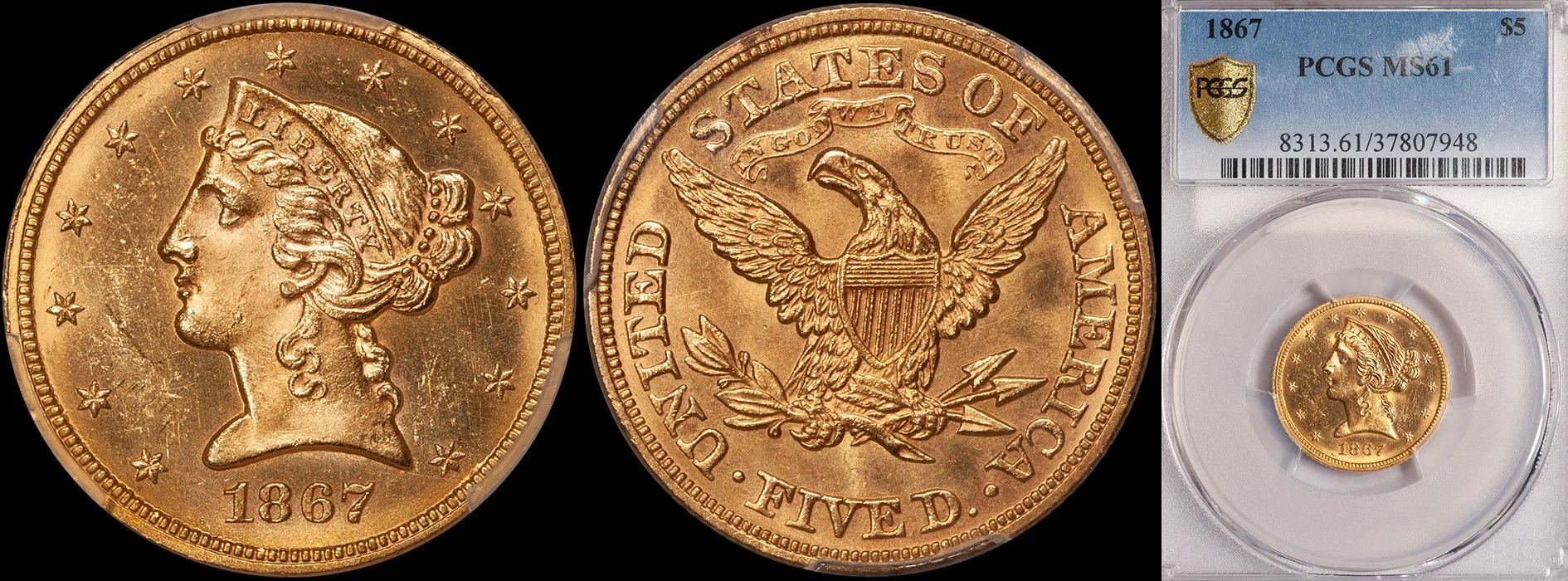
What dates in this series have I never owned in Uncirculated? While not complete, the list certainly includes the 1842 Large Letters, 1847-O, 1858-S, 1861-S, 1863, 1864-S, 1867-S, 1872-CC, 1875, 1877-CC, and 1878-CC.

The two available dates in this series that I have owned the least number of coins is probably the 1864-S and the 1875. Its been quite a few years since I've seen an 1875 business strike that I liked, and I can recall just two or three 1864-S half eagles that I've had in the last decade+.

There is one early eagle that I've never handled: the 1795 with nine leaves below the wing. Its not that I haven't had the chance; this variety has just never really appealed to me all that much.

I've owned multiple examples of every Liberty Head eagle with the exception of the 1875; I've owned just two and none since the Dallas Bank collection example that I bought in 2001.

There are a host of issues in this series that I haven't had in Uncirculated; mainly because there are a host of issues in this series that don't exist in Uncirculated. But I can think of numerous issues that I have only owned one or two " really nice" pieces: dates like the 1841-O, 1843, 1844, 1849-O, 1852-O, 1855-S, 1858, 1858-S, etc. And that's just up through 1858!

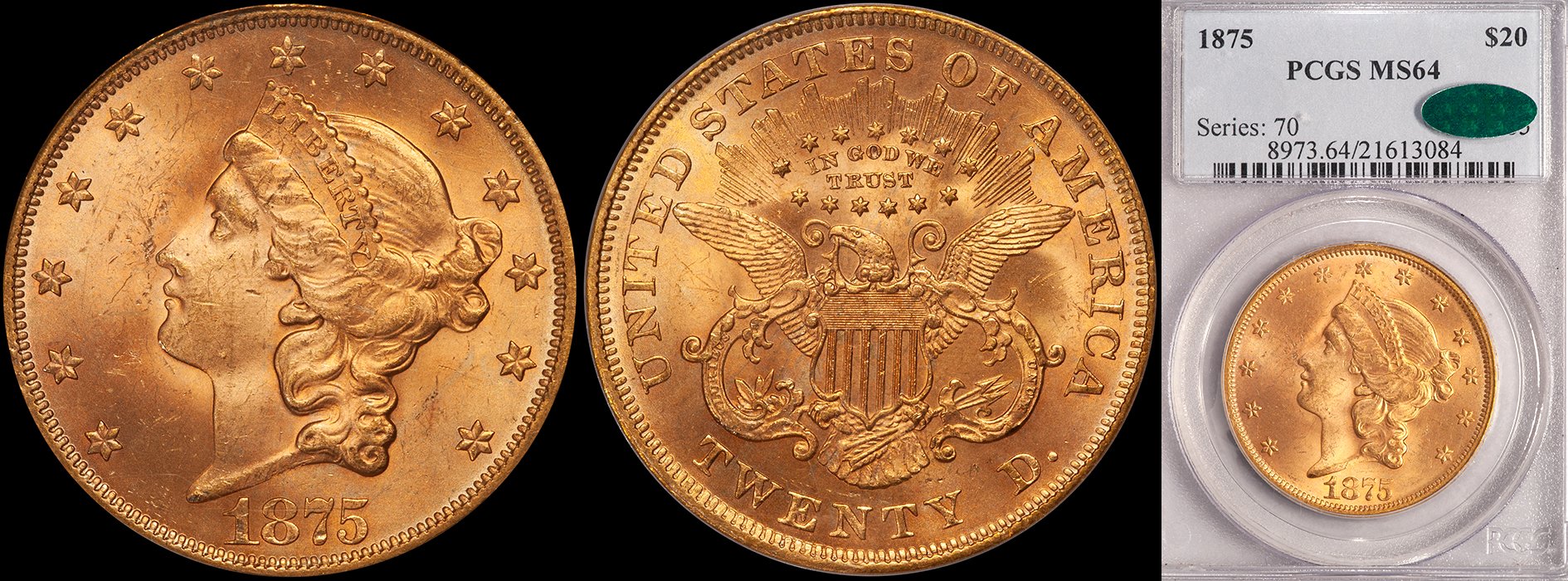
I'm proud to say that I've owned every regular issue business strike Liberty Head double eagle at one time or another. This includes multiple examples of all the rare Type One issues such as the 1854-O, 1856-O, 1861-S Paquet Reverse and the 1866-S No Motto.

I'd like to think that I've handled as many 1870-CC double eagles as any active dealer. Looking through my records, I see that I've sold at least eight of then in the last 12 years.

The three double eagles that I've handled the fewest of are probably the 1883, 1884, and 1887. These are all Proof-only issues and as someone who has traditionally been a stronger buyer of business strikes than Proofs it seems inevitable that I'd pass on opportunities to own these coin. I've only owned one 1884 and two 1883's

One of the things that's great about being a serious coin dealer is that you get to handle serious coins. I've been lucky over the last two+decades to handle many great 18th and 19th century United States gold coins, and I look forward to handling many more during the next two decades.
Ten Tips For Selling Your Coins

As someone who sells a lot of coins, I have some selling tips/tricks/thoughts that I'd like to share. 1. Don't Get Into a Forced Sale Situation. When it comes to buying coins, most people (dealers and collectors) are sharks. If they know that you are in a situation of desperation, it is likely that they'll take advantage of you. The worst thing that you can do as a seller is to tell someone--even someone that you have a "close" relationship with--that you have to sell a coin and that you need a fair offer. In my experience, a forced sale can cost you 20-30% or more.

Ideally, you want a sale of an individual coin (or collection) to take at least 45-60 days; possibly more for an in-depth specialized collection. That will give you enough time to prepare the coin for sale, market it, and give the buyer time to pay if this becomes a factor.

2. Pick the Right Time to Sell. Although the internet is blurring the traditional coin seasons, the two best times of the year to sell your coins are still around the FUN show in January and at the summer ANA in July or August.

This holds true for selling a coin yourself, on consignment, or through auction. You are likely to do better when people are in the mood to buy coins; not when they are preoccupied with summer vacation or preparing for the Winter holidays.

3. Send Your Coins to CAC. I don't subscribe to the theory that you "have to" buy CAC coins and nothing else. If you are a savvy, educated buyer you should be able to discern what is nice and what isn't within your specialty.

But when you are selling I think it does make a difference to have a CAC sticker on your coin(s). I think the best thing about CAC is that it instills confidence in buyers and makes a coin more liquid. I certainly notice that CAC coins at auction tend to sell for more money than non-CAC, and appear to sell to retail buyers/end-users more often than non-CAC coins.

4. Strike While the Iron is Hot. Let's say you read about an auction that contains some great Liberty Head eagles that bring very strong prices. You own similar coins. Should you turn around and sell as soon as possible?

Yes and no. Sometimes you get lucky and can find the underbidder who just missed out on a record-setting coin. But more often than not he was an underbidder who might not feel so good about the level he was at a second time. As a seller, replicating an all-time record price can prove difficult. But it might be worth an effort to at least experiment, no?

5. Clean Your Slabs. This sounds silly, but dirty, scratchy slabs can cost you money. Let me give you an example.

About a year ago I saw an interesting gold at an auction. Well I sort of saw it; the holder was so scratched up you literally couldn't see the surfaces of the coin. I took a chance and bought it, mainly because it sold so cheaply, then sent it to a grading service to be re-holdered. Lo and behold, it was actually very nice. It later got a CAC sticker and I sold it for a good profit; all because it looked great in its new holder.

6. Leave Your Old Holder Coins in Old Holders (sometimes). OK, I'll be the first to get up in front of the group and admit that I'm an Old Holder-aholic. I get excited by coins in older PCGS and NGC slabs and tend to overpay for them; as do most dealers. But for a seller there's a catch to this, which is why I put the "sometimes" after the statement.

If you have a $2,000 old holder coin that has the potential to be a $4,000 coin if it upgrades, leave it alone, and price it accordingly. Let the buyer take the gamble. But if you have a $2,000 old coin coin that could be worth $10,000 if it has a good upgrade....hmmm, that might necessitate regrading the coin yourself.

7. Attribute Your Coin(s). Its probably not going to happen to you, but what if the lowly 1794 Cent you just sold to another collector across town turned out to be a $35,000 rare variety? That's going to make you feel just great, right?

Take a few minutes and attribute your coins. If you don't know how, send them to NGC's attribution service or have a trusted collector friend do it for you.

8. Have an Emergency Plan. Life is full of unexpected turns. Have you fully planned what would happen to your coins if you were to suddenly die or become incapacitated? You obviously don't want your wife walking into the local pawn shop and getting taken advantage of. Make it easy for her or your heirs and leave explicit instructions on how to dispose of your coins.

True story: a few years ago, a good client of mine passed away without a will and without leaving instructions on how to dispose of his coins. He was a secretive guy so I'm assuming the invoices for his coins weren't around and he peeled my inventory stickers off the back of the slabs which indicated what he paid. The coins were left to his sister who proceeded to take them to a "road buyer" at a local hotel. I would have paid close to a million dollars for the coins if she had called me. I'm told the road buyers paid her somewhat less than $200,000.

9. Do Your Due Diligence When it Comes to Pricing. Depending on the types of coins that you are selling, it should be possible to price your coins. But there are important things to consider.

In certain series, PCGS coins sell for premiums over NGC coins. Are your coins worth a premium? Is your coin approved by CAC and, if so, does this make a difference? Do you own a coin that's currently "hot?" Is your coin high end for the grade?

Common issues and generics are easy to price. Rare coins and very rare coins can be very difficult. Examine recent auction records. Are they consistent or all over the place? Has there been a comparable coin that has sold at auction in the last year?

If you have an extremely rare coin, it is probably best to put it in auction. But specialist dealers can be a great resource for selling rarities as well and they may be able to help you maximize the prices you get.

10. Leave a Little Bit on the Table for Everyone. Piggy sellers. Everyone knows them, and no one likes them. I'm talking about sellers who want to squeeze every last dime out of every transaction and make each sale an ordeal.

When I sell coins to other dealers I intentionally try to leave a little room so that they can make money on what they've just bought. This makes them happy and it makes them want to buy more coins from me in the future.

When I buy from collectors I try to be extra-fair and pay the most that I can while still leaving some room for myself to mark-up the coin up and resell it.

Do you have any tips for selling coins? If so, I'd love to know what they are and for you to share them with me. Please add them at the end of this blog or email them to me at dwn@ont.com.

"What Do You Collect?"

Reader F.N. of New York City recently asked me an interesting question: "Do you collect coins and if so what do you collect?" I'd like to take the chance to give you a brief history of what I have collected in the past and supplement this with some thoughts on collecting coins in general. I started early in numismatics. I was pretty much hooked by age seven, and was obsessed with coins by the time I was nine or ten. I was always attracted to cool, older coins and the first things I can remember buying included a few bust half dollars, a holed small size quarter (that I tried to plug with candle wax; an early foray into doctoring?) and a few odds and ends.

When I was ten or so, I started a set of Indian Cents. I got bored quickly with this and could never really "get" why I'd have to pay $100 for a decent 1877 when they seemed to be so easy to find.

I always had an interest in Colonial and Revolutionary War history and this was fueled by trips with my maternal grandfather to places like Boston, Lake George/Fort Ticonderoga, Valley Forge, etc. It was around this time that I got hooked on colonial coins; Connecticut coppers specifically.

For a kid in the 1970's with a small budget, collecting Connecticuts was ideal. They were cheap, reasonably easy to find, and very few people knew or cared about rare varieties. After some searching, I discovered the standard reference by Henry Miller and started to learn how to attribute the coins by variety. I was good at this, and within a year I was able to attribute many of the better varieties by memory.

Growing up in New York in the 1970's was a great environment for a kid who loved coins. There were shops everywhere and a major show seemed to take place at least once every two months (sadly, these shows are long gone. RIP to the GENA, AINA, Greater New York, etc.) There were also shows every Sunday at the long-gone Roger Smith and Hotel Manhattan where I would, from time to time, stumble on a really good colonial coin.

I stayed loyal to colonials until the time I was a mid-teenager and discovered Seated Liberty coinage; specifically seated quarters. I can still remember the epiphany I had about this series: one day I was skimming the Redbook and realized that there were really rare coins with mintages of 20,000 or so that had guidebook values of less than $200. These coins were so cheap that, if I could find them, I'd actually be able to buy nice looking, rare issues for $100-200 per coin; my budget at the time.

My Seated Liberty mentor when I was a kid was the late Kam Ahwash. Kam treated me really fairly and I fondly recall combing through boxes of his seated coins at his tables when he would come to a New York show. I'd generally select more than I could afford, but I'd sell a rare colonial or two that I had cherrypicked.

Grading back then was far less exact than it is today and I would carefully check the surfaces of all the seated quarters that Kam had to avoid those that had been cleaned and retoned.

Given my budget and my sense of aesthetics, I developed a strict set of parameters for my quarter set that has stayed with me even today. I preferred coins in the VF-EF range as they showed good detail but were affordable. I loved coins that were original with warm gunmetal grey color. To me, the things that killed a coin were deep, unsightly scratches, rough surfaces, and rim problems.

I learned what dates were the most undervalued and wasn't worried about owning "too many" 1859-S or 1872-S quarters; I could always trade them for something else when the rest of the world learned how rare these coins were (they did; just 20 years later than I thought they would!)

Once I went to college and started my own coin business, the extra money I had went other places than coins. And when I finally did have some extra money, I either reinvested it into my business or bought real estate.

During the last two decades as a dealer specializing in rare U.S. gold coinage, I haven't really "collected" much in the way of what I sell; primarily because I don't want to have a conflict of interest with my clients.

About a decade ago, I worked on a set of MS66 Three Cent Nickels. I got to within two coins of being complete, but got bored and sold the set for a nice profit.

The most serious collecting I did was a year set of 18th century coinage (I specialized in a specific year that I won't mention here) that was complete from half cent to eagle, and which included a number of important varieties and sub-varieties. When prices for early type soared in 2006-2008, I decided that it was time to sell and broke the set up.

Today, I'm kind of a dabbler. I buy the occasional pretty, interesting coin and put it away. But I know I'll always be a seller of these coins, especially if I have a client who I like and who is looking for a coin of the sort that I have put away.

If I ever became a more serious collector again, there are a few parameters that I'd work within.

I love gem slider AU58 coins for the appearance and value that these coins provide. I'm talking about a choice, original coin that is a technical AU58, but which has the look and appeal of an MS64. These coins are far harder to find than you might imagine, but I do handle them from time to time. I could see having a random collection of 19th century gold coins with these attributes.

I love pedigreed coins. I find the coins that are hardest for me to part with as a dealer are ones that were owned by great past collectors like Harry Bass, Louis Eliasberg, James Stack, or the Norweb family. As a dealer, I tend to be more interested in the history of the coin business than the history of the coins themselves and there is something that excites me about being only the third owner of a specific gold coin since, say, the early 1900's.

I love gold coins with great eye appeal. If I buy a Dahlonega quarter eagle with really rich natural coloration, I sometimes think "I want to put this coin away." (I almost never do, though, because coins like this are so easy for me to sell.) Bright coins from the 1840's aren't appealing to me unless they are Choice or Gem quality and are naturally vibrant.

If I had to pick a specific era of numismatics from which the coins are most appealing to me, I'd have to say it would be from the late 1820's through the late 1840's/early 1850's. I think this is a great period of American history, but what I find most interesting are the designs of these coins, the richness of the naked-eye varieties, and the fact that there are coins from this period that can be found for less than $10,000 with superb eye appeal.

As someone who has been involved with coins for just about his whole life, I know I'll never totally stop collecting. I wouldn't be surprised if, within a few years, I find a series that I want to start a small collection in. I just worry that, given the amount of passion that I approach the other collectibles that I specialize in, I would get too consumed by this new area. Given how selective a buyer I am that probably won't happen, but you never know....

The Two Types of Coin Collectors

In my day-to-day dealings with collectors, I note at least two distinct typologies. First, there is the collector who has either been buying coins since he was a child, or who was a collector as a kid and has since rekindled his early romance with numismatics. And then there is the newcomer who is generally introduced to coins through precious metals/bullion/modern coins. The lifetime collector versus the precious metals advocate. Which is "better?"

My answer to this question is simple: neither is "better." And I think both schools can learn a little something about coins and the coin hobby from each other.

Whether you choose to admit it or not, financial considerations should enter into every transaction that you the collector makes. A true collector might not worry about paying an irrational amount of money for a much-coveted coin, but every purchase should be considered for its long-term implications. I've seen dealers write comments to the effect that "it doesn't matter what you pay for a great coin; the market always takes care of high-quality purchases." I think this is a self-serving comment and I think that price considerations are, in virtually all cases, important.

In other words, the dyed-in-the-wool collector sometimes needs to think more like an investor and consider what the upside and downside is for his purchases.

Since the 1980's and the era of coin telemarketing, many people have been introduced to numismatics by a simple three step process: 1) buy gold, usually in the form of bullion, 2) be converted or up-sold to semi-numismatics, usually in the form of St. Gaudens double eagles or, lately, Proof American eagles, and 3) become interested in rare coins and start a collection (or a random assortment) of numismatic coins.

Given their backgrounds as investors, these individuals need to think a bit more like collectors.

It's kind of a cliche, at this point, to write this but in my long years of experience in numismatics, the collectors that I see who are the most successful are a hybrid of collector and investor. And the ones that are the most unsuccessful are the ones who approach numismatics strictly as an investment.

Any sort of hobby, whether its crochet, yoga, or coin collecting, is made more enjoyable when it is approached with passion. In the case of numismatics, this means learning about coins, learning about the market, and becoming familiar with the buying and selling process. Coin buyers who see nothing more than market cycles and who study the CU3000 index more than the latest auction catalog and not going to get the fulfillment (emotionally or financially) that the old-school collector derives from his coins.

One of the great things about today's world is the accessibility to information that we all have. If I were writing this same blog ten years ago, it would be hard for me to tell an investor to go online and read a lot about rare coins to become a more confident buyer. Today, there is a tremendous amount of information available.

What can the investor do to orient himself more like a collector? Obviously, the first answer is to do as much due diligence as possible. Read. Learn about the market. Choose a reputable dealer. Become a specialist. Become as familiar as possible with the concept of eye appeal and comfortable with the basics of grading.

What can the collector do to think more like an investor? Learn not to make purchasing decisions based entirely on emotions and learn the concept of buying and holding. Study the ups and downs of the coin market and learn to buy at the bottom or middle of the cycle and not at the top. Become aware of who to buy the best coins from at the most reasonable prices.

I find that as the years pass, the pure collector becomes more of a collector-investor and the pure investor becomes more of an investor-collector. Ultimately, the "twain does meet" (sort of) and these two types have more common ground that you might actually believe.

Some Rare Coins That You (Almost) Never See Anymore

I was thinking the other day about the cycles of availability that run through the coin market. Around ten years ago, the market was flooded with rare date Proof gold; today you almost never see it. In the late 1990's, there were a number of wonderful collections of Charlotte and Dahlonega sold at auction; today you rarely see more than a few interesting pieces scattered here and there. What are some of the other rare, interesting coins that have gone from being formerly available to currently almost unavailable? 1. 1861-D Gold Dollars and Half Eagles: A quick check of my records shows that I handled four 1861-D gold dollars in 2008, three in 2009 and exactly one since then. After sighing in frustration, I couldn't bring myself to check the numbers on the 1861-D half eagle but I'm sure they are similar.

Neither of these issues are truly rare but they are immensely popular and have a collector base that extends out of the core group of Dahlonega cultists that you'd expect would want to own them. This means that once a collector buys a "dream coin" like an 1861-D gold dollar he isn't likely to sell it; even though values have risen appreciably on this coin (and the similarly dated half eagle) in the last three years.

2. Really Nice AU55 to AU58 Dahlonega Half Eagles. Where exactly have these all gone? In the not-so-distant past I might have three to five different crusty AU55 to AU58 Dahlonega half eagles in stock, especially after returning from a major show or big auction. Today, it seems like months can go by before I am able to buy one or two.

I have a few theories as to these coin's sudden disappearance. many of the formerly crusty AU55 and AU58 coins have been dipped-n-stripped and are now bright, unappealing MS60 to MS61 coins. Many of the very nice crusty pieces that I sold over the years are in tightly-held collections and aren't likely to be sold any time soon. Prices have been flat for a number of years on these coins and collectors who might have bought, say, an 1852-D half eagle in crusty AU58 back in 2004 have no real reason to sell from a financial standpoint. So, the supply of nice DWN-quality Dahlonega half eagles is currently at the lowest level I can remember in years.

3. Rare Date Fat Head Fives: I used to be an active buyer of the half eagles struck between 1813 and 1834, I still am except for the fact that nearly all of my activity in this area, of late, has been focused on a small group of dates: namely the 1813, 1814/3, 1818 and 1820. Virtually all the other dates of this type have become unavailable in recent years.

Not that they were ever flooding the market, but a decade ago you could count on one or two examples of dates like the 1824, 1826, or 1827 to become available every year. Now, they seem nearly unavailable. Four 1826 half eagles half eagles have appeared at auction since early 2006, only two 1826's since 2005 and no 1827 half eagles since the middle of 2008. That's frustrating for collectors and dealers alike!

4. Uncirculated No Motto New Orleans Eagles. If you discount the small groups of coins found on the S.S. Republic and S.S. New York shipwrecks, the number of nice Uncirculated No Motto New Orleans eagles available in the last five years or so has been very small.

Looking back at my records, I've handled no 1841-O or 1842-O in Uncirculated, two 1843-O, no 1844-O, one 1845-O, no 1846-O, three 1847-O, one 1848-O, no 1849-O and so forth and so on. Yes, these coins are all rare (with the exception of the 1847-O) but it seems like the pattern of availability has changed. I'd attribute this to the fact that the majority of the coins that did become available in the late 1990's and early 2000's (which I'm now beginning to realize was a once-in-a-generation period of rare date gold fertility) were generally snatched up by serious collectors who are not currently in a sell mode.

5. Major Rarities. If you own truly rare United States gold coins, pat yourself on the back. You own something that many new collectors and investors would give (almost) anything to add to their collections.

Let's look at a few examples. The rare 1854-S quarter eagle suddenly became reasonably available in 2005 and three examples (out of around 12-13 known) were sold at auction. But since then, only three other appearances at auction have occurred with the last of these being in July 2009.

Another rarity in the quarter eagle series is the 1841 with around fifteen or so known in total. In 2004, there were three auction appearances and another two sold in 2005. Since then, only two have been offered at auction with the last record in July 2009.

The list could go on and on and, by now, I'm assuming you get the point: really neat coins that we had become fairly accustomed to seeing during the late 1990's and up to the middle of the 2000's have become rarer than I would have imagined. With the demand for these really neat coins seemingly at its strongest point in a number of years, it will be interesting to see what, if any, important single coins or collections come to the market in the next year or two.

The 1856-S Eagle: A Study of Mintmark Varieties

I'd like to thank collector John Toffaletti for writing this interesting study of 1856-S eagles and contributing it to raregoldcoins.com for publication. I think you'll find it very interesting and it contains information that has never been published before. There appears to be new interest in the older gold coins from the San Francisco mint. This is especially true for the double eagles, but also for the other denominations.

In searching the eagles from this period, I have noticed that the 1856-S comes in two very different mintmarks: a large S located farther to the right between the arrow feathers and the stem of the right branch and a medium S, located to the left of these same arrow feathers and the eagle’s right claw (left claw as you view the coin).

I started searching the Heritage Auction Archives for this date and mint mark and noticed that the large S was sometimes described as “very rare” because that’s how it was described in Breen’s Complete Encyclopedia of US and Colonial Coins. To me, “very rare” means a coin that is really difficult to find, so I was puzzled when the two most recent 1856-S Eagles in the Archives for April 2011 were both large S types.

Continuing to look farther down, the Archives appeared to confirm that the large S was less common among the images that I viewed: of the first 20, 14 were medium S and 6 were large S. Still, not what I would call “very rare”. However, I was really interested by now, so I continued down the list until I got to 1999, at which point Heritage did not include images in their Archives.

All told, there were 80 1856-S Eagles sold from April 1999 to April 2011, with 55 being the medium S and 25 being the large S variety. So the large S would certainly appear to be rarer by about a 2 to 1 ratio.

Now for the “double S,” as in Steam Ship. I noticed one P55 1856-S eagle had an exceptionally high price for the grade. This was a shipwreck coin from the SS Central America. In a recent article, Doug Winter mentioned that certain shipwreck coins were selling at markedly increased prices relative to their landlubber cousins. Winter noted that the greatest differential was for such coins with low “shipwreck populations”.

As an example, the very common 1857-S shipwreck double eagle sells for a small premium in the middle Uncirculated grades, while most others would sell for a significant premium. Since the large majority of coins found at shipwreck are double eagles, eagles would certainly have low shipwreck populations. Here is a list of the 1856-S shipwrecked coins on the Heritage Archive:

April 2010 N25 SS Republic $1955.00 March 2010 P55 SS Central America $7475.00 May 2008 N50 SS Republic $2990.00 June 2008 N45 SS Republic $1610.00 January 2002 P58 SS Central America $3450.00 (typical 58s sold for around $2600 at the time)

While I much prefer an original, attractively toned coin that survived actual circulation with minimal wear and damage, it is clear that these shipwrecked coins sell for a premium.

Now back to the mintmark search. Breen states that the medium S variety has at least 2 positional varieties. As I looked at the medium S eagles, I noticed that one of the medium S mintmarks really stood out. It seemed to be much lower and to the right than the other medium S’s that I had seen (but still an obvious medium S).

I saved this image and another of the more common medium S coin with the mintmark located in the upper left area. Now able to clearly compare these two images, I confirmed that the two medium S’s were located in distinctly different locations.

The more common medium S is more toward the left and tucked up between the arrow feathers and the left claw, with a line along the right tips of the S pointing almost directly through the left bar of the “N” in “TEN” [for an example, see the coin sold in the Heritage January 2011 auction, graded P58].

On the other type, the right tips of the S point almost to the middle of the same “N” and the top of the S is no higher than the lower tip of the arrow feathers [for an example see the coin sold in Heritage’s April 2008 sale, graded P40].

Also, I felt that another of the medium S marks seemed a little different than the others. Indeed, this third type of medium S variety is somewhat between the other two: the right tips of the S point down to the right of the left bar of the “N” in “TEN” and the top of the S is just above the lower tip of the arrow feathers [for an example, see the Heritage March 2010 coin graded P58 CAC. This same coin was later upgraded to an N61 and sold in the September 2010 auction by this firm].

Breen speculated that the large S eagles may have been the last of three deliveries by the San Francisco mint: Jan 1856: 14,000; Sept: 55,000; Dec 2,500. However, the relative rarity figures of the Heritage Archives do not support this.

Since the 1854-S eagle has a large S, while the 1857-S eagle has a medium S in the lower right position, this suggests that the first shipment of 14,000 were the large S variety. Most of the 55,000 shipment (from September) were the upper left medium S, while the final shipment was the lower right medium S. These numbers are congruent with the Heritage Archive numbers.

The rarest variety appears to be the medium S in the lower right position, followed by the large S, then the upper left medium S. The center medium S is relatively scarce also, perhaps about the same as the large S type.

In closing, I have to tip my hat to Walter Breen, who amassed much useful information about a huge number of coins without the grading service population reports or the great convenience of the Heritage Archives.

How Much Do You Have to Pay to Play?

I get calls from potential new gold coin collectors nearly every day. Some of them have spent a good deal of time researching the gold coin market and have a good idea what the coins that they may be buying will cost. Others have no clue and are almost charmingly naive about what they can buy given their budget. This leads me to the topic of today's blog: how much does a collector realistically have to commit per coin to put together a nice collection of rare gold coins? I've stressed in numerous articles and blogs the importance of specializing when it comes to coin collecting. Collections that are all over the map tend to have "issues" (putting it nicely) and having a greater in-depth focus makes for a better, more productive collector. But a collector's chosen specialty needs to be in sync with his budget.

If a collector calls me and tells me he wants to put together a set of Indian Head eagles on a budget of $1,000-2,000 per coin, my first reaction is that he's not going to get far. Only a few coins in this series can be purchased in this price range and these tend to be either the generic issues like the 1926 and 1932 or relatively lower grade (Extremely Fine and About Uncirculated) versions of the slightly better dates.

This doesn't mean that a collector with a $1,000-2,000 budget can't play in the rare date gold coin market, there are some reasonably interesting coins available.

The collector with a $1,000-2,000 budget needs to make one immediate decision: does he care more about comparatively high grade than rarity?

If the collector with this budget is grade-oriented, there are a number of options that he can pursue.

One nice set that comes to mind are Philadelphia gold dollars struck from 1877 through 1889. This set consists of 13 coins and all of them can be found in MS63 for less than $1,500 per coin. And, if the collector in question wants to step up to MS64 examples, all the dates in this set can be found for less than $2,000.

Once this set is completed, the collector can focus on many other of the gold dollars from Philadelphia. All of the Type One issues from 1849 through 1854 can be had in MS63 for less than $1,500. And many of the Type Three issues from the mid-1850's, 1860's and early 1870's are very affordable in MS60 to MS63 grades.

If the collector on a fairly tight budget is more rarity oriented, the Liberty Head quarter eagle series offers a number of potentially interesting options. Most of the Philadelphia issues from the 1840's are scarce, and nearly all can be obtained in the lower to mid-AU grades for $1,000-1,500.

Many of the Civil War era quarter eagles--from both the Philadelphia and San Francisco mints--offer a great amount of bang for not a lot of buck. Let me pick a random example to illustrate my point. The 1867 quarter eagle has an original mintage of just 3,200 business strikes and it is likely that fewer than 125-150 are known. Yet, when available, a nice AU55 example of this date should cost $1,500-1,750.

The low mintage quarter eagles from 1880 to 1894 are intriguing. With the exception of the ultra low mintage 1881 and 1885, most of these dates can be obtained in the AU55 to MS62 for under $2,000.

There are a number of interesting half eagles that can be purchased for less than $2,000 per coin. This includes many of the No Motto Philadelphia coins in About Uncirculated and a number of the New Orleans issues as well. This includes some interesting dates, such as the 1843-O Small Letters and Large Letters, 1845-O, 1846-O and 1851-O in Extremely Fine.

Speaking of New Orleans coins, is it possible to have a budget of $1,000 to $2,000 per transaction and still purchase the popular Charlotte and Dahlonega issues? The answer is a qualified yes. I regularly handle common date C+D gold coins grading VF35 to EF45 that are priced from around $1,750 to $2,500. You aren't necessarily going to get a coin that is a candidate for beauty-prize winner at the price/grade level but you'd be surprised at the interesting lower grade issues that come available from time to time.

What about larger size coins?

At the $1,000-2,000 it is possible to buy as many as twenty to thirty different No Motto eagles in the EF40 to AU55 range. Most of these will be Philadelphia coins but there are many New Orleans eagles that can be found in EF grades for around $1,500 to $2,000.

Your dollars are going to go much further in the eagle denomination if you stick with the With Motto coins. The issues struck from 1878 to 1907 are readily available in the $1,000 to $2,000 range and you can find many of the more common dates in MS63 for $1,500-2,000. Given the fact that eagles have nearly half an ounce of gold and thus melt for around $700-800, that you can buy reasonably interesting coins for $1,000 seems like great value to me.

Since a Liberty Head double eagle has a basal value of nearly $1,500 worth of gold, your $1,000 bill isn't going to do much damage in this denomination. But if you can swing a $2,000 purchase, you'd be surprised at what you can find. Case in point: I recently sold a lovely PCGS EF45 1858-S double eagle with a CAC sticker for around $2,000. This coin isn't a great rarity but it isn't easy to find, its over 150 years old and it has a great association with the Old West.

I'm a big advocate of having a smaller collection of cool coins as opposed to a large collection of widgets. To me, the rare gold market's "sweet spot" is around $2,500 to $7,500 per coin. In this range you can start to purchase some really interesting pieces, both in terms of grade and rarity.

At this level you won't find much in the way of early gold. But you will be able to buy nice quality Classic Head quarter eagles and half eagles including some of the mintmarked coins.

There are some great values in the Charlotte and Dahlonega market in this price range. For $3,000 to $5,000 you can buy really nice half eagles in About Uncirculated from either mint and this includes some better dates from both the 1840's and the 1850's. You won't be able to buy the keys like the 1842-D Large Date or 1861-D half eagles but there are not many other dates you won't be able to afford in the price range.

Even if have around $7,500 per coin to spend, you'll probably find Proof gold to be well out of your range. But how about nice Uncirculated No Motto half eagles or eagles in the MS61 to MS62 range for around $5,000 per coin? These still exist and the quality of tends to be well superior to comparably graded C+D mint issues.

At the $5,000 price point, you can purchase some really interesting Liberty Head double eagles. Want some examples? Some of the coins that I've personally sold for five grand or so in the last 45 days include a trio of nice EF45 1851-O's, an 1855 in AU58, an 1856 in AU55, an 1864 in AU55, and an 1865 in AU58. All of these were approved by CAC, all had good eye appeal and all are "out of the ordinary" dates in above-average grades.

There is so much more to select from at the $5,000 to $7,500...the list could go on and on. Better date Three Dollar gold pieces or common dates in nice MS63 to MS64. Rare, seldom-seen San Francisco issues of all denominations. Nice common date Carson City double eagles in About Uncirculated.

New collectors are often intimidated by the better date United States gold coin market and they don't need to be. There are a tremendous amount of interesting coins out there at $7,500 or $5,000 or even $2,000.

Do you have questions about how much you have to pay to play in the rare gold market? Feel free to ask me via email at dwn@ont.com or leave your comments below.

Why the Rare Coin Market Isn't the Art Market

As much as coin dealers--myself included--try to compare the coin market to the art market, the more you look at coins, the more you realize how insignificant this market (currently) is when compared to art. Will the coin market ever "catch up" to the art market and is it fair to make any coin vs. art comparisons? I'd like to share my thoughts on this with you. If you look at art from an outsider's perspective, the prices that great objects bring seem baffling. $50 million dollar Warhols? $100 million Giacometti sculptures? And what seems all the more baffling are that prices like this are for items that not everybody agrees is a masterpiece.

But examine the art market with a little bit more perspective and the prices that make coin dealers exclaim that MS64 Indian Head half eagles at $3,500 are a smoking value seem less relevant.

The market for seven, eight and even nine figure art objects is extensive and it is world-wide. If a Vermeer painting was discovered and authenticated, there would be a deep pool of buyers waiting to purchase it; even if the final price realized at auction was in excess of $200 million. Compare this to a famous rare coin like a 1913 Nickel or an 1804 Dollar. Sure, these are famous and desirable coins and an example of either would bring $5 to $10 million in the right market conditions. But the number of buyers who would be competing for these classic rarities is probably less than ten; maybe even as few as five.

The lack of depth in the coin market is even more apparent in thinly traded areas like Territorial gold or Patterns. A coin can be extremely rare and there might only be three examples known. But if there are only two strong buyers for that issue and both already have the coin, the thinness of the market is detrimental. This tends not to be the case in the art market which is deeper and which has institutional buyers as well.

There are hundreds of art museums in the Western world and a small but significant number of these have the money available at most times to buy great art that fits into their collection. Sadly, the Mint Museum in Charlotte has no budget (or desire) to purchase a great Charlotte quarter eagle if it becomes available. The Getty Museum, on the other hand, has been a major buyer of antiquities and photography for years and has helped to push values upwards in those areas.

The art world does a wonderful job of cultivating new buyers. In addition to museums there are active art scenes in cities like New York, London, Berlin and Los Angeles that have beautiful, high-end galleries where collectors (or potential collectors) can go to learn about new art, view exhibits and socialize with other collectors. The number of high-end coin stores in the United States is next to none, and I somehow can't imagine hedge-fund directors in New York or trust-fund kids in London spending Saturday mornings chatting with the proprietor of the local coin shop.

While I personally love rare coins and I do think the market has come a long way in the past decade or two, it still has a long, long way to go as far as self-promotion goes. Art shows are much more upscale than coin shows, and gallery exhibits introduce new works to collectors or reinforce the greatness of existing masters. When's the last time you went to your local museum to see a coin exhibit?

The rare coin market has become increasingly internet-driven and I think that's a great thing; I know that it has certainly helped my business immeasurably. But the personal interaction between dealers and collectors in the art world remains more sophisticated and "better" than in the coin world and I think the art world is healthier for this.

Another thing to remember about the art market is that it is far more international and cosmopolitan the the coin market. When a great French Impressionist painting is offered at auction, it is possible that the winning bidder might be American, British, French, German, Swiss, Russian, or even Chinese. When a great Liberty Head half eagle is made available, the chances remain very strong that it is going to sell to an American buyer.

Buying art serves an important social function that doesn't yet (and may never) apply to coins. When a billionaire Russian oligarch wants to makes a splash in the West, he does three things: buys an English Premier League soccer team, purchases a great apartment in New York, and makes a splash at the season's Christie's and Sotheby's Contemporary and Modern Art sale.

Coins are not on the radar of many big money buyers because they are too small to display and you can't impress your friends by laying out a PCGS box full of Gem rare date Saints.

But I think that the transportability and compactness of coins may ultimately appeal to big money buyers. Its a lot easier to move your coins from New York to London to Dubai than it is your art collection. As the world becomes a more complex, dangerous place the ability to quickly transport significant amounts of personal wealth gains in importance.

Would the rare coin market have a sudden transformation if coins, as a category, were suddenly included in Sotheby's and Christie's roster of sales? Probably not. There are not enough expensive coins around to keep these two firms interested in maintaining departments and both firms don't appear to want to fool with art objects that are worth much less than $25,000-50,000 and up. And even when Sotheby's and Christie's had coin departments, their sales were primarily attended by American dealers.

If anyone is going to take the coin market to an international audience, it's Heritage and I would assume that selling coins to Chinese industrialists is on their radar. And let's not forget that both PCGS and NGC have overseas offices and are focusing considerable time, energy and marketing dollars on appealing to foreign collectors and dealers.

For the United States coin market to become more like the art market, I think a few things need to happen. Some of these are possible, some are already happening, and others seem more like a pipe-dream.

1. There needs to be more and better high-quality general numismatic reference books. We are in a golden age of numismatic research but most of the books published appeal to a narrow range of specialists. We need more books like "The 100 Greatest U.S. Coins." A superb quality coffee table book on United States gold coins, for example, would be a great way to get more high net worth individuals interested in coins.

2. There needs to be a few upscale coin stores in New York. Manhattan remains the financial and social capital of the world and it is filled with superb art galleries. But there is no place a hedge fund manager can go and look at great coins for sale in comfort and privacy. Heritage has launched a New York office and Stack's-Bowers will become more retail friendly (I assume), but there is still a huge void in New York.

3. The Smithsonian collection needs to reopen and there need to be touring exhibits of great American coins at locations more accessible than coin shows. There are hundreds of places in the United States to view great American art. There are only a handful of institutional collections available to view in this country.

4. There needs to be at least one or two upmarket coin shows in New York every year. Captains of Industry aren't going to fly to Rosemont or Long Beach to go to shows. I doubt if an Armory-style show for coins would work but I'd be curious to see what happened if a coin dealer were allowed to exhibit at a fancy east coast art and antiques show.

5. The coin market needs to think with a long-term perspective. Dealers need to be thinking about the market in 2021 and 2031, not just in 2011. Coin doctoring is bad for the long-term health of the rare coin market just like scandals in the art market can hurt that industry in the long run. In a good market, coin dealers are too busy to promote numismatics and in a down market, they are too poor. There are times I wish there was a Benevolent Dictator in the coin business who told us dealers what to do and how to do it.

6. The professional side of the coin business desperately needs an infusion of fresh young faces. The art market has the advantage of hundreds--if not thousands--of smart, enthusiastic Art History majors who enter the market each year from college. The coin market has a lot of the same faces who have been around for two, three, and even four decades.

That said, I still like the future of the rare coin market. I think there is real value in selected areas of American numismatics. The relative affordability of Classic American Rarities is a compelling factor for wealthy collectors used to seeing average quality artwork priced in the millions of dollars. And the fact that the $5 Indian in MS64 that I mentioned above is within the price range of most upper middle-class Americans means that coins have the potential for much more widespread appeal than great (or even good) art.

What are your thoughts about the coin market versus the art market? Leave your comments about this below.

"Stick With The Keys..."

Strategy For Collecting Rare Gold Coins

When I was a kid just beginning to get serious about coins, an older local dealer made a comment that has stayed with me for years. When discussing his buying philosophy he said, "Stick with the keys, kid, you'll never go wrong." What he meant, of course, was that if you bought the rarest, most desirable coins in a specific series, you would do well over time.

His advice was sound, and key date coins in nearly all series have performed brilliantly during the last decade. This was even further reinforced this morning by a key date that I had just purchased at a show.

I listed an 1854-D quarter eagle in PCGS AU58 CAC on my website this past weekend. Within one day I had no less than six people inquire about it (all the more impressive when you consider I was asking $18,000 for it) and this got me to thinking about a hypothetical situation involving buying key date rare gold coins.

Let's say a collector had around $100,000 to spend over the course of a few years on Dahlonega quarter eagles. Would he be better off trying to assemble a complete (or near-complete) set in the EF grades or trying to spend all the money on as many nice 1854-D, 1855-D, and 1856-D quarter eagles as he could find?

I'm not certain that there is a "right" or a "wrong" answer for this. He could spend his $100,000 on processed, over-graded examples of these three dates and have a group of coins that, while rare, will prove hard to sell when the times comes to do so. In this case, I'd rather see the collector purchase thirty nice $3,000-3,500 coins.

But assuming our collector friend was patient, savvy, and well-connected and was able to acquire a few nice key dates would he have a "better" collection? I'm not certain that a small group of key dates actually constitutes a collection per se but as someone who buys a lot of Dahlonega quarter eagles, I'd personally be more interested in a small group of rarities than an assortment of more common examples.

Let's talk about "key" dates.

There are key dates that aren't especially popular (the 1842-C Small Date half eagle comes to mind) and there are key dates that seem fully priced at current levels (some would say the 1870-CC double eagles fits this category although I wouldn't necessarily agree with this). The three Dahlonega quarter eagles that I mentioned above fall into the category of key dates that are popular and priced at levels that make sense.

What makes one specific key date more desirable than another? In the area of rare date gold, I'd list a few specific factors.

The first is the overall collectibility of the series a coin is a key in. If a series is actively collected by date (say St. Gaudens double eagles) than a key date within that series is likely to be highly prized--and priced. If a key date is part of a series that is not terribly popular (say San Francisco quarter eagles) than a key issue might not be in strong demand.

Certain key issues aren't necessarily rare but they are in strong demand due to the nostalgia factor. When you were a kid, you were probably obsessed with the 1909-S VDB Cent, right? There was that gaping hole in your blue coin folder that you knew you'd never fill and that pesky S-VDB haunted your dreams for years...until you became successful and could afford a nice one. In its own little way, for a coin geek buying a nice 1909-S VDB Cent is like becoming the starting quarterback for your high school team or dating that hot girl from your 10th grade English class who'd never make eye contact with you.

For a more sophisticated coin collector, the concept of the key date has other ramifications. Is the coin rare in all grades? What is the "right" grade to buy the specific key date? Is the issue in question historically recognized as a key or is it an issue whose rarity is recently noted?

But I digress...

Getting back to our original hypothetical question, I think I would choose the key threesome Dahlonega quarter eagles if I were presented the question I asked earlier. I'm basing this decision on the fact that whenever I do list any of these three dates on my website they get multiple orders and seem to attract collectors who don't necessarily specialize in the series.

This last point is important. A key issue is iconic if it has multiple levels of support. A coin like a 1795 half eagle or a 1907 High Relief St. Gaudens double eagle isn't truly a "key" issue from the standpoint of true rarity but both are issues that are sought by collectors or investors who aren't specialists in early half eagles or Saints.

I haven't met many gold coin collectors who focus exclusively on key issues and after thinking about this, I'm sort of confused as to why more collectors don't do exactly this. How cool would it be to see a collection of Liberty Head half eagles that contained Condition census examples of the ten rarest issues or a Liberty Head eagle collection that focused on rarities such as the 1858, 1864-S, and 1875?

What are your thoughts on key dates? Please feel free to share them with me in the comment section below.