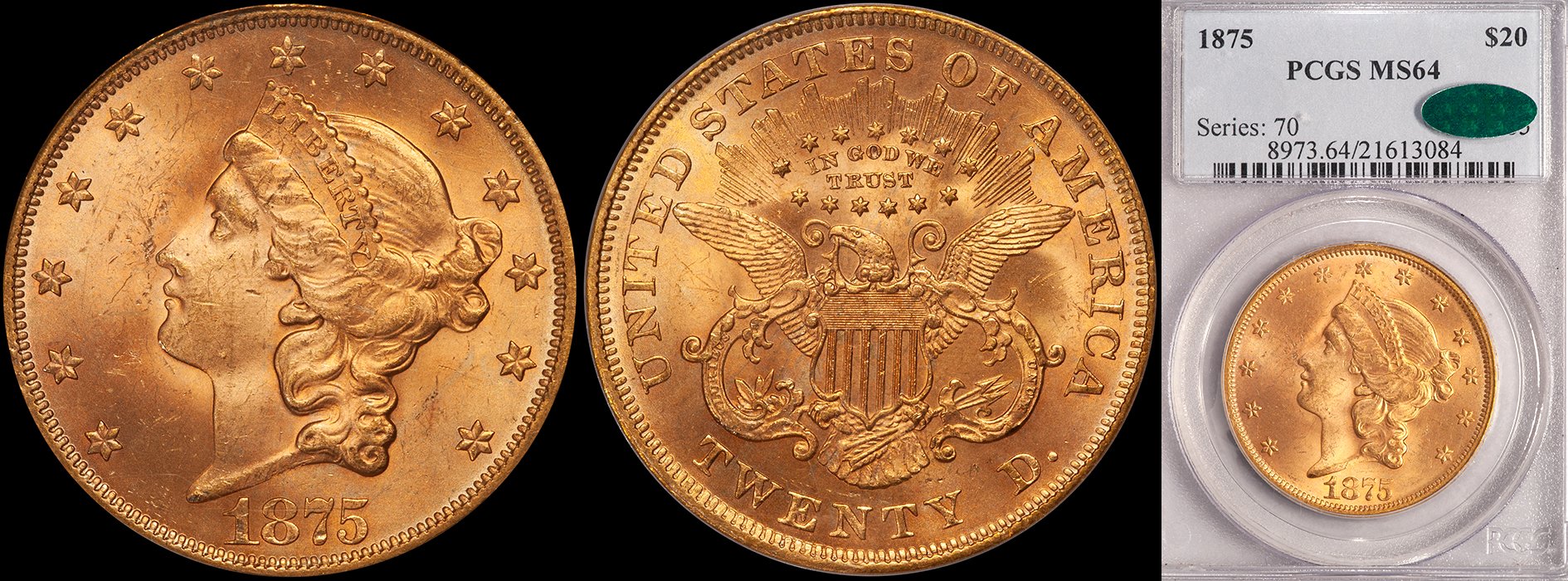
What's Hot and What's Not: Spring 2011

One of the more popular entries in the DWN Blogospehere is the "Hot/Not" feature. Its been a while since I've written one of these, and with groundbreaking ideas not exactly teeming in my little coin brain right now, it seems as good a time as any to analyze which coins are in demand right now and which aren't. WHAT'S HOT

1. Virtually any coin that is either finest known or which appears as such according to the PCGS/NGC population figures.

There have been some really incredible auction results (and private sales) in the last few months involving United States gold coins that were "population one with none better." Obviously, there has always been a great level of demand for coins like this. But in the past the "make your mouth drop" prices tended to be for very actively collected areas like Carson City gold or New Orleans double eagles.

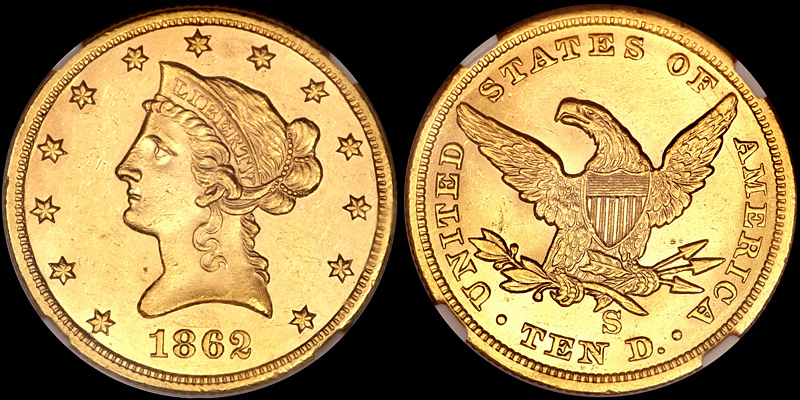
A recent market trend is for even esoteric coins that are indisputably great to bring big bucks. An obvious example is the $103,500 1862-S eagle that I blogged about recently. This is a coin that as recently as two years ago (or less) would have probably flown under the radar. Today nothing is "too" esoteric; as long as it is a nice coin and it has that all-important "pop top" feature going for it.

Will this continue? I see no reason why not. There is clearly a very strong ultra high-end segment of the market right now; investors and collectors who are seeking the best of the best and will pay virtually whatever it takes. And here's the rationale behind this: a really great finest known United States gold coin from the mid-19th century is still buy-able, from time to time, in the $50,000-100,000 range. Compare this to prices on great American art (or other collectibles) from the same era. Coins at the upper end of the market still make lots of sense when viewed from this perspective.

2. Rare Proof Gold

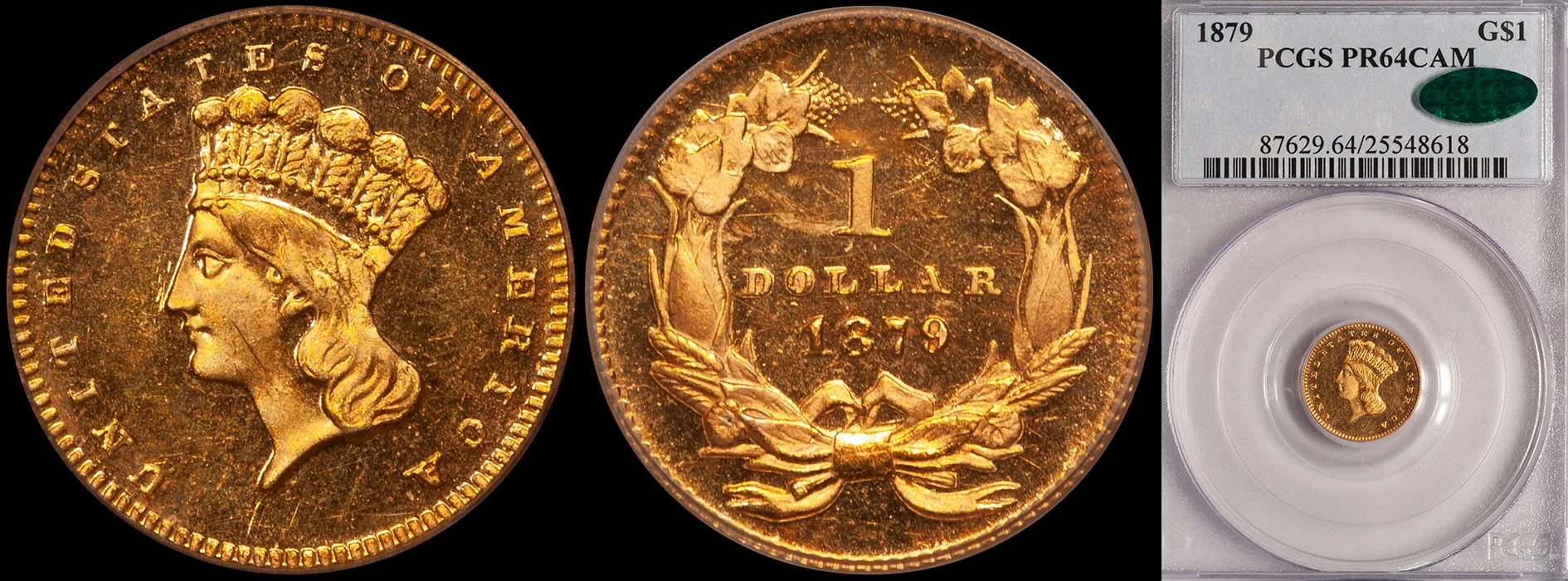
Another area that I've written about recently is rare Proof gold. By this I am generally referring to pre-1890 issues with mintage of fifty or less; more often than not in the eagle and double eagle denominations.

This is an area that appeals to well-heeled collectors and investors who are typically relatively new to numismatics. These coins are indisputably rare, tend to be visually impressive and are large in size; three perfect factors in determining their increased level of demand.

A coin like an 1870 double eagle in Proof was never "not hot." The fact that coins like this have actually become available in the last six months to a year is a factor in their record-setting prices at auction. A coin can't be "hot" if it is never available and before this recent mini-spate of high-profile Proof gold it had been a considerable amount of time before such coins were available.

3. Interesting Early Gold

If you are a collector of early gold, you've probably noticed a real drought of interesting pieces available in the last year of so.

This scenario is even worse at coin shows. I typically buy four or five interesting early gold coins at a major show. So far this year I've been nearly shut-out in my early gold buying at shows; even at such large events as FUN and Central States. Most of what I do see is either the same group of over-graded retreads that remain in stale inventories or semi-generic issues (1813 half eagles, 1803 eagles, etc) that just don't appeal to me unless they are fresh and lovely.

What's with this lack of product? I think it has to do with a couple of factors. First is the strength of the hands that the good stuff rests in right now. A lot of strong buyers focused on early gold during the 2005-2010 era and they aren't selling right now. Second is the fact that nice quality early gold is tougher to find than most people realize. Now I'm talking about 1821 half eagles and 1798/7 eagles here; I'm talking about relatively common coins like 1805 quarter eagles or 1803/2 half eagles. Crusty, eye-appealing and affordable gold is hard to find in any market and especially so in this quality and rarity-oriented era in which we collect.

If a sale of early gold that contained a few dozen really fresh, really appealing early gold coins were to occur (the early gold equivalent of the Miller sale held by Heritage at this year's FUN convention) I think you'd see crazy, crazy prices.

4. Solid Value Collector Coins

It doesn't matter if were talking rare date San Francisco half eagles in Fine to Very Fine or New Orleans eagles in Extremely Fine or crusty Dahlonega quarter eagles. If the coin is a solid value, if its priced in the $1,500-5,000 range and if it has something "special" about it (great visual appeal, estimated population of under 100 pieces, low mintage, etc.) it is in very high demand right now.

You'll notice that most of my first three "hot" series dealt with expensive to very expensive coins. While it is true that the very high end of the market is good right now, the same can be said with the true collector end of the market.

People are little less scared to spend money now than they were two or three years ago. I'm noticing that collectors who might have sat on the sidelines in 2009 and even 2010 are now returning to the market. But these same collectors are more particular with what they are buying.

I'm noticing that it has become harder and harder to find attractive, interesting coins in this price range. And this is even with me broadening my horizons and dealing in areas that I shunned in the past (Philadelphia and San Francisco issues come to mind here).

I'm going to limit the "hot" areas to four but there are other coins that seem really strong right now. These include but are not limited to Dahlonega quarter eagles and half eagles, Type One double eagles, Carson City double eales, rare date Liberty Head eagles and Civil War era gold.

WHAT'S NOT HOT

1. Off Quality Better Date Saints

I've discussed in detail in previous blogs as to why the St. Gaudens double eagle market has floundered in the past. Its most definitely in a floundering mode right now and the coins that seems to be in the least demand are the semi-keys in off grades. Examples of such coins would be a 1924-D in MS63 or a 1925-S in MS62.

Why are these coins that nobody wants right now? There are a host of reasons. These All these better dates are available in higher grades and with the exceptions of true rarities like the 1921, collectors don't want to settle for grades. Saints in MS62 and MS63 grades typically are not attractive and many of these coins are rubby "sliders" that have low-end eye appeal. And the populations of these faux better dates are high in these grades. A mintmarked Saint from the 1920's might have a population of well over 100 coins in the MS62 to MS63 range with another 50+ higher yet still be priced in the $5,000-15,000 range.

Unless promoted, I don't see the market for these coins getting better anytime soon.

2. Commemorative Gold

In nearly three decades of being a professional rare coin dealer, I can't recall having met anyone who actually collected gold commemoratives. I've looked at collections/holdings/portfolios that contained collections of gold commems but these were invariably sold as investments.

Every five years or so, someone promotes commemorative gold, makes a lot of money and escapes before the market deflates. I think its been at least five years since this area of the market has been promoted and I'd have to think these coins are overdue. That said, I personally hate them.

Why? Too small, too common, banal designs, no challenge for the collector; everything that as a numismatist I find boring in one small package. There are two notable exceptions: the Pan-Pac $50 Round and Octagonal issues. These seem as popular as ever and despite some drop in the price a few years ago I think these are a safe and solid "big ticket" item for the well-heeled investor.

3. Indian Head Quarter Eagles

As I've mentioned before, this series was "hot" for many years; mainly due to outstanding promotion(s) by a small group of marketers. For the most part, these firms have stopped selling Indian Head quarter eagles and there appears to be a glut of coins on the market.

Prices are down quite a bit in this series and I'm not sure if now might not be a good time for contrarians to take a position (at least a small one). If you could find real Gem common dates at current levels they seem like a fair value. The same might even hold true for the better dates (especially the 1914 and 1914-D) if you can find Gems with CAC stickers and great eye appeal.

The key 1911-D has taken quite a beating price-wise and bid has dropped down to $54,000. I'm guessing that a CAC-approved Gem would bring a lot more than this if one were available. I've mentioned before that I find this to be one of the most overpriced American coins of any date/size/shape but....

4. Off Quality Material

Looking through many cases and boxes at coin shows, I'm amazed at the large number of really awful coins that are still around. I almost never price this sludge but sometimes, just for grins, I'll pull out an especially nasty coin and ask for a price; just for educational purposes, of course. Sometimes, the answer sounds almost desperate: "I dunno; what will you pay?"

Since the advent of CAC and with the scrutiny given coin doctoring by the grading services, perceived quality has become fashionable among collectors. (Note that I say "perceived" since I think many collectors who think they are buying quality coins do not really know what a quality coin is). This has increased the demand for "A" quality coins and "B" quality to an extent while making "C" quality very illiquid; especially in the $5,000 and up category.

I see no change in this. Collectors will continue to seek nice (or at least nicer coins) and this will increase the spread between these and blatantly unoriginal, low end pieces.

Other areas in the market that seem "not hot" to me but which didn't make the List of Shame include PR70/MS70 moderns, generics, MS64 and MS65 Indian Head half eagles, many Indian Head eagles and faux-scarce date Type Three Liberty Head double eagles.

The Eliasberg 1858-O $20.00

I'd like to share a photo and some information about a really interesting coin that I recently bought and sold. It's a lovely 1858-O double eagle, graded AU55 by PCGS. What makes this coin really special, in my opinion, is its fantastic pedigree. To the best of my knowledge it has the oldest continual pedigree of any 1858-O double eagle, and certainly the best. The 1858-O is the 8th rarest of 13 double eagles produced at the New Orleans mint. You'd think this meant it was a common coin, but this is far from the case. There are an estimated 200 or so known with most in the EF40 to AU50 range. This date becomes quite rare in the medium to higher AU grades and it is extremely rare in Uncirculated with just six or seven known to me.

The finest known 1858-O double eagle is a PCGS MS62 owned by a prominent Midwestern collector. It came from the Bass III sale (May 2000) where it sold for $50,600. Harry Bass obtained it from the Merkin 10/66 sale.

There were four Uncirculated 1858-O double eagles found in the S.S. Republic treasure and this swelled the number of Uncirculated examples. The best of these four was an MS63 (graded by NGC).

I love the freshness of this coin and I think a quick study of it will prove helpful to rare gold coin collectors. It has wonderful soft, frosty luster, and pleasing natural yellow-gold coloration on the obverse and the reverse. This coloration is exactly "right" for the issue and the few 1858-O double eagles that I have seen that haven't been dipped or processed displayed a similar hue.

The Eliasberg 1858-O $20.00, PCGS MS62

This date is not generally seen with a sharp strike and this example is about as well detailed as any I can recall. Note the full radial lines in the obverse stars and the nearly complete detail on Liberty's hair. In both instances, this is very unusual.

The surfaces of this coin are clean for the grade. There are a few scattered scuffs in the fields, which is to be expected from an AU55. That said, I think this coin is as clean as other Type One double eagles that I have seen in AU58 holders.

This coin last appeared as Lot 1948 in Stack's November 2009 auction where it sold for $27,600. Before this it was in the October 1982 Eliasberg sale where it brought $2,640. It was obtained by Eliasberg in the famous Max Mehl June 1946 sale of the Atwater collector where it realized $105.

The Eliasberg 1858-O double eagle is now owned by a Southern collector who specializes in New Orleans gold coinage. He already owns a number of impressive New Orleans double eagles, but I'm willing to bet that this coin will become one of his favorites.

Are you interested in adding coins like the Eliasberg 1858-O double eagle to your collection? If so, please feel free to speak to me at 214-675-9897 and let me know how I can be of assistance to you and your collection.

The $103,500 1862-S Eagle

Lost in the hubbub surrounding the recently-concluded Central States coin show and the Heritage auction held with it was a sale that I think ranks as one of the more remarkable in the rare gold coin market all year. The coin of which I speak is an 1862-S eagle graded MS61 by NGC. Unless you are pretty knowledgeable, this coin probably doesn't seem like anything too impressive. But to those of us who know and love the Liberty Head eagle series, this is a coin that is impressive; downright impressive, in fact.

1862-S $10.00 NGC MS61, image courtesy of Heritage

According to information from the cataloger, this coin showed up at the March 2011 ANA show in Sacramento where it was graded and encapsulated by NGC. The cataloger went on to add "the coin was apparently preserved by a single family for many years and we can find no previous auction appearances for it." Now that's a fresh coin!

The 1862-S, as a date, is sort of overlook-able. It is not even close to the 1864-S in terms of overall rarity and it is overshadowed by the 1865-S Normal Date as well. A total of 12,500 were struck of which an estimated 75 or so are known. This date is actually not all that hard to find in the lower grades (in this case, VF and EF) but it is very rare in properly graded AU and extremely rare in the higher range of this grade. It was previously unknown in Uncirculated and I have never seen one better than AU55.

As of the middle of 2011, PCGS hadn't graded any examples of this date higher than AU55. NGC had graded two in AU58. The previous auction record for an 1862-S eagle was $25,300 set all the way back in May 1994 by a PCGS EF40 in the Bowers and Merena sale that would grade at least AU50 by today's standards. The best coin that I can remember having seen prior to this newly-discovered piece was Bass III: 653, a PCGS AU55, that sold for a very reasonable $8,050.

When I examined the coin in person, I was impressed. I'm not certain that the coin would "cross" to a PCGS MS61 holder but I thought the coin was really Uncirculated with nice surfaces and a great overall look for the date. I was particularly impressed with the coin's luster. Considering what the typical 1862-S looks like (very worn and usually very abraded), this was clearly a special coin.

But here's the rub. While "special," this coin is as esoteric as all get-out. Its the sort of coin that, if it had been offered to me by the owner, I would have had the following conversation with myself:

Doug Winter's Adventurous Side: "This is a great coin! Its unique in Uncirculated! You love coins like this! You have to buy it!"

Doug Winter's Practical Side: "But who cares? Its a very expensive S Mint Ten and coins like this are unsaleable. The two biggest collectors for this series already have decent coins and they might not want to upgrade. If they pass, there might be no one else who cares. Cool, cool coin but I pass."

Usually, the DWPS is smarter than the DWAS and Mr. Practical wins. But in this case, Mr. Adventurous was right.

I don't know who bought this coin or who the under-bidder was. I was guessing before the sale started that the coin would bring in the area of $50,000-60,000. CDN Quarterly Bid was $31,000 in MS60 (which is a totally arbitrary number since none existed before this coin was slabbed in March but it was the basis that most buyers were going to operate from). I did make the statement to a fellow dealer a few hours before the sale began that this was a coin that I could put in my case at a major coin show, price at $60,000 and not get so much as a bite.

The price realized of $103,500 is remarkable for a variety of reasons. The first is that this price is further proof that the Liberty Head eagle series, after years and years of neglect, has really come into its own. The second is that it shows that great coins, no matter how "esoteric" they appear, are capable of bringing startling prices in today's quality and rarity driven market. The third is the fact that a coin like this even exists and how it came onto the market with no prior history. It proves that there are great coins out there, still awaiting discovery.

Why is Proof Gold Suddenly a Hot Commodity?

Without a lot of fanfare, Proof gold coins have become a strong area of the market. In this blog, I'd like to postulate as to why Proof gold coins have become so avidly desired, which Proof coins are currently in greatest demand and what the short-term outlook is for Proof gold. To understand the current Proof gold market, it is important to understand the market over the past decade. The years from 1995 to 2000 represented the greatest period of availability for rare Proof gold in modern numismatic history. The sale of the Childs, Bass, Pittman and other collections made very rare issues seem almost common. I can remember there being multiple examples of issues from the 1860's and 1870's available simultaneously. This availability was coupled with a lack of demand for expensive coins once the Bass sale(s) were finished in 2001.

I think dealers who were around for this period (including myself) got a little spooked by expensive Proof gold coins. We remembered owning great, great pieces in 2000-2003 and not being able to sell them. Even when the coin market started getting very strong around 2004 and expensive coins were suddenly in vogue, I can remember that Proof gold seemed to lag the market. Everyone suddenly wanted great business strikes but formerly in-demand Proof gold just seemed harder to sell.

(Side note: Proof gold had been actively marketed in the 1980's and early 1990's. During the go-go investment years of the late 1980's I can remember Coin World ads touting Proof gold as "real coins for real men." But the coin market goes through cycles of demand and it seemed that many of the biggest dealer advocates of Proof gold in 1988 were no longer buyers of such coins in 1998).

This seems to have changed.

What are the major reasons for the sudden surge in demand (and increased prices) in Proof gold? The first answer has to do with supply. In the last year or so, there have been some really interesting Proof gold coins available. The Miller collection, which was featured in the Heritage 2011 FUN Platinum night sale in January, contained many coins that I think will be looked at in the future as truly significant. The quality of these coins was amazing and it was one of the few "time capsule" groups of Proof gold that still exist(ed). By this, I mean the coins hadn't for the most part been conserved. Proof gold with original surfaces is exceedingly hard to find in 2011, and the Miller sale had coins that were not only rare, they were magnificent.

The second reason has to do, obviously, with demand. There was a low level of demand for Proof gold as recently as a few years ago. Oh sure; there were a few people collecting Proof gold by date and when something really rare and really cool appeared at auction it would sell for a strong price. But since late 2007/early 2008 there has been a new breed of collector-investor that has suddenly made a beeline towards Proof gold.

These individuals are wealthy, sophisticated, and generally operate well under-the-radar. They tend to like U.S. gold coins that are very rare, very beautiful and historically significant. For a number of reasons, Proof gold is especially well-suited to them.

But not all Proof gold.

In the coin run-up of 2004-2007, super-grade Proof gold coins were in demand. Investors liked coins like PR68 Liberty Head quarter eagles and PR67 Type Three gold dollars. Now don't get me wrong; these are great coins and they are certainly rare in the grand scheme of things. But their value is derived more from grade than absolute rarity.

Case in point: a perfectly wonderful common date PR65 Deep Cameo quarter eagle from the early 1900's is worth around $17,500. The same coin in PR69 Deep Cameo is worth around $90,000. The quarter eagles from the turn of the 20th century are comparatively available (by the standards of Proof gold) and these sophisticated collectors, many of who have made a lot of money in the stock market by value investing, just don't see the need to own a $90,000 common date Proof 69 Liberty Head quarter eagle.

What does appeal them are Proofs that are very old (in this case, pre-1880) or very rare. And if the coin is large-size (ten dollar or twenty dollar) so much the better.

There are a few other parameters that seem to be important with this new breed of collectors. Off-quality coins won't fly so the baseline for grade seems to be at least PR64. Coins with great eye appeal are in demand and this means that Ultra Cameo or Deep Cameo pieces are commanding more significant premiums than in the past.

With the exception of the Miller coins, originality doesn't appear to be as much of a factor as I would have thought. My unscientific reasoning for this is that there are so few original Proof gold coins left that a premium is hard to place on them. And, most of these collectors really don't like the deep, cloudy natural toning that might be found on an unmessed-with proof double eagle. Big and bright is better and this is the market reality, for better or worse.

The quality of the coins in the Miller sale were an anomaly and you can't necessarily use them as a barometer of the market. There were a number of very rare Proof gold coins in the recent Heritage that sold for very strong prices and were apt metaphors for the entire thesis of this blog. Let's peek at a few.

Lot 5435 was a PCGS PR64 DCAM example of the 1860 eagle. Despite a seemingly high mintage of 50, this is a very rare coin with an estimated ten or so known. The example in the Heritage sale was decent for the grade with a nice naked-eye appearance. It sold for $161,000. The exact same coin sold for $69,000 back in June 2004; its last appearance at auction. More tellingly, a similarly graded but different coin brought $83,375 in January 2009.

An even more interesting coin was Lot 5492; an 1860 double eagle graded PR64 Cameo by NGC. This exact coin had last sold for $94,875 (as a PCGS PR63) back in September 2004. It brought $230,000; exactly the same amount as a similarly graded example (but much nicer, in my opinion) just sold for in the Miller auction.

I was certain that the next lot (5493) was going to be a big-ticket item as it had all the Big Bright and Rare factors going for it. The 1870 double eagle, one of around ten or so known from an original mintage of 35. Another factor was that the coin was actually nice; it was stickered by CAC and I thought it was solid for the grade. In the Miller sale, graded PR64 DCAM, this exact coin brought $189,000. Despite being freshly upgraded (kudos to Heritage for pedigreeing it...) this coin brought a solid $345,000.

Just to let you know that not everything that was big, bright and rare sold for a ton in the Heritage sale, Lot 5496 was an interesting study. Graded PR64 Cameo by NGC, the 1878 double eagle sold for $69,000. This is a very rare coin with no more than ten known from the original mintage of only twenty. Why did it sell for "just" $69,000? Probably because it really wasn't very nice. Also, this is an overlooked date that doesn't have great auction records despite its great rarity. Heritage 1/09: 4135, graded PR64 DCAM by PCGS and nicer than the coin referenced above brought $74,750 in a weaker market.

My guess is that we'll see some more big-ticket Proof gold coins on the market this summer during the ANA sales. Anyone who bought very rare Proof double eagles around 2004 to 2006 has seen them double or even triple in price and this will motivate some collectors to sell. I'm not certain that the market can sustain this price movement but a coin like an 1870 double eagle in Gem Proof at $500,000 or even $600,000 might not seem as impossible as it sounds as you are reading this right now.

Is it a Widget?

One of the newer catch-all coin terms that's been making the rounds is "widget." This is a derogatory term meaning a coin that is common, boring, and lacking in character. I would primarily characterize a widget as something that is generic in nature. No one goes out and says "I'm putting together a collection of widgets," but then again, the definition of this term seems a bit vague to me. I thought it might be helpful to take a random array of United States gold coins, describe them and posit as to if they qualify as widgets or non-widgets.

1. 1905 Quarter Eagle Graded MS65 by NGC. Even though this is in theory a relatively scarce coin, I think it qualifies as a widget. It has no real character to speak of and it is a coin that lacks any real collectors as end-users. I think that in order for a coin to be considered as a non-widget it has to have a solid collector base as opposed to being an investor-dominated type or series.

The exact same coin with some cool mint-made copper spots or extremely deep Prooflike fields becomes more interesting. A 1905 quarter eagle in MS65 with exceptional multi-hued color or one that is designated by NGC as being DMPL is actually not a widget.

2. The same coin but in MS63, raw and enclosed in an old presentation box with a note that reads "To Son, with love from your father Xmas 1905." The presentation box makes this a unique item and gives it character. So, I'd have to say that this coin, even though it is worth less than the coin mentioned above, is not a widget.

3. 1859-D Quarter Eagle, Graded VG-8 by PCGS. Yes, its a low grade coin. But it is scarce in any grade and the fact that it is a Dahlonega quarter eagle that somehow circulated for years makes it (at least to me) fascinating. It is clearly not a widget.

4. 1859-D Quarter Eagle, Graded MS61 by PCGS. Sounds like a cool coin, right? But what if said coin is covered with deep artificial color and it looks like the Deep Southern first-cousin to a Cheeto? Is it a widget? This is a tough question to answer. I would personally say that it is not a widget but at the same time it is not a coin that a connoisseur would want to own. It may actually look nice after being conserved. But I would have a hard-time calling this coin a widget.

5. 1927 St. Gaudens Double Eagle, Graded MS66 by NGC. High grade, pretty coin, etc. etc but still the ultimate widget.

6. Same coin, same grade but now with a CAC sticker. Here's another tough call. The CAC sticker shows it is a nice coin for the grade and I doubt if 10% of all the 1927 Saints that have been sent to CAC have been approved. But its still a widget, albeit an accurately grade one.

7. Same coin, same grade, same CAC sticker but now in an old green label holder. I'd vote that the coin while "witget-y" is no longer a widget. The old PCGS holder gives it some character and, all of a sudden, a level of demand that wouldn't exist if the coin were in a fresh, new holder.

8. An 1861-D gold dollar with a hole at 12:00. I'm not a fan of damaged coins and a gold dollar with a hole in it ranks pretty low on my list of coins to buy for inventory. But the rarity of the 1861-D makes it deisrable in virtually any grade. If the hole were small and not not overly crude and I could still see the date and mintmark, I'd buy this coin (as long as it were reasonably priced). It is most definitely not a widget.

9. A recently conserved PR66 Indian Head half eagle. Even though this is an expensive ($40,000+) coin, it is a coin whose value is predicated more on its appearance than on its grade. I would rather own a PR63 Indian Head half eagle with nice original color but a few shiny spots than a PR66 with no semblance of originality.

One of the points I'm trying to get across here is that a coin can be worth $50 and be a cool, numismatically desirable item while another coin can be worth $100,000 and be an expensive widget.

What are some coins that are expensive that you feel are widgets? And what are some inexpensive coins that you find to be very interesting and far from widgethood? Leave some comments below and let's talk widgets!

What is a Fresh Coin?

I was recently having a numismatic conversation with someone about an auction (sad life, I know...) and the subject of "fresh coins" came up. This person is knowledgeable and I respect his opinion. And after three minutes of discussion, I realized that his view of freshness and mine were different. But then I got to thinking, "What is a fresh coin? Are there varying degrees of freshness? Can an ugly coin be fresh?" And so on and so forth. The term "fresh" has become an overworked piece of numismatic salesmanship; along with "original," "premium quality," and "crusty." And, yes, I freely admit that I am as guilty as anyone of overusing these terms.

The entire act of buying rare coins is a leap of faith; spending thousands of dollars for little discs of metal is a bit crazy when you think about it. To make ourselves feel better about these random acts of craziness we focus on the sophistication of our purchase(s). The savvy buyer wants to feel like he is getting a fresh coin; not one that's been around the block.

I've heard that the "official" reasoning behind the concept of freshness is that its a coin that has been off the market for five to seven years. I'm going to throw out a few hypothetical situations and, if you are still following this, I'd like you to think about whether the coins, in each instance, are or aren't fresh.

Scenario 1: I recently bought an important 1865-S Normal Date $10.00 in NGC AU58. This coin hadn't been on the market since 2007 but it had appeared in two concurrent Heritage sales during that year. I purchased it from a dealer who was representing the collector who purchased it directly out of the second aforementioned Heritage sale. Is the coin fresh?

In this instance, I'd say without hesitation that the coin is fresh. After its two appearances in 2007, it had resided in a collector's holdings since 2007. This was the first time it had appeared for sale since then and it was being purchased essentially from the person who had held it for the last four years.

Scenario Two: While playing golf at a country club in Pascaloosa, an auction director at Stack's-Bowers meets Louis Eliasberg's distant third cousin Tyrone at the snack bar. They begin talking and after the auction director learns that the golfer's last name is Eliasberg he determines that after his death, Louis Eliasberg's estate gifted Tyrone with a small group of coins. They appear at auction. Are they fresh?

They are not only fresh; they are extremely desirable because of the Eliasberg name. Had these very same coins been passed down to Tyrone by his uncle Rufus Sneed, the coins would lack the cachet of the Eliasberg pedigree.

What if the consignment contained nothing more valuable than a roll of slider 1923 Peace dollars and some heavily worn Liberty nickels? This would still technically be a fresh deal, but since these are mundane numismatic items, the degree of "freshness" is irrelevant.

Scenario Three: A group of crusty Type One double eagles surfaces at a bank in Belgium. Its purchased by a French dealer who then sells it to an American dealer with an office in Paris. It is shipped back to the States and graded. The coins are sold en masse to an American dealer who has them regraded then sells the group to another American dealer. Finally, the coins are brought to a show where they are broken up and sold piece by piece. The whole process takes only a month but the coins have been owned by at least five people and have they been graded twice. Are they still fresh?

In this instance, I'd say they most certainly were. Many so-called "fresh" coins actually have a busy background history and may have passed through many levels of the Coin Pyramid before they reach the top of the numismatic food chain.

What if these exact same coins had been consigned to a major auction and then bought back and re-offered for sale by the consigning dealer? Here's where the concept of "freshness" gets tricky. You've got a bunch of coins that were as fresh as fresh can be before an unsuccessful appearance in an auction. Are they suddenly "de-freshed?"

Scenario Four: A group of neat early gold coins appear at a small antique auction in Massachusetts. Every major dealer on the east coast attends the sale and the coins bring a fortune in brutal bidding. The successful bidders send the coins into PCGS or NGC for grading and then consign them to a major Heritage sale. They are virgin, untouched and crustier than crusty. But are they truly "fresh?"

Remember at the beginning of this blog where I mentioned that my conversation partner stated that a coin has to be off the market for at least five to seven years to be considered fresh? What about these otherwise-fresh coins which did appear at a small, obscure non-numismatic auction a month before they re-appeared in a major all-coin sale? Are they simultaneously fresh and not fresh?

Scenario Five: A great little group of Proof type coins from an old-time collection walks into a coin store and are purchased by the shop's owner. The coins are very deeply toned but appear to have nice underlying surfaces with cameo contrast. He sends them to NCS where they are conserved and come back with great visuals and high grades. He then consigns them to an auction. Are these coins fresh?

In theory, yes they are fresh; after all they've never appeared at auction and haven't been available for decades. But after being conserved they've lost their "fresh" appearance and now look like any other run-of-the-mill high grade Proof type.

This brings us to an important point and one that I think introduces an element of semantics into the discussion. "Freshness" of a coin refers as much to its appearance as it does it lack of appearance(s) on the market in the past five to seven years.

If a coin has an ugly, dipped-out appearance or it is obviously conserved I personally could care less if the last time it appeared at an auction sale was in 1939. By the same token, if the coin has great color, choice surfaces and a wonderful "fresh" look I don't personally care if its been in three sales in the last two years.

I believe this point is important but it's where the whole ambiguous nature of "freshness" exists in any collectible field.

Bottom line: if a coin is uninspiring and doesn't have a good appearance, the term "fresh" doesn't apply to it; no matter how long its been off the market. But if a coin is choice and has good visual appeal, the concept of freshness takes on a whole different meaning.

What are your feelings about freshness? I'd love you to add your comments after reading this blog.

Gold Coins With "MLD"

In my 25+ years of specializing in United States gold coins, I have noticed some interesting trends as far as collector preference goes. One of these preferences is what I call "multiple levels of demand" or MLD. A coin that has multiple levels of demand is popular with multiple layers of collectors. As an example, a certain coin may have interest only to a date collector within a specific series. But another coin might be of interest not only to a date collector but a type collector or a low mintage collector or a design collector or even just to a generalized collector who prefers coins that are "cool."

Let's take a look within various denominations of U.S. gold coins and try to determine which issues have MLD and why.

Gold Dollars: I would contend that just about and Charlotte or Dahlonega dollar that is choice, problem-free and priced in the $1,500-3,000 range is a coin with multiple levels of demand. This sort of coin would certainly appeal to a date collector or a type collector. I frequently encounter collectors looking for a single affordable C and/or D dollar who want one just because it is a cool coin.

A case could be made for the 1849-C and 1849-D dollars as they are affordable, generally well-produced and are first-year-of-issue pieces. A stronger case can be made for the 1855-C, 1855-D and 1855-O dollars as well as the 1856-S as they are one-year types.

Clearly, the 1861-D dollar has the strongest MLD of any gold dollar. It is a rare, historic issue that has the strongest across-the-board level of demand of any date in this series. Interestingly, even as its price has soared in recent years, the level of demand for the 1861-D dollar has grown along with it.

One last issue that has some element of multiple demand is the 1875. This tends to be because of the fact that it has the lowest mintage figure for any business strike in the series with just 400 produced.

Quarter Eagles: Although they are expensive, the 1796 No Stars and the 1808 are both coins that have stronger demand than other early quarter eagles. In the case of the 1796 No Stars, it is a one-year type and the very first quarter eagle ever struck. The 1808 is a one-year type as well with just 2,710 examples produced.

The 1838-C, 1839-D and 1839-O quarter eagles are all first-year issues from popular branch mints and they are as popular now than I can ever recall. I also note that nice, affordable C+D mint quarter eagles in the $1,500-3,000 range remain popular with collectors who aren't specialists in Southern gold but merely want an affordable example to include in their collection.

The 1848 CAL may not be the rarest 19th century quarter eagle but it has a great story and it is often purchased by collectors who own no other Liberty Head issues of this denomination.

There really aren't any other Liberty Head quarter eagles with true MLD. The 1841, 1854-S and 1863 are classic rarities that all rank in the list of the 100 Greatest American Coins but they aren't necessarily that widely known outside of the quarter eagle specialist community. The 1875 is popular due to its mintage of just 400 business strikes.

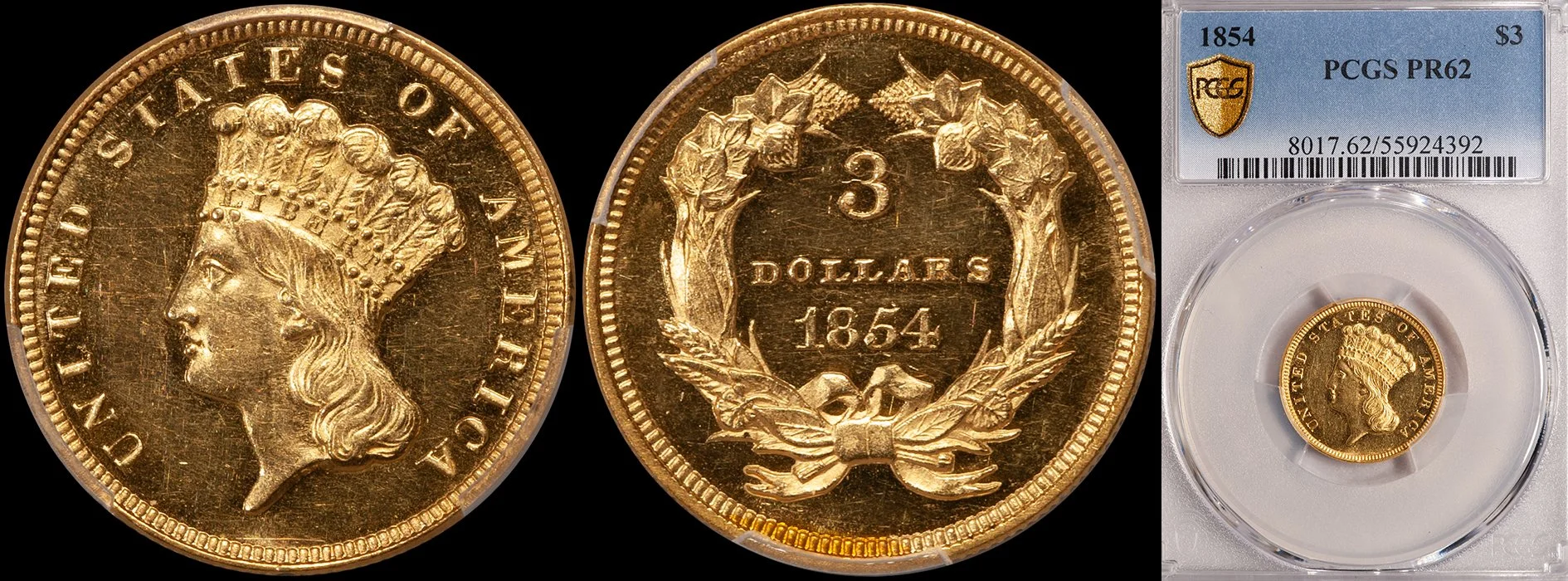
Three Dollars: There are not a lot of three dollar gold pieces that have true multiple levels of demand. The one issue that comes to mind as having MLD is the 1854-D; the only date of this denomination made at the Dahlonega mint. The 1854-O is in the same boat but it is far more available and not as popular as its Georgia counterpart.

A number of the threes dated 1880 and later have mintages of 1,000 and less and they are still affordable. These have become popular with collectors who have no interest in putting together a set of threes but who like interesting, affordable low mintage gold coins.

Half Eagles: The 1795 Small Eagle half eagle is certainly an issue that has a high level of demand outside of the specialist community. The same can be said for nearly any early half eagle, especially those dated prior to 1800. The 1800-1812 issues are also popular with non-specialists but more typically in the $5,000-10,000 per coin range.

The 1838-C and 1838-D are extremely popular with myriad collectors. These are both first-year issues and one year types with the added "oddness factor" of having the mintmark on the obverse.

As I've mentioned with the other denominations discussed above, affordable C+D half eagles have a level of demand that extends out of specialist collecting. This seems especially true with coins in the $1,500-3,000 range.

The 1854-S is the rarest Liberty Head half eagle with just three known. None has been available since 1982 and my guess is that if one did become available, it would sell to a collector who didn't specialize in this series or denomination.

The 1870-CC half eagle always seems to be a popular coin with a variety of collectors as it is the very first half eagle produced at the Carson City mint. It certainly has a wider range of demand than, say, an 1873-CC which is, ironically, a scarcer coin but one with a more specialized type of demand.

I often see collectors purchase affordable common date Carson City half eagles (such as the 1891-CC) more for their "coolness" factor than for a need to include one in a date set. The 1891-CC, in fact, is popular with non-specialists in grades as high as MS63 to MS64 due to its affordability and the fact that it is well-made and can be very attractive.

Eagles: I've seen even jaded, long-term collectors get excited when they see a nice 1795 eagle. What's not to love: big coin, first-year of issue, low mintage and, all things considered, really not that expensive in the EF-AU grade range.

While not as popular as the 1795, the other 18th century eagles always seem in demand amongst non-specialists. This is the case even with the 1799 which is actually a relatively common date and which can be purchased in the higher circulated grades for less than $20,000.

The 1838 eagle has developed a little bit of a cult following due to its status as a first-year issue and the last three that I've owned have all sold to non-specialists.The 1854-S is a date with strong across-the-board demand as it is the first eagle from San Francisco and it has great Gold Rush connotations.

As with the 1870-CC half eagle, the eagle of this year is rare and in demand by various collectors. In my opinion, it is a decidedly undervalued coin in all grades and this has been noted by collectors who look for value as well.

I'm not totally certain why prices for the 1883-O eagle have exploded in the last five years but this ultra low mintage issue (only 800 struck) has gained widespread acceptance amongst collectors of all stripes.

Affordable CC eagles remain popular as well. It amazes me that even in this market, it is possible to buy a really nice 1891-CC for $2,500 or less.

Double Eagles: With the price of gold racing towards $1,500 you can say that every double eagle now has some degree of MLD. I find this to be especially true with Type One issues that sell in the $1,750-3,000 range. You can still buy a nice EF45 to AU55 Type One that is dozens of times rarer than a common Type Three for a small premium.

In the Type One series, the dates that seem to me to have the highest degree of non-specialist demand include the 1850 (first year of issue), the 1861-S Paquet and the Civil War issues.

After years of market indifference, the shipwreck double eagles from this era have developed a strong secondary market. Many collectors who could otherwise care less about Type Ones want to own an S.S. Central America, Brother Jonathan or S.S. Republic coin.

Another double eagle that has quietly developed a strong demand level is the 1854-S. This is the very first coin of this denomination to be produced at the San Francisco mint and it has wonderful Gold Rush association.

The demand for Carson City double eagles is great with specialists and non-specialists alike. The ultra-rare 1870-CC is an issue that has long been craved and even the more common dates, in the $2,500-5,000 range, have found an appreciative audience with collectors who like the gold content and great history in one package.

Gold coins with multiple levels of demand have out-preformed their more esoteric counterparts in the last decade as date collecting has become less practical. I would expect that as the market develops in the next decade, you'll see other coins added to the MLD list. Which ones do you think deserve to be placed in this group? I'd love to hear your comments.

How Proof Gold Coins Are Graded Differently Than Business Strikes

Reader JF of Ohio gets full props for suggesting the topic of this blog: how are Proof gold coins from the 19th century graded differently than their business strike counterparts? Great question, JF, and one that has to be answered in a multiple-part format. In order to fully grasp the topic of this blog, there are a few concepts that I'd like to introduce. The first is the mistaken concept that "Proof" refers to a grade. Proof is actually a method of manufacture that entails striking coins with care on specially polished planchets and often using multiple blows of the dies. Proofs are made in limited quantity and are produced by the Mint for collectors. Business strikes, on the other hand, are not afforded any special care or striking and they are produced for circulation with little thought regarding their appearance or quality. Thus, by their very nature, Proofs should have a "better" appearance than business strikes.

As I have explained before, grade is a shorthand that denotes the appearance of a coin. As collectors we have established expectations of a grade. In other words, we expect an MS63 or PR63 coins to have a nice appearance but a few noticeable marks or flaws which remove it from a higher category in the grading continuum.

Expert graders use a number of factors to establish the grade of a coin. These include surface preservation, strike, luster, coloration and eye appeal which, in theory, is a combination of these individual factors.

The area in which Proofs differ most from business strikes is surfaces; both characteristics and preservation. Proofs generally did not circulate so they are not as prone to nicks, abrasions and marks as much as business strikes are. Proofs were generally better handled as well as they went into collections (i.e., people who cared about the coins and ostensibly knew how to handle them) as opposed to going into circulation (where they were roughtly handled by non-collectors). Also, Proofs were carefully transported after minting unlike business strikes that were often shipped loosed in bags to banks.

When determining the grade of an Uncirculated gold coin, the quantity and placement of abrasions is extremely important. With Proofs, marks tend not to be as big of an issue. Around 15-20% of all known Proof 19th century gold coins are in some way "impaired." This is typically from having been placed into circulation at one time. (The reason for this, I believe, is that Proof gold coins sold for a very small premium even as late as the early 1930's and as the economy grew weaker and weaker during this era, coins like double eagles with a high face value and low numismatic premium were placed into circulation as a matter of survival for their owners). But most Proofs have "better" surfaces, for the grade, than do their Uncirculated counterparts.

The bane of Proof gold coins are hairlines. Hairlines are thin, fine scratches in the surfaces that are caused by cleaning, wiping or poor handling. On a proof coin, with bright, reflective surfaces, hairlines are easy to see and can be very detracting. On a business strike, with surfaces that tend to be satiny or frosty, hairlines can be more difficult to detect; especially by an unsophisticated eye. Therefore, Proof gold coins are graded more based on a standard that involves hairlines or a lack of them.

I just mentioned that business strikes have a number of different textures such as frosty or satiny or even prooflike or semi-prooflike. Brilliant Proofs from the 19th century all have the same basic reflective appearance although some issues (especially gold dollars and three dollars) might have an "orange-peel" texture while others have a smoother, more even texture. This consistency of texture makes it easier, in my opinion, to grade Proof gold coins than it to grade business strikes.

One negative aspect about a Proof's reflective, brilliant surfaces is the fact that marks and hairlines tend to be more amplified. An MS63 might have a few marks or hairlines that don't really detract much from the overall appearance. On a PR63 gold coin, the same marks or hairlines could be extremely detracting based on the fact that they are more "in your face" because of the surface's reflectiveness.

On 19th century business strike gold coins, strike is a fairly minimal factor in determining grade. On Proofs, it is basically a non-issue. Because they are well-made with great care, most Proofs gold coins are very well struck. On the few that show some degree of weakness, this isn't considered enough of a factor to remove a point or two from the overall grade.

Color is an important factor on business strike gold coins. A reasonably abraded Dahlonega half eagle with good luster but poor color might only grade MS60. The exact same coin with great natural color could be pushed up to an MS62 because the hues it shows add great eye appeal.

Until a decade or so ago, it was not uncommon to find Proof gold coins with deep, original coloration. Today, such coins are nearly impossible to find. The reasons for this are many but the most significant is that the grading surfaces tend to like bright, flashy gold coins and an 1874 eagle with deep, naturally hazy surfaces won't have the "look" that is favored by today's graders and collectors.

In my experience, the highest grade that a totally original, hazy 19th century gold coin will be graded by NGC or PCGS is PR65 or possibly PR66. In order to get a "supergrade" (PR67 and above) a gold coin has to be bright and shiny. Thus, it gets dipped.

Another interesting factor to consider is the premium paid for adjectival modifiers such as Ultra Cameo or Deep Cameo. A deeply toned, hazy gold coin almost never gets one of these modifiers. A bright, reflective gold coin that shows contrast between the devices and fields does. Thus, Proof gold coins with attractive deep color get dipped or brightened in order to become Deep Cameos or Ultra Cameos. Its sort of sad but its also an economic reality of the rare coin market.

There are a few other things to consider when discussing how Proof gold coins get graded differently than business strikes. Early Proofs don't show adjustment marks as on business strikes but early business strikes don't tend to show lintmarks as seen on some Proofs. This tends to nullify each other and neither factor is ultimately that important. In other words, a PR65 gold coin can have a few lintmarks just as an MS65 Heraldic Eagle ten dollar gold piece might have a few light adjustment marks.

Ultra rare Proof gold coins tend to get a one point to one point plus push just like their business strike counterparts do. In other words, because of its rarity and mystique, a Proof 1875 three dollar gold piece might get graded a little less strictly than a similar quality 1885 Proof three. I'm not saying that this is right or wrong but it just seems like a numismatic fact of life.

So are Proof gold coins held to a different standard than their business strike counterparts? I would say that the answer is a strong yes. I don't think that grading of Proofs is any less strict (or more strict) than it is for business strikes. It's just different, for a number of reasons as touched on above.

I'd love to hear your comments on grading Proof gold coins. Please feel free to add a comment to this blog or email me at dwn@ont.com.

How the Internet Has Changed Rare Coin Auctions

In my last blog, I discussed ways how the internet has impacted the concept of eye appeal when it comes to coins. Continuing this internet-related theme, I'd like to focus on how the web has impacted rare coin auctions. The impact of the internet on coin auctions in the past ten years has been monumental; more so, I'd venture to say, than virtually any other collectible. Ten years ago, the auction business had a number of vital firms offering coins; today it is essentially a duopoly. Ten years ago, auctions were primarily a place where dealers battled against each other in a sort of numismatic bloodsport; today, they are kinder and gentler. Most importantly, the numbers have grown beyond what I would have ever expected. It is now commonplace for an auction to realize $40-50 million; a decade ago this would have been startling, front-page-of-Coin World news.

Let's look at a few specific areas of how the internet has changed the coin auction market and, as you knew I would, I'll add my two cents worth about the positives and negatives of each.

1. Everybody (and I mean everybody) now has a computer. Ten years ago, it was not uncommon for me to speak with a well-heeled collector and have him say "I don't do computers." In 2011, if you don't have a computer, you are either a total Luddite or you are stubborn and doing yourself a huge disservice as you placing yourself at a hugely competitive disadvantage; sort of like fighting a war with sticks and fire clubs. And ten years ago, most people who had computers didn't have DSL or fast connections. Remember dial-up? Remember waiting two minutes for an image to load only to lose a connection? Not an image I look back at fondly...

The fact that everybody now uses fast computers is compounded by portability of these machines. Ten years ago, a collector might panic when he realized that an auction he cared about was the same time as his family's spring break trip to Florida. With laptops and iPads, your location is almost meaningless. This makes participation is an auction easier than ever as does, of course, the increased memory of today's computers.

What will see ten years from now? Three dimensional images of coins? Auctions broadcast live in 3-D? Tons of applications to make bidding and determining value easier? My guess is that we'll see things we can hardly imagine now and that they will continue to revolutionize the rare coin business.

2. Collectors have gained so much confidence in the auction process (kudos here to Heritage who I give total credit to for this) that a sizable percentage of coins at auction now sell to end-users. I don't know the exact percentage of coins in a typical Heritage sale that sell to collectors but I'm guessing its over 50% by value. And I'm guessing that ten years ago this figure was far less.

This brings me to a quick story. For me, the greatest coin sales of all time were the Bass auctions, held in 1999 to 2001. I can remember at the Bass II sale (to me, the single most memorable of the four sales) there were less than a dozen collectors in the auction room participating. And, of course, no internet and probably not much mail or phone bidding. Today, a sale of this magnitude would attract hundreds of well-heeled collectors from all over the world. The internet has made coin auctions so much more accessible and, as a result, they are now so much more collector-dominated.

3. Transparency is the numismatic buzzword of this decade; sort of like "green" is to consumer products. Ten years ago, the thought of transparency made numismatic auction firms recoil in horror. Only Heritage was smart enough to realize that by being transparent they would gain the trust of their clients and, in turn, do more business. The lack of transparency (and the failure to embrace technology early on) was one of the main things that did in Heritage's largest rivals in the coin auction business.

The coin auction business is now built on a platform that is far more transparent than other collectibles. This has had an impact on both collectors and dealers. In the past, a dealer could buy a coin from an auction, mark it up (or upgrade it) and offer it for sale, often with the potential buyer having no idea where it was from. Now, most coins in dealer's inventories can be easily traced to auctions. If a dealer offers a coin for $8,000 that just sold at a Heritage sale for $5,000, it might greatly offend a potential client. Margins, for internet-savvy buyers, tend to be smaller as a result.

4. This access to information has put the collector on much more level playing field than ever before. Even a new collector can see what coins bring at auction and now have a degree of comfort knowing that there is (hopefully) a legitimate under-bidder at 5-10% less than what they just paid.

To me, the existence of such huge databases as the Heritage auction archives and the PCGS auction prices realized archives are incredibly valuable. Ten years ago, I had my own databases for most branch mint gold but this was a ton of work. Now, someone else does the work for me and, frankly, they do it better. The amount of information available to collectors has leveled the playing field; not always the best thing for me as a dealer but certainly a great thing for the collector. Actually, let me correct myself. It probably, in the long run, is great for me as a dealer...

5. With the exception of Platinum Night sessions at FUN and summer ANA, the typical coin auction room is now nearly empty. You can go to a Heritage or Bowers sale at a B level show and see eight people in the room who don't work for the firm holding the sale; and four are there for the free food. People now use the internet to bid or they bid by phone.

I have mixed feelings about this. I don't miss the days when I'd be at a coin show from 8am until 6pm then run to an auction and work another five or six hours. Those 16 hour days were OK when I was 28 but they became less and less fun as I got older. But I do miss knowing who was buying what; especially at "name" sales or specialized collections where this knowledge was important for the future. I think this sort of "depersonalizes" the rare coin auction business and when I do get to dress up and bid on expensive, important coins in front of my peers I still get a little bit of a tingle.

6. You know the feeling when you are on eBay and you get outbid on an $8.00 post card? You get irritated and even though you know you shouldn't bid anymore, you bid another time (or two or three or four...) to get back at the anonymous competitor who is keeping you from adding that 1939 World's Fair postcard to your collection. Take the same scenario and apply it to a $50,000 coin. I call this the rise of the "I-must-have-it" internet bidder.

Heritage has created an amazingly efficient live auction internet platform that makes it easy to bid in their sales in real time. I can think of many occasions when two determined internet bidders have done battle on a coin worth, say $25,000, and wound-up pushing the selling price to $50,000 or even $75,000 because they were pissed at their anonymous competitor(s).

Heritage has made it so easy to bid and re-bid online that many collectors go "ah, what's another bid or two or three" before they realize that they've added a big amount of money onto a lot. But the beauty of this system is that there are two actual bidders in real competition. In the past, it could have been (and often was) one unfortunate bidder being run up by an unscrupulous auctioneer.

I could go on and on but need to get ready to go to the Baltimore coin show--and attend an auction. I'd love to hear your input on how the internet has changed the coin business. Leave a comment at the end of this blog and let me know your thoughts!