Why Don't More People Collect 20th Century U.S. Gold Coins by Date?

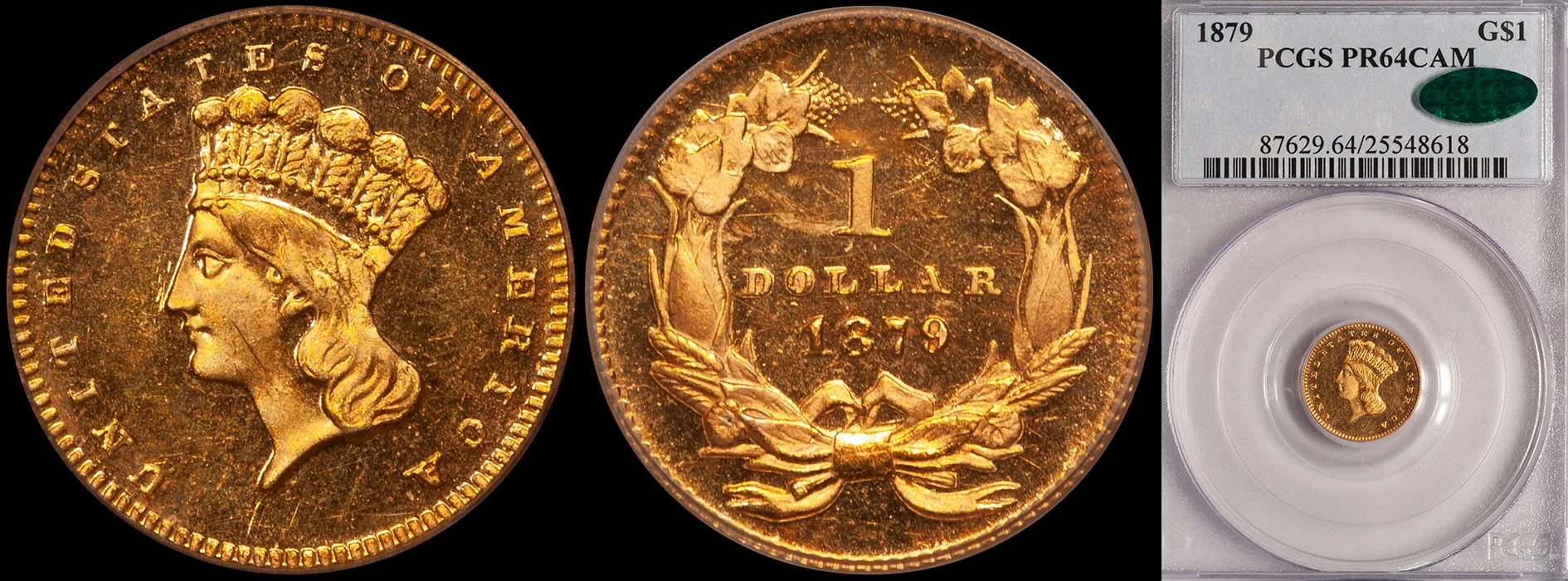
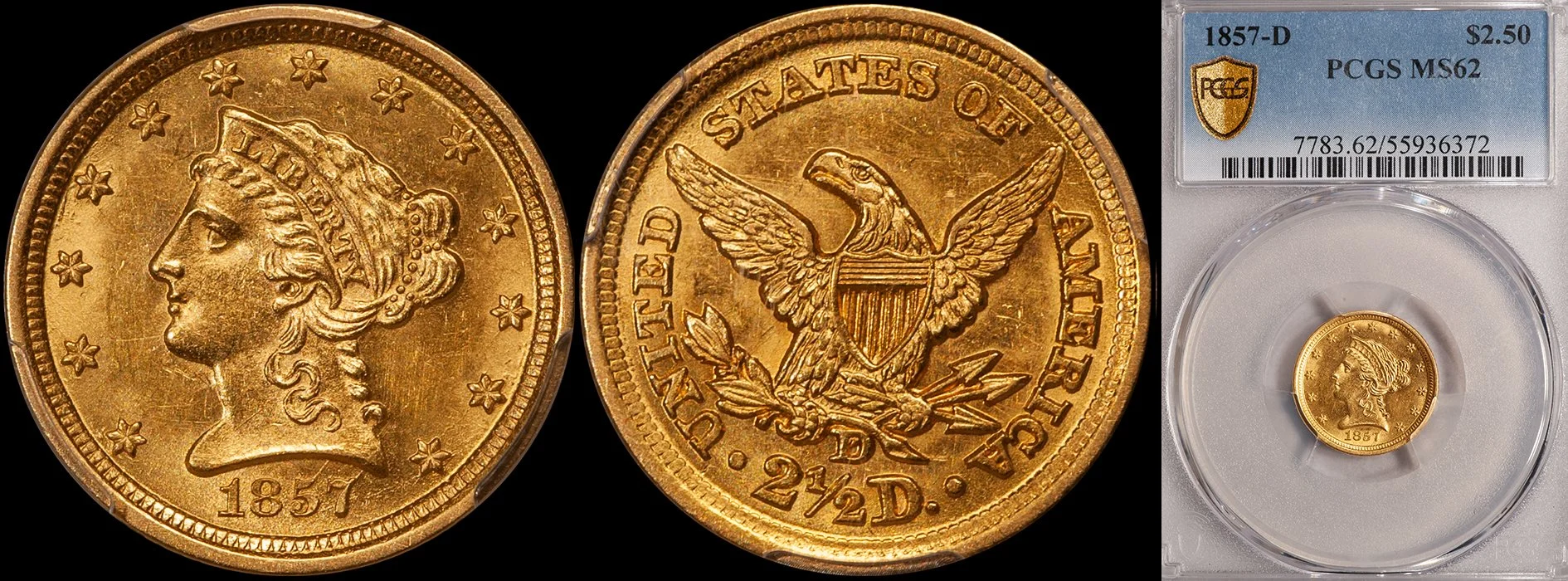
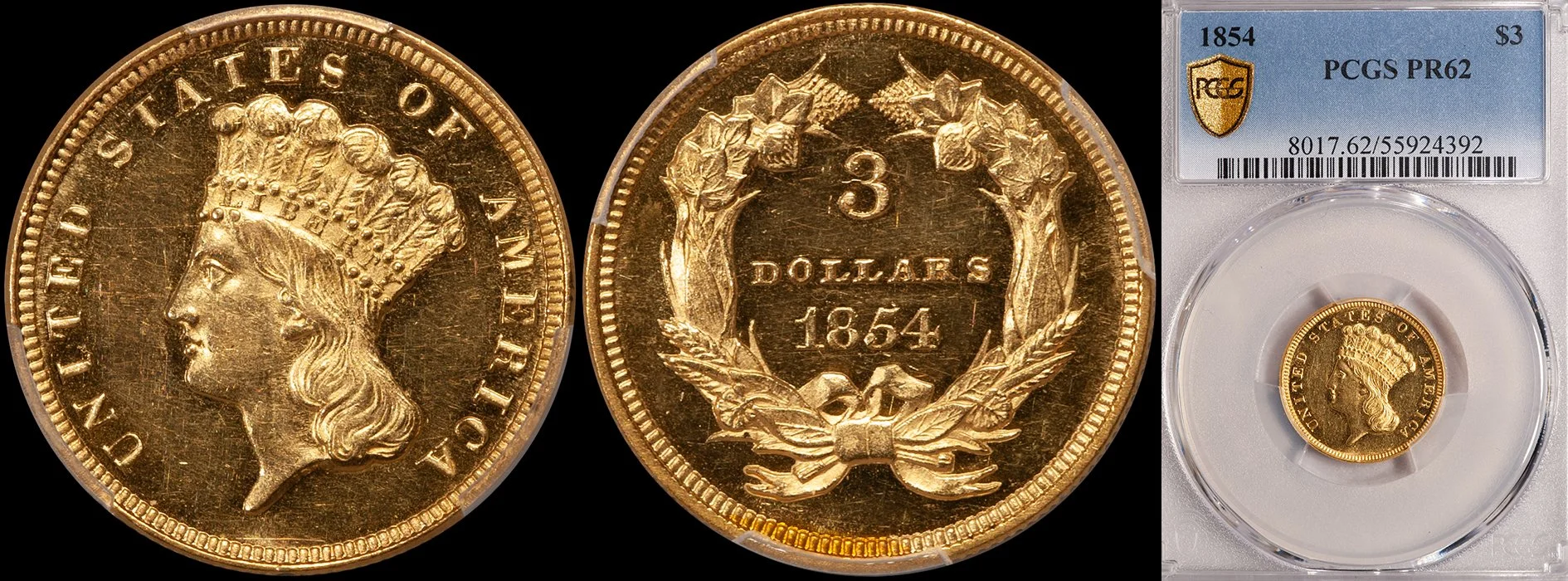
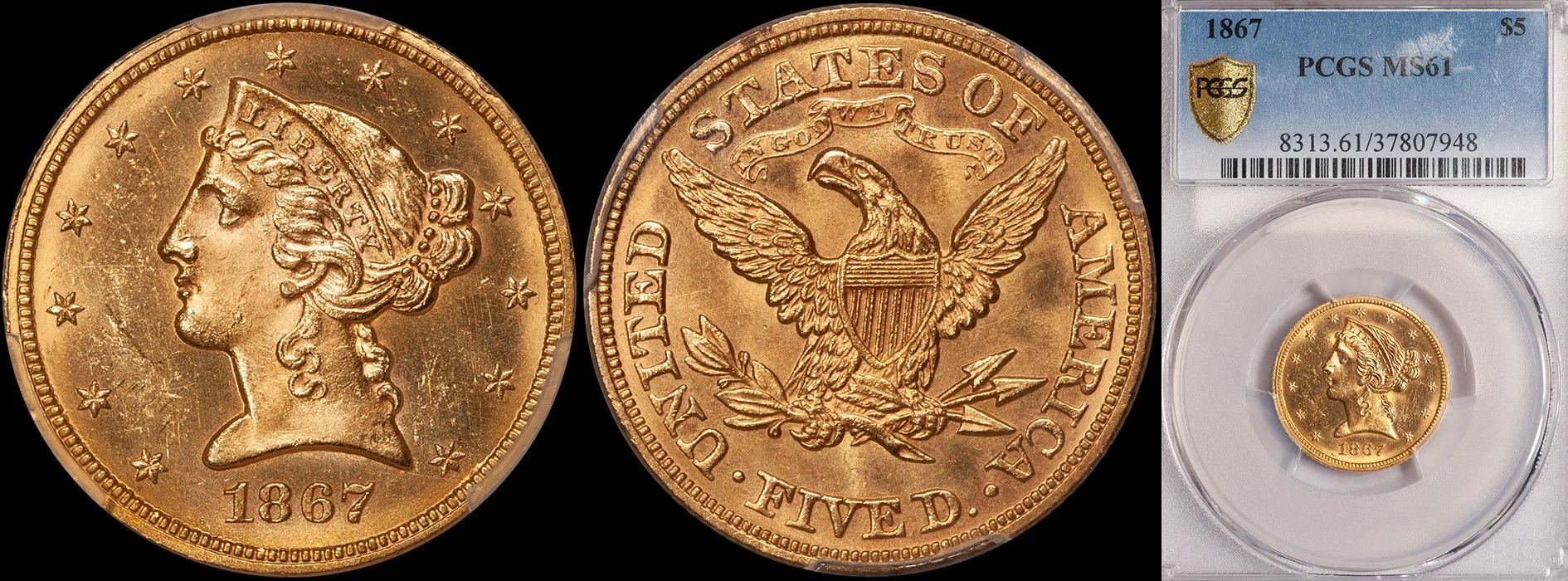
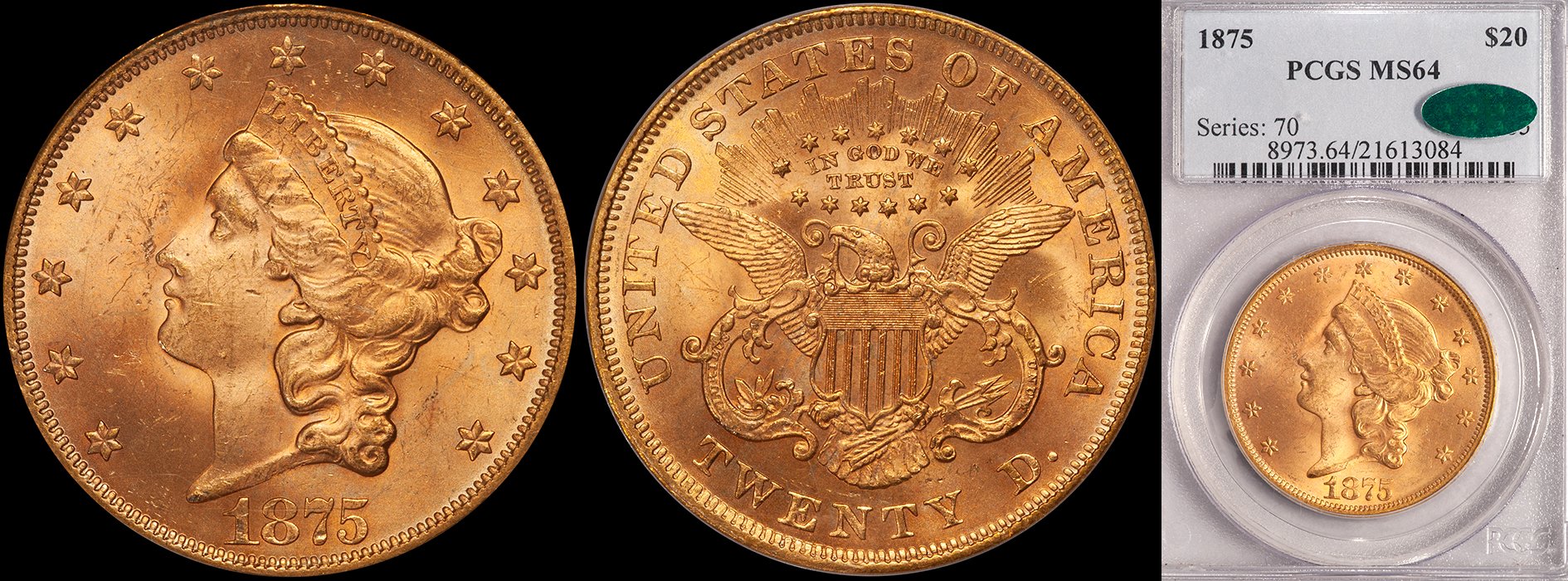
Why don't more people collect 20th century gold coins by date? The four major designs (Indian Head quarter eagles, half eagles and eagles and St. Gaudens double eagles) are clearly among the most beautiful United States issues ever released. They are relatively short-lived and none of them are impossible to complete due to fabulously expensive or incredibly rare individual dates. So why, then, do these series lag such non-gold 20th century designs as the Lincoln Cent, Buffalo Nickel, Mercury Dime and Walking Liberty Half Dollar when it comes to numbers of active set collectors? I can think of a number of reasons. Some are pretty obvious while some are pretty far-fetched and I'm throwing them out there only to encourage debate. Here are some of the reasons I came up with:

1. 20th century U.S. gold is typically marketed as type coins and not by date. Traditionally, people have viewed coins like Indian Head half eagles as something you just need one of, not dozens. Simultaneously, higher grade 20th century gold coins are frequently sold more as "investments" than collectible coins. Over the last two decades, I have seen many collectors burst on the scene in a specific 20th century series only to flame out and sell their coins back a year or two later. The Steve Duckors and Austin Fursts of the 20th century gold world are alot rarer than their quick-in quick-out counterparts.

2. "They all look the same." A new collector once told me this when he decided not to continue with the Indian Head eagle set that I was helping him build. Now, I don't agree with this. If you become a student of, say, the Indian Head half eagle series it becomes clear that a 1911-D looks a lot different than a 1916-S. Its struck differently, has a different texture and has different coloration as well. But these subtleties are often lost on novice collectors.

3. There's too much difference in value for barely distinguishable quality. For many key date 20th century U.S. gold coins, the difference in price between an MS64 and an MS65 can be huge. As an example, an MS64 1913 Saint Gaudens double eagle is worth $7,500 or so while a no-question asked MS65 is worth over $50,000. It takes a real leap of faith for a new collector to pay a 7x premium for a difference in quality that he not only doesn't see but probably doesn't understand. The creation of CAC has made it a little less scary for a new collector to pay huge premiums for MS65's but from personal experience I know that the value for Gem coins just isn't always there.

4. There is no up-to-date reference work. David Akers wrote a terrific book on 20th century United States gold but it was published in 1988 and the information is out-of-date (not to mention that the book is out-of-print and fairly scarce). If Akers or a new expert were to take this book and update it with information that was relevant to the current coin market, this would be a huge shot in the arm for 20th century gold.

5. There is no sense of nostalgia inherent with these coins. People buy coins like 1909-S VDB Cents or 1916-D Dimes because they couldn't afford one when they were ten years old and filling holes in their blue Whitman folders. No one is haunted by the 1927-D Saint that they couldn't save enough money from their paper route to afford when they were a kid.

6. High grade 20th century gold coins are very expensive. It is a pretty serious financial commitment to collect Saints in Gem or Indian half eagles in MS64 and up. This obviously limits the number of people who can collect these coins.

7. Affordable grade 20th century gold is ugly. OK, maybe not "ugly." But you'll have a hard time convincing me that an Indian Head gold coin in EF and AU grades is remotely attractive. This is not the case with Liberty Head gold coins which is really attractive with limited wear.

8. Pricing information for many 20th century gold coins is hard to come by. Yes, its easy to figure out what a common date Saint is worth in a PCGS MS64 holder. But its not so easy to determine what a 1913 is worth in an NGC MS65 holder versus a PCGS MS65 holder versus a PCGS MS65 holder with CAC approval. If someone published accurate pricing information on the 20th century series, I believe it would jump-start collector interest.

9. There are few "go to" retail dealers for better date 20th century gold. If you collect 19th century Liberty Head gold, there are some obvious candidates who to buy from (and I'd like to think that DWN is one of them). The person who, in my opinion, is the sharpest dealer for rare date 20th century gold is Kevin Lipton and Kevin is a wholesale dealer who probably is going to be hard for many collectors to deal with as he has no website.

As I mentioned in the beginning of this blog, 20th century gold coins deserve to have more date collectors than they currently do. These are attractive, interesting coins. They are within reasonably short-lived series and unless you attempt a Gem set, they are within the price range of many collectors. I'd be curious to know what your take is on why they are not as popular as Lincoln Cents or Mercury Dimes and invite you to send me an email at dwn@ont.com with your input.
What Gold Coins Do CAC Stickers Add the Most Value to?

After two+ years of being traded on the open market, I think few collectors and dealers would argue the statement that CAC stickering has added considerable value and liquidity to many types of United States gold coinage. But are we now able to determine with a decent degree of accuracy which coins are most affected by a CAC (or the absence of a sticker)? Let's take a look at some areas of the gold coin market and see how CAC is adding value. One of the areas that CAC has added the greatest amount of value is in the St. Gaudens double eagle market. The impact is seen two ways. The first is with common "generic" issues in MS65 and MS66. One of the main reasons why the premium for non-CAC certified MS65 Saints is so low when compared to MS64 coins is that most of the coins in MS65 holders are not significantly better than those graded MS64.

What CAC has done is to identify those coins graded MS65 that are nice quality and which are "real" 65's. Currently, non-CAC Saints in MS65 trade for around $2,300. Those with CAC stickers are worth at least 10-15% more. They are also quite liquid and can be sold even when dealers have extensive numbers of non-CAC coins in stock. Non-CAC MS66 Saints are currently worth around $2,750-2,850 per coin. The premium for MS66 Saints with CAC stickers is at least $750-1,000 per coin. Given the fact that the stickered MS66 coins I have seen are very nice (as compared with the non-stickered coins which range from inferior for the grade to decent) this premium makes sense.

Another area where CAC stickered coins are selling for a significant premium is in the better date Saint market. Let me pick a random issue: the 1927-S in MS64. This coin has a current bid of $70,000 in this grade and a bona-fide Gem is worth double this. The quality of 1927-S double eagles varies greatly and there are coins that are very low end and hard to sell for $55,000 and coins that are very high end and worth over bid. I can't recall having ever seen a 1927-S in MS64 with a CAC sticker but if I had a PCGS/CAC coin that I liked I'd quote $75,000+.

Early gold (i.e. gold coins struck from 1795 to 1834) is area that has shown itself to be influenced by CAC stickers. I don't like every single piece of CAC-stickered early gold that I see but I like at least 90% of the coins. Compare this to non-CAC early gold where probably 50-60% (or more) of the coins offered at auction or through dealer's websites are not, in my opinion, nice for the grade. I find this to be especially true with early gold in the MS63 and MS64 grades. As an example, an 1812 half eagle in MS64 with a CAC sticker is currently worth around $40,000. The same coin in the same grade that is not stickered and which is not a CAC-quality coin, in my opinion, might be hard to sell for $32,500. More and more collectors of coins like this are demanding that they be CAC stickered and the premium for the pieces that have the Green Bean is at least 10-15% and climbing.

Because so many Proof gold coins have been doctored over the years, CAC-stickered pieces are currently garnering high premiums. This is more so with Matte Proofs than Brilliant Proofs. I can't remember seeing more than a few Matte Proof gold coins in the last two years that weren't doctored to the point that they weren't even the right color. When the few remaining fresh pieces come onto the market, they realize strong prices. As an example, Stack's just sold at auction a lovely 1913 Matte Proof gold set. All four coins were CAC stickered and all four brought exceptional prices. I see similarly graded washed-out NGC Matte Proof gold from time to time and it brings Greysheet prices or lower; these superb, vibrant Gems brought numbers that were way over "sheet."

I've found CAC to be very particular when it comes to Brilliant Proof gold as well. Lower grade (PR63 and below) Proofs aren't really impacted by having or not having having CAC stickers unless they are a very rare early date issue. In this case, the premium seems to be around 10%. The real premium is for very high grade pieces. As an example, from time to time, a really remarkable PR68 or PR69 Liberty Head quarter eagle will become available. While these coins tend to be pretty amazing from a visual standpoint, very few are CAC approved. I believe that a PR68 or PR69 gold coin with a CAC would sell for a very significant premium; maybe 20-30%.

There is no doubt in my mind that CAC has greatly improved the value and liquidity of nice NGC coins. As someone who sells a good number of NGC coins, I've noticed that pieces that have CAC stickers are regarded as being just about as "good" to collectors as PCGS coins; unless the collector is working on a PCGS-only Registry Set and will not purchase any coins at all in NGC holders. In the collector marketplace, the current hierarchy for many series of US gold coins is as follows:

1. PCGS coins with CAC stickers 2. NGC coins with CAC stickers 3. PCGS coins without CAC stickers 4. NGC coins without CAC stickers

A major exception to this rule is rarity. If a coin is a very rare date (say an 1883-O eagle or an 1842-C Small Date half eagle), collectors are still concerned first and foremost with the coin itself and not the plastic.

Another exception is the popularity of the series and who the end users are. Certain series, like three dollar gold pieces, are just not popular enough right now that CAC stickers make all that much of a difference from a price standpoint. Other series, like Type Three Liberty Head double eagles and Indian Head quarter eagles, are sold mainly by marketers who do not "preach the gospel" of CAC and, therefore, the current market premium is not as great as in other series.

It has been interesting to view the market acceptance of CAC in the last two years. The market has gone from being initially cynical (and in some cases hostile) to being accepting to, in some cases, fully embracing CAC. This has been most clear in the premiums paid for CAC coins and I think we'll see these premiums continue and, in many cases, increase as demand grows in the coming years for the highest quality rare coins.

Is It Time to Buy an S.S. Central America Double Eagle?

For many years, it's been no secret that I haven't been a big fan of the 1857-S double eagles that trace their origin from the famous S.S. Central America shipwreck. I've written that price levels of these coins haven't made sense to me and I've have had problems with their appearance. More than a decade after they were first released onto the market, has my opinion changed? I believe that this is (finally) a sensible time to purchase an S.S.C.A double eagle. But there are some important parameters for the collector to follow when considering a purchase. Some of these are as follows:

1. Be Selective. There are over 5,000 1857-S double eagles from this shipwreck and they range in grade from Extremely Fine to Mint State-67. With this wide variety of grades, there are a tremendous number of coins to choose from. At any given major auction, there are typically three to five available and it isn't terribly hard to find them in specialist dealer's inventories. I have noticed a huge variation in quality for coins in the same grade. As an example, I've seen some in MS63 holders that I've loved and I've seen some in MS63 holders that I thought were horrible. Spend 10-20% more and buy a coin that is high end and attractive. In some instances, you will be able to buy nice, high end examples for little or no premium.

2. Find the Sweet Spot. In my opinion, the "right" grade range for one of these 1857-S double eagles is MS63 to MS64. There is not much of a premium for these two grades over AU and lower Mint State grades and when you buy a coin that grades MS63 to MS64 you are getting good value. In the current market, AU58 examples can bring as much as $3,500-4,000. An MS63 is worth around $7,000-8,000 while an MS64 is worth $8,000-9,000. It seems to me that an MS63 at around 2x the price of an AU58 is good value. And it also seems to me that an MS64 at around $1,000 more than an MS63 is good value as well.

3. Stick With Coins in Original Holders. It is important to focus on 1857-S double eagles that are in their original gold foil PCGS holders. And having the original box and other packaging is an added benefit. Avoid coins that are not in these holders and stay clear of NGC graded S.S. Central America double eagles. They may be nice coins but they have been cracked from their original holders and probably upgraded.

4. Avoid Coins That Have "Turned" in the Holder: All of the coins in this treasure were conserved after they salvaged. The conservation process has been well-documented and, in some cases, the work was outstanding. But there are other coins that have "turned" in the holder. These can be identified either by very hazy surfaces or unnatural splotchy golden color. Avoid these coins and look for pieces that are bright, lustrous and evenly toned. At this point in time, coins that haven't turned are probably not going to.

5. Disregard The Die Varieties. All 1857-S double eagles from the shipwreck are attributed to a distinct die variety. There are over 20 varieties known. Some are probably rare but it is even rarer to find a collector who cares. I'd suggest not paying a premium for these.

6. If You Are Buying a PL or DMPL Example, Carefully Study the Market. A very small number of 1857-S double eagles were designated as either Prooflike (PL) or Deep Mirror Prooflike (DMPL) by PCGS. These are some of the most visually arresting coins from the shipwreck. I have seen a few pieces in the last few years bring extremely high premiums. These are no doubt very scarce and very flashy coins but I question the premium that they are currently bringing. If you do decide to purchase such a coin, carefully check auction prices for comparable examples and make certain that the price you are paying is in line with the last auction trade.

Now that I've told you the coins to avoid, let me tell you my ideal S.S. Central America double eagle and let me tell you why my opinion about these coins has changed over time. My ideal 1857-S double eagle from this shipwreck would be a choice, high end PCGS MS64 in a gold foil holder with original papers and box. It would be very lustrous and bright with no haze or discoloration. I'd expect to pay $8,000 to $9,000 and I'd expect to be able to find a nice one within a month or two of beginning my search.

What made me change my mind about these coins? For years, I thought they were very overpriced. I don't remember the exact issue price but I do know that whenever I would buy the coins from original investors, they would have to sell them at a loss; often a considerable one. I didn't like it that there was no real secondary market for these coins and that many of the investors who bought them had been told that they would appreciate in value.

What changed about these coins, at least for me, was the creation of a secondary market. A few of the larger firms that sell Liberty Head double eagles have done a great job of creating this market. For many new double eagle collectors, a bright, shiny high grade 1857-S is a great starter coin and this has created a new level of demand that hasn't exited since the coins were being sold (and heavily hyped) over a decade ago.

Another thing that changed my mind about the S.S. Central America coins is their comparative value with other Type One double eagles in higher grades. As an example, compare an MS64 1857-S to an 1861 in this grade. Prior to the discovery of this hoard, the 1861 was the "generic" date of this type and it was certainly the only coin that was seen, from time to time, in MS64. In 2001, an MS64 1857-S in a PCGS gold foil label was a consistent seller at auction for $6,900. At that same point in time, an 1861 would sell for $10,000 to $12,000. Today, the same 1857-S is only worth $8,000 while an MS64 1861 would sell for $18,000-20,000+. Non-1857 S double eagles in high grades have become expensive and hard to locate. This has increased demand for the 1857-S double eagles and I wouldn't be surprised to see them reach $10,000 in the next year or so.

One last observation about my about-face. I've seen thousands of 1857-S double eagles from this shipwreck and I've got to admit, that they've grown on me. Ten years ago, when conservation was not so widespread, these coins appeared funky and I hated the way they looked. Today, with conservation more readily accepted (and way more widespread) they don't look so funky anymore. I love the quality of strike and blazing luster that many of them show and they are certainly an interesting contrast to the dirty, crusty often bagmarked AU Type One double eagles that are a staple of my day-to-day business. Do I love these coins? Not really. But I've become more accepting of the way they look and have always loved their back story. Today, if a collector asks me "should I buy an S.S. Central America double eagle my answer will typically be "yes, but with a few red flags." A few years ago, my answer would have been a quick and curt "no."

AU58 New Orleans Eagles: A Case Study

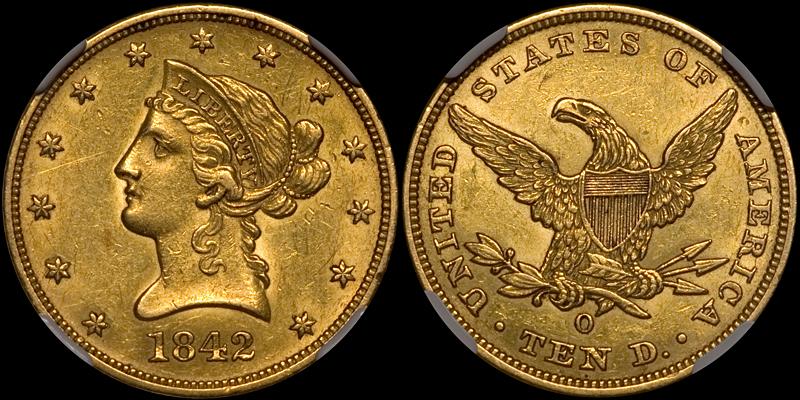
Take two 1842-O Liberty Head eagles in NGC AU58. One is worth $11,500 and gets multiple orders on my website within hours of being posted. The other sells in an auction for $6,325 and is a marginal value. Why is one coin worth nearly twice as much as the other despite the fact that they are the same date in the "same" grade? The coin(s) in question is, as I stated above, an 1842-O eagle in AU58. A little background information on this issue is appropriate to help better understand the issue at hand. A total of 27,400 examples were produced. This issue saw extensive use in commerce and it is essentially the first available eagle from this mint given the rarity of the 1841-O (only 2,500 were produced). When available, the 1842-O tends to be in VF and EF grades and it is scarce in the lower AU grades. It becomes rare in properly graded AU55 and it is very rare in AU58. This issue is an extreme rarity in Mint State with just two or three known. The second finest of these, graded MS61 by PCGS, just brought $74,750 in the August 2010 Stack's auction.

I bought the NGC AU58 example illustrated below at the recent Philadelphia coin show sponsored by Whitman and it was among my best purchases at the show. I paid a strong price for this coin but was happy to do so (and would do so again).

1842-O $10.00 NGC AU58

What makes this a special coin? I was really attracted to this coin by its originality. It has superb deep original coloration on the obverse and reverse which suggests that it has never been cleaned or dipped. Notice the depth of the color and how even it is on both sides. I also like how clean the surfaces are. This is an issue that is typically found with densely abraded surfaces and even the MS61 piece that I mentioned above had considerable marks on the surfaces. This example, however, was immaculate. The luster of this coin, while a bit subdued as a result of the intensity of the color, is undisturbed; a result of its not having been cleaned, dipped or processed. This coin has wonderful overall eye appeal and this sort of "look" is much appreciated by connoisseurs of U.S. gold coins.

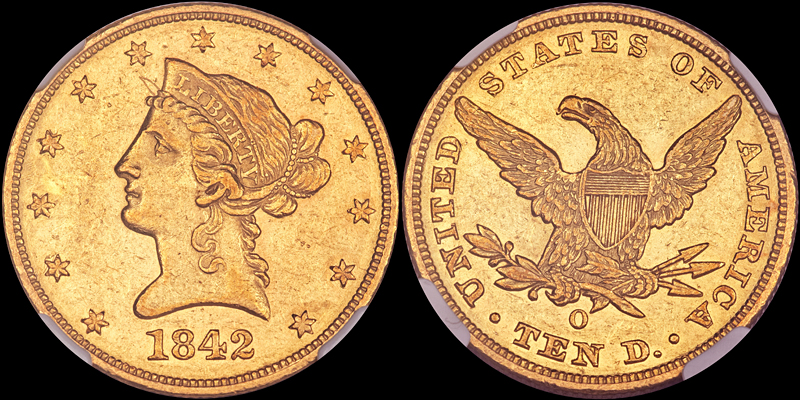
Now take a look at what I consider to be a very average "commercial quality" NGC AU58 that was last sold as Heritage 4/10: 3705. This coin brought $6,325. If you were the successful bidder, you might want to cover your eyes and not read this paragraph but...I didn't like this coin. Why didn't I like it? A number of reasons. First, I think the coin was over-graded. I regard it to be little better than AU50 to AU53 and have a problem with it in a 58 holder. Secondly, the coin is almost entirely unoriginal. It has little natural luster and is brighter than I would like to see in a coin graded AU58. Finally, it is very scuffy for the date and grade. There are numerous marks in the fields and the luster is clearly broken on both the obverse and reverse. A detracting elliptical-shaped mark below star six might possibly be mint-made but, to me, it really hurts the overall eye appeal.

1842-O $10.00 NGC AU58

Here's an instance where a plus grade would help distinguish the coins a bit or, even better, a designation of "original surfaces" could be placed on the DWN AU58 which might allow potential buyers to know the coin is special.

The difference in values for this issue in this grade is not a one-time occurrence. Heritage 4/06: 3915, a remarkably clean AU58 example in a PCGS holder, brought $15,065. This is more than two and a half times the amount that Heritage 4/10: 3705 brought earlier this year.

The moral of the story is that a grade on a holder is important but coins still sell themselves based on excellent visual appeal.

A Numismatically Significant 1859-D Quarter Eagle

I recently bought and sold a seemingly innocuous 1859-D quarter eagle that had a great degree of numismatic significance. Before I explain why, let me give you a little background on the specific coin and on this issue in general. This 1859-D quarter eagle has been graded as Fine-15 by PCGS. It is the single lowest graded example of this date seen by either service. In looking back through my records, I have seen very few that grade below Extremely Fine and certainly can't recall a non-damaged Fine example.

The example I sold is problem-free and actually quite attractive despite its extensive wear. It shows nice natural coloration and the obverse is a full Very Fine from the standpoint of detail.

This is the final quarter eagle produced at the Dahlonega mint. But, for all intents and purposes, the death knell for this denomination at the Dahlonega mint had been spelled as early as 1854 when mintages figures declined precipitously from the 1840's. In 1856, only 874 were struck; making this the lowest mintage figure of any coin ever produced at this branch mint. In 1857-D, the mintage increased to 2,364 but no quarter eagles were made in 1858. 1859 saw a resumption of the denomination but only to the tune of 2,244 coins. None were struck in 1860 and when the mint closed in 1861, no further plans had been made to coin quarter eagles.

The 1857-D and 1859-D are interesting issues among the quarter eagles from this mint. The grade distribution is different for these issues than for nearly all other coins from Dahlonega. The coins from the 1840's and early 1850's have what I regard as a typical distribution of survivors: most are in the VF-EF range with AU coins being scarce to rare and Uncirculated coins being very rare to extremely rare.

But in 1857 and 1859, the distribution curve looks different. These two dates are almost never seen in grades below EF and are most often seen in About Uncirculated. Both are rare in Uncirculated but not as much so as their very low mintage figures would suggest. There are as many as ten Uncirculated 1859-D quarter eagles known as well as another four or five dozen in About Uncirculated. This doesn't seem like a lot of coins but when you consider that there are only 150 or so known from the original mintage, the fact that nearly half grade AU or better suggests that this issue didn't circulate as freely as the quarter eagles from the 1840's.

I had long believed that the 1859-D was an issue that saw very little circulation. The existence of the coin shown above is proof that at least a few examples did circulate. I don't believe that this Fine-15 example was a pocket piece as it shows all the hallmarks of extensive natural circulation. Ironically, it is more rare in this grade than it is in Uncirculated and, to my way of thinking, this is one of the neater Dahlonega quarter eagles to have come up for sale this year: a highly circulated example of a date that was hitherto believed to have never seen extensive circulation. Considering that this coin cost its new owner well under $2,000 I think it is an amazing piece of Southern gold history.

Some Recent Observations From A Coin Show Perspective

Having just come from the Philadelphia Whitman Coin Expo show and, the week before this, the Long Beach show, I feel pretty qualified to make some market observations. Without further ado, I'd like to share them with you. 1. There Are Too Many Coin Shows Right Now. I'm sure I'm not going to make any friends with coin show promoters for saying this but with Long Beach occurring last week, Philly this week and the St. Louis show next week, this is too many coin shows in a short period of time. I saw few fresh coins in Philadelphia because I looked at many dealer's coins in Long Beach and the thought of turning around next week and going to St. Louis...uh, no thanks. The market just can't support this many shows and this is why you are seeing many formerly good regional three and four day events beginning to die rapid deaths.

2. Buying Nice Coins Is Tough, Tough, Tough. If you thought it was hard two or three years ago to buy nice coins at shows, it is as tough now as its ever been; maybe tougher. I've heard dealers all of all sizes and shapes complain how hard it is to find interesting fresh material at recent shows. I was lucky and I had an amazing ANA show with lots and lots of great new coins to offer DWN clients. But it is a real grind to find coins now and, clearly, the good stuff is going off the market and staying there.

3. Everyone Wants to Buy Type One Double Eagles. There are many firms and individual dealers (myself included) who are very active buyers right now of Type One double eagles. At the Philadelphia show I saw almost nothing for sale other than the usual motley assortment of Uncirculated S.S. Central America 1857-S , a few lower grade common dates and the odd overpriced rarity here and there. This is clearly an extremely popular area of the market and coins in the $2,000-15,000+ price range are exceptionally popular right now.

4. And CC Double Eagles Too. You can add $2,000-10,000+ Carson City double eagles to this list as well. They are most definitely in strong demand and if the coins are properly priced (or even just a hair too expensive) they are easy sellers. Even big money coins like 1870-CC double eagles are beginning to sell again and I am aware of at least two EF examples changing hands since ANA. If you have any nice CC double eagles for sale, please contact me as I'd like to buy them from you!

5. Nice New Orleans Gold Has Disappeared. Where has all the nice New Orleans gold gone? Good question. The last few months have seen very, very few interesting New Orleans gold coins available and the few choice or rare pieces that I have had in stock have sold quickly. Clearly, this is an area of the market that is very active.

6. And Dahlonega Gold Also. I think you can safely add choice, original Dahlonega gold in all denominations to the "where the heck are the coins?" list. I can generally only find two or three decent D mint coins at a major show and they seem to sell very quickly when I list them on my website.

7. Coin Pricing Is a Total Disaster. I've mentioned this a number of times but I am finding it more and more of a hassle that coin pricing is such out of touch with reality. What typically happens is that one very low quality rare coin trades cheaply at auction and Trends whacks the price for the issue down. This has recently happened with rare, desirable coins like the 1796 No Stars and 1808 quarter eagles and the 1795 eagle. I look at this as, in its own way, as big a concern in the coin market as the doctoring issue. One reason why good coins aren't being sold is that pricing doesn't reflect the real value of choice, high end pieces. Fix this problem and you will fix the lack of supply that is hurting the market right now. Don't fix it and new buyers will be more interested in purchasing MS64 Saints than "real" coins.

8. I'm Not Seeing Many PCGS "Secure" or "Plus" Coins. Either the new PCGS Secure and Plus program isn't working or its working so incredibly well that the coins in these holders never make it to the market, But I am not seeing many of these coins and I continue to feel that CAC has really set the pace in the high end segment of the market. It remains hard to price PCGS Plus and Secure coins when so few trade at auctions or at shows.

9. The Birth of the "Lucky Charms" Grade. I wish I was clever enough to have invented this term but, alas, I'm not. But I recently have seen coins graded "AU58+*CAC" and these pieces with all the attached symbols and stickers are now known as "Lucky Charms" coins because they seem to have imported their verbiage from the shapes found in this cereal. Magically delicious, no?

Some Further Thoughts on Carson City Double Eagles

I've been working on a third edition of my book on Carson City gold coins. For some odd reason, I've been working from back to front, meaning that I've done the new research of double eagles before following this with eagles and half eagles. I've been able to uncover some really eye-opening new information on the rarity and price levels of Carson City double eagles and I'd like to share a few tidbits. The last Carson City book that I produced was published in 2001, so almost a full decade has passed. My first impression about the market for Carson City double eagles is that it has become far, far more active than ever. Prices have risen significantly since 2001, especially for rarities and for high grade pieces.

In 2001, the five rarest Carson City double eagles in terms of overall rarity (i.e., total known) were the 1870-CC, 1891-CC, 1871-CC, 1878-CC and 1879-CC (these last two issues were tied for fourth rarest). In 2010, the five rarest Carson City double eagles in terms of overall rarity are the 1870-CC, 1871-CC, 1891-CC, 1879-CC and 1885-CC (these last two issues were tied for fourth rarest).

The 1870-CC has remained an extremely rare coin, despite a surprisingly high frequency of auction appearance in the middle part of this decade. I had previously thought 35-45 were known. Today, I think that number is around 40-50. This includes a number of low grade coins and at least five or six that are either damaged or cleaned to the point that can not be graded by PCGS or NGC.

The rarity of the 1891-CC seems to have diminished quite a bit. I think there are two reasons for this. The first is that I overestimated its rarity in 2001. The second is that a significant number of examples have been found in Europe and other overseas sources. This date hasn't become plentiful in higher grades but it is far more available in AU50 to AU55 than I ever remember it being before.

The 1871-CC seems more available as well. In 2001, this issue was very hard to find in any grade and it was almost never seen above AU50. Today it is more available and the number of coins graded AU53 to AU55 has risen dramatically. I would attribute much of this to gradeflation as the majority of the 1871-CC double eagles that I see in AU53 and AU55 holders are "enthusiastically" graded, to say the least. In properly graded Mint State, the 1871-CC remains exceedingly rare.

A date whose rarity has become more apparent is the 1885-CC. In the 2001 edition of my book, this date was not even listed in the top six rarest Carson City double eagles. I now rank it as being tied for fourth along with the 1879-CC.

Everyone loves a sleeper, right? The dates that I believe are underrated (and undervalued) in the Carson City double eagle series include the 1872-CC, 1877-CC, 1882-CC and 1892-CC.

In higher grades (AU50 and above), the rarity scale of the Carson City double eagle series has remained remarkably consistent. In 2001, I stated that the 1870-CC, 1871-CC, 1879-CC, 1878-CC, 1891-CC and 1872-CC were, in that order, the six rarest issues. In 2010, I believe the six rarest are the 1870-CC, 1871-CC, 1878-CC, 1879-CC, 1872-CC and 1891-CC. In other words, the same six dates are still the keys in higher grades but there are now some minor changes in the order.

How much more available have high grade Carson City double eagles become since 2001? In some instances, population figures have doubled or even tripled. This tends to be primarily in the MS61 and MS62 range and I think there are a few good reasons for this. The first is gradeflation. Some coins that were nice, high end AU55 to AU58 pieces in 2001 are now MS61 or even MS62 by today's more liberal standards. The second is resubmissions of existing coins. For many Carson City double eagles there is a significant price increase from MS61 to MS62 and submitters may send in a high end coin many, many times in attempt to get a higher grade. The third reason is that some very impressive coins have been found in Europe since 2001. I know that I have been able to buy dozens of fresh-to-the-market Uncirculated CC double eagles that trace their origins to overseas sources and I would imagine that other dealers have handled numerous choice, fresh Mint State pieces as well.

If you purchased Carson City double eagles in 2001 and have held them since, you have done very nicely. Obviously, one of the main reasons for this is the fact that gold has gone from around $400 to close to $1300 in the past decade. I can remember buying common date CC Twenties in lower grades (VF and EF) in the early part of this decade for $750 or so. Today, the basal value of any CC double eagle is around $1,750-2,000.

Prices of high grades coins are interesting to study. One date that I looked at carefully was the 1893-CC, mainly because it is more available in MS63 than any other CC double eagle. In 2001, you could buy an 1893-CC in MS63 for around $10,000-12,000. In 2005-2006, the same coin would have probably cost you between $15,000 and $20,000. Today, if you can find an 1893-CC in MS63 it will run in the $25,000-30,000 range and a really choice PCGS example with a CAC sticker might even bring $35,000.

I'll continue to tease you with updates on my Carson City book in the coming months and I'm hoping that it will be ready for publication sometime in the Spring of 2011.

Five Things You Can Do to Make Your Coins Worth More

If you have been collecting rare coins for more than a few years, there is a good chance that you have "found money" in your holdings. What I mean by this is that there are a number of things that you can do--often with little or no cost--that can significantly improve the appearance and value of your coins. Here are five suggestions: 1. Send Your Coins to CAC. CAC is now well established as an important factor in the high-end segment of the market. In certain areas, CAC coins trade for a nice premium and there is no doubt in my mind that a CAC sticker makes a coin more marketable. Submitting a coin to CAC is very inexpensive; typically just $10 to $20 per item. Another thing that's nice about submitting coins to CAC is that you are getting an expert's opinion (in this case John Albanese) for next to nothing. You might try sending a sample of your five best coins to CAC. If you get CAC approval on all five coins, you know you are doing something right. If only one or two get the coveted "green bean" then you can assume that the dealer you are buying from needs to be replaced.

2. Attribute Your Coins. Let's say that you are a date collector of early half eagles. It makes sense to purchase the Bass-Dannreuther book on early gold to attribute all your coins to "BD" numbers. You might get lucky and find that one of the coins that you own is a very rare die variety. This isn't necessarily an immediate financial upgrade, as it would be in a series like Bust half dollars or Large cents which are avidly collected by variety. But wouldn't you rather keep the potential financial upgrade for yourself than to read on page three of Coin World how some lucky collector just cherry-picked an excessively rare variety of 1806 half eagle? Also, if PCGS or NGC attributes varieties in the series you collect and you find a good variety, have it marked on the slab.

3. Pedigree Your Coins. If you have a coin from a famous collection like Bass, Garrett, Eliasberg or Norweb, a pedigree can add value. Some coins from these collection are clearly marked on the PCGS or NGC insert. But there are hundreds of others that have "lost" their pedigree for one reason or another. I'd suggest that you purchase all of the major auction catalogs in the area that you specialize in and spend a few hours searching through them. Your coin(s) may have a different appearance than they did in an earlier sale, but if they have an obvious mark this will make it easy to trace them. If a great pedigree is easy to prove, send the coin along with a xerox of the catalog page to PCGS or NGC.

4. Reslab Your Coins. Please note that I didn't say "regrade" your coins. That's another subject entirely and one that, if you have coins in old green label or "fatty" holders, I do not necessarily think will add value to your coins. What I mean by "reslabbing" is that many coins are in holders that show severe scuffing, wear, or dullness. A great coin can look just so-so if the holder it's in doesn't present itself well. I know this sounds a little hokey but its no different than deep-cleaning your house when you get ready to sell it. If all of your coins are in pretty, fresh slabs it is going to make your coins look nicer.

5. Create a "Cult of Personality." For a number of reasons, there are many collectors who become larger than life because of what they collect. Some of these individuals become famous because they buy seven figure coins. Others become famous because they write books or articles about the area(s) that they specialize in. And others become famous because they are "mensches" who endear themselves to collectors and dealers alike. A collector who has worked hard to establish himself as a leading authority on Charlotte gold coins is probably going to have an easier time selling his coins than a collector who is totally unknown; even if the mensch has inferior coins, the belief that he has high quality will typically outweigh the reality. The same holds true for collectors on the PCGS and NGC Message Boards. Creating the illusion of collecting greatness is a lot easier today than it was in the pre-Internet era.

These are just five suggestions. There are many others that I can think of, and I'd be interested in hearing your suggestions as well.

What Does "On Hold" Mean on Your Website?

I was asked this seemingly innocuous question by a client the other day and it made me pause. Even though many coins are listed as "on hold" on my website, there are actually a number of potential scenarios that could more accurately describe them. These deserve a brief explanation and an end-of-the-blog realization (I hope) that just because a coin marked on hold it doesn't mean that you shouldn't inquire about it. In most instances, a coin is marked "on hold" because it has been ordered by an existing client and sent out to him on an approval basis. Generally, the status of such a coin will change quickly as I tend to ship coins out the same day they have been ordered by overnight delivery. If a coin on approval is sent out, say, on a Tuesday, I might known its atatus as early as Wednesday or Thursday.

However, I do not mark such a coin as being "sold" until it is paid for. If I trust a client enough to send him a $5,000 coin on approval, I trust him enough to pay me in good funds for it. That said odd things do happen from time to time and it is not impossible for a coin that I thought was sold on Thursday to become available again on Friday.

If a coin is sold to a client and he requests extended payments, the coin is taken off the website. This way, coins won't sit and fester with an endless "on hold" status. I update my website constantly and as soon as I know the exact status of a coin, it is marked as such.

There are times when another dealer or a collector will ask for a coin on my site to be put on hold for a pre-determined period of time while he tries to sell it or, in the case of a collector, he makes a decision. In most instances, this decision-making period is 24 to 48 hours. I don't think its fair for a coin to be tied-up longer than this and I do not generally allow for this to happen.

In a case where a coin is "on hold" while being considered, I will typically tell the second person who calls that they have second shot should the deal fall through. This doesn't happen often but it does happen enough that I would strongly urge you to request second shot on a coin you want even if it is already marked as being on hold.

The "on hold" process might be slowed down by a few factors. If the potential buyer of a coin wants it sent to CAC for approval or to PCGS for a crossover this will add time to the process. I don't want to take such a coin off my website as it is still not technically sold but, to be fair to the buyer I might attempt to get the coin stickered or crossed. Or, there might be a situation where the coin was shipped to a collector on Monday but he is out of town on business for a few days, slowing down the process.

Sometimes I will have a coin on my site marked as "sold." There are a few reasons for this. The first is thast, after selling a rare or important coin, I kind of like to brag a little bit. I might leave it up as being sold for a few days just to show people looking through my coins that I am capable of selling major coins. Plus, it feels good for me to browse my coins and see a few "solds" here and there.

I'm in the business of selling coins, so I want as many people as possible to feel confident about the entire buying process at DWN. I know collectors get frustrated when they go on my website and see many of the coins marked "on hold." I'd like to think that this is because I sell really nice coins and that there are a lot of people looking for the quality that I specialize in. Because I run a small, boutique coin business, I don't have salespeople who will manage want lists or send out emails with specific coins you may (or may not) be looking for. My feeling is that by maintaining and frequently updating a high-quality website, I am giving everyone an equal chance of purchasing coins with character.

Please remember that a coin marked as "on hold" could become available but if I don't know that you have an interest in it, it will never be offered to you directly. Just send me at email at dwn@ont.com or phone me at (214) 675-9897 when you see a coin on my site that is of interest. I will give you as much information about its availability as I can and, who knows, it might be sitting on your desk in a few days!