Rating the Numismatic Auction Companies

For better or worse, auctions have become a more integral part of the numismatic scene than at any time in recent memory. In 2006, hundreds of millions of dollars worth of coins traded at auction and a number of price records were set. How do I rate the auction companies and what are their strengths/weaknesses? I thought it would be interesting to share my opinions of the five major American numismatic auction firms. There are five categories that I feel are important to consider: catalogs (and the ability to accurately catalog coins), websites (ease of use, usefulness, technology, content and images), customer service (how well do these companies handle problems), prices realized (what types of coins bring the most money at each sale) and overall strengths and weaknesses. Each of these categories is then ranked as follows: excellent, very good, good and poor.

1. Heritage: In the past few years, Heritage has clearly become the industry leader. It is now common for Heritage to conduct a $20-30 million dollar sale which features a huge variety of coins ranging in value from a few hundred dollars to hundreds of thousands of dollars. Heritage has become dominant for two reasons: their use of technology is incredibly innovative and they are extremely aggressive when it comes to securing consignments.

Catalogs: Heritage produces a good catalog. Their use of graphics is exceptional and the design is far more professional than any other firm. Their photography is not as good as certain other firms but I would attribute this primarily due to the fact that they tend to have so many more coins for sale that they can not spend enough time on quality control. I regard their cataloging as good to very good. They write nice, accurate descriptions of coins but tend not to have enough time or manpower to do much in-depth, original research.

Website: No one has a numismatic website with more useful bells and whistles than Heritage. It is incredibly easy to bid online in their sales and their auction archives feature is wonderful. My one complaint about the Heritage website is that it is a bit cold and impersonal. But its overall ranking is excellent and no other numismatic auction firm even comes close.

Customer Service: Since Heritage sells more coins than anyone else, they make more mistakes. But I’ve found them to be excellent at dealing with these issues in a timely and fair fashion. I would advise the collector to find someone at Heritage they like and build a long-term relationship with that person. I personally recommend Sam Foose.

Prices Realized: Prices in a typical Heritage sale tend to be strong, especially due to the fact that they have dramatically more retail buyers participating than anyone else. The areas that Heritage does best in are 20th century issues and Registry Set quality coins. Their weakest areas tend to be the more sophisticated, esoteric areas that Stack’s/ANR excel in.

Strengths and Weaknesses: Heritage has the best website and the greatest number of bidders of any numismatic auction firm. They are extremely easy to do business with despite their size. My major complaint with Heritage as a consignor is that their sales are way too big and coins can get lost in 5,000+ lot sales. But they are clearly the leader in this segment of the market and this does not appear to be changing any time soon.

2. Stack’s Rarities: In the fall of 2005, Stack’s and American Numismatic Rarities merged. I am basing my ratings for this new firm primarily on ANR as I’ve had many positive experiences with this firm in the past unlike Stack’s who I have not.

Catalogs: ANR, hands down, had the best catalogs in the numismatic auction business. No one does a better job of cataloging coins that ANR, especially rare and esoteric items like tokens, medals and colonials. With the exception of colonials, I thought Stack’s cataloging was inconsistent, at best. Stack’s color photography was exceptional while ANR’s wasn’t as good. Assuming these firms can combine the best of each world, their new catalogs should remain the best in the industry.

Website: Stack’s website was very poor for many years but in the last two or three years it improved considerably. ANR’s was decent but could have stood to have been updated and given a technological makeover. The new combined website is good to very good but it still is long ways away from comparing to Heritage’s.

Customer Service: I always thought ANR had excellent customer service while Stack’s was poor. It will be interesting to see whether the new firm is friendly and “small townish” like ANR or rude and “New Yorkish” like Stack’s. My two “go to” people at ANR have always been John Pack and Cynthia LaCarbonera and I think very highly of both of them.

Prices Realized: ANR and Stack’s were both capable of realizing extremely strong prices for fresh, original collections. Their prices for the more mundane meat-n-potatoes items which constitute the bulk of most sales were never as strong as Heritage’s due to the fact that neither firm had an active online bidding presence.

Strengths and Weaknesses: It will be interesting to see how the combination of Stack’s and ANR works. There is a tremendous amount of talent present at the two firms although this talent tends to be more academic while Heritage’s is, in my opinion, more market-savvy. I would expect that the new Stack’s Rarities firm will never replace Heritage as the top dog in the numismatic auction world but it will continue to at least keep Heritage from getting too complacent.

3. Bowers and Merena: The last few years have been a roller coaster ride for Bowers and Merena. As recently as the early part of this decade, Bowers and Merena was one of the major forces in the coin auction business. A disastrous stretch during the middle part of the decade almost destroyed this firm’s reputation but the last year or two have seen considerable improvement.

Catalogs: The graphics and design of a B+M catalog are good but the overall quality of the cataloging and the images could stand improving. However, I have noted a marked change for the better in the past year. B+M still needs to hire photographers who can make coins not look like lumps of coal.

Website: The B+M website is attractively designed but it does not have many interesting features. Bidding online is easy and secure. I would rate their website as good but it could certainly stand to be improved.

Customer Service: I have had a few problems in the past with B+M but they have always been resolved to my satisfaction. The biggest problem that this firm has had in recent years is considerable turnover which makes it difficult to establish a relationship with a capable person. I would personally recommend dealing with Debbie McDonald as I have found her to be very competent and honest.

Prices Realized: In the past year or two, Bowers and Merena has begun to create a niche as a company who is able to get strong prices in the various 20th century series. Their ability to get collections which are strong in 18th and 19th century material is not yet as well developed.

Strengths and Weaknesses: After a rough few years, Bowers and Merena has established itself as a strong #3 in the coin auction business. But in order to become more competitive, they will have to show they are capable to doing something that distinguishes themselves from their competitors.

4. Goldbergs: As someone who runs a niche business himself, I admire the fact that Ira and Larry Goldberg have a clearly defined goal as a company. They do not want to be as big as Heritage and they want their sales to be small, manageable and held in their own backyard of Beverly Hills. They have created a well-run, solid company that consistently offers good coins.

Catalogs: I think the Goldberg catalogs are very nicely designed with excellent graphics. Their cataloging is weak and their images appear to be enhanced. I would not personally feel comfortable bidding on a coin in one of their sales based on the image in the catalog.

Website: The Goldbergs website is solid if unspectacular. It is sometimes hard to find a specific coin due to an unsophisticated search feature. I do not personally care for their online images although I think they look more realistic and accurate than the ones in their catalogs.

Customer Service: The level of customer service in this firm is very good and when problems arise it is easy to deal directly with one of the owners. I personally recommend dealing with Glenn Onishi who I have known for many years and who I think is extremely trustworthy.

Prices Realized: Like any coin auction firm, the Goldbergs can get great prices for fresh, original deals. They tend to have recycled dealer consignments in their auctions and these coins typically bring exactly what they are worth. My one complaint with their sales is that some coins are too aggressively reserved by consignors.

Strengths and Weaknesses: If you live on the West Coast, this firm is a good resource. I’m not certain that I would travel all the way from the East Coast just to attend a Goldberg sale but the fact that they are typically held in conjunction with the Long Beach shows makes them convenient for dealers. The best compliment I can give this firm is that if I were creating an auction company, it would have many of the same basic goals as the Goldbergs do.

5. Superior: This is another firm that appears to have seen better days. Back in the 1980’s and 1990’s, Superior sales were massive and featured extremely interesting coins. In the last few years, the volume and quality of their sales appears to have shrunken considerably although they still get the odd interesting fresh deal every now and then.

Catalogs: Superior’s catalogs are unimpressive from a visual standpoint. Their cataloging is underwhelming and their images are poor. To remain competitive in the marketplace, they will have to improve in these areas.

Website: Not to pick on Superior, but their website is by far the worst of the five firms discussed in this report. It is confusing, sloppy and difficult to navigate. This is another area that will require a comprehensive overhaul by the powers that be at Superior if they are going to remain relevant in this increasingly web-driven business.

Customer Service: I’ve found customer service at Superior to be well-intentioned but erratic. One person at Superior who is very competent and knowledgeable is Larry Abbott. I have also had good experiences with Paul Song.

Prices Realized: Prices at the last few Superior auctions have ranged from very strong to indifferent. These sales are generally not well-attended and have little retail participation.

Strengths and Weaknesses: The numismatic auction business is very competitive and Superior finds itself (currently) lagging. The future of this firm depends on whether or not they can retain their key personnel. I’d guess that if Superior’s next two or three sales are not successful then the signs are ominous for their future.
Factors That Determine a Good Coin Show

I hate to think how much time I’ve spent at coin shows. As an example, I’ve been going to Long Beach for 24 years now. Long Beach shows are held three times a year (that’s 72 Long Beach shows) and I’m there an average of three nights. Which adds up to a total of at least 216 days spent at Long Beach shows or, gulp, nearly three-quarters of a year. There are clearly good coins shows and bad coin shows. What are some of the factors that make a coin show good and why do some thrive while others languish or die?

1. Location: I live in the far upper left corner of the United States so every location is tough for me to get to. But I can endure endless plane flights to Orlando for the FUN show or to Baltimore (two or three times a year) because these are first-rate shows where I do a lot of business. A good coin show needs to be in a heavily populated area and in an area that is regarded as being “good” for coins. It is hard to explain why a wealthy, vibrant city like San Francisco is not a good coin town but it is pretty easy to venture a guess that St. Louis (a site of numerous conventions) is a really bad coin town. New York would seem to be a great location for coin shows but the price of putting on a good show in Manhattan makes it prohibitive for most promoters. I’ve often wondered why there aren’t more shows in Chicago—it’s in the center of the country and home to many collectors but for whatever reason there hasn’t been a major show in downtown Chicago for years.

2. Facilities: I don’t even want to attempt to figure out how many days of my life have been in spent in convention centers across the United States. After a while, the convention center in Pittsburgh seems to blend into the facility in Kansas City which appears to look like the building in Denver. But I will say that a nice, convenient location sure beats spending a few days in the basement of some ratty motel. I can remember coin shows back in the 1980’s that were held in underground garages and others that I half expected my lunch to be carried off by vermin. Unfortunately, a nice facility does not guarantee a good show. The Palm Beach show which died a fast death last year was held in a beautiful new facility in a great city. The bad news was that the closest hotel to this facility was a long walk and just try to get a flight from Portland, Oregon to Palm Beach, Florida…

3. Timing/Conflicts: One of the reasons why everyone loves the FUN show is that it’s held in a (usually) sunny climate in a month that’s traditionally gloomy and awful if you live in much of the non-tropical parts of the country. If the FUN show were held in Boston in January, I don’t think it would quite as popular. Another important factor to consider about a show is its conflicts with the traditional coin circuit. If I were starting a brand new show I would make certain it isn’t competing against a major convention and I would also be sure that it wasn’t being held a week or two after a major show. I suffered from a major case of “show burnout” in 2005 and 2006 and the conventions that I decided not to attend were the ones held too soon after major shows.

4. Public Attendance: This is less of a factor for me today than it might have been in the past. Many of my clients do not attend coin shows and prefer to do business with me via private treaty. And with just a few exceptions, I look at coin shows as opportunities for me to buy and sell coins with dealers. The exceptions to this are the major shows like FUN, ANA, Central States and Baltimore. I typically meet a number of collectors at these shows and I tend to stay longer, in an attempt to be “retail friendly.” The bottom line is that a show with good retail attendance has a much better buzz than a show that seems like a morgue and this translates to a better overall atmosphere.

5. Major Auctions: Every major show has a major auction which is held in conjunction with it. You can have a major auction without a coin show attached to it but you certainly can not have a major show with an auction to bring in collectors. One of the problems that new shows face is the difficulty in getting an auction company to commit to holding a major auction. At this point, the only big show that does not have an auction which I consider first-rate is Baltimore but even this seems to be changing as Bowers and Merena is attracting more interesting and better consignments. At other shows, like FUN or ANA, the problem tends to be too many auctions and not enough time to get these auctions done.

6. Grading Services In Attendance: If PCGS and NGC aren’t at a coin show, no fresh coins get made and the show is a waste of time. This may not necessarily be the case for a collector but for a dealer it goes without saying that “if the coins aren’t being made than the dealers aren’t getting paid.” I can’t think of a single coin show that I’ve attended in the past few years that was worthwhile when one or both of the major services weren’t in attendance.

7. Miscellaneous Factors: I can think of a few other factors that separate the wheat from the chaff as far as shows go. If the best hotel option is a Motel Six, then I’m probably not going to be anxious to get a table at a show. The same goes for the ability to fly into a town. If I’m traveling with coins and I have to change flights three times or fly a tiny commuter plane, I’m either going to come without coins or, better yet, not go at all. Safety is always a factor with me. I do not like going to shows in downtown Detroit or St. Louis because, in all honesty, I don’t feel safe. By the same token, I’ve always thought that suburban venues were sterile and boring and it’s sad when your best dining option after a hard day’s work is Applebee’s.

In summary, I think there are too many coin shows and I, for one, have decided that I will not be attending as many of them in 2007 as I did in 2005 or 2006. I’m not certain if other dealers will do the same (everyone complains about there being too many but everyone is too greedy to not go to every major show) but I predict that whenever the market gets soft, some of the shows that seem healthy now will either contract or fade away altogether.

November Baltimore Show Review

Great crowds, a strong gold market, a daily ration of Lobster rolls from the nearby Legal Seafood Restaurant, amazing Spring-like weather…what more could you ask for at the third and final Baltimore show of the year? It was an excellent show and one of the few in some time that had me wondering if I wasn’t leaving too early when I boarded the plane at BWI airport late Friday evening. Baltimore has clearly become the #3 coin show, trailing only the FUN and ANA conventions and the Fall edition is, in my opinion, easily the best of the three held each year. Thursday was a day given over primarily to wholesale trading and it was one of the busier days I can remember having at a coin show all year. From the minute the show opened until it closed that day, I was busy buying and selling. In the course of one three hour burst in the middle of the day, I sold three six-figure coins including a Stella in PR66 and a very rare piece of Proof gold.

It was really easy to sell coins at this show, provided that the coins were interesting or fresh. Given the fact that I had a number of interesting, fresh coins in my inventory, it was clearly a great selling show. Buying was another story altogether. There were just not a lot of interesting coins at the show. I spent much of Friday pounding the pavement looking for interesting gold coins. I did find a few great items (all of which are listed on my website with descriptions and images) but would have liked to have purchased more.

If you collect Carson City gold coinage, I have a major announcement to make. I am working on acquiring two important collection of Carson City gold with an emphasis on eagles. I hope to have these available in a few weeks and when I do, you will have the opportunity to acquire numerous important coins including a few Finest Knowns and many Condition Census pieces. For more information, please feel free to email me.

The Stack’s/ANR sale held prior to the show did not contain much in the way of rare date gold coinage. It did contain some amazing Washingtonia from the fabled Norweb collection and prices were, in most cases, remarkable. Still think that a good pedigree doesn’t make a difference to buyers? Try explaining that to the room full of buyers at this sale.

One of the most remarkable items in the auction was a unique presentation medal awarded to Zachary Taylor and struck from the first gold found in California in the original Gold Rush days of 1848. It was massive (weighing a pound), it was gorgeous, it was fresh to the market (having been consigned by descendants of President Taylor) and it was accompanied by its original presentation box. It sold for $460,000 which is almost certainly a world-record price for a United States medal.

I did not participate in the Bowers and Merena auction held during the sale because it contained virtually no gold coins of interest to me. I was told that a number of Registry Set quality 20th century coins sold for very strong prices including a PCGS MS67 1941-S half dollar which brought an amazing $90,800 (!). Its probably not my place to comment here about this purchase and I’m certain that the new owner is happy with his coin but $90,800 is A LOT of money for a 1941-S half dollar, especially given the fact that a nice MS66 can be readily bought in the $2,000-3,000 range. This is an example where I think two bidders kept pushing and pushing in a display of who is more macho and the winner may well have been the loser. (But you have to think the consignor, at least, was thrilled…)

Gold jumped up quite a bit right before the show began which gave generic issues a nice little upward push. The generic market is still not exactly healthy but buyers were more active than at any show since ANA in this area and this translates to greater overall liquidity in the market with more money available for rare coins. It will be interesting to see what generics do in the next thirty days and if they continue to trend upward, I can’t help but think this will be a good thing for the coin market in general.

For me, the 2006 edition of the coin market is pretty much drawing to a close. I am not attending any more shows until FUN in January 2007 and plan on taking some much-needed vacation time in December. I do plan on going to Dallas in mid-December to look at FUN auction lots in what, rumor has it, could be the most valuable coin auction of all time.

Getting back to the Baltimore show for a second, I’d like to answer a question someone asked me the other day. Why has this show grown and prospered in the past few years while the Long Beach show seems to have lost some its luster? I think the Baltimore show is doing a great job of promoting itself and it has, at the very least, doubled in size in the past year or two. In addition, it is now for all intents and purposes the only show of any consequence on the East Coast. When I was growing up in New York, there were major shows in New York, Philadelphia and Boston every month or two. Today, all these shows have fallen by the wayside and the many thousands of serious Eastern collectors are left with Baltimore as their closest convention. One has to wonder if someone isn’t missing the boat not trying to put on a good another good show on the East Coast; perhaps in Philadelphia or a site close to Manhattan.

Which Coins Are the Best Investment?

A potential new client recently asked me a basic but interesting question: which gold coins are the best investments? As those of you who know me realize, I don’t really tout coins as an “investment.” But I want my customers to make money on the coins that they purchase from me and I try to steer them towards pieces that I think will appreciate in value over the course of time. In my opinion, there are a few factors that make specific coins a good investment and which should perform well. Some of these factors are as follows:

1. Liquidity: Does a specific type of coin sell very quickly when I list it on my website or does it tend to languish for an interminable period of time? I notice that certain coins are consistently good sellers. Generally speaking, they fall in the “sweet spot” pricing range of $2,500 to $7,500. They are usually coins with an interesting history and pieces with good aesthetic appeal. As a rule of thumb, the more expensive a coin is the less liquid it becomes (although, in the last three to five years, very expensive coins and ultra-rarities have been remarkably liquid). As I told the gentleman who inquired about coins as investments, the pieces that are the most liquid are the best to own.

The “quality of liquidity” is important as well. Will the person most likely to buy your coin(s) be a specialized collector or a dealer? I personally like coins that I can sell to end-users as opposed to dealers who will look at them primarily as commodities and be more conscious of price than quality.

2. Popularity: Popularity and liquidity are not the same thing. A coin can be liquid but be a part of a not especially popular series (an 1838-C half eagle is an example of coin that is very popular but it is from a series—Charlotte half eagles—that I would not describe as being immensely popular) while a popular coin can be relatively illiquid (an example of this would be an unappealing, lower grade High Relief which most collectors would probably pass on and spend a bit more money to acquire a nice piece). An excellent collection could be created out of nothing but very popular coins—pieces like 1861-D gold dollars, 1839-O quarter eagles, 1838-C and 1839-D half eagles, 1838-D and 1839-D half eagles, 1838 eagles, 1861-O double eagles, etc. I refer to issues like this as the “Krugerrands of Rare Date Gold” as they are coins that are almost like cash.

In the same vein, I am an advocate of “absolute rarity” as opposed to “condition rarity.” A coin like an 1841-O eagle is rare in all grades and I will buy any example I can find, unless it has been harshly cleaned or damaged. An 1843-O eagle is not a rare coin in lower grades and I will generally not purchase a piece unless it grades at least AU55. Give the choice of owning a nice EF40 1841-O eagle or an AU55 1843-O eagle, I would personally rather have the former.

3. Rarity: It would seem obvious that the rarer the coin, the better the investment it is. This is actually not always the case. If a coin is very rare but it is part of a series that is not popular and/or readily liquid, then it may not necessarily be a good investment. An 1846 eagle is a genuinely rare coin that is nearly impossible to find in any grade higher than EF45 to AU50. If I were offered a nice, original AU55 I would certainly purchase it. But this is a coin that I would not expect to sell quickly and it might actually take me a number of months to move it. The problem with this coin is that it is a member of a series (Liberty Head eagles) that does not have many specialists and it is a Philadelphia issue.

The perfect “investment quality” coin is one that is not only rare but which is popular and liquid. A coin that scores highly on all three of these fronts is one that should perform well.

4. Historic Price Performance: With the advances in price dissemination available to collectors, it is easier than ever to track how coins have performed over the past three to five years. We have been in the midst of what is ostensibly the greatest sustained bull market in numismatic history and if a specific coin hasn’t done well since the early 2000’s, than the chances are good it isn’t going to do very well when this market finally cools off.

By the same token, an investor wants to avoid a coin that is currently at an all-time high in price. If you look at the price levels for a coin like a 1911-D quarter eagle in Uncirculated, you can see that it was selling for considerably more money by the beginning of 2006 than it had at any time since the halcyon days of the late 1980’s. It didn’t take a rocket scientist to figure that the 1911-D had probably risen to the point where it was no longer a good value. And this is exactly what has happened, as the value of this issue has dropped 10-20% in the past few months.

If you are a bottom-line oriented coin buyer, avoid issues which appear to be at a market peak. Conversely, being a total contrarian might not be a great idea either. The perfect coins to buy are those that have shown some price increases in recent years but whose price levels still make sense, considering their rarity and grade.

Exciting Coin Sets Yet To Be Assembled

In the twenty-five years that I’ve been a professional numismatist, I’ve had the opportunity to build some pretty interesting coin collections. I’ve put together two of the finest sets of New Orleans gold ever assembled, the unquestioned finest set of Carson City gold and numerous high grade Charlotte and Dahlonega sets, to name just a few. At this point in my professional career, what sets would really excite me to have the chance to assemble? First and foremost, I’d love to have a wealthy, patient connoisseur call me and decide that he wanted to put together a complete set of high grade United States gold. How much fun would it be to be able to buy all the really high grade and really rare issues that I’ve passed on in the last few years because I just didn’t have a home for them at the time?

(And how cool would it be to walk around a coin show with a checklist of all United States gold issues and have to look at it when I saw, say, a nice About Uncirculated 1858-S eagle and remind myself if the collection already had an example of this date or not…)

My dream collection would, in some ways, use the Eliasberg collection as a benchmark but it would have some obvious differences. When the Eliasberg collection was assembled, it was much easier to locate choice, original coins than it is today. Unfortunately, I would be unable to locate early gold that could rival the phenomenal unmolested pieces in the Eliasberg collection; many of which were purchased by the Clapp family as early as the 1890’s.

But I would also be able to buy many issues in much higher grade than what was present in the Eliasberg collection. As an example, many of the post-1880 issues in this collection were represented by very low grade pieces which would be considered unremarkable, at best, today. A number of these dates are now available in fairly high grade as a result of finds in Europe and other overseas sources. It would certainly be fun to tell this new collector that a coin that he just purchased in MS64 was represented by a dingy VF in the Eliasberg collection!

Another collection that I would love to work on would attempt to replicate the John Adams collection of 1794 Cents but in a less specialized fashion (for those of you unfamiliar with this collection, John Adams is a well-known Boston collector who formed a remarkable die variety set of 1794 Cents by Sheldon variety. His parameter for purchasing a coin was to find a piece with a great pedigree entailing as many famous collectors as possible. I have always thought that this was the most fascinating specialized collection ever formed).

The gist of the Adams collection was to “collect the collectors” who had become part of the folklore of the Large Cent culture. This has never really been done in the area of gold; partially because pedigree research on gold coinage is nowhere near as comprehensive as it is on early copper. But wouldn’t a collection that included examples from all of the great gold collections from the past be interesting?

Getting to assemble a major set of early gold coinage would be a lot of fun as well. I’m currently working on a few very impressive sets of early gold but I seldom—if ever—get the chance to buy the macho, six-figure pieces that sometimes come up for sale at shows and auctions. My personal dream assignment would be to assemble a world-class set of Fat Head half eagles (from 1813 to 1834) and to be able to purchase duplicate examples of the dates that the collector and I thought were “neat” or “undervalued.” And to maybe even expand this set to include the die varieties that exist for dates such as the 1818, 1820, 1823, etc. Now that would be fun!

But, really, I have no complaints about what I’m doing right now. I get the chance to work with interesting, nice people who trust my judgment when it comes to coins. Some of these people have become good friends of mine and I’ve now known many of them for over a decade (actually two decades in some cases).

That said, if Paul Allen or Bill Gates call me tomorrow and tell me they are ready to seriously start collecting United States gold coinage, I think I can get the proposal written pretty quickly…

What Constitues A Complete Coin Set?

A client of mine recently asked me an interesting question about whether the addition of a specific Charlotte half eagle would—or wouldn’t—remove the stigma of Incompleteness from his set. I thought this was an interesting question and it got me to thinking about how the presence or absence of certain issues relate to rare gold coin collecting. Not everyone is cut out to work on a complete set. Some collectors do not have the patience; others do not have deep enough pockets. To some collectors, a complete set is monotonous and an exercise in futility. To others, it is an interesting challenge with defined goals.

So what exactly constitutes a complete set?

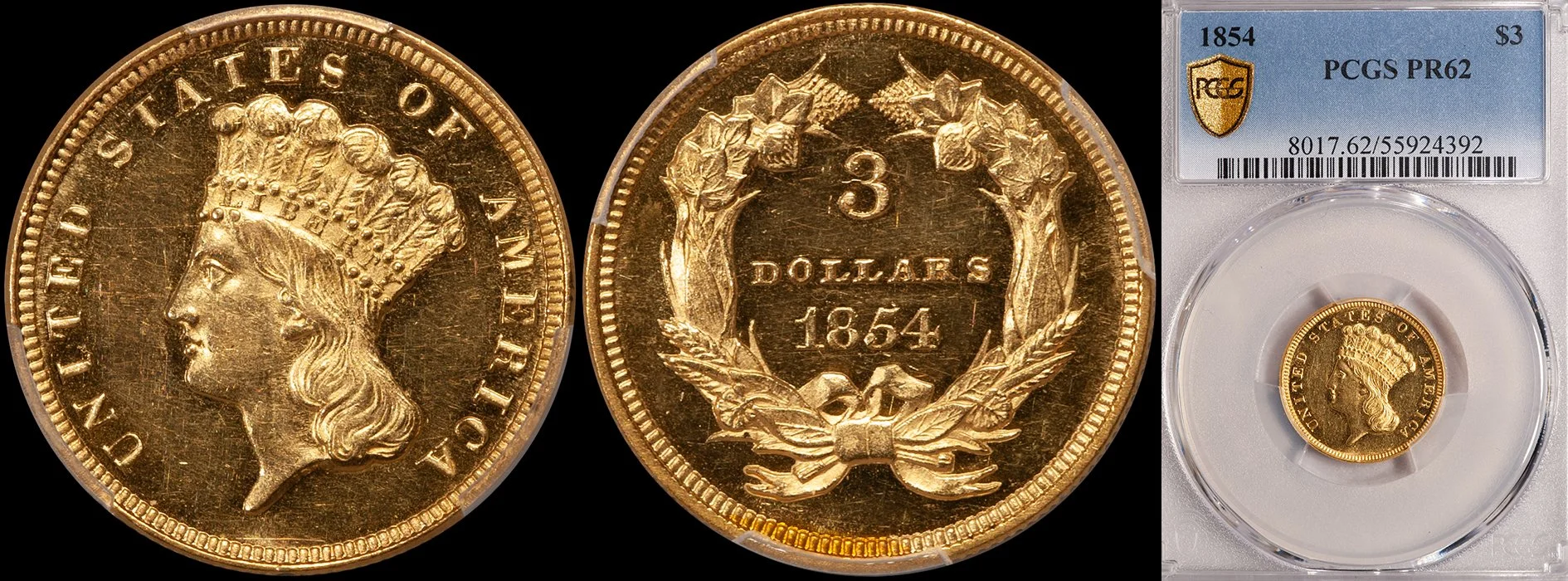
There is no standard answer to this question. As an example, what should a collector do if he collects Three Dollar gold pieces and he doesn’t want to spend $200,000+ to purchase nice examples of the 1875 and 1876. These are issues that were struck only as Proofs and, in theory, they do not need to be included in a set of Three Dollar gold pieces if the focus is business strike issues. In my opinion, a set of Threes is not technically complete without an 1875 or an 1876 but I can fully understand a collector’s decision to not purchase these two issues due to the fact that they were not struck for circulation.

In the case of Three Dollar gold pieces, what is the collector supposed to do about the proverbial elephant-in-the room, the unique 1870-S? My suggestion would be to ignore this date as its extreme rarity makes it an essentially impossible issue to obtain.

In the Charlotte series there are a few issues that are open to debate as to whether they should or should not be in a complete set. In my opinion, both varieties of 1842-C quarter eagles (Large Date and Small Date) and both varieties of 1842-C half eagles should be included. These are design variations which are readily visible to the naked eye. A set that has only one of these could be called a complete date set but it would not be a complete variety set.

What about mintmark variations on Charlotte coins, such as an 1850-C Weak C. Is a set complete without one of these pieces? This is a striking variation and it is not, in my opinion, an essential component of a set unless the set is very in-depth and it includes die varieties and strike variations. In this case, I would then include interesting items such as an 1855-C half eagle with a cud reverse or an 1840-C half eagle with broad and narrow milling.

The Dahlonega series has a few issues that are difficult to decide where they fall as far being included in a set or not. Clearly, the 1842-D Small Date and Large Date half eagles should both be included in the set as they are design variations. What about the interesting 1846-D/D and 1848-D/D half eagles? I have always regarded them as members of a complete set but can totally understand the argument that they are die varieties. And if these two varieties are included than what about the less well-known but equally significant 1840-D and 1841-D Small D and Tall D varieties? Again, my position on these is that they are die varieties and should only be included in a highly specialized collection that includes significant naked-eye die varieties.

And what about New Orleans gold coinage? I have always considered the 1843-O Large Date and Small Date quarter eagles to be essential components of a complete set as well as the 1843-O Small Letters and Large Letters half eagles. In my opinion, anything else is a die variety which does not need to be complete.

What about the 1854-O and 1856-O double eagles; two issues which now cost over $250,000 each for a presentable example? Sorry, but a set of New Orleans gold coinage that is complete except for these two coins is impressive but still not finished. These two coins are totally legitimate regular issues with no stigma of controversy attached to them. If you are a serious enough collector to want to assemble a full set of circulation strike New Orleans gold coins, you just have to face up to the fact, unpleasant or not, that there are two very, very expensive coins waiting for you down the road. And, for better or worse, these two coins are probably going to define the quality of your set.

(Oh, and by the way, the 1841-O half eagle does not exist. So don’t worry about filling a phantom hole…even if this coin is mentioned in the Redbook and the Breen Encyclopedia).

OK, so what about 20th century issues?

In my opinion, an Indian Head half eagle set is very straight forward. The Indian Head eagle set has traditionally required a 1907 Rolled Edge and 1907 Wire Edge to be considered complete. This is a pretty tricky question. The Wire Edge was issued in a large enough quantity that I think its safe to say that it was a regular issue and, thus, it should be included in any set. The Rolled Edge is a much tougher call. Only 50 or so pieces were produced and the fabric of this coin suggests that it is experimental in nature. The 1907 Rolled Edge is listed in the Judd book as a pattern (but, then again, so is the Wire Edge…) but it has traditionally been included in the regular issue set. I’m not certain what the right answer is but I think most advanced collectors have decided that they will purchase the Rolled Edge.

The St. Gaudens set contains some really tricky “include it vs. don’t include it” issues. Obviously, the Ultra High Relief does not belong in a regular issue set. Neither, of course, does the (currently) illegal 1933. What about the Wire Edge and Flat Rim varieties of High Reliefs? To me, it’s obvious that these are strike-related varieties and they do not constitute any sort of design change. The 1927-D? It’s a regular issue coin and you don’t have a complete set of Saints if you don’t have a 1927-D.

2006 Las Vegas Show Summary

The recently concluded Las Vegas coin show could certainly be summarized by the well-known Spaghetti Western director Sergio Leone as “the Good, the Bad and the Ugly.” First, the Good. I wasn’t expecting much from this show. In fact I was expecting so little that I decided to cut my stay to just one night and to bring only a small group of coins that I wanted to blow out of my inventory as I thought they were tired.

The coin show turned out to be more active than I would have expected. Dealers were clearly looking to buy. I sold all of my coins to the first (and only) two people I showed them to and for what I thought were pretty strong prices. In my conversations with other dealers at the show, I got the feeling that some of the doom and gloom that was being bandied about in September might have been a bit premature. The market has certainly corrected in certain areas but I think the pronouncements of its impending demise might have been a bit premature.

I was actually able to buy a few interesting coins as well (all of which are now listed on my website with descriptions and images). I wouldn’t by any stretch of the imagination call this show a blockbuster but it wasn’t all that bad and was certainly worth it for people like myself who live on the West Coast.

Next, the Bad. Do we really need an ANA sponsored show in Las Vegas? Clearly, Vegas is not a “coin town.” There are a lot of reasons to go to Las Vegas but trying to buy coins is probably pretty low on the list. Plus, this show is less than two months after the September Long Beach and just a few weeks before the Santa Clara show held in November. Does the West Coast need a third show in the Fall? I would tend to think not and this could really hurt the future growth potential of the Las Vegas show.

Finally, the Ugly. The previous incarnation of this show was held at the Mandalay Bay hotel. Now I do not consider myself to be a “Vegas kind of guy.” But I love the Mandalay Bay and had really gotten to know my way around the massive grounds. At the Mandalay, a non-gambler like me could find plenty to do in the way of eating, drinking and people watching.

This time, the show was moved to the Riviera Hotel convention center. I didn’t know anything about the Riviera so I went online and checked out their website when I was deciding where to stay. I figured it was a bad sign when I read that I could get a room there for $74 and that their “signature” restaurants were a buffet and a coffee shop.

The Riviera Hotel turned out to be everything I hate about Old Las Vegas. 96% of the people in the hotel were chain smokers and it looked like the average age of the gamblers there was 76 years. Many of the people were wandering around the hotel in a zombie-like stupor and the whole atmosphere was pretty depressing.

Although I didn’t stay there (I wound up at the Wynn which was four times more money but worth every penny) I was told that the rooms looked like they had been last updated in 1974. If the promoters of this coin show are interested in attracting upscale collectors and dealers, I think they are going to have to present a nicer venue than the Riviera. It might have been a swingin’ good time back in the days of the Rat Pack but, today, it was just plain Ratty…

Online Coin Sale Observations

In the last five years, my website raregoldcoins.com has become a primary focus in my business. It has been interesting to observe which coins sell the most quickly and why, in my opinion, they do. I’d like to pass on some of the lessons I’ve learned as I believe it will help you make better decisions when it comes to your collection.ntage Adidas jackets and sporting event tickets. But when it comes to buying coins on Ebay, I think I’m pretty much done. 1. Photogenic coins sell. In this instance the term “photogenic” is interchangeable with the more numismatic term “eye appeal.” When I buy a coin which has really pretty color or which has great luster or which has a very sharp strike (or, better yet, a combination of all these attributes) I can be reasonably certain the coin will sell well. If a coin has a glaring negative attribute that is readily apparent in an image, it is likely to be a hard sell. As an example, an otherwise nice coin which has a large grease spot on Liberty’s cheek will be hard to sell, even if the coin is quite rare. When you are putting together a collection, buy coins that are pretty.

2. Coins in the right pricing “sweet spot” sell. For me, this pricing zone is in the $2,500 to $7,500 range. There are coin dealers who seem to be able to sell lots of $25,000+ coins. (I certainly sell my fair share of them). But once you get past $10,000 or so, the air gets pretty thin in most series and liquidity drops. That’s why I like interesting coins in the $2,500-7,500 range. They are generally quite liquid and I can turn over my inventory a lot more quickly when I’m selling coins in this price range then when I’m selling expensive coins. Let me add that I have no problem with buying expensive coins but that my resistance level increases based on the series. In other words, with early gold coins, there are virtually no decent pieces available in the $2,500-7,500 and I would expand this sweet spot to $10,000-20,000. But with Charlotte, Dahlonega and New Orleans issues, I feel that there is excellent value in the lower price range(s) and my focus shifts accordingly. I will certainly buy a $20,000 Charlotte or Dahlonega coin but it has to be pretty special to get me interested.

3. Interesting coins sell. People like coins which can be summarized in a few words or less. The 1838-C half eagle is popular because it’s a first year of issue and it’s the only Classic Head half eagle from the Charlotte mint. Even if you aren’t a specialist in Charlotte coinage, you are likely to quickly discern the appeal of this coin. In the same series, an 1844-C half eagle may not be an easy to sell. It is clearly a scarcer date than the 1838-C but its range of appeal is limited to collectors who specialize in Charlotte gold coinage; whereas the 1838-C might appeal to type collectors, date collectors and people who just like neat coins. There are other “neatness factors” that appeal to collectors: very low mintage figures, unusual designs, key date status, good pedigrees and large size are all positive attributes. If a coin which I am being offered for sale has one or more of these attributes, the chances are good that I will add it to my inventory. A collection that contains interesting coins is a collection that I would be very pleased to purchase from its owner.

4. Coins have to be properly priced. In this day and age, it is reasonably easy for a collector to determine how much the last four AU55 1840-0 quarter eagles have brought at auction. If I price a coin comparably to these four auction records (and it is a decent looking piece) the chances are good that it will sell. If I price my coin at 50% more than the last four records, it won’t sell. Now there are exceptions to this rule. Coins that do not trade regularly at auction (like the same 1840-O quarter eagle but in MS63) are much harder to price. And certain coins (like an 1880-O eagle in AU50 or better grades) are clearly undervalued and are worth more than most published pricing guides suggest.

5. Rare coins sell. This sounds obvious but it is a point that needs to be reiterated. Whenever I list a really rare coin for sale (like an 1861-D gold dollar, an 1847-O half eagle or an 1870-CC eagle) it sells quickly and receives multiple enquiries. People want to own rare coins, especially if they are attractive and fairly priced. If I had to chose between, say, an 1870-CC eagle in EF45 and an 1873-CC eagle in AU55 (an issue which is rarer than the 1870-CC in higher grade yet priced comparably) I would always choose the former. Unless you are putting together a date set, focus on the rare dates for each series.

So what doesn’t sell? Obviously, I don’t go out and try to purchase coins for my inventory that are going to sit around for months and stagnate. But there are patterns I see on my website and these are patterns which you should avoid when assembling your collection:

1. No matter how rare the coin, certain series are really hard to sell. An example of this would be Liberty Head San Francisco eagles. Even if I have a really attractive, fairly priced example of a very rare issue like an 1863-S this is a hard coin to sell unless I happen to be working with a specialist collector who needs this specific date. I try to avoid thin, highly specialized markets.

2. Even if they are cheap, I avoid ugly coins. On more than one occasion, I’ve bought a coin at auction because it’s been too cheap to resist. But it’s been cheap for a good reason: it has heavily abraded surfaces or it is obviously scrubbed or it is very poorly struck. You get what you pay for and if you are buying coins based solely on price, you are destined to have a collection full of duds.

3. Ubiquitous coins are hard to sell as well. If I listed a bunch of common and semi-common Liberty Head half eagles or had a long list of common Saint Gaudens double eagles, the chances are good that they wouldn’t sell, even if they were genuinely nice coins for the grade or if they were priced competitively. Buyers go on my website looking for rare gold coins. You are building a rare coin collection. Always keep the word “rare” in mind when you are considering adding a coin to your set.

I Hate Ebay

It’s official. I hate Ebay. This is a pretty big statement coming from someone who has, in the past, been an enthusiastic user and supporter of Ebay. And I still do use Ebay to look for knick-knacks like National Bank postcards, vintage Adidas jackets and sporting event tickets. But when it comes to buying coins on Ebay, I think I’m pretty much done. For the sort of coins that I am interested in, the selection of coins on Ebay has gotten pretty dismal. With a few exceptions, most of the coins are either cleaned no-grades or they are housed in third-world slabs (including a few so-called grading companies that even I haven’t heard of!). Yes, there are occasionally a few interesting, fresh coins but, man, do you have to troll through a lot of trash to find the occasional jewel.

For me, it’s a question of time. If I want to spend time searching through coins online (and at this point in my life I’d like to think I have a few better things to do…) I’d rather spend an hour on the Heritage website going through their 7,000+ Signature Sale lots. There seems to be a lot more of a payoff on an auction site specifically designed for coins than on one like Ebay, where coins are one of hundreds of categories.

Ebay really is like the world’s biggest flea market. It’s as if every item was dumped on a table and you have to sort through it (with the assistance of some pretty nifty technology…). I’m tired of the lousy images, the poor descriptions and the games that you know many of the sellers are playing.

And when I do bid on something on Ebay…ah, that’s when the fun begins. It seems that every day I get yet another Phishing email from someone trying to get my account number or password or credit card number. When I bid with Heritage, I might get a little too much spam but at least I don’t get Phished three times a day. Not to mention the fake post-sale re-offering of lots from my friend Vladimir in Estonia.

With Ebay, I just don’t feel a sense of security anymore. Sure, I’m willing to bid on a $65 Adidas jacket but I’m very hesitant to bid on a $5,000 coin from a seller that I don’t know. I think that Ebay’s caveat emptor attitude is tiresome.

Ebay would argue that their feedback system is safe and it represents the market policing itself. I say that is a crock. I have seen coin sellers with extremely high feedback rates (and hundreds—if not thousands-- of transactions) that I wouldn’t trust as far as I could throw them. When I bid in an online coin auction with Heritage or ANR or Goldberg, I know exactly who I am dealing with and I have recourse in case there is a problem. In Ebay’s world, you’re on your own.

Another thing that drives me crazy about Ebay is sniping. Yes, I know that I can use software that enables me to bid 0.01 seconds before a lot closes. But why should I have to go through the hassle? The problem with Ebay is that I never feel secure enough about the whole process to bid my maximum early in the game.

I’m not certain that I’ll ever be able to totally resist the allure of Ebay. I can think of at least three items I purchased on Ebay that I’ve made alot of money on. The greedy side of my nature thinks there is another five-figure payday waiting for me at the end of the Ebay Rainbow and I guess I’ll have to check the coin listings every now and then to find that special New Orleans double eagle or Dahlonega gold dollar.

But that doesn’t mean that I’m going to enjoy my Ebay experience any more than I already do…not.